ONE TOUCH OF NATURE.
Reading edition
A LEGEND OF WESTERN NEW YORK.
BY G. T. FERRIS.
hat d'ye think it all means?" said Mark Lytte, peering through the tangled thicket of hazel and sumach, where the earliest autumn dyes had begun to lay their crimson.
Buckskin, before answering his young comrade, pondered on the scene before him. In the hollow nestling at the foot of the hill and clasped in the bend of the river lay the large Indian village, all astir with motion and excitement. But it seemed not to be the fever of war and slaughter which so often convulses the aboriginal man, but a jubilee of mirth and innocent delight. They were looking down on one of the most considerable towns of the Seneca tribe in western New York, near what is now Olean. Hurrying through the village streets, laughing groups of dark-skinned youths and maids carried wreaths of wild-flowers, branches of trees, and great sheaves of maize-stalks toward a lofty pole which towered in the centre.
"To think I shouldn't 'a' known quick as powder flashin'" finally said Buckskin John, whose iron face and tanned skin showed his occupation no less than his garb. "It's the Feast of the Green Corn[2] among these Iroquois devils, an' then they're allus as frisky as so many lambs. They put off the wolf-skin for a while, but they keep it mighty handy, I kin tell ye."
"Perhaps it'll give us a better chance to try our luck," answered Mark, whose face was that of a lad of sixteen, though his height and the sturdy square of his chest looked older. He wrung his hands excitedly, and continued, with a quiver in his voice, shaking his long rifle in the direction of the village: "What can we do? I shall go crazy if we fail. Mother's grievin' to death, fadin' each month into a mere shadder. 'Twas all right till last year, Buckskin, and she showed no sign but what she'd a'most forgot about our lost Nellie. Then we heard of the little white gal in Cornplanter's village, and that he was the very chief who made the raid when we lived at Fort Pitt. Then Cunnel Johnson over to Fort Niagara, though he did fight agin us in the late war, came to see Cornplanter six months ago. An' the chief would say nuthin' but that the little gal, whoever her parents were, was no longer white, but Indian, his adopted sister, whom he loved dearer than life. That broke mother's heart, for she began to pine soon as she found as Cornplanter ud never let the captive free."
Mark's brief rehearsal did scant justice to a typical drama of the border. Six years before, during the early days of the Revolutionary war, a war party of the Senecas had made an irruption into western Pennsylvania, and among their captives was a girl of four years old belonging to the Lytte family. The great chief, who shares with Red Jacket the highest mark in Seneca tradition, took the trembling captive to his mother with the words:
"My mother, I bring to you a daughter to supply the place of my brother, killed by the Lenapé six moons ago. She shall dwell in my lodge and be my sister." So little Eleanor Lytte became Ma-za-ri-ta, "the Ship under Full Sail," so named from her joyous and energetic disposition.
"Waal, we'll have to go slow," Buckskin had answered his companion. "I'll resk my topknot to help ye, lad, but we'll see how the lan' lays." The old hunter knew that at this festival-time hospitality would be flung with both hands to all comers. So they moved down the hill into the main village street, where a tall Indian, with all the insignia of a great sagamore in his tattooing, head-dress, and port, received them with a grave welcome.
"My white brothers have come to the green-corn feast of the Senecas. They are welcome. Our hearts are glad, and all we have is theirs." Then he ordered his guests conducted to a well-built log house, where a generous provision for all their wants was found. They had scarcely satisfied their simple needs when the music of Indian flutes and drums drew them to the door, and there they found the messenger ready to conduct them to the "long house," where the procession was forming which would begin the festivities.
MA-ZA-RI-TA LED THE CHANT AS THEY DANCED ABOUT THE PILLAR.
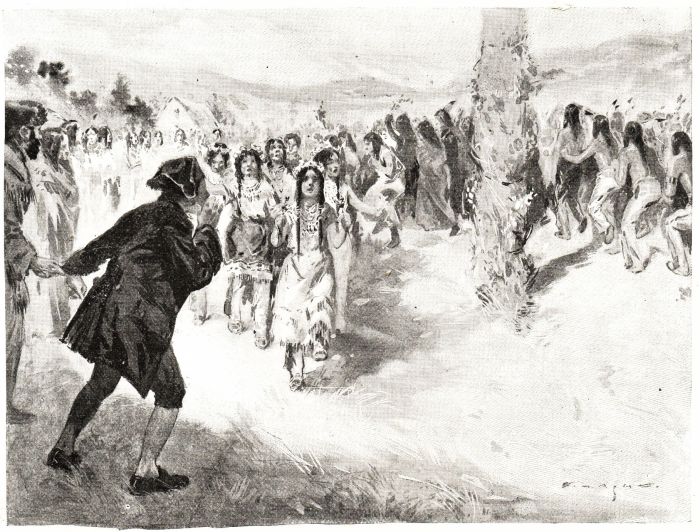
Foremost, hand in hand with the chief, was a brilliant little figure, a girl about ten years old. With a skin naturally snow-white, but now kissed to a ruddy hue by the sunshine, and long brown plaits glittering with the most brilliant beads; petticoat and bodice of the finest broadcloth, and around her neck and shoulders rows of silver brooches and strings of white and purple wampum; on her feet deer-skin moccasins embroidered with porcupine quills, contrasting with the scarlet leggings above—Ma-za-ri-ta looked indeed the fit princess of the revels. The pride which shone in Cornplanter's eyes, the admiration with which all the Indians gazed on the dancing girl—for her feet had already begun to move to a nimble measure—struck a chill to the heart of Mark, for it seemed a portent of sure defeat. Her blue eyes sparkled with joy as she danced in the van, followed by the Seneca girls in pairs, all attired in gala dress, and with wreaths of flowers on their heads. Then came Cornplanter and his lesser chiefs, the warriors, the squaws, and the children, and the march advanced to the pole in the centre of the village, shaped in a square enclosure, that painted pole horribly etched with the scars of innumerable tomahawks when the frenzy of war-dancing made it the symbol of the enemy's body. Now the great mast was belted thick with greenery to its very top, corn-stalks with pendent ears, bunches of golden-rod, and all the richest spoil of the thickets and meadows. Ma-za-ri-ta's sweet voice, as the dance of the maidens gyrated more and more swiftly about the gorgeous pillar, led the chant among the more shrill and unmusical notes of her companions.
Mark edged his way through the throng, for a fancy had suddenly come to him, and he stood in the inner ring next the circle of dancers.
"Nellie! little Nellie! don't you remember Mark?" he said, in a piercing whisper, as she approached several paces in the van of her choir.
Ma-za-ri-ta slowed her pace, looking at him wonderingly with a flush of offended pride, for the little princess felt she was the queen of the Senecas, child as she was. Again as she neared his place she heard the words, "Nellie, can't you remember?" The beautiful child face was troubled, as though some dumb vague memory were stirring under the surface, but again she moved on, shaking her head. Bitterly did Mark bewail his failure to Buckskin, for, "I'm sure," he said, "she is our lost Nellie, and I can see our mother's look in her pretty eyes." Something worked like yeast in the old hunter's thoughts as he listened in silence to Mark's passionate rambling words that night, when all the camp was hushed to silence, and they lay tossing on their bear-skins.
"Why don't you answer?" the boy burst out, with petulance.
"Mark, I'm glad," the other said, deliberately, "that there seems to be no chance of takin' the little gal away by force or cheatin'. I rayther guess there's a doggone poor show of doin' anything that-a-way, and we might 'a' known it afore. But I'll swar she's her mother's darter, as ye said a minnit since, and when ye talk about the mother, thar's the key of the hull sityvashun, as the lawyer chaps ud say. Ye don't quite unnerstan' what I mean, hey? Waal, it's jes this, my young master. Your mammy must come down here to Cornplanter's village, and she'll do mor'n all the guns and bagnets of Gen'ral St. Clair's army to get the little gal back, ef so be she is the right one, and I genooinely believe it. The chief loves his adopted sister with every drop of his blood, and his people adore her as their little princess. They'd lay their lives down afore givin' her up, onless ye tech 'em jess right. But I know 'em well, blood-thirsty varmints and wild beasts as they are when you cross 'em, and a redskin's got a heart as beats big and strong as any white man's, ef ye can find it oncet. Then I've heerd uv Cornplanter fur the last fifteen year, and they all say he's one of the best as well as bravest critturs as ever wore a scalp-lock. Cheer up, laddie; we'll git her, but we can't do it yet. Trust ole Buckskin's idee."
Buckskin's solace scarcely calmed Mark's restlessness, and after the hunter's snores proved him in the realm of dreams, he arose with the idea of strolling through the moonlit village, and walking off the fancies that would not let him sleep. The lonely streets were wrapped in the pallid shine which silhouetted the log houses and the trees in ghostly shadows, and had it not been for the occasional howl of a distant wolf or the snarl of an Indian dog, he might have fancied himself the only waking creature. He wandered aimlessly, in a maze of fear and doubt what would be the outcome of it all. His careless footsteps finally carried him to the edge of the village, where, at the very shadow of the forest, stood a large double house apart from all the others. Then he saw he was not the only sleepless soul, for from its doorway glided a figure whose height and garb—for the moonlight glittered on the costly bead-work—showed it to be the one who filled his heart full to bursting. He forgot all prudence and doubt, and sprang forward swiftly.
"Nellie! Nellie!" he cried, in tones that cut the silent air like a knife. "I am your brother Mark—your playmate that loved you so dearly. Come home with me to mammy, who is dying for you, away from this dreadful place. A long time ago they carried you away from us, and now I've found you again, and will not let you go, my darling little sister." He forgot all the surroundings—all but need of giving voice to the feeling that shook him as the wind shakes the leaves in the trees.
Ma-za-ri-ta's face quivered in the starlight as she shrank from the hand that eagerly clutched her arm, as if he would have led her away at once; then something like half-awakened intelligence was quenched in a wave of blind terror, and she shrieked aloud.
A tall figure leaped like a tiger from the dark of the doorway, and Mark felt the grip of iron fingers on his throat which threatened to strangle him. As he lay helpless in that clutch, he saw an upraised tomahawk sparkling in the moonshine; but Cornplanter did not strike, though his words were edged with cutting disdain.
"Such is the honor of palefaces," said he; "from the cub to the full-grown wolf the same. The Senecas welcomed their guests and did them honor. Their hearts were warm and friendly, for it is now their festival of peace and goodwill. But what should they do to one who would steal in the dark, and rob them of their dearest?"
"Do?" said another voice, for Mark was speechless with rage, shame, and impotence, and Buckskin darted forward, grasping Cornplanter's uplifted arm, though the chief showed no immediate purpose to use his gleaming weapon. "Do? They should respect the voice of natur' and blood cryin' aloud!" Honest Buckskin had wakened suddenly, and alarmed at Mark's absence, sought him through the Indian village. "Look ye here, chief, this is a foolish boy, and he couldn't 'a' done what ye think, had he been in ever so much airnest. But he suspecks he's found his little sister that you and yourn took from his mammy's arms six year ago durin' the time o' fightin'. The great Seneca is just; and let him say, then, who's the thief, ef it comes to a matter o' stealin'."
The ferocity which had hardened Cornplanter's lineaments still threatened the offender in spite of the hunter's plea. But Ma-za-ri-ta, who had listened with shifting emotions chasing over her face, vainly striving to pierce the meaning of the words, now threw her arms about the neck of the chief, and spoke rapidly in the Seneca tongue. The Indian's stern aspect melted and took on its more wonted expression, in which there was something almost benignant.
"Go without harm even while it is night," he said, "lest the Senecas discover all, and sore mischief befall." He brought them their arms, loaded their wallets with food, and dismissed them. And as Mark turned before entering the forest, he caught a last look of Ma-za-ri-ta, watching their retreating footsteps with clasped hands and head bent forward.
It was about a week afterwards that Colonel Johnson received a visit at Fort Niagara in Canada, just across the river, which whetted his interest keenly. This whilom British agent of the Iroquois tribes still exercised a powerful influence over them, though their territory now belonged to the conceded limits of the new republic. To him they looked even yet for advice and authority. He recognized the Lyttes, mother and son (for the father was dead), and his feelings guessed shrewdly at the occasion as they walked up the esplanade from the jetty where they had landed.
"Well, Mrs. Lytte," he said, after the first look at her pale and working features, which were full of news, "I see you've learned something more."
"Cunnel, in the name of God, and for the sake of your own dear wife and children, you must help me now," the woman gasped, for her throat was too full. "Mark has jess come from Cornplanter's village, and he says for sure and sure it's little Nellie. An' she didn't know him! But, Cunnel, she will know the mammy that bore her and gave her suck, for I'll die of a broken heart ef she don't."
"We must trust for the best, my dear lady," said he, cheerily. "The first thing will be the child's knowing you. That clearly proven, the question will be as to Cornplanter. It will be a knock-down blow, but the Seneca has great qualities. He may set his face against it like flint, yet I shall be surprised if he thinks of self alone in the matter. And what idea did you get of Cornplanter?" he concluded, turning to Mark.
"Pretty good for an Indian," said Mark, moodily; "but ef he don't give up Nellie to mother, I'll brain him with his own hatchet, ef I die for it next minute."
"Well crowed, young cockeril," laughed the Colonel, "but we'll find better weapons than tomahawks. It's the heart and not the skull we've got to reach." There was no need to waste time, and quick outfit was made for the journey to the Seneca village, about eighty miles away.
Cornplanter received the message from the Indian runner, giving warning of Colonel Johnson's proposed visit, but with no further hint of purpose. Yet he felt a keen pang of foreboding. Stoic as he was, there was something in the air that mocked him with the notion of fate lying in ambush close at hand. As Ma-za-ri-ta afterwards recalled, the chief treated her with a clinging, pathetic tenderness during these days she had never known before. And finally, when he saw with Colonel Johnson the youth who had been his recent guest, and a pale-faced woman with questioning gaze that wandered and hunted like that of a mad-woman, it was no longer guesswork. It was as if a bullet had pierced his chest. The Englishman knew his man, and made a plain appeal with all the fling of that bullet.
Cornplanter heard with a stern, impassive face. "My father's words are good and just," he said. "Let Ma-za-ri-ta decide," and hope knocked again faintly at the gate that his little sister would not know the white woman who had come to rob him of his heart's blood. The girl was led from her lodge, unknowing the test, and ran gayly to her Indian brother's side, and looked curiously at the little white group in the centre of the watchful throng of red men. Her eyes glanced smilingly at her Indian friends, till they were fastened as if by a magnet on the white woman's face, and there they hung, fascinated, open-mouthed, spellbound, as though they could never drink their fill. The woman stood, arms half extended, burning eyes unquenched by their own tears, lips dumbly moving. Fear, wonder, longing, doubt, swept over the girl's face, till all thought was swallowed up in a light unspeakable, and her tongue babbled "ma-ma." She tottered, but Mrs. Lytte leaped at her and locked her fast with convulsive cries and sobs.
The chief's rigid face was that of a bronze man. All listened for his lips to speak. But it seemed as if the jaws were locked. And when the voice came his followers scarcely knew its hollow accents:
"The Great Spirit has spoken, and who are his red children that they should refuse to listen." Then he covered his face with a corner of his deer-skin robe and passed swiftly from their midst, this Indian Agamemnon, who would not reveal his own agony of spirit.
Eleanor Lytte never saw her Indian brother again, but costly presents each year proved his indelible memory till his death.