OLD PORTSMOUTH.
Reading edition
A CHAPTER OF AUTOBIOGRAPHY.
BY SIR WALTER BESANT.
Portsmouth, as I remember the place in the days of my early youth—say, somewhere about the years 1844 to 1850—was surely the liveliest place, the most full of action, movement, and life, of any in her Majesty's dominions, which were then half as wide as they are at present. Not as a place of industry; there was never, if you please, any industry at all carried on in that town outside the Dock-yard, except of course the industry of fleecing the sailor. This was a merry and an exhilarating sport, because the sailor himself enjoyed being fleeced, entered thoroughly into the spirit of the game, and neither resented nor regretted what he knew would be the end of it—viz., the loss of all his money. Nor, again, could the town be considered picturesque. Somehow, Portsmouth always escaped any beauty of buildings and streets. There was, it is true, a late eighteenth-century look about most of the streets; there was one old church within the Walls; there was a square low tower at the end of High Street which looked well; there were Gates in the Walls; and there was the Domus Dei, the ancient garrison chapel, then not yet "discovered" or restored. There must have been, I suppose, a time when the High Street and St. Thomas's Street and St. Mary's Street were built with gabled houses and with timbered fronts, but they had all disappeared long before my time.
The real centre of the town was, of course, the Common Hard—which is one of the streets of the world like the Cannebière of Marseilles, the King's Road of Brighton, or the High Street of Oxford. Portsmouth cannot be conceived as existing without the Common Hard. It is a broad street facing the harbor; at one end are the gates of the Dock-yard; at the other, a police station, in front of which at one time stood a pair of stocks. The magistrates, in their wisdom, revived this time-honored punishment for a while, but I believe it did not answer. Certainly I myself once saw a man in the stocks. I must have been a child of six or eight at the time, but I remember him well, because I was immensely impressed with the shamefulness of it, and I expected to see the prisoner hanging his head and weeping. Not a bit, if you please. The hardened villain sat up, faced the foot-lights, and grinned merrily all the time.
The street contained shops of all sorts—shops of curios brought home by the sailors and sold to their merchants; jewellers' shops; shops offering telescopes, sextants, and all kinds of naval things; taverns and hotels—then called inns. These shops, however, were not designed for able-bodied Jack, I believe, but for his officer.
It was a fine lookout from the Hard upon the harbor, which was crammed full of ships—ships fitting, ships just come home, harbor-ships, hulks, store-ships, tugs, tenders, and small steamers. As yet the man-o'-war was a wooden ship. She carried 120 guns and a thousand men; mostly she sailed, and in the art of sailing she had no equal. As a boy I thought, and still think, that there is no work of man's craft and ingenuity more wonderful, more beautiful, than a great three-decker in full sail.
Those who wished to cross the harbor or to visit a ship, started from the "Beach" or from the "Logs." The Beach was a narrow spit of sand and shingle running out into the water; it was the "stairs" for the watermen, who all day long kept up a perpetual bawling. "Going over? One more. Just going over. Only one more!" When they had a boat-load, say six or eight passengers at a penny apiece, they put off, and rowed across the harbor to Gosport, on the other side.
Saw one ever a more animated sight than the harbor on a fine summer morning in the forties? Boats manned by Royal Navy men working their way here and there, yachts letting out their sails for a cruise in the Solent, wherries plying backwards and forwards, ships in the grip of the tide. We pass on our way the Victory, Nelson's last ship; she is moored off the Beach, and swings round with every tide. If you went on board you would see the place where Nelson fell, and the place where Nelson died—a dark and noisome hole on the orlop-deck down below. Yonder black hulk without masts is a ship whose exploits would fill a volume. Her name is the Billy Ruffian—mealy mouths call her the Bellerephon. Beside her, another dismasted hulk, now a coal-ship, is the Asia, from which was fired the shot which blew up the Turkish Admiral at Navarino. Beside her is the Arethusa, another historic ship. Beyond, in line, the old worn-out ships are laid up one after the other up the harbor; they are all historic ships; to hear their names is to be reminded of Copenhagen, the Nile, Trafalgar; they are store-ships, coal-ships, training-ships now, and those painted yellow are the convict-hulks. How much misery, how much brutality, how much despair had their permanent home on those terrible yellow ships called convict-hulks? The men were taken ashore every day to work—their work, the heaviest and the most disagreeable, lay chiefly in the Dock-yard; they worked under warders armed with guns, shotted and bayonetted. Many a time have I gone into the yard, a penny quid or screw of tobacco secreted in my pocket. One would get as near as one dared to one of the gang without raising suspicions. There one waited, pretending idle curiosity, till the warder's eyes were turned in the opposite direction, then out with the quid, and down with it at the nearest convict's foot. He made no sign; he never moved or looked up; he just covered the packet with his foot, and went on with his work. The donor retired a space, yet kept an eye upon him. Presently the man straightened himself out; he looked at his tool; he picked up a stone as if to knock off something; he hammered it, and looked at it again critically; the warder, who had watched his movement, turned his head, as satisfied that it was harmless; the convict put down the stone; then, if you had good eyes, you would see the quid transferred in a moment to the man's mouth. Oh! the rapture of that quid! He could not express his gratitude in words, but with a glance of his eye he could, and did. What would have been done to the boy had he been discovered is too terrible to be considered. However, that boy escaped. The sight of convicts working in a gang has always fascinated and terrified me. The submission and obedience, the awful silence, the evident determination to do as little as possible, the profound misery of the life, the cruel crushing down of manhood—these things I felt as a boy of twelve as much as I feel them now. And always with it that feeling of John Bunyan, "But for Grace, John, thou too hadst been here."
A little up the harbor there rose a few inches out of the water an islet called Rat Island. This was the burying-ground of those poor wretches who died on the hulks. I have rowed round this island in the twilight of a summer evening, wondering whether the ghosts of the convicts still haunted this dreary spot and exchanged stories of crime and the cat-o'-nine-tails and irons with each other. I now understand that the ghost which could choose to remain on so desolate a spot must have been indeed a fool.
The Logs were a narrow and rude pier constructed of square trunks laid side by side, with upright posts here and there to keep them in place. They were chiefly used by the Royal Navy boats which were coming and going all day long. I recall the picture of one. At sight of the boat and the officer in command the boy on the Logs runs a little farther out where the Logs are covered with water—he would not willingly stand in the way of that officer, whom he envies with a yearning inconceivable to be in his place. Nobody remembers how boys yearn and long for the impossible. The boat is manned by eight stout, well-set-up fellows; they wear spotless white ducks, jerseys, and straw hats. The officer stands up in the stern, strings in hand. He commands these splendid fellows—He!!!—and he is no older than the envious boy who looks on. He wears a jacket, white ducks, and a cap with the enviable crown and anchor on it. His voice is clear and loud. Timid? Afraid? Not a bit of it. This midshipmite is already Captain and First Lieutenant and all. He jumps on the Logs and marches off, head erect, conscious that all other boys regard him with envy unspeakable. Do the sailors put tongue in cheek and mock him when he is gone? Not a bit of it. The child is their officer; he represents authority. It is not the boy who commands men—it is the Captain. The faces of the men, if you look at them, are not quite like the faces of their grandsons who at present man the navy. Our man of '96 is sober, quiet, thoughtful, as becomes one whose long training has almost made him belong to a learned profession. He is a total abstainer too. When he goes ashore it is to the Sailors' Home and not to the old quarters. The men of '48 are sturdy and bluff and resolute; but they have a certain look that means rum when they can get it, and other indulgences such as can be afforded.
At the back of the Hard was Jack's own pleasure-ground—half a dozen streets belonging to him, to the watermen, and to those who made it their business to look after Jack. These streets were full of strange things. There were shops where they sold old clos', with many queer things that came home on board. There were birds—parrots, parraquits, avvadavats, love-birds, monkeys, lemurs, flying-fish dried, rotting bananas, Venus's fingers from the Philippines, cocos de mer from the Seychelles, carved wooden boxes from China, queer little nameless things from Japan, curved swords from Malay, groups of figures from India—all these things are common now; they were not common then. I would gaze at them displayed behind the small windows illuminated at night by a single candle, with a sick yearning because I could not buy them all. Meantime—oh, heavenly sound!—the fiddle at the public-house next door strikes up. It is an ancient tavern; the floor was lower than the street; the windows were decorated with transparencies showing the valor of the British tar when engaged with the Chinese. Heavens! How those Chinamen ran! And with what a rapturous sense of duty did Jack seize a pigtail with the left hand, and with the right decapitate poor John Chinaman! It was after the war of 1842, or thereabouts—a war now wellnigh forgotten. Within—I would look in and even step in unregarded—the fiddler sat on a stool at the end of the long low room. He was a Pole. He had but one leg, and he fiddled marvellously, so as to make even a man with a gouty toe stand up and shake that limb. Jack danced hornpipes chiefly; he liked best to dance by himself because the cavalier seul enjoyed more scope for figure-dancing and for flourishes; also because the undivided applause and attention of the house were bestowed upon him. In the reel, in which the fair sex took a share, beauty more than skill—looks, rather than merit—provoked admiration. Poor Jack! Poor fair sex! Was it possible for any human creatures to look more deliriously happy?
I have said that the watermen also lived in those back streets; I believe, however, that the watermen lived apart from the sailors; the most of them had been sailors—they were all full of yarns—they were all heroes of the old war; their sons were sailors; but they themselves were married men with families. It was not considered the thing for a sturdy old waterman to frequent the same tavern as Jack ashore; his time for the hornpipe and the fiddle was over.
I have said that Jack's face and appearance have not been transmitted to his grandsons. There was one peculiarity about Jack of '48 that has been somewhat forgotten. He of 1800 wore a pigtail—that pigtail was cut off. I do not know, exactly, in what year. It was succeeded, however, by ringlets. The Jack of '48 wore ringlets very carefully curled, glossy, and artistic. If you passed Jack to leeward you perceived—what? Rowland's Macassar? Tallow? My friends, let us never inquire into the machinery by which those ringlets were made to curl so gracefully, and to assume an appearance so beautifully, so wonderfully glossy.
Of the Dock-yard I must say little, though the part it plays in Portsmouth is like the part played in Winchester by the cathedral, or in Cambridge by the university. There were the huge skeletons of the wooden ships, one after the other, in various stages; there were the dry docks, with the workmen hurrying round the sides on narrow boards, calking and painting; there was the pond, where they laid up the timber to "season"; there was the Rope-house, a quarter of a mile long, where the men "who made their living backwards" so walked all day long twisting the yarn; there was the place where they steamed the beams so that they could be bent; there was the carver of figure-heads; there were the manufacturing of blocks and the making of spars. And every day and all day long the sound of multitudinous hammers, the creaking of cranes, the grinding of saws, went on without stopping. A lovely workshop, and now, I believe, more wonderful still!
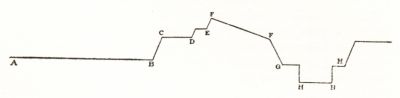
The town, I said, had little beauty in its streets. There was a George the Second church, which had a spaciousness and a dignity of its own. There was another which had neither dignity nor space. There were no public buildings to speak of. But there were the Walls. The Walls! Oh, the Walls! These are all levelled and pulled down now. Nobody knows why they were levelled, but they were; and with them disappeared the beauty and the glory of the town. They were not ancient stone Walls, but earthworks in the style approved about the year 1780. I append a section of the Wall as I remember it. An open space, A B, separated it from the building of the town. A slope, B C, brought one to a broad road, C D, for the carriage and passage of cannon, ammunition, etc. At D, another low slope, about three feet high, to a narrow standing-place, D E, in front of which ran E F, a breast-work. The defenders were to fire, thus protected, across F F. F G was the slope to a level lower than that of A B on the other side. At H H was a narrow moat, but the intention of the builders of the Wall was to let in the water so as to cover up the whole of the valley G H; at H the ground sloped up; at many places the ground beyond H was also protected by an earth-work. The Wall ran in lengths protected by bastions; these bastions were mounted with cannon. At intervals there were stone gates with stone lookout-places, most mysterious. The town was divided into two parts, a Wall ran round each. No one would believe what a lovely place for a boy was the Wall—either Wall—to walk upon, or sit upon, or linger, and look, and listen, and dream upon. If you wanted a quiet place for reading you could sit protected from cold wind on a cannon-wheel; if you wanted to dream you could lean over a certain angle on the Queen's Bastion—was it the Queen's?—and there below stretched out the whole extent of the harbor, a broad lagoon at high tide, four miles from north to south and six from west to east; at the head of the harbor, Porchester Castle stood out, gray and frowning over the clear water that lapped her water-gate. This was a Roman fort; the outer Walls—the Roman work—still stand, and will continue to stand for many centuries; within there are the ruins of a Norman castle, the lofty design still uninjured; in another corner is a long and narrow Saxon church—a fine thing, this, for a boy to gaze upon. But that was not all. The space in front of the Wall was laid out in grass; in spring these meadows were full of buttercups; in the summer the grass all over the Walls, the parapet, the slopes, the sloping up of the Wall, the spaces on the bastions between the cannons, were filled with clover, daisies, buttercups, wild convolvulus, colored grasses—everything. There were also trees—"to catch the shells," we used to say; they were planted all along the Walls, and made a sweet and delightful walk in summer-time. And it was so quiet all day long upon the Walls; nobody but a few children ever came there; we had our own favorite bastion, our own view across the harbor; we carried home handfuls of the wild flowers.
If one of the two Walls looked out over the harbor, the other looked out over the Solent and Spithead. The second Wall was not so beautiful in my eyes as the first. It began at a place which even a boy would not but recognize as squalid and horrible. Very near there stood a church of great interest, though of repellent appearance—I know not why it was repellent to look at, but it was. Between the church and the Wall lay a broad piece of consecrated ground. More than once have I been reminded what this ground was used for. More than once have I stood upon the Wall and looked down upon a funeral; the coffin, borne by six soldiers, was covered with the union-jack for a pall—could one have a better? behind, marched, with guns reversed, a small company of soldiers; in front went the muffled drums and the fifes. 'Twas the burial-place, you see, of the private soldier. When the service was over, the soldiers stood over the grave and fired their last farewell to their poor dead comrade; then the drummers took off their muffling and they fell in, and the fifes struck up a merry tune and so away back to barracks. Poor lad! Who was he? No one knew; no one cared. In those days no one, I believe, ever sent a message to his people that he was dead.
On the outside, where the moat and slopes afforded a fine place for practice, the young drummers and the young buglers were practising all day long. I never hear a bugle-call, to this day, without being reminded of morning upon Portsmouth Walls. At the other end of this Wall were two or three very fine bastions, armed with larger cannon and with bombs which looked out on Spithead, where the fleets assembled before they put to sea. From Spithead sailed those great fleets, the Baltic and the Black Sea fleets, at the beginning of the Crimean war. A very splendid sight it was. The Queen led the way in her yacht. Then followed the Admiral, old Charley Napier; then came the gallant line-of-battle ships, each in place. To look at a ship of the modern type and to think of that magnificent fleet reminds one of the Israelites when they wept at the opening of the second Temple, to think of the perished glories of the first!
It was in the harbor, from the Dock-yard, that the troops used to embark. There is a picture, I forget by whom, representing the embarkation of a regiment for the Crimea. I can testify that the picture is faithful, for I saw, I believe, that very embarkation. There are the girls crying—I saw them; the young fellows full of spirit and courage—I saw them with envy and admiration; the sailors quietly carrying out their orders—I saw them too. As one recalls the scene, one thinks of what these poor fellows were going to endure—the cold of a Crimean winter; boots made of brown paper; coats of shoddy; green coffee-berries with which to make their coffee; oh! the blind rage! the helpless rage! the bitter tears of rage! of the whole country! and nothing done—no—nothing. Alas for the wickedness of it! Yet nobody hanged—and these poor brave fellows done to death—not by the enemy, but by their own people!
Besides the embarkation, I remember seeing the return of one of these regiments. It had been terribly cut up at Inkermann or at some other engagement; once, too, a shell burst in the middle of their band. They marched, what was left of them, up the street, colors flying, band playing. And all the way along the women wailed aloud and the men choked. For of all the band there remained but five; of all the gallant boys who marched out playing the fife and beating the drum there were but two; of all the men who played the cornet and the clarion and the serpent and the rest of the wonderful instruments there were but three.
I have gone on too long. One more picture, and I have done. On the Hard, along the railings which ran in the front, only ceasing with the beach and the Logs, extended a long bench, on which every morning all the year round, except in rain and snow, there sat a row of grizzled veterans. They were mostly one-legged; some were no-legged. The bench presented a very remarkable spectacle of "timber toes," i.e., wooden legs sticking out in a horizontal row. The owners of the "timber toes" were affable; they would graciously accept a quid, or the price of one, or the equivalent of a quartern of rum, and in return they would cheerfully tip you a yarn—but, for choice, beyond the hearing of the other old boys. Now the really remarkable thing about these heroes was that every man among them had been on board the Victory at Trafalgar; every man among them had been the first man to observe when Nelson fell, the first man to pick him up, the chief hand in carrying him to the cockpit, the trusted man kept down by the surgeon to perform the last offices for the dying Admiral. Nay, so often had every man told this story that he had at last come to believe it; and the genuine tears would crowd into his eyes when he arrived at the last scene in the mournful history: "'Kiss me, 'Ardy,' was the last words of the Dyinero." They had of course other memories which were, I believe, more authentic. There were memories of the American war in 1814, of French prisons, of actions long since forgotten, of admirals whose fame has been eclipsed by that of Nelson. I remember one man who was in the Mutiny at the Nore, which was in 1796; and one ancient mariner I remember who said he was a cabin-boy with Captain Cook in his last voyage—he saw him speared. Well, it was quite possible; the man looked a mere monument of antiquity; it was quite possible if he was eighty-eight—he looked ninety-eight. It was quite possible, on the other hand—but let me believe that I have myself conversed and shaken hands with one of Captain Cook's crew.