CARDS
Reading edition
FOR 1897. 50 Sample Styles AND LIST OF 400 PREMIUM ARTICLES FREE. HAVERFIELD PUB CO., CADIZ, OHIO
Florida Pines and Pickaninnies.
Pines are the principal trees of this part of Florida, though gnarled and mossy oaks are common. A glimpse of a sunset or the glow of a forest fire behind a group of these trees outlined against the sky forms many a beautiful picture. The pines are very picturesque too, they stand so tall, and the gray Florida moss hangs from their branches like draped garments.
A picturesque feature of the Florida woods is the numerous negro cabins made of logs. All have the same kind of mud and stick chimneys, built hardly up to the peak of the hut, so that when the thick black smoke, perhaps full of sparks, comes out of the mouth of the chimney, it curls against the under part of the projecting shingles, and then passes away. It is certainly very curious that the huts do not burn down, but it is a fact that they rarely do.
The cabins are very dirty, and passing one, you may see from two to perhaps five negro "pickaninnies" laying in the sand with a pig or two sometimes. The pigs here are commonly termed "razor-backs," because they are so small and thin that their backbones seem almost to prick through their skin. This county is named Alachua (the ch is pronounced as k), meaning in the Seminole Indian tongue "big jug," because there is a sink in an open space that is called Paine's Prairie when it is dry, and Kanapaha Lake when it is changed—after a heavy rain—into a sheet of water. The sink is so deep that no one has ever discovered the bottom.
The names of some of the places in Florida, and the flint arrow-heads which are frequently found, are all the traces that are left here of the Seminole Indians who once owned the land. Down by the coast, about fifty miles west from here, are found mounds of sand and oyster-shells, which, when dug into, reveal skeletons of Indians, and Spaniards who were killed. There is a place south of here which is historic. A great many soldiers were killed there by the Indians when asleep and off their guard. The Seminoles have been driven down into the "Everglades" of South Florida, a great swamp into the heart of which no white man has ever penetrated. Here the Indians stay, never daring to venture out to massacre in their old way, for there is no use in trying to do that now. Palmettoes grow in great abundance here. Sinks are very numerous, and so are natural wells.
There is a place called Waldo in Florida, where there is a swamp in which cedar-trees grow, and a lake in which alligators live in great numbers, and on the banks of which beautiful wild-flowers grow. The alligators lay their eggs in straw on the land, go back to the water, and visit the eggs from time to time until they hatch. Then the parents lead their young to the water, where they live. These alligators are caught for their handsome skins, of which many things are made.
Elsie Vermilye Smith (aged 12). Arredonda, Florida.
Accompanying this most interesting letter is a wash-drawing of a negro cabin, with the too-short chimney, and the pig and pickaninnies in the foreground. It is a clever drawing. The Table is glad to print descriptive letters like this one, because everybody likes to read these interesting insights into peculiar features of other parts of the country. Will other readers send the Table equally good morsels?
It Went to Paradise Valley.
There are always hurry and confusion at the end of every session of Congress, and these are multiplied severalfold, if that be possible, when the Congress dies, by Constitutional limit, with the expiration of a President's term. In these busy hours droll things sometimes happen and witty things are said. In the Congress just expired—the extra session just called by President McKinley is of the new and not of the Congress that sat during the winter—an incident occurred that illustrates how great things often come about from small causes—a slight turn in the tide of their fortune at the right time.
A railroad company wanted a right of way through a forest reserve in the West. Senator Vest, of Missouri, opposed the grant for the reason that in the dry summer seasons forest fires would be kindled by the locomotives. The time was limited, and many important measures were to come up. A Senator sitting near the famous Missourian whispered something.
"Time presses," remarked Senator Vest, "and I am just informed that this road leads to 'Paradise Valley.' If the road helps anybody to get to Paradise, why, let it go through."
And it went.
How the Prisoner Escaped.
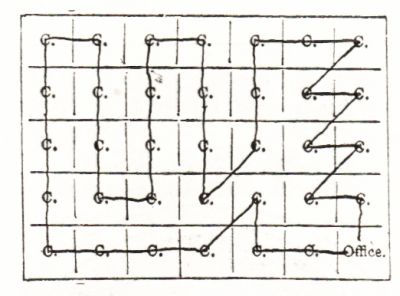
H. D. Dantzler, St. Matthews, S. C., and several other readers, ask about the solution of the "prisoner puzzle." A prisoner was offered his liberty if, by starting at the warden's office, he could enter each of the thirty-six cells once, and only once, double on his route, and arrive at the office again.
Here is his route.
Programme for April-fool Day.
The Table is asked: "Can some one through your columns suggest some entertainment for a young people's party to be given on April-fool day? Something appropriate for the day is wanted.
"I. S."
If any reader will favor us, we will mail direct to this inquirer, since the time is growing short, and print for the benefit of other readers in future years.
The Sign in the "Sail" Puzzle.
"I hope you will not think me very stupid, but even with the answer I cannot read the sign of the boat-house in the puzzle. Will you kindly explain through your columns now to read it?"
The preceding, either in these words or others of the same meaning, came to us from several readers. The first word is read by taking not the letters on the sign, but the succeeding one in the alphabet, as "b" for "a," "e" for "d," and so on. The second word is read by taking the preceding letter in each case, as "l" for "m," etc. The remaining words are read by taking the letters in reverse alphabetical order. For example, the fourth word on the sign begins with "x," which is the third letter, reading backwards, or from the end of the alphabet. For it read "c," and so on.
In that Fifteen Problem.
The way to place the figures one to nine on a "tic, tac, toe" diagram so that in eight ways the sum of the three figures will be fifteen is: Reading from left to right, the top line, 4, 3, 8; the second line, 9, 5, 1; and the lower line, 2, 7, 6.
Thirty Cents and Five Cents per Dozen.
Frank Smith figures out that A, B, and C sold eggs at the following prices. Did you get answers agreeing with his?
A sold 9 doz. at 30 cts., and 1 doz. at 5 cts. = $2.75
B sold 5 doz. at 30 cts., and 25 doz. at 5 cts. = 2.75
C sold 1 doz. at 30 cts., and 49 doz. at 5 cts. = 2.75
Questions and Answers.
"B. H. S." asks: "To whom is application made in order to get a position in any of the large railroad offices? I have heard that in order to get a position in any of the New York Central offices certain examinations had to be taken." The railroad you name examines applicants for positions in the auditors' and all departments where good penmanship and accuracy in figures are required, but it does not examine applicants for positions in other departments. But it has no regular examining-board. Nor do railways of the country have, as far as we know, such boards for applicants to apply to. If one desires to get into the telegraph service of a railway, he applies to the superintendent, or in some cases to the chief operator or train-despatcher. Any local telegraph operator can give the name of the proper official on his road. For positions in auditors' and other accounting offices applications are made to those officials. For places on trains apply to the superintendent, and on locomotives to the master-mechanic. As a rule the best course is to get acquainted with some employé, and through him make the application.
J. B. Coles asks how to get into West Point. Old readers must bear with us when we answer again this much-answered query to say: Apply to your member of Congress. The appointment is made by him, and by him only, save in the case of a very few appointments made by the President of the United States, which appointments are usually reserved for sons of army officers, who have, as a rule, no legal residence and, therefore, no member of Congress to apply to. The same course is to be followed to get an appointment to Annapolis. If you prefer, you can write, merely for information about vacancy and conditions, to the Secretary of War or Secretary of the Navy. Address your communication as here named, and add, Washington, D. C. Make the request plain and brief, and you will receive a reply in good time. Don't hesitate to write to these officials. They are public servants, and are always ready to answer such proper inquiries. Only one cadet from each district can be at West Point and at Annapolis, respectively, at a time.
Ralph Leach: Address G. A. Hentey, in care of Boys' Own Paper, Paternoster Row, London, and Kirk Munroe, in care of this publication.—Minnie Louise Naething asks what a "parchment eater" is. We give it up—because our reference-books, like hers, are silent on the subject. Can some one enlighten us?—"Cape Vincent" asks us some questions, and desires answers by mail. We are always glad to oblige our readers, but our purpose in answering questions is to give information to all. Why not have answers published?
Robert H. Nead asks for information about the "Mad Yankee," which occurred in one of the recent puzzle questions. We discarded "Mad" Anthony Wayne because he was not a Yankee. Robert retorts that Elisha Kent Kane was born in Philadelphia. The question was, in effect, what public man went by the nickname "Mad Yankee"? The answer was Kane. Whether the nickname was or was not correctly applied we cannot say. Nor is it material. Wayne could not be accepted, for he was not the bearer of that nickname, and our conditions included nicknames in the list of questions.
Louise A. Littlepage, who lives in Colon, Guatemala, sends us a poem of six verses on "The Noble Boy." The Table rarely prints poems—for obvious reasons. Louise says, "If the Table wishes, I will send some more verses." Will she not tell us in plain prose not about noble boys, because such are not rare with us, but about Guatemala—the school she attends, the interesting sights of the city she lives in, what time blackberries are ripe, if she have such fruit, the flowers that bloom in Colon in March, what the people of Colon think of the new republic of which Guatemala is now a part? Does Colon have cable cars? Has she ever been out in the country on a visit to a country house? If so, what was it like, how furnished, and what did the housewife have for dinner? Noble boys are noble boys the world over. But Guatemala is different from Georgia, Maine, or Dakota. Please describe for us some of these interesting differences.—A member: Wood-engravers' tools are for sale only by a few first-class dealers in hardware. They are purchased in the rough, and have to be finished and put in condition by the engraver. A set of tools, including leather-pad and magnifying-glass, suitable for a beginner would cost about ten dollars.
THE LUXURY OF SOAP.
Dr. Nansen is not a man whose happiness depends much on the possession of luxuries, but there was at least one luxury which he confesses that he missed during his long tramp with Lieutenant Johansen after they left the Fram. The winter they spent in a hut passed comfortably, he says, and if they had had a little flour, a little sugar, and a few books they could have lived like lords. They did not complain at the absence of these things, however, but one thing they did long for was soap. "It was difficult enough," Dr. Nansen writes, "to get one's person clean, but that we managed to a certain extent by rubbing in bear's blood and fat, and then rubbing this off with moss." But this process was inapplicable to clothes, and they were very desirous of washing their under-clothes before beginning their spring journey. "After trying every other possible way, we found, to our despair, no better expedient than to boil them as best we could and then scrape them with a knife. In this way we got so much off of them that they did to travel with, though the thought of putting on clean clothes when we once got back to Norway was always in our minds as the greatest enjoyment that life could bestow."
An analogy is traceable between this pleasure of anticipation and the glee of Dan Troop, as described in Kipling's Captains Courageous, at the prospect of getting back to Gloucester after five months on the Banks and sleeping in a clean boiled night-shirt.
There is a picture in Farthest North of Nansen at the end of his long ice journey, and still in the soapless state, meeting Captain Brown of the Windward, who brought him home.
A RESTLESS BOY'S REASON.
"I'm going to be a minister," said Tommie, forcibly.
"Why, Tommie dear?" asked his father.
"So's I can talk in church," said Tommie.