THE REMARKABLE ADVENTURES OF SANDBOYS.
Reading edition
A BIG HAUL.
BY JOHN KENDRICK BANGS.
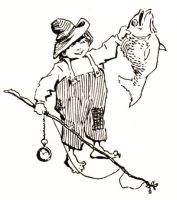
There was great excitement at the hotel. The oldest guest—that is to say, the one who had passed the greatest number of summers at the Mountain House—had just come in from his morning's fishing, and had brought with him the largest trout that, so far as any one knew, had ever been caught in the lake. It was a perfect beauty. Its body was long and graceful in its lines and curves, and its "speckles" were of such a lovely hue and quality that a little girl who was looking at them remarked that she "wouldn't mind gettin' her nose all over freckles if they was only pretty and pink like that instead of rusty-lookin' little yeller spots." And everybody in the hotel, even the fishers who had fished for days and days without catching anything, or getting even any bites save those of the black-flies, were glad that the luck had come to the oldest guest, for he was a great favorite with everybody; grandfathers as well as boys had a great affection for him, he was such a fine fellow, and so pleasant and courteous to every one. Probably no one else in the hotel could have caught the "record" trout without making somebody jealous of him, but in this case it was different, the oldest guest had such a habit of seeming to share his good-fortune with all with whom he came in contact. So it happened that there was great rejoicing over the morning's catch, and everybody said it was a wonderful one—even Sandboys acknowledged that it was a catch to be proud of.
"Never been beat as an individual catch," he said. "Never. Biggest trout I ever see; but not the biggest haul—not quite. No, not by a long shot, by hookey!"
This remark made in the hearing of Bob and Jack naturally aroused the curiosity of the two boys. They had been, on the whole, the chiefest of the admirers of the oldest guest for a long time, and when he came in just before dinner with his three-and-three-quarter-pounder, Jack ranked him on the score of achievement with Napoleon Bonaparte, and Bob admitted that he stood second to none but George Washington. Sandboys's observation, however, changed this somewhat. If somebody had once made a bigger haul, even if he had not caught a bigger fish, there might have to be some slight rearrangement in the order of their lists of heroes.
"What do you mean by that, Sandboys?" they asked.
"Just what I say," replied Sandboys. "As a fish, that's the biggest fish that's ever been took out of any of these lakes about here; but as a haul on a single cast, it ain't in it with one I know about."
"Who made it?" asked Bob. "Jimmie Hicks?"
"Jimmie nothin'," retorted Sandboys, scornfully. "Jimmie was a mighty smart lad at fishin'; but I'm talkin' of something alongside of which smartness ain't no more'n a peanut side of an elephant."
"Then who did do it?" queried Jack. "You?"
Sandboys gave a significant little nod, and answered modestly, "Well, I had something to do with it; but old Spavinshanks is entitled to some of the credit—most of it, in fact."
The boys settled down on the settee, which, when he was on duty, was Sandboys's throne.
"Tell us about it," they said.
Sandboys glanced anxiously around, and then he shook his head.
"Some other time," he said in a whisper. "When he ain't in ear-shot. He don't know nothin' about it, and if he did he'd be awful mad."
"He" to whom Sandboys so mysteriously alluded was Mr. Bingle, the owner of the Mountain House stables.
"If he ever suspected," continued Sandboys, "he could ruin me. It was his tackle I used!"
And with that he was off out of ear-shot, and away from the sharp eyesight of Mr. Bingle, whose glance seemed to penetrate to the core of his conscience, as it is apt always to be when consciences with something weighing upon them are involved.
Later on when he was off duty, and Mr. Bingle was far away, Sandboys made confession to Bob and Jack, and it ran somewhat in this wise:
"The reason I didn't want old Bingle to hear," he explained, "was exactly as I told you. It was his tackle I used with my big haul, and he'd be fightin' mad if he knew who it was as done it. He knew it had been done, of course, but he never knew it was me."
"But I don't see," said Bob. "Using somebody else's tackle isn't any crime. Everybody does it, don't they?"
"It all depends on the tackle," said Sandboys. "Some tackle's more expensive than others, and more easily damaged. Old Bingle holds his at about eighteen dollars a day—and I must say when he got it back it was pretty wet and muddy—'specially old Spavinshanks."
Bob looked at Jack and Jack looked at Bob. Sandboys when he spoke plainly was hard enough to find otherwise than queer, but when he chose to veil his words in mystery, he was even harder to see through than a stone wall. The idea of any man's holding his fishing-tackle at a valuation of eighteen dollars a day was preposterous enough; that he should object to its being brought back wet and muddy was surprising; but the phrase "'specially old Spavinshanks" was absolutely past comprehension.
Jack laughed, however, in spite of his mystification, and said, "Who was old Spavinshanks? The worm?"
"Not a bit of it," returned Sandboys. "Old Spavinshanks was that old gray horse Mr. Bingle paid ten dollars for thirty years ago, and has been earning fifteen dollars a day out of every summer every year since. I borrered him, though Bingle didn't know it, and that's how I came to get the big haul, and my, what a wet and muddy beast he was when he got back into the stable that night! He was so muddy they thought he was the black mare for a minute.
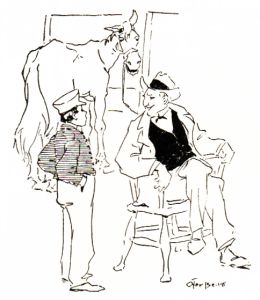
"The way it came about was this. I got word one day that an old schoolmate o' mine I hadn't seen for two years was down at the Flume, and I thought I'd like to go down and see him. So I went to old Bingle, and asked him to let me have a horse and buggy to drive down there in, for, as you know, it's over five miles from here. Bingle looked at me calmly for a second, and said all right. The reg'lar fare down an' back is ten dollars. You can have the rig for six—four dollars off. He knew I couldn't pay it, and I told him so. Well what of it, says he. You don't think I'm keepin' a livery-stable for fun, do ye? No, says I, but I've done lots o' things for you for nothin'; you might do somethin' for me. Well I will, says he. Next winter, when there ain't no call for hoss-and-buggies, you can have the rig free. Now it'll cost you six dollars. That made me mad, an' as it was in days when I didn't think much about right or wrong, not havin' studied theeligy, as I have since, I made up my mind to have the rig, an' have it free. And when I make up my mind to a thing, it's as good as done. I had the rig when night came on an' I was through with my day's work, and old Bingle had locked up for the night and gone to bed—he generally got so tired figerin' up his profits at night he went to bed about half past eight—I sneaked down to the barn, took old Spavinshanks, harnessed him up to the buggy, and started off for the Flume. I spent a very pleasant evening with my friend Silas, and along about eleven o'clock I started back home again. Everything went well until I got up to within a half-mile of the lake, when it began to rain like buckets. I never see such a pour in all my life.
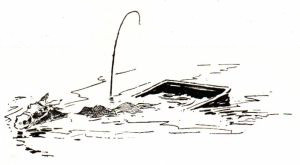
"'Whoa!' says I to old Spav., an' when he come to a standstill I fastened the reins to the whip-stock, an' jumped out to put up the leather cover of the buggy. I wasn't goin' to be drenched if I could help it. Spav. stood still enough whilst I was fixin' the buggy-top and fastenin' down the flaps at the sides. He was a good old horse, and had worked so hard for the money he'd earned for Bingle that he hadn't any false pride about bein' skittish. He was just a tired, sensible old hoss. But there's a limit to what horses'll stand, an' when lightnin' strikes a tree back of 'em, with a noise like a slew of artillery let off all to once, no self-respectin' hoss can be asked to stand quiet. That's what happened. Just as I was gettin' ready to get back into the buggy again, flash! boom! comes the streak, and Spav simply flew off in a great scare. As he approached the lake he shied, an' when he got to the part of the road that's right on the lake he lost his senses and plunged in, the buggy, with the top up, trailin' after him. I was kerflummexed that time, I can tell you. I thought sure Spavinshanks'ld be drownded and the buggy bust, but it didn't happen that way at all. He swam right around the lake, luggin' the buggy right along too, an' by the time I got to the boat-house he was nearin' the shore just beyond. I made a rush for him, and as he came out had him by the bridle, and inside of five minutes we was at the barn. There he was, covered with mud and the buggy just reekin' with fish. There was two hundred an' twenty trout, forty-seven suckers, and 'most a million minnows—every one of 'em caught in the buggy-top!"
"Dear me!" cried Jack. "Really?"
"Yes, really," said Sandboys. "An' that's why there's so few fish left in that lake now. Old Spavinshanks must have hauled that buggy through every blessed school in the place. Which is why I say that while that trout we see to-day was the record trout, he ain't no record haul for one cast, not by a long shot, by hookey."
And the boys agreed with him that it was indeed a marvellous haul, and with a mighty strange kind of tackle too. Nor did they wonder that Sandboys was reluctant to have Mr. Bingle hear of it. Hardly any owner of horses would care to have his horse and buggy used in exactly that way, no matter of how grasping or of how generous a spirit he might be.

The Arlington High-School Polo Team has won the High-School Championship in Massachusetts, winning seventeen games out of nineteen played. Aside from these successes in the League matches the Arlington players have met and defeated nearly all the other high-school teams in the vicinity of Boston, and have played two tie games with the Harvard 'Varsity team, and one tie game with the Cambridge League team, which is considered the strongest in the State.
The championship of the Interscholastic Association in the polo series was won by Cambridge High and Latin; but this school's team has been twice defeated by Arlington, so that it seems only just to award to the latter the credit of being the best school polo team in Massachusetts.
THE ARLINGTON HIGH-SCHOOL POLO TEAM.
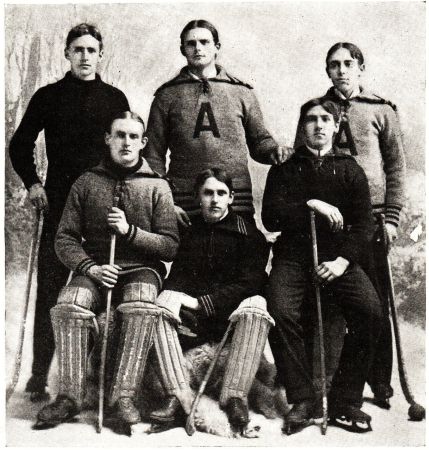
A few words only concerning the individual players. Johnson, the captain, played first rush, and is considered one of the cleverest men at this position. He is a very fast skater. He played on the team last year, and is somewhat of an all-round athlete, holding down centre-field on the nine and playing half-back on the eleven. Puffer, the second rush, was captain of the polo team last year, and in the fall he played tackle on the football eleven. His strong point is the accuracy of his shots, and he is credited with having scored the greatest number of goals during this season.
The half-back position was well played by Pierce, who was a new man, but had had some athletic training on the eleven in the fall, where his position was that of guard. Wood also played half-back, and was on the team the year before. He, too, is a member of the school nine and eleven. The goal was looked after by White, and he did as good work in his position as any of the goal-keepers of the neighborhood. It was his first year as a polo-player, but like the other members of the team he has had football and baseball experience. His brother played centre, and is a veteran, having been a member of last year's team, second base on the nine, and quarter-back on the football team.
The hardest games that Arlington has played were those against the Felton A.A., the Harvard 'Varsity, and Summerville High-School. The Felton team was a very strong one, and after two twenty-minute halves defeated Arlington 1-0. Summerville High also got a game away from Arlington, but in the return match was defeated 4-0 in a fifteen-minute half.
BASEBALL CHAMPIONSHIP CUP. New England Interscholastic League.
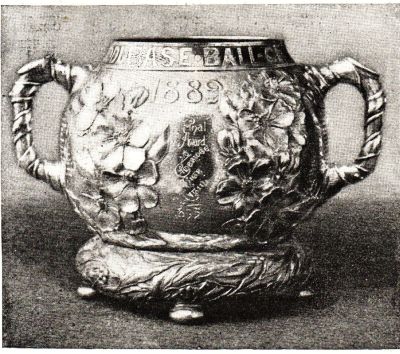
The Interscholastic Baseball Championship Cup, which has been played for for seven years, has finally been awarded to the Cambridge High and Latin School, their team having won it the greatest number of times. This cup is of solid silver, nearly nine inches high, in the form of a loving-cup with handles. In design the bowl rests upon a circular wreath of holly, and the bulge of the bowl itself is decorated with wreaths of wild roses.
The first winner of this cup was the Boston Latin School, which secured it in 1889. In 1890 and '91 Cambridge High and Latin held the trophy, but surrendered it in 1892 to English High, getting it back from them again in 1893. In 1894 C. H. and L. was tied with two other teams for the championship. No award was made that year. Then again in 1895 C. H. and L. was tied with Hopkinson's. No school in the seven years' struggle having made so good a record as Cambridge, the cup is consequently now the permanent property of the school.
The principal feature about the two most important in-door scholastic tournaments held in this city within the last two weeks was the promptitude with which the events were disposed of. As a rule, these in-door games drag along until after the dinner hour; but the Berkeley games were over quite early in the afternoon, and the Barnard games, a week later, took little more time to be decided. The credit in both cases is doubtless largely due to Mr. E. J. Wendell, who acted as referee on both occasions.
As usual, the Berkeley athletes did not enter the competition for points in the cup contest, leaving it to their guests to struggle for this trophy. But in spite of this they took more points than any of the other schools, leading with 3 firsts, 1½ seconds, and 1½ thirds, a total of 21 points. Barnard captured the prize with 2 firsts, 2 seconds, and 2 thirds—making a total of 18 points. The Jerseymen from Pingry School made a strong showing on this occasion and scored 2 firsts and 2 seconds, earning 16 points, and thus coming in a close second to Barnard.
One of the most interesting performances of the afternoon was Paulding's vaulting, the height he reached being 10 ft. 6 in., which is two inches higher than the in-door record established by him only a short time ago. We may, indeed, look for some excellent work in this event at the Madison Square Garden games next Saturday. Another record that was broken at the Berkeley games was the shot put, Bigelow going 41 ft., which is considerably beyond the former mark of 39 ft. 8½ in. Tomlinson, who took second to Bigelow, also passed the old record.
Another mark that was lowered was that of the 60-yard dash for Juniors, which now stands 7-1/5 sec., and the deed was done by Whitmore. Manvel of Pingry did well, as usual, but he did particularly well on this occasion by winning both the quarter and the half mile runs. The mile event went to Tomlinson of Barnard, and the walk was taken by Ladd, although Boyesen had been counted on for the winner.
At the Barnard games the record of 7-1/5 sec. for the 60-yard dash (Senior) was lowered by Wenman of Berkeley to 7 sec. Tomlinson, who won the mile run at the Berkeley games, also took first at the Barnard tournament, and brought the record down to 4.49-1/5, which was a much better performance than he made the week previous—5 min. 1-3/5 sec. At these games Pingry again showed up well, and tied with the Brooklyn High-School for first place, each having scored 11 points.
As these last two in-door scholastic games are undoubtedly the most important that will be held in the city this winter, it may prove of value in making some sort of a prognostication of what will happen at the Madison Square Garden next Saturday to append the summaries:
THE BERKELEY GAMES.
60-yard Dash, Senior.—First heat won by Byrd Wenman, Berkeley; H. Cadenas, Columbia Grammar, second. Time, 7-1/5 seconds. Second heat won by C. A. Sulzer, Pingry; B. T. Doudge, Blake School, second. Time, 7 seconds. Third heat won by J. Holland, Barnard; S. Millbank, Trinity, second. Time, 7-1/5 seconds. Fourth heat won by Ira Richards, "Poly. Prep."; W. S. Hipple, Barnard, second. Time, 7-1/5 seconds. Extra heat, for second men, won by H. Cadenas. Time, 7-1/5 seconds. Final heat won by Wenman; Sulzer, second; Holland, third. Time, 7 seconds.
60-yard Dash, Junior.—First heat won by W. Silleck, Barnard. Time, 7-2/5 seconds. Second heat won by G. Whitmore, Dwight. Time, 7-1/5 seconds. Third heat won by J. Lackey, Brooklyn High. Time, 7-1/5 seconds. Fourth heat won by J. Deering, Berkeley. Time, 7-3/5 seconds. Fifth heat won by W. Sartorius, Barnard. Time, 7-2/5 seconds. Sixth heat won by W. Dougherty, Harvard. Time, 7-2/5 seconds. Final heat won by Whitmore; Lackey, second; Sartorius, third. Time, 7-1/5 seconds.
440-yard Run.—Won by H. E. Manvel, Pingry; J. Storms, Barnard, second; B. Campbell, Brooklyn High, third. Time, 55-3/5 seconds.
880-yard Run.—Won by H. E. Manvel, Pingry; A. Tomlinson, Barnard, second; B. White, Berkeley, third. Time, 2 minutes 9-1/5 seconds.
One-mile Run.—Won by A. Tomlinson, Barnard; P. H. Christensen, Harvard, second; R. L. Sanford, "Poly. Prep.," third. Time, 5 minutes 1-3/5 seconds.
60-yard Hurdle-race.—First heat won by F. Bien, Jun., Berkeley; C. Robinson, Trinity, second. Time, 8 seconds. Second heat won by C. A. O'Rourke, Trinity; L. Herrick, Brooklyn High, second. Time, 8 seconds. Third heat won by S. H. Plum, Jun., Newark Academy; E. Johnson, Trinity, second. Time, 8-1/5 seconds. Final heat won by Bien; O'Rourke, second; Herrick, third. Time, 8 seconds.
One-mile Walk.—Won by H. W. Ladd, Melrose; B. Boylesen, Berkeley, second; D. McGrew, Trinity, third. Time, 8 minutes 9-3/5 seconds.
Running High Jump.—Won by G. Serviss, Brooklyn Latin, with 5 feet 7 inches; C. L. Du Val, Berkeley, second, with 5 feet 6 inches; W. Grace, Columbia Grammar, third, with 5 feet 6 inches. Du Val got second place on the toss.
Pole Vault.—Won by R. G. Paulding, Berkeley, with 10 feet 6 inches, beating the in-door scholastic record of 10 feet 4 inches, made by himself earlier in the year; P. A. Moore, Pingry, second, with 9 feet; L. Curtis, Barnard, A. J. Forney, Adelphi, and M. W. Forney, Adelphi, a tie for third at 8 feet 9 inches.
Putting 12-pound Shot.—Won by J. Stewart, Barnard, with 41 feet, breaking the in-door record of 39 feet 8½ inches, made by R. H. Bigelow, Wilson and Kellogg, in 1893; J. C. Tomlinson, Jun., Collegiate, second, with 40 feet 4 inches; M. Page, Trinity, third, with 38 feet 4 inches.
THE BARNARD GAMES.
60-yard Dash, Senior.—First heat won by A. Kennedy, Brooklyn High; M. Arnold, Berkeley, second. Time, 7-2/5 seconds. Second heat won by B. Wenman, Berkeley; B. T. Doudge, Blake, second. Time, 7 seconds. Third heat won by J. Holland, Barnard; H. Cadenas, Columbia Grammar, second. Time, 7 seconds. Fourth heat won by S. Millbank, Trinity; A. Manara, Columbia Grammar, second. Time, 7-2/5 seconds. Extra trial, for second men, won by Doudge. Time, 7 seconds. Final heat won by Wenman; Holland, second; Doudge, third. Time, 7 seconds.
60-yard Dash, Junior.—First heat won by W. B. Sartorius, Barnard; G. Ralph, Collegiate, second. Time, 7-2/5 seconds. Second heat won by H. Leopold, Dwight; J. B. Smith, Collegiate, second. Time, 7-1/5 seconds. Third heat won by F. Wickham, Pratt Institute; A. Meyers, Pingry, second. Time, 7-1/5 seconds. Fourth heat won by V. Dougherty, Harvard; R. Auchincloss, Cutler, second. Time, 7-1/5 seconds. Fifth heat won by C. Warren, Cutler; A. Lackey, Brooklyn High, second. Time, 7-2/5 seconds. Sixth heat won by G. Whitmore, Dwight; E. Bill, Cutler, second. Time, 7-1/5 seconds. Final heat—Whitmore and Wickham, a dead heat; Sartorius, third. Time, 6-4/5 seconds. Run-off won by Whitmore. Time, 7-1/5 seconds.
220-yard Run, Senior.—First heat won by H. Ficke, Barnard; M. D. Evans, Oxford, second. Time, 26-4/5 seconds. Second heat won by Ira Richards, Polytechnic Preparatory Institute; B. Wenman, Berkeley, second. Time, 26-2/5 seconds. Third heat won by E. Pury, Barnard; R. Topping, Adelphi, second. Time, 27 seconds. Final heat won by Richards; Pury, second; Wenman, third. Time, 25-3/5 seconds.
220-yard Run, Junior.—First heat won by W. B. Sartorius, Barnard; J. B. Smith, Collegiate, second. Time, 27 seconds. Second heat won by F. Wickham, Pratt Institute; A. Myers, Pingry, second. Time, 26-2/5 seconds. Third heat won by R. McClave, Trinity; J. Ralph, Collegiate, second. Time, 28-4/5 seconds. Fourth heat won by A. Lackey, Brooklyn High; V. Dougherty, Harvard, second. Time, 27 seconds. Final heat won by Wickham; Lackey, second; Myers, third. Time, 25-3/5 seconds.
440-yard Run.—Won by H. E. Manvel, Pingry; G. Burlingame, Brooklyn High, second; V. Earle, Barnard, third. Time, 56-1/5 seconds.
880-yard Run.—Won by H. E. Manvel, Pingry; A. Tomlinson, Barnard, second; J. Beasly, Adelphi, third. Time, 2 minutes 9-3/5 seconds.
One-mile Run.—Won by A. Tomlinson, Barnard; P. H. Christensen, Harvard, second; R. L. Sanford, Polytechnic Preparatory Institute, third. Time, 4 minutes 49-1/5 seconds.
60-yard Hurdle-race.—First heat won by L. Herrick, Brooklyn High; W. Halsey, Barnard, second. Time, 8 seconds. Second heat won by T. Pell, Berkeley; S. H. Plum, Newark Academy, second. Time, 8 seconds. Third heat won by C. O'Rourke, Trinity; G. Smith, Columbia Grammar, second. Time, 8-1/5 seconds. Extra heat, for second men, won by Halsey. Time, 8-1/5 seconds. Final heat won by Herrick; Pell, second; O'Rourke, third. Time, 7-4/5 seconds.
Running High Jump.—Won by W. Grace, Columbia Grammar, with a jump of 5 feet 2¼ inches; W. Duvan, Newark Academy, second, with a jump of 5 feet 2 inches; L. Curtiss, Barnard, third, with a jump of 5 feet 1 inch.
Pole Vault.—Won by R. G. Paulding, Berkeley, with a vault of 10 feet; C. Eastmond, Brooklyn High, second, with a vault of 9 feet 2 inches.
Putting 12-pound Shot—Won by J. Stewart, Barnard, with a put of 41 feet 11½ inches; John Tomlinson, Collegiate, second, with a put of 38 feet 4 inches; G. Miller, De La Salle, third, with a put of 37 feet 7 inches.
For some time past the athletes at the public schools of this city have felt that they could make a good showing in various branches of sport if they only had the opportunity, but as the Interscholastic Association admits to its competitions students from private schools only, the public-school boys have never been able to meet them. It is reported now, however, that a meeting is soon to be held by representatives from a large number of the New York public schools, with a view to establishing an association similar to the Interscholastic Association.
It is greatly to be hoped that this movement may prove a success, and that the public schools will hold tournaments, as the private schools do; and in baseball and football it would be well if, toward the close of the season, the best teams of the two leagues could meet and settle the supremacy of New York schoolboy teams.
A meeting of the executive committee of the National I.S.A.A. is announced for next Saturday evening at the Knickerbocker Athletic Club.
"TRACK ATHLETICS IN DETAIL."—Illustrated.—8vo, Cloth, Ornamental, $1.25.
The Graduate.