THE AMERICAN NIGHTS' ENTERTAINMENTS.
Reading edition
LEXINGTON ON FOURTH OF JULY.
BY EMMA J. GRAY.
ell you what, fellows, I mean to have a rousing good time this Fourth of July, and no mistake. I'm tired of just torpedoes, crackers, and cannons. What do you say to joining me?"
"Joining you, Alec? Of course we will," was the hearty response given by Sam Thayer, with a hurried look at each of the boys, as if to make doubly sure of their assent; and a second afterwards they all shouted, as if they had practised in concert, "You can make sure of me"; while a later voice added, with a face full of mischief, and a sly wink to the boy at his left, "Catch any of us missing Alec's fun"; and then, turning towards Alec, he asked, "Do you remember last Fourth how we scared cats with torpedoes until, notwithstanding their nine lives, I think some of them gave up the ghost? And do you remember, too, how we watched out for policemen before touching off our crackers? Whew!"
"Oh, that was the time," Alec laughingly responded, "when, to quote from my recitation to-morrow,
"'The boys turned out With noise and rout, And loud halloo, and lusty shout, And racket of crackers, and boom, and pop, And ringing of bells, and sizz, and splutter, Till good folks trying to sleep would stop, And get up, and close the windows and shutter.'
"But this time I propose something quite different."
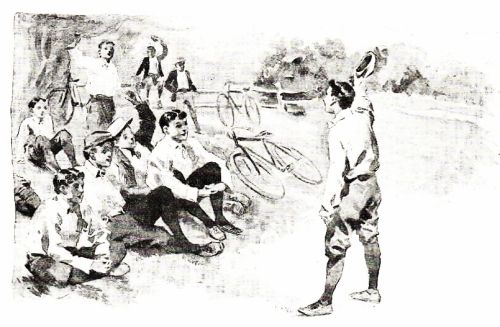
The group numbered fifteen. They had been taking a spin on their bicycles, and now had stopped to rest, to lay plans for the coming Fourth, and also to get comfortably cool under the long branches of this welcome grove of maple-trees.
Alec was undoubtedly the ringleader, but Sam Thayer, John Sinclair, and Clarence Bruce were his right-hand men, so whenever an unusually big scheme was on foot Alec always bided his time until being sure of their support.
"Hurrah for Alec!" suddenly ejaculated John Sinclair, tossing his cap ten feet or more upward; and a tremendous whoop, followed by three times three cheers and a tiger; but Sam Thayer, not yet satisfied with the stir already made, thought he would continue, and picked up a stick and tin pan lying on the road, and, making believe he was a drummer-boy, banged away with all his might, rat-ta-tat-tat, rat-ta-tat-tat—and marching to his left and so around, he speedily made a circle which enclosed the group.
"Thayer is anticipating part of my programme, boys." These words were sufficient, for in a trice the stick and pan were thrown as far as Sam's strong arms could pitch them, while Sam, first having turned a summersault, threw himself on the soft grass, thus joining the other expectant listeners.
"What would you think of a battle, fellows?"
"Fine!" And the very suggestion threw the little group in such disorder and hubbub that Alec laughingly but decidedly called "Order," adding, "The time is rapidly passing, and if we are to go to war we must prepare. You are sure you will not fail me, boys?"
"Certain sure." And once again quiet was restored.
"My plan is very simple. It is to divide ourselves into two armies. One army will represent the British, the other the United States. Make believe that Congress has commanded us to fortify the farm that belongs to my father. You know the location?"
"Rather."
"Suppose we name the place Lexington. You each know that it was at Lexington, Massachusetts, that the first skirmish in the War of American Independence was fought.
"Well, the United States army must occupy the farm, and the British force must attack it; and, of course, the United States army must win.
"The British will simply respect the action of the Revolutionary period at the time of the surrender of Lord Cornwallis—they will run away, but not, like the boy in the story-book, 'come to fight another day.' In order to make it really jolly, though, we should enlist fifty boys, and more if possible, and, to make it a fair fight, divide them evenly.
"You'll have to be General-in-chief of the whole, Alec," interrupted one of the listeners.
"All right; as you have decided to adopt my plan, I cannot do otherwise than accept such a position. I'm bound on having a good time, and if you'll honestly join me, we'll have one.
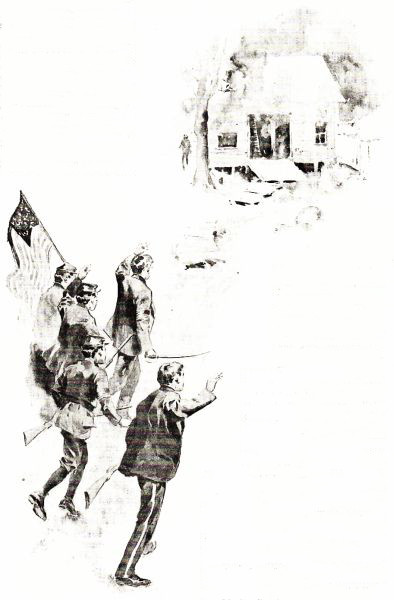
"Now, by right of office, and to get the thing started, I appoint as head of the British army Clarence Bruce, and as head of the army of the United States Samuel Thayer. As General-in-chief of both armies I would further state that the said officers must secure the requisite number of men, and see that they are provided with suitable uniforms and flags. In order not to make ourselves a nuisance to our mothers and big sisters, adopt as uniform our very oldest clothing; then we'll not have any advice or fuss as to care. We can show our colors by means of flags, banners, and a short scarf of bunting tied around our left arms: or what's the matter with basting a narrow strip of bunting around our jackets or on the outside seams of our trousers? Everybody must be provided with a wooden gun, as neither balls, cartridges, nor shot of any sort will be allowed. But both officers and privates may use large fire-crackers, any amount of torpedoes, and cannon, for war is not altogether fun; and the soldiers on both sides must show pluck. My plan of battle would be the following, but the officers in charge must arrange for themselves: Commence hostilities at nine o'clock Fourth of July morning, thus enabling our parents and friends to watch, at which time half of the United States army will be hidden back of the rocks which skirt the southeast side of the farm, and most of the others will be in the old barn that my father has been trying to tear down for the last two years. A sentinel should pass to and fro before the barn, and back of him other men should occasionally appear. The onslaught should be made by the British throwing handfuls of torpedoes against the rocks; but on the same rocks the United States army will have previously placed cannon, which, at a few moments after nine, will go off with a tremendous bang. The British will continue the hurling of the torpedoes until they are satisfied that all of the United States men are about the barn, and then they will recklessly march directly on the forbidden territory. At this moment the hidden soldiers will jump to their feet, and those at the barn will come to assist them. Thus action will determinedly commence. The English, being surprised, will soon be surrounded, and a fierce battle will ensue. The United States soldiers are now firing, and it seems a veritable blinding hailstorm, so thick and fast the white torpedo shells shower down, and the noise from the occasional fire-cracker not only increases confusion, but creates dismay. In the excitement the English make a mad rush for the barn; but that action has been anticipated—indeed, so much so that one of the privates had staid behind with the express purpose of firing it. And what a magnificent conflagration it will make, fellows, for we must carefully prepare it with a coating of tar and long wisps of tarred paper!
"When the barn is fired the battle will end, for there will be nothing left for the British to do but to surrender. Those who will not willingly give up their guns will drop them in the chase, for the United States Soldiers will be after them sure and fast, and all their banners and flags will be exhibited as trophies."
When Alec concluded, the boys drew a long breath, and then all tongues were loosed, and each one seemed to talk faster and louder than the other in his desire for a hearing, all agreeing, however, that the battle would be "jolly fun," and it was "like Alec" to get ahead of them in planning such grand sport. But what would be done with the rest of the day? This amusement would be but a starter; not a moment must be left for idleness.
And so it was another of the boys that was heard. He had lately been reading, he explained, the story of Mary, the mother of Washington, and he suggested that something should be done in her honor. That so much was always said about General George Washington, the Declaration of Independence, and all that, and he had made up his mind for one that George Washington would have been nowhere without his mother, and that she should be celebrated.
This resulted in tremendous applause, and the calling out of, "Only listen to Mr. Wisdom."
For a second the boy was abashed; but suddenly regaining himself, he added, "I've explained I have only but just finished reading about her, and the book told me of General Lafayette's visit and of the impression she gave him; for on reporting the interview to his friends, he stated, 'I have seen the only Roman matron living at this day!' and it is also said of her that the cause of American Independence had no more steadfast adherent."
So, after a short discussion, the boys decided to follow the battle with a procession, in which every one would be invited to join, even the visitors, whether friends or strangers; these should follow either four or six abreast, as their number would allow. That the boys who had represented the English army should make the necessary change in attire, and march as the United States navy, while the other boys would march as the army. There should be a detachment of cavalry—for a few riders ought to be found somewhere—a battalion of volunteers and several companies of infantry, all followed by the Marine Band.
A banner should lead the procession, bearing the inscription, "In honor of Mary Washington," and the Star-spangled Banner should triumphantly wave throughout the entire line.
One of the younger boys was noticeably uneasy, and in reply to the question, "Don't you want the procession?" said:
"Oh yes! but the battle's far jollier. I like the smell and bang of gunpowder, and I've been studying a receipt for a powerful noise."
"What's that—a good receipt for a noise?" and the next instant the boy was surrounded by his fellows.
"Yes, simple enough too—nothing but chlorate of potash and sulphur mixed; you should put several pieces of paper around it, though, and hammer it down as heavy as you can."
Just then was heard a sharp whistle, and Alec, with a jump on his wheel, called, "Good-by, all; it's time for me to start home." And a minute later those who were watching saw a bicycle-race along the road.