OLD TOOLS AND NEW ONES.
Reading edition
BY BARNET PHILLIPS.
I bought a gimlet with a metal handle for five cents, and it turned out to be a good tool. Five cents seemed cheap for a gimlet. Then I read that when manufacturers turned out gimlets in large quantities they could afford to sell them for less than a cent apiece. I happened to remember how a friend of mine showed me, some years ago, a handsome otter-skin pouch neatly ornamented, and told me that when he was in Alaska he had given an Indian a gimlet for it.
"That was a hard trade for the Indian," I said, "for that skin is worth twenty-five dollars."
"I did not take any advantage of the Indian," was my friend's answer. "The man was perfectly satisfied with the barter. A week afterwards I would have given the skin back, and more besides, to have had a gimlet. Skins were plenty in Alaska, gimlets scarce. The real cost of a thing often depends on how much you need it—and that is called the demand; and to something else—the distance from the place where the thing is made. You see, the subject of transportation comes in there, which has to do with supply."
When I thought it over I came to the conclusion that my friend had not got the better of the Indian, and that it was a fair swop.
I have the credit with my own children of being a very poor tinkerer, with a reputation for breaking tools; and I wanted a gimlet, and did not have one, when, strangely enough, the United States National Museum at Washington sent me one, not to use, but to look at, and here is an exact outline of it:
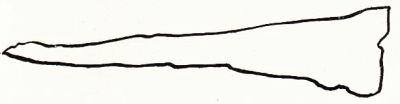
It is a splinter of flint made by primitive man, and he used it to bore holes in wood or as an awl for piercing skins. It came from Boone County, Missouri. It is immensely old, so old that its date, or when it was made, can only be guessed. The antiquity of it in a general way can be insisted upon, because it is what is called "weathered," and by weathered this is meant: that the piece of flint has been so long exposed to the action of the air and moisture that the composition of the flint has altered. If you were to take a piece of freshly splintered flint and put it in a hole in the ground when you were ten years old, and waited until you were seventy, and then dug it up, the alteration on the outside would be but slight. You might, of course, put it in wet ground where the water was full of lime in solution, and more rapid changes would take place. Anyhow, you would not be likely in a lifetime to see much alteration in the character of your flint. If your great-great-great-grandfather had buried that flint, and you had found it, the changes would have been more evident. Now this gimlet, or borer, is of a white creamy color, and you cannot see that it resembles flint. I could not bore a hole with it, because it would be certain to break.
If I were to guess how old it is I should say, "Fifteen hundred years ago that borer was in use," and then I might not give it age enough. It is a very old-fashioned gimlet, and since we can make gimlets to-day for less than a cent apiece, I wonder what this flint one was worth fifteen or twenty thousand years ago?
You might never have thought about it, but the hardest thing to do to-day is to find out exactly what a thing costs. There are, however, certain things that you do know—the cost of the raw material, and the price of labor. When the gimlet-maker in New England made up the price of his wares by the millions, he had to count up a hundred or more different kinds of expenses before he could settle down to what was about the exact cost of a gimlet.
We cannot apply the same rules exactly to this flint tool. In 1896 you can buy iron or steel everywhere. Flint may seem to you to-day as of no great value, because there is so little demand for it, but in the early history of man it was a substance highly prized. It is not scattered about everywhere. Primitive man made long journeys in order to obtain it. He wanted it badly, not only for his tools, but for the purpose of making a fire. He knew that by striking it with a bit of metal or with certain natural metallic substances he could bring forth sparks. There are often found in the graves of men whose race or tribe or origin is lost bits of flint with fragments of pyrites; and pyrites is a natural combination of sulphur and iron. When you strike them together there is a spark. What is strange about these finds is this, that in the surrounding country there is not to be found a bit of flint or a scrap of pyrites. Primitive man must have set out to find them, or they came to him by barter. I should then think that if we could measure the values of tools in the past with those of to-day, such implements as early man had were expensive, and worth comparatively more to him than our tools are to us. It is, however, a puzzle. Labor must have been cheap, because savage people take little account of time. To-day we know how these flint tools or weapons are made, and coarser ones can be fashioned by us in a short time. There must have been developed, however, great skill in the long past, and for this simple reason: The flint tools broke so easily that there was always a demand for new tools, and so the old gimlet business must have been always brisk.
A PREHISTORIC SCRAPER.
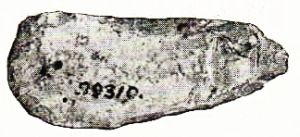
Another illustration is a scraper, and belongs also to the United States National Museum. It served for dressing skins, in removing the hair and grease, before the rough process of tanning. These stone scrapers are found of all sizes, and as implements might have served for a variety of purposes. This bit of flint is as old as the gimlet or borer, being white with age.
THE CHISEL.
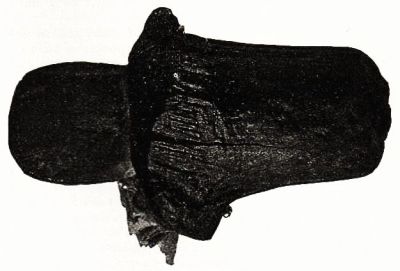
Here is a chisel, or gouge, and, compared with the other tools, this may be called an implement made the day before yesterday. Those who have studied this kind of tool, found in the Swiss lakes, say it is not more than 2500 or 3000 years old. Ages on ages ago there was a race of people who lived in houses built on piles which stood in the water of the Swiss lakes. Nobody ever thought such a race existed until the level of one of the lakes was lowered, and then the secrets of a long-forgotten people were discovered. This tool is made of a piece of green serpentine embedded in a handle, which socket is a portion of the antler of a deer. It has still a good edge on it, though it has remained under water thousands of years. I might scrape off a bit of wood with it to-day. The handle, however, is weak, rotten through age, and would crumble.
This is what I should like to impress on my readers: Our work to-day is what is called specialized. By that is meant that everybody has a special or particular trade or occupation. I should not want a carpenter to make my clothes, or a locksmith to make my boots. Men become skilled because they exercise one craft, doing it quicker and better. In those old days there must have been artisans, as the stone tool maker, who made blunt implements, and nothing else; but from the nature of things those who used the tools had many occupations. Having but few tools, one implement served various purposes. The edge of the drill might be used to cut with, or, attached to a stock, could be converted into a weapon. Primitive man, then, had to be a "Jack of all trades," and was not, as in the old adage, "master of none," for he was forced to turn his hand to many different kinds of occupations.