Chapter XXXVIII
Reading edition
ALARIC AND BONNY AGAIN TAKE TO FLIGHT.
For a full month had our hump-durgin boys occupied the little cedar-built shack, which now seemed to them so much a home that it was difficult to realize they had ever known any other. By this time too they were exercising a very decided influence upon the character of the camp into whose life they had been so unexpectedly thrown. Light-hearted Bonny, with his cheery face and abounding good-nature, was as full of amusing pranks as a young colt, and from every group that he joined shouts of merriment were certain to arise within a few minutes. Thus Bonny was very popular and always in demand. Nor was Alaric less so, for he could tell so much concerning strange countries and relate so many curious old-world tales, that there was rarely an evening that he was not called upon for something of the kind. He so often said that most of his stories could be found in certain books, related a thousand times better than he could tell them, that in the breasts of many of his hearers he aroused a real longing for books, and a wider knowledge than they could ever acquire without them.
At the same time Alaric was not only appreciated for what he knew, but for what he could do. No one in camp could ride a "turn" of logs, swaying, bumping, and sliding down the skid-road, with such perfect confidence and easy grace as he. Only one of them all could outrun him, and none could catch or throw a baseball with the certainty and precision that he exhibited, although ever since Buck Raulet discovered the ball in his young guest's coat pocket the camp had practised with it during all odd moments of daylight.
So our lads made friends with and knew the personal history of every occupant of the camp save one, and he was its boss. Since the night on which they had taken tea in his house Mr. Linton had hardly spoken to either of them; nor did he ever join with the men in their evening gatherings to listen to Bonny's jokes or Alaric's tales. At first they noticed this, and wondered what reason he had for avoiding them; but they soon learned that it was only his way, and that he never talked with any of the men except on matters of business. Buck Raulet said it was because he was a deputy United States Marshal, and didn't know when he might be called on to arrest any one of them for some offence against the government.
With all their present popularity the boys were growing weary of the monotonous life they were leading, of their good-natured but rough and narrow-minded associates, and of the deadly sameness of the food served three times a day in the dingy mess-room. They also dreaded the approaching winter, with its days and weeks of rain, during which the work of getting out logs for the insatiable mills down on the sound must keep on without a moment of interruption. They listened with dismay to tales of loggers who had not known the feeling of dry clothing for weeks at a time; of "turns" of logs rushing down skid-roads slippery with wet, like roaring avalanches of timber, threatening destruction to everything in their course; and of long dreary winter evenings when the steady downpour forbade camp-fires and prevented all social out-of-door gatherings.
In view of these things, Alaric was determined that the end of another month, or such time as his wages should be paid, should see him on his way to San Francisco and home. He did not anticipate any difficulty in persuading Bonny to go with him, for that young man had already remarked that while hump-durgin riding was fun up to a certain point, he should hate to do it for the remainder of his life. Oh yes, Bonny would go of course; and Alaric's only fear was that his father might not take a fancy to the lad, or hold the same views regarding his future that he did. Still, that was a matter that would arrange itself somehow, if they could only manage to reach San Francisco, and the "poor rich boy" now began to long as eagerly for the time to come when he might return to his home as he once had for an opportunity to leave it.
One day, when matters stood thus, a stranger, past middle age, shabbily dressed, and wearing a peculiarly dilapidated hat, appeared at the railway log-landing, and asked of Bonny, whose hump-durgin happened to be there at the time, permission to ride with him to the upper end of the skid-road. With a sympathetic glance at the man's forlorn appearance Bonny answered,
"Certainly, sir; you may ride with me all day if you like, and I shall be glad of your company."
Thanking the lad, the stranger seated himself in the hump-durgin, and after he had been warned to hold on tight and watch out for "slews," the upper journey was begun. At one of the upper relay stations they waited for a descending "turn" of logs to pass them. Here the stranger visited the engine-house, and while he was talking with the engineer they came in sight. Alaric, who happened to be in charge, was at that moment walking easily forward along the backs of the swaying logs, presenting as fine a specimen of youthful agility, strength, and perfect health as one could wish to encounter. He was clad in jean trousers tucked into boot-legs and belted about his waist; a blue flannel shirt, with a black silk kerchief knotted at the throat, and a black slouch hat.
"ISN'T THAT EXTREMELY DANGEROUS?" ASKED THE STRANGER.
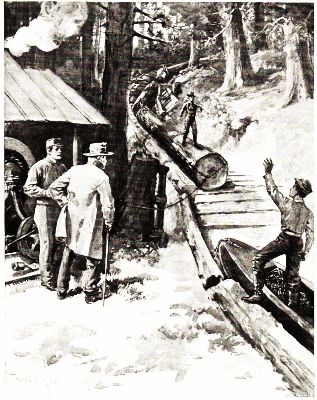
"Isn't that extremely dangerous?" asked the stranger, regarding the approaching lad with a curious interest.
"Not for him it isn't, though it might be for some; but Rick Dale is so level-headed and sure-footed that there isn't his equal for riding logs in this outfit, nor, I don't believe, in any other," answered the engineer.
"What did you say his name was?" asked the stranger, with his gaze still fixed on Alaric.
"Dale. Richard Dale," replied the engineer. "Why? Do you think you know him?"
"No. I don't know any one of that name; but the lad's resemblance to another whom I used to know is certainly very striking."
"Yes. It's funny how often people look alike who have never been within a thousand miles of each other," remarked the engineer, carelessly, as he stepped to the signal-box. In another minute Alaric had passed out of sight, while Bonny and the stranger had resumed their upward journey.
That evening Alaric remarked to his chum, "I noticed you had a passenger to-day."
"Yes," replied Bonny. "Seedy-looking chap, wasn't he, but one of the nicest old fellows I ever met. Never saw any one take such an interest in everything. I suspected what he was after, though, and finally we got so friendly that I asked him right out if he wasn't looking for work."
"Was he?"
"Yes. He hesitated at first, and looked at me to see if I was joking, and then owned up that he was hunting for something to do. I felt mighty sorry for him, 'cause I know how it is myself; but I had to tell him there wasn't a living show in this camp just now. He seemed mightily taken with our shack here, and said he once had a house just like it, but he was afraid he'd never have another. I invited him to stay with us a few days if he wanted to—just while he was looking for a job, you know—but he said he guessed he'd better go on to some other camp. You'd have been willing, wouldn't you?"
"Certainly," replied Alaric. "I've already been in hard luck enough to be mighty glad of a chance to help any other fellow who's in the same fix, especially an old man; for they don't have half the show that young fellows do."
"I told him you'd feel that way," exclaimed Bonny, triumphantly, "and he said if there were more like us in the world it would be a happier place to live in, but that he guessed he'd manage to scrape along somehow awhile longer without becoming a burden to others. I did insist on his taking a hat, though."
"A hat?"
"Yes. We were down at the store, and he was asking the price of things, and looking around so wistful that I couldn't help getting him a new hat and having it charged; for the one he wore wasn't any good at all. He hated to take it, but I insisted, and finally he said he would if I'd keep his old one and let him redeem it some time. Of course I said I would, just to satisfy him, and here it is."
Alaric looked carelessly at the dilapidated hat as he said: "It was a first-class thing to do, Bonny, and I only wish I had been here to give him something at the same time. But, hello! this is a Paris hat, and hasn't been worn very long, either. I wonder how he ever got hold of it? Never mind, though; hang it up for luck, and to remind me to do something for the next poor chap who comes along. I heard to-day that the president of the company was in Tacoma, on his way to make an inspection of all the camps."
"Yes," replied Bonny. "They say he is an awful swell, too, and I heard that he was coming in his private car. I only hope he is, and that I can get a chance to look at it, for I have never seen a private car. Have you?"
"One or two," answered Alaric, with a smile.
At noon of the following day, while a fifteen-minute game of baseball was in progress after dinner, the boss of Camp No. 10 received a note from the president of the company, requesting him to report immediately in person at Tacoma, and bring with him the two hump-durgin boys Dale and Brooks.
Mr. Linton, being a man who kept his own business to himself as much as possible, merely called our lads and bade them follow him. Of course this order broke up the game they were playing, and as they hastened after the boss, Bonny, in whose hands the baseball happened to be, thrust it into one of his pockets. Although curious to know why they were thus summoned, the boys learned nothing from Mr. Linton until they reached the railway log-landing, when he told them that they were wanted in Tacoma, and that he was instructed to bring them there at once.
From the landing they proceeded by hand-car to Cascade Junction, where they boarded a west-bound passenger train over the Northern Pacific. Even now Mr. Linton was not communicative, and after sitting awhile in silence, he went forward into the smoking-car, leaving the boys in the passenger coach next behind it. Now they began to discuss their situation, and the more they considered it, the more apprehensive they became that something unpleasant was in store for them.
"He's a United States Marshal, remember," said Bonny.
"Yes," replied Alaric; "I've been thinking of that. Do you suppose it can have anything to do with that smuggling business?"
"I'm awfully afraid so," replied Bonny. "Great Scott! Look there!"
The train was just leaving Meeker, where a passenger had boarded their car, and was now walking leisurely through it toward the smoker. It was he who had attracted Bonny's attention, and at whom he now pointed a trembling finger.
Alaric instantly recognized the man as an officer of the revenue-cutter that had so persistently chased them in the early summer. Without a word, he left his seat and followed the new-comer to the smoking-car, where a single glance through the open door continued his worst suspicions.
The officer had seated himself beside Mr. Linton, and they were talking with great earnestness.
"They are surely after us again," Alaric said, in a whisper, as he regained his seat beside Bonny; "but I don't intend to be captured, if I can help it."
"Same here," replied Bonny.
Thus it happened that when, a little later, the train reached Tacoma, and Mr. Linton returned to look for his lads, they were nowhere to be found.
[to be continued.]
The first meeting of the National Interscholastic Association was held at the Columbia Oval, New York, June 20, and the records established on that occasion are something that every school-boy in the country may well feel proud of. The day was perfect and the track was good; and although there were only five associations represented, the teams present were undoubtedly made up of the best scholastic athletic talent in the United States. As had been anticipated, victory went to the New-Englanders, with a score of 46 points; the Connecticut H.-S.A.A. took second honors with 25 points, New York following with 23, while the Long Island I.S.A.A. was fourth with a score of 7, and the sandy team from Iowa closed the list with 6 points.
NATIONAL I.S.A.A. GAMES, COLUMBIA OVAL, NEW YORK, JUNE 20, 1896.
Event.Winner.
100-yard dashW. H. Jones (P.A.), N.E.10-1/5sec.
220-yard dashW. H. Jones (P.A.), N.E.22-2/5"
Quarter-mile runH. L. Washburn (B.), N.Y.51-2/5"
Half-mile runW. S. Hipple (B.), N.Y.1m.59-3/5"
One-mile runD. T. Sullivan (W.H.), N.E.5"10-1/5"
120-yard hurdlesA. F. Beers (D.L.S.), N.Y.16-4/5"
220-yard hurdlesJ. H. Converse (E.H.-S.), N.E.26-2/5"
One-mile walkA. L. O'Toole (E.H.-S.), N.E.7"53-2/5"
One-mile bicycleO. C. Roehr (P.P.), L.I.2"36"
Running high jumpF. R. Sturtevant (H.), Ct.5ft.8in.
Running broad jumpH. Brown (H.H.-S.), Ct.21"1"
Pole vaultR. G. Clapp (Will.), N.E.10"5"
Throwing 12-lb. hammerF. C. Ingalls (H.), Ct.129"10"
Putting 12-lb shotF. C. Ingalls (H.), Ct.43"4"
Event.Second.
100-yard dashR. W. Moore (B.), N.Y.
220-yard dashR. W. Moore (B.), N.Y.
Quarter-mile runG. G. Whitcomb (P.E.), N.E.
Half-mile runR. F. Hanson (E.H.-S.), N.E.
One-mile run———————————
120-yard hurdlesF. A. Edmands (W.A.), N.E.
220-yard hurdlesA. F. Beers (D.L.S.), N.Y.
One-mile walkG. A. Blakeslee (H.H.-S.), Ct.
One-mile bicycleM. W. Forney (A.), L.I.
Running high jumpT. Flournoy (C.), Io.
Running broad jumpH. Moeller (C.G.), N.Y.
Pole vaultB. Johnson (W.A.), N.E.
Throwing 12-lb. hammerW. B. Boyce (B.H.-S.), N.E.
Putting 12-lb shotF. A. Edmands (W.A.), N.E.
Event.Third.
100-yard dashHugh Jackson (C.R.), Io.
220-yard dashHugh Jackson (C.R.), Io.
Quarter-mile runC. F. Luce (H.), Ct.
Half-mile runC. A. Brown (S.C.), Io.
One-mile run———————————
120-yard hurdlesF. W. Shirk (W.A.), N.E.
220-yard hurdlesJ. J. Peters (P.A.), N.E.
One-mile walk———————————
One-mile bicycleE. A. Strong (H.), Ct.
Running high jump———————————
Running broad jumpW. Hersey (W.A.), N.E.
Pole vaultF. R. Sturtevant (H.), Ct.
Throwing 12-lb. hammerF. A. Edmands (W.A.), N.E.
Putting 12-lb shotC. Leo (C.R.), Io.
Abbreviations:—N.E., New England I.S.A.A.; N.Y., New York I.S.A.A.; Ct., Connecticut H.-S.A.A.; L.I., Long Island I.S.A.A.; Io., Iowa State H.-S.A.A.; P.A., Phillips Academy, Andover; B., Barnard School, New York; W.H., Worcester High-School; D.L.S., De La Salle Institute, New York; E.H.-S., Boston English High-School; P.P., Brooklyn Poly Prep. Institute; H., Hartford Public High-School; Will., Williston Seminary; P.E., Phillips Academy, Exeter, New Hampshire; W.A., Worcester Academy; A., Adelphi Academy, Brooklyn; B.H.-S., Brookline High-School; C.G., Columbia Grammar-School, New York; C.R., Cedar Rapids High-School; C., Clinton High-School; S.C., Sioux City High-School; H.H.-S., Hillhouse High-School, New Haven.
NATIONAL I.S.A.A. GAMES, JUNE 20, 1896.
TABLE OF POINTS SCORED.
Association.First.Second.Third.Total.
FiveTwoOne
Points.Points.Point.
New England I.S.A.A.66446
Connecticut H.-S.A.A.41325
New York I.S.A.A.34023
Long Island I.S.A.A.1107
Iowa State H.-S.A.A.0146
—-
107
N. B.—Out of a possible 112 points only 107 were awarded, there being no second or third man in the mile run, and no third man in the high jump or the mile walk.
School.First.Second.Third.Total.
FiveTwoOne
Points.Points.Point.
Hartford School30318
Barnard, N.Y.22014
English High-School21012
Phillips Andover20111
Worcester Academy0339
De La Salle, N.Y.1107
Hillhouse High-School1107
Worcester High-School1005
Poly. Prep., Brooklyn1005
Williston1005
Cedar Rapids0033
Adelphi, Brooklyn0102
Phillips, Exeter0102
Brookline High-School0102
Col. Grammar, N.Y.0102
Clinton High-School0102
Sioux City High-School0011
—-
107
Now that the meeting is past and gone, it is very easy for most of us to make comments and suggestions about what should have been done, but these suggestions can be of little use to-day, unless they serve to help matters for next year. Hind-sight is very much better than foresight, and experience is much more valuable than either. If the officers of the National Association, and all who are interested in the welfare of that body, will work next year with wisdom acquired from this year's experience, the field day of '97 ought to be a perfect one of its kind. There are a great many things that I should like to say in this Department about the meeting of the N.I.S.A.A., but there are none of these reflections which cannot just as well be made a week or two hence, when there will be more space at disposal, and when there will have been more time for reflection with all of us. For the present I think that, in spite of all the shortcomings of the first meeting, we have reason to congratulate ourselves over the success of the day, and the promise it holds out for the future.
The New York school-boys need waste no time in regret over the defection of the Berkeley and Cutler teams. It is certain that had they been present at the National meet, they could not have altered the result, so far as victory is concerned. It is possible—it is even probable—that New York might have secured second place, but nothing better. The hurdles were 3 ft. 6 in. and 2 ft. 6 in. in the long and short events, respectively, so that it is not exactly fair to compare the performances in these events at the National games with those of the New York Interscholastics, where the hurdles are lower. Nevertheless, Converse in the low hurdles made better time than Harris, who won at the Interscholastics.
To make a just comparison, we must leave the hurdles out of our calculation and take only the other twelve events, which are the same on both the National and the New York schedules. Of these twelve events the performances at the National meeting were better in ten cases than they were at the New York Interscholastics a few weeks ago. The two which were not surpassed were the pole vault and the mile run. It is probable that Hurlburt of Berkeley could have defeated Clapp. I am not so sure that Turner of Cutler's could have defeated Sullivan, who won the mile in 5 min. 10-1/5 sec. Turner could certainly not have defeated Mills, but Mills was unfortunately ill, and unable to be present. Sullivan ran second to Mills at the New England Interscholastics, Mills's time being 4 min. 33-4/5 sec. Turner's time at the New York Interscholastics was 4 min. 49-3/5 sec.
But it is hardly fair to compare Sullivan's time at the National games with Turner's at the New York games, because Turner was pressed very hard, and did his very best, whereas Sullivan ran around the track alone at the Columbia Oval, there being no other contestant in the mile event; furthermore, at the stretch of the third lap he thought he had finished his mile and spurted, and almost stopped in front of the judge's stand, when the officials called out to him that he still had another lap to go; then he merely trotted the remaining 440 yards, so that of course good time could not be expected. To carry on the speculation further, and to make the comparison more complete, it may be stated that the performances at the National games, besides being better in ten cases out of twelve than the performances at the New York Interscholastic, were better in six cases out of twelve than the N.Y.I.S.A.A. records. The superiority is in the two dashes, the quarter, the half, the hammer, and the shot. In the hammer, both first and second men at the National games made better throws than Irwin Martin did, a few weeks ago, when he set up the New York Interscholastic record at the Berkeley Oval. In the shot, all three point-winners at the National games surpassed the New York Interscholastic figures.
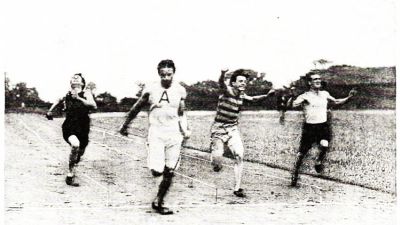
Jackson. Jones. Moore. Robinson. N.I.S.A.A. GAMES: FINISH OF FINAL HEAT, 100-YARD DASH.
Jones. Moore. Jackson. N.I.S.A.A. GAMES: FINISH OF THE 220-YARD, FINAL HEAT.
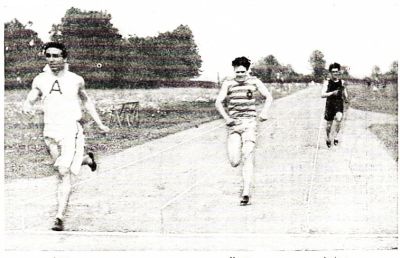
It may clearly be seen from this that the field work at the Columbia Oval was of a very high order. But better still were the performances in the dashes and the middle distances. Jones of Andover defeated Moore of Barnard in both the 100 and the 220, running the shorter distance both in his heat and in the final in 10-1/5 sec. Jones is beyond any doubt the best sprinter in the schools to-day, and gets down the path in beautiful form. Moore was never so hard pushed in all his life, and also ran beautifully, making a close race every time, and his defeat in his heat was doubtless due to his desire to save his strength rather than to the superiority of Robinson, who, however, ran much better in his heat than he did in the finals. The 220 was anybody's race for three-quarters of the distance, Moore and Jones running about even, with Jackson barely a yard in the rear; but Jones, being much the stronger man, and with decidedly more reserve force than Moore, managed to pull out a winner by a couple of yards.
The quarter-mile was hotly contested, and proved a very pretty race. Washburn of Barnard was the favorite, but he had two good men against him in Robinson of Worcester and Luce of Hartford. The bunch went around the turn at a brisk pace, and when half the distance had been covered Whitcomb of Exeter developed unexpected speed, and pushed the New-Yorker strongly. It was plain then that the real struggle was between these two, and it was not until the last three yards of the race that Washburn could feel sure of victory. Luce came in a good third.
Hanson. Hipple. N.I.S.A.A. GAMES: FINISH OF THE HALF-MILE RUN.
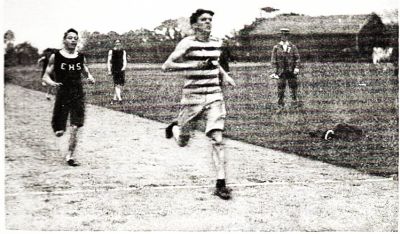
The half-mile was probably the hardest race of the day, and Hipple won only after the hottest kind of a struggle with Hanson. The bunch started off at a good pace, as may be seen from the record-breaking time made, Bedford setting the pace. The Barnard man kept well in the lead for the first lap, and then surrendered his position to his schoolmate. But the New-Englanders had no idea of letting Hipple have an easy time of it, and Hanson, Albertson, and Brown at once began to swing out for position. Hipple stuck to his colors, however, and strained every nerve, running beautifully, and on the stretch he and Hanson pulled away quite perceptibly from the others. Hipple finished about five feet ahead of the Boston man, and both were entirely played out when they crossed the line, Hipple so much so that he was unable to enter the mile, a little later.
Beers. Edmands. N.I.S.A.A. GAMES: FINAL HEAT OF THE HIGH HURDLES.
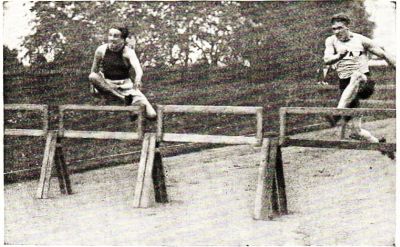
Both the hurdle-races furnished fine sport. Shirk of Worcester Academy took the first heat, not being pressed very hard by O'Rourke, and the second heat was an exceedingly hot race between Beers and Edmands, the time, .16-3/5, being even faster than that of the final. In the final struggle the race was clearly between Edmands and Beers, and the New-Englander certainly ran in far better form than did the victorious New-Yorker. Beers knocked over fully half the obstacles, whereas Edmands only toppled one. I should pick Edmands as the winner in a contest with Beers, both men being fresh. At the National games Edmands was throwing the hammer when the hurdles were called, and he had to leave his exhausting field work, without a chance for a rest, to start in his heat, and again in the final. Considering this, his performance over the sticks was exceedingly creditable. There were only three starters in the low hurdles, and Beers got off the mark first. He had not gone far, however, before Converse overtook him and soon passed him. Converse won in the excellent time of 26-2/5 sec., Beers finishing about six yards behind, with Peters almost on his heels. Beers ran in better form in the low hurdles, although doubtless a little fagged from his two high-hurdle heats. It is only fair to say for Beers that he has been in the habit of running over the dwarfed high hurdles of the N.Y.I.S.A.A., and thus Edmands, who has enjoyed the benefit of belonging to an association which uses recognized standards in athletics, had a slight advantage over the New York man.
The walk was a gift to O'Toole of English High, there being only one other contestant, Blakeslee of Hillhouse. Inasmuch as the faculty of the Hotchkiss School, Lakeville, did not allow any of the Hotchkiss men to come down to the meeting, Eels, who made such a good record at the Connecticut games, was not present. This is greatly to be regretted, for he and O'Toole would doubtless have had a close struggle in that event. The Boston man was pressed at no time, but he kept up a good pace, and when he crossed the line he was half a lap ahead of Blakeslee.
There were no accidents in the bicycle race, for a wonder, and the contestants actually raced from start to finish. The riders remained pretty closely bunched for half a mile, Roehr of Long Island leading. At the three-quarter post Poillon of New York dashed from the rear and took the lead, but he was able to hold it for only half a lap, when the others all put on steam and left him again at the tail. Roehr won in good style, with another Brooklynite, Forney of Adelphi, second, and Strong of Connecticut third.
The field events developed some excellent performances. There were only two men who answered to the call in the high jump—Sturtevant and Flournoy. The Connecticut man had the greater reputation, and the event was conceded to him at once, although the Iowa athlete struggled bravely, and cleared the very creditable height of 5 ft. 7 in. Sturtevant showed good form, and went an inch higher. The pole vault was also well contested, but the winner did not go so high as might have been expected from the various performances that have occurred at interscholastic meetings this year. Clapp, the winner, cleared 10 ft. 5 in., although he did an inch better at the New England Interscholastics, where he vaulted 10 ft. 6 in., and took second to Johnson of Worcester Academy. At the National games Johnson could only clear 10 ft. 3 in., and took second to Clapp.
Ingalls of Hartford, with Jones of Andover, enjoyed the honor of scoring a double win. He took first place in both the hammer and the shot, and his performances are something to be proud of. He established records in both events which will probably stand for some years to come. Boyce of Brookline High-School threw 125 ft. 3 in., and took second in the hammer, Edmands of Worcester being third. The latter also took second in the shot, coming within eight inches of the winner. Edmands is a very good all-round athlete. Leo of Iowa took third in the shot, and was only an inch behind Edmands.
Although every athlete who appeared at the National games is to be congratulated on his sportsmanship, and on the determined way in which he set about his work, especial commendation is to be given to the four young men who came on all the way from Iowa. They were outnumbered by every team, but they nevertheless succeeded in making creditable performances, and in carrying off six points. They are not of the stuff that goes home with a zero, and we may confidently expect, if Iowa sends on a team next year, that the experience of the Iowans this spring will have been profited by, and the Westerners will put up even a stiffer competition than they did a week ago.
The Graduate.
SICKNESS AMONG CHILDREN
is prevalent at all seasons of the year, but can be avoided largely when they are properly cared for. Infant Health is the title of a valuable pamphlet accessible to all who will send address to the New York Condensed Milk Co., N. Y. City.—[Adv.]