HOW TO ENTER THE NAVY.
Reading edition
BY ADMIRAL BANCROFT GHERARDI, U. S. N.

ome of our young readers would be glad to know how to enter the United States navy. There are two ways—one is through the Naval Academy at Annapolis, in which the young man becomes in time a commissioned officer; the other is through the Training-School at Newport, in which case the young man becomes a sailor, and in time may become an officer known officially as a warrant-officer. A commissioned officer holds an appointment from the President, and is confirmed by the United States Senate. A warrant-officer holds an acting appointment from the Navy Department, and after having served six months on a sea-going vessel, and his commanding officer having made a favorable report as to his fitness to remain an officer in the navy, he is then given a warrant signed by the President, and dated back to the time he received his acting appointment. Warrant-officers are designated gunners, boat-swains, and carpenters, and are officers as much as any other officers in the navy, except that they may not hold commissions.
The history of the United States navy has been particularly glorious. It has traditions of heroism and bravery that are a constant source of pride to those in the service, and that appeal especially to young men who are fond of their country and of achievements in warfare. To become an officer in the service is a most honorable ambition, and one to which thousands of young men aspire. It is for that reason that appointments to Annapolis are always sought eagerly. Each Congressional district is entitled to one cadet at Annapolis at one time, and in addition the President has ten appointments at large. There can be, however, only ten appointees of the President, serving apprenticeship at the same time. The District of Columbia likewise sends one cadet to the Academy. The President usually appoints the sons of naval or army officers.
The Congressmen or delegates to Congress from the Territories recommend the appointment of the other cadets. To avoid favoritism the Congressmen occasionally recommend young men who have passed the best examination in a competition, of which there has been public notice given. Congressmen's appointees must reside in the district from which they are appointed, and all appointees must be between the ages of fifteen and twenty.
When a young man receives his appointment to Annapolis he is required to sign articles binding himself to eight years' service. He must pass an examination in the ordinary English branches, special attention being paid to the history of the United States. He must be sound physically, or his "alternate," the young man who usually passes the next best preliminary examination, takes his place as the cadet, provided the latter is sound physically, and can also pass the entrance examination to the Academy. When a young man becomes a cadet he gets $500 salary each year. The course of study lasts six years. Four of these are passed at the Academy, and two at sea. One of these is the "line" division, and the other is the "staff" division. The line-men are the officers who do the fighting, navigating, and executive work of a ship, and the others become officers who have charge of the machinery of a ship, and are known as engineers. The line division is the favorite, because young men rise to the highest grade, such as rear-admiral, in this branch of the service. The other men become engineers, and cannot reach any grade higher than that of commodore.
After two years' service at sea, during which the young man perfects himself in the problems of seamanship, the cadets receive appointments as commissioned officers, if there are vacancies. If there are not sufficient vacancies to go around, the best men are taken, and the others are discharged, with a certificate of graduation and one year's pay—$1000. We are building and manning ships so fast in these days of the new navy that there are always enough vacancies, and it is rare that any cadets are discharged because there is no room for them in the service. After having become a commissioned officer in the staff or line, the young officer is promoted gradually from grade to grade, usually according to relative rank, except in time of war, when, for especial reasons, the brighter men are pushed forward because of their exceptional fitness for command or other important work. The officers remain in the service until they are sixty-two years old, unless they resign before that time, and then are retired under three-quarter pay until they die.
The scarcity of men who go into the engineering department of the navy is such that there is a bill now pending in Congress to admit graduates of colleges where marine and mechanical engineering is taught to enter the navy without passing through the Annapolis Academy. They must pass an examination to show that they are fit for the engineering work, and must spend two years at sea, like the graduates of Annapolis. If this bill should become a law, it will be possible for young men to become officers in the engineer corps in the navy without going through the Annapolis Academy.
ENLISTING ON BOARD A RECEIVING-SHIP.
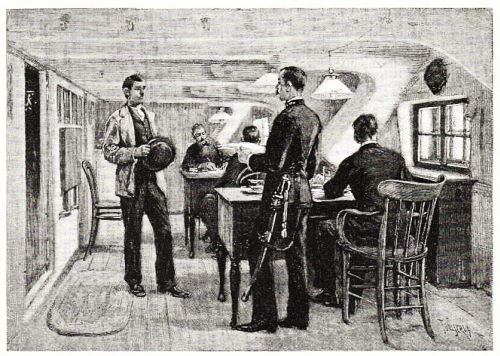
When a boy wishes to become a sailor in the navy he applies to one of the three "receiving" ships. They are the Vermont at the New York Navy-Yard, the Wabash at the Boston Yard, and the Richmond at the League Island Navy-Yard in Philadelphia. The boys must be between fourteen and sixteen years of age, sound in health, and be able to read and write to some extent. No distinction is made in race, and it is a singular fact that the colored boys who apply are almost invariably able to read and write better than the white boys. On board the Vermont the only reading test applied is contained on a card, which is as follows:
"'Be it enacted by the Senate and House of Representatives of the United States in Congress assembled, that fraudulent enlistment and the receipt of any pay or allowance thereunder is hereby declared an offence against naval discipline, and made punishable by general court martial.'
"What I have just read to you is a law of the United States, and it means that if you do not tell the truth about your age, parents, or guardian, or if you are a deserter from the naval or military service, you may be tried by a court martial, be put in prison, or punished in some way."
GUNNERY AND AIMING DRILL AT THE NEWPORT NAVAL TRAINING-SCHOOL.
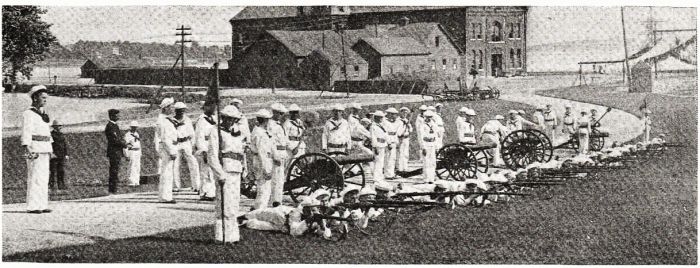
The last paragraph of this is what boys are usually required to read. The officers are not very strict about the hard words, and so almost any boy can pass the test. After being admitted, Uncle Sam gives each boy an outfit. His parents or guardian must sign a paper giving him to the government until he is twenty-one years of age. He becomes known at once as a third-grade apprentice, and in a few days he is sent to a training-school at Newport, where he is taught rudimentary things about a sailor's life and work. After remaining at Newport for six months he is transferred to one of two training-ships. These are the Essex and the Alliance. He remains on one of these for six months, and takes a cruise. On the voyage he learns how to handle the sails, how to sew and splice, and how to handle guns. Innumerable other things about a sailor's life he also picks up, and when he returns he is transferred to a modern man-o'-war, where he becomes an apprentice of the second class. Here he takes his place with the regular crew, and has his allotted share of the daily routine to perform. He is examined every three months, and usually he becomes an apprentice of the first class in six months, when he has a rank which corresponds to the rank of seaman with sailors.
When a boy becomes twenty-one he may leave the service, or enlist again, and be independent of parents or guardian. There are three grades of enlisted men in the navy—landsmen, ordinary seamen, and seamen. Besides these the following are enlisted: machinists, masters-at-arms, and coal-heavers, and from these classes there are other special classes. The boy who enlists after he has served his apprenticeship usually goes into the highest grade—that of seaman. After a while he may be promoted to be a warrant-officer, and so reach the highest grade.
When a man enters the navy he enters one of the three grades—landsman, ordinary seaman, or seaman. If he has had no experience whatever on shipboard he becomes a landsman, and practically is taught all he knows on shipboard. If he has had some experience on ships, but is not expert in all branches of his work, he becomes an ordinary seaman. If he has served five years at sea and is intelligent, he usually goes to the grade of seaman. Such men are competent to "reef, hand, and steer," as the expression goes; that is, they are competent to do all the work required of a sailor without further instruction. As fast as their terms expire men and boys may re-enlist, and at each re-enlistment they receive a slight increase of pay.
As third-class apprentices the boys get $9 per month; when they become second-class apprentices they get $15 a month, and when they become first-class apprentices they get $21 a month. If they re-enlist after they are twenty-one they get three months' extra pay at the rating they had when they became of age, and, in addition, get one dollar a month more pay than they received as apprentices.
There are other ways for men to get into the navy than those I have mentioned, but these are what might be called special enlistments. For example, a man may enlist as a fireman. There are two grades of these, according to skill and experience. Then there are machinists, who must pass an examination, and stewards, carpenters, musicians, and the like. These special grades require skilled labor to some extent, and of course higher pay goes with their work.
It is imperative when a boy enters the service that his parents or guardian shall sign papers giving him to the government until he is twenty-one. When a boy applies who has no parents or duly qualified guardian the officials supply him with a guardian. They do this through the generosity of a lawyer in New York, named Herbert Van Dyke. He becomes their guardian, and all such boys are known as "Van Dyke" boys—a discrimination which from the name should of itself be quite aristocratic. Mr. Van Dyke has become the guardian of probably 1500 boys since he has been in this kind of work. He does it entirely from motives of philanthropy, and there is no doubt that he is a public benefactor. Many a boy has been started in an honorable career in the navy through his kindness and generosity. He performs a most welcome service not only to the boys, but to his country as well. He does this so quietly that almost nothing is heard of him, and it is simply a matter of justice that credit should be given to him.
It is a mistake to think that there is room in the navy for "bad boys," that is, boys who are unmanageable at home or have done some crime. There is a popular idea that when a boy becomes utterly bad, and fit only for the reform school, his parents may get rid of him, and hope at the same time to make a man of him, by getting him into the navy. No such boys are taken if the officials know of it. The uniform of the United States is honorable, and only honorable persons are expected to wear it. No others are wanted. When the officials find out that a boy has a bad record morally, he is rejected forthwith. Even with the applicants who are fit morally to wear the uniform, only about one-quarter are taken, but no one is rejected so quickly as a boy who ought to go to a reform school rather than into the navy, even though he may be able to pass the mental and physical examination with ease. There is no law to prevent the enlistment of aliens in the United States navy, but it is a singular fact that so popular has this branch of the public service become in recent times that for the last two years practically none but Americans have entered it.
The truth of the old saying "that it is sweet to die for one's country" shows itself in the spirit which animates most of those who compose the navy of the United States to-day, whether they are officers or sailors. A notable instance of this was seen during the recent civil war in Brazil. The rebels at Rio Janeiro blockaded the port, and would not allow our merchant ships to go into the harbor. Admiral Benham, in command of our squadron, notified the ships of the rebels that he intended to take our merchant-men into the harbor, and that if they were interfered with he should fire on the rebel fleet. Our war-ships were cleared for action, and every man waited a single word before he plunged into a fight that must have meant death to many of them. One of the spectators of that scene has declared that he never saw a more inspiriting sight than the way our sailors, probably not a dozen of whom had ever had experience in war, responded to the call of duty. To a man they were ready to die for one's country if necessary. Surely, if it is sweet to die for one's country, it is honorable at all times to wear the uniform of that country, and that doubtless explains why our naval service is so popular nowadays, and is composed chiefly of native-born Americans.
In order to induce good men to return to the service, there is a law of Congress which gives to every man on re-enlisting three months' pay of the grade that he held at the time of his discharge, providing he enlists within three months from the date of his discharge. Then the regulations of the department, as another inducement for men, give a continuous-service certificate to all men receiving honorable discharges, which certificate entitles a man at every re-enlistment to one dollar's additional pay.