Charles Carleton Coffin's
Reading edition
FASCINATING HISTORICAL WORKS
ABRAHAM LINCOLN.
THE BOYS OF '76.
THE STORY OF LIBERTY.
OLD TIMES IN THE COLONIES.
BUILDING THE NATION.
A History of the Rebellion in Four Volumes:
DRUM-BEAT OF THE NATION.
MARCHING TO VICTORY.
REDEEMING THE REPUBLIC.
FREEDOM TRIUMPHANT.
Nine Volumes. Profusely Illustrated. Square 8vo, Cloth, Ornamental, $3.00 each.
Mr. Coffin avoids the formality of historical narrative, and presents his material in the shape of personal anecdotes, memorable incidents, and familiar illustrations. He reproduces events in a vivid, picturesque narrative.—N. Y. Tribune.
Mr. Coffin writes interestingly; he uses abundance of incident; his style is pictorial and animated; he takes a sound view of the inner factors of national development and progress; and his pages are plentifully sprinkled with illustrations.—Literary World, Boston.
Published by HARPER & BROTHERS, New York.
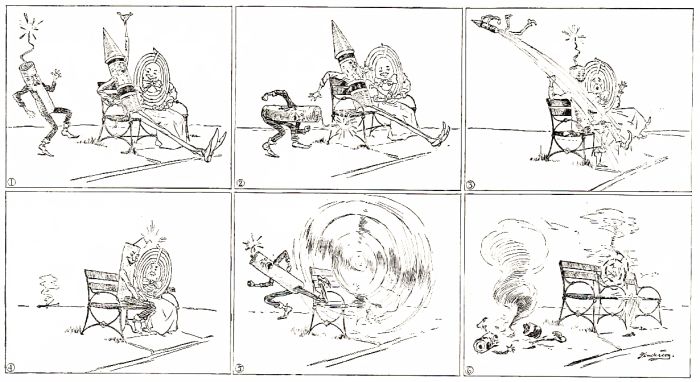
A FOURTH OF JULY TRAGEDY.
The Professor was crossing a small lake in Ireland. After admiring for some time the way his boatman, John, handled the oars, he thought he would like to try and row. John, nothing loath, surrendered the blades, and the Professor essayed the task of rowing. Things developed rapidly into a shower-bath as the oars splashed this way and that, and finally catching a crab, the learned gentleman landed with a crash in the bottom of the boat, very nearly upsetting it.
"Well, well," said the Professor, "rowing is quite a difficult thing, after all. Dear me, how my back aches!"
"Faith, yer know," said John, "it's all in the sculls."
The Professor is still pondering over what John said; whether he meant the oars or the heads of the oarsmen. The sly twinkle of John's eyes when he said it rather inclines him to believe the latter.
A PISCATORIAL OBSERVATION.
Tommy. "Isn't it funny, mamma, that these eels live in the wide, wide ocean?"
Mamma. "I don't think it's funny, Tommy."
Tommy. "Well, I do; I should think them built for narrow winding streams."
Patrick was lying in bed in a hospital. He had been brought in a few days before after a severe fall from the top story of a building on which he had been working. With all his suffering he never lost his cheerful spirits, and livened up many of the other patients with his bright remarks and short stories. The doctor happened along, and asked him how he felt.
"Fairly well, doctor; this right leg of moine is a very ungrateful spalpeen consitherin' that it wuz only broke in wan place whin it moight have been smashed in a dozen."
"How did you fall, Patrick?" I asked. "Did you lose your head?"
"Faith, no; sure it was me footin' oi lost."
"What time did it happen?"
"Well, oi wuzn't so sure before I fell, but I wuz thinkin' comin' down that it wuz near dinner hour, an' oi wuz convinced of that same as oi passed the second story, fer oi saw the people in there atin' dinner."
In the days of Emperor William the cadets in Berlin were obliged to adhere very closely to the rules of their respective academies. They were not allowed to go to entertainments at night without the escort of an elder relative. One evening, a cadet thinking he would escape observation, slipped into an entertainment, and taking a back seat quietly enjoyed the performance. He presently entered into conversation with his neighbor, a very pleasant gentleman. An academy officer passing spotted him, and the cadet, seeing that he had been observed, whispered to his new acquaintance, "Will you be my uncle?"
The gentleman, understanding the position of the cadet, smilingly agreed to be his uncle. Next morning the cadet was sternly called from the ranks.
"You broke the rules last night, sir."
"Yes, sir," replied the cadet; "but I was with my uncle."
"Hum! Well, your uncle last night happened to be the Crown Prince, and he wrote me this morning begging that you should be let off. Remember next time that your alliance with the royal family is a strict military one only."
THE REASON.
Willie. "I know why the Chinese send all their fire-crackers over here?"
Mamma. "Why, Willie?"
Willie. "Why, because they don't have any Fourth of July over there."
THE PIN-WHEEL.
I love to watch the pin-wheel go A-spinning round so free, To make its goldfish dive into The starry night's black sea.
A ticket-seller in a theatre once owned a parrot that was quick at learning to repeat the phrases he heard. Thus, among other things, he was soon able to exclaim, "One at a time, gentlemen! one at a time, please!" for this sentence was constantly in the mouth of his master. The ticket man went to the country for a summer vacation and took the educated parrot along with him. One day the bird got out of his cage and disappeared. His owner searched all about for him, and finally toward evening found him despoiled of half his feathers sitting far out on the limb of a tree, while a dozen crows were pecking at him whenever they could get a chance. And all this time the poor parrot, with his back humped up, was edging away and constantly exclaiming, "One at a time, gentlemen! one at a time, please!"