TYPICAL ENGLISH SCHOOLS.
Reading edition
BY JOHN CORBIN.
ETON.
Fifty years after William of Wykeham founded Winchester, King Henry the Sixth founded a school at Eton, a little town across the Thames from his great palace at Windsor. The rules he drew up for governing his "college" he copied from Wykeham; and in order to give it the best possible start, he took one-half the college at Winchester—the head master, five fellows, and thirty-five scholars—and settled them at Eton. For a hundred years or so Eton was a mere daughter of Winchester; but as centuries passed it took a different character. Its site, in the very shadow of Windsor Castle, naturally secured for it royal favor. George the Third and William the Fourth took a lively personal interest in its welfare; and in late years members of the royal family, the sons of the Duke of Connaught and the little Duke of Albany, grandchildren of Queen Victoria, have come to Eton to prepare for the university. To-day the school numbers over a thousand—twice as many as Winchester—and its graduates include far more men of birth or genius than those of any other public school. Just as Winchester raised the standard of scholarship at Oxford, so Eton has made Oxford the university of the English aristocracy.
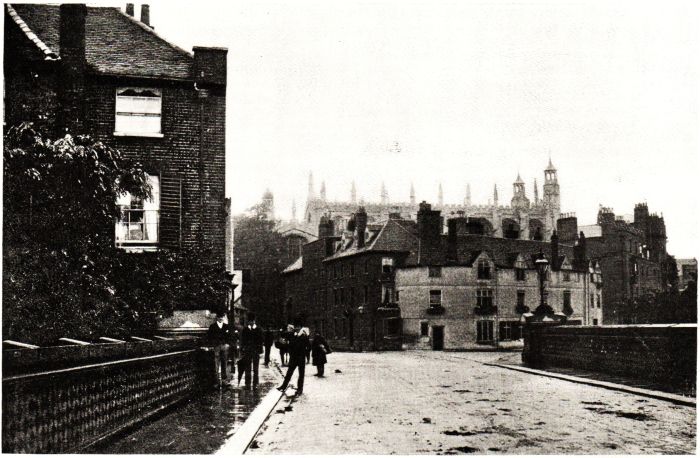
A GROUP OF "HOUSES," THE CHAPEL IN THE DISTANCE.
The most interesting part of the buildings are the school-rooms, which stand to-day almost precisely as they were built. It gives you a queer feeling to think how many boys and how many generations of boys have sat on those benches at Arma virumque cano, or trying to drum the hὁ, hἡ, τó into heads that are already overflowing with dreams of fresh breezes on the river, and of the sound of the cricket-ball on the playing-fields.
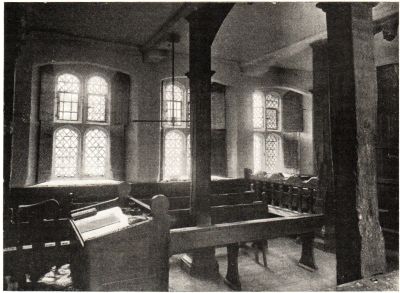
On the wood-work of the rooms you will find the names of the boys who have studied here. On this post you can read H. Wesley, which, Etonians will tell you, is the way Arthur Wellesley, Duke of Wellington, used to write his name. Pitt carved his name twice, in modest little italics. Charles James Fox sprawled his in bold capitals across a high rail of the panelled wainscot. And here is Shelley. Each letter is quite plainly, even boldly formed; and yet they all huddle together so nervously that they seem to shrink from being seen. As you look at them, you call to mind the courage and independence that made Shelley refuse to be fagged, and then his pitiful plight when the fag-masters got up "Shelley baits," and hunted him through the town;—you can almost see his pale cheeks and his lustrous eyes. Many of these famous names stand in a group of their school friends—a poet between a banker and a soldier, all boys together—and among these many another, perhaps the most popular of all the boys at school, of whom the world has never heard. Gladstone's name is as correct as an epitaph. And so it is an epitaph of the ancient custom of carving your own name, for since his time you have to pay ten shillings when you leave school, and have a carver do it for you. These carved names are still arranged in groups of friends; and sometimes you will find a boy's name where his father and grandfather placed theirs; but they are all as like as so many types in a font; not one of them tells you a syllable about what kind of a boy the owner was. It would be so much better to allow each boy a certain space, and let him carve his own name the day he leaves.
THE LOWER SCHOOL, WITH CARVINGS ON SHUTTERS AND POSTS.
Eton, like Winchester, has seventy scholars—"King's scholars," or "collagers," as they are called—who are chosen by competitive examination, and are supported by the funds of the foundation. Every year four or five of these are awarded scholarships at King's College, Cambridge, just as the best boys from Winchester go to New College, Oxford. The rest of the boys, as at Winchester, live under the care of masters in houses of about thirty-five boys each, scattered through the town, and are called "oppidans." The oppidans call the collagers "tugs," a word which probably refers to their togas—that is, gowns. Not many years ago the collagers were so poorly fed and housed, and so wretched generally, that the phrase was "beastly tugs"; but of late this class prejudice is dying out, and the fact that several of the collagers have been great athletes and good fellows all round has worked wonders. One still hears of "beastly tugs," and the prejudice against being supported by the college is not yet dead; but one finds it mostly among the younger boys, and even they do not feel it half so much as they pretend.
The government of the school is very like that at Winchester. The Captain of the College has much the same duties as the Prefect of Hall, and is aided by the other best scholars. The oppidans have also a Captain, but he is under the Captain of the College. Besides this, the houses have each a Captain, as the Winchester houses, have Prefects. Of course it does not always happen that the man who leads his house in scholarship is man enough to rule the rest; but if he is not, the leading athletes step in and take matters into their own hands.
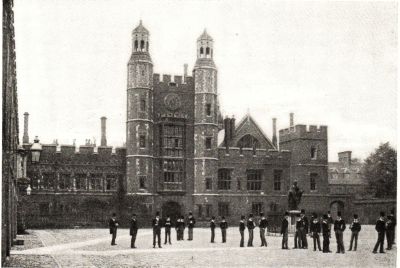
THE QUADRANGLE OF THE "COLLEGE."
The punishment masters give for small offences is pœnas—that is, lines of Latin or Greek to write out. In extreme cases the head master "swishes" a boy with a lot of birch twigs tied together. In time past swishing seems to have been about the only means of discipline, and the head master had a regular block for the purpose. One night a lot of old Etonians, who had been celebrating a cricket victory, broke into the room where the block was, and carried it off to London. There they hired rooms and founded an Eton Block Society, to which no one could belong who had not been swished on the block at school.
What Wykehamists call tunding, Etonians call smacking. The only difference is that instead of standing up, the culprit sometimes has to put his head under a table, while the Captain rushes across the room with uplifted rod. Etonians say that though smacking sometimes draws blood, the worst part of the punishment is the suspense of waiting between blows with your head under the table. The offences punished by smacking are disorder and disobedience in the house. On an average, the head master has only half a dozen boys or so to swish each term, and the average boy is not smacked more than a dozen times during his six years at Eton. Many people, of course, think bodily punishment very brutal, but I never knew a public-school boy or a master who did not approve of it as practised nowadays. In fact, you could hardly enlist the older boys on the side of law and order without giving them a means of discipline which the younger boys respect; and if you didn't do this, you would have to give up the best parts of the public schools.
The houses at Eton are clustered about the college, and look very comfortable with their broad, ivy-covered fronts, and window-boxes blazing with flowers. In the description of Winchester, there was so much to say about the college that I had no room to speak of the houses; but at Eton the houses are the more important part. Instead of large common sleeping-rooms, the boys have each a room of his own. These are not usually more than ten feet square, and besides a folding-bed, bath-tub, and wash-stand, they contain not only a fireplace, to cook meals, and a tea table, but also a study table and chair, and sometimes a bookcase and ottoman. You wouldn't think there was much space left for a boy to live in, to say nothing of making a racket, but there is. A favorite joke in some of the houses is to gather all the bath-tubs in a hall, and shove them through the transom into some poor fellow's room. This fills the room so full that the boy who owns it has to get the care-taker to drag out each separate bath-tub, amid vast sound and confusion, before he can go to bed. In the winter months the boys play football up and down the halls, using the doors at either end for goal. This also makes enough noise. But these are not the only diversions. In a number of rooms you will find collections of books far larger and more wisely selected than is usual on the shelves even of American university men.
A boy enters his house at about twelve years old. From this time on he is carefully watched by the house-master, with a view to checking his bad traits and developing his good ones. Most of the masters make it a point to find out all they can about a boy from his parents, and then carry on his training as it was begun; or if he thinks his training unwise, to correct it. The fact that most of the troublesome details of discipline are in the hands of the elder boys makes a master's relations with his pupils unusually frank and affectionate. And as the masters are always well educated, usually sensible, and often famous athletes, they have a strong and very admirable influence. Much of all this, of course, the boy never suspects. He simply grows to respect and like his master without quite knowing why.
A master's best means of bringing out a boy's character is to put him in the way of having the right sort of comrades. Sometimes the older boys—perhaps at the master's suggestion—invite new boys to breakfast, as second-year men at the university invite freshmen; but usually a boy becomes acquainted with his seniors by fagging for them. His severest duties as a fag are to cook breakfast and supper in his fag-master's room; but in many of the houses the boys eat their meals together, so the fags have a pretty easy time of it. In fact, altogether too much has been said about the tyranny and brutality of fagging. Most small boys are glad enough to be with the big boys, and a Senior who plays football or rows well might have as many youngsters to wait on him as he chose. Fag-masters are often the fags' best friends, and even at the universities afterward keep a kindly eye upon them. Sometimes it happens that a fag turns out a great cricketer or oarsman, in which case his old fag-master is as proud of him as of a younger brother. Like as not in after-life a country parson can look back upon the time when he fagged the bishop of his diocese. Like tunding or smacking, fagging is at bottom more humane than the neglect which a small boy suffers at an American school.
The boys are kept very much together in each house by their meals and the early hour of "lock-up"; while chapel, frequent school-hours, and "absences"—that is, roll-calls—keep them from spending much time away from the school. As a result the fellows in a house get to know each other thoroughly, and to stick together like brothers. Each house has its debating and literary society, its football and cricket teams, and its crew. Where there is so much loyalty to the house, it is only natural that rivalry among the houses should be keen. Ten times as many boys go into athletic contests as in America. Altogether a house is a miniature college, and a school a small university. Even if a boy didn't know a soul outside of his house, he need never become lonesome, and seldom homesick. This life in the houses is almost all the society boys have at most public schools.
Eton, however, is so large that it supports several school societies. The most important of these is the Eton Society, or "Pop," as it is generally called. When Pop was founded early in the present century, its aim was purely literary. Mr. Gladstone relates that in his time they used to elect now and then a solid athletic man, because they believed in encouraging sports. To-day Pop still holds debates; but it has grown almost exclusively athletic. One of the younger masters told me that as a boy he and a few others succeeded in electing a Captain of the College who, though a good fellow, was not an athlete; but that to do it they had to blackball everybody else till their man got in. Present members say that only good athletes are elected. The clever fellows have a society of their own, which is much what Pop was at first.
The members of Pop are mainly the cricketers who play against Winchester and Harrow, and the boating-men who row for and often win the Ladies' Plate at Henley. These together make, say, twenty, and eight more or so are chosen from the fellows who "get their colors" for playing the Eton games of football, which are so different from all other Rugby football that they can play them only among themselves. You must not think, however, that a man will get on Pop merely for being a great athlete. He must be a first-rate fellow besides, and as it happens, there are always a number of clever men and good scholars among the athletes in the society. In a word, Pop is the best society that can be made up from the athletic men, and is even more purely athletic than the Dickey at Harvard or Vincent's at Oxford.
The authority Pop exercises over the school, though so peculiar as to be difficult to describe, is enormous. It is as great, for instance, as that of the three Senior societies at Yale, and is shown in much the same way. Yet such revolts of public opinion as have occurred of late at Yale, for instance, during the discussion of the undergraduate rule, are unknown. It would be more just to compare Pop to the Yale Senior societies at their prime—that is, before the university began to outgrow them. The most obvious way in which Pop affects Eton life is, of course, in matters of school discipline. Such offences as do not come directly within the province of the Captains or the masters, Pop deals with in no faint-hearted manner. For instance, some years ago a boy who had gone with the Eton eleven to Winchester sent home bogus telegrams about the match, and kept the fellows swarming about the bulletin-boards at Eton in anxious suspense. Now there is nothing an English boy likes better than a hoax, but not about such serious subjects. When that youngster got back to Eton, Pop smacked him soundly—or, in the Eton phrase, he was "Pop-caned." On another occasion, when a number of boys had been expelled for a very serious offence which had been proved against them, one of them made an imposing exit in a drag at an hour when the street in front of the college was swarming with the boys. Being a popular fellow, he was loudly cheered. For this outbreak against the action of the masters, numbers of the elder boys were Pop-caned.
Such societies as Pop form almost the entire social life at most American schools and universities; but in England the members never lose loyalty for the college or house they belong to. This is the reason why at Eton Pop has such a strong and good influence over the rest of the school. In America, when a man gets into a leading society he is naturally and almost inevitably drawn away from his earlier and less fortunate friends, so that the school or university is split up into two parts—those who are in things and those who are not. Very often, too, as at Harvard, those who are in things are divided among themselves, so that there is no unity of spirit. Our societies will, of course, always exist; but their evil influence might be destroyed, and their good influence strengthened, by forming the school into houses as soon as the boys arrive, and the universities into something like colleges.
By this time you must have suspected that in spite of a lingering class prejudice against the tugs, the Eton spirit is really democratic. At Oxford and Cambridge Lord So-and-so may often find his way where plain So-and-so could not go; but English schoolboys refuse to give way to mere lords and earls. A tradesman once told me of the experience of the little Earl of Blank, who used to present his card when buying things. The other boys found it out, followed him from shop to shop, and booted him every time he did it. "All the same," said the tradesman, "it is awkward when a nobleman tells you his plain name, and you send the goods to Blank, Esq." As often as not one gets to know a fellow pretty well before finding out that he has a title. The little Princes of Connaught, and even the Duke of Albany, will boil their own kettles for tea, and perhaps even fag with the other boys. It was not only on the playing-fields of Eton that the battle of Waterloo was won. It was in the school-rooms and houses as well.