THE BROTHER OF STEFANOS.
Reading edition
BY G. B. BURGIN.
He was a lad of fifteen, sinewy, lithe as a greyhound, with dancing blue eyes and immensely strong shoulders. Under one arm he carried a long gun, a game-bag slung beneath the other; his legs were encased in yellow gaiters, and his slouch hat, with a peacock feather in the band, shaded bronzed resolute features. "Permit me to make known myselfs," he said, with an amiable smile, as he raised the slouch hat and disclosed a head crisped over with short dark curls. "I am Oscar Van Heidsteyn. And you are the good Smithsons of Constantinople, is it not so?"
I languidly admitted that I was "the good Smithsons," and looked with interest at the picturesque crowd on Smyrna Quay as my boat pulled back to the ship which had brought me from Constantinople. A brawny ruffian stood beside Oscar Van Heidsteyn with a whole arsenal of weapons stuck about his person. This was the kavasse. His mustachios protruded like the whiskers of a truculent tomcat; but I felt reassured on noticing that his pistols had flint-locks only, and were as harmless as pop-guns. I was just in the convalescent stage after a sharp attack of typhoid fever, and most of my thoughts were concentrated on getting something to eat. No one ever would recover from typhoid if he ate all he wanted to when beginning to reach the convalescent stage. In all the sixteen years of my life I had never before lived in such a chronic state of starvation.
Van Heidsteyn saw that I was very weak. At a sign from him, the kavasse slowly unslung most of his ponderous weapons, picked me up in his arms, and carried me, feebly kicking and expostulating, to the carriage.
"What the dickens is he treating me like a baby for?" I asked.
Van Heidsteyn wrapped the rug round me. "Oh, because you are one little babies!" he said. "You must make yourselfs to shut ups, or you will be ill again. Now here is the train. I will carry you into it like leap-frogs if you prefer it."
I submitted to the indignity of being carried "like leap-frogs" into the ramshackle train. Three-quarters of an hour after the proper time, to a chorus of "Inshallahs" and "Mashallahs," we crawled out of the station into the beautiful country, still fresh with spring verdure.
"Ah, that is betters!" said Van Heidsteyn, with a long breath of enjoyment. "I cannot live in the town."
"Where did you learn your English?" I asked.
Van Heidsteyn was busily engaged in opening a parcel of chicken sandwiches, and the odor thereof was as manna in my hungry nostrils. At a sign from him, the kavasse again picked me up, whilst Van Heidsteyn spread a rug on the seat of the carriage, and turned that gorgeous functionary's silk jacket into a soft pillow for my weary head. "Now you will feeds," said Van Heidsteyn, energetically. "Never mind my English languages. I have read it in books; and don't gobbles. When you have eaten, you shall have some wine and waters."
"You're awfully good," I said, shamefacedly. "I can't help being hungry all the time. Perhaps your father didn't know how hungry I should be when he wrote to my father asking him to let me come here to get well."
Oscar laughed. "Ah, that is betters! Now you enclose yourselfs—shut ups," he added, explanatorily, "and I will make you comfortables."
For two hours and a half we dawdled along in an aimless leisurely sort of way, which would have been infinitely exasperating to a man in a hurry. But I was not in a hurry. Every now and again I had a short nap, then another sandwich, and then a glance at the fertile valleys, not yet parched by the heat. As we got nearer the station for Oscar Van Heidsteyn's father's farm, I noticed the lad look to his pistols, see that his knife moved easily in its sheath, and glance carefully out of the carriage window.
"We will wait, my friends," he said, as the people began to stream out of the carriages and to thank the station-master for such a prosperous journey. (We were only two hours late; but that was partly owing to a great man having planted his mounted servant on the line, and told him to stop there until it suited the great man's convenience to follow. No one dare run over the servant of a Turkish official, and so, by this simple expedient, the Pasha caught his train without hurrying.)
"But why wait? And why are we in the last carriage?"
Oscar smiled. "Oh, I will tell you by-and-bys. Suppose there was a man waiting in the station to stab or shoot you, wouldn't you stop here till all the peoples had gone?"
"Of course."
"Very well, then. The station-master will come to make his salaam; then I shall know it is all rights."
"But what is 'all rights'?"
"Ah-h! Brigand-d-d!" Oscar's rifle was at his shoulder as he leaped from the carriage. "There is the brother of Stefanos behind the engine-sheds. Tomasso, take care of the Effendi, and I will make the brother of Stefanos 'gits.'"
He ran nimbly towards the engine-shed, but the man loitering there did not wait for his coming. By the time Oscar reached the sheds the fellow was half-way up the opposite hill. Then he stopped, flung up his long gun, and took a deliberate shot at the lad. The peacock feather in Van Heidsteyn's hat was cut in two, and the lad himself lay sprawling on the ground.
Faint with horror and weakness, I tottered up against the kavasse, who caught me in his arms with a paternal smile. When I opened my eyes, Oscar was joyously regarding me.
"I have hit him in the shoulders," he said, modestly. "If I had not let him fire first, for old friendship's sake, I should have killed him."
"Fire? Kill who? What does it all mean?"
"Oh, it is the brother of Stefanos, and he has sworn to kill me, because the Greek priest did kill his brother Stefanos, and he thinks I helped. Now we will hold you on the white pony, and you shall ride him like one Cyclops."
Van Heidsteyn presumably meant a centaur, but I was too tired to argue the point. He leaped into the saddle, and, with the aid of the kavasse, hauled me up behind him. A stout strap was passed round our waists and the ends securely buckled together. Oscar had already reloaded his rifle. A nondescript animal, which he informed me was a splendid hound for wild-boar (it did not look it), ran sniffing ahead on the right-hand side of the track; and Tomasso, the kavasse, ancient matchlock in hand, went off in advance on the left.
"W-what's all this for?" I gasped.
Oscar steadily started the old pony. "I make myselfs to sit in fronts," he cheerfully explained. "If the brother of Stefanos has one pot shots at me the bullet will not go through us both, and you will be all rights. Courage, mon ami! It is only two miles to my father's, and when we get there you shall have ever so much more to eats."
It seemed to me that if the brother of Stefanos, whoever that mysterious and bloodthirsty individual might be, succeeded in carrying out his murderous intentions, there would not be any necessity for me to "have ever so much more to eats." However, I was too weak to do anything except to lean limply over Van Heidsteyn's shoulder as we splashed through a brook and descended into the plain below.
"There are not many trees," said Van Heidsteyn, reassuringly. "We shall soon get to my father's tchiftlik all right. Then I will tell you all about the brother of Stefanos."
I was too tired and done up to remember much about the rest of the journey. The brother of Stefanos might have shot us a dozen times without disturbing me. The smooth pace of the pony gave a rhythmical swing to my body, and I fell into a state of dreamy indifference, from which I was roused by the animal suddenly coming to a stop. When I looked up we were in a great yard filled with cows and excited dogs, one of which was endeavoring to hang on to my leg.
Tomasso, driving away the dog, gently unbuckled the belt, and lifted me off the pony in his great brawny arms. He said something musical to me in Greek, with the cooing softness of a dove, and I felt that his exterior had belied him. So mild and gentle mannered a man had doubtless been endowed by nature with his fierce mustachios as a means of protection. I was not surprised, when bedtime came, to find Tomasso hovering round me with a sponge and hot water. He even undressed and carried me to bed as easily as if I had been a child. Then he benevolently tucked me up, put some biscuits in a dish by the side of the bed, and recited a prayer to keep off the evil eye, moving about the room the while, in spite of his huge bulk, as noiselessly as a cat. Whenever I woke in the night, there was Tomasso sitting by the wood fire, watching me with friendly solicitude.
"Oh yes, Tomasso is one very good old womans," said Van Heidsteyn, the next afternoon, as we sat sipping our coffee in the quaint old garden attached to his father's house. "His people have been with us for so long times I cannot count. He has asked for a holiday to-day, and borrowed my gun. Perhaps he is going to make you a present of one wild-boar. He calls you the 'Little Yellow One,' because of your hair."
As we sat, sheltered from the heat of the sun by the branches of a big plane-tree, the pure air put new life into my veins. At the back of the house was a long range of hills, the haunt of the wild-boar.
"Isn't that range rather handy for sheltering brigands?" I asked Van Heidsteyn.
He laughed. "Oh yes, but it is all the betters. Now, Little Yellow One, before you go to sleep I will tell you about Stefanos. I expect to hear from his brother soons, very soons."
"My father told me you had been captured by brigands and behaved very pluckily," I said, leaning drowsily back and gazing up through the spreading branches of the plane, the gorgeously hued anemones in the garden beds dancing joyously as my glance returned to earth.
Oscar lit another cigarette and stretched his sinewy arms. "Oh, it was nothings," he said, modestly. "I am fat now, nice and ploomps, but when I have come back from the brigands, ah! I was of shadows, so thin—like grey-hounds or Greek pigs."
He leisurely produced a photograph from his breast pocket. On a deal table were piled the heads of several men in a ghastly heap.
"But I shall better begin at the begins," he said, quietly.
"Put that thing out of my sight immediately. Do you want to give me a fit?" I shouted. "You are ruining the remains of my nervous system."
"Ah, but then I cannot explains," said Oscar. "You see, I was in the entrails of the steam-ploughs, and somethings tickles me. When I come out of the bowels of the ploughs there was Stefanos the brigand, and his brother, and his uncles, and three nephews, and some friends. (Stefanos always went about en famille.) 'Ohé, my little mans,' said Stefanos, 'you must come with me for some ransoms.' I did not want to go for some ransoms. I have the steam-ploughs to put rights. I said to Stefanos, 'Go away, you and your ransoms—pezziwinkbashi (it is a very strong Turkish words)! but he would not go away. He puts a pistol to my ear, and so did the rest. 'Oh yes, you will comes, my little mans.' And so," ingenuously added Oscar, "I comes."
"And then?"
"The villagers come round with some screams. Stefanos (he was such a nice mans, Stefanos. That is Stefanos, with the hole in his fronts," and he pointed to the photograph) "puts his gun to the backs of my necks. 'Tell the villagers to go away.' I tell them to go away. When you have guns down the smalls of your backs you are very anxious to do what you are said," continued Oscar. "They shakes their fists at the brigands, but I am marched off to the mountains, and we are soon great friends."
"Friends?"
"Yes, friends! If some ransoms not come they threaten to send my father small bits of me to make him not forgets. First my ears and my fingers and my toes; and then, if no ransoms, my trunks."
"You don't mean portmanteaus?" I interrupted. "Do you mean to say they'd cut off your limbs and send your body home?"
"Yes, of course," said Oscar. "I mean my trunks—my chests, my bellies. We wander about all night and steal sheeps for food. In the daytime we sleeps or sing Greek songs, and I dance on a big stone till they call me their brother."
"Did you never—eh—wash?" I asked.
Oscar mournfully shook his head. "What for? It was no goods."
I shuddered, but thought it well not to ask for further details.
"One day I did write a letter to my father," said Oscar. "Stefanos was a little angry; for the soldiers come after us, and he has much exercise with me in the mountains. 'My dear father,' I write, 'send me one big Bibles and seventeen pairs of leather trousers. The Bibles is for my soul; one trousers is for my body; and the others two each for my friends. If some ransoms do not come in one weeks I shall be all in little pieces. Take care of my dogs, and do not blame Stefanos, for it is all businesses.' And the trousers and the Bibles and some ransoms comes all in one heap. Stefanos embraces me; I kiss all the others; they take me to the plains, and I find myself running homes. Then one old woman sees me far off. She screams. Another old woman sees me. She screams. Another old woman sees me. She screams. Whilst I did run home the air was full of old womans and screams," continued Oscar, meditatively. "And when I get to the ford, the old womans they all kiss me. That was very painfuls; I do not like to kiss old womans. The old womans takes me by the legs and the arms and the trunks to carry me over the ford and up the hill, and whenever I tried to get downs they did kiss me, so I did not try much more. Oh, it was very terribles, and I had never so much before been kissed by anybodies. They take me home, and my father comes to the door and he say, 'Welcome, my sons, which is some more alives.' And more old womans kiss me, and I embrace my father, and they asked me where the soldiers could find Stefanos and his brother and his uncles and his nephews, but I would not tells."
"Why?"
"He was my friends," said Oscar, indignantly. "That is why. It was all businesses, like some other businesses. Ah, those soldiers! Cowards! Assassins!"
"What did they do?"
"Oh, it was very painfuls," said Oscar, with regretful melancholy. "Very painfuls!"
"What was?"
"It was very painfuls. For three months the soldiers did hunt poor Stefanos and his brother, and killed all the others. One day I was sitting on a divan after shooting boars, and the Greek priest of the village and his friends came in with the head of Stefanos in a bundle. The brother of Stefanos had escaped. The Greek priest wore a purple robe, which was some presents from the Governor of Smyrna."
"Well?"
"Oh, there is nothing more. They all sit round the floor, and I say, 'Who is this?' The Greek priest, he say: 'Effendi, I am a great man, a very great man. I killed Stefanos.'
"They say: 'This is a great man, a very great man. He killed Stefanos.'
"The Greek priest say: 'I went up the hill in the heat of the sun, and Stefanos sleeps himself in the vineyard. I took my gun, my very great gun, and crept close to Stefanos.'
"They say, 'He took his gun, his very great gun, and crept close to Stefanos.'
"'I put the muzzle to his ear, but he did not wake.'
"They say, 'He put the muzzle to his ear, but he did not wake.'
"'I shut my eyes and pull the triggers, for I am a great man, a very brave man.'
"They say, 'He shut his eyes and pulled the triggers, for he is a great, a very great man.'
"And that was the end of poor Stefanos. I did give the Greek priest some kicks," said Oscar, reminiscently. "Oh yes, many kicks, but they did not bring back poor Stefanos."
As Van Heidsteyn kicked an imaginary Greek priest, two shots rang out almost simultaneously, and a bullet buried itself harmlessly in the trunk of the tree.
"Sit still," said Van Heidsteyn, with a nonchalance I was far from feeling. "Sit still, unless you are afraid, O Little Yellow One. Tomasso will be here directly."
PRESENTLY TOMASSO APPEARED CARRYING A BUNDLE IN A HANDKERCHIEF.
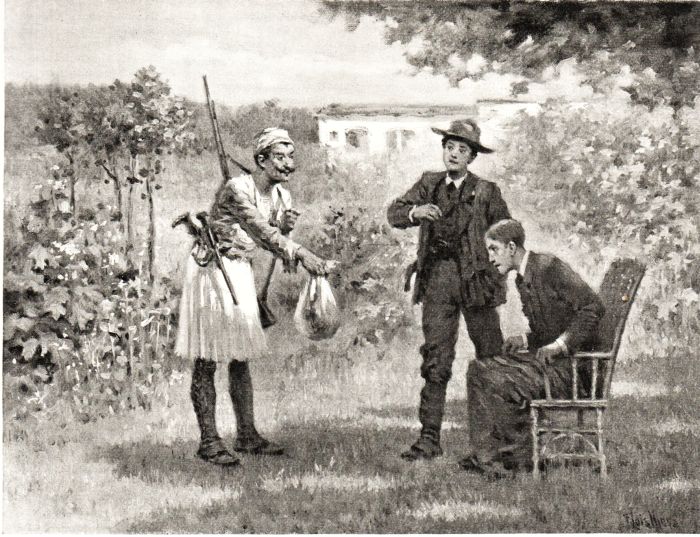
Presently Tomasso appeared from the shelter of some out-buildings, carrying a bundle in a handkerchief. The handkerchief was carelessly tied up at the corners, and held something round. Tomasso came up to Van Heidsteyn, made the customary salutation, and with his usual placid smile, laid the bundle on the ground before us.
"Open the bundles, Little Yellow One," said Van Heidsteyn.
I did so, and out rolled the bleeding head of a man.
"Now we can go without any more pot shots. I will make a photographs of him to put with the others. It is the brother of Stefanos," said Van Heidsteyn, complacently rolling a cigarette.