HARPER & BROTHERS'
Reading edition
Descriptive list of their publications, with portraits of authors, will be sent by mail to any address on receipt of ten cents.
HARPER & BROTHERS, Publishers, New York.

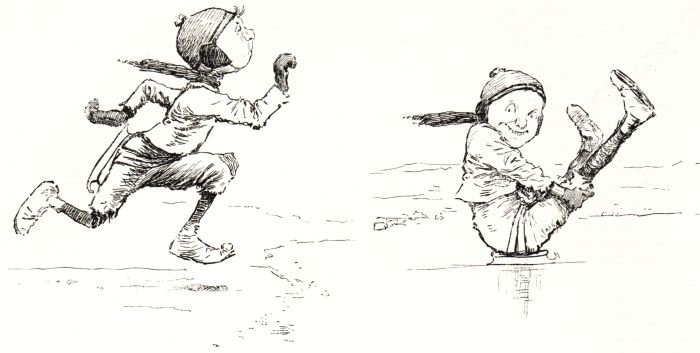
HOW TOMMY MADE ONE SKATE DO.
A SURPRISE FOR EMPEROR WILLIAM.
Before the many independent states of Germany were united into an empire by Bismarck and Emperor William I., the Bavarians and the Prussians were on terms of a none too solid friendship. The old feeling of rivalry has not been entirely eradicated from the lower classes, as may be gathered from the following anecdote which is authentic, the incident occurring only a few weeks ago. The Emperor had just been reviewing a body of naval recruits brought together from all parts of the Empire, and he had addressed them briefly upon the glory of a naval career, and had warned them against the enemies of the nation both at home and abroad. At the close of his speech the young Prussian Emperor was attracted by the stalwart appearance of a big bluejacket in the front rank. He called the man to him and asked him what part of the Empire he came from.
"From Wiesbach, in Bavaria, your Majesty," replied the recruit, saluting.
"And did you understand all I have said," continued the Emperor. "Do you know whom I mean when I speak of our foreign enemies?"
"Yes, your Majesty. The Russians."
"And do you know whom I refer to by our enemies at home?" continued the Emperor, referring, of course, to the socialists and other disturbing elements of the Empire.
"Yes, your Majesty," replied the Bavarian, promptly. "You mean the Prussians!"
A SMALL BOY'S AMBITION.
I want to be a newspaper-boy, And just as soon, sir, as I can, For when I'm grown up 'tis my wish To be a big newspaper-man.
EXTREME POLITENESS.
Politeness is of course one of the most desirable qualities in a man or a woman, and particularly in boys or girls. The following story may teach us something even if we do not necessarily believe it to be true. It appears that in Japan not long ago three men broke into a dyer's house while he was away. They were surprised at their work by the dyer's wife, who asked them what they wanted. One of them replied by gently asking the wife how much money there was in the place. She answered that there was just a little in the house. The robber laughed and said:
"You are a good old woman, and we believe you. If you were poor, we would not rob you at all. Now we only want some money and this," placing his hand on a fine silk dress.
The old woman replied: "All my husband's money I can give to you, but I beg you will not take that dress, for it does not belong to my husband, and was confided to us only for dyeing. What is ours I can give, but I cannot give what belongs to another."
"That is quite right; we certainly have no wish to deprive you of what does not belong to you. Be so good as to give us the money, and we will go," said the robber. The old lady having complied, he immediately withdrew with his confederates.
Mr. John Bull (of England). "Why do the boys talk so hexcited?"
Mrs. Bull. "They're at sixes an' sevens over some happles they 'ave."
Mr. Bull. "Hat sixes an' sevens! They'll soon be at hates if they keep hon."
It is not to be supposed that the missionary's lot is always the happiest in the world, but there are times when there are incidents in it so full of humor as to make up for the troubles and trials which are more common. Among the stories in illustration of this point is one that comes from a recent British Consul to Samoa, who states that a missionary there was one day visited by a gentle-looking youth, who asked, "Please, sir, may I get married?" A day was appointed for the ceremony, when, at the time named, appeared the youthful bridegroom, looking neat, shy, and guileless; he was asked to take a seat and did so, blushing vigorously. A quarter of an hour elapsed, and there were no fresh arrivals; yet there sat the young man without the slightest show of that anxiety usually attributed to gentlemen about to take the fatal plunge. At last the missionary became impatient, and asked him where the young woman was.
"Who?" said the youth.
"Why, the girl you want to marry!"
"Oh, she's at Safata!"
"What!" cried the minister. "Have you come here for me to marry you to a woman sixteen miles off on the other side of the island?"
"Yes," replied the innocent; "I didn't think you would want her!"
He was sent away to fetch her, and in the course of a week returned to go through the marriage ceremony in due form.