THE EVOLUTION OF ELECTRICAL ENGINEERING.
Reading edition
BY HERBERT LAWS WEBB.
Electrical engineering began with the telegraph, some sixty years ago. The road for the telegraph was paved by many great experimenters and discoverers. Under their patient and fostering care the infant showed its first teeth, so to speak.
In 1837, when Queen Victoria was just beginning her long reign, the telegraph began to do practical work. Cooke and Wheatstone started a system in London, with instruments having five little needles bobbing about, by which the signals were read. Five wires had to be strung between the two stations, but the system was soon improved so that only one was required. This telegraph very early in its life received a splendid advertisement by causing the arrest of a murderer, who otherwise might have escaped. He was travelling to London after his crime, and expected to lose himself among the crowds of the city. But it so happened that a trial of the telegraph was being made along the very line of railway. His description was telegraphed to London, and he stepped from the train into the arms of the police.
At the same time that Cooke and Wheatstone were working in England, Morse was hard at work in America. His system was very complete and practical, and, once he was able to give it a fair trial in public, it was received with great enthusiasm in this country and all over the world. The instrument that makes the furious rattling you hear in the halls of all the hotels is Morse's instrument.
Morse's first public trial was made in 1844—fifty-three years ago. After that telegraph lines were built up very quickly in all parts of the world. Many clever men took up the work, and invented methods and devices for improving the systems, and to-day the extent of the telegraph lines of the world and the amount of work done are simply stupendous. To give just two examples: In the early years of the telegraph the lines were quite short, and only a few words could be signalled in a minute. To-day a line is building from Cairo to Cape Town, the clear length of the African continent, and there are in daily use automatic instruments which send long press messages at the rate of 450 words a minute. In sending by hand forty words a minute is quite a common speed.
As soon as land telegraphs were fairly started men said, why not lay wires under the sea? Why not? So in 1850 they laid a wire under the English Channel, from Dover to Calais. It was a very short-lived line, because the day after it was laid a French fisherman picked it up with his anchor, and knowing nothing about telegraphs, and caring less, cut it in two to clear his miserable anchor. The next year they laid a strong cable, sheathed with iron wires, proof against fishermen's knives. That worked splendidly, and they say that parts of that same cable are still working under the Channel. Of course it has been often repaired and pieced out with new, but it shows what sturdy offspring an infant can have when a submarine wire forty-five years old still does service.
After that submarine cables were laid down between various countries. Some of them were costly failures, because, although the men who had taken the infant in charge had learned a great deal about its little ways, they had not learned all the refinements necessary to success in laying and working deep-sea ocean cables. So, in 1857, when Cyrus Field formed his Atlantic Telegraph Company, the cable that he and his plucky companions laid under the Atlantic failed completely of its object. But Field and some of those with him simply would not accept defeat. So they spent more money, laid more cables, failed again, toiled and moiled and worked like beavers for years, until at last in 1866 they finished a cable from Ireland to Nova Scotia that worked like a charm. It was, without exception, the greatest piece of work ever done in electricity, and its history is one of the finest of the many tales of engineering enterprise.
To-day there are about a dozen cables between North America and Europe, and three between South America and Europe. There are cables in every sea and ocean in the world, and across every ocean except the Pacific. In all there are more than 150,000 miles of submarine cable under the waters of the globe, and there is a fleet of forty ships, large and small, fitted out solely for the purpose of laying and repairing submarine cables. Nowadays the laying of an Atlantic cable attracts no attention, and the fishing up of a slender rope less than an inch thick from the floor of the ocean, 12,000 or 15,000 feet down, is a thing done a dozen times a year. In Cyrus Field's time the Atlantic cable was the topic of the world for years, and the recovery of the broken cable was for a long time impossible, because no machinery then made could stand the strain.
In 1866 a telegram from New York to London took hours on the way. For many years past the merchants of the two cities have been in the habit of grumbling vigorously if they don't get replies to their messages within half an hour of despatching. The result of the Derby is known in New York before the winning horse has slacked his pace after passing the judge's box, and it is all over the world before the proud owner has had time to lead him back into the paddock. A cable message goes round the world in an hour or so, and the sun gets so rattled that people hear of events that happened to-morrow.
No sooner had the world got fairly settled down to submarine telegraphy than the dynamo came along. Up to that time electricity had always been procured from chemical batteries. To obtain it mechanically by moving a coil of wire in front of a magnet was a great step in advance. The infant was now striding along lustily. Batteries are expensive, inconvenient, and of very small power. Once get electricity from a machine, and there is no limit to the amount to be got. The arc-light had been produced by means of joining many hundreds of batteries together, but that was a brilliant experiment—there was nothing practical or commercial about it. But with an electric machine it was different, and once the machine was in existence the electric light was something to think about.
AN ELECTRIC LIGHTING PLANT.
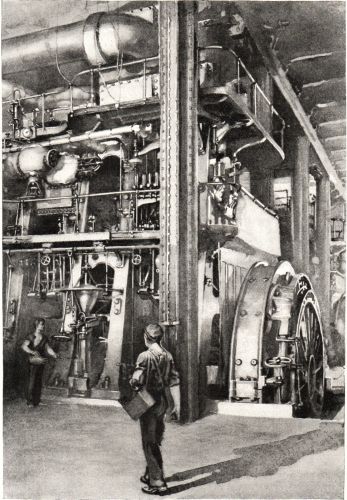
The evolution of the electric motor followed, as a natural thing, from the evolution of the dynamo, for a motor is simply a dynamo reversed. In the dynamo you revolve the armature—as the coils that move between the magnets are called—and the machine gives out current. In the motor you feed current into the armature, and it revolves and gives out mechanical power. There is a very pretty story to the effect that this action was discovered quite by chance. In some accidental way the wires leading from a dynamo at work were connected to another dynamo, and this second one at once began to turn merrily round, as if by magic. However this may be, the dynamo had been in existence for some time before any practical work was done in sending power from place to place along a slender wire. The electric motor, as a commercial machine, is barely ten years old. Yet now its busy cheerful hum may be heard under thousands of street cars in hundreds of towns. It is used to work all sorts of machinery, from the sewing-machine and the dentist's drill (beastly thing!) to heavy factory machines of all kinds. Ten years ago the electric motor was in its swaddling-clothes, and was never placed out of sight of its nurse, the dynamo. Nowadays electrical engineers think nothing of building motors of several hundreds of horse-power, and of placing them many miles from the dynamos that supply them with current. In this way a factory may be run by the power of a waterfall ever so many miles distant. The waterfall drives the dynamo, the dynamo sends its current along wires carried on poles up hill and down dale until they reach the motor, and the motor drives the machinery of the mill. At Niagara Falls work of this kind will be done on a very large scale, and many places round about will be supplied with light and power from the huge dynamos that are to be placed there.
Perhaps the most beautiful and intelligent of this wonderful family of "infants" was born eighteen years ago—the telephone. Even when it was the tiniest kind of an infant, and many men, some of them quite clever in other lines than prophesying, thought it would never be more than a puny little creature—a sort of scientific freak—the telephone was the most wonderful thing of the century. It did something absolutely new. It took your voice, made an electric current of it, and turned it out at the other end voice again, with all the little quivers and tones that each voice has of its own. The telephone, more than any other electrical invention, made people think that anything is possible with electricity. It was such a marvellous performance to send the voice along a wire from one end of a city to another, that when people became a little familiar with it they were prepared for anything. A famous electrician once raised a laugh at a dinner by relating in his speech that when a friend had asked him over the telephone if he recognized his voice, he replied, "Yes, and I can smell your cigar." But you would not be surprised if you learned to-morrow that you could see the man at the other end of the wire, or smell his cigar by electricity, or that a line of flying ships between New York and London was to start skimming next week.
But it was some little time before people got familiar with the telephone. At first they did not believe in it, though now they will believe in anything called electrical. For some time there were few telephones in use, and the lines were very short. Then the exchange system was started, and telephony began to grow with leaps and bounds. In 1874 the telephone, as the saying goes, "was not born nor thought of" outside of the laboratory of Professor Bell. In 1894, there were 250,000 telephone subscribers in the United States. New York and Chicago each has 10,000. The number of conversations carried on each day by means of the telephone—well, you might almost as well try to count the grains of sand on the sea-shore. Not only has this infant learned to talk a great deal—and, surprising to say, it speaks all languages with equal ease, even the hopelessly difficult ones—but it has got amazing lung power. Its voice reaches in a moment farther than you can travel in a day. When young, it whispered a distance of a mile or two. At six or eight years of age it talked clearly with a couple of hundred miles between speaker and listener. For three years or more people in Boston and New York have talked with people in Chicago, and to-day they think nothing of that, and want to talk to San Francisco.

The reform in interscholastic athletics in the middle West seems to be going forward most satisfactorily. We hear fewer complaints of semi-professionalism among the school teams, and most of these have no foundation in fact. It seems clear now that most of the breaches of amateur spirit that we have had to record heretofore were largely the result of a lack of knowledge and appreciation of the strictness of the rules which have to govern amateur sport, rather than of a desire to defeat the ends and purposes of these regulations.
MADISON, WISCONSIN, HIGH-SCHOOL FOOTBALL TEAM.
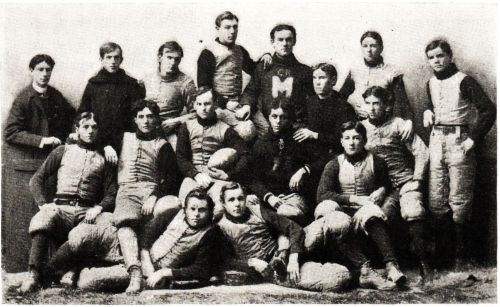
As has been chronicled in this Department, Madison High-School at one time allowed two players on its football team to take courses at the university while still attending school. The fact that they attended the university at all should have disqualified these men; but the Madisonians did not interpret the rules in that way. Now, however, they have come to see that this sort of thing involves a principle, and that it cannot be allowed.
The past season, therefore, so far as I am able to find out, the Madison High-School team has been made up strictly of students of the school, and the players have taken up football for the sport of the game, rather than for the sake of the empty honor of a championship. This "championship" business is getting to be very much overestimated and exaggerated, and may eventually do much harm to sport; but this is another subject, and we shall have to come back to that at another time.
The Madison High-School team had a uniformly successful season this fall, although, because of its reputed strength on the gridiron, its managers found some difficulty in securing games with other high-school teams. The Madisonians were therefore compelled to arrange a number of games with elevens which might not ordinarily be considered in their class. For the second time they defeated the St. John's Military Academy team, the only eleven which has ever defeated Madison H.-S.,—barring the university team.
The strongest opponents they met were the Minneapolis H.-S. eleven. Five days after this hard game they played a team which came up from Chicago, representing the Hyde Park High-School, but I have never been able to find out what percentage of the members of this eleven ever saw the inside of a Hyde Park school-room. The managers and players of the team were not above practising deception either, for some of their men played against Madison under assumed names.
The Madison newspapers, it seems, had some fault to find with the method of play indulged in by the Chicagoans, and accused several of them of slugging. Full-back Trude was one of the men who received a raking over the coals. A few days later, however, the manager of the Madison High-School team received a letter from Mr. Trude, saying that the charges made against him were totally false, for the very simple reason that he was not in Madison on Thanksgiving day. Who the young man was who masqueraded as Trude and played full-back for the Hyde Park team I do not know.
This incident goes to show what serious results may come from what young men at first consider as merely innocent deception—if any deception may be considered as innocent. Many parents of Chicago school football-players objected this year to the game, and signified their unwillingness to have their sons take part in it. A number of these boys, however, disregarded these wishes, and played football under assumed names. In fact, it got to be quite a joke among Chicago high-schools that a number of boys had two names—their real name, and their "football" name. Of course, a few months of this sort of business hardened the unscrupulous players, and was no doubt indirectly responsible for the deception practised by Hyde Park upon Madison High-School.
Four of the members of the successful Madison High-School team graduate this year, but a good nucleus is left to start in with next fall. The average weight of the eleven was 143 pounds, and the average age, I am told, was 16½ years. This seems very young to us in the East, where boys remain at school until they are considerably older, or, perhaps, do not get to school until they are more advanced in age. With teams averaging between sixteen and seventeen years there is no necessity for an age-limit rule, apparently; whereas in Boston and New York there is always an altercation when the age standard has to be decided, a strong faction regularly demanding that men of twenty-one shall be admitted to school athletics.
My opinion is, and always has been, that no one twenty-one years of age has any business being at school, unless he is extraordinarily stupid, or unless illness or a weak constitution has made it impossible for him to keep up with his studies. In either case such boys had better keep out of athletics, except for necessary light exercise, and devote all of their time to learning enough to get out of school with credit. All this is aside, and I find that I am again wandering far from the Madison High-School.
The Madisonians, to take the subject up again, did not meet any team this fall which was not considerably heavier than their own, and it is plain therefore that their victories were largely due to their team-work, and, doubtless, to the agility of their ends and the swiftness of their backs. Their eleven scored during the season 135 points to their opponents' 46.
GRAND RAPIDS, MICHIGAN, HIGH-SCHOOL FOOTBALL TEAM.
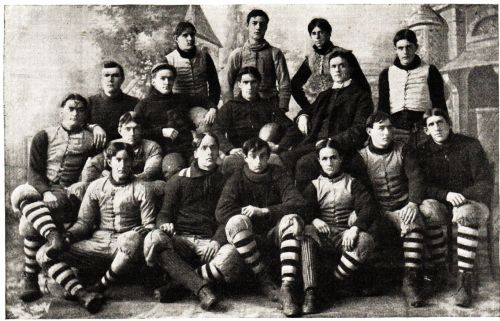
The interest in football in Michigan has increased greatly of recent years, and this fall, out of five hundred boys attending the Grand Rapids High-School (many of these, of course, far too young to be allowed to play the game), fifty-two were candidates for positions on the football team. As finally selected, the average weight of the eleven was 149 pounds. Of nine games played eight were victories for the High-School, the one defeat being administered by the University of Michigan eleven.
The Detroit High-School team was likewise a strong one but, as it did not meet the Grand Rapids H.-S. eleven, the question of State superiority is left undecided. I hope that the lads of both schools will come to see that this is a matter of very small moment, so long as they have derived benefit from their sport; but unfortunately we have to face the condition that unless one aggregation can write "championship" all over its record, there is dissatisfaction in every camp.
BANGOR, MAINE, HIGH-SCHOOL FOOTBALL TEAM.
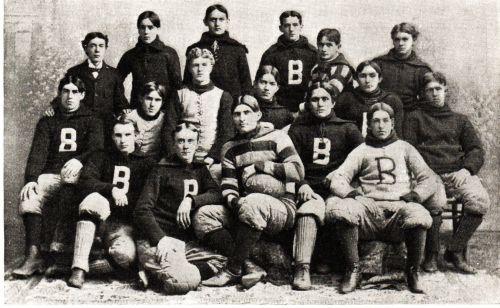
The football season in Maine has closed in a muddle, the schedule of the Interscholastic Association not having been properly played out, and two or three schools are now lifting up their voices to claim that they are the best the State ever produced. It seems to be largely a case of a fear of defeat on the part of somebody, and a great lack of that spirit which should prompt the young men to go out on the field and play for the sake of playing, and not for the sake of winning the game.
Among the Hudson River teams which played good football this season was that of the Mohegan Lake School. They closed the season with a record of four victories and one defeat—losing to Riverview Academy, Poughkeepsie. The success of the eleven was largely due to the good work of Captain Kendall, who coached and looked after the eleven without the assistance of more experienced advisers. The Mohegan team had a very effective system of offence, but they were not strong in defensive work, doubtless because their second eleven was too weak to afford them hard enough practice.
BROOKLYN LATIN SCHOOL FOOTBALL TEAM.
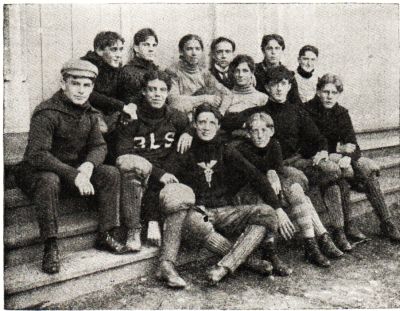
Further up the river the Albany High-School took the laurels in its neighborhood. It won the championship of the Northeastern New York Interscholastic Association, and was the strongest eleven the school ever put forth. The chief feature of Albany's play was its team-work, which proved effective against heavier opponents.
Little progress has been made by the managers of the Knickerbocker Athletic Club Interscholastic Games, which are to be held in the Madison Square Garden this winter. So far, at the meetings of the executives many questions have been left undecided, and the events that are to be contested have not even been announced. Neither is it possible to announce as yet the names of any of the prominent athletes whom we shall see come together there, but as soon as there are any developments we shall take up the subject again, as this meeting will undoubtedly prove the most important interscholastic athletic event in New York this winter.
The skating races this year in New York are to be sanctioned by the Interscholastic Association, although they were not so sanctioned last year. Arrangements have already been made, and I hope to be able to deal with the subject more fully next week. It will be remembered that last season Morgan of De La Salle carried off all the honors. His records were as follows: 220 yards, 23 sec.; quarter-mile, 50-1/5 sec.; 2 miles, 6 min. 36-2/5 sec. He was also a member of De La Salle's winning team in the 1-mile relay race. This year undoubtedly there will be a greater interest in these skating races and surely a larger number of entries, for a number of skaters are already in training for the several events. I believe that arrangements have been made to hold the contests at the St. Nicholas Rink instead of at the 107th Street rink, which is no doubt a change for the better.
The Cook County League has adopted a schedule for the in-door baseball season as follows:
January 9—North Division at Hyde Park.
January 9—Austin at Lake View.
January 9—Englewood at Evanston.
January 16—Austin at Hyde Park.
January 16—Lake View at Englewood.
January 16—Evanston at North Division.
January 23—Hyde Park at Englewood.
January 23—Evanston at Austin.
January 23—North Division at Lake View.
January 30—Hyde Park at Evanston.
January 30—Austin at North Division.
February 3—Hyde Park at Lake View.
February 3—Austin at Englewood.
February 6—Englewood at North Division.
February 6—Lake View at Evanston.
February 13—Lake View at Austin.
February 13—Hyde Park at North Division.
February 13—Evanston at Englewood.
February 20—North Division at Evanston.
February 20—Hyde Park at Austin.
February 20—Englewood at Lake View.
February 27—Austin at Evanston.
February 27—Englewood at Hyde Park.
February 27—Lake View at North Division.
March 6—North Division at Austin.
March 6—Evanston at Hyde Park.
March 13—Lake View at Hyde Park.
March 13—Englewood at Austin.
March 20—Evanston at Lake View.
March 20—North Division at Englewood.
In every case the first-named team is scheduled to play against the last-named at the home of the latter.
It was decided by the managers when they laid out this schedule that it would not be required of the teams to play on the exact dates specified if another, earlier, day of the same week proves more convenient. The only stipulation is that if the managers of any two teams cannot agree upon an earlier date they must play no later than upon the day specified.
There is so little interest in this winter sport among the students of English H.-S. that no team has been entered by that institution, and South Division will prove a weak contestant on account of its lack of facilities for the development of athletic material, there being no gymnasium connected with the school. Englewood and Hyde Park are new members to the League. The former's team has played some good practice games, but the latter's has not as yet showed of what material it is composed. Austin, the champion team of last year, has but two new men on this year's team, so that the prospects are they will finish near the top if they do not get the pennant. Lake View's is another strong team that has been playing excellent ball. North Division has played several good games, but also several poor ones, and its final make-up is undetermined. Evanston will undoubtedly send a team that will be the strongest ever put out by that school. From present indications the championship seems to lie among Austin, Lake View, Englewood, and Evanston, their chances being in the order named.
The comment upon the division of spoils in Connecticut, recently made in these columns, has elicited a number of protests from readers in the Nutmeg State. Most of my correspondents, however, in their arguments have seemed to miss the main point of the evil. One argues that it is necessary to charge admission-fees to football games because the public interest in high-school athletics is so great in Connecticut that a stiff admission-fee is the only barrier against a disorderly crowd. He writes that where no charge is made a rough element lines the ropes, and frequently creates a disturbance for which the schools are in no way responsible, but which naturally reflects upon the management.
In support of these contentions he cites the disturbance at New Britain a year ago, when a number of the town rowdies destroyed a Hartford banner. If the conditions, therefore, are such that it is necessary to make the spectators pay an entrance-fee, purely as a means of protection, I believe by all means in retaining the box-office and the turnstile. My suggestion to do away with the sale of tickets was offered merely as a means to cut down the accumulation of an unnecessary surplus, not because there is any objection to the system. On the contrary, if the box-office keeps out the undesirable element, by all means let the box-office remain. But the fact that a rough element compels the Connecticut schools to charge an admission-fee to their games has no relation to the subsequent spoliation of the treasury.
Another writer states that some of the schools in the League are unable to raise money for athletics, and so must depend upon the Association to help them out financially. There is no objection to this either, so long as the money drawn from the Association is used strictly for the purpose of promoting that branch of athletics by which the money was earned. It is only natural that, in a League whose membership is scattered over so broad an area, some schools should incur greater expenses than others. For this very reason, if for no other, there should never be an equal division of profits.
Those schools that have heavy expenses should put in their bills to the Association's treasurer, and receive payment for their necessary expenditures. Thus one school will need $125, perhaps, while another will find it necessary to spend but $50. The latter should therefore only receive from the central treasury just that amount, and not a cent more, "to be devoted to athletics." The root of the evil is the pro rata division. Aside from any ethical question, this promotes extravagance, and leads to a loose financial system. Money earned by athletics should be handled most judiciously, or it will prove a very insidious and complicating element in the economy of sport.
"FOOTBALL FACTS AND FIGURES."—By Walter Camp.—Post 8vo, Paper, 75 Cents.
The Graduate.