"STRAW-FIDDLERS."
Reading edition
On a certain cold morning in the October of 1824 a young man, scarcely eighteen years old, but with a thin face full of premature intelligence and a poetic sort of beauty, was hurrying through the street of Sklow, in Poland, his cloak wrapped closely about his slender figure, his head thrown back, the felt hat not concealing his eager anxious dark eyes, which, roving here and there, were in reality absent in their expression as young Gusikow reflected on a verdict just passed on him by a prominent physician.
For some weeks he had been suffering from pains in his chest, increased whenever he played his beloved flute, and that day J——, the doctor, had declared that the musician must at once give up his work.
Gusikow, boy that he was, had a young wife awaiting his return in a little house, which he entered with a sad enough expression, for what would they have to depend upon if he was forced to abandon his performances in the theatre, his lessons, his concert tours?
I fancy Michael and Marie Gusikow, poor children, were miserable enough that morning. But genius, especially when it is musical, will not be subdued, and in his wretchedness the lad searched the garret for an old "strohfiedel" he had cast aside long ago as an instrument too insignificant to be of any value. I cannot tell you precisely the origin of the strohfiedel, which was made of strips of fir on a straw frame-work, but it belongs to a most interesting "family" of instruments, the present generation being the wooden and glass xylophones, which we hear nowadays in every orchestra, while one of its prominent traditions is the unexpected producing of musical sounds on glasses partially filled with water, and which has suggested to innumerable boys and girls, I am sure, experiments, from the trial on a finger-bowl to a whole row of glasses on a smooth piece of board. In the quaint old town of Nuremberg some instruments are preserved, known now as harmonicas, which were played with the moistened finger; but I think the instrument best known is that which the composer Gluck is said to have invented, and which, by the name of the "musical glasses," was all the rage in England in 1746. Gluck arranged twenty-six glasses irregularly filled with clear spring water, and upon these he played a variety of music with his fingers slightly moistened. In the Vicar of Wakefield the fashionable London ladies are described as able to "talk of nothing but high life ... pictures, taste, Shakespeare, and the musical glasses," while Horace Walpole, writing the same year, 1746, to his friend Mann, refers to Gluck's performance, but says he thinks he has heard of something of the same kind before. But it was to our own Benjamin Franklin that the improved or perfected harmonica is due. He was in London eleven years after Gluck's visit, and found a Mr. Puckeridge performing on these musical glasses, very well, it is true, but Franklin at once said that something better could be done.
Accordingly he put his scientific wits to work, and the result was an instrument he called the armonica, to which an "h" was added, as being more appropriate, and on this many celebrated musicians performed. It consisted of basins of glass strung on an iron spindle, the lower edge dipped into a trough of water. As an improvement on Gluck's method, Franklin regulated the pitch of the tone by the size of the glasses, not the amount of water in or under them. Mozart and many other well-known composers did not disdain to write for the harmonica, and in 1788 a "Method" for students was compiled. The very simplicity, however, of the instrument made it easy of imitation and improvement. Wood and glass with straw were combined under various names. In the beginning of this century Ernst Chladni, who is called the father of modern acoustics, devised an instrument of glass cylinders, wood, etc., which he called the euphon, from which he evolved another, remarkable chiefly for its power of increased and diminished sound, which he named a clavi-cylinder. Dr. Chladni travelled about Europe with this instrument, giving lectures on acoustics, which started much of the research we benefit by to-day; but unfortunately for certain important work he had on hand, Dr. Chladni died suddenly in 1827.
To return to Gusikow and his little wife, we can fancy the young people on that chill October day accepting the dismal fact that the young artist must lay aside his flute, yet realizing that only by means of music could he earn a living. He took the strohfiedel to pieces, worked over it, practised on it, and at last devised certain valuable improvements; indeed, so far expanding and increasing its power and musical importance that he was talked of by some almost as though he had invented it, and presently he was known as a straw-fiddler of wonderful ability, while his playing revived interest in all the old dulcimers and psalteries, which the straw-fiddle closely resembles.
Gusikow continued to work over his strohfiedel, to improve it, and from his suggestions we have a variety of the wooden, glass, and straw instruments heard on all sides to-day. To what perfection he might have brought his crude materials I can scarcely say, for he was busy with new designs when, in 1837, he fell ill with his old foe, pulmonary trouble, and died at Aix-la-Chapelle, in October of that year, in the thirty-first year of his age.
If boys—and I know more than one of them—have contrived to make a violin out of an old cigar-box and some rough materials, surely they might do something with the ideas suggested by strohfiedels, and their family connections in wood, glass, and chamois-leather hammers.
BY GASTON V. DRAKE.
I.
FROM BOB TO JACK.
New York, June 4, 1895.
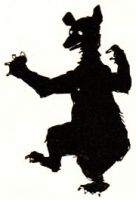
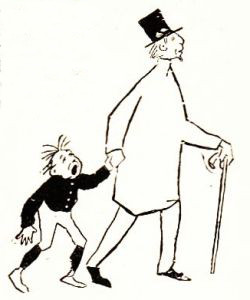
DEAR JACK,—I don't think they's going to be much chance for us to see each other this summer, for where do you suppose we're going to go to? You'd never guess. Hoboken! It's a queer place for a summer resort, and Pop says there ain't much to do there, only, he says, getting there's going to be fun. He says about the only thing people do in Hoboken is to leave it in the morning and go back to it that night, which I can't say strikes me as quite so much fun as being off there in the White Mountains, with you getting scared at 'maginary bears, playing wild Indian, fishing, rowing, playing tricks on bell-boys, and all that. It may be just as Pop says, that living in Hoboken and going to business in New York is a great thing for a man, because it makes going to business a pleasure, but for a boy I don't see what good it is. Even if it's true that Hoboken people don't need yachts, because they've always got the ferry-boats handy for sailing, I can't get excited over the idea of going there. There ain't any fishing, and as for hunting, Pop says there's nothing wild there except Trolly Cars, and I never could see what fun there was in hunting trolly cars. They arrest you for even throwing stones at 'em in Brooklyn—I know that because I read it in a newspaper. There was a boy who lived in a crowded part of Brooklyn where there never was any birds and precious few dogs, and as he was the kind of boy that had to throw stones at something, he flung a few at the trolly cars, and a policeman caught him and took him to court, and the judge made his father pay ten dollars to get him set free again, and, of course, when he got him free again and took him home, you and I know what the boy got, which I don't think isn't fun. I haven't got any use for throwing stones at birds or dogs or trolly cars, but, as far as I can find out, Hoboken's very much like Brooklyn in not having anything else to hunt, even in fun. It hasn't got any woods for Indians to hide in, and not a cave anywhere around.
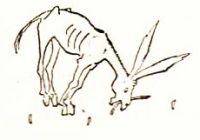
You can't go off and have a real picnic anywhere. Pop says there 'ain't ever been more'n eight blades of grass in the whole place, and five of those was ate up six years ago by a donkey that was so hungry he didn't know any better, and he isn't sure but what one of the other three was killed by the intense cold of last winter. That, of course, spoils all chances for picnics. Even if all the grass was left, you couldn't have much of a picnic on eight blades, anyhow, and besides, they didn't all grow in the same place. It must be a queer old spot, that Hoboken, and I can't say I see how Pop ever made up his mind to go there. He says he can't help going there, but seems to me that must be a mistake, because a man as old as he is can generally manage to do about what he pleases.
If it wasn't that we were going the long way, I kind of think I'd ask Pop to leave me home, and ask your Pop if he wouldn't take care of me this summer. You know what I mean about the long way, I suppose? You Boston boys generally do know all about everything; but in case you don't, I'll tell you that there's two ways of getting there. One way takes about ten minutes, and the other way takes three months. We're going the three-months way. You get on a ferry-boat to go the short way, but it takes an ocean steamer about two blocks long and a fog-horn on it to take you the long way. We're to get aboard of the steamer New York, go across to a place called Southhampton, where we take the cars for London. You've heard about London, I guess. Pop says it's the Boston of Europe, and the people there speak the same language; and I guess he is right, because he knows a man that's been there, and saw the Queen. After that we're going over to Paris, where Napolean Bonaparte lived, and Pop says he'll show me lots of fine things there, and maybe, if he's got time, will teach me how to speak French; and when I come back I'll teach you how to speak it; and then if we ever have any secrets, we can talk 'em right out loud before the girls, and they'll never know what we're talking about.
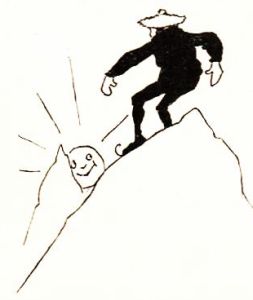
The next station we stop at will be Geneva. That's in Switzerland, and it's where they make watches. And while we're in Switzerland Pop's going to show me every Alp he can find, and he says if I behave myself he'll get me some snow and let me make a snowball in midsummer. Just think of that! Snowballs in winter is fun, but in July! My! Eh? I'm going to try to get him to let me have a sled, and go coasting down one of the glaziers, and if he does I'll tell you all about it; and maybe we'll get some skates and skate up Mount Blank on 'em. Talk about your views! Mount Blank is more'n twice as high as Mount Washington, and snow and ice most all the way. Just think of the bully slide it'll be coming down!
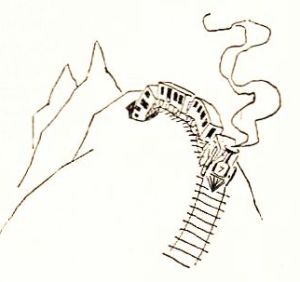
Then we're going to go over the Alps in a train that runs through tunnels that jirates like a corkscrew. You go in at the foot of the hill, and sort of meander around inside the mountain until you come out on top, and when you get over finally you're in Italy. There we're going over a few lakes and end up at Milan, after which we're going to Venice. That'll be fine. Venice is built right out in the ocean, and if you're in a hurry to get across the street you've got to row over or swim. My bathing-suit'll come in handy there.
After Venice we're going to Genoa, where Christopher Columbus was born, and from there we go by another steamer through the Mediterranean sea, which Uncle Joe says is made of blewing, to Gibraltar; on from there to those Azores Islands, where the stamps you swapped for my paper pencil came from, and that's the last stop till we get to Hoboken.
I thought I'd write and let you know about this so you'd know why I didn't turn up at the White Mountains. I'll miss you like everything, but I'll miss you less if you'll write to me once a week and tell me all that's going on. I'll write to you, and maybe, after all, we'll get some fun out of it. If Sandboys is at the hotel this summer with any of his stories about bears and things, please let me know all he tells you, and whenever I see anything exciting I'll tell you.
Good-by for the present.
Affectionately yours, Bob.
To become a successful broad-jumper the athlete must, to a certain extent, combine the skill of the sprinter, the high-jumper, and the hurdler, for the event now under discussion is a sort of combination of the other three. Like every other athletic feat, this one requires systematic work both of the body and the head, and persistent, continuous effort before any kind of form can be developed.
THE RUNNING BROAD JUMP.
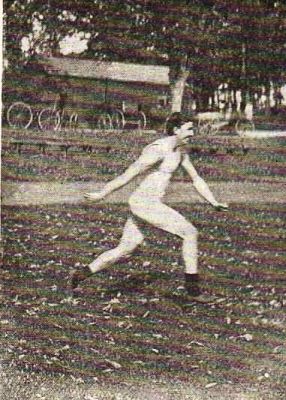
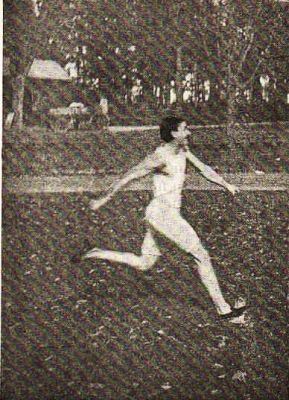
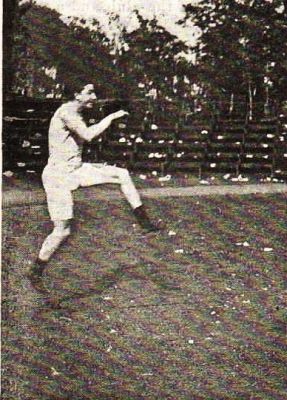
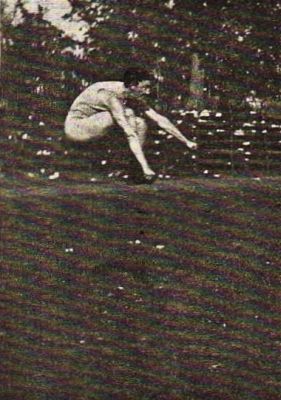
From instantaneous photographs taken of Robert F. Lyons.
1.
2.
3.
4.
5.
6.
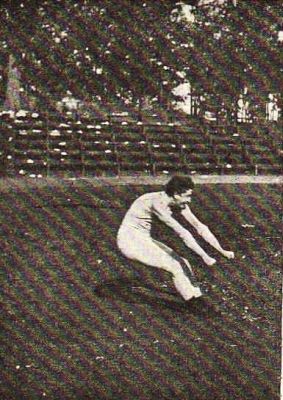
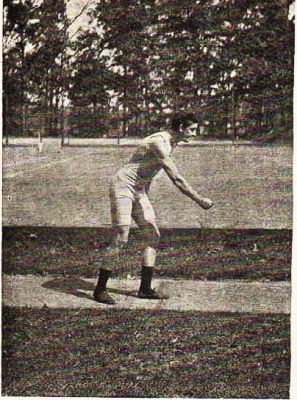
The first difficulty for the novice to overcome is the laying out of his run and the arrangement of his take-off. These details are both of the highest importance, for although he may be a good sprinter and a good jumper, these two qualities are nullified if the take-off is uncertain. The run differs with almost every individual, each athlete must determine this for himself by experiment. It is necessary to lay out two marks on the cinder track; the first one must be a given number of strides this side of the take-off, and the second at a distance further back, to suit the taste of the jumper. Bloss, for instance, counts back nine strides from the take-off to his first mark, and then goes back a dozen strides further. Lyons, whose jump is illustrated by the pictures above, goes back only eight strides from the take-off for his first mark, and about a hundred and five feet to the start of his run. Let us call, for convenience, the mark nearest the take-off the first mark, and the other the second mark. These have been laid out so that the jumper may feel certain that if his jumping foot, whether it be the right or the left, strikes fairly upon the first it will also come squarely upon the take-off, and the jump will be a good one.
It sometimes happens in contests that the conditions of the wind or of the track will be such that these marks will have to be slightly altered; and every athlete should be careful to examine the runway before his event is called, so as to be able to fix the points that he must depend upon for his success.
The position for the start of the broad jump is the same as that which used to be taken by sprinters a few years ago, before the present leaning-over method was adopted, and is illustrated by the first picture. The jumping foot, in this case the right foot, is on the starting mark, with the other slightly in advance. The sprinter starts down the track, measuring his strides carefully so as to come properly upon the first mark, and then he sprints at his greatest speed down the track to the take-off. If he has measured his distances correctly, he will land, as is shown in No. 3, with his jumping foot squarely upon the take-off. If he feels that he has gotten out of his stride, it is better not to make the jump at all, but to stop, for over-stepping the mark by a few inches will ruin the jump, and under-reaching the mark will detract just that much from the measure of his effort.
The act of the jump itself is where the greatest effort of muscle and nerve is required. Just before coming to the take-off, say at the last step, the athlete should gather himself together and crouch as low as his great speed will permit, and bring his jumping foot down as hard as possible upon the take-off, at the same time throwing his hands forward and upward. Bringing down the foot with such power serves to throw the body into the air, and this movement is aided by the lifting of the arms. The hardest strain comes on the back muscles, just as in high-jumping. The eyes should be fixed on some distant high point rather than on the ground where the jump will probably end. This seems to give a better "aim," and in many cases adds an inch or so to the distance. The fourth picture shows the jumper just after he has left the take-off. The next sees him well on his way, with his legs curled up close under the chin, and his arms reaching out far forward, so as to throw the balance as much as possible in that direction.
As he comes down the jumper should hold his feet as far forward as he can, in order to gain every inch that is to be had, and he should also keep his head and arms forward, so as not to lose his equilibrium and fall backward, thus making his jump void. The last picture shows the correct attitude for the end of the flight through the air, the feet being well ahead of the trunk, but the arms and the head held so far forward that they will bring the body along, too, as soon as the feet dig into the soft earth below. The feet should be kept well together on landing in the jumping-box, and a good broad-jumper will never allow himself to fall forward on his hands, but will always resume his erect position, and walk out of the soft earth, instead of rolling out.
Training for broad-jumping consists mostly of hard practice in sprinting short distances—say, from seventy-five to a hundred yards. This is to acquire the highest speed for the runway. High-jumping should also be practised, but the athlete should not attempt to become proficient in the number of inches he can clear, but rather in the form with which he covers a reasonable height. A spin now and then over the hurdles will also do a great deal toward improving a broad-jumper's form. After the athlete has become more or less a master of his event, he will find that half a dozen jumps, two or three times a week, will be enough to keep him in practice, and I should advise him by all means to rest for three or four days before going into a contest. When the time for jumping at a field-meeting arrives, never try to do the best work on the first jump. Be satisfied to make your marks well and to catch the take-off squarely. Do your very best on the second jump. Before making the first try, however, take a spin around the track, and make one or two small short jumps on the grass, so as to be thoroughly limbered up; otherwise, if you have not softened your muscles, you might injure yourself on your first attempt, and be laid up, as a result, for weeks.
The scheme for holding a large in-door interscholastic track-athletic meeting, which has been under discussion for some weeks past by the directors of the New Manhattan Athletic Club, has finally taken definite shape, and the games are to be given in the Madison Square Garden on the evening of March 28th. The New Manhattan Athletic Club, as is well known, has recently come under a new management, and I have been led to believe that, in the future, the much-tarnished cherry diamond will be polished up and made to stand for purity in amateur sport, as prominently as it was once degraded into representing exactly the other extreme. There is every reason to believe that such will be the case, if we may judge by the characters of the men at present in control.
These moving spirits have very wisely decided that the best way to achieve prominence in the field of amateur sport is not to gather in the reigning lights of the present, but to educate and bring forward their own men. It may take a number of years to do this, but once it is accomplished success will have been worthy of the effort. The plan is to recruit membership from the young athletes of to-day, who are to become the ruling athletes of the future. With this object in view the new club will take the greatest interest in all school sports, and will strive to assist school athletes in every possible way. The first step will be this large in-door meeting, open to all the schools of the country.
The meeting will be held for the benefit of the schools, not for the glorification of the club, and although the latter is to take entire charge of the business end of the enterprise, the schools are to control the rest. The plans, as yet, are not wholly completed, but doubtless they will be in a few days.
What is determined thus far, however, is that the meeting will be held at the Madison Square Garden on March 28th, beginning at eight o'clock in the evening. The events will be 75-yard dash, 220-yard dash, 440-yard run, 880-yard run, 1-mile run, 1-mile walk, 75 yards over the low hurdles, running high jump, putting the 12-pound shot, pole vault, and a relay race. There will probably also be a relay race for college teams.
The entrance fee for each event will be fifty cents, and the entries will close on March 21st. The events will be open to the school-boy athletes of the United States, the eligibility of contestants to be governed by the rules of the N.Y.I.S.A.A. (Here is the first occasion where the importance of a National Association is made evident. If the constitution of the N.I.S.A.A.A. were only completed now so as to cover in-door as well as out-door contests, the rules of the general body would have been adopted for the N.M.A.C. games!) The New York association has been amending its laws within the past few weeks, and it is too late at the present writing for me to make sure that the eligibility rules have not been changed with the others. For the benefit, however, of members of other associations who will enter these games in March, this Department will publish next week the regulations that are to govern the entries.
It is the plan at present to invite teams and individuals from every school near enough to this city to send delegates. It is expected that the Boston and Philadelphia schools will send large delegations, for this is practically the first in-door meeting, open to all schools, that has ever been held on such a scale. The relay races will no doubt prove exciting, and it will be interesting to compare the work done by the school and college teams.
The feature of this scheme which should particularly appeal to those of us who are clamoring for a diminution of the evils of athletics is that the entire business management of the affair is taken completely out of the hands of the students. If this might only always be so!
Of minor in-door games there will be plenty in the next six weeks. The Barnard games are to be held next Saturday, the 8th, in the Eighth Regiment Armory, and promise to be well attended. Moore and Washburn ought to be heard from in the runs, and the latter has also been doing some good work over the hurdles. Wilson, who surprised the know-alls in the junior events last spring, is another Barnard man that will be well up in the front, although Leech of Cutler's will make him do his best. Freshman relay teams have been invited to compete from the neighboring colleges, and a number of acceptances have already been received.
Relay races are about the most interesting contests to put on an in-door programme, and I am glad to see that the event is coming into such wide popularity. There is a greater element of interest in such a race because it involves team-work, and team-work is always more attractive than individual work. And then again, where a solid body of supporters are encouraging one team, while similar crowds are urging on another, the enthusiasm and rivalry reach a far more inspiriting level than in any other case.
These races also afford an opportunity for smaller schools, that have not any particularly able athletes, to send representatives in the form of a relay team, and such a team from a small school, if well trained, stands as good a chance of success as the runners from any larger institution, because success depends upon team-work. If relay races become fixed events on the in-door card, it is probable that the country schools—such as Lawrenceville, the Hill, and others—will eventually regularly enter a team at one or more of the winter meetings here. I think it very probable, from information already at hand, they will send teams to the new Manhattan Athletic Club meeting in March.
A number of school papers, in referring editorially to the National Interscholastic A. A. A., speak of it as the "International" Association. Now there is nothing international about the new organization, and many persons are liable to be led into a misconception of the Association's objects if this term is continually mis-applied to it. The N. I. S. A. A. A. is a purely American affair, and has been organized for the purpose of encouraging and promoting amateur sport in the schools of this country alone. That, as we all know, is a big enough undertaking in itself. The other nations will have to take care of themselves!
That the National Association is to be a power for good, there can be little doubt. Its rules will be of the most stringent kind, and the fact that the majority of interscholastic leagues now in existence are hastening to join the larger body shows pretty conclusively that they appreciate the value of a strong governing head. Another result of the new venture is the organization of additional school leagues. I spoke last week of the coalition newly made by Lawrenceville, the Hill School, and Hotchkiss Academy. A call has now been issued for a convention of the New Jersey schools, for the purpose of forming an association in that section. The convention is to be held at the High-School, West Fifth Street, Plainfield, New Jersey, February 8th, at 10 o'clock in the morning.
The Graduate.

This Department is conducted in the interest of stamp and coin collectors, and the Editor will be pleased to answer any question on these subjects so far as possible. Correspondents should address Editor Stamp Department.
An accumulation of answers to correspondents makes it impossible to illustrate the remainder of the rare Confederate Locals in this issue. I shall try to finish the list next week. Meanwhile, I advise all readers of the Round Table in the Southern States to look over any correspondence of the year 1861.
A correspondent sent me some Cape of Good Hope stamps to pass on, all of which proved to be counterfeits. By mistake these stamps were returned to another correspondent. Will the receiver kindly return the stamps to the Editor of this Department, in care of Harper & Brothers?
H. S. Riederer.—All coins made in Philadelphia are without any special mint mark. Of the other mints the marks on coins are as follows: O. for New Orleans; D. for Dahlonega; C. for Carolina; C.C. for Carson City; S. for San Francisco.
R. W. L.—Dealers ask from $27 to $30 for a complete set of Columbian stamps unused, and pay from $23 to $26 for the same, if in good condition, well centred, original gum, etc.
M. F. Easton.—The green Centennial envelope is sold for 25c.
C. R. Bragdan.—Many firms in England have all their stamps perforated with their initials to prevent theft. This perforation destroys the value of the stamp, whether used or unused, except for postal service, and identifies the owner of the stamps. Russian coins are not collected in this country.
A. Carrier.—A Columbian dollar stamp with holes punched in the same has little value. Collectors want whole stamps or none.
W. P.—The $5 gold coin is a common date. It is worth face only.
G. M. Kelley.—See Round Table of December 17, 1895, for the value of U.S. cents.
R. Bennett.—"The Union" is a token, not a coin. It has no value. The 3c. U. S. purple stamp, used, is worth 1c.
H. M. Baldwin.—U.S. coins so badly worn that the date can not be read have no premium.
S. J. Dayton.—If the 3c. coin is in "mint" condition—that is, practically just as it came from the mint, not in the least worn, dealers in coins may pay half the catalogue value. It is not rare in ordinary good condition.
H. W. Ticknor.—See answers to S. J. Dayton and H. S. Riederer.
E. C. Wood.—I do not recognize any variety from your description. Probably you mean the 1890 and 1894 U.S. stamps. The last named are printed from the 1890 plates, with the addition of a triangle on the upper left and upper right corners.
Philatus.