Popular Books for Boys
Reading edition
BY THOMAS W. KNOX
THE "BOY TRAVELLERS" SERIES
Copiously Illustrated. Square 8vo, Cloth, Ornamental, $3.00 per volume.
ADVENTURES OF TWO YOUTHS—
IN THE LEVANT.
IN SOUTHERN EUROPE.
IN CENTRAL EUROPE.
IN NORTHERN EUROPE.
IN GREAT BRITAIN AND IRELAND.
IN MEXICO.
IN AUSTRALASIA.
ON THE CONGO.
IN THE RUSSIAN EMPIRE.
IN SOUTH AMERICA.
IN CENTRAL AFRICA.
IN EGYPT AND PALESTINE.
IN CEYLON AND INDIA.
IN SIAM AND JAVA.
IN JAPAN AND CHINA.
OTHER BOOKS BY COLONEL KNOX:
Hunting Adventures on Land and Sea.
2 vols. Copiously Illustrated. Square 8vo, Cloth, Ornamental, $2.50 each.
THE YOUNG NIMRODS IN NORTH AMERICA.
THE YOUNG NIMRODS AROUND THE WORLD.
Published by HARPER & BROTHERS, New York
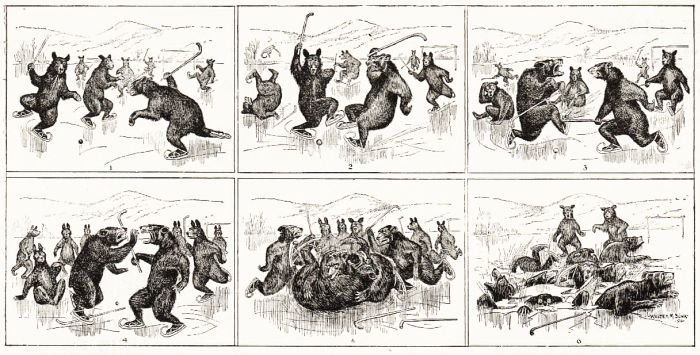
POLO ON SKATES, AND HOW THE GAME ENDED.
A JOLLY OLD TAR.
A London newspaper tells an amusing sea tale which concerns the recent experience of the Captain of a certain large sailing-vessel, who is probably the most polite officer in the whole mercantile service. He has, however, a great idea of his own importance, and loses no opportunity of impressing this upon his crew, who, while good tars and generally far from mutinous, do not always relish the Captain's airs, as they call them.
In particular, for instance, he insists upon being addressed as "Sir" by every one on board. One day a new hand joined the ship, and a short time after leaving harbor, being a well-seasoned old salt, he was intrusted with the wheel. The Captain came up and put the usual question, "How's her head?"
"Nor'-by-east," answered the old tar, very gruffly, taking the customary hitch in his trousers.
"My man," suavely answered the Captain, "on this craft, when one of the crew speaks to me, he gives me a title of respect. Don't you think you might do so, too? Now how's her head?"
"Nor'-by-east, I tell yer," shouted the tar, displaying not a little irritation.
"I'm afraid you don't quite understand me," responded the Captain, good-humoredly. "Let me relieve you at the wheel, and then do you take my place and ask me the question. I will then show you how it should be answered."
They accordingly changed places.
"'Ow's her 'ead?" roared the tar.
"Nor'-by-east, sir," replied the Captain, with gentle emphasis on the "sir."
"Then keep her so, my man, whilst I goes forrard and has a smoke," was the startling rejoinder from the old reprobate, who calmly commenced to suit the action to the word, and disappeared up by the forecastle, lighting a match as he went.
PAT'S RETORT.
Pat has turned up again in a collection of anecdotes. Here is a specimen of his wit lately come to hand:
A one-legged Yankee orator, who had been very successfully chaffing an Irishman, was finally asked,
"Oi say, soor, how did yez lose your leg?"
"Well," replied the Yankee, "I found, when I came to look up my ancestry, that I had a little Irish blood in my veins, and becoming convinced that it had all settled in my left leg, I had it cut off at once."
"Bejabers!" cried Pat. "Phot a pity it hodn't shettled in your head!"
BOBBIE'S PLAN.
Whene'er at night I'd know the time And cannot see the clocks, I feel about beneath my crib For those upon my socks.
"It is very naughty of you, Wilbur, to answer back to mamma in this way. Where did you ever learn to do that?"
"Watchin' papa, I des, mamma," said Wilbur, "He most generally answers back."
SINGULAR CLOCKS.
In an answer to a correspondent who asks, "What is the most curious material out of which a time-piece has been made," a London journal prints the following rather interesting item:
Bread, we think, is the most curious material out of which a clock has ever been constructed. There was, and may still be, in Milan a clock made of bread. The maker was a native of Milan, who devoted three years of his time to the task. He was very poor, and being without means to purchase the necessary metal for the making of a clock, he sat apart regularly a portion of his bread each day, eating the crust and saving the soft part. To solidify this he made use of a certain salt, and when the various pieces were dry they became perfectly hard and insoluble in water. The clock was of good size, and kept fair time.
Another strange clock was exhibited some years ago in Liverpool. It was constructed of pins, buttons, and all sorts of odds and ends by a pauper named Mercer. The maker of this extraordinary time-piece thus describes it himself: The back and the front of the clock were made from iron bed-laths, while the barrel was part of a large brass ferule, the ends being brass buttons hammered out. The barrel arbor had originally been the blade of a shoe-maker's awl; the main and several other wheels were nothing more nor less than suspender buttons from the maker's own trousers, while the cog teeth were portions of bygone knitting-needles. The teeth of the centre wheels had been boot-rivets. In the dial there were one hundred separate pieces.
A NONSENSE RHYME.
Oh, wouldn't it be splendid, Oh, wouldn't it be grand, If I could play the ear-drum In an elastic band!