10 Stamps
Reading edition
free to every applicant for our app'l sheets at 50% disct. Franklin Stamp Co., 74 Fayette St., Allegheny, Pa.
FINE APPROVAL SHEETS. Agents wanted at 50% com. P. S. Chapman, Box 151, Bridgeport, Ct.
FINE PACKETS in large variety. Stamps at 50% com. Col's bought. Northwestern Stamp Co., Freeport, Ill.
STAMPS! 100 all dif. Barbados, etc. Only 10c. Ag'ts w't'd at 50% com. List free. L. DOVER & CO., 1469 Hodiamont, St. Louis, Mo.
Amateur Press News.
EDWARD HERING, President of Pacific Amateur Press Association.
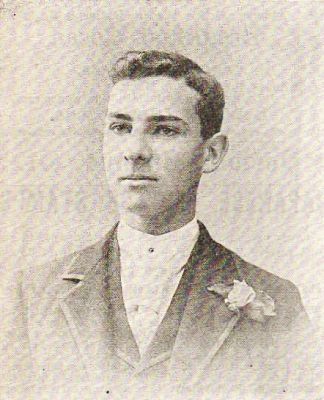
At present there are four amateur press clubs on the Pacific coast—one sectional and three local. The Pacific Amateur Press Association is composed of amateurs residing in the States of California, Oregon, and Washington. It meets annually in different cities on the coast. The next convention will be held in San Francisco next July. At conventions we have an exciting time at banquets, political fights, etc. Mr. Edward A. Hering, of Seattle, Wash., is President. The dues are fifty cents per year, no initiation fee being charged.
The Golden State is the largest local association in amateurdom. It meets semi-monthly. The initiation fee is fifty cents, and the dues thirty-five cents per month. The officers are: D. J. McCarthy, President; L. M. Voorsanger, Vice-President; Samuel T. Bush, Recording Secretary; Ethel Neal, Corresponding Secretary; P. C. Mortimer, Treasurer; and William A. Day, Official Editor.
The Seattle Amateur Press Club is composed of amateurs residing in Seattle. The Portland Club is composed of amateurs residing in the city of Portland. The latter has just been organized, and is in a flourishing condition. W. L. MacMullin is President. For amateur papers, applications, or any information apply to Herbert Hauser, 1423A Bush Street, San Francisco, Cal. Of course you are welcome to the ranks of these amateurs if you live on the Pacific coast and contribute to or publish an amateur paper.
Neat and bright amateur papers to reach the Table are: the Defender, Grove City, Minn.; the Newsboy, 1609½ Baker Street, San Francisco, Cal.; the Boys' Club Magazine, the Press Club, 740 Bryant Street, San Francisco, Cal.; the Gleaner, Walter A. Dyer, 274 Worthington Street, Springfield, Mass.; the Monthly News, Paul Foster Case, Fairport, N. Y.; the Recorder, 579 American Avenue, Milwaukee, Wis.; the Recruit, 1104 East Fifteenth Street, East Oakland, Cal.; the Talisman, 100 East Twelfth Street, Portland, Oregon; the Monthly Visitor, Haverhill, Mass.; and the Albemarle, Eau Claire, Wis.
Publishers of all the papers will be glad to hear from members of the Order. All, or nearly all, send sample copies free upon request, and all welcome bright contributions. They are creditable to their editors and publishers as well as contributors. Some time since we remarked that few amateur papers could be made to pay expenses. Several publishers write to say that they make both ends meet, and even realize a profit. But the greatest benefit is not a financial one, but the experience gained.
The following members are interested, and want sample copies: A. C. Bell, Garfield and Central avenues, Medford, Mass.; Philip A. Barry, 22 Clifton Place, Boston, Mass., who wants members for the "Round Table" Amateur Press Association; R. M. Shumway, Batavia, Ill.; Sigurd Rhode, 1202 West Michigan Street, Duluth, Minn.; and James F. Bowen, 36 St. James Avenue, Boston, Mass.
Biscayne Bay and Its Marvels.
Biscayne Bay is situated far down the east coast of Florida, a little below the settlements of Miami and Cocoanut. It is a magnificent sheet of water, the largest in Florida. If you enter the bay in a boat, you will first notice the crossing of a bar. Then you will naturally look across for the other shore and see groups of white houses seemingly far apart. And then you will look into the water below you and see, far down, "submarine gardens of purple, yellow, and red weeds, bright green moss, and multicolored shells of various shapes and sizes." The water is of the clearness of amber, for it is seldom roughened by storms.
How to reach Biscayne by land. The journey to the bay by stage requires two days, with a stop at Camp Stranahan, on New River. You will obtain more fun, though, if you take the schooner at Lake Worth and sail down the Atlantic, a distance of eighty miles. Going south the boat hugs the shore to avoid the northward flow of the Gulf Stream. During the autumn the band at the Royal Poinciana Hotel, at Palm Beach, can be plainly heard. The freight and passenger boats that run between the lake and the bay generally use Bear Cut entrance to the bay.
The fish found in the bay are remarkable for their great variety. There are the tarpon, the silver king, and the kingfish, all of which afford great sport. They are from twelve to fifteen feet long, and weigh from seventy-five to two hundred pounds. Then there are the bream, Jack, mullet, trout, and salt-water shad, the angel and hogfish, the baracouta, and the Spanish mackerel. There is also a fish which goes under several names. Some call it the cavalier, the negroes, "car-walley," and Dr. Henshall, in his Camping and Cruising in Florida, calls it the crevalle. I forgot to mention that pompano, sheepshead, runners, and mud-fish are also found plentifully. But these are not the only species of fish found. There are the shark, jew-fish, ray, and porpoise, and in the small creeks abound alligators and crocodiles. The manatee, or sea-cow, has just lately found its way here. It came originally from the St. Lucie River. Huge pachyderms are found whose flesh resembles that of bear steak. Of shell-fish you will find clams, oysters, crabs, shrimp, conchs, and the logger-head, hawksbill, and green turtle, and plenty of terrapin. Is not this sufficient to show you what a fine fishing-place Biscayne Bay is?
The population about Biscayne Bay is cosmopolitan, possessing, on one hand, a well-known author, and on the other a pure-blood Indian, called Tiger Tom, or Old Tiger. Kirk Munroe and Old Tiger are good friends. The original inhabitants of this region were English and Bohemian settlers. The Everglades lies to the west of the bay about six or seven miles. A recent poetic writer said of them: "A huge lake, miles upon miles in extent, of cold, clear, pure water, black as night, studded with innumerable small islands thickly grown with moss-draped cypress-trees, nesting and breeding places for millions of birds, hiding-places for deer, bear, panther, alligators, and wild-cats, and the larger ones affording camp, farms, and villages for the Indians. The scenery is beautiful and weird beyond description; the silence is an anodyne that lulls the senses to sleep as irresistibly as the croon of the mother soothes her child.
"The sough of the cypress in the passing breeze, the rocking of the canoe on the all but motionless water, the call of a bird, the dip of a distant Indian paddle, the crack of a rifle, the bellow of a 'gator—these are only occasional sounds. It is a wilderness of silence, beautiful and restful, if just a little aweful sometimes, far away from the world, unmolested nine months of the year, healthful and pure, because natural." A glowing description, is it not?
The islands are fertile, and the Indians make them very productive, raising corn, pumpkins, pease, and melons.
Harry R. Whitcomb. Umatilla, Fla.
How Granite is Sawed.
Not long ago I went to a granite-works. The first place was a shedlike building where they were chiselling the granite. The next was where they sawed the stone. The saws are straight, and are made of steel. They have no teeth on them, but instead they let sand and water in under them. The saws draw the sand back and forth over the granite. The sand acts as teeth to the saws. It takes an hour to saw an inch.
The next place is where they polish the stone. At first ground iron is used; afterwards emery. The polisher is a flat iron disk, which turns round and round over the surface. A man stands by to guide it.
Claude Kendall, R.T.K. Norfolk, Conn.
A Bit about Autumn Birds.
Heretofore I have only occasionally seen a ruby-throated humming-bird around my home. This fall they are very common. The gentleman who lives next door is a florist, and this year planted a long row of different varieties of nasturtiums. In September, when school began, I spent my afternoons studying in the hammock. At first I noticed only a few birds, but as the month wore on they became more numerous. About the middle of the month I could always see several of them poised in the air before the blossoms, their throats gleaming with metallic lustre.
There was a small pear-tree with scanty foliage near the flowers. Many a time I have seen the birds light on some slender dead twig and daintily arrange their plumage with their bills, then shoot off like a flash to gather some more nectar or to indulge in a turn at watching their little ones. The flowers climbed the fence and came over into our yard before the month was over, and then I could watch them from my hammock without sitting up. Several times I have approached the fence as noiselessly as I could and looked over to find myself within a few feet of a ruby-throat.
I have witnessed several severe battles between the males. They would fly this way and that, shoot upwards and then downwards, sometimes uttering a not unmusical squeak. Before September was over my feathered jewels were gone. My neighbor florist also planted some sunflowers near the fence. They grew to be about six feet high. As he did not pick the blossoms they went to seed, and during the latter part of September and the first part of October the vicinity of the plants has been the battle-ground of the English sparrows—a regular "Delmonico's" for thistle-birds.
While the seeds lasted there was always a flock of birds around clinging to the swaying stalks or picking the seeds up off the ground. The English sparrows are the same that they were in the spring, but the thistle-bird is quite different. That little ball of feathers had given up his gaudy yellow colors and black cap and wing coverts, for a general color of dark olive with the above-mentioned black parts of a dirty blackish-brown. The American goldfinch or thistle-bird or wild canary or yellow-bird is about four and a half inches long, and in the spring has a general color of yellow with a black topknot, wings, and tail.
Albert W. Atwater, R.T.K. Springfield, Mass.
A Florida Prairie.
How different is one of our prairies from those out West! Ours are low, flat, clay ground sometimes hundreds of acres in extent. Not very large, you say. These prairies are interspersed with large groups of shrubbery and palmetto, which stand alone on this wide expanse of marshy land. In the rainy season these prairies are covered from six inches to a foot deep in the water. Sportsmen in water-proof boots used to tramp through the water, and many a wild-duck did they bring down. Ducks are scarce now. But if the ducks are gone, the prairie abounds in game in spring-time and autumn. Then the sportsman is in his element—rabbits and quail galore. At night the boys blow up their dogs and go 'coon and 'possum hunting, which sport is one of the most exhilarating and fun-producing I know of.
Harry R. Whitcomb. Umatilla, Fla.