CARDS
Reading edition
FOR 1896. 50 Sample Styles AND LIST OF 400 PREMIUM ARTICLES FREE. HAVERFIELD PUB. CO., Cadiz, Ohio.

This Department is conducted in the interest of Bicyclers, and the Editor will be pleased to answer any question on the subject. Our maps and tours contain much valuable data kindly supplied from the official maps and road-books of the League of American Wheelmen. Recognizing the value of the work being done by the L. A. W., the Editor will be pleased to furnish subscribers with membership blanks and information so far as possible.
Copyright, 1895, by Harper & Brothers.
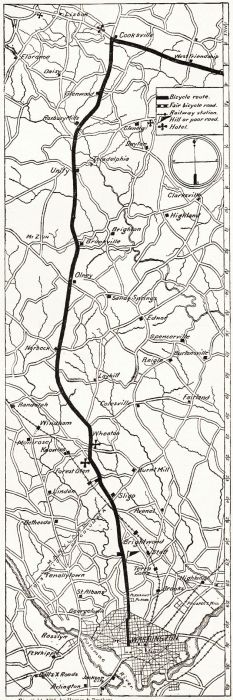
This week we give the last stage of the journey from Philadelphia or New York to Washington. Taking up the route from Cooksville, the run into Washington to the Capitol is between thirty-two and thirty-three miles. On leaving the cross-roads in the centre of the town, run south to Glenwood, thence direct to Roxbury Mills, straight on through the village to Unity, keeping always on the main road to Brookville. The distance is about ten miles over a road that is not of the best, and has some pretty bad places. It is, in the main, sandy loam, and the rider should keep in mind that he is to avoid coasting down most of the hills, and, in fact, will do well to only ride down the hills where he can see the bottom, as there are one or two which it would be as well to avoid, in view of the sharp turns and disagreeable lay of the land at the bottom. From Brookville to Olney, and then on to Norbeck, is a clear road and in much better condition, being a regular turnpike thoroughfare. It is difficult to miss the way, in spite of one or two forks between Olney and Norbeck. The road is in much better condition, and improves between Wheaton and Sligo, which is just on the Maryland side of the line between Maryland and the District of Columbia. About half a mile out of Sligo take the right fork and cross the railroad, which at this point runs along the Maryland line. Immediately upon crossing you are in the District of Columbia, and from here into Washington the road is in admirable condition. It is about five miles from Wheaton to the District of Columbia line, and a good five miles further into the city of Washington. The route lies through Brightwood on by a straight pike road through Pleasant Plains into the city, where the Arlington is perhaps the best hotel for a cyclist's purpose.
It should be noted that all the rides in the vicinity of Washington, especially on the Virginia side, but to a certain extent on the north as well as the south, are apt to be very bad during wet weather. The clay formation of the ground forms a soft mud during a rainy period, which, if it does not make bicycling impossible, makes it most disagreeable and unsatisfactory in every way. This is especially true if you take the run from Washington to Mount Vernon, the best route for which being on the Virginia side. Here it is almost impossible to get along after much rain. This route, however, should be taken, as Mount Vernon, being one of the important places in the vicinity of Washington, should unquestionably be visited. To take this route, cross the river by the bridge to Jackson City, and from this point it is easy to find the road, which is fourteen miles down the river on the Virginia side.
This completes the continuous journey from Philadelphia to Washington, and the reader of this Department can easily fill out the entire journey from New York to Washington by looking up the maps already published in the Round Table. By taking these and studying them out carefully, it will be seen that the journey can be laid out in stages of whatever length is most suitable for the particular rider who is considering them. As we have published them, they are in short stages of between thirty and forty miles, and ordinarily good riding. He could take two of these stages a day, which would divide the journey from New York into half, and at a pinch he could make the run from New York to Philadelphia in one day, though that is a rather long ride for even the best; but by taking two days to reach Philadelphia, and four, or even three, to make the run from Philadelphia to Washington, not much time is taken, although the route from Philadelphia to Washington which we have given will require more than that amount.
Any questions in regard to photograph matters will be willingly answered by the Editor of this column, and we should be glad to hear from any of our club who can make helpful suggestions.
PLATINOTYPE PAPER.
The platinotype process was discovered a long time ago by Sir John Herschel, but it is not till within a few years that it has come into general use for photographic prints. The paper has been brought to such perfection, and the working made so simple, that the young amateur will find no trouble in using it when he wishes to make specially fine prints.
While one may sensitize the paper, it is better to buy the ready prepared, and as it is packed in tin tubes, the joint being made as near air-tight as possible, it will keep for a long time, especially in a dry climate.
The paper is of a lemon-yellow color, and it prints about three times quicker than albumen paper. Gas-light or a weak white light will not affect the paper, and it may be adjusted in the printing-frames in an ordinary lighted room away from the windows.
To print, place the negative and paper in the printing-frame in the usual manner, and expose to diffused daylight—that is, in the shadow of a building or at a window, but not in sunlight. The image is faintly printed, and then developed. After two or three minutes examine the print, and if the image is well defined, with detail showing in the middle tones, the picture is printed enough. The color of the printed image will be of a grayish-orange tint, and will not appear as distinct as on aristo or albumen, which are printing-out papers.
The developer for platinum prints comes in bulk, with directions for preparing, and better results are obtained by using the prepared developer, especially for the first few times of making platinotypes.
Dissolve the contents of the box of developer according to directions, and place in a tightly stoppered bottle. This is the stock solution. Make a clearing bath of 60 oz. of water and 1 oz. of muriatic acid (chemically pure).
The prints may be either developed by floating them in the developing solution, or the prints may be laid on a sheet of glass and developed by the "brush" process. The latter is better for small prints.
To develop by floating the print, place the print, exposed side down, in the developer by letting it slip evenly and quickly into the solution. Lift and see if any air-bubbles have formed on the surface of the print. If there are any, touch them with the tip of the finger or the corner of a card, and return the picture at once to the developer. The picture will develop quite fast, but it can be stopped at once by transferring the print to the acid bath.
The developer must be used in a porcelain or agate tray, and another tray—a glass tray such as is used for hypo will do—must be filled with the acid clearing bath so that the print may at once be placed in it as soon as it has been developed enough.
As soon as the print has developed enough remove at once, before washing, to the acid clearing bath. The prints must have three changes of the acid bath, leaving them in ten minutes each, and afterward wash them in three or four changes of water, lasting about half an hour altogether. Pin up to dry, blotting off the superfluous moisture with clean blotting-paper.
Developing with a brush is sometimes to be preferred to floating. Take a wide flat camel's-hair brush, turn some of the developer in a shallow dish, lay the print on a sheet of glass, face up, dip the brush in the developer, and beginning at the top of the print, brush it across from one side to the other, and then lengthwise of the print, using light even strokes. The picture will not be so evenly developed as by floating, but this unevenness may be remedied by floating the print for half a minute in the developer and then transferring quickly to the acid bath.
Stop the development as soon as the right depth has been brought out, and while the detail is perfect. If a print is developed too long the print will appear flat, as in the case of a negative when overdeveloped.
As platinum prints are more quickly made than aristo or albumen, this paper is very desirable for winter photographic printing.
The mounts for platinum prints have a plate sunk centre covered with India paper, and are usually of a soft gray color for the margin. The prints may be mounted on plain cards, but are much more effective if mounted on the cards prepared expressly for platinotypes.
The paper costs 50 cents per dozen for 4x5, 80 cents for 5x7. The paper can be bought in any size desired. The developing solution or salts cost 35 cents for a package containing enough to make 50 oz. of developer.
LAUGHING BABIES
are loved by everybody. Those raised on the Gail Borden Eagle Brand Condensed Milk are comparatively free from sickness. Infant Health is a valuable pamphlet for mothers. Send your address for a copy to New York Condensed Milk Co., N. Y.—[Adv.]