AMERICAN-NIGHTS' ENTERTAINMENTS.
Reading edition
MARTHA WASHINGTON'S VALENTINE.
BY EMMA J. GRAY.
A group of merry girls and boys were talking with Mrs. General Washington one February evening, when one of the number suddenly inquired: "Did you ever get a valentine from the President?"
To which came the ready reply, "Of course I did!" as a conscious smile rippled over the still beautiful though now elderly face.
"And did you ever go to a valentine party when you were a girl?"
"Why, of course I did," and Mrs. Washington straightened herself more particularly in her high-back chair.
"Oh, do tell us all about it!"
And as she responded with a most indulgent smile, they gathered close to hear.
It was night in old Virginia when, for the entertainment of our visiting friends, grandmother laid aside her knitting, and glided slowly, stately, gracefully around the room. She was dancing the minuet.
Unexpectedly my maid entered, bearing a tray on which was a white envelope sealed with rose-colored wax imprinted with a laughing cupid. I was much embarrassed at receiving this before so many curious eyes, and warningly looked at the girl, but it was too late; indeed, her ready words made me only the more conspicuous.
"I 'member to watch, kase uver sence dey here"—with a nod of her head in the visitors' direction—"young misses mons'us quiet!"
Fearing she might become yet more garrulous, I hurriedly asked, "Nancy, did the carriage return from the King's Mill Plantation?" and the girl left the room to inquire.
It was St. Valentine's eve. And who had sent this beautiful valentine—for beautiful I knew it was—notwithstanding that as yet the seal remained unfastened! Would I open it before all these guests, or would I make excuse and go in hiding?
Grandmother settled the question by inquiring, "Valentine, dearie? Many's the one I got when I was a girl."
"I suppose you did, grandma, for you've told me you were much like your old friend Madam Ball—and she was a great belle;" and then continuing, foolish child that I was, with a quick rush of the red blood all over my face, even to the roots of my hair, "I've heard, too, that her daughter, when at my age, was just the comeliest maiden possible—so modest, so sensible and loving, with hair resembling flax, and cheeks like May-blossoms."
These words caused grandmother to come closer, and, scrutinizing my face, she asked, "Why, what's put Mary Ball into your head, child?" and, not waiting for reply, added, "You cannot deceive your old grandmother; you might as well give up now as at any other time;" and pointing to the still unopened valentine, while looking at the group of visitors, she tantalizingly said, "Open it, dearie, and see what George has sent you."
This was too much, and I fled from the room.
Grandmother was right, and I knew it, for I was learning to know George Washington's handwriting, and I was already planning how I would tease him when we met at the party to be given the following evening at the Oaklands, to which home we were both invited.
There had lately been a wedding at our house; a cousin of my mother's was the bride, and such a gay time as this excitement had brought! George Washington was among the guests, and I was much pleased because he danced with me several times.
Referring to an old Virginia wedding, there is nothing comparable to it, as the preparations go regularly on for successive nights and days—such preparations as ruffle-crimping, jelly-straining, cocoanut-grating, egg-frothing, silver-cleaning, to be ready for guests who arrive a few days before, and, as in our case, remain for a week or more afterwards. Nor do the guests arrive alone; they come in their private carriages, with horses and an army of negro servants to be entertained. Just think of the numberless rice-waffles, beat-biscuit, light bread, muffins, and laplands to be brought hot on the breakfast table! and the ham, dried venison, turkey, fried chicken, cinnamon cakes, quince marmalade on the tea table! Oh, a wedding meant an out-and-out stir in those days! But our house was a large old place in the midst of scenery both lovely and picturesque, and we owned many negroes, who had been taught all sorts of work, and therefore it was easy for us to prepare. Indeed, our head cook, Aunt Tamer, was a character, black and portly, but cleanly turbaned and white-aproned. I seem to hear her now praising her own concoctions, and she was especially proud of "bakin' de bes' beat-biscuit an' loaf bread."
But I was talking about my valentine and the party. Probably because the fête of St. Valentine belongs to nearly every country, and since the fifteenth century it was exceedingly popular in England and France, the girls were asked to wear fifteenth-century costume; my dress was of the finest white mull, as fine as a spider's web, and embroidered with lilies-of-the-valley. The boys' clothes were in exact copy of old English gentlemen, and they wore long queues tied with black ribbons, wide ruffled shirt fronts, short breeches, and knee-buckles. The decorations were elaborate—pink roses and rosebuds in solid banks of lavishness. Indeed, the large square rooms seemed transformed into flower-gardens. One exquisite effect was produced with magnolia leaves and wax candles. These leaves formed a cornice to the drawing-room ceiling, and the candles were so deftly placed that only the lighted tapers were seen. They shone like stars on a summer's night, for the dark green gloss on the large leaves acted as reflectors, while suspended from the ceiling's centre were several rows of pink satin sash ribbon, each piece hanging so gracefully that when the ends were fastened, about four feet below the cornice, the ceiling was as effective and beautiful as the most critical fresco-painter could desire. Where each end was fastened there was a large bunch of magnolia leaves and candles assimilating a side-chandelier, and in the centre of the ceiling there were magnolia leaves in profusion.
No sooner was I in the drawing-room, than my friend George Washington gallantly advanced, and begged me to do him the honor of being his partner in the cotillion. After that there followed many other dances, all of which he would ask me to dance; but I did not forget he had sent me a valentine the night before, and therefore I decided to tease him by dancing with some of the other boys, especially with my particularly kind friend, young Custis.
OUR HOSTESS APPEARED AS THE GODDESS OF LOVE.
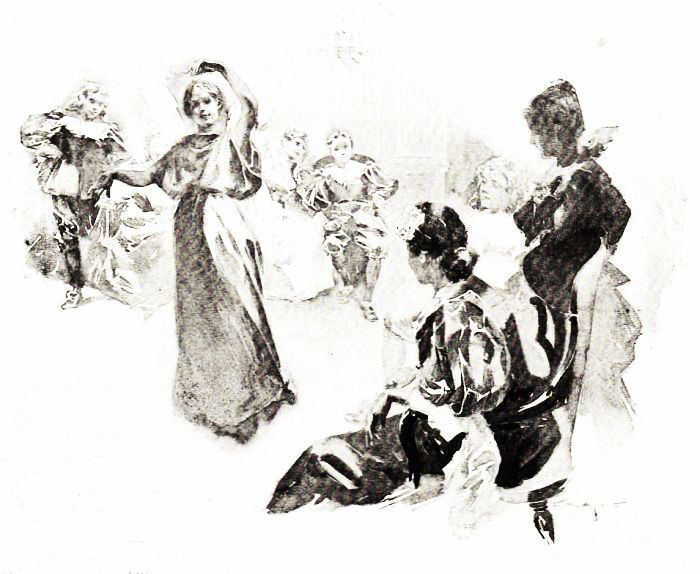
We had reels, cotillions, and schottisches almost without number; but the dance just before supper was arranged for the occasion, and called St. Valentine. Our hostess suddenly appeared in soft fleecy white stuff, with spangled wings, as Venus, the goddess of love, her mother explained. First dancing one of the plantation dances that her old mammy had taught her, she sang a song about valentines; then taking a gilded basket, and coquetting through the drawing-room in the most graceful of reel steps, she gave a valentine to each guest. Then again dancing another of the plantation dances, she as gracefully withdrew.
A few moments later a musician's voice called, "Choose your partners by matching valentines"; and thus again George Washington advanced, and finding that his valentine really was the exact counterpart of mine, we walked to our places in the now rapidly forming minuet, and afterwards we marched together up and down the rooms and through the wide halls to supper.
After supper we played several games, one of which represented prominent characters, and some not so prominent—for example, making believe we were our own mothers or fathers. In this way, Colonel Ball of Lancaster, who was George Washington's grandfather, was taken, and Augustine Washington, his father. George Washington himself took the character of George III., while I took the character of Betty Washington, his sister. But some of the other boys and girls preferred representing Sir Walter Raleigh, Lord Fairfax, Governor Dimwiddie, Miss Burney, Hannah Ball, who married Raleigh Travers, of the same blood as Sir Walter Raleigh, and other titled gentlemen and women. Those who were to be guessed decided for themselves who they would be. Then all the guests asked questions, to which correct answer was given. If the name was not guessed within five minutes, it had to be told, for longer than five minutes made the game too tedious.
GOSSIP.
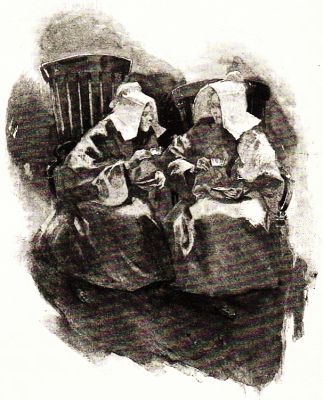
This game was followed by two of the girls taking seats in the middle of the room. They had previously withdrawn and put over their pretty dresses queer-looking old shawls, and covered their chestnut-brown curls with odd-looking bonnets tied under the chin. Then a cup of tea was given to each, and looking intently at one another, slowly stirring their tea meantime, one exclaimed in a high-pitched voice. "You don't say so!" whereupon our hostess inquired, "Who can tell what these girls represent?" and a number of voices replied, "Gossip." At this answer the girls rose, and laughingly threw aside their shawls and hats.
Then the youngest boy took one of the chairs made vacant by the girls. After seating himself, it was noticed that he put a big coat over his lap, and making a great show of threading his needle, he diligently sewed on a button. And the hostess asked, "What does Charley represent?" The children could hardly reply for laughing, for the boy looked so demure and industrious; but after a moment's hesitation there came the vigorous answer, "A bachelor."
Then Aunt Charlotte, an old negro woman, entered; she pretended to be a fortune-teller. And I afterwards learned her coming had been all arranged by the hostess, to whom I had been foolish enough to tell of the advent of my valentine.
She approached me first, and prostrated herself, face downwards, on the floor. "Why, Aunt Charlotte!" I exclaimed, "do get up."
"Lor', honey, I never specs to see de greates' ladie in de lan'."
"Well, stand up," was my agitated reply, "and explain what you mean."
"Bless de chile! I love to think I'm some 'count."
"Hurry!" was my impatient exclamation, "I can't wait." And all my young friends were grouped close around, zealously listening for what the old creature was about to say.
"I mean you'll make de grandes' marriage 'bout here."
"Whom will I marry?" were my now eager though venturesome words.
"Why, de young mars' who sent you de valentine."
I was so provoked with myself that I could have bitten my tongue off, though, after all, it was a most natural answer to give on St. Valentine's night; and thus having decided my future, Aunt Charlotte hurriedly turned to another, and yet another, as both girls and boys pressed forward for their turn. When she reached George Washington I listened closely. She told him he would ride in a coach and six, and that "we've nuver seen sich wondrous time as 'Mars George'll hav'."
When the fortune-telling was concluded, I learned that it was already considerably beyond the time to start home, and therefore speedily made my adieux; a few moments later found me in our high-stepped carriage rapidly rolling out of the Oakland grounds.
"And thus ended the episode which I promised to tell you," said Martha Washington, the wife of the Commander-in-Chief of the Continental army and President of the United States, to the French officer De Grasse at the Peace Ball given in Fredericksburg.
"Pardon, madame; not ended, but rather begun," was the courtly response.
"Oh, what a lovely party!" was the exclamation from many of the attentive listeners. "And why couldn't we repeat it now?" was the immediate question.
"Indeed I shall," said one of the girls, with a decided shake of her long curls. "My very next party will be an old Virginia evening—dresses, dances, games, and all."