U.S.
Reading edition
Postage and Rev. Fine approval sheets. Agts. wanted.
P. S. CHAPMAN, Box 151, Bridgeport, Ct.

This Department is conducted in the interest of Bicyclers, and the Editor will be pleased to answer any question on the subject. Our maps and tours contain many valuable data kindly supplied from the official maps and road-books of the League of American Wheelmen. Recognizing the value of the work being done by the L.A.W., the Editor will be pleased to furnish subscribers with membership blanks and information so far as possible.
Copyright, 1896, by Harper & Brothers.
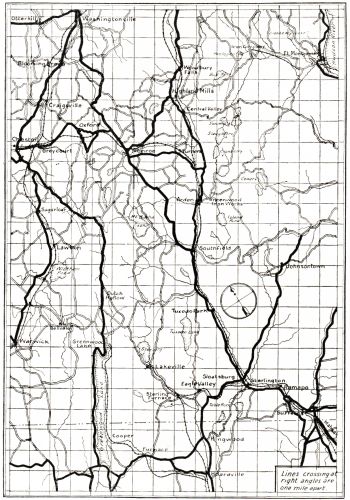
The third stage on the general route from New York to Newburgh by the west bank of the Hudson is given in the map accompanying the Department this week. We spoke last week of the road running from Hackensack or Paterson to Sufferns. This road is perhaps the best route for Newburgh, as it runs through beautiful country, and, on the whole, the roads are the best.
On leaving Sufferns a short run brings the rider to Ramapo, thence a mile or more brings him into Sterlington, and following the railroad he can run direct to Tuxedo Park. The road is very attractive about there, and the road-bed good. From Tuxedo Park continue on to Southfield, keeping to the right here, and following the railroad track to Arden, there crossing the railroad, and running on to Central Valley, Highland Mills, Woodbury Falls, and so on. This is the direct route for Newburgh. A good run, however, is to turn westward at Southfield, leaving the railroad and running to Monroe, and thence through Oxford to Washingtonville, returning thence to Blooming Grove and Chester, through Dutch Hollow to Greenwood Lake, and down the west shore of the lake, turning eastward at this southern end, and running up to Sterlington and Ramapo again through Kingwood and Eagle Valley.
The roads from Tuxedo Park to Greenwood Iron-Works and Central Valley, westward, on the Hudson are not good riding, as there are many hills, and the road-bed is not well cared for. The wheelman is advised, therefore, if he is taking a series of runs through this country, to keep either to the bank of the Hudson, or to the country back from the river. The best way to get from Sufferns (supposing the wheelman to be there) to the Hudson is to run southward through Tallmans, Clarksville, and West Nyack to Nyack, then turning northward, through Upper Nyack, New City, Haverstraw, Dunderberg, to Fort Montgomery, which appears on the accompanying map. This road runs along close by the bank of the Hudson, and most of the time in sight of the river. It is an attractive road, but the road-bed is not in as good condition as the turnpikes in and around Greenwood Lake. At Nyack there is a good stretch of road close by the bank of the river running southward for several miles, which is in capital condition, and is one of the picturesque stretches in this part of the country. No one who rides up this side of the Hudson should fail to take this short run at some time during his trip.
HIS DOG SNYDER.
He was a tattered, weary-looking beggar, and he had hardly commenced speaking before one knew that Germany was his native land. He was in quest of a dog, and Snyder was the canine's name.
"You don't know noddings mid him?" he asked. "Dot vos queer; eferybodies knowed him, 'cause vot mit only vone eye dat don't pother him, on accoundt of he knows noddings of the odder, seein' mit one shust as he seed mit two before, de beoples already don't fergot him. No, he don't answer ven you calls him soon, but come quick ven you shust asks him Snyder. He say pow-wow-wow, unt his tail dot vos lost mit vone-half by a vagon vheel he vag, und he don't vag the end vat he don't have on accoundt of he fergets vat he don't have now.
"Inshtinct, yah; he vos have vonderful inshtinct. You shust pat him mit your hand on his head, und he die for you on accoundt of he knows soon dot you like him, but you hit him mit your stick on de head, und den he suhspect right off dot you care mit nottings for him. His hair vos upon a time vonce peautiful, but und gonsquence of a tramp cat mit scraggy fur he loss some by te handful, und now he don't scratch himself no more; but de cat vat vos 'cause him trouble mit his hair, she don't valk on de fences neider.
"You could told Snyder vot vas so much like himself dot you vould dink he vos dwins. Und you see him you knows Snyder 'cause he vos mitout anoder dog de same as he vas, und now I goes to find my palt-headed doggie;" and the poor old man wandered down the street.
Any questions in regard to photograph matters will be willingly answered by the Editor of this column, and we should be glad to hear from any of our club who can make helpful suggestions.
Owing to the number of questions, we devote the entire Department to answers this week.
Sir Knight Robert Hunter asks if the Premo B Camera, with Rochester Optical Company's single-view lens, is a good hand-camera for an amateur. The Premo is an excellent camera, and the lens mentioned is a good one. This camera is fitted either for films or glass plates.
Sir Knight Frederick Clapp sends a photograph of some greenhouses taken from a kite sent up with a camera attached to it, and promises to send full directions of the manner of taking them. They are quite interesting, and Sir Frederick wants to know if any of the members of the club have ever tried the experiment.
Sir Knight W. D. Campbell asks how long prints made on solio paper and toned in Eastman's combined bath will keep. Prints made on this paper, if fixed and well washed, should keep indefinitely. If after toning they are put for three minutes into a fixing-bath of 1 oz. hypo, to 10 oz. water, it will tend to make them more permanent, as the combined bath does not always fix them enough. Our correspondent is the first member of the club to take advantage of the photographic print exchange outlined in No. 885.
Loe Olds asks if one can purchase a good camera for ten dollars, and wishes the name of some reliable firm, and if one taking a picture 3½ by 4½ would be large enough. A good camera may be had for ten dollars, but would advise getting one which will take a picture 4 by 5 in size. Write the Eastman Company, Rochester, N. Y.; Rochester Optical Company, Rochester, N. Y.; Manhattan Optical Company, or Scovill, Adams Company, New York city, for catalogues.
M. Foster asks for a formula for platino paper; if platino and platinum are the same; a formula for platinum toning-solution; if Rives paper is salted; and if it is necessary to prepare blue-print paper on salted paper. Do not try to make platino paper, as it is a long process, and not always successful. It is cheaper in the end to buy it. Try some of the simpler processes for sensitizing paper. Will send the formula if you wish to try platinum. Platino is a commercial term applied to paper sensitized with platinum. Rives paper is raw photographic paper. Blue prints do not need to be made on salted paper.
L. K. asks what is the matter with his negatives which show, after a few months, spots on the film. From the description of the spots, they are doubtless due to a poor fixing-bath. Will L. K. please give his formula for fixing?
Percy Meredith Reese, Jun., 1210 Mount Royal Ave., Baltimore, Md.; Lesley Ashburner, Media, Pa.; Harry Chase, 175 Summer St., Malden, Mass.; Dwight N. Foster, 35 Pleasant St., Dorchester, Mass.; John N. Prothero, Du Bois, Pa.; John Norton Atkins, Bayonne City, N. J.; J. R. Sixx, 95 Broadway, Paterson, N. J.; R. T. Pobbs, Swedeland, Pa.; L. P. Dodge, 71 High St., Newburyport, Mass; Foster Hartwell, 629 Third Ave., Lansingburg, N. Y.; S. F. Macquaide, 46 Mechlin St., Germantown, Pa.; Vincent Aules, New Dorp, Staten Island; E. V. Bragdon, 87 West Thirty-second St., Bayonne, N. J.; Ernest T. Selig, Lawrence, Kan.; George L. Coleman, 114 Van Buren St., Dayton, O.—wish to be enrolled as members of the Camera Club.
Sir Knight John Norton Atkins asks if the glycerine solution used for keeping films from curling can be used more than once; if the accelerator mentioned in No. 822 may be used with eiko-cum-hydro developer; and if the piece of drawing-paper enclosed in his letter could be used for sensitizing. The glycerine preparation may be used as long as it is clear. The accelerator may be used with the developer mentioned. The sample of drawing-paper did not reach the editor, but if it is pure paper, free from chemicals, it may be used for plain paper. Whatman's drawing-paper is considered pure.