HARNESSING NIAGARA.
Reading edition
BY ELIZABETH FLINT WADE.
Two men were once boasting of their wonderful physical powers, and a story told by one would be immediately capped by the other by the relation of a capability far more marvellous. Suddenly one of them pointed to a church spire which could be seen across the valley, and said,
"Do you see that church spire yonder?"
"I do," replied the other.
"Well, I can see a fly crawling on it! Can you?"
His companion looked at it attentively a moment, and said, slowly,
"No, I can't see it, but," placing his hand behind his ear and leaning forward, "I can hear it walk!"
Something quite as remarkable as the hearing the foot-step of a fly on a church steeple a mile distant was accomplished a few weeks ago, when, by means of a slender wire attached to an ordinary telephone, the sound of the "voice of many waters," situated 500 miles away, was distinctly heard in New York city.
The National Electric Light Association held its last annual meeting in New York, and in the Industrial Arts Building were exhibited the latest appliances of electricity; but of all the wonderful demonstrations of that strange power which slips so swiftly and silently along a slender wire, the most novel, if not the most wonderful, was the transmitting the roar of the Falls of Niagara through the long-distance telephone by means of the power generated by the cataract itself.
The meaning of the Indian name Niagara is "thunder of the waters," and it certainly was a most original idea to place this thunder on exhibition—"thunder on tap," a humorist might call it. The point chosen for collecting the sound was near the Cave of the Winds, where at the foot of the cliff one can get nearer to the waterfall than at any other point. The Cave of the Winds is between Goat and Luna islands, and is reached by the Biddle Stairway, a frail-looking structure built on the face of the cliff, and the adventurous tourist who ventures down this winding stair is almost deafened by the noise of the water as it strikes the great rocks that lie just below him.
MOUTH OF THE TUNNEL.
The mechanical arrangements for sending the sound were very simple. An ordinary telephone, with the necessary apparatus, was placed in a tight wooden box, so that the instrument might be protected from the spray. Wires connected with the long-distance telephone were carried down the side of the cliff and attached to the telephone in the box. From one side of the box projected an immense tin funnel. This was the sound-collector. The rest of the operation was very easy. The current was turned on, and in a few seconds the sound was heard at the extreme end of the line. In the centre of the hall where the electric exposition was held was a working model of the Niagara Falls electric plant; around this model were twenty-four telephone transmitters, and the visitor could not only see the machinery moved by the power generated at the Falls, but hear the ceaseless roar of the great waters.
The greatest distance that electric power had ever before been transmitted was from the Falls of Neckar, in Germany, to a point 110 miles distant. Power for the exposition was to come nearly five times that length, and the occasion was so momentous a one that the gold key which President Cleveland used to set in motion the machinery for the World's Fair was used by Governor Morton to turn on the electric current generated by the Falls. As soon as the exposition was declared open, Governor Morton, according to a previously arranged plan, turned on a current from the Falls power which discharged a piece of government artillery simultaneously in the public squares of Augusta, Maine; St. Paul, Minnesota; San Francisco, California; and New Orleans, Louisiana.
TURBINE READY TO BE LOWERED TO THE BOTTOM OF THE WHEEL-PIT.
The capturing of Niagara and setting it to work is one of the greatest feats of modern engineering. For years engineers have watched the power going to waste down the great cataract, and studied how it could be made available for mechanical purposes. The only device for using it was the building of a hydraulic canal opening out of the river above the Falls, and emptying into it at the edge of the bluff a mile or two below the Falls. Power was thus carried to several mills built on the bank, but it was a mere cipher compared to the great force daily poured over the great precipice, a force which has been scientifically estimated to equal nearly 6,000,000 horse-power, enough to drive all the machinery on the American continent.
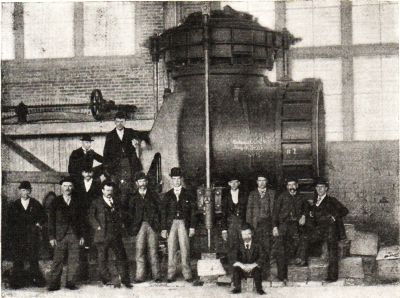
Many plans for using this power were made, only to be abandoned, till Mr. Thomas Evershed, a division engineer on the Erie Canal, devised the scheme of digging wheel-pits above the Falls, placing turbine-wheels at the bottom of the pits, conveying water from the river to turn the wheels—which should be used to furnish the power to generate electricity—and carrying off the waste water through a large tunnel and emptying it into the river. The plan was found feasible, and in 1886 the Niagara Falls Power Company was incorporated by the Legislature of New York. Millions of dollars and the service of the most skilful engineers in the world were employed in carrying out the plan. Work was begun in 1887, and in January, 1894, the first great turbine-wheel was set at work.
THE WHEEL-PIT IN COURSE OF CONSTRUCTION.
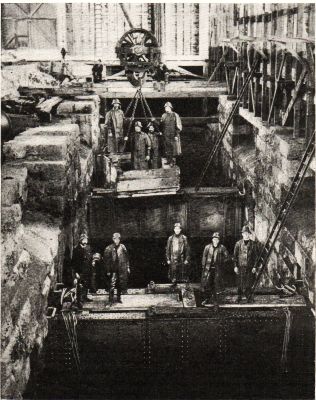
The manner of using a part of the tremendous power of the cataract, though constructed on so gigantic a scale, is as simple to understand as the mechanism of a toy water-wheel, which, placed under a tiny fall of water, turns a miniature windmill on the bank of the stream. An inlet canal 1500 feet long, 500 feet wide, and 12 feet deep opens from the river at a point about a mile and a half above the Falls. A short distance from the side of the canal nearest the Falls, and near the end farthest from the river, are two wheel-pits 160 feet deep, and at the bottom of each pit is a 5000 horse-power Girard double turbine-wheel. From the canal to these pits are head-races fitted with sluices through which the water is admitted to the wheel-pits. Both the canal and the head-races are lined with solid masonry, and the gates which regulate the supply of water are open and shut by automatic levers. In each wheel-pit is an immense iron tube reaching from top to bottom of the pit, made of boiler iron. This tube, called a penstock, is seven feet in diameter, and the water pours down this huge pipe into the wheel-case in which the turbine revolves. A turbine-wheel is a vertical wheel which revolves from side to side like a top, the name being derived from the Latin word turbo, whirling, or spinning like a top.
SECTIONAL DIAGRAM OF POWER-HOUSE.
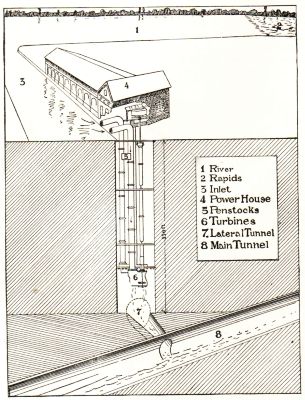
Now a stream of water seven feet in diameter, falling from a height of 140 feet, must cause this mammoth water-top to spin round in its case at rather a lively rate, and so it does, for the turbine shaft revolves at the rate of 250 times a minute, and the speed can be increased to twice that number of times. The vertical shaft of the turbine is attached to a propeller shaft which rises to the floor of the power-house—built over the wheel-pits—where it is attached to a dynamo. Though the dynamos are the largest in the world, they are not the size originally designed, owing to the fact that no cars were large or stout enough to transport them, so the size of the base-plate of the dynamo was limited to one which could be carried by rail from the manufactory to the Falls.
Standing in the visitors' gallery of the power-house and watching these great dynamos whirling round so swiftly that the eye can scarcely perceive their motion, and remembering that it is caused by the expenditure of but a fraction of the power flowing over the Falls, one can form some idea of the great force which it has so long been the dream of engineers to turn to account.
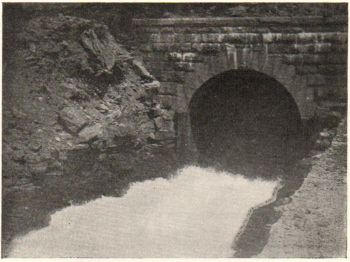
Almost as great a feat as the digging of the wheel-pits and placing the turbines at the bottom, was the excavating of the tunnel to carry off the waste water. This tunnel, which is 7000 feet long, starts near the bottom of the wheel-pits, runs under the city, and empties into the river just below the suspension-bridge. It is horseshoe shaped, is 21 feet high, and 19 feet wide, in the curve. It is lined with brick, overlaid with rubble above, and the outlet is lined for 200 feet back with heavy cast-iron plates. The water does not run directly into the tunnel from the wheel-pits, but flows into it through a lateral tunnel or tail-race. This tail-race enters the main tunnel at an angle of sixty degrees. Both tunnels are horseshoe shaped, and where they unite they each curve differently, and it required a skilful mathematician to calculate the cutting and fitting of the stone for the bisecting of the arches.
It is interesting to see how this powerful machinery is kept in working order. From a circular opening in the floor of the power-house a winding staircase descends to the elevator landing. From this landing one may pass directly under the electric generators and see the various pipes which convey oil and water to the different parts of the machinery. One pipe carries oil to the upper, and a second pipe oil to the lower, bearings of the dynamos. A third pipe allows water to pass to the cooling chamber of the upper bearings, and a fourth, water to a similar chamber in the lower bearings.
The tank which holds the oil supply is placed near the roof of the power-house. After the oil has passed to the bearings of the dynamos and shafts it is conducted into a filtering cylinder; the clean oil runs into a tank below the cylinder, from which a pump forces it back into the supply tank. The pumps are run by the waste water in the bottom of the wheel-pits.
The main-shaft bearings are oiled in a novel manner. An immense iron cup, large enough to serve as a drinking-cup for the greatest of Gulliver's Brobdingnagians, is attached to the revolving shaft below the bearings. A pipe dips into the oil with which the cup is filled, and the centrifugal force of the revolving shaft is so great that it forces the oil up through the pipe to the top of the bearings, which it thoroughly oils, and the waste oil finds its way back into the cup. All that is necessary to supply the cup with fresh oil is to open a valve at the bottom, the dirty oil runs into the filtering cylinder, and the cup is filled with fresh oil from the supply tank.
An elevator descends to the bottom of the wheel-pits, where there are four galleries which enable the engineers to pass round the turbines and examine the workings. On the upper elevator landing one may see the gearings which connect the governor with the dynamos and with the turbine shaft, and the perfectly balanced levers which open and close the water-gates.
One of the interesting features of the power-house is a travelling-crane, which commands every portion of the floor of the building, and is capable of handling the largest piece of machinery in the works. If anything goes wrong with any part of the machinery, it can be removed with the greatest expedition, and a similar piece fitted in its place by means of this useful crane.
In July a company was incorporated under the name of the Cataract Power and Conduit Company for the purpose of furnishing electric power to the city of Buffalo from the Niagara Falls plant. Niagara Falls at once became the centre of interest for manufacturers, engineers, electricians, and scientists, and two days after the company was incorporated the electric plant was visited by a large party of distinguished men from different parts of the country.
Among the number was the great electrical magician Nikola Tesla, who believes that sooner or later the electricity in the earth may be pumped out of it at any point where it may be needed. The opinion of Mr. Tesla on the possibility of transmitting the power from the Falls any considerable distance was awaited with a great deal of eagerness.
"The project is sure to be successful," said Mr. Tesla, after inspecting the marvellous electrical machinery and viewing the almost unlimited capacity of the water-power.
The contracts for constructing the transmission line were let at once, and on November 4—two days after the election of the next President—Buffalo will be receiving power from the Falls of Niagara. The lines through which it is to be sent will be capable of transmitting 40,000 horse-power—enough to turn all the wheels in the Minneapolis flour-mills and whirl all the spindles in busy Holyoke.
The present power-station at the Falls, when fully equipped, will contain ten dynamos, the combined capacity of which will be 50,000 horse-power. Besides this station the company has a permit for constructing another canal the same size on the American side, and a franchise for a similar work on the Canadian side, provided the work is begun in three years from the granting of the franchise.
Everything connected with this work is on so gigantic a scale that it will not be surprising to learn that the tunnel through which the waste water is discharged is the largest hydraulic tunnel in the world, and of sufficient size to carry away enough water to develop 120,000 horse-power. Even this great volume of water diverted from its natural channel will not perceptibly lessen the 7000 tons which leap over the precipice every minute.
The end of the tunnel opening into the river is fifty feet lower than at its beginning, and as there are no rocks or stones to impede the passage of the water, it slides over the smooth floor at a tremendous speed, taking but a little over three minutes from the time that it enters the tunnel before it reaches the outlet. It rushes out of the tunnel with such force that it creates a cross-current far out into the river.
Knowing from whence it came and what it has been doing, one cannot but think, as he sees it come tumbling, leaping, and roaring out of the dark underground passage, that it is like a boy who has just finished some irksome task and is at last free to run and shout and play.