RABBIT-HUNTING IN THE SNOW.
Reading edition
BY ANNIE T. ASHMORE.
Jim and Ned were evidently bound to be good business men. Some of their plans for money-making were very peculiar. They lived side by side on Staten Island, in places where there was a magnificent view of the bay and harbor, and whence incoming and outgoing steamers could be seen to great advantage. They fitted up an office in a room in the attic of Jim's house, hung up a sign, "Shipping Office; latest news furnished of incoming and outgoing crafts"; and as they went at it in a systematic manner, had a capital spy-glass, and had been drilled from their earliest infancy in the knowledge of the different boats, they were often called upon by their neighbors to tell when a ship was due, or if it had already entered the Narrows. For this information they charged varying sums; and while not on the high-road to fortune, still made enough to provide many bottles of sarsaparilla, and more chewing-gum and bolivars than were at all good for the digestion.
Another scheme was selling eggs to their respective mothers, and they really had a very good chicken-yard for a time, while a mysterious account-book which bore the heading "JimandNedeggs" occasioned much merriment among their families (of course unknown to the boys). But latterly business had been dull. The best hens had succumbed to an epidemic, nobody wanted to know about the ships; it was early winter, and there were no more walks to be raked; in fact, a financial crisis was fast overtaking the two partners. Something had to be done, for there were Christmas presents to be bought, new bob-sleds to be had, and of a kind more dangerous than any they had yet risked their lives on. It was evident that only serious and concentrated thought could extricate the firm from the situation in which it was placed.
"Ned, we must think of some way in which we can make money. I was talking to Tom about it the other day, and all he would say was, 'Marse Jim, you leave it to me, and I'll think out a plan.' But not a syllable will he say as to what the plan is. He came up to the dining-room last night and called me out, said he had something of importance to tell me, and all it was, he asked me to ask mother for five dollars. Now you know as well as I do that mother won't let me have another cent for I don't know how long. She's mad because that money she gave us to put into the incubator was all thrown away by our forgetting about it, and leaving the eggs in there till the lamp exploded, and the eggs too. No, there's no use; we've got to find our way out ourselves. What do you think of our going out on a musk-rat hunt, and then selling the skins?"
"All very well," said Ned, the more prudent of the two; "but where are you going to find musk-rats, to begin with? How are you going to catch them when you do find them, and who's going to skin them?"
Blank despair settled down upon the two boys' countenances, and two more unhappy-looking individuals have, fortunately, rarely been seen. Suddenly around the corner of the house appeared a colored boy of about eighteen, black as the ace of spades, but grinning from ear to ear with good humor and amusement.
"What you sitting here in the cold for, you boys? Marse Ned, Marse Jim, you ought to be ashamed of yourselves. If missus found you sitting in the cold, she won't give you no more money for your 'lowance, and you dun bus' now, you tole me."
"Oh, Tom, do tell us a way to get out of this—a way to make money!" said the two boys, simultaneously.
"Well, this nigger ain't much good making money, but you two boys come in the black hole and talk it over, and Tom'll help when he can."
The black hole was in the cellar where the furnace was, and was a favorite resort of Tom's. As they talked now Tom looked up suddenly. An idea had come to him, and he said: "Marse Jim, Marse Ned, you better raise rabbits. Then ask yer mother to let me go to New York jus' befo' Christmas-time; I'll sell 'em in the streets, fifty cents and dollar apiece. Rabbits don't cost nuffin' down hyar, to begin with, and we'll make so much money that you boys will give Tom 'nuf to go down South with an' see his poor old father and mother."
The scheme sounded very plausible, told in Tom's excited way; but then Ned suddenly said, "Tom, where are we going to get the rabbits to start with?"
That was rather a poser. But Tom had his answer ready.
"You boys, now listen to me. I wah just now chasing a rabbit harder'n I ever chased one befo'. Dat ah rabbit, he lives down the big hedge round de garden; he got sisters, brothers, cousins, lots of 'em. We ketch father and mother rabbit, then when we have lots of little rabbits we'se all right. Tom'll build big house for rabbits, keep it outside dar in the coal cellar, and feed 'em every day regular; no trouble at all after we catch father and mother."
The boys knew what rabbit tracks looked like in the snow, and the plan proposed by Tom was that, the first morning after a light snow-fall, they should get up early, and follow the tracks to the part of the hedge where the rabbits lived. He would every night put out some chopped carrots and turnips, and just as soon as the rabbits appeared, they all being in hiding themselves, jump out and catch them. After a long consultation they agreed the old plan was the only safe one—that of tying a string around their big toes, hanging the string out of their respective windows down over the piazza, then Tom would pull the string attached to Massa Jim's toe, and as soon as Jim was dressed, he'd run over and pull the string attached to Ned's. This plan had its disadvantages in summer, for mischievous elder sisters and brothers who sat up late in the evening had a nasty way of pulling the string before they went to bed, and more than once the boys had gotten up in the middle of the night, accordingly, and dressed themselves to go out, only to be met downstairs by the other members of the family with the news that it was still night, and not morning. In December few people sit up on the piazza, so there was less danger, and finally that was settled upon as the best way to do.
Several anxious days passed without any more snow, and the parents of the boys could not understand their sudden interest in the weather, as they generally didn't care at all. They read the weather reports until their eyes ached, but the only snow in sight was out in western Dakota, and it seemed as if it never would come to this region of the country. But as all comes round to him who will but wait, Jim was awakened one night—or as it seemed to him, night—with a hideous dream in which a rabbit was eating off his toe, to find that the string was being violently jerked. It didn't take him half a minute to get to the window, and when he looked out there was the sun just coming up and the ground covered with the loveliest, whitest snow. Jim did not wait to perform a very extensive toilet, and was over at Ned's, pulling the string attached to his toe, in less time than it takes to tell about it. Then as soon as Ned got out the two boys went in search of Tom, who was in a great state of excitement, and who had collected together two other darkies. The air was decidedly cold, but nobody minded it, so great was the excitement; and when some tiny little marks were seen in the snow the boys felt as if it were the greatest moment of their lives, all the more delicious because they all had to keep absolute silence. They went in single file, following down the little footfalls of the rabbit, when suddenly, just ahead of them, they saw the animal they were in search of, and not one only, but three of them. They looked so pretty nibbling away there at the carrots and turnips, and so wise with their long ears, that the boys could not bear to have them interrupted, and watched them for some little time.
A NICE LONG CHASE HE LED THEM OVER HILL AND DOWN DALE.
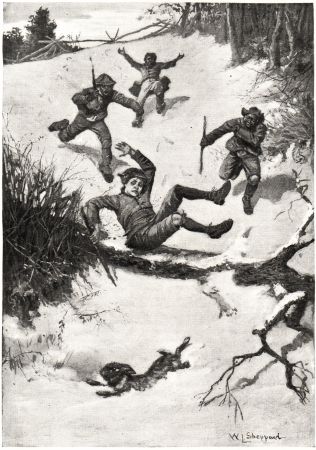
Suddenly, as though scenting danger in the air, the biggest fellow sat up on his haunches, then gave a sideways leap, and went down the hill with big bounds. This was too much for the darkies to stand, and with wild whoops of delight they followed, Jim and Ned also joining in the chase. But Master Rabbit did not intend to be caught so easily, and a nice long chase he led them over hill and down dale. One of the darkies who was holding a big stick flung it after the rabbit, and came within an inch of hitting him; but that put an end to the fun, for while Jim and Ned wanted to catch the rabbits, they were not willing to see them killed, and they called to Tom to stop—the game was up.
"Tom," said the boys, "we want to catch those rabbits, but we do not want to kill the animals."
"All right, massa," said Tom, "we catch 'em, not kill 'em"; and like a general marshalling an army, he gave each boy directions where to go. They formed in a ring, and gradually drew nearer together, until the rabbit lay quite still, utterly tired, and quite at the mercy of his captors. Tom then slipped him into a bag, which he slung over his back, and they went back to where the other rabbits were feeding again. They had returned, and by a little strategy another one was caught, and the boys declared they had had enough of it for the day. They had gotten two fine rabbits, and soon had them safely ensconced in the rabbit-hut. They took good care of them, and with Tom's constant aid and attention the scheme proved a good one; and yet, strange to say, the boys never went rabbit-hunting again after that first morning. They could not forget how piteous the poor little animal had looked when the darky wanted to throw the stick at him, and as they had enough to get along with, they concluded they'd rather try another plan next time.
Colored people have a great weakness for what they call hares—they like them almost as well as they do watermelons—and it is sad to say that the three darkies who went on that expedition went on many another before the winter was over.

Lawrenceville defeated Andover in their annual football game a week ago Friday. This result was doubtless a surprise to those who had witnessed the Exeter-Andover game of the previous week, but it was an event not entirely unlooked for by the Lawrenceville coachers.
The game was interesting and exciting from start to finish, and the result doubtful until the last moment of play. The strength displayed by Lawrenceville was no doubt largely due to the good advice they have been getting during the past few weeks from Princeton football-players, who had been trying to knit some sort of a team out of the many individuals that had been developed by the work of the early fall. Lawrenceville had hoped that this method would culminate in a general successful movement by the entire team, and after a week's hard work just this result was obtained. I do not think that Lawrenceville has ever before put into the field an eleven that played so steadily as these men did in the Andover game. The necessity for steadiness was urged upon the players, and they were well aware that this must be their only reliance, since no man upon the team could be termed a brilliant player, and looked to for some dashing performance at a critical moment.
The game progressed most satisfactorily, and during the entire afternoon there was not one word of protest or argument from either side. This was largely due, no doubt, to the excellence of the officials—Messrs. Alexander Moffat and Clinton T. Wood. The Lawrenceville players were penalized a great deal in the first half, some sixty yards being lost for off-side play and interference. This spirit of restlessness, which causes men frequently to be over-anxious, proved a good thing in the end for Lawrenceville, in spite of her heavy penalties, for as it became controlled during the progress of the game it was transformed to a quickness and alertness that proved most valuable.
On the kick-off in the first half, by Andover, Lawrenceville returned the ball, which was fumbled by Elliott of Andover. Of the two teams I had expected to see Lawrenceville do most of the fumbling, but it was Andover that proved the weaker of the two in this matter. I had expected likewise to see Andover kick a great deal, but she did not adopt these tactics, her line being unable to protect her backs. The Andover full-back kicked but four times in his regular position; the rest of the time he kicked from the half-back's position, and consequently his kicks were high and short. The best feature of Andover's work was the interference. This was formed quickly, and was very effective. On four occasions runs were made around the Lawrenceville ends, which almost proved disastrous. Andover's ends were superior to the Lawrenceville players, and Captain Richards, of Lawrenceville, was fairly outplayed by his opponent in the first half. In the second half, however, Richards held his own.
As to generalship Andover was inferior to Lawrenceville. This may have been due somewhat to the absence of Captain Barker in the first half, although matters did not improve materially when he entered the play in the second half. The Lawrenceville full-back made long and sure punts, and on several occasions her quarter-back kicked effectively for a gain of several yards. With the exception therefore of the ends and Captain Richards, in the first half Lawrenceville may fairly be said to have outplayed Andover. I think, however, that to these exceptions should be included Elliott of Andover; he is really better than either of the Lawrenceville half-backs.
As to the game itself: After Andover's kick-off and Lawrenceville's return, the Jerseymen got the ball on a fumble, and by an attack on the centre and tackles worked down to the twenty-yard line. A quarter-back kick brought the ball to the five-yard line, where Andover secured it on downs. Andover kicked to the twenty-yard line only, and after being rushed back to the fifteen-yard line, the full-back missed a goal from the field by a few inches. On the kick-off from the twenty-yard line Lawrenceville advanced the ball surely down the field by short plunges through the line, and the first touch-down was made by Cadwalader, who also kicked the goal. On the kick-off Lawrenceville was successively penalized for off-side play until the ball was on her twenty-yard line. By the criss-cross trick White ran for Andover's only touch-down around Lawrenceville's right end. The ball was punted, but the goal failed. On the next kick-off Lawrenceville braced up considerably, both as to playing and keeping on-side. By short rushes around the ends and through the line she had the ball on Andover's one-yard line, on the first down, when the first half was called.
The second half began by Andover playing very fiercely, but Lawrenceville played better than ever. After ten minutes' play Lawrenceville punted to the one-yard line, and when the ball was punted out by Andover, Lay heeled it on the twenty-five-yard line. Cadwalader failed on the place kick. On the kick-off again, Andover by short plunges through the line, and two runs around the end for fifteen and twenty yards respectively, had the ball on Lawrenceville's five-yard line. Lawrenceville here made a strong stand. On the second down Andover surged to within three feet of the goal-line; on the third down Andover was pushed back five yards, and the ball changed hands. Here Cleveland made a fumble, and the ball was Andover's again on the four-yard line. Lawrenceville held Andover again for the four downs, and Mattis dropped back of the goal-line for a punt. The ball struck an Andover man in its upward course, but was not retarded sufficiently to be caught. Dudley, Lawrenceville's end, who had started down the field to tackle Andover's full-back, got the ball, as it failed to go within twenty yards of the Andover full-back. Dodging White and Barker, who were playing back, Dudley made the play of the day, running eighty yards for a touch-down. Cadwalader again kicked the goal in the gathering gloom. On the kick-off Lawrenceville held the ball for some minutes, and it was not until this time that she was able to make any ground around Andover's ends. The ball was on Andover's twenty-yard line when time was called, on account of darkness, with a few minutes yet remaining to play.
BROOKLYN HIGH-SCHOOL FOOTBALL TEAM.
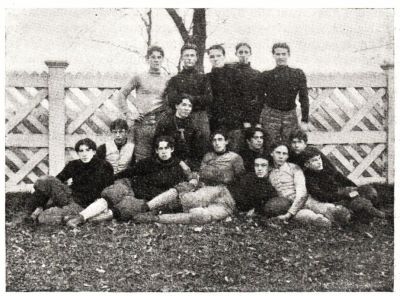
Although the final game in the championship series of the Philadelphia Inter-Academic League was not played until a week ago to-day, that game being between Penn Charter and Germantown, Cheltenham Military Academy won the pennant by defeating Germantown on November 13th (16-10). The game was a hotly contested one, and the feature of the play was Cheltenham's team-work. The soldiers' superiority in this matter won them the game.
On the kick-off Cheltenham got the ball, and by steady gains pushed it over for a touch-down, from which a goal was kicked. A little later on, Lincoln of Cheltenham secured the ball on a fumble by Germantown, and by a fine run placed it behind the posts. The goal was kicked. Up to this time Germantown had not been able to gain any ground worth speaking of. About five minutes before time was called Perkins took the ball on a criss-cross, and by a run of thirty yards around right end touched it down in Cheltenham's goal. Pearson kicked the goal. This ended the scoring in the first half, the game now standing 12 to 6 in Cheltenham's favor.
In the second half Germantown, by using the Pennsylvania style of guards-back play, scored another touch-down, but failed at goal. At this point Cheltenham braced up, and by steady plunges through the line and one end run scored a touch-down, but failed at goal. Time was called soon after, with the ball in Cheltenham's possession on her opponents' ten-yard line. Score—Cheltenham, 16; Germantown, 10. For Cheltenham, Potter and Boyd did good work, while Flavell, Perkins, and Newhall excelled for Germantown.
Cheltenham deserves credit for her fine showing this year. The school is by long odds the smallest in the Association, yet by hard practice they have developed team-work and interference that would do credit to a college. Vail, the Pennsylvania quarter-back of '93, coached the team, and by his untiring energy infused them with that snap and dash so essential to good playing.
TAFT'S SCHOOL (WATERTOWN, CONNECTICUT) FOOTBALL SQUAD.
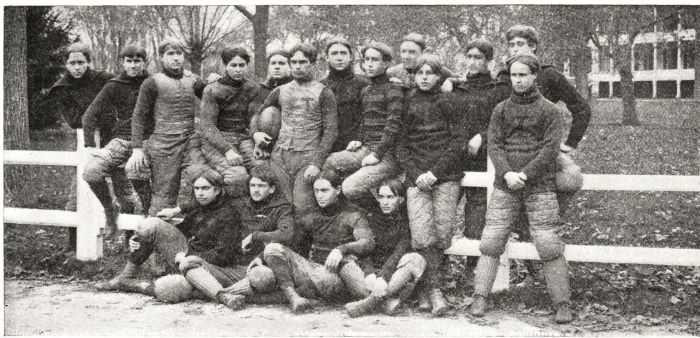
A very strong team for a school of sixty boys has been developed at Taft's School, Middletown, Connecticut, this fall. At the time the accompanying picture was taken the team had played six games, all but one being against much heavier opponents than themselves, and had not been scored against. Their weight averages about 148 pounds, and the players are nearly all strong and heavy. Their success is due, not to brilliant plays of individual members, but to team-work, which they have brought up to a very high standard.
If any member of the team may be said to excel the others, perhaps Townsend, at full-back, does the best work. In the game against Cheshire Episcopal Academy he broke through the opposing line, dodged one half-back, threw off their full-back who tackled him, and after a run of sixty-five yards made a touch-down. In the line, Welch, right guard, probably offers the strongest and steadiest game. Merriman, at centre, Guthrie, left guard, and L. White and Bell, tackles, are all well skilled in blocking, making openings, breaking through, and hard tackling. Lloyd and Barnett, the ends, are sure tacklers and swift runners. O. White, at quarter, is quick and generally accurate. G. and J. Lear (the captain), the half-backs, are both heavy plungers and hard tacklers.
Shady Side Academy of Pittsburg was again defeated by Kiskiminetas on November 16th last—the score, 12-4. McColl, the Kiskiminetas right half-back, was the star player of the day; by his splendid running he scored two of the touch-downs credited to his side. The first touch-down was scored by the winners a few moments after play began, but S.S.A. took a brace immediately afterwards, and the ball was kept slowly travelling up and down the field. The S.S.A. line was very good, and at no time was Kiskiminetas able to make any very considerable gains through it. Brainard and Irwin stopped a number of plays through the centre. Aikens did a good deal of fumbling, but fortunately none of his fumbles proved very costly.
The interference of the Kiskiminetas team was considerably superior to that of Shady Side. Beeman's kicking was accurate and quick, and he frequently put his side out of danger by a timely punt. McConnel distinguished himself by his tackling, and especially at one time, when McColl was making for the goal-posts with no one in his way but Shady Side's quarter-back. In the second half, Kiskiminetas started off with another rush, and scored almost immediately. Thereupon the Shady Side players gathered themselves together again, and managed to keep the play in the enemy's country for the rest of the half. Toward the close of the half Beeman got around Montgomery and scored for Shady Side, but no goal resulted.
The best playing for Kiskiminetas was done by Montgomery, McColl, and Aikens. Montgomery at end was a good tackler and a speedy runner. McColl seemed indefatigable, and mostly ran with the ball. Captain Aiken interfered well, but was not as good a quarter-back as McConnel. For S.S.A., Captain Schildecker broke through and made several good tackles. Irwin played a better game than he has played yet. He is strong, bucks the line hard, but does not use his head enough. Neither of the ends put up their usual game. Arundel got into the play more than he has done before, and made some hard tackles. On the whole S.S.A. tackled better than Kiskiminetas, and they had plenty of opportunities for practice, as the ball was mostly in their opponents' possession.
The Madison High-School has again won the championship of the Wisconsin Interscholastic League by defeating, 42-0, the Milwaukee East-Side High-School on November 14. The game was played on a slippery field, and the Milwaukeeans apparently had an off day. Madison secured the ball on the kick-off, and scored three touch-downs before Milwaukee had really been able to find out what the ball felt like. When at last Milwaukee did secure possession of the leather her players managed to work it slowly up the field, but time was called before any decided advantage had been gained.
In the second half Milwaukee again had little chance for aggressive play, having the ball in her possession but once. Madison had things practically all her own way. The weakness displayed by the Milwaukee East-Side High-School team is probably due to the strict rules recently adopted by the faculties of the various High-Schools of Milwaukee. It is probable, for one or two seasons to come, that these rules will to a certain extent cripple teams that have hitherto had little to regulate their style of make-up, but in the end I feel sure that the regulations laid down by the faculties will prove of the greatest benefit to amateur sport in Wisconsin.
In the game between Madison High and the South Side High-School of Milwaukee, the Madisonians were again the victors, 14-4. The game was played on November 7, and was close all the way through. Madison scored first on a fluke, but after this she outplayed the Milwaukee team. The captain of the South Side High-School team did the best work for his side, while Curtis and Anderson did the best work for Madison.
The football season in Chicago is nearing its close. The most important of recent games were those played on November 18, between Lake View and North Division, and Northwest Division and West Division. Lake View won its match, 18-6. Everybody played hard, since the result of that game would put one of the teams into an assured position for fourth place in the League. In the first half the score was 6-6, but North Division could not keep up the pace, and Lake View had an easy time of it in the second half.
"A PRIMER OF COLLEGE FOOTBALL."—By W. H. Lewis.—16mo, Paper, 75 Cents.
The Graduate.
THE EFFICACY OF A COUNTERSIGN.
While Colonel Gillam, with the Middle Tennessee regiment, was occupying Nashville during the late war, he stationed sentries and patrols in all the principal streets of the city. One day an Irishman who had not been long enlisted was put on duty at a prominent crossing, and he kept a sharp and faithful watch. Presently a citizen came along.
"Halt! Who goes there?"
"A citizen," was the response.
"Advance and give the countersign."
"I have not the countersign," replied the indignant citizen, "and the demand for it at this time and place is unusual."
"Well, begorah! ye don't pass this way until ye say Bunker Hill."
The citizen, appreciating the situation, smiled and advanced to the sentry, and cautiously whispered the magic words.
"Right! Pass on!" and the wide-awake sentinel resumed his beat.
FALSE ECONOMY
is practised by people who buy inferior articles of food. The Gail Borden Eagle Brand Condensed Milk is the best infant food. Infant Health is the title of a valuable pamphlet for mothers. Sent free by New York Condensed Milk Co., New York.—[Adv.]