THE MAKING OF CANNON PROJECTILES.
Reading edition
BY FRANKLIN MATTHEWS.
For twenty-five years the men who make material used in warfare have been engaged in the sharpest kind of a contest between themselves. On the one side they have been trying to make armor so tough and strong that it could withstand the heaviest shots, and on the other side they have been trying to make projectiles, which is another name for big bullets, that will go through this armor. Sometimes the armor men have been ahead, and sometimes the projectile men have been foremost. The armor men have usually forced the fighting, and then the projectile men have matched them. At present the projectile men say they are ahead, and that the armor men must make armor tougher and harder or they will be beaten.
TWO THIRTEEN-INCH SHELLS. One having pierced and the other been stopped by armor plate.
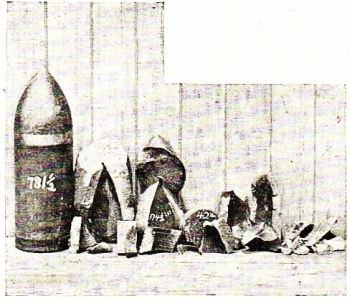
All this struggle grew out of the war between Germany and France a quarter of a century ago. The experts noticed then that the cannons and powder were wasting a great deal of force, because the projectiles they threw couldn't begin to carry all the energy of the weapons. At once scientific men began to make a study how to produce projectiles that would do the full work of the guns, and year by year they have been improving these enormous bullets, until now marvellous results have been reached. A writer who made a study of these results said, not long ago, that the weight of the projectiles in a broadside in 1779 from the Bonhomme Richard, Paul Jones's famous flag-ship, which carried forty-two guns, weighed only fifty-seven more pounds than the shot of one of the 10-inch guns of our present second-class battle-ship Maine. The broadside of the guns of our famous old Constitution, in her fight in 1812 with the Java, weighed sixty-three pounds less than the shot of one of the 12-inch guns on the Monterey of the new navy. The twenty-three guns of the well-known Pensacola, the ship that did marvellous work in running by the batteries at New Orleans in 1862, in our civil war, threw less in a single discharge than two of the 13-inch guns of our first-class battle-ship Indiana could throw to-day. There is no use in having big guns and improved powder unless you have strong and tough projectiles to convey the power of the guns and powder against the target at which you are shooting. The experts put this in a different way by saying that the projectile is "the vehicle of the energy of the gun." This is a dry and scientific way of saying that there is no use in having a giant's strength if you have only pebbles to throw. We can all understand that.
There is no secret about the making of the big cannons in these days. There are many secrets, however, in the making of the powder used in these guns. There is much more secrecy in the way the projectiles are made. In fact, so secret is the process by which these enormous bullets are made that not even the naval officers, who are stationed at the factories where they are produced to see that each projectile answers the requirements, are allowed to witness the process of manufacture. The naval officers are not supposed to know what goes into the make-up of these bits of steel, except in a general way, nor how they are hardened so that they may pierce thick plates of toughened steel. I am sure, therefore, that those of you who read this will not expect me to reveal these secrets. Even if I knew them—and I confess that I don't—I couldn't be expected to tell them, and I am inclined to think that, after all, as is the case with secrets usually, they wouldn't be of much use to us after we did find them out. They would be as dry and as uninteresting as the hardest kind of a problem in arithmetic or algebra. When all would be told, we should probably find that they consisted of a lot of strange letters and figures, such as they use in chemistry, and there would be no pleasure in reading about that.
TESTING PROJECTILES ON ARMOR PLATE.
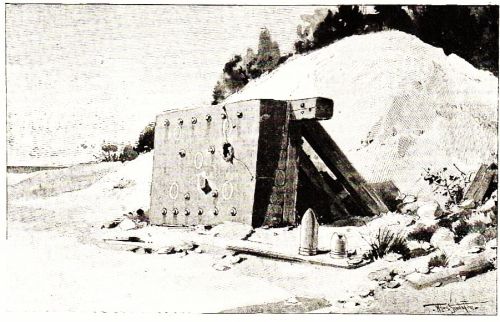
Still there are many things about projectiles that are common property, and we may talk about them freely. Every one must know that projectiles are made from hardened billets of steel, and that they are heated and rolled and pounded until they are of the desired shape and strength. Certain chemicals are put into them to give the steel additional strength, and the most careful adjustment, even to a one-thousandth part of an inch, is made when the projectiles are shaped finally. The test of the size and shape of these missiles is so thorough that the most delicate work is necessary in finishing them. You look at a 13-inch shell. It is probably three feet high, and weighs about 1100 pounds. It is anything but a delicate-looking object, and certainly the work it is intended to do is not delicate. A 13-inch shell, which is the largest size made in this country, is about as robust an affair as human skill has yet devised. To test such a shell two slender steel rings are used. One is two-thousandth part of an inch larger in diameter than the required size of the shell, and the other is two-thousandth part of an inch smaller. The larger ring must pass freely over the projectile, and the smaller ring must not pass over it. When one thinks of the difficulty of pounding or rolling a heated piece of ordinary steel into such a perfect shape, he can see what a delicate task it must be. But think how much more difficult it must be when certain alloys are put into the steel to make it so rough that it can be made to pass through a plate of hardened armor, say seventeen inches thick. Probably no more delicate mechanical work exists than in shaping these projectiles.
LOADING 13-INCH GUNS WITH 1100-POUND SHELLS AND POWDER CHARGES.
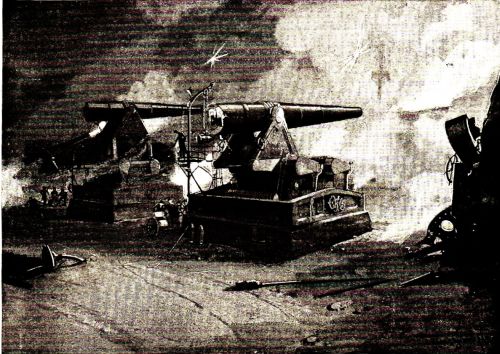
There are five places in this country where the projectiles for the cannons of the army and navy are made. Most of them use processes which are secured from Europe. The fewest possible number of persons, both in this country and abroad, know the secret of their production. The workmen in the factories do not know the various steps and compositions of the metals they use. Aside from the owners of the process and the chemists in their employ, almost no one else knows the secret. Each workman only knows his own part, and if they should all get together and each should tell what he knows, their combined knowledge would be of little value to them in discovering the secret. The chief places of manufacture in this country are at the Midvale Steel-Works, in Philadelphia, where the famous Holtzer projectiles are made; the Carpenter Works, at Reading, Pennsylvania, where the Carpenter projectiles are produced; the Wheeler-Sterling Mills, in Pittsburg, where the Sterling projectiles are made; the Johnson Works at Spuyten Duyvil, New York; and the United States Projectile Company's Works in Brooklyn. The three first named produce the larger projectiles used in our guns. At the Midvale Works, through which I had the pleasure of going by courtesy of the president, Mr. Harrah, before I wrote this article, one may see many picturesque things in the manufacture of steel, and it is possible that one may look upon some of the more rudimentary processes of projectile-making without knowing it; but when one comes to the place where the projectiles are really made, he finds himself facing a big fence with a locked gate, and a sign saying that no one, not even those employed in other work about the immense establishment, is permitted to go inside the barrier. A big bell hangs outside the gate, and if one wishes to speak with any one inside the enclosure, he must ring that and call out the man. There is a big open cistern outside, where the specially prepared water used inside the mill is collected, but that is all one can see. Inasmuch as all this secrecy is necessary to the welfare of our country, I am sure that the curiosity of all patriotic persons should stop at this point, and we must all go away satisfied and even pleased with all these precautions.
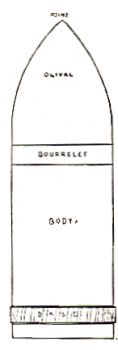
THE PARTS OF A SHELL.
Projectiles are of three kinds: the armor-piercing, the semi-armor-piercing, and the ordinary bursting projectiles, commonly called shrapnel. We are confining most of our efforts at present to making the armor-piercing and the semi-armor-piercing projectiles. The armor-piercing shot are practically solid pieces of metal. The semi-armor-piercing projectiles are hollow, and contain a bursting charge, usually of ordinary powder. The solid shot are for use in the large guns of ships, and are intended to pierce the armor of battle-ships and wreck their machinery. They simply break up the armor of a vessel. The semi-armor projectiles are for the same purpose, and also especially for use in mortar guns. These guns are short-muzzled affairs, and they throw their shells high in the air, so that they may come down on a deck, burst, and pass clear through a ship's bottom. The chief defences of New York harbor consist of a large battery of these mortar guns in the trees and behind the sand hummocks at Sandy Hook. It is estimated that only one out of two hundred shots that they fire into the air with a high curve will strike a war-ship attempting to pass into the harbor, but it is also known that one of these shots will pass through any ship from top to bottom, and, bursting as it passes through, will sink any vessel afloat. A 13-inch semi-armor-piercing projectile carries about fifty pounds of powder inside, and it is exploded by percussion—that is, by the shock of contact with a solid substance. The shrapnel shells contain bullets of various sizes, and they explode on percussion. Their object is to scatter bullets about a ship's deck and clear it of men, rather than to sink the ship.
A projectile is useless, provided it is of the solid kind, if it breaks in pieces when it hits its target. The energy of the gun and powder is all used up in breaking itself to pieces. If it passes through armor without injuring itself at all, the full energy of the gun is sent against the target, and the projectile does its complete work. A projectile is supposed to pass through armor one and one-eighth times its own diameter in thickness—that is, an 8-inch projectile is supposed to be a match for 9-inch armor, and so on.
There are five distinct parts to every projectile. They are the point, the ogival, the bourrelet, the body, and the base. The point, of course, is the extreme forward end; the ogival is the rounded part just behind the point; the bourrelet is a bright band of steel where the rounded part ends—it is intended to fit the bore of a gun closely, and with a tight grip; the body is the long, straight part; and the base is the flat end, with a band which grips the rifling of the gun, by means of which a revolving motion is given to the projectile as it is hurled against its target.