ADVERTISEMENTS.
Reading edition


This Department is conducted in the interest of Bicyclers, and the Editor will be pleased to answer any question on the subject. Our maps and tours contain many valuable data kindly supplied from the official maps and road-books of the League of American Wheelmen. Recognizing the value of the work being done by the L.A.W., the Editor will be pleased to furnish subscribers with membership blanks and information so far as possible.
Copyright, 1896, by Harper & Brothers.
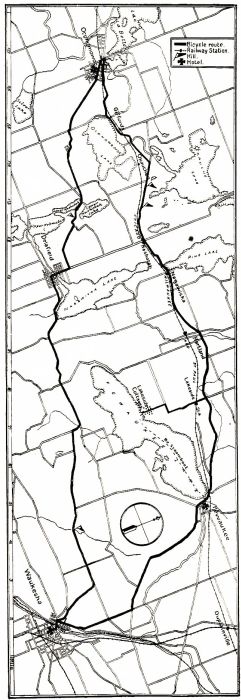
This week we give one of the best short trips in the vicinity of Chicago. To take the trip, leave Chicago some afternoon by train, say Saturday, planning to arrive at Waukesha in time for supper. Begin the run early enough next morning so that you can reach Oconomowoc before the heat of the middle of the day. It is possible to either take breakfast at Waukesha, or to merely have a cup of coffee, and plan to eat breakfast at Pewaukee, at the head of the lake of the same name. The road is easily found, running north and northwest from Waukesha. Follow the railroad for a short mile, then take the left fork and run out two miles, after turning left again, before reaching the river, and follow along on the westward side of this stream into Pewaukee. The distance is about five miles and a half. After breakfast you can either take the steamboat down the lake to Lakeside Cottages, or run out across the Chicago, Milwaukee, and St. Paul Railroad, keeping to the left fork at the crossing, and running westward by Lakeside Station to Hartland.
From Lakeside Cottages you wheel up by the Lakeside station, cross the track, and turn to the left into the road running into Hartland. From Hartland to Nagawicka the road follows most of the way along by the railroad, passing Pine Lake, and then, still following the railroad, runs through Nashotah, at the head of Nagawicka Lake, continuing through a slightly hilly country to Okauchee, and thence passing between Okauchee Lake and Oconomowoc Lake, crossing the railroad just before reaching Giffords, and recrossing again a mile beyond, running thence into Oconomowoc. The road is easily found, except at a point just as you pass through Okauchee, where, on reaching the school-house, you turn to the left where the road forks and run direct to Giffords, as described. From Hartland to Oconomowoc the road is through very attractive country, covered with thriving farms, with frequently a water view over one of the lakes that is well worth the ride from Waukesha. Here and there you see summer cottages of city people in the midst of the farming country. The hills between Nashotah and Okauchee are easy to climb, as they are all graded, and the roads are as fine as any in that part of the State. The gravel which lies on the top is well rolled down.
After having had two or three hours' rest in the middle of the day, with dinner at Oconomowoc, the return trip can be made by what is called the Nashotah road, passing Soft Water Lake, and running on between upper and lower Nashotah lakes, thence following the road into Delafield, crossing the stream in the centre of the town, and running out eastward along the lower end of Nagawicka Lake. From this point the run into Waukesha is made over what is known as the graded road to Waukesha. This trip can be made easily in time for you to arrive in Waukesha early enough to take a late afternoon train for Chicago.
The whole country about Waukesha is filled with lakes and with picturesque scenery, and this particular trip can be extended in several different ways by circling any one of the lakes, or by making a stay of a day or two at any one of the towns, especially Pewaukee. Besides this, a good way to reach Waukesha is to take a steamer from Chicago to Milwaukee, and then ride down to Waukesha itself over the Waukesha-Milwaukee road race-course, the distance being twenty-five miles. This particular route will be given in the Round Table at an early date. The Waukesha route itself is about thirty-six miles in all.

Any questions in regard to photograph matters will be willingly answered by the Editor of this column, and we should be glad to hear from any of our club who can make helpful suggestions.
THE MYSTERY OF SILVER FEINTING.
Correctly speaking, the image on the sensitive paper is permanent when it is removed from the printing-frame, but the silver chloride which has not been acted upon by the light is still sensitive, and unless it is removed, it would also decompose, and thus the picture would be lost. In order to preserve this picture some chemical agent must be used which shall remove or dissolve the unchanged chloride of silver.
It has been shown that the portion of the chloride of silver which has been acted upon by the light has been changed to a different chemical compound. Any chemical process to which the picture might be subjected would be likely to act on each compound in a different manner. In order to preserve the picture some chemical agent must be employed which shall remove or dissolve the silver chloride, but which shall not affect the chemical compound which forms the picture.
After many experiments a safe, and now cheap,[2] agent was found in hyposulphite of soda. When the print is placed in a solution of hyposulphite of soda a new compound is formed—silver sodium hyposulphite. This double salt dissolves very quickly in water, and is easily washed out of the film. If, however, the hypo solution is not strong enough, another compound is formed, which will not dissolve, and cannot be washed out of the film. It decomposes by degrees, and produces a yellowish-brown deposit, which ruins the paper or film. This is the reason why prints and films are a dull yellowish color; it is the formation of an insoluble salt by using too weak hypo, or not leaving the paper or negative long enough in the solution.
Each atom of nitrate of silver requires three atoms of hyposulphite of soda to form the soluble double salt. Negatives require a solution double the strength of that used for prints. The proportion for negatives is 1 oz. of hyposulphite of soda to 4 oz. of water, while the solution for prints requires 8 oz. of water to 1 oz. of hypo.
Hypo does not keep well in solution, and should be made up in small quantities. It is better to keep the bottles containing it in a dark place, or to wrap them in paper. A small piece of chalk dropped in the solution will counteract or neutralize any trace of acid that may be formed.
A bottle which has contained hypo, or a dish in which it has been used for fixing purposes, should not be used for other chemicals. Hypo will penetrate glass or porcelain in a few days, and therefore contaminates any solution which is placed in a vessel which has once contained it.
The only printing process in which water is used as a clearing or fixing agent is in the cyanotype or "blue-print" process. This blue-print paper is coated with a solution of potassium ferrocyanide and ammonio-citrate of iron. Each of these salts is soluble in water, but when the paper with which they are coated is exposed to the action of light, the two substances combine and form a compound which is something of the nature of "Prussian blue." This compound is insoluble in water, and when a print is made on the sensitive paper and placed in water the salts which have not been acted upon by the light dissolve and wash away, while the compound formed by the union of the two salts under the light action remains, and the image is permanent.
A curious experiment may be made with the blue print. A paper is coated with an equal mixture of the two salts in equal proportions, and a blue print made on it in the usual way. When this print is dry, if it is placed in a solution of proto-nitrate of mercury the picture will soon disappear. If this apparently clear paper is washed and dried, and ironed with a hot iron—not hot enough to scorch the paper—the picture will gradually reappear, but the color will now be brown instead of blue. When this picture is placed for a few days in a book or portfolio it will fade away, but can be restored by again pressing with a hot iron.
The next paper will give the explanation of the toning or—as the early photographers termed it—the coloring process of the silver print.
THE SECOND SUMMER,
many mothers believe, is the most precarious in a child's life; generally it may be true, but you will find that mothers and physicians familiar with the value of the Gail Borden Eagle Brand Condensed Milk do not so regard it.—[Adv.]