HELD CAPTIVE BY SAVAGES.
Reading edition
BY CAPTAIN HOWARD PATTERSON.
Few boys are ever called upon to go through such an experience as fell to the lot of John Jewett, and it is safe to claim that no boy of his age would have shown a braver spirit than he exhibited during his three years' captivity among the savages.
The ship Boston, belonging to the port of that name, commanded by Captain John Salter, sailed a good many years ago for a trading voyage to the then little-visited northwest coast of America. The hero of this story had been apprenticed to his father, a shipsmith of Boston, but developing a longing to see the world, obtained his parents' consent to ship as an armorer on board of Captain Salter's vessel. After the usual boisterous Cape Horn passage, the Boston ran into the fine weather of the Pacific, and made a speedy voyage to Nootka Sound, coming to anchor in a sheltered cove close to the principal village on the coast.
As soon as the ship was moored, the King of the country went on board and welcomed Captain Salter warmly, promising that he would bring off for trade many furs, seal-skins, and other articles. The ruler of this section of Nootka Sound was known as King Maquina. He was over six feet in height, powerfully built, and possessed good features; but his face and body were made hideous by being smeared with stripes of white, black, and red paint. His long black hair fairly reeked with oil, and through a hole cut below the under lip a ring of ivory dangled. The dress of this chieftain was composed of a splendid otter-skin cloak reaching to the knees, and a head-dress of various colored feathers. On each arm above the elbow were several circles of copper, and around the ankles were strapped a number of small bells which jingled as he walked. Having been frequently visited by trading captains, he had picked up enough English to make himself understood in that language. Vessels bringing firearms, knives, hatchets, and fancy articles in the way of beads, bells, etc., were sure of carrying away, in exchange, valuable furs and skins. For several days after bartering had commenced the natives continued to bring on board otter and other furs. Large quantities of salmon, duck, and geese were also exchanged for trinkets, which were highly prized by the natives.
About a fortnight after the arrival of the ship it became evident that the Indians had traded their available stock, so preparations were made to leave this part of the coast. It is probable that Captain Salter and the King would have parted in a friendly way had not the former's greed led him to speak disrespectfully to the proud savage. The cause of the trouble was a fowling-piece which Maquina wished to obtain, but for which he was unwilling to pay the price demanded, being nothing less than the elegant cloak that covered his person. Thinking to bring the King to terms, the master told him that he would not deal with him ever again, and ordered him to leave the cabin and quit the ship with all his people. Maquina made no reply to the Captain, but his countenance expressed the rage he felt. Going to the side of the vessel to regain his canoe, he met the boy John, who was at work at his forge near the gangway. The King had taken a great fancy to the young armorer on account of the latter having mended a number of broken implements belonging to the royal collection, as well as having made in his presence a finely shaped tomahawk, with which the admiring chief had been presented. Seeing the fierce looks of the King, John asked him the cause. Maquina explained the trouble, and during the recital frequently clutched his neck and smoothed his breast, explaining that this performance was necessary to keep down his angry heart, which was rising in his throat and choking him.
The following morning, while the mate and a number of the men were on shore filling the water-casks, the King came off to the ship with a present of a fine salmon for the Captain, and appeared to be very cheerful and friendly. Shortly after this a number of canoes paddled alongside, their occupants holding up various things which they offered to trade. One by one, on various pretexts, they climbed over the rail, until there were about fifty of them on the deck. Maquina spoke to John, asking him to fix the lock of his gun, which he said he had broken. Entering the carpenter's work-room to get a screw-driver, John found the door quietly closed upon him, and secured from the outside so that exit was impossible. Almost immediately a frightful warwhoop and the sound of a scuffle on the deck proved that the savages had turned against the crew. At the end of two or three minutes Maquina opened the door and said:
"You, John, no hurt—heap good boy—make plenty spear—come."
As the young armorer held back, not knowing but what it was the intention of the savages to murder him as soon as he should appear, the King added, impatiently:
"What for no come? No hurt you—heap plenty all dead. King him save you make plenty gun—you come."
When John, sick at heart, followed Maquina outside, he saw the natives throwing overboard the mutilated bodies of the crew. Concerning John they had evidently been posted by the chief, for when they caught sight of the boy they patted him on the head and shoulders, and turned the palms of their hands toward him as signs of friendship. John was now directed to enter the King's canoe, which, followed by several others, paddled to that part of the coast, about two miles distant, where a stream of fresh water emptied into the bay, and to which the mate and sailors had gone just after breakfast with the water-casks. It was only when the boats neared the spot that John realized the mission of the painted savages, whose restless eyes swept the length of the beach, while their sinewy arms plied the paddles that drove their boats of bark with surprising quickness over the smooth water. The ship's launch was soon made out hauled up on the white sand, but the crew were nowhere in sight, and it was evident that they were hidden by the bushes that fringed the beach. Before the canoes had effected a landing the mate and his men emerged from the undergrowth, rolling the water-casks in the direction of the boat. Catching sight of the little fleet that now, at a sign from the chief, advanced slowly toward them, the seamen halted suspiciously; but Maquina waved a green branch before him as a token that his errand was one of peace, and the sailors started down to the beach to meet them.
Up to this time John had remained passive, crushed under the recollection of the awful end that had overtaken the Captain and men who had remained on board; but now, resolved to warn his shipmates even at the risk of his life, he jumped to his feet, waved his arms to attract their attention, and was about to cry to them, when a blow from the King's war-club upon the back of his head tumbled him senseless into the bottom of the canoe. When John opened his eyes some time after this, it was to meet Maquina's triumphant gaze, and to hear that individual say:
"How John? Now can make heap noise—no hear—all dead. Maquina he plenty big chief."
When the canoes returned to the village they were met by the entire population, who welcomed them with shouts of joy and war-songs chanted to an accompaniment played on their tomtoms, these instruments consisting of the dry skin of a seal stretched over a hollow shape of wood. Towards John the kindest treatment was shown, but the King explained that he was a slave, and that he must obey his orders and not try to escape, otherwise he would be given to the old women to be tortured. The chief wound up his harangue in this way: "Much good boy John. Maquina plenty big chief—heap friends. John make spear, make gun, make heap plenty all Maquina. No never go way—stay old man—heap good. Ugh!"
Finding that he was free to go about as he pleased, John threw his tired and aching body down under a tree, and surrendered his mind to bitter reflections. Only a few hours before yonder ship had been animated with a happy crew, speculating, as they worked, about the queer presents they proposed to purchase for friends and sweethearts when the ship arrived in the pig-tailed kingdom, for it had been Captain Salter's intention to proceed to China for a cargo of tea after trading with the Indians. Now the only human beings on board the ill-fated Boston were the savages left by the King to guard the great treasure that made Maquina the richest lord among all the chiefs on the northwest coast. Throughout the long afternoon the boy was left alone to nurse his sorrow and despair. He knew that few vessels visited this far-away, uncivilized land, and that years might elapse without offering him a chance of escape from his captors. Mother and father would long wait for his return. Brothers and sisters were likely to grow to manhood and womanhood without seeing the brother they remembered last as a sailor-boy, kissing them good-by beneath the vine-encircled porch of their modest home on the morning when the good ship Boston opened her white wings and glided out of the harbor to the hearty chorusing of the seamen as they pulled upon the ropes.
When evening came, the King, who had been on board the vessel, approached the boy, saying:
"John come—plenty eat—sleep Maquina's tepee. To-morrow make big tomahawk chop off head—-Maquina heap big chief."
Whereupon the King took John by the hand and led him to his hut, inside of which the chief's wives had arranged the evening meal. To please the King, poor John made a show of eating; then asked permission to lie down on one of the skins scattered around on the floor, to which request Maquina nodded an assent, and the boy stretched his tired limbs upon the rug, and in spite of his aching head, soon fell asleep. He was awakened by the King prodding him with the handle of his spear. For a few moments the strangeness of his surroundings dazed him, then, with the larger recovery of his faculties, the bitter truth was forced upon him. Choking back a sob, he returned Maquina's salutation, and followed him out of the hut to find that the morning had come and that the village was astir. After breakfast the King told John that he was to accompany him to the ship and bring the forge on shore, explaining his purpose in this way:
"Get iron fire—plenty iron—make heap things—get heap sail—heap things—burn ship so no can find—good—Maquina heap rich—plenty much gun—fight—kill—big chief. Ugh!"
Here he smote his breast, and strutted about in a lordly way until he caught sight of one of his wives taking a drink out of a decanter of rum that had stood on the Captain's table, and which the King had brought on shore as a precious find. Calling her a "peshak," which signifies a very bad woman, Maquina threw his spear at her, with the effect of knocking the bottle from her hand and breaking it on the ground. Forgetting kingly demeanor in his rage, he next hurled his war-club after the screaming woman, narrowly missing her head.
"Squaw bad—much whip," grunted the King, as he surveyed the broken glass and the little pool of liquor fast being absorbed into the earth. For a moment he eyed it wistfully, then got down on his knees and sucked up a mouthful of the spirit, after which he received back his spear and club from an obsequious attendant, rewarding his subject and relieving his own outraged feelings by giving the poor savage a rap across the back that sent him flying from the royal presence.
Upon going on board the Boston the chief entered the cabin to ransack the officers' rooms, and John descended into the hold in order to obtain a number of bars of iron with which to make the spear-heads and the like. While getting them slung for hoisting on deck he heard his name pronounced in a Christian voice, and looking in the direction of the sound, saw the dishevelled sail-maker of the ship. He had been in the 'tweendecks when the massacre occurred, where he had hastened half dressed from his bunk at the time of the attack. In a few words he was made acquainted with the story of the tragedy; then John told him that as everything was to be at once removed from the vessel, his hiding-place would soon be discovered, but that he had a plan by which he hoped to save his life, and for him to conceal himself again while he would go on deck and talk with the King. Entering the officers' quarters, John found the chief had togged himself out in the Captain's clothes and was in excellent humor as he proudly surveyed himself in the looking-glass which encased the mizzenmast where it passed through the cabin. Throwing himself on his knees before the King, John said that he had found his father, the sail-maker, alive, and begged that his life might be spared, claiming that his parent would make a great white house out of the ship's sails, and that this would be so beautiful as to cause all the other chiefs in the land to die of envy. Maquina appeared greatly pleased, and promised that "John's father" should not be harmed. Going on deck he addressed his men, telling them the story, and ordered John to call the sail-maker on deck. The old man made his way up the ladder and kneeled before the Chief, who lifted him up, saying:
"How John's Father? Maquina no kill—make plenty white tepee—make heap canoe sail—heap good. Ugh!"
"THE SAIL-MAKER SMOKED THE PIPE OF PEACE WITH THE KING."
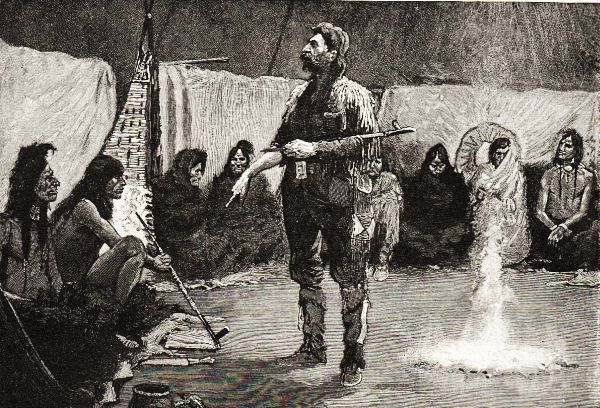
Several days later, when everything of value to the savages had been carried on shore, the vessel was set on fire. That night on shore in Maquina's tent, dressed in the remnants of some hunter's costume, the sail-maker smoked the pipe of peace with the King, and made his position in the camp as secure as John's.
Maquina's riches soon became known to the tribes on the coast, and several raids were made upon his village by the covetous savages, but in every instance they were repulsed with considerable loss, owing to the muskets with which the chief's followers were armed. John and John's Father, as the sail-maker was known and called, were made much of by the King, and granted many indulgences, but were not allowed to lead idle lives, as the duty of the first was to keep all the guns and other arms in repair, while the other, as sail-maker-in-chief of the King's navy, was obliged to manufacture the sails with which the canoes were fitted. Thus nearly three years passed away, and when they had almost given up hope of escape, the trading brig Lydia, of Boston, commanded by Captain Samuel Hill, came to anchor one afternoon in the cove where a few blackened timber-heads sticking out of the sand marked the grave of the stately vessel that had once been moored on its gentle surface. After placing a guard over John and the sail-maker, and forbidding them to move out of their hut, Maquina went off to the brig to trade. Owing to a curiosity that probably cost them their heads before the next sun rose, the two sentinels shortly made their way to the beach in order to look upon the strange ship with whose people their neighbors were carrying on a lively trade, while they were left in the deserted village and deprived of the opportunity of exchanging the skins and furs that they had been saving for so long.
As soon as their guard disappeared the two captives plunged into the woods and made their way around the bend of the cove so as to approach the brig on the opposite side to the village. Waiting under cover until night had fallen, they took to the water and swam off to the ship, where they told their story, and were warmly received by the Captain and crew. A close watch was kept during the night to prevent a possible surprise by the natives, and when morning came the vessel was hauled out of the cove and anchored at some distance from the shore. Shortly after this Maquina's canoe was seen coming out to the ship. When it drew near, the King stood up and eagerly scanned the faces observing him from over the rail. He failed at first to recognize his two former captives, so great a change had been effected in their appearance by the aid of soap, scissors, and civilized dress; but suddenly penetrating this disguise, he burst into tears, stretched his arms out to them, and passionately cried:
"How John? How John's Father? No go away—come back Maquina!"
John answered the chief, telling him that he would never see them again; that he and his father thanked him for saving their lives and treating them kindly, but that Captain Hill was so enraged with him for killing the white men that if he came near the ship he would be shot. Whereupon the King beat his breast, threw his cloak over his head as a sign of grief, and was paddled back to shore.
Fearing to remain in this place lest Maquina might make a desperate effort to recover his lost slaves, and having completed his cargo, the Captain made sail during the day, and by nightfall was out of sight of land, the good ship Lydia sweeping over the long Pacific swells as though realizing that she was on her journey home. Some months later the anchor that had last rested on the white sand of Nootka Sound was dropped off the long wharf in Boston Harbor, and an hour later our young hero was folded in loving arms, while the father and mother offered up their thanksgivings for their boy who had been lost but was found again.

St. Paul's School, Concord, is one of the few preparatory institutions in this country, if not the only one, that has a fully organized golf club and regularly established links. When the links was laid out in 1894 it was considered one of the best in the country, but since that time such an advance has been made, and so much interest has been taken in the game all over the United States, that the St. Paul's course cannot now boast such prominence. Nevertheless it is a fine course, and as the game is very popular at St. Paul's, improvements are constantly being made, and the grounds keep getting better and better.
The St. Paul's Golf Club was formed a little over two years ago, and it was made the club president's duty to have the greens cut and rolled when they need it by the men who regularly look after the other athletic fields of the school. The membership fee is two dollars a year, and an orphan asylum near by furnishes caddies. A ticket is given to each boy for every round of one person, two tickets for two persons, and so on, and these tickets are redeemed at five cents each about once a month.
The links is a good three miles in length. The start is from a slight incline, and over a smooth field having a fence, a road, and tall bushes to the right, with a free meadow to the left, and, at a distance of a fair drive, a ditch bordered by tall willows.
ST. PAUL'S SCHOOL, CONCORD, GOLF LINKS. Teeing-ground at the start, looking towards the course.
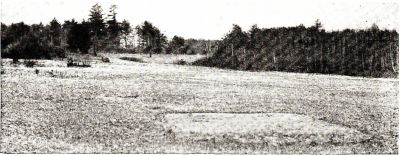
This lay of the land makes it necessary for the player to adopt one of two plans when he starts. He must either make a fine drive right over the willows, and land in the meadow which lies between the teeing-ground and the first hole, or he must make a careful drive so as to place the ball on the hither side of the bushes, and then loft it over them with an iron. If the ball drops in a favorable position, however, the player may use his brassey with advantage, and drive through a gap that exists in the underbrush. This move will generally save him a stroke over the iron play. If he uses the iron, and arrives safely on the ground beyond, a good cleek shot will land him on or near the green. If he used the brassey and went through the willows at the ditch, a mashie shot should put him in position for a putt.
In all plays for the first hole the fence as well as the road and the bushes on the right must be avoided. Within sixty feet of the tee for the second hole there is a ditch, and beyond it a slight hill, and after that a level clear stretch to the second hole, just behind which is a fine woods. Careful driving is therefore required to avoid going into the ditch or hitting the hill, and many of the novices find they need to give good care to their lofting to save themselves from jumping into the woods.
ST. PAUL'S SCHOOL, CONCORD, GOLF LINKS. Looking back from the middle links; course is around the fence on the left.
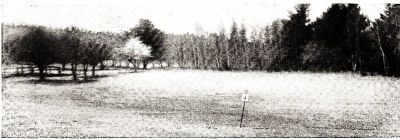
From the second to the third hole it is perfectly plain sailing, an even, smooth meadow with a slight downward inclination. This part of the course is so good that it has frequently been made in one drive. Between the tee for the fourth hole and the hole itself there is a potato patch surrounded by a fence, and, as every man who plays golf knows, a potato patch is a very unpleasant hazard. But to the careful driver its terrors in this case may be greatly reduced, for a good strong drive will put you out of all danger. The putting green, however, is on a slight elevation with woods behind it, so that considerable care is required when dropping the ball upon it with a mashie stroke.
From the fourth to the fifth hole the course runs through an orchard, which, however, is not very extensive, and many of the most expert players on this links can drive entirely over it. The ground slopes toward the putting green until within about fifty yards of it. From the fifth to the sixth hole the ground is overgrown with crab bushes about two feet high and very dense, so that a ball dropping fairly into the midst of this patch is likely to lodge there. The space around the green, however, is perfectly level, and is screened on the far side with pine woods. It is one of the shadiest and best of greens that it has been my fortune to see anywhere.
The course from the sixth to the seventh hole is likewise over a reasonably smooth green, with tufts of crab bush sticking up here and there. It has no especially difficult features, being a plain straightaway course, but it offers a favorable chance for a good iron-player to distinguish himself. The green from the next to the last hole ends in a semicircle of pine woods, and then comes the long hole home.
The home putting green, although level itself, is situated on a hill-side, and so the man who is reckless or over-energetic with his putting-iron is liable to make a long putt—and see his ball roll all the way down the hill. At the bottom of this hill are a fence and bushes, where many a game has been lost through the carelessness or misfortune of the players who have allowed their balls to get into this hazard at the last moment.
This St. Paul's links is situated in a very pretty part of the country, and there are enough natural hazards to make it interesting even for a first-class player. As may well be judged from the brief description I have been able to give here, it is plain that the course is not over a barren, uninteresting table-land, as is the case with many of our American links, but in a locality where there are plenty of woods and hills to make the scenery interesting. There are no impossible bunkers or hazards, so that a round of the links is sure to be interesting. The course is only about four or five minutes' walk from the main school grounds, and is situated on school property, so that the students do not have far to go for their sport, and find no one to interfere with them when they get there.
The interest in the game has been growing steadily ever since the links was first laid out, and it is to be hoped that other schools will take the game up in the near future. There are a few country schools that cannot have links, for even if the school property is not extensive enough for the course to be laid out upon it, there ought to be little difficulty in securing the permission of land-owners to lay out a few putting greens, which would be about the only improvements required. Almost any section of country has a sufficient number of natural hazards to make it unnecessary to construct artificial bunkers and sand-pits.
And now that we are on this interesting subject of golf and bunkers and hazards, it may be well to devote the rest of our space in the Department this week to the answering of questions which have been coming in with greater or less frequency during the year. Most of these questions have concerned links and their construction, and as this is a subject which cannot be treated satisfactorily in short letters, it has seemed best to wait for a convenient time when the laying out of links might be debated in these columns.
It may seem at first a very easy matter to lay out a golf course, but when one begins work upon a links there are several things to be considered. A very hilly country is unsuited to the game, and stony fields or ploughed land is impossible. The best kind of land for a course is pasture land, such as may be found in the neighborhood of almost any town not situated in the mountain country. When a suitable stretch of ground has been found, the first thing to be done is to make a general survey of its salient features in order to determine the general direction of the course and its length.
A links may be laid out with six holes or nine holes or eighteen holes, and such courses would vary all the way from a mile and a half to four miles. The ideal course should be about three miles and a half long. If the available ground is limited, it is much better to lay out nine good holes than to try to get eighteen into the limited space. Having settled upon the starting-point and the number of holes that you are going to have, the general direction of the course should be laid out so that it will swing around in a sort of circular path, and finish up somewhere near the starting-point. In other words, the home green should be placed as near as possible to the first tee.
The length or distance between holes varies anywhere from a hundred up to five hundred yards, the distance being based on the number of full shots that a player must make to reach the next hole. The idea is to make it easy for a good player to reach the green, but difficult for a poor player, whose lack of skill must be penalized. Therefore a distance of two hundred yards is generally bad, for it brings about the objectional combination of a full shot and a short approach.
It is always well to have the holes well guarded with hazards on all sides. Of course few holes can be thus completely surrounded, but when laying out a links it is well to keep this object in mind, for hazards call out the skill of a player. Sometimes there are not enough natural hazards along the course, and it is necessary to throw up banks of earth, or to plant bushes, or to dig ditches. If it becomes necessary to throw up a bank across the course, it is better to build it in a sort of curve rather than along a straight line, for it thus makes a much better golfing hazard. One thing must be remembered in the construction or arrangement of hazards, and that is that they should not interfere with good play.
In the laying out of putting greens one should endeavor to have a space clear of hazards about twenty yards square. The hole should be sunk in about the centre of this green, and lined with an iron or tin cylinder. But on no account should the rim of the cylinder come above or even flush with the edges of the hole, or it will interfere with the play. These cylinders may be bought at almost any shop where sporting goods are for sale, or, if nothing better is at hand, an old piece of tin water-pipe will do.
It is preferable to have level greens, although any slight inclination is no serious disadvantage. It is well to dig up the ground where the putting greens are to be laid out, in the autumn, and sod them in the spring. They should be rolled frequently, and the grass must be kept short.
Teeing-grounds should be marked with whitewash, or with disks of whitewashed tin stuck into the ground. A teeing-ground should be as level as possible, and never hanging—-that is, sloping in the direction from which the shot has to be played from it. Almost any slight elevation will do for a teeing-ground, and it must be within easy walking distance of the hole that has just been played.
After a golf course has been in use for a short time, it will be noticed that the parts which suffer most are the places from which approach shots are made to the greens, and the putting greens themselves. The use of heavy irons is very injurious to the soft turf, and players should always make it a point to replace any sod they may have torn up by careless or poor strokes. When a green gets badly worn it is usually advisable to change the location of the hole to another part, and replace it in its original position after the turf has recovered some of its original good condition.
Rolling is an important factor toward the keeping in order of a putting green, but the roller should be a light one rather than a heavy one, as heavy rollers are liable to get the turf root-bound. If the turf be very coarse it is well to sprinkle sand over it, as that seems to have a beneficial effect in thinning out and fining down the grass.
It has become a custom with the more important golf clubs of the country to use flags of various colors to mark the outgoing and incoming holes. Outgoing holes are marked with a red flag, and the incoming with white flags. These colors are more easily distinguished against foliage than any others. The line flags should be of a different color, so as not to be confounded with the hole flags; yellow or pink is a good shade.
Another good thing to do in the way of marking a course is to indicate the limits of such important hazards as water, roads, fences, or brier islands with short wooden sticks painted white or whitewashed. Such stakes may prove of great convenience, and take but little time and trouble to set out.
In reference to the tables of records published last week, it is well to say that the National figures may be looked upon as exact, because the performances of the first National meeting stand as the Association's records until they shall be bettered at future meetings of the National I.S.A.A.A.; but of the figures in the Interscholastic table we cannot be so sure, because there are so many interscholastic meetings all over the country that it is almost impossible to get correct and reliable reports of all performances, but this table is as near right as can be made under the circumstances, and has been very carefully revised by a number of athletes and other gentlemen interested in school sports in various parts of the country.
It is interesting to note that most of the members of the Berkeley School baseball team, who won the N.Y.I.S.B.B.A. championship this year, are residents of New York city; thus it cannot be said with any justice that New York boys cannot play ball. In the comment on the work of the N.Y.I.S.A.A. nines in a recent issue of the Round Table it was stated that Markell led in batting. This was a typographical error for Mallett. Mallett of Trinity School heads the batting list with an average of 1000.
"TRACK ATHLETICS IN DETAIL."—Illustrated.—8vo, Cloth, Ornamental, $1.25.
The Graduate.

This Department is conducted in the interest of stamp and coin collectors, and the Editor will be pleased to answer any question on these subjects so far as possible. Correspondents should address Editor Stamp Department.
Some time ago Mr. Friedl of Vienna, whose postal museum was one of the sights of Vienna, came into possession of a large number of the Austrian Mercury stamps of which the used copies bore a cancellation mark hitherto unknown. He sold some of these stamps at large prices, when the sale was stopped by a charge that these stamps were counterfeits. A lengthy controversy ensued, which ended by an open acknowledgment that the stamps were genuine. Mr. Friedl felt aggrieved at the charges, and has determined to sell out his collections, his stock, and the contents of his museum. One of the leading American dealers met him in Germany, and secured a number of very valuable stamps; among other things he purchased the unique complete unused sheet of 3 pf. Saxony, 1850 issue, catalogued at $50 per stamp. Unfortunately the sheet never came to America, as it was sold to a leading English collector who was also in Germany at the same time. Numerous other good U.S. stamps changed hands through this dealer, so that very little has come across the water.
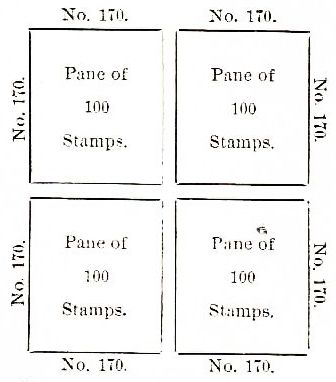
The only plate of the 2c. stamps containing different triangles is No. 170. This plate is printed in one sheet of four panes, each pane containing 100 stamps. These sheets of 400 stamps are cut apart, and the panes of 100 each form a complete sheet as we get them from the post-office. The two left-hand sheets of Plate No. 170 contain seven rows of Triangle III., and three rows of Triangle II. When a complete sheet is not kept, collectors usually take a pair or block showing both triangles.

The summer months are usually dull in a philatelic sense, yet many collectors find time to devote themselves to their hobby, and frequently manage to get stamps at a lower price than during the brisker winter months. This year the off season seems to have been devoted more especially to Revenue and other stamps which are not connected with the postal service. A collection of these oddities is very interesting in itself, and also very instructive. In Germany many collections of the Governmental Insurance stamps are made. (See illustration of the 14 pf. Elsass-Lothringen stamp.) Late issues of German papers state that the government has a surplus of 125,000,000 marks insurance money on hand, which it proposed to invest in the building of cottages and houses for workmen, to be let at reasonable rates. The law has been in force since January 1, 1891, and it probably affects over 15,000,000 workmen and work-women. It provides insurance against sickness and accidents, and for a pension in old age. The benefits are: 1. Free medical treatment, medicine, and surgical appliances through life. 2. Half-pay in cash during illness, or free hospital treatment for thirteen weeks each year. 3. Twenty days' wages on death, and, if insurance is kept up, those dependent on the deceased receive a small pension. 4. At a fixed period, late in life, payments cease, and a small pension is given. The payments into the fund for insurance are made weekly (forty-seven weeks to the year) one-third by the workman, one-third by the employer, and one-third by the government. Each state in Germany has its own series of stamps, 14 pf., 20 pf., 24 pf., 30 pf., etc., similar to the Elsass-Lothringen represented above, but bearing its own name.

In this country quite a number of savings-banks and similar establishments have introduced a similar system. For instance, the Pratt Thrift of Brooklyn sells stamps at 5c., 10c., 25c., and 50c. each. These are pasted in a book or on a card, and can be turned in as so much cash whenever desired. The great objection to collecting stamps of this nature is that no used stamps can be bought, and unused stamps must be paid for at full face.
On the other hand, it is not necessary to collect every value of each issue. The lowest value will answer for the set if the design is the same. Indeed, "general" stamp-collectors will soon be forced to take a step like this in view of the absolute impossibility of obtaining copies of the rarer stamps.
A. Lombard.—Any of the U.S. Revenues, unperforated, are worth keeping. Many of them are rare, and uncovered pairs are always worth much more than two single stamps.
Philatus.