THE AMERICAN NIGHTS' ENTERTAINMENTS.
Reading edition
THE PICNIC.—BY EMMA J. GRAY.
Mariette's eyes looked rather red, as though she had been crying, and then came the words. "A dreadful thing has happened!"
"What?" And the next second her dearest friend, Laura Brainerd, was standing before her, and putting her hand on each shoulder, scanned Marietta's face.
Then, with a sob accompanying each word, came the sentence, "My caramel cake is heavy!"
This answer was so unexpected that, although Laura twisted her lips in every possible direction, and contorted her pretty mouth until it was absolutely homely, she had to give way at last, and then followed such a hearty laugh that her friend Marietta opened her dark blue eyes to their widest, and simply stared at her.
"Dear little Mariette," she exclaimed, "how absurd of you to care so much about a cake!" And then, seeing a wounded look steal over her friend's sensitive mouth, she added, "I know your caramel cake is always delicious, and I'll trust your hamper any time for holding no end of good things." And Laura smacked her lips, as if already tasting them.
"But it won't now," was the doleful response.
"Oh, pshaw! don't be such a silly girl. Tell me what you're going to take."
"Oh, nothing but sardine and chicken salad, pickled beets and walnuts, roast-ham sandwiches, blackberry and lemon meringue pie, cookies, almond cake—"
And as she was evidently not yet through, Laura interjected: "Don't tell me there is any more, or I'll not be able to sleep all night. Oh, how can I wait for to-morrow to come, anyway?" and impatient Laura paced hurriedly up and down the room.
"Yes, there is something more. I shall take big juicy plums;" and Mariette, holding up her hand, made a ring by touching her second finger and thumb together, and laughingly added, "So big, and with such a soft bloom on them that you'd like to taste one, I know."
"One! A dozen!"
And then quickly followed, "You just ought to see my peaches, though—so large and ripe, such beauties!" and Marietta's lips were pressed together as if already enjoying them.
And so the clouds rolled away, for in counting the many delicacies her picnic basket would hold, the heavy caramel cake was altogether forgotten.
"But what are you going to take, Laura?"
"I?" and Laura straightened herself back with a most self-satisfied air while saying, "Potato and asparagus salad—just made from asparagus tips, Mariette."
"Yes, I know," and she smiled, while nodding her curly brown head.
"And besides those, chicken pie, hard-boiled eggs, nasturtium seed, and peach pickles; pâté de foie gras sandwiches, a loaf of fresh home-made bread, and a roll of unsalted butter; large ripe tomatoes, some pepper and salt to help them down, and a frosted walnut cake."
"Oh, what a tempting luncheon! I guess no one will starve at our table!"
"I hope not. But, you know, picnics give powerful appetites; that's why I shall take an extra loaf of bread; besides, it will seem so fresh to cut it foreign fashion, just as it's needed."
The girls were talking in the large wainscoted parlor, and, it is needless to say, made a fascinating picture in their pretty summer toilettes, Mariette all in white, and Laura all in pink, her pink satin ribbons the exact match of her pink cheeks, as with mischievous manner she talked excitedly on. And we made a play of reading; for, instead, we were idly resting in this temptingly cool airy room, and could not help but listen to their gay chatter. So it was we learned that the picnic was to be to-morrow, that the party numbered twenty, an even number of girls and boys, that they were to be driven to their destination in large market-wagons made festive with flags; that each girl was to bring luncheon enough for herself and one of the boys, and that the boys would bring all the necessary outfit for games, such as ropes, archery, grace-hoops, tennis-net, and racquet balls.
The woods were not regular picnic grounds, and therefore the children knew there would be no tables, and as they wanted to do everything correctly and comfortably, they would meet the deficiency by taking their own. Five cutting-tables had been borrowed from their mothers; these would be folded over and put in the bottom of the wagon, and four persons could easily sit at each. The boys would arrange the seats, which, more than likely, would be the wagon seats, built to the requisite height by supporting each end on a pile of stones, or they might find convenient rocks, or take the rails from the post-and-rail fence adjoining. Should they decide on the latter, they would be put in place again when luncheon was over. Milk, lemonade, ice, and even ice-cream were to be carried; for some of the girls were excellent ice-cream-makers, and everybody would get so warm playing games and rushing around continually that ice-cream would be in demand.
That plated spoons, forks, etc., would be used, "so as to save worry," Mariette explained, and that Japanese napkins would do double duty, as they would also serve as table-cloths; besides they were pretty, and really dressed a table, and there was no fuss about their laundering afterwards, and her mother had said, "Maids should be considered as well as mistresses in such warm sultry weather."
All the sandwiches would be neatly wrapped in white tissue or waxed paper, and the thin wooden platters would be far more suitable for picnic purposes than delicate dainty china, as no one would be afraid of chipping them; and, besides, they were so light, "the horses would be glad," Mariette was sure.
"What's the harm of burning them when we are through, and the napkins, for that matter!" was Laura's interjection.
But the more thoughtful Mariette replied, "No harm, if we don't set the woods on fire."
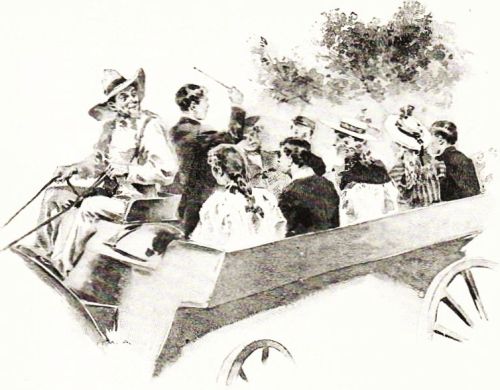
It was thought best to put all the lunches, wraps, etc., in one wagon, and the picnickers would go in the other. Trusty drivers were going with the wagons, and the men were to keep watch all day, and be ready to help in whatever capacity necessity would require.
The atmosphere for the picnic proved perfect, and the girls' laughing sunbrowned faces and tangled curls testified to their having had a jolly day, while the boys' gay raillery, frequent cheers, and fern-trimmed hats showed that they were not left rearward when the fun was going around.
Long before the wagons were in sight the children were heard, for song followed song all the way back, they explained.
"It seems as if I was a boy again," said an old man, as the words "We'll not go home till morning" reached us, just before the wagons came in sight.
And when, with springing feet, the merry girls and boys jumped out, they were all so earnest to tell the story of the day that everybody talked at once. However, we learned that games were their chief sport, and that the rope now taken out of the wagon was first used for the Crown Game:
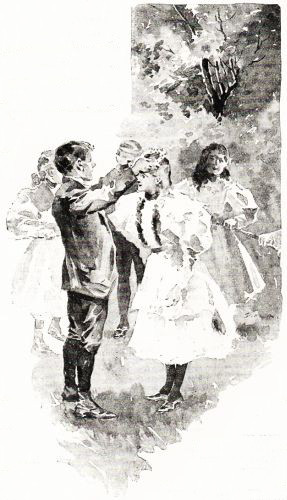
A girl enters the ring; all the others take firm hold of the rope. No sooner is she in than they skip about her, keeping the rope in motion. As they skip they sing, to the tune of "Auld Lang-syne,"
"Who'll crown our queen, our merry queen, Who'll crown our queen to-day? Who'll crown our queen, our merry queen, Who'll crown our queen to-day?"
When this is sung the children stop skipping just where they are. And at once one of the boys puts his head under the rope, and, standing by the queen, replies, "I will." Then raising a crown of wild flowers, he puts it on her head. No sooner is she crowned than she blindfolds the boy, and another girl enters, thus making two girls in the ring. The game is to "tag" the right girl before the other players count nine. When the boy "tags" the girl, he must at once say whether or not she is the queen, and if he makes a mistake he must remain in the ring and try again. The first girl withdraws, the second girl is crowned queen, and the game is repeated. But should he make no mistake, the boy remains in the ring, is crowned king, and the game goes on, only that two boys are in the ring when a girl is blindfolded.
Another rope game was called the Guess.
Put a rope on the ground in the form of a circle; in the centre put a stone about the size of a duck's egg. The players stand backwards around the rope, with their heels touching it. Each one in turn throws a grace-hoop over his right shoulder, with the hope it will encircle the stone. As soon as the hoop is thrown all may turn and see the position. If the hoop encircles the stone the player may try again and again, until he fails, counting one for each time. Then the party to his right tries, and so on all around the rope. Whoever has the largest count wins the game.
This game is also played facing the stone; it is then no longer a game of guess, but a game of skill.
After the rope games, one of the boys taught a German game called Urbar, which he said was really a play on the word bear.
Every one excepting the boy who was instructor, and who was now known as Bear, twisted and knitted their handkerchiefs. The Bear selected a tree as starting-point, and stated his object would be to tag the others, and that whoever was tagged would become a Bear, and would have to return to the tree, pursued and beaten all the way back with the knotted handkerchiefs. The two Bears then join hands, and starting out, try to tag every one that is possible, and this action is repeated until all the players are Bears. Whenever the chain of Bears is broken, as it sometimes is by an attack from the rear, the Bears again return to the tree.
This game was followed by the Jolly Dinner:
Each girl in succession led a boy to a position to dance a reel.
First girl then said to first boy, "This is my flower to decorate the table," and she gave the boy a flower, which he put in his button-hole.
Second girl to second boy, "This is my flower to decorate the table," and giving him a different flower, he put it in his button-hole.
Third girl to third boy, "You tread clams for dinner," and the boy made the motion of treading for clams.
Fourth girl to fourth boy, "You catch trout for dinner," and the boy made believe he was a fly-fisherman.
Fifth girl to fifth boy, "You get lamb to roast," and the boy called. "Bah! bah!"
Sixth girl to sixth boy, "You get the turkey to roast," and the boy gave the call of a turkey-gobbler.
Seventh girl to seventh boy, "You shoot the duck for roasting," and the boy called, "Quack! quack!"
Eighth girl to eighth boy, "You are my pigeon to bake in a pie," and the boy flapped his arms, in imitation of wings.
Ninth girl to ninth boy, "You are the baker, and must make our cake," and the boy pretended to beat eggs.
Tenth girl to tenth boy, "You are the young man who grinds good coffee," and he acted as if turning the crank of a coffee-mill.
As soon as the tenth boy responded, those who received flowers whistled "Yankee Doodle"; all the others danced a reel, repeating their calls and motions while dancing.
This game caused so much hilarity that one of the boys proposed that childish game and old favorite the Mulberry Bush, and joining hands around a bush, they sang out loud and clear, "Here we go around the mulberry bush so early in the morning." Then they pretended they were sewing, and sang, "This is the way we sew our clothes, so early in the morning." And so on, adding verse after verse.
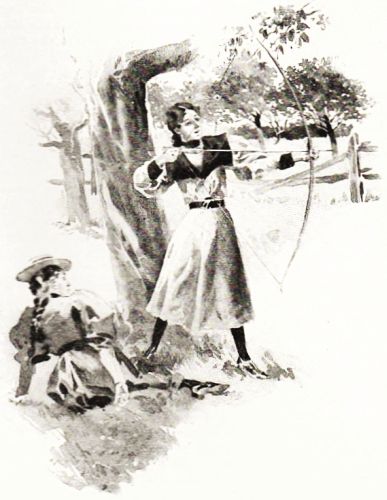
"So it's no wonder I feel tired now," one of the girls explained, "for, besides these games, we had tennis and archery matches. Indeed, we had nothing but fun all day long."