THE INTRODUCTION.
Reading edition
THE CARVING FORK. "Mr. Pitcher, allow me to introduce you to my friend Mr. Bunny."
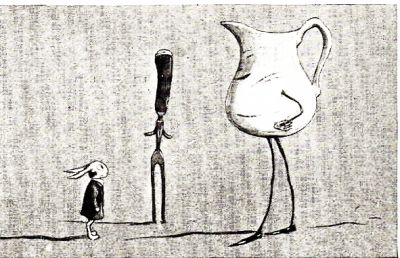
THE PITCHER (bowing low). "Happy to meet you, Mr. Bunny."
A WISE BOY.
Helen (awed). "Oh, Tommie, aren't you awfully afraid of the bears they tell about up here?"
Tommie. "Naw! I'm not afraid of the bears anybody tells about. I'm only afraid of the bears I see."
A HAND-CLAPPER.
"Papa," said Willie, as he entered his father's room at the Mountain House, "can I join the band here?"
"I don't know. As what—bass-drummer?"
"No, clapper," said Willie.
"You can't play the clappers," said his father.
"No," said Willie, "and they don't want me to; but I'm to start the applause when the band stops playing."
There is a smart little town out in North Dakota, and its inhabitants imagine they are a great deal smarter. They have an excellent opinion of their city, as they term it, and blow and bluster more over its welfare and growth than a Kansas cyclone. The main line of a railroad runs through it, and once a week a train stops there. This indifference on the part of the railroad people is a source of bitterness to the inhabitants, especially as the engineers make it a point to go through the place at full speed. Finally, they resolved to put a stop to it, so one day they built a barricade on the tracks, and forced the first train to come to a halt. Then they arrested the engineer and took him before the judge of the place. He was charged with running through a city regardless of speed, and to the danger of the populace.
"What have you to say in answer to this charge, sir?" sternly asked the judge.
The engineer smiled and looked around. He stepped to the door and looked at the few straggling houses, and allowed an expression of astonishment to settle on his face. Then he walked slowly up in front of the judge and said:
"Upon my honor, judge, this is the first time I ever knew there was such a place as a town on this part of the line."
The citizens after that slowly removed the barricade, and let the engineer proceed on his way.
AN ACCOMPLISHED LITTLE GIRL.
Aggie. "Mamma, can't I stay up to the dance to-night?"
Mrs. B. "Why, you can't dance, my dear."
Aggie. "No, mamma; but I can stay up splendidly."
AN OBSERVANT YOUNG LADY.
"It's dreadfully mean," said Mollie. "They have an elevator in this hotel to take you up to bed when you don't want to go; but they haven't anything to take you up the mountains that tire you out to climb."
A MISTAKE SOMEWHERE.
"There's one thing I can't understand about the mountains," said Benny. "Pop says it's awfully expensive up here, but I can't see it. This is my third summer here, and it's never cost me a cent."
VERY SUPERIOR.
Mollie (at the Mountain House). "We had a german last night."
Pollie (a visitor from the Valley House). "Pooh! We have a Frenchman at our house for the whole summer."
"Say, Jack, that catfish you've got was a howling success as a catch." "Yes. It just filled the bill."