RÖNTGEN RAYS.
Reading edition
BY WILLIAM A. ANTHONY.
It is now some two months since the public was startled by the announcement that Röntgen of Bavaria had discovered that electric discharges in certain vacuum tubes, that is, tubes from which the air has been exhausted, gave out rays that would pass through wood, card-board, flesh, and numerous other substances opaque to light—that is, through which light would not pass, and would then affect the sensitive plates used in photographing, making it possible to show upon the plates the outlines of objects entirely hidden from the eye.
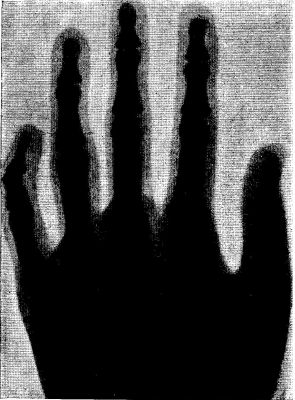
Probably what most aroused the interest of the public was the fact that when a structure, like the hand, was interposed in the path of these rays, the bones would cast a deep shadow, while the shadow cast by the flesh was very faint. It was thus possible to photograph the bones of the living body, and, of course, to show the presence of foreign substances or abnormal growths.
What has excited most surprise, perhaps, is the fact that these rays pass through bodies that are generally considered opaque, for it seems to those not familiar with the facts and demonstrations of science a most surprising thing that any rays should go through wood planks or sheets of metal or living flesh or brick walls. But is it really any more wonderful than that rays of light should go through glass or quartz or diamond or water? We are familiar with this last fact, because we can "see through" these substances. We know that glass does not shut out light, because we can see the space beyond it illuminated. But we have no sense that tells us of the presence of the Röntgen rays. We must resort to the photographic plate or the fluorescent screen (to be described further on), to show their presence, and for all information as to their behavior. The photographic plate is affected, while our eyes are not, and we are obliged to let such plates take the place of our eyes, and receive impressions which we can afterwards interpret.
But what are "rays"? When we stand in front of a fire of glowing coals we feel the warmth, and our eyes tell us of the light. Light and heat are said to radiate from the glowing coals, and both light and heat proceed in straight lines. These straight paths followed by radiations we have called rays. These rays are quivering motions in a medium which we call the ether, and which we believe extends through all space and pervades all bodies. They are waves, having the character of waves on the water, which we can see, and sound waves in air, which we know exist.
These ether waves, those that affect the eye and those which do not, differ from each other, as all wave motions differ, in the distance from wave to wave, or what is the same, in the frequency of the vibratory motions. As an example, compare the long ocean swell that comes thundering upon the beach at intervals of several seconds with the frequent swash, swash, swash of the little ripples on the shore of a fish-pond, or the vibrations that can be felt as a tremor of the whole church when the deep bass pipes of the great organ are sounded with the sharp shrill tones of the high treble pipe.
There are means of measuring the distances from wave to wave of the different rays in the ether, and the result is astounding. The frequency is something of which it is impossible to form any conception. About 20 millions of millions per second is the lowest, and about 1000 millions of millions the highest frequency. Of these, those only which lie between 400 and 760 millions of millions per second excite vision. In other words, the ether waves breaking upon the optic nerve must come at the rate of at least 400 millions of millions per second before that nerve will carry any impression to the brain—before we can "see" them. Why rays of these frequencies only should affect the eye we do not know. We only know that the structure of the eye is such that the other rays are powerless to produce vision. Neither do we know why the low-frequency rays will go through hard rubber and will not go through glass. We only know it is a fact.
All these ether rays may produce heat. The high-frequency rays affect the photographic sensitive plate, and also produce another effect that is of especial interest in connection with the study of the Röntgen rays. They have the power of exciting a peculiar luminosity, or light, in certain substances, which are for that reason called fluorescent.
Electrical discharges in vacuum tubes have long been known as sources of radiations which produce heat and affect the eye. Every student of physics knows the experiment with the aurora tube, which, when exhausted by a good air-pump and connected to a Holtz machine or induction coil, is seen filled with a pale light having something the appearance of the streamers of the Aurora Borealis.
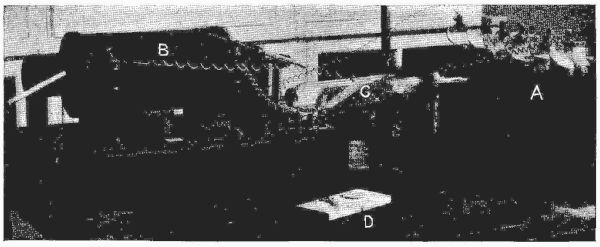
FIG. 1.—THE APPARATUS USED IN MAKING RÖNTGEN RADIOGRAPHS.
Professor Crookes, by obtaining a vastly better vacuum, obtained in these tubes some new and very interesting phenomena. As the vacuum became better and better, the light within the tubes finally disappeared, and only the inside of the glass was illuminated. This Professor Crookes explained upon the supposition that the air particles remaining in the tubes are repelled from the negative terminal or "cathode" within the tube, and shoot off from it, proceeding in straight lines, until they come into collision with other particles or with the walls of the tubes, producing light wherever the collision occurs. When the exhaustion is sufficient these particles shooting out from the cathode meet with no obstructions until they reach the walls of the tube, which are bombarded by the flying particles until they shine with a sort of phosphorescent light, while the whole interior of the tube remains dark.
FIG. 2.—A RADIOGRAPH OF A MAN'S HAND.
These experiments have been repeated again and again for the last eighteen years in scientific laboratories and lecture-rooms, always exciting the greatest interest in the wonderful phenomena disclosed. But not until recently has it been known or suspected that all the time there were proceeding from the bombarded surface other rays, incapable of exciting vision, but possessing properties, and capable of producing effects even more wonderful than any that the Crookes tube had before shown. That certain invisible rays existed in the Crookes tube radiations was known about four years ago, but it remained for Professor Röntgen to demonstrate the remarkable properties which they possess. He found that a piece of card-board painted on one side with barium platino cyanide was illuminated when held near the excited Crookes tube, and that the painted surface was equally well illuminated, whether it or the reverse side of the card-board was presented to the tube. He further found that when the whole tube was covered with black paper, so that no rays affecting the eye could emerge, the painted screen was still illuminated, and further yet, that the illumination remained visible when a board an inch thick, a book of a thousand pages, or a plate of hard rubber was interposed between the tube and screen.
On the contrary, he found that glass, thin pieces of metal, the bones of the hand, more or less stopped the rays, and so cast shadows. It must have been a startling image that met Professor Röntgen's eye when first he placed his hand in the path of the rays, and saw upon the screen a bony skeleton hand with only a faint outline of flesh and cartilage. It was a startling experiment to me, after I had read all the accounts of Professor Röntgen's work, and knew what to expect, when I first saw the shadow of my own hand upon the fluorescent screen. Fig. 2 shows the appearance of such a shadow. After demonstrating in this way the transmission powers of various substances, Professor Röntgen tried the effect of the rays upon the photographic plate, and found it possible to fix there the images that he had seen upon the fluorescent screen.
Fig. 1 will show how the results are obtained. A is a galvanic battery, B is a Ruhmkorff induction coil, C is a Crookes tube, and D is the plate-holder containing the sensitive plate.
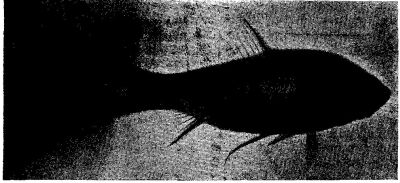
FIG. 3.—A GOLDFISH WITH THE SPINE AND SOME OF THE INTERNAL ORGANS VISIBLE.
The battery produces a low-tension harmless current that is rapidly closed and broken at the induction coil, which transforms it into a high-tension current capable of producing electric sparks, and giving exceedingly painful if not fatal electric shocks. Wires convey this high-tension current from the coil to the terminals of the Crookes tube, where the Röntgen rays are produced whenever the current is turned on. In the figure the plate-holder is shown only a few inches from the tube, where the effect of the rays is strong.
Fig. 3 shows a goldfish, with all his scales and flesh on. The line of his spine is clearly visible, and many of the inner organs of his body can be clearly seen, and the skeleton comes out very clearly, because the bones are more opaque to these rays than is any other part of the body.
FIG. 4.—WING OF A PIGEON, SHOWING THE SHADING EFFECT IN BONES.
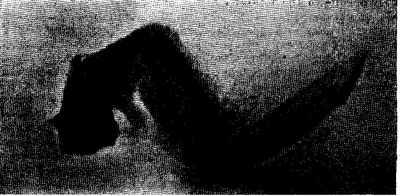
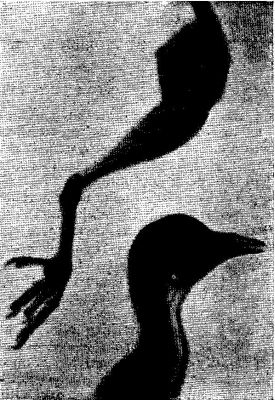
Fig. 4 shows the wing of a pigeon, which is interesting, because while the outline of the flesh is distinctly marked the feathers have practically disappeared. The bones are not only clear, however, but the thinner parts are lighter than the thicker. Fig. 5 shows the leg and head of the pigeon. Around the head it is just possible to make out the outline of the feathers, the flesh is clearly marked, and all the bones of the neck are visible. In like manner the leg is interesting.
The transparency of the flesh makes it possible to show the presence and location in the body of foreign substances. Bullets, needles, and bits of glass have already been located by means of Röntgen ray photographs, and afterwards removed by a surgical operation.
FIG. 5.—HEAD AND LEG OF PIGEON.
It is curious that the part of the eye which is transparent to the light, and through which light passes to reach and affect the optic nerve, is nearly opaque to the Röntgen rays. Vision by means of these rays would therefore be impossible, even if the optic nerve were sensitive to them.
But suppose these rays could excite vision. What should we see? Holding a purse between the eye and a Röntgen ray source, we should see the coins within it. If a person stepped in the path of the ray we should see his bony skeleton. We might see something of his internal organs; perhaps we could see his heart beat. A broken bone could be seen, and the operation of setting it could be watched. Diseased bones or enlarged joints could be examined. Tubercles in the lungs would be visible. But these things would be visible only when they came between the eye and the source of the rays, much as on a dark night objects might be visible between you and a camp fire.
In daylight objects become visible by means of the light which falls upon them and is reflected to the eye. This brings out the detail of the visible surface. But the Röntgen rays are scarcely at all reflected, and even if they produced vision, objects would become visible only as they intercepted the rays. They would not be illuminated as they are illuminated by rays of light, and only outlines, therefore, would be seen. Even fluorescent bodies which appear light under the action of the Röntgen rays are not really illuminated, but are rendered luminous—that is, are made to shine by their own light. When bodies opaque to the rays are placed before the fluorescent screen, merely a shadow is seen on it. So the photographs or "radiographs" obtained are only shadows, but they are not the flat featureless shadows of the "shadow pictures" often introduced as an entertainment at social gatherings, when the identity of the person casting the shadow is often impossible to make out. Few substances are entirely opaque to the Röntgen rays, hence the shadows of thicker portions of an object will be deeper than of the thinner portions, and the shadow becomes a shaded picture that may give details of the surfaces of the object. A Röntgen ray shadow of an aluminum medal may show the design stamped upon the surface. The shading effect is well shown in the bones of the pigeon.
But if there are few substances entirely opaque to the newly discovered rays, there appear to be none that are entirely transparent. Even in air the rays appear to be rapidly absorbed, so that an extremely powerful apparatus is required for producing effects at any distance. Air seems to behave toward the Röntgen rays much as fog behaves to light, and it seems unlikely that effects can be procured at any great distance, perhaps not more than one hundred feet from the source.
It would be rash to attempt to predict the future of the Röntgen ray. The uses to which it may be applied in surgery have already been hinted at in this article. The transparency of wood makes it possible to inspect the work of a carpenter, and determine whether the work hidden under the exterior finish has been honestly done. Hidden compartments in a desk or cabinet might be revealed. The contents of a packing-box might be ascertained without opening it. But to scientific men these rays have a very great interest. What are they? Are they vibrating movements transmitted in waves, like light? Are they particles shot off from the Crookes tube and flying with enormous velocity? These are questions to be answered.
When you stand in front of a Crookes tube in action these flying particles are streaming through your body, stopping not at all at your clothing, and hardly at all checked by the flesh, nor wholly stopped even by the bones. A hard-wood board held between you and the tube is no protection. The streams pass through it unchecked. Sheets of metal even do not wholly stop them. The wonder of it all is that for nearly twenty years experimenters with the Crookes tube have been pierced through and through by these subtle streams and have never known it. Do they produce any effect as they pass through the body? Can they cause or cure disease?
It has been proved that they pass quite freely through the lungs, but if tubercules are present they stop the rays. Might not the touch of the flowing streams dissipate the tuberculosis growth and restore health? Questions like these are coming up for solution, and experimenters are seeking the answers. The study of the Röntgen ray has just begun. What may not the next few months bring forth?