A WIDE-AWAKE COLLECTOR.
Reading edition
One of the most enterprising stamp-collectors that has ever come to our notice was a small Swiss boy, who, during the late war between Japan and China, wrote the following note to Marshal Yamagata, in command of the Japanese forces:
Honored Marshal,—I am only a school-boy ten years old. I live at Berne. Upon the map, Switzerland is smaller than Japan. I was very pleased to hear that you have been serving the Chinese as my ancestors served their enemies. I hope that you will conquer all China, and throw down the famous wall which prevents people from going there. No doubt it is because of that wall that I have not got any Chinese stamps in my album. You must have captured a lot where you are, and I should be pleased if you would send me some.
Unfortunately for this record of his enterprise, the boy's name is unknown to us, but it is stated that the Marshal, having received the letter, was so much amused by it that he took the trouble to secure a large number of Chinese stamps and to send them to his lively little correspondent.
BY GASTON V. DRAKE.
XI.—FROM BOB TO JACK.
London, July —, 189-.
Dear Jack,—We're still in London, and I guess if we stay here until we've seen it all we'll never get to Hoboken. Talk about your three-ringed circuses! London beats 'em all for side-shows and go. When you think you've seen all there is to see you come across an entirely new lot of museums, and parks, and hysterical spots to be visited, and I'm just dizzy trying to remember what Pop told me not to forget. What with St. James's Palace and Madame Tussaud's wax-works, the Zoo and the National Gallery, I hardly know what I saw where, except that of course I didn't see any wax-works at the Zoo.
I think altogether the Zoo and the wax-works are the things I've liked best of all about here. The National Gallery is pretty good, but after you've seen about forty-two miles of pictures, some of 'em as big as a farm your eyes get tired and the back of your neck sort of hurts. Still, I went through it because Pop said I ought to, and whenever I have a nightmare nowadays instead of seeing boojums and snarks I see old masters. You never saw an old master did you? Well you needn't be in any hurry to. They aren't the sort of things boys like very much. They're generally cracked so's to look like a go-bang board and keep you guessing about what they're pictures of, but Aunt Sarah who studied art last winter in Yonkers says they're very educating, and I guess she knows. She says she does anyhow and I don't think she'd say a thing that wasn't so. I can't say that I've learned much from 'em except perhaps that the pictures you and I draw in the backs of our spelling books aren't so bad after all.
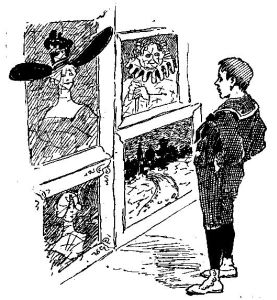
Pop says he's learned one thing from 'em too. There used to be a fellow named Gainsborough that painted acres of pictures every year, and Pop says his things are fine and prove that theatre hats aren't modern inventions and he's right about it. He's got several pictures in this gallery that would drive me crazy if I had to sit behind 'em at a matinee. There were some pictures there though that I'd give house-room to if they asked me, by Sir Edwin Landseer. Pictures of dogs. I tell you he could paint dogs that bark. It was as much as I could do to keep from whistling to 'em and patting 'em on the head, and one little spaniel was painted so well that it seemed to me I could see his tail wag. Pop says that that was all imagination, but Aunt Sarah said no it was art, and I let 'em argue it out between 'em. Whatever it was though that painted dog's tail wagged and it was worth travelling miles to see.
I was kind of disappointed with St. James's Palace. I expected to see something like a transformation scene at Humpty Dumpty, gold doors, and fountains, and bands playing and all that. You'd think a Palace would be different from a factory anyhow, but it wasn't, very. It didn't look any livelier than a jail would, and as far as the outside of it was concerned I couldn't see that it was any handsomer than the Grand Central Depot in New York, and not half as big. They wouldn't let us inside. I thought perhaps the Queen was asleep and they were afraid I'd whistle, but Pop said she didn't live there any more, and I didn't blame her. I wouldn't either if I could help it. I dare say it's very fine inside, with onyx stairways and solid gold banisters for the children to slide down, but outside I wouldn't give a cent for it. If it wasn't for the soldiers with their big bear-skin hats and robin-red-breast coats on I wouldn't have cared if we never saw it. The soldiers were worth looking at, though most of 'em have such great big bulgy chests you'd take 'em for pouter pigeons.
Right alongside of the Palace is where the Prince of Whales lives and while we were looking at it he came out in a cab. He was another disappointment. He wore a beaver hat just like Pop's, and instead of having a scepter in his hands he carried an umbrella and a cigar; just the sort of man you'd expect to meet on Broadway any day of the year. Somehow it's hard to get used to the idea of a real live Prince wearing a beaver hat and carrying an umbrella, and it almost makes me sorry I came. I suppose if I could really find out how to go to Fairyland and should go there I'd find all the fairies dressed up in pea-jackets and sailor hats like most of the boys we see nowadays, and probably they'd be playing ball or riding bicycles instead of flying about on gossamer wings and swinging on cobwebs.
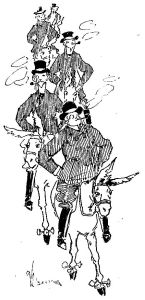
I spoke to Pop about it, and he said it was because the Prince loved the people that he didn't dress up like Solomon. All the men feel that they've got to dress like the Prince of Whales and if he came out in a bathing suit and a blue plush smoking-cap on his head, every man in England and New York that wanted to be fashionable would do the same thing, and if he dressed as magnificently as he knew how, in a diamond-studded dress-suit and gold trousers, it would ruin everybody to go and do likewise. So he wears clothes that are within the reach of all, which I think is very nice of him, though I wish I could see him on Sunday when he puts on his best. Pop says the way the men imitate him is very funny. He says there was an actor once disguised himself as the Prince who went riding through the Park on a donkey with bells on its hoofs, and next day sixty-three of the most fashionable young men of London appeared the same way, and when they found out that they had been fooled they were so angry that they wouldn't go to that actor's theatre again, but everybody else thought it was such a good joke that they went and the actor made a fortune.
I was going to tell you about the wax-works at Madame Tussaud's and the Zoo in this letter, but Pop says it's time for me to go to bed, because we are going to have a hard day to-morrow. We're going to take a coach and drive out to Hampton Court and back, so I'll have to close here. I wish you'd ask that Chicago boy if he's a grand-nephew of Baron Munchausen. I told Pop about that prairie-yacht and how Billie's seal-skin cap saved him from being scalped, and Pop was very much interested and said he thought he knew now who Billie was, and when I asked him who, he said the grand-nephew of Baron Munchausen, a man who never told the truth unless it was absolutely necessary.
Yours ever, Bob.
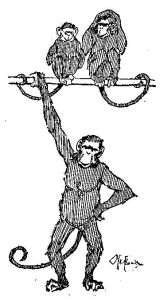
P. S.—I've just got out of bed for a minute to tell you that you never saw such monkies as they have at the Zoo. They look almost as human as some of our Aldermen in New York, Pop says.
E. W. MILLS.
The success of the New Manhattan Athletic Club in managing the recent in-door interscholastic games has suggested the possibility of having the club manage the National meet in June. This would be a very good scheme, if practicable, because experience has shown that hitherto the chief obstacle in the way of success for scholastic meetings has been poor business management.
It is not always possible for young men who have nearly all they can attend to at school to devote enough time to the business management of an athletic meeting to make it a thorough success; and it is therefore well, when possible, that this kind of work should be turned over to those who have more time and greater experience for the amount and kind of work required. The N.M.A.C. handled the recent games in a satisfactory way, and there is no reason to think that it would not carry out the plans for the National meet fully as well.
At the in-door games the club assumed the entire financial responsibility, and offered prizes besides; but the managers would naturally feel some hesitancy about doing the same thing for an out-of-door meeting, where the weather must have so much to do with the attendance. The constitution of the National Interscholastic Association stipulates, I believe, that the prizes in each event shall amount in value to $25. The N.M.A.C. would not care to saddle itself with the responsibility of offering thirteen or fourteen sets of $25 medals, besides paying the rental of the grounds and other incidental expenses; but I am informed on good authority that the club would be perfectly willing to assume the responsibility of securing grounds and of making all arrangements for advertising and management, as they did for the in-door games, at their own risk. Should there be any surplus after these expenses have been defrayed, this would go toward paying for the prizes—no set of medals to cost more than $25; and should there still be a surplus after that, the money would be turned over to the National Association's treasury. The club, I am sure, does not wish to make any profit out of the enterprise.
By such an arrangement, of course, there would be no shining medals on a table in the middle of the Berkeley Oval for the contestants to admire before they had been defeated in their events, and that would doubtless detract much from the interest in these games of our friends the medal-hunters; but on the other hand it would be a good thing if it could be announced that there would not be any medals on show that day, as this might keep these same medal-hunters off the grounds—which would be an advantage.
The prizes, as I have frequently said, are purely a secondary consideration; and even if there was not enough money left over, after all the expenses had been paid, to get anything better than ribbons, the success of the National Association would not suffer, for the games are not held for the purpose of distributing gold and silver disks, but for the purpose of encouraging amateur sport and to bring about meetings between the strongest athletes in the schools of the country. At the Olympic games which have just closed in Athens the victors received mere olive wreaths, but these wreaths are as precious to them as if they were of gold or precious stones. It is not the value of the wreath itself, it is what the faded leaves represent that the true sportsman cherishes.
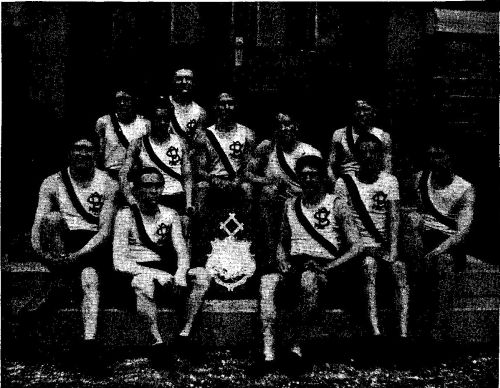
H. J. Brown. O. Lorraine. D. P. White. O. E. Robinson. C. M. Hall. B. Kinney. E. L. Johnson. A. Robinson. S. L. M. Starr. W. L. Van Wagenen. H. W. Goldsborough. ST. PAUL'S TRACK-ATHLETIC TEAM, Winners of First Place at the N.M.A.C. Interscholastic Games, March 28, 1896.
It would not be fair to ask the N.M.A.C. or any club to assume the responsibility for the rent of the grounds and other necessary expenses, and for the medals too. It is a sufficient risk for them to undertake to pay for the former, without going into jewelry. I hope the National Association's Executive Committee will see the advantage of having the games—their first venture—managed by a club or an association of older and more experienced men, and come to an understanding on some such lines as the N.M.A.C. may propose.
A number of letters have come to this Department recently asking for suggestions about the construction of hard tennis courts. There are several kinds of these, the gravel court being by far the best of all. A gravel court is laid out by first digging about fifteen or eighteen inches down and filling this hole with broken brick, stone, and other coarse rubbish to within six inches of the top. Then coarse gravel of any kind should be put on and well packed down with a hose. This layer should come up to within two inches of the top. The last two inches should be filled in with fine screened gravel, and if this will not bind, add a little clay. On top of all this put from one-eighth to one-quarter of an inch of the finest red gravel—just enough to give color to the court. If too much of this red gravel is put on it will not bind well. It soon wears off, and then more should be laid on, and after this has been done a few times a court will keep its color all summer.
The advantage of such a court is that it needs but little care. All you have to do is to sweep the gravel off occasionally, and water and roll it. A light roller is sufficient for this purpose, as it is expected to affect the top layer of the gravel only. The best way to mark out a gravel court is with an inch tape nailed down with tacks. Whitewash will not do, as it spreads. The least satisfactory kind of hard court is made of cinders. These pack fairly well; but a cinder court requires a great deal of care to keep in order, and is always a dirty place to play on, the balls becoming black after a few sets, and consequently useless.
In nearly every city of the Middle West high-school associations have been organized during the past year or so, and these associations have done much toward encouraging school sport, and toward making the contests among their members more systematic than they have been heretofore. In Wisconsin interscholastic football and baseball games have until recently been carried on in a haphazard fashion, without any special attempt toward the formation of a union that might properly recognize the claims to supremacy of the successful team.
Last fall, however, the initial steps toward placing all branches of sport on a sound and permanent basis were taken. The season of 1895 clearly showed the need of an organization, and in December representatives from the schools of all the principal cities of southern Wisconsin met in Milwaukee and formed the Southern Wisconsin Inter-High-school League. The purposes of the organization are to develop all kinds of athletic sports in the schools, and to encourage a friendly rivalry in the various contests among its members. It also aims to correct some abuses which have crept into interscholastic sport—abuses which always will creep into any kind of sport where there is no restriction of government or organization. The league is divided into four circuits, each embracing the cities located in a certain territory, and the team which carries off the honors in its own circuit contests for the State Championship with the leaders in the other circuits.
The constitution of the Wisconsin League, while placing many wise restrictions upon its members, leaves them free to arrange their own schedules of games and to manage their own affairs as may seem best and wisest to them. The league will open the season of 1896 with baseball and track athletics—the field day for the latter to be held in Madison on June 9th. The first interscholastic field day of the Wisconsin schools was held June 8th of last year, under the auspices of the Wisconsin University Athletic Association. Twelve high-schools were represented, and many good records were made, a brief account of which was given in this Department in Harper's Round Table for July 2, 1895. Much interest is being displayed now in the coming meeting, and doubtless even a better showing will be made than that of last season.
It is in football, however, that the various schools of the league expect to see developed the hardest struggle for the championship. Last fall, although no organization had been effected, the contest for first place was a hard one, and the interest aroused in the schools was intense. Madison High-school justly deserves to rank at the head of the scholastic teams of that section. Her eleven won every game played. In fact, M.H.-S. has only been defeated once in football since it put an eleven into the field, three years ago. Of the eighteen contests in which it has engaged only one was lost, and that to the strong team of the St. John's Military Academy, which ought not to be classed as a school team, or played against by school teams, so long as the academy authorities sanction the methods at present in vogue at Delafield. The reason for M.H.-S.'s good record rests, doubtless, in the fact that Madison is an enthusiastic football town, and the school team gets much valuable experience and benefit from playing against the university eleven.
The formation of the Twin-City Dual Interscholastic League, which was mentioned in this Department last week, was brought about by complications which arose in the league formerly composed of the St. Paul High, the Minneapolis High, and the Duluth High schools. The old league fell to pieces, and the new one was constructed on different lines, which promise to make the venture a success. I am glad to say that I was misinformed concerning the presence of the standing jumps on the card. Mr. George Cole is the President, Stewart J. Fuller, the Vice-President, George Angst, Secretary, and Chester H. Griggs, Treasurer. These young men have all been prominent for some time in interscholastic sport, and if they can control the policy of the league, it will doubtless earn a high standing among similar associations.
The organization does not aim to control track athletics only, but will also look after the football and baseball interests of the St. Paul and Minneapolis schools. Track athletics have only been taken up systematically for the past five years in these two cities, and yet the schools have made rapid strides in this short time, and have sent a number of clever men to Eastern colleges. The St. Paul High-School has perhaps done better than most of the schools in that section in sending good men East. Winters, the well-known Yale tackle, Cochran, the end-rusher, and Langford, the stroke of the present Yale crew, are all graduates of that institution.
The Inter-collegiate Association has stricken the bicycle race from the regular schedule of the spring games. It would be a very good thing if the New York and Brooklyn I.S.A.A.'s, and, in fact, if all interscholastic associations would follow their example. The New York and Brooklyn associations could combine and have a bicycle field day in the same week of the annual interscholastic meetings, or at any other time that might seem more convenient, and do away with the unpleasant bicycle event at the track-athletic meeting altogether.
I suggest that the New York and Brooklyn associations combine, because it seems to me that it would be more profitable, on account of the larger number of entries, the greater interest, and the greater attendance such a union would command. Should the bicycle event be stricken from the interscholastic card, an excellent substitute would be a relay race. Relay races, as I have frequently said within the past few weeks, are becoming more and more popular all over the country, and sooner or later the relay race will become a standard event on every track-athletic card. Therefore, the sooner the interscholastic managers recognize this fact and put the race on their schedules, the better. If the entries for the relay races are so numerous in an association as large as the New York or Boston I.S.A.A. it would be possible to have the preliminary heats run in the morning, and have only finals at the games in the afternoon. This is a matter well worthy of consideration.
The Graduate.
This Department is conducted in the interest of stamp and coin collectors, and the Editor will be pleased to answer any question on these subjects so far as possible. Correspondents should address Editor Stamp Department.
Portugal announces a new set of commemorative stamps to be issued shortly. The designs have been accepted, but the colors and values of the stamps have not yet been decided upon. Nicaragua has issued a set of postage-stamps—1, 2, 5, 10, 20, and 50 centavos, 1, 2, 5 pesos. Also the same stamps surcharged "official." In addition, a new set of postage-due stamps—1, 2, 5, 10, 20, 30, and 50 centavos, all in orange color—and an "Officially Sealed" stamp in blue. Porto Rico has changed the colors on the current set of adhesives, thirteen stamps in all. Honduras has also just issued a new set. The Cuban Republic stamps, 2, 5,10, and 25 centavos, are sold by some of the smaller dealers.
All the above would probably come under the ban of the S.S.S.S. as unnecessary, and issued for revenue only. The work of eliminating or diminishing "speculative" stamps is very slow; but progress is steadily made, and the number of new issues during the past six months is less than the average.
J. L. Hunter.—The coin is a French 5 centimes of 1856. No premium.
H. Vaughn.—The probabilities are that the Cuban Republic stamps will be accepted by the great majority of collectors; but as yet the advanced philatelists will not admit them in their albums. They seem to me purely speculative, hence uncollectable. The $20 U.S. revenue is worth $1.50; the 24c. and 30c. War Departments are worth 50c. and 30c. respectively.
F. B. Kingsbury.—Your coin is worth 6c.
J. Schmidt.—The 24c. 1869 U.S., with reversed centre, is worth $100 if in good condition.
G. B. Snider.—The only way the number of the sheet can be known is by the printed margin of the sheet. All the stamps on a sheet are identical.
R. S. Chase, 30 Alumni Avenue, Providence, R. I., wishes to exchange stamps.
R. F. T.—Stamps printed "Marca di Bolo" are Italian Revenues. The 25c. Venezuela 1892 are common; millions were printed and used.
F. H. Horting, F. J. Wattson, D. W. Hardin.—The coins are common. No dealer would pay a premium on them, as he picks them up in the regular course of business at face value. When dealers sell they of course ask an advance on face. They have to pay rent, clerk hire, advertising, and their own living expenses.
E. L. H.—The 8d. yellow New South Wales, 1860 issue, is worth 25c. The Canada 12-1/2c., 1868, is worth 18c.
D. W. H.—The millennial stamps have not been accepted as collectable by the majority of philatelists; but, of course, that is a matter to be settled by each collector for himself.
Philatus.