CARDS
Reading edition
The FINEST SAMPLE BOOK of Gold Beveled Edge, Hidden Name, Silk Fringe, Envelope and Calling Cards ever offered for a 2 cent stamp. These are GENUINE CARDS, NOT TRASH. UNION CARD CO., COLUMBUS, OHIO.

A Swiss Wedding.
We have lived in Switzerland for five years, and have, of course, seen a great many weddings among the people, but never one of those grand affairs which are the talk of a small town for weeks. Last autumn, while we were in Winterthur, we learned that a wedding was to take place in the "Stadtkirche," bride and bridegroom coming from two of the best old families. As both were millionaires (in francs, not dollars), people expected something magnificent, so we decided to go to the church to see what it would be like.
There are no private church weddings in Switzerland. Every one who chooses may go to witness the ceremony, and the day we went the church was full of people of every description—ladies and gentlemen, as well as bareheaded peasants and children. It seems to me that one must have an enormous amount of courage to get married in Europe. The bride we saw had to submit to be stared at for a good hour in church, and even then she was not allowed to go off and rest.
When we had waited patiently for about half an hour the clock struck one, the church doors were thrown open, the organ pealed forth a wedding march, and in came the bride on the bridegroom's arm. They walked up to the beautifully decorated altar, in front of which were the seats reserved for the wedding guests, and here they separated, the bride going to the places on the left of the aisle, the groom to those on the right.
Then followed couple after couple, the ladies all in full evening dress, and each separated at the altar also. When they were all seated the minister preached a short sermon. Then the organ accompanied a song sung by the bride's sister. This was very beautiful, for there was also a violin obligato. Then the bridal couple stood up and were married, after which they again parted, going back to their seats. Some little children sang with the organ, and then the ceremony was over, but not the wedding.
There was a grand dinner which lasted hours and hours, for between each course there was acting, or tableaux, or dancing, and it was not until late in the evening that the bride could depart on her wedding journey, and very tired she must have been. Some people go for long drives in the afternoon, if the day is beautiful. In this case they all go bareheaded and in open carriages. The peasants cannot always afford to drive, so simply take long walks, some to the country, but the general preference is for the town. Here they walk, two by two, through all the principal streets, going in at some confectioner's for something to eat, and enjoying themselves greatly. These brides generally dress in black with white veils (or none at all), and artificial flowers in their hair. The girls are always confirmed in black dresses in German Switzerland, and the poor people wear the same dresses for their weddings. A very thrifty custom, is it not? Swiss weddings may be very nice to Swiss people, but I, for my part, prefer American ones, and if I ever marry, I hope it will be in my own dear country.
Marian Greene, R.T.F.
Cryptography.
From very ancient times secret writing, known as cipher (from the Arabic sifr, "void"), or cryptography (from the Greek "hidden writing"), has been an important means of communication. In great national crises, where absolutely secret communication was necessary, it has saved much time and trouble. Charles I. wrote his famous letter to the Earl of Glamorgan in cipher, consisting of variously shaded and lengthened strokes of the pen. This letter was afterwards deciphered, and proved to be a concession to the Roman Catholics of Ireland, which, if generally known at the time, would have caused serious trouble. Lord Bacon also made frequent use of the cipher but even his ingenious methods have since been discovered.
There are many methods. Perhaps the most common is the variety found in one of the Sherlock Holmes tales, where, in a seemingly plain, every-day sentence, words set at intervals give the hidden meaning. Poe's fascinating "Gold-Bug" is founded on the solution of one of Captain Kidd's cryptograms. One can readily construct a cipher requiring considerable effort to read. One of the best known for common purposes is the "Dial Cryptogram."
A DIAL CRYPTOGRAM.
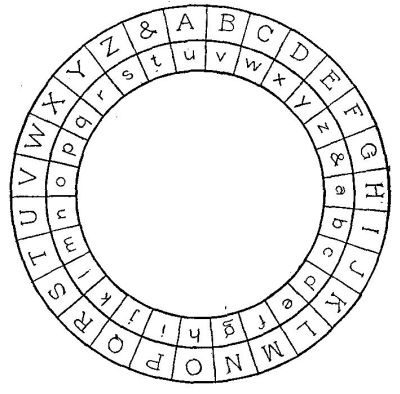
On a six-inch square of card-board draw a circle containing twenty-seven parts. In each write one of the capital letters of the alphabet, including &. Also cut out a circle of card-board which exactly fits the circle on the square. It should be edged by twenty-seven spaces containing the small letters of the alphabet, including &. Place this disk on the square and drive a pin through the centre. Your correspondent having a similar dial, you are ready to write. Suppose your message is the following:
The box containing the famous Marston-Endive ciphers has at last been found in a secret drawer of the billiard-room wainscoting. Yours, Kelpee.
At the beginning you write the capital, and at the end the small letters which are opposite each other when you have arranged your dial. The inner circle is so placed, say, that T and m are opposite each other. Beginning your message with T, and closing with m you would have:
T. may vhq whgmubgbg& may zufhnl fuklmhg-ygxboy wbiaykl aul um eulm vyyg zhngx bg u lywkym xkupyp hz may vbeebukx-khhf pubglwhmbg&. rhnkl dyeiyy. m.
The stencil cryptogram is also a very good one, and is easily managed. Take two squares of paste-board, and at irregular intervals cut out narrow openings. Your correspondent being provided with one of the stencils, you place your own on a sheet of paper, and in the openings write your message. You then fill the intermediate spaces with any words that will connect the whole and make sense. Your correspondent places his stencil on the message—and the meaning is clear.
Vincent V. M. Beede.
That Clever Kink.
Did you find out how much that nobleman was worth? The answer is:
£21,459. It is found by taking all of the letters in the passage quoted that are employed in the Roman notation—I, V, X, L, C, D, M—setting down their value in the Arabic notation, and adding all together.
The Music Rack.
Good Stories about Chopin.
Frédéric François Chopin, born 1809, died 1849, very early showed his sensitiveness to music, when only a baby prevailing upon his parents to allow him to share the lessons given to his eldest sister. Many tales are told of his performances as a child, but perhaps the best is the one related by Karasowski, his biographer, of his appearance at a public concert for the benefit of the poor when he was not quite nine years old. He was announced to play Gyrowetz's piano-forte concerto, and a few hours before he was put on a chair, and there dressed with more than ordinary care, being arrayed in a new jacket with an ornamented collar specially ordered for the occasion. When the concert was over Frédéric returned to his mother, who had not been present; she asked him what the public liked best. "Oh, mamma, everybody looked only at my collar!" Little Frédéric could do almost anything he wished with the piano, and all his life, when in happy moods, he was fond of weaving fanciful fairy tales and romances in music so beautiful and real that the listeners were able to follow and understand by the mere tones alone.
One evening his father was away, and there arose a tremendous hubbub among the pupils which the assistant master was quite powerless to quell. Frédéric came in, saw how things were, and good-naturedly sat down to the piano. Calling the other boys around him, he promised, if they kept quite still, to tell them a new and most thrilling story on the piano. This at once quieted them. Frédéric extinguished all the lights (for he was all his life fond of playing in the dark). Then he sat down to the piano and began his story.
He described robbers coming to a house, putting ladders to the windows, and then, frightened by a noise, rushing away into the woods. They go on and on, deeper and deeper into the wild recesses of the forest, and then they lie down under the trees and soon fall asleep. He went on, playing more and more softly, until he found that the sleep was not only in his story, but had overcome his listeners. On this he crept out noiselessly to tell his mother and sisters what had happened, and then went back with them to the room with a light. Every one of the boys was fast asleep. Frédéric returned to the piano, struck some noisy chords, the enchantment was over, and all the sleepers were rubbing their eyes and wondering what was the matter.
Meredyth Jones, R.T.K.
Kinks
No. 1.—A Story.
It was a rainy day. George, spoiling for something to do, said: "Say, Fred, here's a question you can't answer within five minutes, or ten either. Wan' to try?"
"Yep."
"A lad, carrying a page of that circular to the printer who printed it, stubbed his toe. It hurt him so that he went to the same place the 'three wise men of Gotham' did, and almost lost his life, because that which ruins many a field of wheat was in his drinking water, and he couldn't drink it. But he put all three together, ate it, and saved his life. What did he eat?"
No. 2.—Quinary.
"With you, don't think I'll bate a stiver!
And folks who put me in a passion
May find me —— to another fashion."
In the above lines of a famous poem the word which fills the blank is the last syllable of the five words described below.
1. By bonnie braes in Scotland old,
My notes are heard with love untold.
2. Tars in hours of well-earned leisure
With twinkling feet would tread my measure.
3. A man in love with rocks and ore
Can by my aid know Nature's lore.
4. I'm hollow, and of sable hue,
And cousin to the chimney flue.
5. When sadly off the proper key,
A friend in need you'll e'er find me.
No. 3.—Heads and Tails.
Behead to censure, and leave to cripple; to gather, and leave to heat. Curtail to grieve for, and leave to fasten; a beverage, leave to beat; a damsel, and leave to succor; a color, and leave an edge. Behead the latter, and leave a quarrel. Curtail sly artifice, and leave a sledge; confusion, and leave an infant. Behead derision, and leave a grain; a flower, and leave a fluid; to study, and leave to gain.
Rita E. Boardman.