1600
Reading edition
of the Choicest Old and New Songs
and Hymns in the Wide World.
Fifty Cents per Number in paper; Sixty Cents in substantial Board binding; One Dollar in Cloth. The Eight Numbers also bound in two volumes at $3.00 each. Address Harper & Brothers, New York.


This Department is conducted in the interest of Bicyclers, and the Editor will be pleased to answer any question on the subject. Our maps and tours contain much valuable data kindly supplied from the official maps and road-books of the League of American Wheelmen. Recognizing the value of the work being done by the L. A. W., the Editor will be pleased to furnish subscribers with membership blanks and information so far as possible.
Copyright, 1896, by Harper & Brothers.
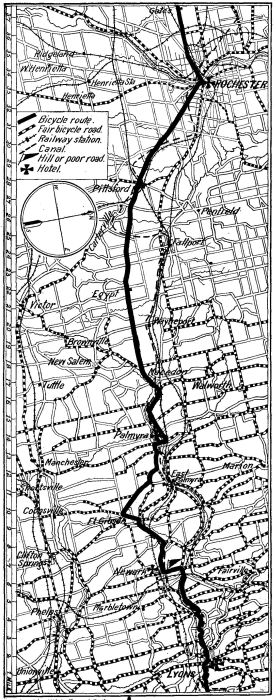
Continuing the journey from where it was left last week, proceed from Lyons westward up hill, turn left at the top, and proceed downward, over the canal, and thence, keeping to the right, cross the canal again, turn sharp left up a hill, and cross the bridge into Newark. This is eight miles from Lyons. The road, except at the hills, is in very good condition. Leaving Newark, take the second turn to the right and cross the canal, but instead of proceeding straight ahead towards East Palmyra, turn sharp to the left, and crossing the canal again, proceed to Fort Gibson, three miles further on. It is better to take this road and to proceed direct to Palmyra over the turnpike, which is reached at Fort Gibson by turning sharp to the right, than to pass through East Palmyra itself, though it is possible to take the direct road, which is somewhat shorter, and proceed through East Palmyra. From Palmyra run out over Main Street, using the side-paths and side-walks where available, until the yellow mills are reached, thence cross the canal, turning to the right, and keeping to the left, follow the turnpike to Macedon. Macedon is twenty-one miles from Lyons, and from this point the route to Rochester is easily followed. The road is in good condition, and the rider will find no difficulty in keeping to the road from Macedon to Pittsford, and thence to Rochester itself.
Entering Rochester, ride in through Monroe Avenue to Clinton Street, thence to East Main Street, where the Powers House will be easily found. Rochester is another place where there is great interest taken in bicycling. There are several good routes in the vicinity of the city. One of these is to Elmira, the route being to return, as already described, to Pittsford; thence proceed to Canandaigua, to Reed's Corners, Gorham, Ferguson's Corners, Penn Yan, Milo, Dundee, Rock Stream, Reading Centre, Watkins, Montour Falls, Mill Port, Pine Valley, Horseheads, into Elmira. This is a run of one hundred miles. Another run is to leave Rochester and run out to Sodus Bay, passing through West Webster, Webster, Union Hill, Ontario Centre, Ontario, Williamson, Sodus, and Alton, to Sodus Bay, a distance of thirty-nine miles. Another interesting but much shorter run is to proceed from Rochester out through Genesee Street to the end of the street, thence following the road along the banks of the Genesee River, through Buttermilk Hill, to Scottsville. Thence proceeding to Spring Creek Hotel, which is twenty-one miles from Rochester, you will get a good dinner for fifty cents. After dinner it will be interesting to go over the State Fish-hatcheries. There are several different routes of greater or less distance by which you may return to Rochester.
Edward J. Brown.—There are several kinds of chain-cleaners, but none of them are of very much use. An ordinary rag that is clean, used with some care, is quite as effective as anything else.
Note.—Map of New York city asphalted streets in No. 809. Map of route from New York to Tarrytown in No. 810. New York to Stamford, Connecticut in No. 811. New York to Staten Island in No. 812. New Jersey from Hoboken to Pine Brook in No. 813. Brooklyn in No. 814. Brooklyn to Babylon in No. 815. Brooklyn to Northport in No. 816. Tarrytown to Poughkeepsie in No. 817. Poughkeepsie to Hudson in No. 818. Hudson to Albany in No. 819. Tottenville to Trenton in No. 820. Trenton to Philadelphia in No. 821. Philadelphia in No. 822. Philadelphia-Wissahickon Route in No. 823. Philadelphia to West Chester in No. 824. Philadelphia to Atlantic City—First Stage in No. 825; Second Stage in No. 826. Philadelphia to Vineland—First Stage in No. 827; Second Stage in No. 828. New York to Boston—Second Stage in No. 829; Third Stage in No. 830; Fourth Stage in No. 831; Fifth Stage in No. 832; Sixth Stage in No. 833. Boston to Concord in No. 834. Boston in No. 835. Boston to Gloucester in No. 836. Boston to Newburyport in No. 837. Boston to New Bedford in No. 838. Boston to South Framingham in No. 839. Boston to Nahant in No. 840. Boston to Lowell in No. 841. Boston to Nantasket Beach in No. 842. Boston Circuit Ride in No. 843. Philadelphia to Washington—First Stage in No. 844; Second Stage in No. 845; Third Stage in No. 846; Fourth Stage in No. 847; Fifth Stage in No. 848. City of Washington in No. 849. City of Albany in No. 854; Albany to Fonda in No. 855; Fonda to Utica in No. 856; Utica to Lyons in No. 857.

Any questions in regard to photograph matters will be willingly answered by the Editor of this column, and we should be glad to hear from any of our club who can make helpful suggestions.
TIME-SAVING HINTS FOR THE AMATEUR.
When one has a quantity of aristo prints to mount which he does not intend to have burnished, he must be careful not to wet the face of the print, as it destroys the gloss imparted by the ferrotype plate. The usual method is to lay the print face down on a sheet of glass and paste it, cleaning the glass after each print has been mounted. A much simpler way is to take pieces of newspaper several sizes larger than the prints to be mounted, lay them in a pile on the table at the left hand, lay a print face down on the top piece of paper, paste it, and drop the piece of newspaper in the scrap-basket. Continue thus, using a fresh piece of paper for each print, till all the prints are mounted. The newspaper makes a good surface to paste on, as the print does not slip, as it does sometimes on the glass if not held very firmly. This way of pasting prints saves a great deal of time and trouble.
Before beginning to mount pictures trim each one and lay it on the card on which it is to be mounted. Some amateurs when mounting pictures always mark where the picture is to be placed on the card. This is not necessary, for the eye can be readily trained to see when a picture is straight if the picture itself is properly trimmed.
A simple arrangement for drying negatives is made by taking a stout wire, bending it in the middle at a right angle, and then bending the ends over to make short hooks, which clasp the edges of a plate. The wire should be bent close enough so that it is necessary to spring it a little to fit it to the plate. Put the wet side of the plate toward the wire, and set the plate on a shelf with the edge resting on the shelf, the wire supporting it somewhat after the fashion of an easel.
In filtering solutions, unless one has a fluted glass funnel, the filtering paper adheres to the glass and allows the liquid to pass through very slowly. A simple way to hurry the process is to fold the circle of filtering paper together, and then fold it from the centre back and forth like a fan. Crease the folds so that they will remain, and when put in the funnel there will be spaces between the glass and the paper through which the solution will run very quickly.
Films are quite inclined to curl both in the developing solution and in the fixing solution. This necessitates pushing them down into the fixing bath, and often causes much annoyance to the operator. If the hypo is put into a large glass tumbler the film may be curled round a bottle, and the bottle set in the tumbler of hypo, which will do away with any trouble of keeping the film down into the hypo. The bottle should be clean, and filled with water so that it will set flat in the tumbler.
Sir Knight Frank Evans, Jun., 1116 Brown Street, Philadelphia, Pa., wishes to correspond with some of the Camera Club members. Sir Knight Frank says he has some good formulas which he would be pleased to send to the Camera Club. We shall be glad to have them and to publish them. Send full directions for use, please, and write on one side of the paper only.
Sir Knight Ragean Tuttle, Auburn, Col., asks where to get the photographic supplies mentioned in the Round Table. They may be bought of any reliable dealer in photographic goods.
Lady Mana M. Monahan, of Michigan, asks the address of a good school of photography. At Effingham, Ill., is a school of photography called Illinois College of Photography, where all the branches of photography are taught.
Sir Knight Herschel F. Davis wants to know the right exposure for a moonlight view, with largest stop, and if it will blur the plate to include the moon in the picture. From a half-hour to an hour is the usual time given for a moonlight view, according to the brightness of the light. The moon may be included in the picture, and will not have a halo; but the moon, instead of being round, will make a longer or shorter streak on the plate, according to the length of time it is exposed, as, of course, with the motion of the earth and moon, it will have traversed quite a space in the course of an hour.
A CHANCE FOR AN EXPERIMENT.
Have plants intelligence? Do they ever think? These are interesting questions that would have to be answered by the statement of an observer of the ways of pumpkins and melons. Says he: "Plants often exhibit something very much like intelligence. If a bucket of water, during a dry season, be placed a few inches from a growing pumpkin or melon vine, the latter will turn from its course, and in a day or two will get one of its leaves in the water."
We do not vouch for the truth of this, but if there be any young gardeners among the readers of the Round Table it might make an interesting experiment for them next summer when they are pursuing their avocation.