7 Political Life
Reading edition
Background of Present State Constitution
The original Constitution for the State of Virginia was written at a special convention held in Williamsburg from May 7, 1776 to July 5, 1776. The Constitution itself was officially adopted on June 29, 1776, making this date the birth date of the State. The individual who was primarily responsible for most of the content in the original Constitution was George Mason. The creation of the first Constitution was unusual in two respects: at the time it was written, the convention members decided upon specific powers which the newly-formed government should not have before it determined those powers which it should have; furthermore, the Constitution was adopted officially by the convention members without the usual procedure of submitting it to the voters for final ratification.
As years pass and conditions vary, it becomes necessary to make changes in the framework of a government to meet such needs. Consequently, on four specific occasions, the Constitution of Virginia has been rewritten: namely, in 1829-1830, 1850, 1867 and 1901.
In 1816, the residents west of the Blue Ridge Mountains demanded more representation in their state government and fewer suffrage restrictions. After many years of discontent, these individuals finally encouraged enough residents throughout the state to vote for a constitutional convention to be held in Richmond in 1829. At the convention, suffrage was extended slightly although all non-real estate owners still could not vote. The term of the Governor was extended to a three-year term with an increase in his powers, and representation was reapportioned to benefit the inhabitants living west of the Blue Ridge Mountains. However, in the redistribution of seats in the House of Delegates, the residents in the Trans-Allegheny section lost some seats. When the proposed Constitution was submitted to the people of Virginia for ratification, 26,055 voted for it and 15,166 voted against it. In this vote, for the first time, the Valley people of the western part of the state joined the residents of the east rather than their Trans-Allegheny neighbors who had strongly opposed it. The new Constitution was officially adopted in 1830.
After the national census of 1840 had been taken, it revealed an unfair numerical representation of the white people west of the Blue Ridge Mountains in comparison with the representation of the number of white people living east of the Blue Ridge Mountains. Such unfair representation existed in both houses of the General Assembly to the extent that some residents even suggested that the people of the western part of Virginia create a separate state and call it Appalachia. Special local meetings were held and a referendum was finally suggested to determine the need of a constitutional convention as an attempt to correct this unfair condition. Finally, a state-wide vote in 1850 recommended such a convention be held in Richmond in the same year. After numerous arguments among the delegates had been voiced over a four months' period, a compromise was eventually adopted. The national census of 1850 was to be used as the official white population count and legislative representation was to be based upon this count: the effect of the compromise was to give the counties west of the Blue Ridge Mountains a majority in the House of Delegates and the counties east of the Blue Ridge Mountains a majority in the State Senate. Additional reforms were adopted which resulted in this 1850 convention sometimes being referred to as "the reform convention": suffrage was extended considerably to white male citizens; oral balloting was to be maintained; the Governor, the Lieutenant Governor, the Attorney General, certain judges, county clerks and sheriffs were to be elected directly by the qualified voters; the tenure of the Governor was extended to a four-year term; and the General Assembly was to meet once every two years instead of annually. A capitation or poll tax was to be levied upon each voter and half of the revenue from this tax was to be used for school purposes. The General Assembly was given additional power to control slavery by the passage of certain restrictions which were to be imposed upon slaveowners. This third Constitution for Virginia was officially adopted in 1851 after it had been ratified by the voters of the state.
After the War between the States had ended and the Reconstruction Period had begun, Virginia became Military District Number One in March 1867 with General John M. Schofield as its chief executive. The United States Congress demanded that Virginia and the other nine former seceded states rewrite their state constitutions. When the delegates of the constitutional convention met on December 3, 1867, they consisted of 32 Conservative Party members, 25 Radical Republican Negroes, 14 native Virginia Radical Republicans and 31 Carpetbaggers, Scalawags and aliens. The constitution which resulted from this convention is known as the Underwood Constitution because the chairman of the convention was Judge John C. Underwood, a Radical Republican. Some of the provisions of this constitution included the division of each county into townships, the establishment of a county court with a single judge in each county, the appointment of a Board of Supervisors in each county to carry out the executive powers, the levying of a high tax rate on landed property, the compulsory creation of a public school system, the denial of suffrage to many former Confederate leaders and a restriction of allowing only former non-supporters of the Confederacy to hold office or act as a juror. In 1869, upon the recommendation of President Ulysses S. Grant, the United States Congress allowed Virginia voters to vote at a popular referendum on the Underwood Constitution itself and then to vote separately on the sections which denied suffrage rights and office-holding rights to former Confederates. On July 6, 1869, the qualified voters of Virginia ratified the Underwood Constitution and rejected the other two sections.
In 1897, an attempt to hold a constitutional convention was defeated but three years later, the people of the Commonwealth voted in favor of a constitutional convention. This fifth constitutional convention began in June 1901 and continued for approximately one year. As a result of this convention (described in Chapter Four), numerous changes were made which were considered so important by the delegates at the convention that they decided to "proclaim" this Constitution of 1902 as the fundamental law of Virginia rather than to submit it to the voters for ratification. Consequently, on May 29, 1902, the Constitution of 1902 was voted by the convention delegates for adoption and this is the present Constitution of the Commonwealth, with certain subsequent revisions.
Like the Constitution of the United States, the Virginia Constitution is divided into major areas called articles and into subdivisions called sections. There are seventeen articles and two hundred and one sections. The following topics found in the articles indicate the broad range of subjects included: the Bill of Rights, Elective Franchise and Qualifications for Office, Division of Powers, Legislative Department, Executive Department, Judiciary Department, Organization and Government of Counties, Organization and Government of Cities and Towns, Education and Public Instruction, Agriculture and Immigration, Public Welfare and Penal Institutions, Corporations, Taxation and Finance, Miscellaneous Provisions—Homestead and Other Exemptions, Future Changes in the Constitution, Rules of Construction, and Voting Qualification of Armed Forces.
The Virginia Bill of Rights
Article I is the Bill of Rights. Such rights are prefaced by an introductory paragraph in the article which states that this series of rights form the backbone of the governmental structure in Virginia: "A declaration of rights made by the good people of Virginia in the exercise of their sovereign powers, which rights do pertain to them and to their posterity, as the basis and foundation of government." The famous Declaration of Rights which follows the introductory paragraph was written by George Mason and introduced at the Williamsburg Convention by Archibald Cary. It was unanimously adopted by the convention members on June 12, 1776, and its principles were considered so significant that they were later used as the basis for the Bill of Rights in the Constitution of the United States as well as for many other state bills of rights. The importance attached to these provisions has resulted in the Virginia Bill of Rights often being called the "Magna Charta of Virginia."
In seventeen different sections, the Virginia Bill of Rights guarantees various underlying principles of government:
(1) "That all men are by nature equally free and independent and have certain inherent rights, of which, when they enter into a state of society, they cannot, by any compact, deprive or divest their posterity, namely, the enjoyment of life and liberty, with the means of acquiring and possessing property, and pursuing and obtaining happiness and safety"—Thus, freedom and equality of every individual is recognized, and one's rights of life, of liberty, of owning property and of achieving happiness and safety are guaranteed.
(2) "That all power is vested in, and consequently derived from, the people; that magistrates are their trustees and servants, and at all times amenable to them"—Thus, a principle of democracy is expressed that the right to rule comes from the people themselves and that office-holders are representatives of the people and are responsible to the people.
(3) "That the government is, or ought to be, instituted for the common benefit, protection and security of the people, nation or community; of all the various modes and forms of government, that is best which is capable of producing the greatest degree of happiness and safety, and is most effectually secured against the danger of maladministration; and, whenever any government shall be found inadequate or contrary to these purposes, a majority of the community hath an indubitable, inalienable and indefeasible right to reform, alter or abolish it, in such manner as shall be judged most conducive to the public weal"—Thus, the objective of a government is to benefit, protect and preserve security for the people. The best type of government is that which results in the greatest happiness and safety of all those whom it governs. Whenever a majority of those being governed consider such government as not attaining such an objective, they have a right to change it, reform it, or, if deemed wise, to abolish it as long as it is done in a legal manner considered for the good of all involved.
(4) "That no man, or set of men, is entitled to exclusive or separate emoluments or privileges from the community, but in consideration of public services; which not being descendible, neither ought the offices of magistrate, legislator or judge to be hereditary"—Thus, the amount of financial profit or gain received by an office-holder in any community is to be based solely upon his rendering public service to the community. Consideration of birth, influence or wealth is to be ignored, and office-holding itself cannot be automatically inherited or handed down from father to son.
(5) "That the legislative, executive and judicial departments of the State should be separate and distinct; and that the members thereof may be restrained from oppression, by feeling and participating the burthens of the people, they should, at fixed periods, be reduced to a private station, return into that body from which they were originally taken, and the vacancies be supplied by regular elections, in which all or any part of the former members shall be again eligible, or ineligible, as the laws may direct"—Thus, the principle of the separation of powers is set forth, that is, the legislative, executive and judicial departments are organized as three separate, independent departments. Officials should have specific terms of office and should be elected for designated periods of time at the end of which time they should return to their former private status and be eligible for re-election if the law provides for such an opportunity.
(6) "That all elections ought to be free; and that all men having sufficient evidence of permanent common interest with, and attachment to, the community, have the right of suffrage, and cannot be taxed, or deprived of, or damaged in, their property for public uses, without their own consent, or that of their representatives duly elected, or bound by any law to which they have not, in like manner, assented for the public good"—Thus, all elections should be free and open, and all men who have become regular residents of a community should be allowed to vote. Property cannot be taxed, disposed of or damaged for public use without the consent of the people involved or that of their representatives. Neither can the people be forced to abide by any law unless it has been voted upon by them or by their elected representatives.
(7) "That all power of suspending laws, or the execution of laws, by any authority, without consent of the representatives of the people, is injurious to their rights and ought not to be exercised"—Thus, no office-holder should have the authority to suspend a law or to carry out a law, independent of the legal representatives of the citizenry.
(8) "That in criminal prosecutions a man hath a right to demand the cause and nature of his accusation, to be confronted with the accusers and witnesses, to call for evidence in his favor, and to a speedy trial by an impartial jury of his vicinage, without whose unanimous consent he cannot be found guilty. He shall not be deprived of life or liberty, except by the law of the land or the judgment of his peers; nor be compelled in any criminal proceeding to give evidence against himself, nor be put twice in jeopardy for the same offense...."—Thus, any man accused of a crime is entitled to certain rights: to be informed of the charges placed against him, to meet face to face with the witnesses and accusers, to defend himself in a fair and speedy trial with an impartial or unprejudiced jury. He cannot be deprived of life or liberty except by legal judicial action; he cannot be made to testify against himself; and he is ineligible to be tried twice for the same crime.
(9) "That excessive bail ought not to be required, nor excessive fines imposed, nor cruel and unusual punishments inflicted"—Thus, bails, fines and punishments must be reasonable.
(10) "That general warrants, whereby an officer or messenger may be commanded to search suspected places without evidence of a fact committed, or to seize any person or persons not named, or whose offense is not particularly described and supported by evidence, are grievous and oppressive, and ought not to be granted"—Thus, a search warrant should state specifically the exact place to be searched or the exact individual to be seized and the offense should be specified.
(11) "That no person shall be deprived of his property without due process of law; and in controversies respecting property, and in suits between man and man, trial by jury is preferable to any other, and ought to be held sacred. The General Assembly may limit the number of jurors for civil cases in courts of record to not less than five in cases cognizable by justices of the peace, or to not less than seven in cases not so cognizable"—Thus, since man has a right to own property, he cannot be deprived of it without due course of law. In certain types of lawsuits, trial by jury is believed the best legal procedure.
(12) "That the freedom of the press is one of the great bulwarks of liberty, and can never be restrained but by despotic governments; and any citizen may freely speak, write and publish his sentiments on all subjects, being responsible for the abuse of that right"—Thus, the right of the freedom of press and of the freedom of speech is advocated as long as an individual assumes the responsibility for same.
(13) "That a well-regulated militia, composed of the body of the people, trained to arms, is the proper, natural and safe defense of a free State; that standing armies, in time of peace, should be avoided as dangerous to liberty; and that in all cases the military should be under strict subordination to, and governed by, the civil power"—Thus, a militia promotes the safety of the people. There are dangers of a standing army of professional men in peacetime, and, even in wartime, the military group should be subject to civilian authority.
(14) "That the people have a right to uniform government; and, therefore, that no government separate from, or independent of, the government of Virginia, ought to be erected or established within the limits thereof"—Thus, the people in the State should be governed by the same rules and regulations. No other separate or independent government within Virginia other than the one established by the State Constitution can be organized.
(15) "That no free government, or the blessings of liberty can be preserved to any people, but by a firm adherence to justice, moderation, temperance, frugality and virtue, and by frequent recurrence to fundamental principles"—Thus, government, like men, must be guided by moral principles: namely, justice, moderation, temperance, frugality and virtue. Without repeated adherence to these moral precepts, free government cannot survive.
(16) "That religion or the duty which we owe to our Creator, and the manner of discharging it, can be directed only by reason and conviction, not by force or violence; and, therefore, all men are equally entitled to the free exercise of religion, according to the dictates of conscience; and that it is the mutual duty of all to practice Christian forbearance, love and charity toward each other"—Thus, the right of the freedom of religion is advocated and guaranteed.
(17) "The rights enumerated in this bill of rights shall not be construed to limit other rights of the people not therein expressed"—Thus, since there are other rights not included in this Bill of Rights, this last section reminds the people that there are additional rights not specifically included in this article.
An understanding of the natural fundamental rights of a people as individuals, as guaranteed by the Virginia Bill of Rights, causes one to appreciate deeply the guarantees of liberty and freedom provided for the people of the State.
Election Requirements, Offices and Procedures
The extreme importance which the early Virginians attached to suffrage is recognizable by the location of the voting qualifications in the Virginia Constitution. Such qualifications directly follow the Bill of Rights as Article II and include the following requirements:
(1) a citizen of the United States
(2) at least twenty-one years of age
(3) a resident of Virginia at least one year
(4) a resident of the county, city or town at least six months
(5) a resident of the voting precinct at least thirty days prior to the election
(6) the payment of an annual state capitation or poll tax of one dollar and fifty cents to the county or city treasurer at least six months prior to the election; the receipt of such payment is necessary for registration before voting. A resident who, although eligible to vote at the age of twenty-one, has refrained from doing so must pay a poll tax assessable against him for a maximum three years before being able to vote. A new resident must pay only for each year or part of a year spent in Virginia.
(7) the passing of a literacy test to prove one's ability to read and write in English and to understand the functions of government
(8) proper registration at least 30 days before the election at the office of the local Registrar of Elections which includes the presentation of one's poll tax receipt, the filling in of certain required forms pertaining to personal history and the swearing under oath of the truth of one's statements. Registration in Virginia is now permanent so that after a resident citizen has properly registered, he does not have to repeat this process unless he moves. A noteworthy provision of the Constitution allows any person who is an active member of the United States Armed Forces to be exempt from paying a poll tax and from registering as a prerequisite to voting. Likewise, his poll taxes are cancelled and annulled for the three years next preceding if he has an honorable discharge.
Certain persons are excluded by Article II from registering and voting: idiots, insane persons, paupers, persons disqualified by crime or specific disabilities which have not been removed, persons convicted of treason, felony, bribery, petit larceny, obtaining money or property under false pretenses, embezzlement, forgery or perjury. The General Assembly has the power, by a two-thirds vote, to remove such disabilities.
Qualified citizens of Virginia have the opportunity to elect three types of officials:
(1) national officials—the President and the Vice-President of the United States (every four years), two United States Senators (normally, every six years) and ten United States Representatives (normally, every two years).
(2) state officials—the Governor, Lieutenant-Governor, Attorney-General (every four years), forty State Senators (every four years) and one hundred House of Delegates members (every two years).
(3) local officials—County: Treasurer, Sheriff, Commonwealth Attorney, Commissioner of the Revenue (every four years), County Clerk (every eight years) and Assembly members or members of the Board of Supervisors; City: Treasurer, Sergeant, Mayor, Councilmen, City Attorney for the Commonwealth, City Commissioner of the Revenue (every four years) and Clerk of the City Courts (every eight years).
All elections by the people are by secret ballot. Generally, election officials are sworn in office the day of the election; one of the judges opens the ballot box publicly, turns it upside down to prove its emptiness, locks it and keeps it locked until the voting polls are closed. At the beginning of the election day, the election judges receive the registration books and the list of those citizens whose past three years poll tax has been paid. The election clerk receives a poll book, a blank book to be used for the official listing of the voters who come to the polls. After all election officials have received their necessary clerical supplies and their instructions, the polls are opened for voting. Thus, a citizen is immediately checked for his proper registration and poll tax payments when he comes to vote. He then receives a ballot which he alone marks secretly in a voting booth. Voting must be performed carefully because a defaced, improperly marked ballot may be challenged and thrown out. He folds his ballot to maintain secrecy and hands it to an election judge who places it immediately in the ballot box. It is illegal for a voter to be approached concerning a possible candidate any nearer than 100 feet from the polling place. Fifteen minutes before closing time for the polling place, one of the election judges will loudly proclaim this fact in front of the polling place. Exactly fifteen minutes later, the voting officially ends and only ballot holders at this time are allowed to cast their vote.
After the polls are closed, all the unused ballots are placed in a special envelope marked accordingly. The used ballots are tipped out of the ballot box onto the table. All the election officials present check the complete emptiness of the box. Representatives of each of the political parties are allowed to watch the correct counting of the votes. The election clerks make two sets of tally sheets which include the names of all the candidates which appeared on the ballot and each clerk keeps personal tally as the ballots are counted and the names of the candidates voted for are called off by the election judges. The usual tally method is used, and the word "tally" is spoken by each clerk as the diagonal fifth line is drawn so that any mistakes in the count made by either clerk can be caught quickly. Any time there is disagreement between the tally scores of the two clerks, a complete recounting of the ballots for the candidate whose score disagrees must take place. In case of a tie vote for a Congressman, Assemblyman, or county or city official, the outcome is determined by the Election Board, often by the flip of a coin. When all the votes have been tallied, an official written report is prepared on the back of each poll book: it includes the number of votes cast individually and totally for each candidate. This report is signed by the election judges and the election clerks. These poll books plus the used ballots and the unused ballots are submitted to the county or city clerk and later reviewed by the Board of Elections. The successful candidates then receive a certificate of election which makes them officially elected to their respective offices.
Every person qualified to vote is eligible to any office of the State, county, city or other subdivision of the State wherein he resides except as stated otherwise in the State Constitution. Persons eighteen years of age are eligible to the office of notary public. The terms of all officers elected begin on the first day of February after their election unless otherwise stated. The members of the General Assembly and all officers, executive and judicial, elected or appointed, take the following oath or affirmation: "I do solemnly swear (or affirm) that I will support the Constitution of the United States, and the Constitution of the State of Virginia, and that I will faithfully and impartially discharge and perform all the duties incumbent on me as ——, according to the best of my ability, so help me God."
Any person who is registered and qualified to vote at the next succeeding regular election is eligible to vote at any legalized primary election held for the nomination of any candidate for office.
Legislative, Executive and Judicial Departments
The separation of powers theory in government is considered so important that Article III of the Virginia State Constitution concerns solely this underlying principle: namely, that the legislative, executive and judicial departments are to be separate and distinct. To emphasize this idea, the Constitution further states that neither department shall "exercise the powers properly belonging to either of the others nor may any person exercise the power of more than one of them at the same time."
The Legislative Department—Since one of the chief functions of a government is to make laws, it is logical for Article IV of the Constitution to consist of a detailed description of the Legislative Department: its composition, membership, qualifications, powers and limitations.
The State legislature or legislative branch is called the General Assembly. It is a bicameral legislature composed of an upper house, the Senate, and a lower house, the House of Delegates. This legislative body has been in continuous existence since 1619 and is believed to be the oldest one in the Anglo-Saxon world and the second oldest Parliament in the entire world.
The Constitution requires that the Senate consist of not more than forty and not less than thirty-three members, elected quadrennially (once every four years). There are forty members in the present State Senate, and their term of office is four years. They are elected to office by the qualified voters of the State Senatorial Districts on the first Tuesday following the first Monday in November of every other odd-numbered year in which the Governor is not elected. Therefore, they are elected during the mid-term of the Governor. The State Constitution requires that the House of Delegates consist of not more than one hundred and not less than ninety members. In the present House of Delegates, there are one hundred members, and their term of office is two years. Members of the House are elected to office by the qualified voters of the State House districts on the Tuesday following the first Monday in November of every odd-numbered year. Both the Senatorial and House of Delegates Districts are set up by the General Assembly in that a special commission is appointed by the governor to do the districting: this commission membership must be approved by the General Assembly. The Constitution requires that reapportionment or redistricting take place every ten years to offset population changes. The last reapportionment was made in 1952; therefore, the next reapportionment or redistricting is due in 1962. There are now thirty-six State Senatorial Districts, thirty-three of which are entitled to one Senator each and seventy-six House of Delegates' districts, sixty-two of which are entitled to one Delegate each.
Any qualified voter living in a Senatorial or in a House district is eligible for election from that district to the General Assembly. However, no General Assembly member can hold any other public office at the same time or be elected by this assembly to any civil office of profit in the state during his term of office. Likewise, an individual who holds a federal government or state government salaried office or employment or the position of court judge, Commonwealth attorney, sheriff, sergeant, treasurer, assessor of taxes, commissioner of revenue, collector of taxes, or court clerk cannot be a member of either house of the General Assembly during his continuance in office. If such an individual is elected to either house of the General Assembly, his former office must be vacated. Two Constitutional requirements are necessary: the individual must be a qualified voter and must live in the district he represents.
The salaries of the members of the General Assembly are fixed by law and are paid from the public treasury. Any act passed which provides for an increase of legislative salary cannot take effect until the end of the term for which the members voting thereon were elected. The present salary is $1080 per regular sixty-day biennial session (plus $720 for expenses) for the House of Delegates members and for the State Senators and $1,260 for the Speaker of the House of Delegates and the President of the Senate.
The General Assembly meets at Richmond in regular session once every two years on the second Wednesday in January in even-numbered years, directly following the election of the members of the House of Delegates. The maximum number of days in the regular session is sixty, but a session may be extended not longer than thirty days if three-fifths of the members of each house concur. The usual session, however, is sixty days in length. A special session may be called at any time by proclamation of the Governor on his own initiative or by him at the request of two-thirds of the members of both houses. Neither house can, without the consent of the other, adjourn to another place nor for more than three days while a session is still in progress. A quorum is necessary to do business and a majority of the members of each house is considered as a quorum. However, a small number may adjourn from day to day and they have the power to compel the attendance of members according to the rules established by each house individually. The House must organize itself at the outset of each session because its members have been elected the preceding November. The Clerk of the previous House serves until a new chairman has been chosen. Therefore, the Clerk calls the House to order, calls the roll, and officially swears in the members.
The chairman of the House of Delegates is called the Speaker: he is chosen by the House of Delegates members after a party caucus. The chairman of the Senate is called the President of the Senate and the Lieutenant-Governor automatically serves as chairman. In the absence of the Lieutenant-Governor or whenever he finds it necessary to carry out the office of Governor, the Senate chooses a president pro tempore (president for-the-time-being) from its own membership. Each house of the General Assembly selects its own officers (Clerk, Sergeant-at-Arms, two Door Keepers), settles its rules of procedures and directs writs of election for filling vacancies which may occur during the General Assembly's session. If vacancies occur during the recess period when the General Assembly is not in session, the Governor may issue writs of election as prescribed by law. Each house is responsible for determining its own rules and for judging the election, qualifications, and returns of its own members; each house may punish its members for disorderly conduct and may expel a member whenever two-thirds of its members so concur.
The members of the General Assembly are entitled to certain privileges. They are free from arrest during the session of their particular house except in cases of treason, felony (a serious crime) or breach of the peace. They cannot be questioned in any other place for any speech or debate in which they participate in either house. Furthermore, they are free from arrest under any civil process during the regular sessions of the General Assembly and during the fifteen days directly preceding or directly following the session.
Each house of the General Assembly must keep a journal of its proceedings and must publish it from time to time. Whenever one-fifth of the members present express a desire to have the "yeas" and "nays" of their members on a specific question recorded, such information must be entered in the journal. The Clerk of each house has this important duty of journal-keeping. In addition, the Clerk also prepares the payroll, keeps the docket and supervises the printing of the legislative acts—hence, he is often called the "Keeper of the Rolls" of the Commonwealth.
As mentioned earlier, the chief purpose of any legislative body is to make laws. In Virginia, every law must be introduced in the form of a bill. There are six major steps in the process whereby a bill becomes a law:
(1) A bill may originate in either house. The legislator who sponsors it is called the "Patron." It is customary for all appropriation bills to be introduced in the House of Delegates; the Clerk of the house in which it originated assigns a number to it. No regular bill can be introduced after the beginning of the last three weeks of a session.
(2) The bill is then referred to the proper committee of each house. There are twenty-one standing committees in the Senate and thirty-four standing committees in the House of Delegates. In addition, there are a few joint standing committees—Senators and Delegates serving together on a committee—including an auditing committee, nominations and confirmations committee, printing committee and a library committee. The bill is considered carefully by the proper committee and then reported back to the Clerk of the House.
(3) The bill is then printed by the house in which it originated. The original bill is sent directly to the printer, and the copies are usually then printed and distributed to the members the next day. When the Clerk, having received the committee report, places the bill an the calendar, it is called the first reading and only the title of the bill is read at this time.
(4) The bill is read in its entirety when its turn comes on the calendar and the "Patron" explains carefully its contents. Detailed discussion may take place and amendment, rejection, referral to another committee for further study or approval occurs. If the bill is approved, it is then sent to be engrossed—the contents of the bill is pasted on a large sheet of paper with the amendments or suggestions included in the proper place for final examining. This entire procedure is called the second reading.
(5) The third reading takes place when the bill is being considered for final passage. The bill must be passed in both houses in a recorded vote of "aye" or "nay" on a roll call with a majority of "ayes" from those voting: at least two-fifths of the members elected to each house must be participants in the voting. This is performed in Virginia by an electric voting machine. The names of the members voting for and against must be entered on the official journal of each house. Thus, a bill may be approved or rejected by either house. Frequently, a conference committee has to be appointed to smooth out differences between the two houses in regards to the details of a bill.
(6) After the bill has been passed by both houses, it is enrolled—that is, printed in final form—and signed by the presiding officer of each house in the presence of the house members. The bill is then sent to the Governor for his consideration. (See Article V concerning the Executive Department.)
Either house may amend a bill by an approved "aye" vote of a majority of those voting (at least two-fifths of the total membership in each house is a required minimum for voting).
In case of an emergency measure, a recorded "aye" vote in the official journals of four-fifths of the members voting in each house may result in the omission of the usual required printing and reading of the bill on three different calendar days.
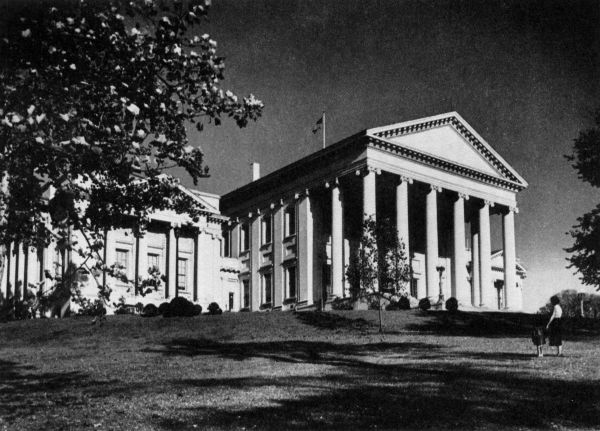
VA. DEPT. OF CONSERVATION AND ECONOMIC DEVELOPMENT
State Capitol at Richmond
A recorded affirmative vote by a majority of all the members elected to each house is necessary for the passing of any bills which create or establish a new office, which create, continue or revive a debt or charge, or which concern public monies or taxes. All tax bills must specifically state the tax requirements clearly.
Each law can include only one subject or object, and such subject or object must be expressed in its title. In order to revive or amend a law, the title reference alone cannot be used; the act revived or the section amended must be re-enacted and published at length. After a bill has been successfully passed, it generally cannot take effect until at least ninety days after the adjournment of the General Assembly session during which it was enacted. Two exceptions to this restriction exist: a general appropriation law and an emergency law. In these two instances, the General Assembly by an official "aye" recorded vote, by a vote of four-fifths of the members voting in each house, has the power to state the time such laws are to take effect.
The House of Delegates has the right to bring impeachment charges against the executive or judicial officers of the state. Impeachment charges may be brought for malfeasance (unlawful or wrongful action) in office, corruption, neglect of duty, or other high crimes or misdemeanors. Such charges are prosecuted before the Senate which has the sole power to try impeachments. A two-thirds affirmative vote of the senators present is necessary for conviction. If an individual is convicted of impeachment charges, he is subject to the following penalties: removal from office and disqualification from further office-holding under the State. In addition, the individual is subject to indictment (a formal charge of crime presented by a grand jury), trial, judgment and punishment according to law. It is possible in Virginia for the Senate to try impeachments during the recess of the General Assembly if the charges are preferred before adjournment.
In addition to passing state laws, the General Assembly also has the responsibility of electing (1) the judges of the Supreme Court of the State where terms have expired and (2) the judges of all circuit, corporate and chancery courts. Although the Governor appoints all the executive department heads, appointments generally must be approved by the General Assembly and likewise, all commission member appointments must be confirmed or rejected by the General Assembly.
According to the Federal Constitution, each state is represented in the United States Senate by two senators usually elected directly by the qualified voters of the state. The number of representatives from each state in the United States House of Representatives is based upon the proportional population of each state to the others. According to the last national census, the state of Virginia is entitled to ten members in the United States House of Representatives, based upon its population in proportion to the other states. In order to determine the sections of the state each member will represent, the state legislatures usually are given the power to divide their states into Congressional election districts as well as state election districts. Therefore, the Virginia General Assembly has the power to apportion the State into Congressional districts. Virginia has, at the present time, ten Congressional election districts. The state Constitution provides that these districts must "be composed of contiguous (adjacent) and compact territory containing as nearly as practicable, an equal number of inhabitants."
Section 58 of Article IV of the Virginia Constitution is considered so significant that it is required by the General Assembly to be included in the subject matter of all schools in the state. Its significance lies in the provisions included in this section which guarantee added protection to individual liberties by a series of prohibitions on the General Assembly itself. These prohibitions include the following:
(1) The General Assembly cannot suspend the writ of habeas corpus unless when, in case of invasion or rebellion, such action is required for public safety. Habeas corpus, literally, is a Latin expression meaning "You have the body"; a writ is a written legal command or order. Therefore, a writ of habeas corpus is an official order commanding a person who has another person in custody to produce the body of such person who is being detained before a court; thus, any person arrested or otherwise detained upon suspicion of crime has the right to demand an immediate hearing in court with a view to determine officially whether or not there is adequate ground for his detention. If the prisoner is then believed to have been detained on insufficient grounds, he will be given his freedom; otherwise, he will be held for trial, with or without release on bail. Consequently, the writ of habeas corpus acts as a protection for each individual against possible illegal or unlawful imprisonment.
(2) The General Assembly cannot pass a bill of attainder. In English law, a bill of attainder was an act of Parliament which pronounced the sentence of death against an accused person with consequent complete destruction of his civil rights without even a trial being conducted. In the Seventeenth Century these bills were commonly used in England. The writers of the Virginia Constitution did not believe in having an individual punished or convicted of a crime without a trial by jury in a court with proper jurisdiction. This prohibition guarantees a fair trial and means that an individual is "not guilty" until proven "guilty" of violating some law or constitutional provision.
(3) The General Assembly cannot pass an ex post facto law. "Ex post facto" literally means "after the fact." An ex post facto law is defined by the United States Supreme Court as one which "makes an action done before the passing of the law, and which was innocent when done, criminal, and punishes such action." Therefore, the legislature cannot pass criminal legislation after an alleged crime has been committed that, if brought to bear against an accused person, would be to his disadvantage. Retroactive criminal legislation which is not detrimental to an accused person is permissible (for example, a law reducing a penalty). Therefore, only those individuals who violated a law after a law has been passed are subject to punishment.
(4) The General Assembly cannot pass a law impairing the obligation of contracts. A contract is a formal agreement between two or more persons binding them to a particular action. Such contracts play a most important role in society today and must be regarded with utmost sincerity. The United States Constitution specifically prohibits the states from passing any law which would impair the obligation of contracts, would weaken their effect or would make them more difficult to enforce.
(5) The General Assembly cannot pass a law abridging the freedom of speech or of the press. Individuals are granted the right to participate in political discussion and criticism and in the interchanging of ideas and opinions in general. This, however, does not guarantee absolute freedom: one cannot utter or publish untruths, incite insurrections, encourage the disobedience of laws, defame the government, or give aid and comfort to foreign countries involved in war against the United States. One can easily understand the necessity for such limitations to freedom.
(6) The General Assembly cannot enact a law whereby private property would be taken or damaged for public uses without just compensation. The General Assembly has the authority to define the term "Public Uses." Originally in Virginia, the courts decided this definition, but an amendment later transferred this power from the courts to the General Assembly, making it a legislative rather than a judicial decision. The sovereign power of a state to take private property for public purposes with proper compensation is called the "right of eminent domain." The General Assembly must abide by such a right. Therefore, a resident in Virginia is guaranteed protection from having his private property seized from him for unfair or unjust compensation. In case of a dispute over the fair value of such property, the court decides the fair amount.
(7) The General Assembly cannot compel an individual to frequent or support a particular religious place of worship and cannot force an individual to suffer because of his religious beliefs or opinions. All individuals are to be guaranteed their religious freedom and the General Assembly cannot require religious tests, bestow certain privileges or advantages to a particular sect or denomination and cannot pass any law requiring or authorizing any official church within the state. Likewise, the General Assembly cannot levy taxes on the people forcing them to support the activities of a particular church or the building program of any house of worship. The General Assembly, therefore, is forbidden to interfere with the religious belief and worship of the inhabitants within the state. Another section of the Constitution forbids the General Assembly from incorporating churches or granting charters of incorporation to any religious denomination.
These religious safeguards for a person's individual beliefs are primarily repetitions of the provisions of Thomas Jefferson's "Statute of Virginia for Religious Freedom." Since it is more difficult to change a provision of a constitution than a statute or a law, these provisions were included in the Virginia Constitution for emphasis and for a more enduring effect.
The General Assembly is also forbidden to authorize lotteries (the distribution of prizes determined by chance or by lot) or to allow the residents of the state to buy, sell, or transfer lottery tickets or chances.
An extremely important power of every state legislature is the creation of political subdivisions within the state itself: namely, the counties. The Virginia Constitution specifically provides for the formation, division and consolidation of counties. A new county must have a minimum area of 600 square miles and the county or counties from which it is formed cannot be less than 600 square miles after the new county has been formed. No county can be reduced in population below 8,000 people. Whenever any county has a length three times its breadth, or has a length exceeding fifty miles, it may be divided at the discretion of the General Assembly. Such added length can occur as a result of boundary changes or the annexation of territory. The General Assembly may consolidate existing counties upon the approval of a majority of the qualified voters of each of these counties voting as a result of an election held for this specific purpose. If the majority do not vote approval of consolidation, such consolidation cannot take place.
Virginia had eight counties originally, dating from 1634: Accawmack (now known as Accomack and Northampton), Charles City (now known as Prince George County), Charles River (now known as York County), Elizabeth City (ceased as a county in 1952), Henrico, James City (now known as Surry County), Wamosquyoake (no longer in existence—existed only from 1634-1637) and Warwick River (known as Warwick but ceased as a county in 1952). In 1648, an Indian district called Chickacoan was formed into the County of Northumberland. From these nine counties eventually 172 counties were created, with the largest number, 116, created from Northumberland. The last change in the number of counties occurred in 1952 when both Elizabeth City County and Warwick County became first class independent cities, thus relinquishing county status. At the present time, there are 98 counties in Virginia. Furthermore, since 1788, nine counties became part of the present state of Kentucky, fifty counties became part of the present state of West Virginia and fifteen counties (including the two mentioned previously) went out of existence through consolidation or other methods. The General Assembly has exercised and will continue to exercise its power of county-making in Virginia.
In the Virginia Supreme Court case of Moss versus County of Tazewell, the decision stated that "the power of the legislature of the State is supreme, except so far as it is restrained by State or Federal Constitution." Therefore, a State constitution is usually considered as a restraining agreement whereby the Federal Constitution is considered as a granting agreement. Thus, the legislative body of a State has all the powers not prohibited to it by the State or Federal Constitution. A State constitution is often, therefore, a summary of what the state legislative body may not do. The Virginia Constitution specifically states that "the authority of the General Assembly shall extend to all subjects of legislation, not herein forbidden or unrestricted; and a specific grant of authority in this Constitution upon a subject shall not work a restriction of its authority upon the same or any other subject." The principles described are further emphasized in this quotation from the Virginia Constitution which follows: "The omission in this Constitution of specific grants of authority heretofore conferred shall not be construed to deprive the General Assembly of such authority, or to indicate a change of policy in reference thereto, unless such purpose plainly appear."
There are several limitations placed upon the General Assembly by the Constitution: the General Assembly cannot enact any local, special or private law in the following instances (but can enact general laws in the same instances):
(1) for the punishment of crime,
(2) for providing a change of venue (the place where a trial is held) in civil or criminal cases,
(3) for regulating the jurisdiction of, or changing the rules of, evidence in any judicial proceeding,
(4) for changing county seats,
(5) for assessing and collecting taxes and for extending the time for assessment or collection of taxes,
(6) for exempting property from taxation,
(7) for postponing or diminishing any obligation or liability of any person, corporation or association to the State or to any local unit of government,
(8) for refunding money lawfully paid into the treasury of the State or the treasury of any local unit of government,
(9) for granting from the treasury of the State any extra compensation to any public officer, servant, agent or contractor,
(10) for conducting elections or designating places of voting,
(11) for regulating labor, trade, mining or manufacturing, or the rate of interest on money,
(12) for granting any pension,
(13) for creating, increasing or decreasing fees, salaries, percentages, or allowances of public officers during the term for which they are elected or appointed,
(14) for declaring streams navigable or authorizing the constructions of booms or dams or the removal of obstructions from such streams,
(15) for regulating fencing or the boundaries of land, or the running at large of stock,
(16) for creating private corporations, or amending, renewing, or extending their charters,
(17) for granting to any private corporation, association or individual any special or exclusive right, privilege or immunity,
(18) for naming or changing the name of any private corporation or association,
(19) for forfeiting the charter of a private corporation.
General laws pertaining to the above subjects may be amended or repealed as long as they do not have the effect of enactment of a special, private, or local law.
The General Assembly also has the power, by means of general law, to confer upon boards of supervisors of counties and the councils of cities and towns powers of local and special legislation insofar as the delegation of power is not inconsistent with constitutional limitations.
Each time the regular session of the legislature is held, the General Assembly appoints a standing committee, called the auditing committee which consists of two members of the Senate and three members of the House of Delegates. The chief function of this committee is to examine, at least once a year, the books of the State Treasurer and other government executive officers whose duties concern auditing or accounting for the State revenue and of the public institutions. This committee reports the results of its investigations to the Governor and must arrange for publication of results in two newspapers of general circulation. The Governor himself submits such reports to the General Assembly at the beginning of each session. The members of this committee have the right to employ accountants to assist them in carrying out their investigations.
The Executive Department—Article V of the Virginia Constitution concerns the Executive Department. The chief function of the Executive Department is to enforce or carry out the laws. The highest executive officer in the State is the Governor. He receives his position by direct election of the qualified voters on the Tuesday following the first Monday in November of every other odd-numbered year—at the same time and place as the election of the General Assembly members. The term of office for a Governor is, therefore, four years. He is not eligible for re-election to the same office during the succeeding term; in other words, a Governor cannot succeed himself.
The Governor's term begins on the third Wednesday in January on the first year after his election and ends on the Tuesday following the second Wednesday in January of his fourth year. This timing allows a new Governor to come into office one week after the General Assembly has convened for its regular session and has had the opportunity to organize. The interval also affords an opportunity for the outgoing Governor to present his opinions and experiences to the state legislature before his departure.
After the votes have been cast for the State gubernatorial (Governor) candidates, the returns of the election are usually sent, under seal, to the Secretary of the Commonwealth. He delivers the returns to the Speaker of the House of Delegates on the first day of the next session of the General Assembly. Within three days, the Speaker of the House of Delegates must open the returns in the presence of a majority of the Senate and of the House of Delegates. Then the votes are counted. The person who receives the highest number of votes is declared elected. If there is a tie, however, the two houses of the General Assembly jointly vote for the Governor.
In order to be eligible for the governorship, a candidate must have three qualifications: (1) he must be a United States citizen (if not a native-born citizen, he must have been naturalized for at least ten years preceding his election), (2) he must be at least thirty years of age and (3) he must have been a resident in the State of Virginia for at least five years directly preceding his election.
The Governor must live in the city of Richmond, the capital of Virginia, during his term of office. He resides at the Executive Mansion and receives at the present time a salary of $20,000 per year. Such compensation cannot be increased or diminished during his term of office. He cannot receive any other emolument (money) while in office from the state government or from any other government and he cannot hold any other position while he is Governor of the State.
The chief duty or power of the Governor is to faithfully administer or execute the laws. Other powers include:
(1) reporting to each session of the General Assembly the condition of the State in a message known as the "Governor's Message"
(2) recommending to the General Assembly for consideration measures which he believes are beneficial to the State
(3) convening the General Assembly whenever two-thirds of the members of both houses request it
(4) convening the General Assembly into special session whenever, in his opinion, the interest of the State requires it
(5) acting as the commander-in-chief of the State land and naval forces
(6) calling out the State militia or State Police whenever necessary to repel invasion, suppress insurrection and enforce the execution of the laws
(7) conducting all relations with other states
(8) during the recess of the General Assembly, suspending from office for misbehavior, incapacity, neglect of official duty, or acts performed illegally, any executive officer in Richmond except the Lieutenant-Governor (whenever he exercises this power, however, he must report to the General Assembly, at the beginning of the next session, the fact that he suspended an officer or officers and the cause for such suspension: then the General Assembly itself determines whether or not such individuals are to be restored or finally removed from office).
(9) during the recess of the General Assembly, appointing pro tempore (temporary) successors to all individuals suspended (as described previously)
(10) likewise, during the recess of the General Assembly, filling pro tempore vacancies in all offices of the State if such filling is not otherwise provided for by the Constitution or by laws. (Such appointments must be by commissions which automatically expire at the end of thirty days after the beginning of the next session of the General Assembly).
(11) remitting fines and penalties under rules and regulations as prescribed by law
(12) granting reprieves and pardons after conviction except those in which the House of Delegates carried on the prosecution
(13) removing political disabilities resulting from conviction for offenses committed prior to or subsequent to the adoption of the State Constitution
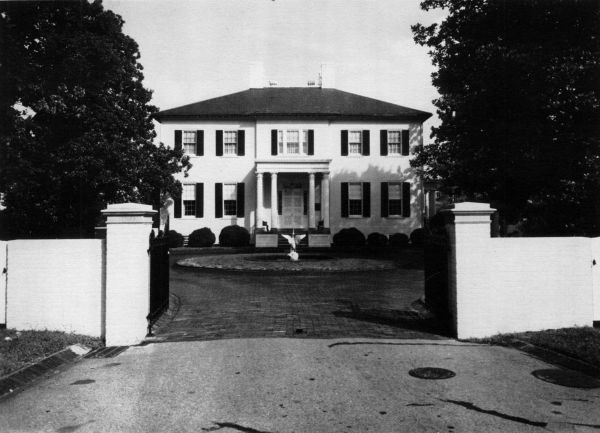
VIRGINIA STATE CHAMBER OF COMMERCE
Executive Mansion
(14) commuting sentences of capital punishment
(15) informing the General Assembly, at each session, of the details of each case of fine or penalty remitted, of each reprieve or pardon granted, and of punishment commuted, plus his reason for doing so.
(16) requiring information in writing, under oath, from the officers of the executive department and superintendents of State institutions upon any subject relating to the duties of their respective offices and institutions (Likewise, he may inspect at any time their official books, accounts and vouchers, and ascertain the conditions of the public funds in their charge and he may employ accountants for this purpose)
(17) requiring the opinion in writing of the State Attorney-General concerning any question of law affecting his official duties as Governor or relating to the affairs of the Commonwealth
(18) legally certifying all commissions and grants in the name of the Commonwealth of Virginia and affixing each with the official seal of the Commonwealth
(19) supervising the activities of all State Executive Departments, Divisions, Boards and Commissions and appointing all the chief officers and members of such groups with the consent or confirmation of the General Assembly
(20) appointing certain officials, subject to confirmation by the General Assembly (for example, the Secretary of the Commonwealth, the State Treasurer)
(21) considering all bills passed by the General Assembly
The Governor's responsibility in the law-making process is significant. After a bill has passed both houses of the General Assembly, it is sent to the Governor who has four choices of action:
(1) He may approve the bill by signing it; it becomes a law.
(2) He may disapprove the bill by vetoing it; he then returns it with his objections to the house in which it originated. This house enters such objections on its journal and reconsiders the bill in view of such objections. If, after careful consideration, two-thirds of the members present (at least a majority of the membership of that house is required as a minimum present for voting) still approve the bill, it is sent with the Governor's objections to the other house. After careful consideration here, if it is approved by two-thirds of all the members present (at least a majority of the membership of this house is also required as the minimum present for voting), it will become a law over the Governor's disapproval. This process is called "Over-riding the Veto." The Governor also has the power to veto any particular item or items of an appropriation bill without vetoing the entire bill. Such veto affects only the particular item or designated items. In such a case, the item or items must be considered by the same methods described previously. If the Governor favors the general purpose of any bill but opposes a part or certain parts, he may return it with recommendations for amending it to the house in which is originated with the same procedures described previously being used. One exception, however, exists: a vote of only a majority of the members present in each house is required to amend a bill.
(3) He may do nothing about the bill; after five days have passed, Sundays excepted, and if the General Assembly is still in session, the bill automatically becomes a law.
(4) He may do nothing about the bill; after ten days have passed, if the General Assembly has adjourned in the meantime, making it impossible to return the bill, the bill does not become a law. Such procedure is called a "pocket veto."
With such a wide range of power, the tremendous responsibility and authority which the Governor of Virginia possesses is readily apparent.
The second highest ranking state executive is the Lieutenant-Governor. He is elected to office by the qualified voters at the same time as the Governor for the same four-year term of office. His qualifications and election procedure are identical to those of the Governor. In case the Governor of the state dies, fails to qualify, resigns, is removed from the State or is unable to discharge the powers and duties of his office, the Lieutenant-Governor then assumes the Governorship with its duties, powers and compensation. Normally, the chief duty of the Lieutenant-Governor is to act as permanent chairman of the State Senate. While presiding over same, he is called the President of the Senate. In such capacity, he has no vote except in case of a tie. His salary consists of $1260 for each biennial session of the legislature plus $3,000 per year for traveling expenses. Hence, he receives the same salary as the Speaker of the House of Delegates.
Two major administrative officials appointed by the Governor and subject to the approval of the General Assembly are the Secretary of the Commonwealth and the State Treasurer. Their terms of office are coincident with the Governor who appoints them. The Secretary of the Commonwealth acts as the official secretary to the Governor and is the head of the Division of Records where all records of the official acts of the Governor are kept. The Secretary of the Commonwealth is also the custodian of the official State Seal and is responsible for affixing same to all the official documents signed by the Governor. The State Treasurer has custody of the funds of the state in the payment of bills. He makes deposits of all revenue belonging to the Commonwealth in certain specified banks and withdraws such money by check only upon the State Comptroller's warrant.
Another important state official is the Auditor of Public Accounts. He is elected by the joint vote of both houses of the General Assembly for a four-year term. His powers and duties include the auditing of all accounts of each state department, institution and agency, and he acts as chief auditor and accountant of the Auditing Committee of the General Assembly. In addition, he is responsible for exposing unauthorized, illegal or unwise handling of state funds to the Governor, the Auditing Committee of the General Assembly and the Comptroller. He is also required by law to audit all city and county officials' accounts unless such accounts are audited annually by a certified public accountant according to the State Auditor's instructions.
All state officials who collect, keep in custody, handle or disburse public funds must give bond for the faithful performance of these duties. The amount of the bond varies with the amount of revenue involved in carrying out such duties.
Any individual who is appointed to any office by the Governor which requires confirmation by the General Assembly and who does not receive such necessary confirmation cannot start or continue in office and is ineligible for reappointment during the recess of the General Assembly to fill a vacancy caused by such refused confirmation.
To assist the Governor in carrying out his executive duties, numerous departments and agencies have been established by the Constitution or by legislative act. Most of the department names suggest the particular type of work for which each is responsible: the Department of Military Affairs, the Department of Law including the Division of Motion Picture Censorship and the Division of War Veterans' Claims, the Department of Accounts, the Department of Purchases and Supply, the Department of the Treasury, the Department of Taxation, the Department of State Police, the Division of Motor Vehicles, the Department of Corporations, the Department of Alcoholic Beverage Control, the Department of Labor and Industry, the Department of Agriculture and Immigration, the Department of Workmen's Compensation, the Department of Conservation and Economic Development, the Department of Education, the Department of Highways, the Department of Health, the Department of Welfare and Institutions, the Department of Mental Hygiene and the Department of Professional and Occupational Registration. The Division of Personnel, the Division of the Budget, the Division of Records and the Office of Civilian Defense are all located in the Governor's Office. Additional specialized commissions such as the Advisory Council on Virginia Economy, the Art Commission, the Safety Codes Commission, the State Library Board, the State Water Control Board, the Commission on Constitutional Government, the Potomac River Basin Commission and the Commission on Interstate Cooperation also participate actively in the carrying out of the financial, law enforcing, service rendering, conservation, preservation, and regulation functions of the executive department of the Commonwealth.
The Judicial Department—Article VI concerns the Judiciary Department whose chief purpose is to interpret the laws properly. The State Constitution in Virginia provides for a Supreme Court of Appeals, Circuit Courts, City Courts and other inferior courts. The jurisdiction of these courts is regulated by law with the exception of jurisdiction granted specifically by the State Constitution itself. The General Assembly authorizes by law the appointment of judges pro tempore by the Governor.
The highest State Court is the Supreme Court of Appeals, located in Richmond. It consists of seven members: one Chief Justice and six associate justices. The Chief Justice is always the Senior Justice in years of continuous service; in case the total years of service are equaled by two or more justices, seniority is then determined by age. The term of office of the justice is twelve years, and they are elected by a joint vote of the Senate and the House of Delegates. Their sole constitutional qualification is that they must have held a "judicial station" in the United States or have practiced law in Virginia or some other state for five years previously. The annual salary of a justice of the Court of Appeals is $15,500 with the Chief Justice receiving an additional $4,500 or a salary of $20,000.
When meeting in court session, the members of the Supreme Court of Appeals may sit as an entire group or may sit in two divisions consisting of not less than three justices each. By sitting in two such divisions, it is possible to hear more cases at a rapid pace. Whenever convening in this manner, each division has the full power and authority on the determination of causes, in the issuing of writs, and in the exercise of all powers authorized by the State Constitution for the Supreme Court of Appeals or provided by law. Each division is subject, however, to the general control of the Supreme Court of Appeals and is subject to any rules and regulations which this court may make. Likewise, the decision of either division does not become the judgment of the Supreme Court of Appeals unless concurred in by at least three judges. Any case which involves a construction of the State Constitution or of the Constitution of the United States must be decided upon by the Supreme Court of Appeals in toto and, furthermore, the assent of at least four of the judges is necessary for the court to determine that any law is or is not contrary to the State Constitution or the Constitution of the United States. If, in such a case, it is impossible for more than three of the judges to agree on the constitutional questions involved and if the case cannot be determined without passing on such questions, the case must be reheard by a full court. Whenever the judges within either division differ as to the judgment to be rendered in any cause, or whenever any judge of either division within a time and in a manner fixed by the court rules certifies that in his opinion any decision of any division of the court is in conflict with a prior decision of the court, the cause must be considered and adjudged (decreed) by the full court or at least a quorum of the full court.
There are two types of court jurisdiction: original and appellate. Original jurisdiction exists whenever a court has the legal right to hear a case for the first time. Appellate jurisdiction exists whenever a court is hearing a case which is being appealed or brought to it from a lower court. The Virginia Supreme Court of Appeals has original jurisdiction in cases of habeas corpus, mandamus and prohibition. Habeas corpus is a court order which commands a person having another individual in custody to bring before the court the individual detained for the purpose of determining the legality of detention. A mandamus is a court order directed to subordinate courts, corporations, or the like, commanding them to do something therein specified. A prohibition is a writ or court order which legally restrains someone from doing some particular action. In all other cases in which the Supreme Court of Appeals has jurisdiction, it has appellate jurisdiction only. The General Assembly has the power to provide, from time to time, for a Special Court of Appeals whose chief purpose is to assist the Supreme Court of Appeals.
Whenever a judgment or decree is reversed, modified or affirmed by the Supreme Court of Appeals, the court must state in writing the reasons for same and must keep such record on file with the case. In criminal matters, the court may direct a new trial. If the court believes that the accused should be discharged from further prosecution, in such instance, it has the right to order the case ended, thereby discharging such an individual from further prosecution. This court has no power, however, to increase or decrease the punishment of an accused person. In civil cases, the court may enter a final judgment.
The courts which rank second highest in the Virginia judiciary are the Circuit Courts. The General Assembly has the power to arrange and re-arrange the judicial circuits of the state and to increase or diminish their number. However, no new circuit can be created containing less than forty thousand inhabitants according to the most recent census nor if such creation would result in reducing the number of inhabitants in any existing judicial circuit below forty thousand. There are thirty-seven judicial circuits in Virginia. The geographical composition of the circuit ranges from one county or city to five counties and one city. Each circuit has one judge chosen by the joint vote of both houses of the General Assembly for a term of eight years. He must possess the same qualifications when chosen as judges of the Supreme Court of Appeals and must live in the circuit area where the circuit court is located while he is in office. The number of sessions of the circuit courts to be held for each county and city is prescribed by law and the judge of one circuit may be required or authorized to hold court in another circuit or city. Circuit courts usually have original and appellate jurisdiction in (1) all civil cases involving twenty dollars or more and (2) certain criminal cases.
Below the circuit courts in the court structure in Virginia are the city Hustings or Corporation Courts. They are courts of record also and have original jurisdiction except in cases of appeals from justices. These courts have the sole power to appoint electoral boards in cities where they are located. They have much concurrent jurisdiction with the circuit courts. They are criminal courts and can try cases of felonies committed within one mile of the corporation limits. There are sixteen such courts: Corporation Courts located in Alexandria, Bristol, Charlottesville, Danville, Lynchburg, Newport News, Norfolk (2), South Norfolk, Staunton, and Winchester; Hustings Courts located in Petersburg, Portsmouth, Richmond (2) and Roanoke. These city court judges must live in the city where the court is located.
The Virginia Constitution divides the cities of Virginia into two classes as far as the judicial system is concerned: (1) cities having a population of at least ten thousand according to the last official census are called cities of the first class; (2) cities having a population of less than ten thousand according to the last official census are called cities of the second class. In each first class city there may be a corporation court in addition to a circuit court. In any city containing at least thirty thousand inhabitants, the General Assembly may provide additional courts with the number of judges it deems necessary for the public interest.
In a second class city, there may be a corporation or hustings court. The circuit court of the county in which the city is situated and the corporation or hustings court have concurrent jurisdiction in actions at law and suits in equity unless otherwise provided by law. Therefore, the General Assembly has the power to confer exclusive original jurisdiction upon a corporation or hustings court in all cases involving residents of any such city; this setup is much more convenient to the residents who live a considerable distance from the county seat. This type of court may be abolished by a vote of a majority of the qualified voters of the particular city in which the court is located at a special election held for this purpose. Another method by which a court may cease to exist is by having the office of judge of such a court whose annual salary is less than eight hundred dollars become vacant and remain vacant for ninety days consecutively. Automatic abolishment of such court results. In each case in which such court is abolished, the city immediately comes within the jurisdiction of the circuit court of the county wherein it is geographically situated unless otherwise provided for by law. The records of the abolished corporation or city court immediately become records of the aforementioned circuit court and are transferred accordingly.
For each city court of record there is a judge chosen for an eight-year term by a joint vote of both houses of the General Assembly. He must have the same qualifications as Supreme Court of Appeals judges and must live within the jurisdiction of the court over which he presides while he is in office. However, the judge of a corporation court of any corporation having a city charter and having less than ten thousand inhabitants may live outside the city limits. Such an individual may be judge of such corporation court and also judge of a corporation court of some other city having less than ten thousand inhabitants. The judges of city courts may be required or authorized to hold the circuit or city courts of any county or city.
The General Assembly has the power also to establish courts of land registration for the administration of any law it may adopt for the purpose of the settlement, registration, transfer, or assurance of titles to land in the State.
Judges are commissioned by the Governor of the State. Their salaries and allowances are prescribed by law and cannot be diminished during their term of office. Their term of office begins on the first day of February succeeding their election by the General Assembly. Whenever there is a judgeship vacancy, the successor is elected for the unexpired term. The General Assembly also has the authority to retire judges and to provide their compensation. The General Assembly has the power to pass laws giving duties to retired judges such as substitute judge work. The salaries of judges are paid out of the State treasury but the State is reimbursed for one-half of the salaries of each of the circuit judges by the counties and cities composing the circuit, based upon their population and of each of the judges of a city of the first class by the city in which each judge presides. The one exception is the judge of the Circuit Court of the city of Richmond whose entire salary is paid by the State. A city may increase the salary of its circuit or city judges if the city assumes the entire increase and guarantees that such salary will not be diminished during the entire term of office. A city which has less than ten thousand inhabitants pays the salary of its city judge.
Judges may be removed from office in Virginia for cause by a concurrent vote of both houses of the General Assembly. A majority of all the members elected to each house must concur in such vote, and the cause of removal must be entered on the journal of each house. The judge against whom the General Assembly is about to proceed for removal must have notice of same accompanied by a copy of the alleged causes at least twenty days before the actual voting takes place. Typically, no judge can practice law within or without the State of Virginia nor hold any other office of public trust while he is in office.
Writs (court orders) must be issued in the name of the "Commonwealth of Virginia" and must be certified by the clerks of the various courts. The Constitution requires that indictments (a formal charge of crime presented by a grand jury) conclude "against the peace and dignity of the Commonwealth."
The General Assembly provides for the appointment or the election of justices of the peace and establishes their jurisdiction. Authority of justices of the peace includes civil suits which involve limited amounts. In addition, Virginia also has police justices, trial justices, civil justices, civil and police justices, juvenile and domestic relations courts and mayor's courts. Their jurisdiction is usually limited, however, and appeals from them are heard by city and circuit courts.
All cities and counties and many towns have local courts called Magistrate Courts or Justice of the Peace Courts. Their jurisdiction includes misdemeanors and civil cases involving small amounts of money.
The Commonwealth also has two Law and Chancery Courts, one located in Roanoke and one in Norfolk. Their jurisdiction includes the probating of wills and the settling of estates. There is a special Chancery Court located in Richmond which has complete charge of wills to be probated and the settling of estates in that part of "Richmond north of the south bank of the James River." There is also a special Law and Equity Court located in Richmond.
The Juvenile and Domestic Relations Court, located in Norfolk, is a special state court which has jurisdiction over cases involving dependent, neglected and delinquent children and in cases involving crimes—except manslaughter—against a family member.
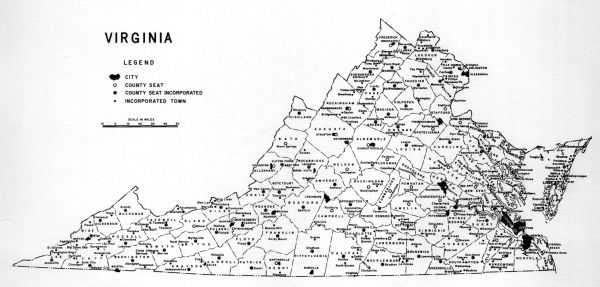
Virginia
The State Attorney-General is elected by the qualified voters of the State at the same time and for the same term as the Governor and Lieutenant-Governor of the State (a four-year term of office). He must have the same qualifications as the Governor but he is eligible for re-election. His chief duty is to serve as the attorney-at-law for the State; he renders opinions concerning the interpretation and application of laws upon the request of the Governor or of various Department heads, he presents cases to the Supreme Court of Appeals if the State's interest is involved and he represents the State of Virginia before the Supreme Court of the United States. The numerous problems arising in the carrying out of these responsibilities make it desirable and necessary for him to have legal assistants who may aid him in furnishing aid to local Commonwealth attorneys. The State Attorney-General is subject to removal from office in the same manner as judges. His present salary is $17,000 annually.
Local Governmental Units
The State Constitution not only establishes state government organization, but it also includes rules concerning local governmental units which are found in Article VII. Local charters are granted by the General Assembly. The political level immediately below the state government level is the county. Virginia is divided into ninety-eight counties at the present time. The last original county to be created is Dickenson County, formed in 1880. The largest county in the state in area is Pittsylvania with 1,022 square miles and the smallest county in area is Arlington with 24 square miles. Fairfax County is currently the most populated county in Virginia, surpassed in population only by the city of Norfolk.
Legally, a county is a corporation. Its main functions, in general, are the preservation of order, the protection of life and property, the establishment of public schools, the administration of justice, the registration of legal documents, the maintenance of highways and bridges outside the cities and the care of the poor and the criminal.
Counties of Virginia are divided into magisterial districts, the number of districts varying from three to ten. Provision is made in the state constitution that additional districts may be made by law only if the new district contains at least 30 square miles. Each district has one supervisor elected by the qualified voters. Thus, the Board of Supervisors of the county consists of one representative elected from each magisterial district in the county with the exception of Arlington County where the Board of Supervisors is elected at-large from the county. Therefore, the number of members of each Board of Supervisors varies among the counties. A chairman for this group is selected by the members themselves. Their meetings are usually held once a month at the Court House located at the County Seat. The Board of Supervisors carries out various duties such as: (1) supervises county affairs, (2) establishes and levies county taxes, (3) prepares the county budget, (4) audits claims against the county, (5) erects and maintains county buildings, (6) acts as a legislative and executive body by issuing and carrying out ordinances on such subjects as sanitation, health and police, (7) approves saluary scales for county workers, (8) controls county property, (9) furnishes care for the mentally and physically handicapped, and (10) borrows money.
There are five county officials of importance who are elected to office by the qualified voters on the first Tuesday after the first Monday in November and take office on January 1 following their election. These officials are:
(1) Attorney for the Commonwealth—a lawyer who acts as a legal adviser to the Board of Supervisors and to the county officials and who acts as legal representative of the people of the county; he also acts as prosecutor for all civil and criminal cases in which the county is interested; he is elected by the qualified voters for a four-year term.
(2) County Clerk—an officer who serves as a clerk to the County Board of Supervisors and to the County Circuit Court; as the main county recording official, he records all types of county documents (such as deeds, wills, judgments, mortgages, births, divorces, deaths, elections, court trials and marriages); attends meetings of the Board of Supervisors and has custody of property records; he is elected by the qualified voters for an eight-year term.
(3) Commissioner of the Revenue—an official who assesses property values for taxation purposes, assesses State personal income taxes, prepares personal property tax books and land books and assesses and collects all professional and business licenses; he is elected by the qualified voters for a four-year term.
(4) County Treasurer—an officer who collects the county taxes assessed by the Commissioner of Revenue, collects the state taxes, keeps the county funds and disburses money upon order of the Board of Supervisors; he is elected by the qualified voters for a term of four years.
(5) Sheriff—an officer who is the chief executive officer of the county; he and his assistants, called deputies, form the county police force; the Sheriff serves warrants of arrests, summons witnesses and jurors whenever necessary, preserves peace in the county, has charge of prisoners, cooperates with the State Police and acts as a Bailiff at meetings of the Board of Supervisors and at Trial Justice and Circuit Court sessions; he is elected for a four-year term.
Other significant county positions include County School Board members, County Superintendent of Schools, County Health Board members, County Surveyor, Welfare Board members, Planning Commission and Highway Commission members, Game Wardens and Election Board members. A state official who exerts strong influence upon the county is the State Circuit Judge. Since he tries cases in various counties within his own circuit, he comes in contact with many county officials and has the authority to appoint certain county officials within his own circuit such as (1) a Trial Justice who tries the less important civil and criminal cases in the county and holds hearings of cases to be tried by the circuit judge and (2) the Coroner who makes investigations and reports concerning sudden, violent or suspicious deaths in the county. The Circuit Judge also appoints the School Trustee Electoral Board which in turn appoints the County School Board.
There are three types or forms of County Government in existence in Virginia: the County Executive Form, the County Manager Form and the County Board (often called the "Traditional") Form. Two counties, Albemarle and Fairfax, have adopted the County Executive Form and two counties, Arlington and Henrico, have adopted the County Manager Form. Arlington County was the first county in the United States to adopt the County Manager form of government by popular vote (1932). The major difference between the County Executive and the County Manager Forms of government is found in the fact that, in the former type, the Board of Supervisors makes all key appointments upon the recommendations of a county executive who is employed to act as the administrative head of the county whereas, in the latter form, the Board of Supervisors employs a manager for the county and gives him authority to name and appoint his own department heads. The remaining 94 counties are operated under a County Board: under this form, the Board of Supervisors exercises not only legislative but full executive authority as well.
The county form of government, therefore, acts not only as a local government unit but also as an administrative agent of the state.
Cities and towns make up the next political level of government organization in Virginia as described in Article VIII of the constitution. A city is defined in the constitution as an incorporated community which has within defined boundaries a population of five thousand or more; a town is an incorporated community which has within defined boundaries a population of less than five thousand. In determining such population, the last census of the United States or an enumeration made by authority of the General Assembly must be used as the basis. Any incorporated community which had a city charter when this section of the State Constitution was adopted in 1902, regardless of its numerical population at the time, was allowed to keep its city charter. The General Assembly has the authority to enact general laws for the organization and government of cities and towns in Virginia. In special instances, the Circuit Court may issue such charters. Whenever an area has a population of at least five thousand, it may apply, but is not required to apply, for city status. Unlike many of the other states in the United States, Virginia does not have any village type of government.
Cities having at least ten thousand persons are eligible to be classified as cities of the first class; cities having less than ten thousand persons are eligible to be classified as the second class. Cities in Virginia have generally followed a three-fold plan or pattern of development: first, an area is established, then incorporated as a town and finally elevated to city status as an independent municipality. During the colonial period, there were only two towns actually incorporated: Williamsburg and Norfolk. By 1800, only six additional towns were incorporated: Alexandria, Winchester, Fredericksburg, Richmond, Petersburg and York (Yorktown). Yorktown is the only town incorporated before 1800 which has not become a city.
A unique characteristic about cities in Virginia is the fact that an incorporated city is politically separate from the county in which it is geographically located. There are thirty-two independent cities: Alexandria, Bristol, Buena Vista, Charlottesville, Clifton Forge, Colonial Heights, Covington, Danville, Falls Church, Fredericksburg, Galax, Hampton (formerly, a second class city; now combined with the town of Phoebus and Elizabeth City County into a first class city since 1952), Harrisonburg, Hopewell, Lynchburg, Martinsville, Newport News, Norfolk, Norton, Petersburg, Portsmouth, Radford, Richmond, Roanoke, South Boston, South Norfolk, Staunton, Suffolk, Virginia Beach, Waynesboro, Williamsburg and Winchester. When Newport News and Warwick became the city of Newport News on July 1, 1958, this was the first city to be consolidated in the Commonwealth since Richmond and Manchester combined in 1910.
There are three types or forms of City Government in existence in Virginia: Mayor-Council form, Commission form and City Manager form. The city charter bears a similar relation to the city that the Virginia Constitution bears to the state. The citizens within the city area may decide for themselves the type of city government they prefer when they apply for their city charter.
Although there are three forms of local government available, there are certain characteristics common to all three types:
(1) A bicameral City Council (unless authorized by the General Assembly to have only one branch) is elected by the qualified voters of the city on the second Tuesday in June. The term of office of the councilmen begins on the following September 1. The council acts as the legislative body by passing city or municipal laws called ordinances. Cities are usually divided into various sections called wards. Since representation from each ward is primarily based upon population of the ward, the city council has the power to change ward boundaries. Since 1933, after every ten-year period, the city council is required by the Virginia Constitution to re-apportion such representation accordingly. Usually, there is one councilman from each ward.
(2) The following officials are required by the Constitution to be elected to office by the qualified voters: City Court Clerk, City Commonwealth's Attorney, City Commissioner of Revenue, City Treasurer and City Sergeant (Sheriff). All these officials (with the exception of the City Court Clerk whose eight-year term of office begins at the same time as the city judges' term) are elected on the first Tuesday after the first Monday in November and their term of office begins on the following January 1. Under a constitutional amendment proposed in November 1960, certain elected officials of a city (or county) could serve as such officials in two or more cities (or counties, or city and counties) if a majority of the voters of the local units affected so decided; however, the amendment was defeated.
(3) Every city has a mayor who is the chief executive and who is elected by the people for a four-year term. Depending upon the form of city government adopted, the mayor may be essentially a figurehead or a key official. The chief duties of a mayor usually include the following:
a. enforcing ordinances, by-laws and orders,
b. ascertaining that duties of various city officials are carried out properly,
c. suspending city officials upon the authorization of the General Assembly for misconduct in office or for neglect of duty,
d. considering ordinances, resolutions, and other measures and approving or disapproving them,
e. presiding at city council meetings (unless a special provision already has provided for a council president) and voting only in case of a tie
f. appointing key officials with the approval of the city council (for example, the Chief of Police, the Fire Chief, the City Attorney) and members of certain boards (Planning, Health, Zoning Boards).
Every resolution or ordinance must be presented to the Mayor of a city after it has been passed by the City Council. The Mayor has three choices:
(1) He may approve the ordinance by signing it; it then becomes operative.
(2) He may disapprove the ordinance by vetoing it; he then returns the ordinance to the clerk of the council with his written objections. The council then enters the detailed objections in its journal and reconsiders the original resolution or ordinance in view of such objections. If, after due consideration, two-thirds of the membership of the council still wishes the original ordinance to pass, it is passed over the Mayor's veto.
(3) He may do nothing about the ordinance; after five days have passed, Sundays excepted, if the Mayor is still in office and the term of office of the members of the city council has not expired, it automatically is passed. If, however, during these five days, either the term of office of the Mayor or the term of office of the members of the city council ends, the ordinance is not passed but is considered "killed."
Like the Governor of the state, the Mayor can veto a particular item or more than one item in an appropriation ordinance or resolution without affecting the rest of the resolution or ordinance. Any ordinance or resolution which concerns the appropriation of money for an amount over one hundred dollars, the levying of taxes or the authorizing of the borrowing of money can be passed only by a recorded affirmative vote of a majority of all council members.
The oldest form of city government in Virginia is the Mayor-Council Form. Under this form, the Council and the Mayor are elected by the qualified voters. The Mayor, therefore, is the chief executive officer of the city and he either appoints solely, or with the consent of the city council in some instances, the city officers not constitutionally required to be elected. He also has the authority to supervise all city departments and to suspend any officer or employee for cause. Under this system, the council is the legislative body only.
Another form is the Commission form of local government. Of the three different types mentioned previously, this form is used in Virginia the least. According to this plan, the city council itself, elected at large, assumes the legislative and administrative or executive powers. A mayor is elected from council membership but he has very limited powers. He is chairman at the council meetings and may suggest recommendations as possible legislative measures as he sees fit. The city itself is divided into various administrative departments by the council and each department is assigned to a different council member who becomes the head executive or administrative official of that department. Thus, each council member acts as an administrator individually and as a legislator collectively. The city council according to this plan carries out the usual functions of the legislative body and of the executive department, including such functions as determining the powers of each department and the rules and regulations of each office holder and employee.