6 Cultural Life
Reading edition
Culture has been defined as the "training, improvement and refinement of the mind." Since literature, art, sculpture, architecture, music, drama and education are factors which influence, as well as reflect, the culture of a group, a survey of some of the outstanding contributors to these fields will reveal the broad, cultural heritage of the residents of the Commonwealth.
Literature
Even with the hardships and difficulties facing early settlers in Virginia, writings in the form of diaries and journals appeared during the colonial period. George Percy describes his explorations in the New World in "Observations gathered out of a Discourse of the Southern Colonie in Virginia by the English." Captain John Smith, the leader of the early colony, is believed to have used both fact and fiction in his writings. "A True Relation of Virginia," which he wrote in Virginia and sent to England in an attempt to attract more settlers to the colony, describes his explorations up the James River. His "Map of Virginia" was based primarily upon observations which he made while exploring the Chesapeake Bay region. In 1624, he wrote "The General History of Virginia," which is considered his literary masterpiece. Under modern literary standards, he would probably be classed generally as a Romanticist.
William Strachey, who left England as the first secretary of the Virginia Colony at Jamestown and who experienced in his journey separation of his ship from the rest of the small fleet, was shipwrecked on the Islands of Bermuda and eventually arrived at Jamestown. Strachey, who had written some poetry before coming to America, used his shipwrecked experiences described earlier as background for a most descriptive letter concerning a tempest at sea. The original title of Strachey's manuscript was "A True Repertory of the Wrecke, and Redemption of Sir Thomas Gates" (Gates, Governor of the colony, was also a passenger on the same ship with Strachey). It is believed by some literary critics that William Shakespeare who read this letter selected much of its contents as background material for his play, "The Tempest." Another writer who left a vivid description of his voyage from England to Virginia is Henry Norwood: his work entitled "A Voyage to Virginia" is regarded as one of the best realistic, detailed accounts of early voyages to America.
Only two poets are remembered for their writings in Virginia during the early period: Richard Rich and George Sandys. Rich utilized his journey from England to the New World as the basis for his poem, "A Ballad of Virginia," sometimes entitled "Newes from Virginia." George Sandys, an Oxford gentleman, did not write concerning Virginia but while he was in Jamestown as the treasurer of the colony, he completed a most unusual translation of Ovid's "Metamorphoses." An anonymous elegy found in the "Burwell Papers" is considered one of the finest literary attempts during the colonial period: entitled "Bacon's Epitaph, Made by His Man," it eulogizes the courage and steadfastness of purpose of Nathaniel Bacon who dared to revolt against the autocratic rule of Governor Berkeley and to lead Bacon's Rebellion. Bacon's untimely death from fever caused many Virginia settlers to feel, as the author of this elegy felt, that the loss of the champion of their cause was a severe one.
A different type of writing was furnished by Reverend James Blair, founder of the College of William and Mary at Williamsburg and president of the second oldest educational institution in the United States for over fifty years. Reverend Blair wrote a scholarly article on the organization of churches in Virginia in an account called "Concerning the Church and Religion." Another minister, Reverend Hugh Jones, who held the position of professor of mathematics at the College of William and Mary and who had a strong personal interest in history, wrote "The Present State of Virginia" in 1724. His writing was characterized by seriousness of purpose, accuracy and keen observations. He later authored the first English grammar book written in America.
When Robert Beverley, a native-born Virginian of Middlesex County, was visiting in London, he was asked by a London bookdealer to review a manuscript which had been submitted concerning the American colonies. Beverley disagreed with much of the information included in the manuscript and decided to write a book himself on Virginia. Consequently, he wrote "The History of Virginia." This book was considered such enjoyable reading that it was later published in French. Robert Beverley is considered the first Virginia formal history author.
The man whose writings are usually classified as the best writings in Virginia before the Revolutionary Period was William Byrd II. He was born on a plantation along the James River and was sent to England for his education at the age of ten. He traveled in Holland, studied law and was admitted to the bar at the age of twenty-one. After returning to Virginia, he was elected to the Virginia Assembly. He built a beautiful home, Westover, became a leading figure in politics and in Virginia society and instituted a personal library in his home which exceeded 3,000 volumes, the largest library in the colonies. He returned to England as the legal representative of the Virginia Assembly where he enjoyed the companionship of the socially elite in England. When his father died, he returned to Virginia and inherited 25,000 acres, political supremacy and a high place in social circles. Byrd's writings did not appear publicly until more than two hundred years after his death. Three papers are believed to be his best literary achievements: "The History of the Dividing Line" (concerning the boundary line established between Virginia and North Carolina), "A Progress to the Mines" (concerning a journey to some iron mines) and "A Journey to the Land of Eden" (concerning a journey to the Dismal Swamp area). These chronicles were combined and included in the "Westover Manuscripts." Notes from Byrd's personal diary, which was kept in code and later translated by Mrs. Marion Tingling, have been published and reveal many human-interest incidents in his eventful life.
Another colonial Virginia historian is Reverend William Stith. He used colonial records, personal papers of his uncle, Sir John Randolph, London Company official records and material available in the Byrd Library to write a most comprehensive history of Virginia entitled "The History of Virginia from the First Settlement to the Dissolution of the London Company." Although it has been criticized for its extreme length and detailedness, this history is a scholarly, authoritative source still used by researchers for knowledge of this period of history.
As the colonists in America were beginning to rebel against the mother country, were gradually learning the feeling of freedom and democracy and were becoming more settled in their mode of living, their interests changed from problems of existence to serious thoughts concerning government, rights of individuals and political theories. The changing thoughts of the colonists were reflected in the type of writings which began to appear prior to the Revolutionary War.
George Washington, who is usually remembered foremost as the first President of the United States and as the great military leader of the Revolutionary War, must not be overlooked in the literary field. Washington left numerous addresses, official documents, orders and letters of various types. However, one of his finest literary works is a personal diary kept by him, at the age of sixteen, while on a surveying trip in the Shenandoah Valley of Virginia. It has become famous for its human quality and is simply named, "Journey over the Mountains, 1748." Washington's acceptance as Commander-in-chief of the United States Army, his "Farewell Speech" to the soldiers at the end of the war, his acceptance of the Presidency and his "Farewell Address"—all reveal the literary qualities which he possessed.
Patrick Henry of Hanover County spoke in dramatic fashion about ideas and ideals which abounded in the minds of many other Americans. Henry's arguments in the "Parsons' Case," his authorship of the Virginia Resolutions prefaced by his famous "Caesar-Brutus" Speech, his pleading address at the Continental Congress for the arming of Virginia and his famous "Give me Liberty or Death" Speech—all these words, written or spoken, are recorded for posterity in the literature of the times.
Thomas Jefferson, the "Monticello Wizard" of multi-talents, made considerable contributions to the historical, social and educational fields. His "A Summary View of the Rights of British America," although considered radical in part, was a pamphlet which brought widespread attention to the important issues of allegiance and natural rights. Jefferson's language predominates in the Declaration of Independence, and, as some authors of history and of literature have asserted, Jefferson's fame would have been international from this one document alone even if he had died at the conclusion of this task. Jefferson rated his "Act for Religious Freedom in Virginia" as one of the three greatest personal achievements of his lifetime. After Jefferson retired to his home at Monticello upon the completion of his Governorship, he wrote his famous "Notes on Virginia."
George Mason, a native of Fairfax County, used a literary style that is described as frank often to the point of bluntness, clear, democratic and unassuming yet distinguished. An illustration of this type of writing is a group of resolutions called the "Fairfax Resolves"—so-called because they were presented at a meeting in Fairfax County. George Mason was selected later at the Virginia State Constitutional Convention at Williamsburg to pen a declaration of aims for a State constitution. The Virginia Bill of Rights which he proceeded to describe consists of the fundamental rights of man which he believed must be guaranteed if happiness and peace are to be attained. These ideas were considered so necessary to mankind that eventually they were drawn upon for the Bill of Rights in the United States Constitution and Bills of Rights in various other State constitutions. Thus, the influence of George Mason of Gunston Hall will be forever enshrined in the literary field as well as in the political field.
Richard Henry Lee of Westmoreland County is included in a survey of literary contributors because of his carefully worded public addresses, his well-written "Leedstown Resolutions" and his introduction of the famous resolution "that these united Colonies are, and of right ought to be, free and independent States ..." at the Philadelphia convention.
Excellent information about life on a Southern plantation is found in "The Journal of Philip Vickers Fithian." This manuscript was written in the form of a one-year diary and includes a description of the life of Philip Fithian as a tutor to the children of Robert Carter at Nomini Hall, Westmoreland County. His various letters and a second diary describing a mission tour in Virginia taken after he had become a Presbyterian minister also make enjoyable reading. His untimely death at the age of twenty-eight while he was working as a chaplain in a Revolutionary Army camp ended a literary career which had begun most successfully.
Besides his political career, James Madison developed persuasive writing techniques as illustrated in his contributions to "The Federalist" papers. He wrote twenty articles in an effort to encourage ratification of the United States Constitution. "The Federalist" remains the greatest single written influence which persuaded Americans who were doubtful about the Constitution to decide finally in favor of it. Another example of his written powers of persuasion is "A Memorial and Remonstrance to the Virginia General Assembly" wherein he successfully defeated a proposal to provide state support for the teaching of religion in Virginia. He was an ardent believer in the separation of church and state. The voluminous, lucid notes which Madison recorded during the Philadelphia Constitutional Convention are still the sole source of detailed, accurate information about this historical meeting.
St. George Tucker, a student and later a law professor at William and Mary College and a Virginia judge, wrote two lyrical poems, "Resignation" and "Days of My Youth," in addition to an annotated edition of Blackstone's "Commentaries" consisting of five volumes. Principles of government and of the Federal Constitution included in the appendix of these works are regarded as legally significant. Tucker showed his versatility by writing drama and political satires as well as poetry. He is probably remembered best in literary circles for "A Dissertation on Slavery: With a Proposal For the Gradual Abolition of It in the State of Virginia."
John Taylor, a statesman, who served in the House of Delegates and in the United States Senate, wrote many economic and political treatises. His most widely-read work was "An Inquiry into the Principles and Policy of the Government of the United States." His strong advocacy of Jefferson's agrarian program gained him a reading audience of farmers as well as statesmen.
John Marshall, a famous Virginian in the federal judiciary, published in 1804-1807 a five-volume scholarly biography of George Washington: "The Life of George Washington."
Mason Locke Weems, often called "Parson" Weems, was a native of Maryland who married a Virginian and spent much of his life in Virginia. In 1800, he published "A History of the Life and Death, Virtues and Exploits of General George Washington, With Curious Anecdotes Equally Honorable to Himself and Exemplary to His Young Countrymen." He combined fact and fiction at his own discretion and had a highly imaginative mind. He is believed to have introduced the method of anecdote writing; the cherry tree episode and the throwing of the Spanish dollar across the Rappahannock were included in his biography of Washington. He later wrote biographies of Francis Marion, Benjamin Franklin and William Penn. Weem's biographies are enjoyable reading rather than accurate accounts of the lives of these individuals.
Henry Lee, father of Robert E. Lee and widely known as "Light Horse Harry" Lee, was selected as the individual to deliver the funeral oration of George Washington. His "Tribute to Washington" is a literary masterpiece which included the oft-quoted lines, in referring to Washington, as "first in war, first in peace and first in the hearts of his countrymen." Later, during his imprisonment for an unpaid debt, he wrote "Memoirs of the War in the Southern Department."
James McClurg, a delegate from Virginia to the Philadelphia Constitutional Convention, enjoyed writing light verse. "The Belles of Williamsburg" illustrates his type of poetry.
Although William Wirt is usually associated with law, his name is also associated with literature. His best known work is "The Letters of a British Spy" in which he included the oratorical ability of the blind Presbyterian evangelist, James Waddell. Wirt published two series of essays, called "The Rainbow" and "The Old Bachelor." He also wrote a biography, titled "Sketches of the Life and Character of Patrick Henry," which has been both favorably and unfavorably criticized.
An individual whose original remarks, both written and oral, have been classified as literarily significant is the famous political leader, John Randolph of Roanoke. He is believed to have symbolized the turning-point of the minds of Virginians from democratic and international viewpoints to aristocratic and states rights' beliefs. His stepfather was St. George Tucker who influenced him in his youth to become intellectually acquainted through reading with some of the great writers of the world: Shakespeare, Voltaire, Pope and Goldsmith. In the literary field, he became noted for his clever, though often sarcastic, epigrams, particularly those referring to political leaders of the times. Although he himself did not publish any material, his remarks have been recorded and were later printed in a two-volume biography, entitled "John Randolph of Roanoke 1773-1833" by William Cabell Bruce.
Nathaniel Beverly Tucker was the half-brother of John Randolph of Roanoke and the son of St. George Tucker. Born in Chesterfield County, he became a lawyer, a judge and a professor of law at William and Mary College. Although he was never able to attain economically and socially this high planter type of social status, he taught the necessity of an aristocracy. He expounded the doctrine of secession, defended slavery in spite of his father's energetic campaign against slavery and disliked practically everything outside of Virginia. In 1836, he wrote "The Partisan Leader" under the assumed name of Edward William Sidney. Since he strongly disliked Martin Van Buren, he wrote this book in direct opposition to Van Buren. He placed the time of the story as 1856 and then proceeded to describe the happenings of a "dictatorship" which had been established by Van Buren and the eventual secession of the Southern states from the Union with a civil war as the result. Peculiarly enough, this book was reprinted in 1861 as a propaganda technique by both the North and the South: the North used it as an illustration that the theory of secession had been planned and discussed for years in the South and the South used it as an illustration that the theory of secession had been justified and accepted for years. Two major literary works of Tucker are "A Discourse on the Importance of the Study of Political Science" and "The Principles of Pleading."
Francis Walker Gilmer, a native of Albemarle County and a brilliant student at William and Mary where he prepared himself for a law career, wrote an anonymous volume entitled "Sketches of American Orators." His "Sketches, Essays and Translations" were published posthumously.
William Alexander Caruthers was a medical doctor who enjoyed writing. His most well-known book is "The Knights of the Horse-Shoe; a Traditional Tale of the Cocked Hat Gentry in the Old Dominion." He also wrote "The Kentuckian in New-York, or the Adventures of Three Southerners," "The Cavaliers of Virginia, or the Recluse of Jamestown" and "An Historical Romance of the Old Dominion."
The greatest literary genius of Virginia is generally considered to be Edgar Allan Poe. Although born in Boston, Poe was adopted just prior to his third birthday by the John Allan family of Richmond. He is said to have once remarked to a friend: "I am a Virginian. At least I call myself one." His early years were spent in Richmond, and his early education was acquired in Richmond. Upon the death of his stepmother, his stepfather arranged to get him appointed to West Point. He had published two sets of poems before he was twenty: "Tamerlane and Other Poems" and "Al Aaraaf, Tamerlane, and Minor Poems." After he had been dismissed from West Point one year later, he decided to dedicate his life to writing. His third volume of poetry entitled "Poems" was published by the age of twenty-two. Poe spent the rest of his life combatting mental sickness, poverty and loneliness. At the age of twenty-four, he began writing prose work. He created the modern short story, the detective story and wrote critical essays for the Southern Literary Messenger which thrived through his writings. He became editor of this publication in 1835. Other works written by Poe include "The Narrative of Arthur Gordon Pym," "Tales of the Grotesque and Arabesque," "The Murders in the Rue Morgue and The Man That Was Used Up," "Tales," "The Raven and Other Poems" and "Eureka: A Prose Poem." He died at the age of forty, the greatest literary purist the country had yet produced.
Another writer who contributed much to the Southern Literary Messenger was Philip Pendleton Cooke of Martinsburg, Virginia (now West Virginia). Although a lawyer by career, he spent much of his time writing. His best-liked poem is "Florence Vane," a memorial lyric. He wrote several poems and prose during his comparatively short life of thirty-three years.
A survey of outstanding Virginia authors of the Mid-Nineteenth Century Period would not be complete without mentioning the name of Matthew Fontaine Maury who is not only recognized for his broad knowledge of science and his unique ability of mapping winds and ocean currents but also for his numerous articles on scientific information. His "Physical Geography of the Sea" (1855) is the first textbook written on modern oceanography and two other books, a "Manual of Geography" and "Physical Geography," were well received by the public.
Robert E. Lee became famous in a literary sense for his sincere, humble, cleverly worded letters, particularly those concerning his declining the command of the Federal army, his acceptance of the command of the Virginia forces, his farewell to his Confederate colleagues at the end of the War between the States and his acceptance of the Presidency of Washington College after that war.
More books have been written about the period of the War between the States than about any other similar period in United States history. One writer who kept a detailed daily account of personal happenings from May 1861 to May 1865 was Judith W. McGuire of Richmond. Her "Diary of a Southern Refugee, During the War, by a Lady of Virginia" was written originally for the benefit of younger members of the family who at that time were not old enough to understand what was happening but would presumably appreciate a first-hand report when they were older. Mrs. McGuire's husband was a chaplain in the Officers' Hospital in Richmond, and she served as a nurse in Richmond after fleeing from their home in Alexandria. She later authored a brief biography of Lee, entitled "General Robert E. Lee, the Christian Soldier."
Individuals today are still writing biographies about military leaders who participated in the War between the States. The first important biography of "Stonewall" Jackson, however, was written by an army chaplain, Robert Lewis Dabney. Although he had written several articles on theology and religion, his most remembered work is "Life and Campaigns of Lieutenant-General Thomas J. Jackson." Since Dabney served as a Major on Jackson's staff, he had access to first-hand information and personal observations of Jackson and proceeded to utilize such information advantageously.
John Reuben Thompson, who was editor of the Southern Literary Messenger from 1847 until 1860, was an author and a poet. He wrote a description of his travels in Europe entitled "Across the Atlantic," but his literary reputation was based upon his pro-Confederate articles and his war poems.
George William Bagby was an essayist and humorist of Buckingham County. He succeeded Thompson as editor of the Southern Literary Messenger. Although educated as a doctor, he preferred writing for a career; six years after his graduation, he pursued his literary interest. He contributed several articles to leading magazines of the times: Harper's, Appleton's, Lippincott's, and Putnam's. His sketches of everyday living are characterized by his human interest touch and his unique technique of realism at that time. His lofty idealism was supplemented by the ability to admit weaknesses as well as strength of whatever or whomever he was discussing. The work which is usually associated with his name is "The Old Virginia Gentleman," a series of talks which he delivered to raise money for historical societies of the state. He was an ardent devotee of the Commonwealth and his writings exemplify this affectionate feeling.
James Barron Hope, a native of Norfolk, is another poet who also contributed newspaper articles. He published "Leoni de Monote and Other Poems," "A Collection of Poems" and "An Elegaic Ode," but his most famous poem was created in 1882 when he wrote "Arms and the Man: A Metrical Address" upon the invitation of Congress in honor of the 100th anniversary of the surrender of Cornwallis at Yorktown. He also wrote a novel, "Under the Empire," and numerous stories for children.
An author who was as strongly a romanticist as George Bagby was a realist was John Esten Cooke. He was a native of Winchester and a brother of Philip P. Cooke. He exemplifies the many Virginians who—even after the Confederacy had ended, the plantation system had been transplanted by the merchant class system and the States' Rights theory had dissolved into a type of nationalism—still clung to the idea of rebuilding or establishing another similar social system in the late 1880's. Cooke used his literary talents to glorify the plantation type of living and the heroic, military deeds of the war itself. He is sometimes regarded as an author who looked "backward" rather than at the present or toward the future. By the age of twenty-four, Cooke had completed and had published a two-volume novel, "The Virginia Comedians," a historical romance, "Leather Stocking and Silk" and another historical, romantic novel, "The Youth of Jefferson." He also contributed several newspaper and periodical articles. His biography, "Life of Stonewall Jackson," was later increased in scope and published under the new title, "Surry of Eagle's-Nest." He wrote novels with extreme rapidity and, consequently, he did not take time for literary refinement as many authors do. His other written works include "Virginia: A History of the People," "Stories of the Old Dominion," "Mohun" and "The Virginia Bohemians." However, he is usually considered the outstanding historical novelist and biographer of the period directly following the War between the States.
Moncure Daniel Conway, a native of Stafford County, may be classified as a writer for the minority. He used forceful language to arouse interest in reforms in which only a minority of the Virginians believed at the time. He wrote a pamphlet in 1850 entitled "Free Schools in Virginia" in which he voiced a strong appeal for public education. He became a minister and used the pulpit as a place to advocate anti-slavery movements to such an extent that he was dismissed from his position as pastor of the Unitarian Church in Washington. He wrote many short articles in pamphlet form about anti-slaveryism. In 1861, he published a volume of similar information entitled, "The Rejected Stone, by a Native of Virginia." He spent the rest of his life writing more than seventy books and traveling in Europe where he made his home in England. Among his best-known books are "Life of Thomas Paine," "Omitted Chapters of History: Disclosed in the Life and Papers of Edmund Randolph," "George Washington and Mount Vernon" and "Barons of the Potomac and the Rappahannock."
Father Abram Joseph Ryan of Norfolk is considered the greatest Virginia poet of the period immediately following the War between the States. He is often referred to as the "Laureate of the South." Using his pen name, "Moina," he specialized in war lyrics which were soon memorized by Southerners in general. His two most popular poems were "The Conquered Banner" and "Sword of Robert E. Lee."
Virginius Dabney, a native of Gloucester County, was an ex-lawyer who taught and wrote. His most famous novel was "The Story of Don Miff" which described the life of the plantation owners prior to the War between the States. His last novel before his death was "Gold That Did Not Glitter."
Father John Banister Tabb was a native of Amelia County who became a personal friend of the poet, Sidney Lanier. His "Poems," "Lyrics," "Child Verse" and "Later Lyrics" are still popular reading for poetry-lovers.
Christopher P. Cranch should be mentioned for his translation of Virgil's "Aeneid" into English in 1875. Like George Sandys who translated Ovid's "Metamorphoses," Cranch's translation promoted better understanding of the "Aeneid" on the part of Americans.
Thomas Nelson Page, a native of Hanover County, became famous from a literary viewpoint when he published in 1887 six stories in a book called "In Ole Virginia." The first story is called "Marse Chan," and is written in Negro dialect. Page, like John Cooke, wrote pleasingly, though not entirely accurately, about conditions in the South after the War between the States. His writings served as a tonic to the depressed and hard-struggling Virginians who were striving to rebuild their state to its former prosperous status. Page also wrote "Two Little Confederates" for juvenile reading and non-fiction articles as well as fiction ones. Some of the non-fiction ones include "The Old Dominion: Her Making and Her Manners," "The Old South" and "Robert E. Lee: Man and Soldier."
Mary Johnston, born at Buchanan, is sometimes classified as a transitional writer as she wrote at the end of the Nineteenth Century and also at the beginning of the Twentieth Century. She is considered a writer of historical realism although originally she began writing as a romanticist. Her writings included "To Have and To Hold," "Prisoner of Hope," "Cease Firing," "The Long Roll," "The Slave Ship," "The Great Valley," "Hagar," "Silver Cross," "Croatan," "Michael Forth" and "The Exile." She lived near Warm Springs when she wrote the last six books, and she utilized the style of mysticism in these works. Her style was a great contrast to the earlier hero-worshiping and glorification of ante-bellum days in Virginia.
John Fox, Jr. of Big Stone Gap used the Cumberland Mountain residents for the characters of his novel, "The Trail of the Lonesome Pine." A visitor to Bound Gap may view the countryside described in this book and still see the spot where the evergreen tree, reputed to be the original Lonesome Pine, stood. The activities of the mountain folk themselves and his own mining experiences in West Virginia mines furnished John Fox, Jr., with most of his plot sequences. His other two most well-known novels are "The Kentuckians" and "The Little Shepherd of Kingdom Come."
Virginia Hawes Terhune, a native of Dennisville, Amelia County, and mother of Albert Payson Terhune, used the nom-de-plume of "Marian Harland." She wrote newspaper articles about household activities and travel books, fiction books and a famous cookbook. Her last book was "The Carringtons of High Hill."
William Cabell Bruce, a native of Charlotte County, was a distinguished author who was editor of the "University of Virginia Magazine" and who won the Pulitzer Prize for biography in 1918. His prize-winning biography was "Benjamin Franklin, Self-Revealed."
Ellen Glasgow, a native of Richmond, was one of the most distinguished modern American novelists. She wrote her first novel at the age of eighteen and chose this type of work for her career. In an era of sentimental and romantic writing, she dared to inject severe realism. She has sometimes been characterized as a romantic realist having no hesitation in frankly portraying weaknesses as well as the strength of her beloved Virginia. Her novels depicted scenes of the South and featured a broad background, rather than a comparatively small segment of people or a few isolated places. In her novels, Miss Glasgow presents a social history of Virginia from about 1851 to 1945. Her writings include "The Voice of the People," "The Battle-Ground," "The Deliverance," "The Romance of a Plain Man," "The Miller of Old Church," "Virginia," "Life of Gabriella," "Barren Ground," "The Romantic Comedians," "They Stooped to Folly," "The Sheltered Life," "Vein of Iron" and "In This Our Life." She published her first two volumes anonymously: "The Descendant" and "Phases of an Inferior Planet." Her last novel, "In This Our Life," won the Pulitzer Prize in 1942.
Another native of Richmond, James Branch Cabell, was the author of thirty books classified as satirical fiction and essays. He had a tremendous imagination which, coupled with his constant use of symbolism and ridicule, resulted in a most unusual style of writing: literature of disillusionment. In eighteen volumes he created an imaginary land of Poictesme and traced the "Biography of Don Manuel." After Cabell finished this lengthy biography, he omitted the name, James, from his name and simply used the name, Branch Cabell. An autobiography, "These Restless Heads," was signed in this manner. Later he wrote autobiographical essays entitled "Quiet, Please" and once more began to use his full name, James Branch Cabell.
VIRGINIA STATE CHAMBER OF COMMERCE
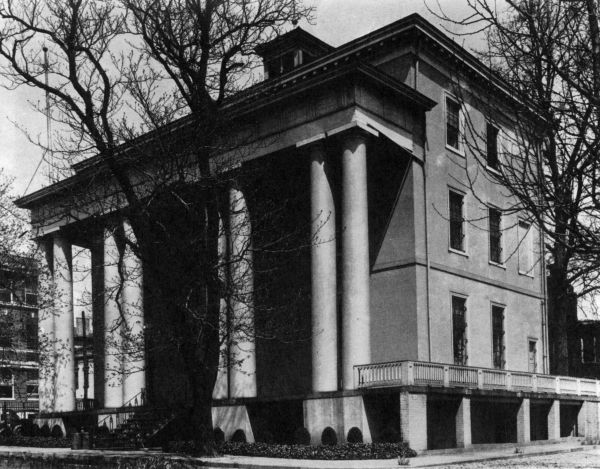
White House of the Confederacy
Douglas Southall Freeman, a native of Lynchburg, is considered the greatest Virginian biographer. He was editor of the Richmond "News-Leader" from 1915 to 1949. In 1935, Dr. Freeman won the Pulitzer Prize for his four-volume biography, "R. E. Lee." He also wrote a supplement of three volumes, entitled "Lee's Lieutenants," which was exceptionally well received. He wrote "The South to Posterity" and was in the process of completing the sixth volume of his biography of "George Washington" at the time of his death in 1953. In this same year another Virginian, David J. Mays, won the Pulitzer Prize for the biography, "Edmund Pendleton, 1721-1803."
RICHMOND CHAMBER OF COMMERCE
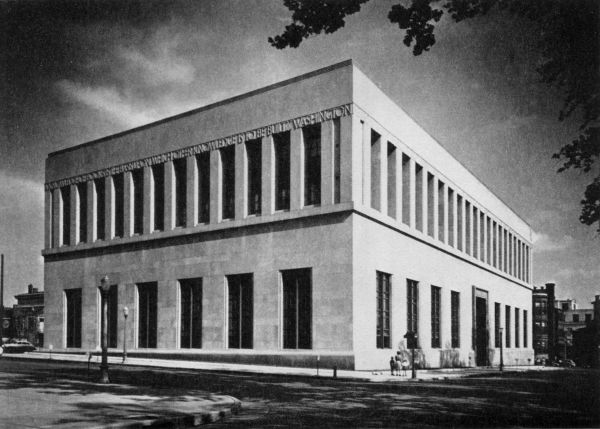
Virginia State Library Building (Including Supreme Court of Appeals)
Emily Clark, a native of Richmond, founded and edited a literary, monthly magazine entitled "Reviewer." Her most well-known work is "Innocence Abroad," written in 1931. Craddock Edmunds, a native of Halifax, specialized in poetry with such titles as "Ulysses and Other Poems," "Mass," "Geese Are Swan," "Poems," "The Renaissance" and "Five Men."
Virginius Dabney, grandson of the earlier author, Virginius Dabney, was born at Lexington. He is known for outstanding editorial writing for the Richmond "Times-Dispatch" and was awarded the 1948 Pulitzer Prize for this field of literature. In addition to his editorials, he also wrote "Liberalism in the South" and "Below the Potomac."
Julian R. Meade, a native of Danville, became a literary figure through publication of his book entitled, "I Live in Virginia." Since his style was characterized by romanticism combined with realism, this book caused much controversy among its local readers. Having horticulture as an avocation, Meade wrote a witty yet sarcastic book on gardening called "Adam's Profession and Its Conquest by Eve" and a novel on gardening called "Bouquets and Bitters."
Clifford Dowdey, a native of Richmond, started his literary career as an editorial writer in New York City. One of his first best sellers was "Bugles Blow No More" which resulted in his being awarded a Guggenheim Fellowship. As he traveled throughout the United States, he wrote "Gamble's Hundred," "Sing for a Penny," "Tidewater," "Where My Love Sleeps," "Experiment in Rebellion" and "Weep for My Brother." He also wrote a book, "The Land They Fought For: The Story of the South as the Confederacy, 1831-1865."
It is difficult to select the outstanding writers of a contemporary period because of the effect of the passage of time, the varied reaction of the reading public, and the detailed factors included in a keen analysis of types of literature. Numerous current Virginians have been accepted by the reading public with some of the best known being Dr. Thomas Jefferson Wertenbaker, Dr. Robert Douthat Meade, Agnes Rothery, Arthur Kyle Davis, Jr., John Wayland, Thomas T. Waterman, Mary Thurman Pyle, Murrell Edmunds, John H. Gwathmey, Leigh Hanes, M. Clifford Harrison, Helen Jones Campbell, Robert Selph Henry, Colonel William A. Couper and Dr. Charles Turner.
The "Commonwealth" Magazine, published monthly by the Virginia State Chamber of Commerce, the "Virginia and the Virginia County" Magazine, published monthly by the League of Virginia Counties and the "Virginia Cavalcade" Magazine, published quarterly by the Virginia State Library furnish excellent articles on domestic problems and progress in the Commonwealth.
The Virginia State Library located in Richmond was founded for the free use of the residents of Virginia as a general library with primary emphasis upon reference service. The library houses an extensive collection of books, maps, public documents, private papers and manuscripts in a variety of subject matter areas. The State Library also provides an interlibrary loan plan and includes Administration, Publication, General Library, Archives, Extension and Historical Divisions. The present library structure was dedicated in 1941 and cost one and one-half million dollars. It includes a photographic laboratory, a work facility for restoring rare books and worn manuscripts, a facility for cleaning and fumigating reading materials, individual study nooks and rooms, an attractive entrance hall with a mural and several display cases as well as the typical reading rooms, offices, and book stacks. The Virginia State Library is well-equipped staff-wise and facility-wise for rendering unusual cultural services for the Commonwealth.
Art and Sculpture
Art—The early colonists found little time for engaging in the arts. Nevertheless, a beginning in art was made. For example, John White (sometimes referred to as Johannes Wyth), the grandfather of Virginia Dare, made water color sketches portraying the life of the native Indians in the area.
Various handicrafts were pursued from time to time. When Sir Christopher Newport came to Virginia, he included in his group some Polish and Dutch glassmakers. When the terrible winter of 1610 caused the death of a majority of the colonists at Jamestown, glassmaking came temporarily to an end. Another early attempt was the making of glass beads as a bartering item for the Indians, but the massacre of 1622 ended these ventures. Other handicrafts generally introduced in the colony included weaving, potterymaking, wigmaking, tanning, pewter making and cobbling. Williamsburg eventually became the center of such handicrafts.
In the Eighteenth Century, numerous European artists visited America. As they toured from one colony to another, they often made prolonged visits in communities where their artistic talents were appreciated. Not only did they sometimes sell their personal paintings, but they were often hired to paint important personages in such communities and members of individual families. In 1734, Charles Bridges, an English artist, arrived in Williamsburg: his reputation for portrait painting spread rapidly after he had painted portraits of the children of William Byrd II. He also painted a picture of Reverend James Blair, the first President of the College of William and Mary.
John Wollaston, Jr., another British artist, came to Williamsburg and earned the title, "The Almond-Eyed Artist," because he painted the eyes of his subjects with a peculiar slant toward the nose. Portraits of Betty Washington Lewis, sister of George Washington, and her husband, Colonel Fielding Lewis, and of Lawrence Washington, half-brother of George Washington were drawn by Wollaston.
In 1785, Jean Antoine Houdon, a distinguished French sculptor, arrived at Mount Vernon to fulfill a commission of the Virginia State Legislature to make a statue of George Washington. After a year of personal observation of Washington at Mount Vernon and an analysis of Washington's facial characteristics, he created a life mask of Washington's face and made specific measurements of his body. Washington was 53 years old at this time and was six feet, two inches in height. Houdon then returned to France and proceeded to carve a Carrara marble statue of his subject. In 1796, the "Figure of George Washington" was placed beneath the dome of the rotunda of the State Capitol. This statue portrays Washington dressed in military uniform with small battle weapons and a plowshare located at his feet and with his left arm on a fasces (a bundle of rods enclosing an ax to symbolize power or authority). This particular pose is believed to have been selected by Houdon after he had observed Washington in a bargaining bout for a yoke of oxen. When Washington heard what he considered an outrageous price requested for the oxen, he exclaimed loudly his opinion of this proposal with his arm outstretched on a fence post. Houdon is said to have witnessed this incident and to have tried immediately to capture this pose of Washington's facial characteristics for his statue. A statue of LaFayette sculptured by Houdon is also included in one of the niches in the encircling wall of the rotunda section and a bust of Washington by Houdon is also located at Mount Vernon.
After Washington had become a member of the Masonic Lodge in Alexandria, the lodge members asked William Williams, a New Yorker, to paint Washington "as he is." The pastel portrait which he painted caused much controversy: some individuals considered it cruel and unartistic, others considered it realistic and the only true likeness of Washington. Williams had even included the scars on Washington's face which were remnants of a scarlet fever siege which Washington had endured. This portrait is in the Masonic Museum in the Masonic Temple Lodge in Alexandria. Williams also made a portrait of "Light Horse Harry" Lee, but this one did not cause controversy as did the one of Washington.
After the Revolutionary War had ended in America, the artists of Virginia and the other ex-colonies of England were influenced by classicism in art in Europe. Many of America's foremost artists of this time traveled to Europe to study this new art movement and were taught by Benjamin West who had set up a school in London. One of his best known students was Charles Willson Peale, who painted a full-length portrait of William Pitt. Peale came to Virginia and soon became well known for his individual and group portraits, silhouettes and miniatures of outstanding Virginians. His portraits of William Henry Harrison and of Lafayette are considered artistic gems. Peale's most famous portrait is his painting of George Washington, clothed in the military garb of a colonel.
Gilbert Stuart is usually considered the finest American painter of the post-Colonial period. Important Virginians whom he painted were George Washington, Colonel John Tayloe, John Randolph of Roanoke and James and Dolly Madison. Most of his paintings were done at Washington soon after it became the national capital city.
In 1807, a Frenchman, Julien F. de Saint-Memin, visited Richmond for approximately one year. He used a machine called a physionotrace which enabled him to make profile drawing in white chalk and in crayon. He acquired the technique of getting these drawings etched on copper plates which allowed him to make fine miniature engravings. One of his most famous art works is an etched view of the waterfront at Richmond.
Benjamin West Clinedinst, a native of Woodstock, is particularly remembered by Virginians for his great panorama painting of the Battle of New Market. Since he had received his education at the Virginia Military Institute, he had a very strong esprit de corps for this battle in which 257 cadets from V. M. I, helped General John Breckinridge at the cost of ten students killed and forty-seven wounded. Over the rostrum of the Stonewall Jackson Memorial Hall at the Virginia Military Institute is a huge canvas painting by Clinedinst portraying a panorama of the charge of the cadet corps at this historic Battle of New Market. In addition to his portrait painting, Clinedinst furnished numerous book and magazine illustrations.
Sculpture—Sculpture did not really develop fully in Virginia until the Nineteenth Century. Alexander Galt of Norfolk was one of the earliest sculptors in this region. Although he died before his artistic ability had been fully developed, his memorable life-size white marble figure of Thomas Jefferson is located inside the Rotunda at the University of Virginia.
In 1865, Edward Virginius Valentine, a native of Richmond who had traveled and studied throughout Europe, came back to his home town. He created not only great sculptures but many unusual sculptures: the bronze figure of General Hugh Mercer in Fredericksburg, a bronze bust of Commodore Matthew Fontaine Maury located in the Virginia State Library at Richmond, a bust of John Jasper, a Negro preacher, located in the Sixth Mt. Zion Baptist Church in Richmond, a marble statue of Thomas Jefferson in the lobby of a Richmond hotel, an ornate bronze statue of Jefferson Davis in a speaking position on Monument Avenue in Richmond and a bronze statue of "Stonewall" Jackson at the grave of "Stonewall" Jackson in the Lexington Presbyterian Cemetery. At Washington and Lee University located in Lexington is the Lee Memorial Chapel. Behind the altar in this chapel is an internationally famous white marble, recumbent "Figure of Lee" which Valentine created. Because of its recumbent position, symbolic of General Lee resting on a battlefield cot, this statue is considered most unique. For thirty years, Valentine used the original carriage house of the Mann S. Valentine House in Richmond as an art studio. When the Valentine House was acquired by the City of Richmond and was finally opened to the public for visitation, many of Valentine's original sculptures were grouped in the collection, including the plaster cast of his famous recumbent statue of Robert E. Lee.
Sir Moses Ezekiel, a sculptor and a soldier, was a native Virginian, but he studied and maintained his residence abroad for most of his life. However, there are many examples of his fine artistic talent in his native state. In the center of the Rotunda at the University of Virginia is a bronze figure of Thomas Jefferson placed upon a pedestal which is in the shape of the Liberty Bell; thus, the work of Sir Ezekiel is called the Liberty Bell Statue of Thomas Jefferson. Ezekiel has another bronze statue on the same campus known as the Statue of Homer which portrays a boy with a lyre sitting against the knee of Homer. Major John Warwick Daniel was a United States Senator from Virginia who was noted for his great oratorical ability. After he was severely wounded in the Battle of the Wilderness, he became a cripple and was nicknamed "The Lame Lion of Lynchburg." Ezekiel designed a statue located at Lynchburg in honor of Major Daniel which shows him seated and holding a crutch. Ezekiel, like Clinedinst, was a cadet at the Virginia Military Institute during the War between the States and was present at the Battle of New Market in which the V. M. I. Cadets participated. In front of the Nichols Engineering Hall at the Virginia Military Institute is a bronze seated figure of "Virginia Mourning Her Dead," known also as the "New Market Monument." Ezekiel is buried in Arlington National Cemetery, not far from the "Confederate Memorial" monument of bronze which he created.
William Ludwell Sheppard, a sculptor, created numerous well-known statues, including a bronze one of Governor William Smith located on the north side of Capitol Square in Richmond, "The Color-Bearer," a bronze haut-relief, the "Soldiers' and Sailors'" Monument and the Statue of General A. P. Hill—all located in Richmond.
Augustus Lukeman, a Richmonder who later moved to New York City, made the portrait bust of Jefferson Davis in the United States Capitol. A Norfolk native, William Couper, molded a bronze statue of Captain John Smith at Jamestown and a bronze statue of Dr. Hunter H. McGuire, a brilliant Winchester doctor, on the north side of Capitol Square in Richmond. He also designed a Norfolk Confederate Soldier Monument.
Many sculptors who were born outside of Virginia have used events and personalities of Virginia as their subjects. Charles Keck executed a bronze group of statues of Meriwether Lewis and William Clark, the two explorers of the Northwest, which may be seen at Charlottesville. Lewis and Clark are shown gazing at the horizon, with their famous woman guide, Sacajawea, not far behind them. At Monument Terrace in Lynchburg is another bronze statue designed by Keck, "Statue of a Doughboy," representing the forty-seven soldiers from Lynchburg killed in World War I. Keck also created the statue of John Tyler located in the Capitol Rotunda at Richmond.
There is a George Rogers Clark Memorial in Charlottesville designed by Robert Aitken. It consists of a bronze equestrian statue of George Rogers Clark surrounded by a group of Indians and scouts.
Six statues depicting the Virginia-born Presidents of the United States found in the Capitol Rotunda are "William Henry Harrison" carved by Charles Beach, "Woodrow Wilson" by Harriet Frishmuth, "James Monroe" and "Thomas Jefferson" by Attilio Piccirilli and "James Madison" and "Zachary Taylor" by F. William Sievers.
Piccirilli also created a 16-foot marble "Statue of Monroe" located at the entrance of Ash Lawn, the home of James Monroe, near Charlottesville. An interesting fact about this statue is that, after the government of Venezuela had commissioned Piccirilli to create this statue of Monroe, a revolution occurred in Venezuela which caused a new slate of officials to succeed in office. Since some of these officials were not pro-Monroe in their regard for the Monroe Doctrine, the statue remained in a studio in New York City from the latter part of the 1800's until 1931. Sievers also designed the bronze figure of "Stonewall" Jackson astride his horse, Little Sorrel, for the "Stonewall" Jackson Monument on Monument Avenue in Richmond.
Sculptural contributions of Thomas Crawford and Randolph Rogers, both New Yorkers, may be found in Capitol Square, Richmond. The Washington Monument here is considered an outstanding sculptural group. Robert Mills designed the base and pedestal. The monument depicts a bronze equestrian statue of George Washington on a stone base surrounded by huge figures of Patrick Henry, Thomas Jefferson, General Andrew Lewis, John Marshall, George Mason and Thomas Nelson. Female figures are seated on trophies of victory around the base of the monument. All the figures were created by Crawford except Lewis and Nelson which were created by Rogers after Crawford had died.
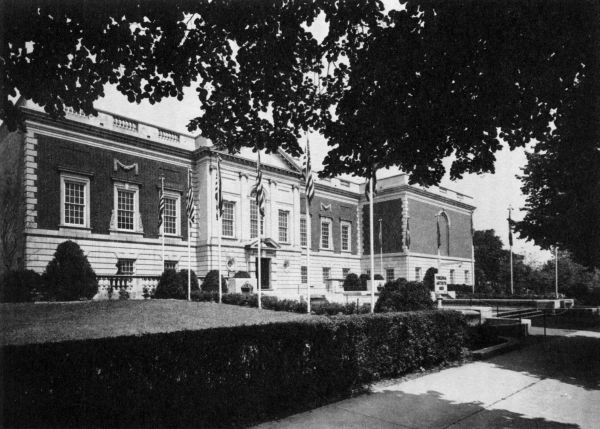
Virginians were encouraged to appreciate the Fine Arts even as early as 1786 when a Frenchman, Chevalier de Beaurepaire, founded in Richmond the Academy of Sciences and Fine Arts of the United States of America. This organization marked the formal beginning of Richmond as a cultural center in Virginia. In 1936, the Virginia Museum of Fine Arts in Richmond became the first state-supported art museum in the United States. At present, the Museum Building, its equipment and the salaries of the staff are provided by the Commonwealth; other sources of revenue come from endowments, gifts, membership, rental and admission fees. There are numerous traveling exhibitions, slide sets, films and filmstrips, permanent famous art collections, temporary loan exhibits and an Art-mobile equipped with a comprehensive art display which travels to specific areas on a scheduled basis. There is also a Museum Theater where a variety of performances in the Fine Arts including the dance, music, drama and motion pictures is presented.
In 1913, the Battle Abbey was constructed in Richmond. It is noted for its large wall murals painted by the French artist, Charles Hoffbauer and portraying the key battles of the War between the States. Battle Abbey also includes valuable collections of paintings of Confederate leaders, of battle flags and of military weapons used during the War between the States.
The White House of the Confederacy in Richmond, known also as the Confederate Museum, is the beautiful old Brockenbrough Mansion leased for the home of Jefferson Davis and his family during the War between the States. In 1893, the Confederate Memorial Literary Society established the house as a Confederate historical museum. Such historical treasures as the sword of Robert E. Lee, military equipment of "J. E. B." Stuart, T. J. Jackson and Joseph E. Johnston and individual sections housing battle mementoes of each Confederate State are located in this structure.
The Valentine house in Richmond, bequeathed to the city by Mann S. Valentine in 1892, was opened to the public as a museum in 1930. In addition to its specialized exhibits on Richmond historical treasures, this museum has some of the original casts of Edward V. Valentine (the sculptor), several rare books concerning Virginia and exhibits on world history and civilizations. Another famous museum which was constructed in 1930 is the Mariners' Museum at Newport News. A personal comprehensive collection of over 45,000 nautical articles (including ship models, figureheads and pictorial material) owned by Archer M. Huntington is housed in this museum.
The skills and techniques of painting are currently taught in the schools, colleges and art clubs, as well as by private tutors, throughout Virginia. Thus, the Commonwealth offers excellent opportunities for the encouragement of, and appreciation for, meaningful art and sculpture.
Architecture
Architecture is often defined as the science and art of designing and constructing buildings or structures. Historically, architecture in Virginia is considered to have begun in 1611-1615 with the building of the first frame row houses at Jamestown and at Henrico. Previous to this period, only crude dwellings had been constructed. The typical early row house, however, was a timber structure usually two stories high with an upper garret often included. Some of the early colonists were bricklayers, brickmakers and carpenters. Often, the Virginia colonists built a typical English timber cottage as similar as possible to those in their homeland insofar as the availability of materials in Virginia would allow. A gabled shingled roof was commonly used; wherever they could be afforded, dormer windows were added. Such a frame house usually measured one room deep and two rooms wide or two rooms deep and a passage-way wide. In the latter type, huge chimneys were usually constructed at each end.
One of the first types of Seventeenth Century brick houses is exemplified by the "Adam Thoroughgood" House built between 1636 and 1640 in Princess Anne County near Cape Henry. It has one complete story topped by a steep gabled roof with dormers and with two T-shaped chimneys. Like many of the early houses in Virginia, its interior is finished in pine paneling. Winona, in Northampton County, is another illustration of the early architectural house in Virginia. It consists of a story and a half structure with brick walls. One of the unique features of the house has been hidden from public view by a frame addition: a buttressed chimney surpassed by three extremely tall stacks.
The houses in Virginia whose construction is believed to have been directly affected by the English Renaissance or Georgian Period of architecture were built after 1720. Since the College of William and Mary had been established at Williamsburg and the colonial capital had been changed from Jamestown to Williamsburg, this area had become the greatest cultural center as well as the seat of government of Virginia. It is commonly believed that the important buildings in Williamsburg in 1720—namely, the Wren Building at the College of William and Mary, the Governor's Palace and the Capitol—actually set the pattern for architectural designs for private homes and public buildings throughout the colony.
The Wren Building is the only structure in America designed by the great Sir Christopher Wren and is the oldest academic hall in the United States. The original design of Wren had to be altered slightly because of the terrain of the country-side. The building, consisting of the commonly used sandy pink brick foundation material, is a two-and-one-half storied rectangular building with a steep roof which includes twelve dormer windows. The roof is topped by a plain cupola in the center with two huge chimneys on either side. Although the Wren Building was burned and rebuilt on three different occasions, in 1928 some of the original walls were used as the basis for the restoration and repair of the Wren Building as part of the Williamsburg Restoration Project.
The Governor's Palace illustrates another Georgian architectural design in Williamsburg. It consists of two stories rising to a cornice topped by a steep, many-dormered roof. Atop the roof is a platform with a lantern-cupola. There are narrow sash windows on the façade and a plain square-transomed doorway with a center wrought-iron balcony overhead. There are separate buildings for the smokehouse, dairy, kitchen and laundry. Above the doorway of the Governor's Palace is the carved coat of arms of George II and Britain's Royal Lion and Unicorn. The fine paneled woodwork in the interior of the palace and the antique tooled leather walls of the library are also noteworthy.
The Capitol at Williamsburg, originally completed in 1704 and later reconstructed on the original foundations, is a two-storied H-shaped brick structure with semicircular bays on either end and a connecting gallery in the center over an arched porch. The roof of the gallery is topped with a cupola which has the arms of Queen Anne, a clock and the Union Jack, one above the other. The Capitol was restored in 1920.
The George Wythe House in Williamsburg is considered one of the purest Georgian Colonial architectural structures in America. George Wythe was the first law professor at the College of William and Mary. The house was a gift from his father-in-law. Although this structure was a town house, it had numerous separate buildings—kitchen, smokehouse, laundry, stable—similar to a plantation. The house is rectangular in shape, constructed of brick and has two built-in chimneys. Under the restoration project, the original paint colors in many of the rooms have been matched, and it is now furnished with appropriate furniture of that period.
Other houses built about this time reveal the similarity of designs of private estates to the Governor's Palace. Westover (1733), home of Colonel William Byrd II on the James River, is considered by many historians and architects as the finest example of colonial grandeur and Georgian stateliness in Virginia. English wrought-iron gates are fastened to posts at the top of which are two leaden eagles with half-spread wings. The mansion house is constructed of red brick with a center section two stories high. On either side of the center section is a wing a story and a half high connected by passageways. At both ends of the house are pairs of tall chimneys. Elaborate entrances, paneled walls, an open-string staircase and black and white marble mantels imported from Italy are some of the elegant features still found in the mansion at the present time.
Christ Church in Lancaster County was erected about the same time as Westover. This structure is an example of a Greek-cruciform colonial church. The church is constructed of brick, has three wide brick doors, oval windows and has the unusual history of having been built solely with funds furnished by one individual, the wealthy "King" Carter.
Stratford Hall (1725-1730) in Westmoreland County, the home of Thomas Lee and the birthplace of Robert E. Lee, exemplifies another H-shaped house of beauty and grandeur. Constructed of brick and dominated by two groups of four chimneys, Stratford consists of the H-plan with four large attached buildings at the corners. A unique feature of this house is its exceptionally long flight of stairs which one must ascend before reaching the main floor. The main floor consists of five large rooms with a huge hall which forms the bar of the "H." Each wing also has a pair of rooms connected by passages.
Carter's Grove (1751) in James City County is another Georgian type house, planned and partially constructed by Carter Burwell in 1751. The main unit of the mansion was constructed by the English builder, Richard Bayliss, and another Britisher, David Minitree. The mansion consists of two-and-a-half stories with wings on each side of one story. It is particularly noteworthy for its almost perfect symmetry. The main unit has a very high roof with a pair of large square chimneys. There are several dormer windows and the entire structure is 200 feet long. The interior as well as the exterior is beautiful with extensive pine paneling, a graceful arch across the middle of the main hall and exquisitely carved walnut railings along the stairway. Some officers of Lt. Col. Banaster Tarleton's troops used this place as headquarters in 1781. When Tarleton suddenly needed his troops, he rode horseback up the beautiful carved stairway. The horse's hoofprints are still observable on the stairway steps.
Mount Airy in Richmond County was constructed by Colonel John Tayloe in 1758. This house is unusual because it was built entirely of stone, a rarity because the Tidewater area did not have an extensive amount of stone. Mount Airy is built of brown stone and trimmed with light stone furnishing a colorful contrast.
The architecture of churches in Virginia is likewise varied. St. Luke's Church, originally known as the Brick Church in Isle of Wight County, is believed to be the oldest church still in existence in the original thirteen colonies. It is easily recognizable from its square tower and gabled nave. The brick Jamestown Church Tower (1639) is a Gothic structure also. The famous Bruton Parish Church in Williamsburg (1715) is an example of the change in architecture due to Governor Spottswood's planned improvement program for Williamsburg. This is the oldest Episcopal Church continuously in use in Virginia. Its cruciform construction of red brick is unusual with its numerous high, white shuttered windows. The square tower was built at a later date and seems to add dignity to the structure. Christ Church in Alexandria, constructed in 1767-1772, has characteristics of the late Georgian Colonial Period: red brick, a square tower with an octagonal-shaped belfry having a dome cupola, a trimming of white stone and a crown of Wrennish pepperpots.
Thomas Jefferson contributed much to original Virginia architecture. Jefferson was devoted to the classical style, yet followed new trends of his own. For example, the Capitol at Richmond was planned by Jefferson. Jefferson used the famous Roman temple at Nîmes in southern France, the Maison Carrée, as the basic design and modified it according to his wishes. He had a plaster model of it made in Paris and sent to Virginia to be used as the pattern for the new Capitol. The original building is the central building which was constructed from 1785 to 1788. Later, the brick was covered with stucco and the wings and the long flight of steps were added in 1904-1906. The revival of classicism in architecture is traced to the individual efforts of Thomas Jefferson. His contacts with many of the outstanding architects of the time, including Robert Mills, helped spread the classic ideas throughout the nation. Thus, the dignity of the great plantation houses constructed during this period is attributed to the style advocated by Jefferson. He not only favored this style but proceeded to utilize the style which he advocated. Monticello, Jefferson's home at Charlottesville, was built of red brick. Its dome, its Doric columns, its symmetrical arrangement, its circular windows, its octagonal bay and stately porticos, its wedgewood mantelpiece—all characterize the Early Republican type of architecture in Virginia.
Jefferson carried out a similar classical style when he founded the University of Virginia. The Serpentine Walls of red brick which surround most of the gardens were designed and built by Jefferson, following a type he had seen in France. The walls are approximately six feet high and one brick thick and constructed on a wavelike plan for added strength. Jefferson also designed the five two-story temple-like pavilions including porticos and had them constructed of red brick walls with white trim and white classic columns. Bremo, near Fork Union, and Poplar Forest, near Lynchburg (where Jefferson used to spend quiet weekends in retreat) are two other houses designed and built by Jefferson.
Robert Mills, who received architectural instruction from Jefferson and whose name is associated with the colonnade of the Treasury Building in Washington and with the Washington Monuments in Washington and in Baltimore, also contributed to the development of architecture in Virginia. Mills designed the Monumental Episcopal Church in Richmond with its structure of stuccoed brick and brown sandstone, its octagonal domes and its columns. Mills' stuccoed houses in Richmond are considered most unique. The front of this type of house which faced the street is comparatively plain and simple, but the back of the house which faced the river usually had a graceful, tall, columned portico with a hanging balcony. Thus, Mills' houses had the appearance of a regular city house in the front and a country house in the back. The Valentine Museum, formerly the John Wickham House, and the White House of the Confederacy, formerly the Jefferson Davis Mansion, located in Richmond were both designed by Robert Mills.
Sherwood Forest, located on the James River, was the home of John Tyler, tenth President of the United States, after he retired from the Presidency. He enlarged the originally-built dwelling twofold and also had a closed-in colonnade constructed to connect the main house with the kitchen and the laundry. After a ballroom and an office had also been added, the entire structure was 300 feet long, one of the longest houses in the country. The original house was built in 1780 with additions made in 1845.
When Jefferson with his great fervor for originality died, Virginia architecture seemed to lose its original character. For many years afterwards, Virginia tended to follow the architecture fashion of the nation rather than to create any particular architectural characteristics of its own. Following the War between the States and its resulting poverty, many of the skills of the earlier craftsmen seemed to disappear. There was a lack of artistic brickwork and handcarved woodwork; imitation and copying of designs throughout the nation seemed to dominate the architectural scene. The influence of much of the foreign architecture of this period seemed to crowd the American scene and to stifle American originality. Experimentation, not often beautiful in appearance or graceful in lines, resulted in an era of architecture with mediocre dwellings and a lack of symmetry and of balanced proportions in design.
Near the close of the Nineteenth Century, an event occurred which influenced American architecture to a great extent. When the Chicago World's Fair was held in 1893, visitors suddenly became reminiscent about the numerous reconstructed American architectural designs of colonial buildings: the rich-looking red brick buildings with graceful, tall white columns and with porticos and pediments. Architects in the United States as well as the American public in general found a new interest in the construction designs, techniques and materials of the Colonial Era. Several visits were made to Virginia and other southern states in an attempt to rediscover the true Colonial style which still has so much to offer in the way of beauty, simplicity and grandeur.
As in the other states, Virginia architects have been busy recently drawing up plans to meet the ever-increasing demand for private dwellings as well as for public buildings. Some of the structures in Virginia which have received nationwide attention are the five-sided, five-floored Pentagon Building in Arlington with 17½ miles of corridors, the Iwo Jima Memorials—one at Quantico and one in Arlington County—and numerous houses, apartment buildings, schools, churches and business establishments.
The greatest architectural restoration project in the United States is the Restoration of Colonial Williamsburg in Virginia. Intense, careful research has made this restoration authentic and appealing to the American public. John D. Rockefeller, Jr. made the project possible through financial backing and, to date, over 400 colonial public buildings, homes, shops and taverns have been restored or reconstructed on a 216 acre section of land. Many of the restored buildings—the Capitol, the Governor's Palace, the George Wythe House, the Raleigh Tavern, the Public Gaol, the Ludwell-Paradise House, the Brush-Everard House and the Magazine and Guardhouse—are now furnished properly according to the Eighteenth Century style. Additional atmosphere is created by the colorful, colonial costumes worn by the guides themselves. The restoration continues, and visitors from various parts of the world, as well as from all of the fifty states, delight in viewing authentic colonial architecture. The Williamsburg Project has had, and will continue to have, a definite influence upon American architecture.
In retrospect, Virginia is usually accredited professionally with two distinct types of individual architecture: the Colonial type brought directly from England and adapted to American surroundings (with a slight variation in Early Colonial and Late Colonial due to the results of the European Renaissance) and the Jeffersonian type distinguished by the creativeness and superb artistic traits of Thomas Jefferson.
Music and Drama
Music—The early Jamestown settlers left no record of their music. They apparently sang the same songs current in England at the time of their departure and probably made up verses pertaining to their environment as time passed. There is evidence that unusual instruments were occasionally used. Even though organs were very expensive in colonial days, by 1700 the Episcopal Church at Port Royal owned the first pipe organ brought to America from Europe. By 1755, the Bruton Parish Church at Williamsburg had also received one.
The wealthy inhabitants usually paid instrumentalists, often foreign musicians, to play at various social functions. String players were particularly popular, not only for chamber music concerts but also for private balls. In 1788, Francis Hopkinson, considered by many historians as the first American composer, dedicated his most ambitious published work, "Seven Songs," for the harpsichord or forte piano to George Washington, his personal friend. Although Washington himself did not play an instrument he was an active patron of the arts including music. The harpsichord which he bought for Nellie Custis is still at Mount Vernon. Hopkinson also had written in 1778 a musical manuscript called "Toast" commemorating Washington's position as Commander-in-Chief of the Continental Army. After Hopkinson had made improvements on the harpsichord, he contacted Thomas Jefferson, beseeching him to acquaint craftsmen with his new, musical instrumental idea. Jefferson was a great devotee to music and was considered by many as an accomplished violin player as was Patrick Henry before him.
The musical talents of the Negroes are usually associated with Southern music. From time to time, collections of slave songs, plantation and cabin songs and religious spirituals have been published by William F. Allen, Lucy M. Garrison, Charles P. Ware, Natalie Burlin and Thomas Fenner. The Hampton Singers from Hampton Institute still preserve the musical beauty of such Negro Spirituals as "Swing Low, Sweet Chariot," "Go Down Moses," "Deep River," "Steal Away to Jesus" and "O'er the Crossing." Reverend James P. Carrell of Harrisonburg and Lebanon published two spiritual song books: "Songs of Zion" and "Virginia Harmony." James A. Bland, a Negro originally from South Carolina but educated in Washington, wrote the song: "Carry Me Back to Ole Virginny." This song was adopted by the legislature as the official state song in 1940. Two other famous songs written by Bland were "Dem Golden Slippers" and "In the Evening by the Moonlight."
Musical publishers and choral groups also encouraged active participation in the musical field. Joseph Funk, a German immigrant, came to Singer's Glen near Harrisonburg near the beginning of the Nineteenth Century. He established a singing school where he taught vocal music and published "Choral Music," a collection of German songs. Aldine Kieffer, a grandson of Funk, created a monthly musical publication, "Musical Millions," consisting of rural music and musical hints for singing schools. Kieffer wrote the words and B. C. Unseld the music to a song which became very popular in the rural areas of the South: "Twilight Is Falling." In 1883, Theodore Presser of Lynchburg founded the well-known music publication for music teachers and pianists called "The Etude." Scholars and music lovers in various parts of the world have enjoyed the contents of this publication. F. Flaxington Harker was a Scotsman who came to America and served as an outstanding choral director in Richmond. He composed organ compositions, choruses, sacred and secular songs, anthems and cantatas. A collection of Virginia Folklore Songs, called "The Traditional Ballads of Virginia," has been compiled by Arthur Kyle Davis, Jr. and C. Alphonso Smith.
Jenny Lind, "The Swedish Nightingale," afforded Richmonders a thrill when she appeared in person at the Marshall Theater in 1850. She was considered an outstanding singer by Virginia music lovers. In 1876, Thomas Paine Westendorf of Bowling Green wrote the song, "I'll Take You Home Again, Kathleen," presumably for his wife while she was mourning the death of her son: she had traveled away from home with her husband and had become very homesick, prompting him to write the song as words of encouragement to her.
The composer who is professionally considered as the greatest native Virginian contributor to the music field is John Powell of Richmond and Charlottesville. He was an accomplished pianist and studied in Vienna as well as in the United States. He wrote "Sonata Virginianesque" for violin and piano (a sonata consisting of the happy aspects of plantation life before the War between the States), several overtures and folk-songs. He became nationally famous for his "Rhapsodie Negre" for piano and orchestra. His varied talents included the writing of fugues and concertos as well as the creation of the Virginia State Choral Festival. Powell was also an enthusiastic participant in the annual White Top Folk Music Festival. No description of musical contributions of Virginians would be complete without reference to Joe Sweeney, a native of Appomattox who invented the five-stringed banjo.
Richard Bales, a native of Alexandria, is a composer-conductor who arranged a cantata, "The Confederacy," consisting of music and literary compositions of the Confederate States during the War between the States. This cantata was so well received that it inspired him to compose a second one called "The Union" which consists of music and literary comments concerning the Union forces during the War between the States. He also composed "The Republic" which consists of prominent European and American musical trends of the Eighteenth Century.
Regional festivals and a State Festival for public school bands and choral groups are held each year. Symphony orchestras furnish superb musical entertainment regularly in Richmond, Norfolk and Roanoke. Numerous Virginians have been, and are, active in the music field as singers of classical, semi-classical and popular tunes of the day. Thus, contributions to vocal music, instrumental music and musical forms have been made by natives and residents of Virginia.
Drama—Unlike residents of many of the thirteen original colonies, Virginia residents delighted in the drama. An Accomack County record states that a group of non-professionals performed in a play, "Ye Beare and Ye Cub," as early as 1655. This record is believed to be the earliest available evidence of an English-speaking play presented in the American colonies.
Virginia is also proud of the fact that the very first theater called a playhouse was constructed by William Levingston at Williamsburg in 1716. Its purpose was to present "Comedies, Drolls, and other kind of stage plays ... as shall be thought fitt to be acted there." In spite of its lofty origin, it soon became a financial loss and, in 1745, the original structure was allotted to Williamsburg to be used as a town hall.
Six years later, however, a second theater was constructed behind the Capitol at Williamsburg. The opening play was "Richard III" and its performers subsequently enacted this play also at Petersburg and at Fredericksburg. It was at the Williamsburg Playhouse that the famous Hallams (London Company, later known as the American Company) first performed in America. The Hallam family—father, mother and two children—and their supporting cast landed at Yorktown where they were welcomed by Governor Dinwiddie and a group of his personal friends. They later traveled to Williamsburg where the playhouse had received appropriate improvements and alterations in keeping with the occasion. Their performance was a success as evidenced by the fact that their play, "The Merchant of Venice," played for eleven months in Williamsburg.
VIRGINIA STATE CHAMBER OF COMMERCE
Virginia Museum of Fine Arts
Other plays including tragedies and comedies, famous and not so famous, were acted at the Williamsburg Playhouse. Most of the plays during this period were European plays or American imitation of European plays. The playhouses themselves were usually wooden structures with crude benches for the average customers and a few "less uncomfortable" boxes for the aristocrats. In the winter, the heat was usually furnished by one stove in the center of the end of the barn-like structure where the spectators congregated between the acts. Often, spectators carried their individual footwarmers with them to assure themselves of comfort during the play. Candles at first were the sole means of illumination. A custom which was practiced for many years consisted of the Negro servants arriving at the playhouse hours before the six o'clock curtain time and reserving seats for their masters by sitting in the most desirable areas until the arrival of the masters.
The early drama companies were often organized and managed as a regular stock company with the importance of the dramatic role determining the number of shares received by an actor. Another common method of paying outstanding actors was the holding of a "benefit" night near the end of the season whereby the receipts of that night would be given to the individual actor.
The playhouse provided one of the most popular types of amusement and it soon became a colorful place for gay, social gatherings. Since Williamsburg was the capital of the colony of Virginia, during legislative sessions the playhouse was particularly crowded with important personages of the government and their friends. George Washington enjoyed dramatic presentations very much and on numerous occasions visited the Williamsburg Playhouse. Just before the American Revolution, however, as political, economic and social relationships between the Americans and the British were being severely strained, most forms of entertainment including the playhouse were prohibited. Consequently, the Virginia playhouses eventually closed and most of the actors and actresses traveled to foreign shores.
After Governor Thomas Jefferson and numerous other Virginians believed that Williamsburg was no longer a safe or central location, the capital of Virginia was moved to the Town of Richmond in 1779. Seven years later, a new theater in Richmond was opened on Shockoe Hill. For twenty-five years, this theater was a social gathering place and a stage background for numerous plays during this period. On December 26, 1811, tragedy struck this theater when it was crowded with holiday festive guests at a benefit performance for the actor, Placide, and his daughter. The entertainment in the theater usually consisted of a prologue, a feature play, a short afterpiece and, sometimes, singing or dancing. On this fateful date, the feature had been completed and the afterpiece was being enacted. Suddenly, a lamp which was used for creating overhead light was mistakenly jerked by a pulley, causing it to swing fully lit into the oil-painted scenery back-drop. Soon the entire theater was a flaming mass. Seventy-three persons were killed in this tragedy including Governor George William Smith. This incident caused many theater-goers to refrain from attending theater performances for several years because of fear for their personal safety.
Drama in Virginia, consequently, received a serious setback from this tragedy, but in 1818, a new theater was built through subscription at Seventh and Broad Streets in Richmond. It was called the Marshall Theater and was named in honor of Chief Justice John Marshall who was one of the theater's greatest patrons. Although this new structure was larger, more conveniently situated and more safely constructed, fear still kept the large crowds of the earlier theater from attending. The theater for a time had to depend upon a famous performer to assure patronage by large numbers. In July 1821, one of these celebrated performers was Junius Brutus Booth—father of the American actor, Edwin Booth—who made his American debut at the Marshall Theater in "Richard III."
By the middle of the Nineteenth Century, Virginia began to experience the "Golden Age" of its theater. Richmond still was the center of the drama in Virginia and one of the outstanding dramatic centers in the United States. The opinion and reaction of Richmond audiences and critics became respected and noticed throughout the country. Such well-known actors as Edwin Forrest, William C. Macready and James W. Wallack played here. On January 2, 1862, the Marshall Theater burned, but its owner immediately had a new one called the Richmond Playhouse built on the same site. Its opening premiere was "As You Like It" starring Ida Vernon and D'Orsay Ogden. Even though the War between the States was being fought, contrary to the Revolutionary War period, the theater furnished amusement and relaxation. Jefferson Davis, President of the Confederacy, and many of his cabinet members attended this theater and viewed many of its tragedies which strangely enough seemed to be the type of play preferred over comedies at this time. One of the favorite actresses of the soldier audiences was Sally Partington.
As the years passed, additional theaters were built in Virginia including the Theater of Varieties in Richmond where vaudeville was first introduced. By the end of the Nineteenth Century, two native Virginians had become dramatic character actors of national fame: Wilton Lackaye of Loudoun County and George Fawcett of Fairfax County. At the turn of the century, Bill Robinson, a native of Richmond, began his ascent to national and international fame for his superb dance style and routines, not only in vaudeville but also in New York plays and, later, in moving pictures.
Early in the Twentieth Century, Francis Xavier Bushman of Norfolk was one of the early moving picture lead actors. As the movies improved and increased in their scope, Virginians such as Jack Hall of Winchester, James H. Bell of Suffolk, Margaret Sullavan of Norfolk, Randolph Scott of Orange County, Richard Arlen of Charlottesville, Lynn Bari of Roanoke, Joseph Cotten of Petersburg, Henry King of Christiansburg, John Payne of Roanoke, Charles Gilpin of Richmond and Freeman F. Gosden of Richmond became nationally known for their acting.
Although strong competition of vaudeville, moving pictures, radio and television undoubtedly has affected the legitimate theater, the strong desire for legitimate acting still remains and has resulted in the formation of summer stock companies and numerous Little Theater groups throughout Virginia. Such groups have become very active and are found in many cities including Alexandria, Danville, Lynchburg, Norfolk, Petersburg, Richmond and Staunton. Virginia colleges and universities also keep the theater alive by sponsoring dramatics classes, workshops and plays.
Two recent developments of the theater in Virginia are the formation of the Barter Theater Group and the presentation of historical plays. The Barter Theater is part of the Barter Colony located at Abingdon, and this colony consists of the theater, a workshop, an inn and a dormitory. The colony was established by Robert and Helen F. Porterfield in 1932 as an attempt to create renewed interest in legitimate play-acting. An original, unique feature of the theater and the activity which was directly responsible for its name was the original ticket purchase price which could be obtained in exchange for produce or edible commodities—similar to the old-fashioned barter system of exchange; at present, however, theater patrons pay money rather than produce for their tickets. During the winter months, the cast travels in other nearby states as well as in Virginia. An annual Barter Theater award was established by Robert Porterfield in 1939 for the "finest performance by an actor or actress on the current Broadway stage." Such well-known individuals as Laurette Taylor, Dorothy Stickney, Mildred Natwick, Ethel Barrymore, Tallulah Bankhead, Louis Calhern, Helen Hayes, Henry Fonda, Frederic March, Shirley Booth, Cornelia Otis Skinner, David Wayne, Rosalind Russell, Mary Martin, Ethel Merman and Ralph Bellamy have received this award. The Barter Theater Award consists of an acre of land located near Abingdon, a world-famed Virginia ham and a silver octagonal platter "to eat it off." In addition, the recipient is given the opportunity to nominate two young dramatic actors at New York City auditions for acting positions at the Barter Theater. The Barter Theater, now recognized as the State Theater of Virginia, is believed to be the only professional theater in the United States which receives financial aid from a state budget.
Since 1947, an outstanding play, "The Common Glory," written by Pulitzer Prize Winner Paul Green, has been presented in the summer at the Lake Matoaka Amphitheater in Williamsburg. The theme of "The Common Glory" is based upon important historical events from 1774 through 1783 with the famous comments of such American statesmen as Thomas Jefferson, Benjamin Franklin, Robert Livingston and Patrick Henry. The realistic performance of this theme in the historical outdoor, natural setting in Williamsburg near historical Jamestown and Yorktown is an experience the audience long remembers. Paul Green also wrote "The Founders," another historical drama in honor of the three hundred and fiftieth anniversary of the founding of Jamestown.
Music and drama—from both the creative sense and the participation sense—still remain an active phase of culture in Virginia.
Education
In colonial days in Virginia, education was considered a personal family matter. A public school, as the term is understood now, was non-existent. Since England had no national public system of education until 1833, the Virginia colonists, of whom a majority were of English descent, did not have any heritage for schools for the general public. Later, the geographical distances between the plantations and the gradual development of social classes tended to discourage public education. The typical child who received formal education was taught by the family members, privately tutored, apprenticed for farming, attended a "Pay School" or "Old Field School" (a community school taught by a teacher paid either by the individual parents or by a particular patron and located on relatively poor agricultural land), enrolled in a Latin Grammar School or attended a fashionable school in London. Only the boys received the formal education and the girls learned the proper techniques of performing household tasks and of being a gracious hostess. Many poor children had no formal education of any kind.
In 1634, the Syms Free School in Elizabeth City County was organized as a local, free school as a direct result of provisions of a will whereby two hundred acres of land were provided and free milk and income from eight cows were included for the support of the school. Twenty-five years later, Dr. Thomas Eaton of the same county also endowed a free school and left a five hundred acre estate with buildings and livestock as the endowment. The endowment also provided for the maintenance of an "able schoolmaster to educate and teach the children born within the County of Elizabeth." Later, the two schools were combined and, by the beginning of the Twentieth Century, they had been incorporated into the public school system as the Syms-Eaton Academy.
A few church schools were organized, but they reached a very small number of children with their enrollment. Orphans and poor children often received the benefits of apprenticeship training in trade or industrial schools and eventually had an opportunity to learn to read and write. By 1775, there were nine free schools endowed by private philanthropists for the poor and needy. Public schools at this time in Virginia were considered as schools for paupers, orphans and needy financial cases rather than schools for the benefit of the general public. Community tax-supported schools for the children of the general public were practically unknown.
Until the beginning of the Nineteenth Century, the slaves—both Negro and Indian—were usually taught religious training and some primary learning, the amount and type of training depending upon the individual master. After certain sensational articles tended to cause discontent and confusion in the minds of some of these individuals which resulted in sporadic raids and open dissatisfaction with living conditions, the legislature of Virginia passed a law making it illegal to teach any slave how to read, write or do arithmetic.
By the middle of the Nineteenth Century, private academies and seminaries (for girls) began to replace the early Latin-Grammar schools. The subjects of English, Latin, science, mathematics, public speaking, spelling and penmanship were taught. The fine arts subjects such as painting and music were stressed in the seminaries. Some of the early academies included Prince Edward Academy (later became Hampden-Sydney Academy and, eventually, Hampden-Sydney College), Liberty Hall Academy (later, Washington College and, eventually, Washington and Lee University), Fredericksburg Academy (later, Fredericksburg College), Alexandria Academy, Shepherdstown Academy (later, Shepherdstown College and, eventually, State Normal School in West Virginia), Central Academy (later, Central College and, eventually, the University of Virginia), Richmond Seminary (later, Richmond College), Salem Academy (later, Roanoke College), Monongahela Academy (later, West Virginia University) and Marshall Academy (later, Marshall College and, eventually, a State Normal School in Huntington, West Virginia). These academies are considered forerunners of public high schools in Virginia because, even as late as the period immediately prior to the War between the States, there were very few public schools of any type in Virginia.
Henrico University was the first attempt in Virginia at an institution for higher learning. The Indian Massacre of 1622 ruined these conscientious efforts. The first two colleges actually founded in Virginia were William and Mary College at Williamsburg founded in 1693—the second oldest college in the thirteen original colonies—and Washington and Lee University at Lexington founded in 1749. William and Mary College was founded for the purpose of providing an opportunity for higher education within the colony itself; Washington and Lee University—originally known as Augusta Academy, then Liberty Hall, and, eventually, Washington College before being renamed Washington and Lee University—was founded to educate young men in Virginia in a similar fashion to the academies in England at that time. In 1819, the General Assembly passed a law allotting $15,000 annually from the Literary Fund to be used for a state university, the University of Virginia, to be located in Charlottesville.
As in most states, the early private colleges were usually founded by religious groups. By the end of the Nineteenth Century, colleges had been established in Virginia by Presbyterians, Episcopalians, Catholics, Baptists, Methodists, Lutherans and the Brethren Sect. The following institutions were in existence at this time: the Protestant Episcopal Theological Seminary in Alexandria, the University of Richmond (Baptist), Hampden-Sydney College at Hampden-Sydney (Presbyterian), St. Vincent's Seminary and College at Richmond (Catholic), Emory and Henry College at Emory (Methodist), Roanoke College at Salem (Lutheran), St. John's Catholic Academy and Seminary at Norfolk, Mary Baldwin College at Staunton (for women—Presbyterian), Randolph-Macon College at Ashland (for men—Methodist), Bridgewater College at Bridgewater (Brethren), St. Paul's Polytechnic Institute at Lawrenceville (Episcopalian), the Virginia Theological Seminary and College at Lynchburg (for Negroes), Randolph-Macon College at Lynchburg (for women—Methodist), Union Theological Seminary in Virginia at Richmond (Interdenominational) and Virginia Union University at Richmond (for Negroes—Baptist).
Other colleges founded in the Nineteenth Century include the Hampton Institute at Hampton (private—Negro), Medical College of Virginia at Richmond (state), Hollins College at Hollins (private), Longwood College at Farmville (state—women), Virginia Military Institute at Lexington (state), Virginia Polytechnic Institute at Blacksburg (private) and Virginia State College at Petersburg (Negro). Madison College was founded in 1908 at Harrisonburg as a private institution of higher learning and, nine years later, Eastern Mennonite College was also chartered in Harrisonburg.
The increase of women in colleges became apparent by the Twentieth Century with the organization of Sweet Briar College at Sweet Briar (private), Mary Washington College at Fredericksburg (women's division of the University of Virginia—state), Randolph-Macon Woman's College at Lynchburg, Lynchburg College at Lynchburg (coed—Disciples of Christ) and Radford College at Radford (women's division of the Virginia Polytechnic Institute—state). In addition, there are seven junior colleges: Stratford at Danville, Averett at Danville, Southern Seminary and Junior College at Buena Vista, Sullins at Bristol, Marion at Marion, Virginia Intermont at Bristol—all colleges for women only. These additional junior colleges—Shenandoah at Dayton, Bluefield at Bluefield and Ferrum at Ferrum—are coed institutions.
Public schools were initially supported by a Literary Fund and by one-half the capitation tax. Gradually, all the capitation or poll tax money was transferred to the Literary Fund. After the middle of the Nineteenth Century, some cities and counties in Virginia began to adopt a system of free schools for the general public. For the first time, a favorable attitude toward public education on the part of a majority of the Virginians became apparent. The long-assumed idea that public schools were charity schools tinged with a social stigma faded into the background and public education for all the children began to be widely encouraged. Before much actual progress along this line was achieved, however, the War between the States took place. As a result, most of the academies were forced to close and education for a time became a comparatively minor issue.
After the War between the States, the Underwood Constitution included a provision requiring public education through the establishment of a uniform system of free public schools in all counties of the state. The deadline date for organizing and establishing such a system was 1876. A State Superintendent of Public Instruction was elected by the General Assembly, a State Board of Education was formed, and public education itself was financed by interest on the Literary Fund, capitation tax revenue, revenue from state and local property taxes and a state tax on each male twenty-one years old or over. Reverend William H. Ruffner of Lexington was the first State Superintendent of Public Instruction in Virginia.
Racial segregation in the public schools of Virginia was constitutionally established in the Underwood Constitution of 1902. Section 149 stated that white and colored children were not to be taught in the same schools. This idea had been in existence in statute law since 1869-1870, and the Constitution of 1902 also specifically stated that public funds were to be restricted, with a few exceptions, to public school use.
Gradually, teacher training courses were offered and improved and teacher scholarships were created in the attempt to organize a large number of new schools with qualified teacher personnel. Eventually, specialized courses were offered in the elementary and secondary schools: vocational courses including agricultural and industrial arts courses and household arts courses, Bible Study, Music, Drawing, Art and commercial subjects such as bookkeeping, shorthand and typing were introduced. These courses coupled with the original fundamental courses provided a rich curriculum for the public school children of Virginia. By 1920, health examinations, health instructions and physical training were required of each student. Early State Superintendents of Instruction faced tremendous problems in their attempts to organize and develop a whole new school system.
The importance of education in Virginia by 1918 is ascertained by the fact that the state legislature at that time passed an act ordering the State Board of Education to appropriate a fund of not more than $10,000 to be used for a scientific evaluation study of the Virginia schools by a special Survey Commission. Both the Inglis Survey of 1919 (named after Dr. Alexander Inglis, Director of the survey) and the O'Shea Survey of 1927 (named after Dr. M. V. O'Shea, Director of the survey) resulted in considerable improvements in the organization and administration of the educational system and in curricular offerings. Some of the recommendations included the appointment of the State Board of Education by the Governor with confirmation by the State Senate, the appointment of the State Superintendent of Public Instruction by the State Board of Education, the selection of a variety of basic textbooks by the State Board of Education, an increase in vocational education courses of study, a minimum nine month academic year, compulsory school attendance, improvement in teacher certification standards, the county unit plan (rather than the district plan) of school organization and a substantial increase in the salaries of teachers.
When the depression occurred in the late 1920's and early 1930's, Virginia was affected but to a lesser degree than most of the other states. One of the first items drastically reduced in the local and state budgets was school expenditures. Regardless of its financial hardship, however, the educational system continued to improve. A new Division of Instruction headed by a Director of Instruction was created in the State Department of Education to assume the responsibility of improving the instruction program in the Virginia public schools. Later, a Supervisor of Elementary Education and a Supervisor of Music was added to the State structure and a Supervisor of Secondary Education, a Supervisor of Negro Education and a Supervisor of Physical and Health Education were selected. Course content has been revised and new subjects added as needs warranted. Recent progress includes the development of audio-visual aids, rehabilitation education courses for disabled veterans, special education for the "exceptional" child and for the mentally retarded child, distributive education and adult education courses. Most of the public schools in the Commonwealth now have a twelve-year basic plan with the seven-five system predominating: seven years in grade school (elementary) and five years in high school (secondary).
Some of the outstanding public educators in Virginia have been James Blair, Reverend William H. Ruffner, R. R. Farr, Dr. F. V. N. Painter, John L. Buchanan, John E. Massey, Joseph W. Southall, Joseph D. Eggleston, Dr. R. C. Stearnes, Harris Hart, Sidney B. Hall, Dabney S. Lancaster, G. Tyler Miller, Dowell J. Howard, Dr. Davis Y. Paschall, Dr. Woodrow W. Wilkerson—State Superintendents of Public Instruction—George Wythe, Edwin Alderman, Edward Armstrong, Samuel C. Armstrong, George Denny, Thomas R. Dew, William H. McGuffey, Benjamin S. Ewell, John Langston, John T. Lomax, Booker T. Washington, William Morton, William Pendleton, Thomas R. Price, Francis Henry Smith, William Waugh Smith, Charles E. Vauter, William Wilson, Milton Humphreys, Ed Joynes, Lyon Tyler and J. L. Blair Buck. Countless individual teachers, state and local administrators, and parent-teacher organizations have also contributed ideas which have influenced and improved the educational facilities throughout the state.
Education has become one of the greatest problems in the Commonwealth and a field of paramount interest to the citizens as well as to state and local officials, the students, the parents, and the professional educational staff directly involved. As the enrollments have rapidly increased, the governors, state legislators and local officials have increased their concern and support, causing the educational facilities to improve and expand. Such actions provide opportunities for the residents of Virginia to obtain a well-rounded education.