5 Economic Life
Reading edition
The Work Force
A variety of geographical resources and of human resources results in diversity in the economic life of the state. The proportion of the population engaged in gainful occupation at the present time is significant. Approximately 38% of the total population in Virginia is included in the work force. The group outside the work force includes individuals who are thirteen years of age or younger, homemakers, students age fourteen and over, the physically and mentally handicapped who are unable to work, and persons who are retired.
Census enumerations since 1890 indicate that total employment in Virginia has expanded continuously. During the seventy year period 1890-1960, the work force increased from approximately 552,000 to approximately 1,473,000. This represents an increase of 176%, or an average annual increase of 13,137 workers.
Three phases in the trend of employment are observable: from 1890 to 1910, 1910 to 1940 and 1940 to 1960. The first phase coincides with the Industrial Revolution in the United States; the increase in employment in Virginia during this time was 44%. In the second phase, from 1910 to 1940, the rate of increase slackened although the total number in the work force grew; the increase amounted to 14% during this period. The third phase of employment began in 1940 as needs of World War II became clear; unprecedented peacetime demands started in 1945 and have continued to the decade of the 1960's; in this phase, for the first time, Virginia outpaced the United States as a whole in growth of employment, with an increase of 63%.
Types of Employment
Government Employment—Government employees make up the largest number of workers in any particular type of occupation in the state. The term "government employees" includes all civilians working directly for federal, state and local governments plus military personnel stationed in Virginia. Nearly one-fourth of the total Virginia employment is found in this group. Government employment is the greatest single source of personal income in the state.
Approximately 65% of the government employment in Virginia, as defined above, is engaged in activities of the federal government. The number of military personnel in the state is slightly more than twice the number of federal civilian employees. Although federal employment is scattered throughout the state—every community has postal employees, for example—there is a concentration of federal employees in two areas of the state, namely, Northern Virginia (Arlington and Fairfax Counties and the cities of Alexandria and Falls Church) and the Hampton Roads area. Within the federal civilian group, approximately 70% are employed by the Department of Defense. Following the Department of Defense, the next largest numbers of federal civilian employees work for the Post Office Department and for the Veterans Administration. In addition to the federal employees working in the state, a substantial number of persons who live in Northern Virginia commute daily to the District of Columbia and nearby Maryland for federal employment.
Approximately 35% of the government employees in Virginia work for the state (11%) and for local (24%) governments. Since more than half of the government employment in the United States is found in state and local governments, the number of such employees in Virginia is relatively smaller. The state and local group in Virginia is nearly equally divided between school and non-school personnel. Although the number of state and local employees in Virginia has grown during the past decade, the percentage of increase has not been as great as that for the United States as a whole.
Employment in Manufacturing—Excluding military personnel from the total government group, employees engaged in manufacturing rank first in number. However, when civilian government and military personnel are combined, government employment surpasses manufacturing employment. Approximately 20% of the total work force is engaged in manufacturing. During the decade of the 1940's manufacturing in Virginia surpassed agriculture for the first time, and the growth of manufacturing continued progressively through the decade of the 1950's. Manufacturing as a whole is diversified.
Expenditure for new manufacturing plant and equipment exceeded one billion dollars in one recent seven-year period. Additional millions of dollars have been spent recently for expanding existing facilities. Fabricated metals (example, swimming-pool type atomic reactors) and machinery and electrical equipment (examples, motors, calculators) groups of industries have grown substantially within the past few years. The four manufacturing industries having the largest number of employees are textile, chemical and chemical products, food and kindred products, and lumber and wood products. The employees in these four industries constitute nearly 50% of all workers engaged in manufacturing.
Textile employment leads all other manufacturing employment. The textile industry in Virginia includes the spinning and processing of yarn and the weaving and finishing of material. Cotton and rayon broad-woven fabrics are the major ones. Approximately 60% of Virginia's textile employment is found in this category. The cities of Danville, Fieldale and Roanoke are especially noted for their textiles. Knitting mills constitute the second type of textile activity, and approximately two-thirds of employment in the knitting mills is engaged in making full-fashioned and seamless hosiery. Lynchburg is a key center of knitting mills for men's and ladies' hosiery.
The second largest employer of workers engaged in manufacturing in Virginia is the chemical industry. Approximately two-thirds of such chemical employees are found in the synthetic fiber field. In 1917, the first large rayon plant was established. This industry has developed rapidly, and Virginia now plays an important part nationally in this production. Virginia now has approximately 30% of the total employees in the United States engaged in synthetic fibers. There are at present large synthetic fiber plants in Richmond, Martinsville, Roanoke, Waynesboro, Narrows and Front Royal. Virginia has been regarded as the geographical center of this industry in the United States. Another type of chemical production involves industrial inorganic chemicals including alkalies—soda ash, bicarbonate of soda, caustic soda—and chlorine (Saltville and Hopewell), sulfuric acid (Norfolk and Richmond) and ammonia (Hopewell). The manufacturing of fertilizer is also important in the state because of the agricultural need for it in the South and because Virginia is conveniently located with respect to the raw materials necessary for making fertilizer (namely, potash, nitrogen and phosphate rock). Hopewell and Norfolk are two cities which have large plants for the manufacture of fertilizers. Both Fredericksburg and Richmond have a large cellophane company and certain medicinal drugs such as streptomycin and thiamine hydrochloride are manufactured at Elkton. In addition, dyes, wood turpentine, dry ice and various insecticides are produced in Virginia.
The third largest employer of workers engaged in manufacturing is the food and kindred products industry. This industry may be conveniently divided into two groups based upon the factors which determine their location:
1) those food industries whose products originate and are marketed in a population center—for example, bakery products (Richmond, Norfolk and Roanoke), beverages (Norfolk and Richmond), meat products (Richmond and Smithfield), dairy products (Richmond, Roanoke, Alexandria and Fredericksburg) and manufactured ice (Richmond and Alexandria);
2) those food industries which find it desirable to locate close to the source of supply—usually a perishable commodity—for example, seafood canneries (Norfolk, Hampton and Reedville), vegetable canneries (Walkerton and Urbanna), poultry dressing plants (Broadway, Harrisonburg and Winchester), fruit processing plants (Berryville, Mount Jackson, Winchester and Front Royal), confectionery plants (Suffolk and Norfolk), meatpacking companies (Suffolk and Smithfield) and frozen foods (seafood—Norfolk; poultry—Broadway; fruits and vegetables—Exmore).
The fourth largest employer of workers engaged in manufacturing is the lumber and lumber products industry. In the latter part of the Nineteenth Century and the early Twentieth Century, this industry had the greatest number of employees in the manufacturing field. Gradually its importance declined until the 1930's when it increased rapidly as the demand for lumber production increased until, at present, it has reached fourth place. Approximately 77% of Virginia's total lumber industry employees is found in the sawmills and planing mills, especially in mills located in Franklin, Petersburg, Norfolk and Richmond. Whereas the synthetic fibers mentioned previously are manufactured primarily in seven large plants with numerous employees per plant, the lumber industry in Virginia consists of approximately 1700 establishments—only approximately 200 of which employ at least twenty employees. Veneer mills, excelsior mills, mill-work plants, plywood plants and companies which make fruit and vegetable baskets, boxes and crates also furnish diverse types of wood products for the Virginia lumber industry.
The fifth largest employer of workers engaged in manufacturing is the apparel industry. Approximately one-half of all such employees are engaged in making men's and boys' clothing: suits, coats and overcoats are made in large quantities in Richmond, Staunton and Norfolk; shirts, pajamas and underwear at Danville, Radford, Lynchburg and Marion; trousers, overalls and sports jackets at Martinsville, Richmond and Staunton. Women's and misses' dresses are manufactured at Roanoke, maids' and nurses' uniforms and sports jackets at Lynchburg, lingerie at Staunton and Roanoke, gloves at Lynchburg, children's and infants' dresses and play clothes at Newport News and Shenandoah. Supplementary textile products include sheets and pillow cases (Danville), towels (Fieldale), hassocks, canvas awnings and automobile seat covers (Richmond).
The sixth largest employer of workers engaged in manufacturing is the transportation equipment industry. Most of this employment is found in shipbuilding at the Hampton Roads area where aircraft carriers, atomic submarines, ocean liners—such as the "Constitution" and the "United States"—and numerous smaller vessels are constructed. Other employees of this industry work in numerous truck and bus body companies scattered throughout the state, in railroad equipment companies—for example, brake shoes (Roanoke); railroad bearings (Petersburg) and in a wagon company (Lynchburg).
Furniture-making ranks seventh in number of employees engaged in manufacturing. Most of Virginia's furniture workers are engaged in the manufacture of unupholstered wooden house furniture. Such furniture includes bedroom, living room and dining room suites (Bassett, Martinsville, Staunton, Marion, Stanleytown, Roanoke and Pulaski), cedar chests (Alta Vista) and radio and television cabinets (Bristol). Living room upholstered furniture including chairs, sofa beds, studio couches and furniture frames are manufactured at Salem, Christiansburg, Norfolk, Roanoke and Galax. Chrome dinettes and plastic furniture are manufactured in plants located at Marion. Office equipment including floor cabinets and metal filing cabinets is made at Crozet. There is also an extensive fixture industry—bank, office and store fixtures—plus such items as literary bookstacks, metal partitions, doors and movable partitions primarily at Orange, Norfolk and Richmond.
The eighth largest employer of workers engaged in manufacturing is the tobacco industry. Although the national consumption of tobacco has increased considerably, the rapid mechanization added to the manufacturing process has resulted in a decline in the total number of employees. Although only approximately six workers per 1,000 engaged in manufacturing in the United States are in the tobacco industry, in Virginia approximately 56 workers per 1,000 are so engaged. The chief locations for the tobacco industry are Richmond, Petersburg, Danville and South Boston. These workers are engaged primarily in the manufacture of cigarettes and in tobacco stemming and redrying. Richmond is the largest cigarette manufacturing center in the world. Petersburg has an exceptionally large cigarette manufacturing plant. Cigars, chewing and smoking tobacco and snuff are also manufactured in Richmond. Danville has the largest number of tobacco stemming and redrying workers. Approximately half of the tobacco industry workers are women.
The ninth largest employer of workers engaged in manufacturing is the paper and allied industries. The greatest number of such workers is engaged in the manufacturing of pulp. The largest pulp mills are located at Covington and Franklin. Approximately one-half of the nation's supply of wood pulp is furnished by the South and Virginia ranks fifth among the southern states in its production. The newly developed methods of utilizing southern pine for producing kraft paper and newsprint have caused considerable increase in this type of production. Kraft paper is usually dark brown in color and is a most durable type of wrapping paper. Such paper is manufactured at Covington, Franklin, West Point, Hopewell and Richmond. Other paper products such as gummed and waxed paper (Richmond), varied types of commercial envelopes and church collection envelopes (Richmond), multi-wall paper bags (Richmond, Franklin and Newport News) and paperboard containers—corrugated shipping cases, cartons, boxes of varied sizes and shapes (Richmond, Lynchburg) are likewise produced in abundance.
Over 9,000 employees are engaged in the printing and publishing industry. Approximately one-half of these employees work in the printing and publishing of newspapers. These newspaper companies are scattered throughout the state. In addition, there are other companies which publish books, engage in commercial printing in general, in lithographing, bookbinding, plate printing, engraving and in photo engraving. These companies also are located in several areas with Richmond, Norfolk and Newport News having the greatest number of employees.
Another industry important to Virginia's economic expansion is the stone, clay and glass production industry. Half of the employees in this industry are engaged in the manufacture of concrete and plaster products. An increase in local construction has resulted in an increase in the production of cinder blocks and other building materials. The following products are included: purchased glass products (example, mirrors)—Galax, Bassett, Richmond, Martinsville; hydraulic cement—Fordwick and Riverton; structural clay (brick and hollow tile)—Roanoke; pottery and china (lusterware)—Abingdon; flower pots and pans—Richmond; asbestos (automatic brake linings)—Winchester; stone products (marble and granite monumental stones)—Burkeville, Richmond, Roanoke and Danville; concrete products—Roanoke and Richmond; gypsum products—Plasterco and Norfolk; lime—Austinville and Kimballton; mineral wool—Riverton; soapstone and stone products—Schuyler; abrasives—Petersburg; and mica—Newport News.
Other manufacturing industries in Virginia include (1) leather and leather products—with tanneries at Luray, Bristol, Pearisburg, Buena Vista and Salem; luggage-making at Petersburg and footwear-making at Lynchburg, Fredericksburg, Farmville and Halifax; (2) primary metals industry—with gray-iron foundries at Newport News, Lynchburg and Radford; (3) fabricated metals industry—with the manufacture of structural metal and structural and ornamental products at Richmond, Norfolk, Bristol and Alexandria; pressure vessels at Newport News; locks at Salem; swimming-pool type atomic reactors at Campbell County (near Lynchburg), and (4) non-electrical machinery industry—with hydraulic turbines, textile wool cards, pulp and papermaking machinery at Newport News, Crozet, Bristol and Richmond.
Employment in Agriculture—A persistent trend in Virginia's economic picture is the continuous decline in agricultural employment, a condition characteristic of agriculture in the United States in general. Approximately 10% of the total employment is presently found in agricultural pursuits. Although the demand for agricultural commodities has increased, the output per worker in agriculture has increased more rapidly. The greater output has occurred as a result of improved methods of farming, technological advances and larger agricultural investments. This situation has resulted also in a greater variety of crops, improved breeds of livestock, and better control of insects and pests.
In the past twenty years there has been a gradual shift in Virginia's agriculture from the production of crops to the production of livestock and livestock products. As a matter of fact, Virginia is a leader in the South in the relative importance of livestock and livestock products. Poultry and poultry products lead the distribution list, followed by meat animals (cattle and calves, hogs, sheep and lambs) and dairy products. Virginia ranks third in the production of turkeys in the United States and sixth in production of broiler chicks in the United States. Rockingham County is famous for its turkeys and chickens. "Cut-up chicken" meat, as well as broilers and eggs, constitutes important poultry products. Culpeper and Loudoun Counties have the greatest number of milk cows per square mile. Large manufacturing plants in the southwestern part of Virginia produce evaporated and condensed milk. Beef cattle are raised in almost every county in Virginia but the Southwest, the Shenandoah Valley and Northern Virginia are the three chief regions. In addition to the meat itself, by-products such as soap and fodder are manufactured and hides and skins are utilized in the making of miscellaneous articles. Hogs and pigs are found in great numbers in Southampton, Nansemond and Isle of Wight Counties and sheep and lambs in large numbers in Augusta, Russell, Rockingham and Highland Counties.
In field crops, tobacco leads the list. One of the nation's largest tobacco producers, Virginia has four types of tobacco: (1) flue-cured—the most extensive one—grown largely in Pittsylvania, Halifax and Mecklenburg Counties with Danville and South Boston the chief markets; (2) burley tobacco grown mostly in the southwest area—Washington, Scott and Lee Counties—with Abingdon the leading market; (3) fire-cured tobacco grown in Appomattox, Charlotte and Campbell with Lynchburg and Farmville important markets and (4) sun-cured tobacco grown in central Virginia—Louisa, Caroline and Hanover Counties—with Richmond the largest market in this area.
Virginia ranks first in the amount of peanut yield per acre and third in peanut production in the United States. The peanut acreage is located in southeast Virginia—Southampton, Isle of Wight, Nansemond and Sussex Counties; Suffolk is often referred to as the "Peanut Capital of the World." Corn is grown in practically every county with most acreage in Southampton, Loudoun and Pittsylvania Counties. The growing of wheat, particularly winter wheat, is widespread also, with Augusta, Rockingham and Loudoun Counties having the greatest harvest. Irish potatoes are grown extensively on the Eastern Shore (Accomack and Northampton Counties) and in the Norfolk area. Virginia ranks third in sweet potato production in the United States and Accomack, Northampton and Princess Anne Counties are the chief growers of these potatoes. Soy beans are cultivated in Norfolk, Princess Anne, Accomack, Northumberland and Hanover Counties. Hay is grown in various parts of Virginia and consists of six types: clover and timothy hay, lespedeza hay, alfalfa hay, peanut hay, soybean hay and cowpea hay. Cotton is grown in the southeast, particularly in Southampton, Greensville, Brunswick and Mecklenburg Counties. Virginia leads all the states in the production of orchard grass seed. Some oats, barley and buckwheat are grown but only in small quantities.
Truck farming is extremely important. Lima beans, snap beans, beets, broccoli, cabbage, cucumbers, sweet corn, kale, onions, green peas, green peppers, spinach, strawberries, tomatoes and watermelons are grown extensively. The truck farming region is located primarily in Accomack, Northampton, King and Queen, Nansemond, Princess Anne and Norfolk Counties. Much of the truck farming crop is sent to New York City, Philadelphia, Baltimore, Boston, Washington and Atlanta.
In fruit production, apples are first; in total production, apples follow two field crops, tobacco and peanuts. Virginia ranks fourth in apple production in the United States. The chief apple producing counties are Frederick, Clarke, Augusta and Nelson and the types of apples produced are York Imperial, Winesap, Stayman, Delicious, Grimes Golden, Albemarle Pippin or Yellow Newton, Ben Davis and Gano, Black Twig, Golden Delicious, Rome Beauty and Jonathan. Peaches are grown in abundance in Nelson, Albemarle, Frederick, Roanoke, Rockingham and Botetourt Counties, making Virginia tenth in peach production in the United States. Pears and grapes are grown on a small scale. In addition to the full-time agricultural employment, there is much seasonal agricultural employment, particularly for fruit and truck farming.
Thus, although agricultural employment has been surpassed by employment in government, in manufacturing occupations and in wholesale and retail trade, the products grown and the livestock raised are numerous and excellent in quality. Thus, Virginia with approximately 135,000 farms, contributes significantly to the agricultural economy of the United States.
In addition to employers engaged in government employment, manufacturing and agriculture, additional groups of employees in Virginia are engaged in a series of diversified economic activities. Among such occupations are those concerned with trade, services, public utilities, construction, finance, mining and forestry and fishing.
Employment in Wholesale and Retail Trade—Employment in wholesale and retail trade has increased in Virginia to such an extent that it ranks third, following government employment and manufacturing employment, in non-agricultural employment. Approximately 22% of the civilian non-agricultural employees are engaged in trade. The shift from an agricultural to an industrial economy has resulted in a greater demand for wholesale and retail goods. During the decade of the 1950's wholesale and retail trade employment increased its relative share of total state employment by approximately one-third. The greatest number of persons in retail trade work in the food trades and in general merchandising.
Employment in Services—Services industries are located throughout the state; approximately 11% of the civilian non-agricultural employees are engaged in such activity. This category includes domestic help and other forms of personalized aid.
Employment in Public Utilities—Employment in public utilities constitutes approximately 9% of the total civilian non-agricultural employment. This occupational group is extremely important because of the key role of transportation, communication and local utilities in the state. About one-half of these workers are employed in taxicab service, local transit service, telephone and telegraph service, radio broadcasting and television service, electric, gas, water and sanitary service utilities. Half of the workers included in this category consist of railroad and water transportation workers.
Employment in Construction Activities—Approximately 7% of the total civilian non-agricultural employment is concerned with construction. More than three-fourths of all construction during the past decade has been for private use, approximately half of this construction involving private residences. The tremendous increase in the population of Virginia during the past twenty years has caused the rate of private residential building to be higher than that for the entire nation. Privately-owned public utility buildings, public highways and private non-residential buildings rank high in kinds of construction projects undertaken.
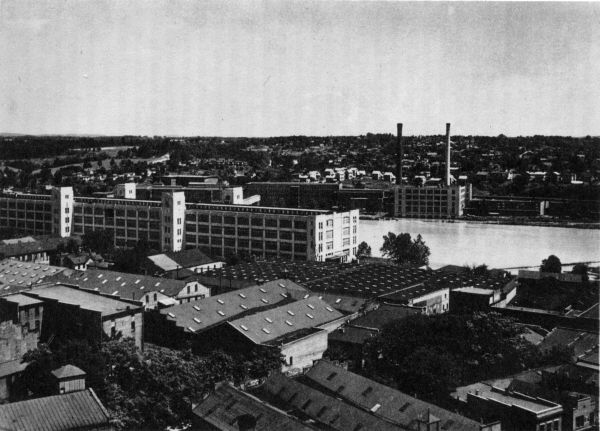
VIRGINIA STATE CHAMBER OF COMMERCE
A Modern Manufacturing Plant
Employment in Finance—Finance, including bank, insurance and real estate activity, affects all geographical areas of the state but, in terms of numbers, these activities are primarily located in or near urban centers. Approximately 7% of the civilian non-agricultural employees are so engaged.
Employment in Mining Operations—Approximately 2% of the total civilian non-agricultural employees in Virginia are engaged in mining. More than 80% of Virginia's mining employment is in bituminous coal which is the chief mining product of the nation as a whole. Virginia furnishes approximately 3% of the total annual output of this product in the United States. Such mining is extremely important in Buchanan and Dickenson Counties where more than half of all the civilian employees are miners. Pocahontas, Big Stone Gap, Dante and Tazewell have huge bituminous coal mines. Stone quarrying rates second in mining employment. Crushed stone granite quarries are found in Roanoke, Richmond, Fredericksburg, Red Hill and Leesburg and crushed limestone quarries are found in Kimballton, Riverton, Leesburg, Stephens City and Buchanan. Employment in crude petroleum, natural gas and in metal mining, which accounts for one-third of the nation's total mining employment, is less than 3% of Virginia's total mining employment.
Employment in Forestry and Fisheries—Current employment in forestry and fisheries constitutes slightly less than 1% of the total civilian non-agricultural work force. Commercial fishermen far outnumber the foresters. However, as described previously, the lumber and lumber products industry, the paper and allied products industry and the furniture industry which are based upon the forestry industry have experienced great increases in their employment. Employees engaged in forest products industries now constitute one-fourth of the total employment in manufacturing. Although fishermen outnumber foresters at the present time, the number of fishermen has been decreasing. Nevertheless, the fisheries supply additional employment to processing and wholesale employees. A few localities such as Mathews, Northumberland, Lancaster, Gloucester, York and Middlesex Counties have a comparatively high percentage of their workers engaged in fisheries.
Employment in Travel Trade—The number of employees engaged in travel trade employment is unknown. Two characteristics of this type of employment should be noted: (1) in addition to full-time employees, there is an indeterminate number of part-time employees; and (2) employees engaged in travel trade are, for the most part, seasonal workers. The greatest number of such workers are found in hotels, motels and other tourist lodgings, in restaurants and cafes, in gasoline service stations and in recreational and entertainment activities. Approximately 94% of Virginia's travel trade comes to Virginia via the automobile; out-of-state tourists constitute about 70% of the travel trade in Virginia. It has been estimated that about half of these travelers are on vacations and the other half are mainly on business trips. About half of the vacationers are usually passing through Virginia on the way to or from specific destinations outside the state. The other half usually have selected Virginia as their particular destination to visit relatives or friends, to tour historical and scenic places and to enjoy the recreational attractions found here. The travel trade has increased considerably during the past few years. As a direct result of the increase, the number of hotels, motels and other lodging places in Virginia has likewise rapidly increased. Williamsburg and Virginia Beach illustrate the singular importance of travel trade in causing widespread growth in total employment in a community.
Importance of Transportation
The economic activity of any region depends greatly upon its transportation facilities. Without an efficient transportation system, goods—either raw materials or finished products or farm produce—cannot be moved from one point to another, workers cannot reach their jobs and consumers cannot reach their markets. Virginia is particularly fortunate in having a network of key railroads, excellent highways, deep harbors and modern airports. Trains, buses, trucks, passenger cars, boats, ocean vessels and aircraft—all play a basic role in the economic life of the state.
Numerous railroads provide interstate as well as intrastate service: the Richmond, Fredericksburg and Potomac Railroad connects Washington with Richmond; running over the R.F.&P. tracks and continuing in a north-south direction between Richmond and the North Carolina border are the Atlantic Coast Line and Seaboard Air Line railroads; the Southern Railway runs diagonally from Washington across Virginia to the North Carolina border near Danville, with another route from West Point through Richmond and Danville; the Atlantic and Danville Railroad operates between Danville and Norfolk; the Chesapeake & Ohio Railroad runs diagonally from Washington to Gordonsville where it connects either in a westerly direction with West Virginia near Covington or in an easterly direction with Newport News; the Norfolk and Western Railroad operates in an east-west direction from Norfolk through Lynchburg and Roanoke to West Virginia; and the Virginian Railway (now a branch of the N. & W.) connects Suffolk with Roanoke and West Virginia. The Pennsylvania Railroad has a branch line crossing the Eastern Shore from Maryland to Cape Charles while the Baltimore & Ohio has a branch through the Shenandoah Valley.
Virginia has a very modern system of primary and secondary roads which permit quick and comfortable motor transportation between urban, suburban and rural points. In addition, Virginia has within its borders several vital links in the national system of interstate and defense highways scheduled for final completion throughout the United States by 1972. In Virginia, the national system involves one link cutting across the western part of the state in a southwesterly direction (Interstate Number 81); a second link cutting across the eastern part of the state in a north-south direction (Number 85 and Number 95) to supercede U. S. Routes 1 and 301; a third link running east-west between Norfolk, Richmond, Staunton and the West Virginia border (Number 64); a fourth link running east-west between northern Virginia near Washington and West Virginia via Strasburg (Number 66) and a fifth link crossing the southwestern part of the state in a north-south direction (Number 77). In terms of total designated mileage of the whole interstate system, Virginia is one of 16 states to have over 1000 miles within its borders. Although most of the interstate system in Virginia will not be completed for a few more years, some portions of the five Virginia links are already open for traffic.
A series of bridges, many toll-free, help the growth of transportation. Construction plans for one of the most difficult water crossings are underway in connection with a $200,000,000 bridge-tunnel to run 17½ miles across the mouth of the Chesapeake Bay in the Hampton Roads area. This crossing will run from Chesapeake Beach near Norfolk to Cape Charles on the Eastern Shore. When completed in 1964, the bridge-tunnel crossing will replace ferryboats, the only type of public transportation heretofore available between these points.
Five major commercial air lines serve Virginia: American, Capital, Eastern, National and Piedmont Lines. In addition to the Washington National Airport near Alexandria and the Dulles International Airport at Chantilly, which serve the northern Virginia area, airports contributing to the economic progress of the state are located at Richmond, Bristol, Danville, Lynchburg, Newport News, Norfolk-Portsmouth and Roanoke.
SUMMARY
An unusually large number of individuals in the Commonwealth—civilian and military—work in either federal, state or local government employment. In proportion to the total population of a state, the greatest concentration of federal government employment within a single state is found in Virginia.
If one considers civilian employees solely, the largest number of employees in the state is engaged in manufacturing. The number of employees in manufacturing first surpassed the number of employees in agriculture in the 1940's. The manufacturing industries which have the largest number of employees are textile, chemical and chemical products, food and kindred products, and lumber and wood products; these employees constitute nearly 50% of all workers engaged in manufacturing.
Other important manufacturing industries include apparel, transportation equipment, furniture, tobacco, paper and paper products, printing and publishing, stone, clay and glass production, leather and leather products, primary metals, fabricated metals, and non-electrical machinery. As Virginia has changed from a predominantly agricultural state to a predominantly manufacturing state, wholesale and retail trade has increased proportionately.
Although agriculture is no longer the leading occupation, Virginia has a variety of important crops and livestock. Poultry and poultry products, meat animals, dairy products, tobacco, peanuts, corn, winter wheat, sweet potatoes, hay, cotton, orchard grass seed, truck farming crops and fruit (especially apples, peaches, strawberries and watermelons) are leading farm products.
Significant numbers of workers in Virginia are engaged in wholesale and retail trade, services, public utilities, construction (especially construction of private houses, buildings and public highways), finance, mining (especially bituminous coal and quarry stone), forestry and fisheries, and travel trade.
An efficient transportation system, consisting of a network of key railroads, excellent highways, deep harbors and modern airports plays a basic role in the economic life of the state.
A survey of the major occupations reveals a diversified economic life which provides the citizens of Virginia with broad opportunities for employment.