4 Historical Life: 1860-Present (continued 2)
Reading edition
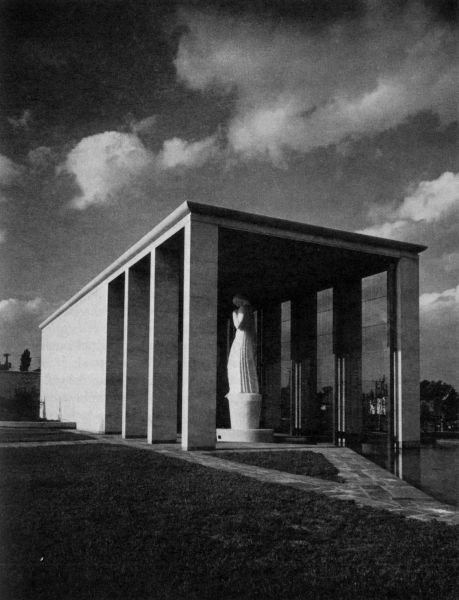
VIRGINIA STATE CHAMBER OF COMMERCE
Shrine of Memory: Virginia War Memorial
One impact of World War II upon state government was action during Governor Colgate W. Darden's term to modify the poll tax requirement as applied to Virginia members of the armed forces on active duty. A special session of the Virginia legislature in 1944 attempted to exempt those persons from poll tax requirements but the judiciary nullified this measure as contrary to constitutional provision. Subsequently, by referendum, the voters of the state favored the calling of a limited constitutional convention to accomplish the objective. A condition of the referendum restricted the delegates to this convention to act solely upon the soldier vote and to agree not to consider, adopt or propose any other law, amendment or revision. The constitutional convention approved a measure which became the seventeenth article of the Virginia State Constitution: this new article allowed service men and women on active duty, otherwise eligible to vote, to vote without payment of a poll tax or without fulfillment of the registration requirement.
Since the end of World War II, war memorials have been erected in various communities as an expression of appreciation for war sacrifices. The most famous such memorial constructed through state or local action has been the state memorial erected in Richmond. A million dollar white marble edifice known as the "Shrine of Memory" consists of a structure twenty-two feet high and includes the names, etched on glass panels and marble columns, of approximately 10,340 Virginians who died in combat in World War II or in the Korean conflict. The memorial, located on a four-acre site overlooking the James River near the north end of the Robert E. Lee Bridge, is also a tribute to the 360,000 Virginians who participated in the armed forces during these two conflicts and to the 100,000 Virginia volunteer civilian workers who contributed much in their various types of activities. At the base of the statue to "Memory" is a gas-fed torch, called the "Torch of Liberty," which burns perpetually. Embedded in the floor of the "Shrine of Memory" are memorial coffers which contain authentic, labeled ground and sea battle mementos from battleground areas. The leading sculptor for this unusually beautiful memorial was Leo Friedlander.
The sites of two battles which took place during the War between the States within the geographical area of Virginia have been accorded official national recognition within the past few years. Specifically, the Appomattox Court House National Historical Monument was granted National Historical Park status in 1954. This area of approximately 968 acres includes a reproduction of the Wilmer McLean House in which the Confederate General, Robert E. Lee, surrendered the Confederate Army of Northern Virginia to the Union General, Ulysses S. Grant. The grounds where the two armies opposed each other for the last time are also included in this park. In the same year, the Manassas Battlefield of approximately 1,719 acres was given the status of a National Battlefield Park. This area was the site of the famous Battles of Bull Run or Manassas.
During the 1950 session of the General Assembly, a bill was passed which provided for a state tax reduction of approximately one million dollars whenever the tax revenue exceeded the estimates by certain amounts, the amount depending upon the state budget. This law was later revised to the effect that if the general fund revenue received from income taxes exceeded the estimates by five percent, a tax reduction would automatically result. Since passage of the act, Virginia taxpayers have benefitted considerably through its provisions. On the other hand, several attempts have been made to repeal the general poll tax. The United States Supreme Court has upheld the legality of the poll tax by refusing to review a suit against some local officials who had barred individuals from voting because of non-payment of the poll tax.
At the Democratic National Nominating Convention held in Chicago in 1952, the Virginia delegates under the leadership of Governor John S. Battle refused to accept the "loyalty" pledge adopted by voice vote in the convention. This "loyalty" pledge or "majority rule" pledge required that each delegate agree to "exert every honorable means" to have the names of the Democratic Party's Presidential and Vice-Presidential nominees included on the Democratic ballot of each state. President Harry S. Truman had encouraged federal measures dealing with fair employment practices, the passage of federal non-segregation laws and the enforcement of a strong federal civil rights program. Some of the delegates who knew that many of the Southern states did not approve of the Democratic legislative program believed that the states of Virginia, South Carolina and Louisiana would refuse to accept the "loyalty" pledge because of this program. Consequently, when delegates from these states refused to accept the pledge, they were not initially seated at the convention. Southern delegates, however, protested that state party rules or state laws prohibited them making such a commitment. Governor Battle, the leader of the 28 member delegation from Virginia, stated that a state law assured the inclusion of the names of the Democratic Party nominees on the Virginia Democratic ballot and that they rejected the pledge only as a matter of principle. Ultimately, Virginia delegates as well as those of South Carolina and Louisiana were given seats and full voting rights at the convention.
The Republican nominee for the Presidency in 1952, 1956 and 1960 carried the state, contrary to previous usual voting results in the state. In the 1952 election the Republican candidate, Dwight D. Eisenhower, received 349,037 popular votes from Virginia and the Democratic candidate, Adlai Stevenson, received 268,677 popular votes. Thus, the Republican Party won the twelve electoral votes of the state. In 1956, 386,320 popular votes from Virginia were cast for the Republican electors and 264,110 popular votes for the Democratic electors who represented the same Presidential candidates as in 1952. In the 1960 election the Republican nominee, Richard M. Nixon, won the popular vote of the state over the Democratic nominee, John F. Kennedy. Virginia again cast her twelve electoral votes for the Republican candidate. However, during this period, the Governor, the two United States Senators from Virginia, eight of the ten Virginia members of the United States House of Representatives and a majority of the General Assembly continued to be members of the Democratic Party, illustrating the traditional role of the Democratic Party in the state since the Reconstruction Era.
Public education has received much attention in Virginia, especially since 1950. On several occasions, for example, the General Assembly has approved million dollar appropriations of state funds for school construction projects. The tremendous influx of youth in the public schools during the decade of the 1950's accentuated the need for more teachers as well as classrooms throughout the state. Hence, rising costs of education have become a key matter at each recent session of the General Assembly. During the last few years, however, the question of integration of white and of Negro students in the public schools of the state has been a paramount education issue.
When the United States Supreme Court on May 17, 1954 handed down its decision which in effect outlawed racial segregation in the public schools of the nation, Virginia faced a very serious problem because the State Constitution has required separate public schools for white and for Negro children in the Commonwealth. Governor Thomas B. Stanley soon appointed a commission of thirty-two state legislators, under the chairmanship of State Senator Garland Gray, to advise him concerning a course of action to be taken by the Commonwealth. The commission conducted a study and subsequently transmitted to the Governor its report, known as the Gray Plan. The plan recommended consideration of an amendment to the constitutional provision requiring separate schools and suggested that local communities be enabled through their school boards to assign students to schools for a variety of reasons other than race. Subsequently, a special session of the General Assembly authorized a referendum election on the calling of a constitutional convention. The referendum question was worded as follows: "Should a Constitutional Convention be called with authority to revise Section 141 of the State Constitution so as to permit the General Assembly to appropriate public funds to further the education of Virginia students in non-sectarian private schools as well as in public schools?" A majority of the voters voted in the affirmative at the referendum election held in January 1956. In March 1956 a Constitutional Convention was held in Richmond and these delegates rewrote Section 141; hence it became permissible under the Constitution of the Commonwealth to use public funds for tuition grants for pupils in private non-sectarian schools. Later, at a special session of the General Assembly in September 1956, a pupil placement program was adopted under which the Governor appointed a pupil placement board whose chief function was to handle all student assignments in the state; under the program, parents of all children entering the public schools were required to fill out assignment applications which, in turn, were ultimately processed through the board.
In 1958, legislation provided for the automatic closing of any school which might be policed by the federal government and permitted the Governor to close any school in a locality in which another school was already being so policed. The admission of any Negro student to a public school for white students required the Governor to close the school and assume full control. Subsequently, federal court orders directed school boards in Arlington, Charlottesville and Norfolk to admit students without regard to race, effective September 1958; following state law, the pupil placement board denied admission to Negro applicants in the localities mentioned previously; the local school boards in these areas and in Warren County initiated action to admit Negro students, pursuant to federal court order. However, the Governor announced the closing of the high school in Warren County, and similar action was taken in Charlottesville and in Norfolk. During the Fall semester of 1958, a total of nine schools (one in Warren County and eight in Norfolk and Charlottesville) were closed to 13,000 students, many of whom transferred elsewhere. When court decisions in January 1959 voided the school closing law, the law cutting off state funds and the law providing tuition grants of public funds for segregated private schooling, the Governor stated that he could take no further action to prevent the opening of public schools on an integrated basis. Some public schools in Arlington, Charlottesville and Norfolk, as well as in Alexandria, began integrated classes in the Spring semester of 1959. Since that time, the number of integrated schools has increased. The implications of the United States Supreme Court decision of May 17, 1954 upon the public school system of Virginia have presented to the Commonwealth one of its most difficult problems of the Twentieth Century.
As the population of Virginia cities and towns has grown during the past two decades, persons have moved to the suburbs and surrounding territory—sometimes at a faster rate than the increase in new population in the urban centers. The 1960 census confirmed such declines from the previous growth of cities in nearly all parts of the nation. Attractions to persons who move from the urban centers include larger amounts of available land, newer homes, shopping centers with comparatively easy parking, and initial lower real estate taxes. After these persons have lived in the suburbs or surrounding territory for a while, various needs such as adequate streets, police protection, schools, sewerage facilities, water and building and zoning codes sometimes develop or become more apparent. Often county governments are not equipped to provide for all of these services; if county governments do establish such services, the initial costs may be very high for the taxpayers.
To counterbalance the move to suburbs and nearby rural areas, urban local units of government seek to annex surrounding land from counties or nearby cities. In Virginia, annexation is determined by a panel of three judges, only one of whom is a resident of the county involved. No referendum is held to ascertain the wishes of the residents of the area under consideration because of the belief that annexation should be based on the need of the majority of the people concerned. While annexation may be an answer to the urban government's need for extending its tax base, county units lose their prime tax property. Over a period of time, the continued growth of the metropolitan area causes persons to locate outside of the revised boundaries and the process of annexation starts over again.
In addition to annexation, another method available whereby an urban unit may extend its boundaries is consolidation of local units. An example is the merger of a city government unit and a county government unit into a revised city government unit. In Virginia, consolidation statutes are relatively flexible: officials of both units negotiate between themselves to reach an agreement on the authority of the new local unit of government, in contrast to annexation where the county government is often forced against its will to give up valuable real estate.
The growth of metropolitan areas has raised a serious challenge to the ability of local units of government to provide adequate government services to their residents at reasonable costs. Unless further understanding is developed among the citizenry involved, the impact of metropolitanism will continue to result in serious inequities among individual local units of government.
SUMMARY
By April 1861, the Commonwealth of Virginia had furnished one-third of all the Presidents of the United States, had had numerous other Virginian leaders in high federal positions, had been responsible for the calling of a "Peace Conference" in the nation's capital and had been most reluctant to vote for secession from the Union. However, the inhabitants of Virginia believed in the doctrine of "States' Rights," in non-interference of slavery by the federal government and in not coercing neighboring seceded states back into the Union via invasion. Consequently, Virginia joined the Confederacy, and Richmond soon became the Confederate capital and the State of Virginia a huge battlefield.
The brilliant military tactics of General Robert E. Lee, Thomas Jonathan Jackson and "J.E.B." Stuart will always be worthy of military study. Virginia helped the Confederacy, economically as well as militarily, especially with the food products of the Saltville area and of the Shenandoah Valley and the manufactured arms equipment of the Tredegar Iron Works in Richmond. When West Virginia became an independent state without the consent of Virginia, it reduced the area and population of the Commonwealth considerably. The ending of the War between the States, like that of the American Revolutionary War, took place in Virginia. The magnificent courage and fervor of the Virginians as members of the Confederacy will always be cherished by posterity. When one is well-informed of the deeds, hardships and activities which occurred during the War between the States in Virginia and in other southern states, one can easily understand the ever-present pride which the Confederate Flag does, and always will, inspire. This era of American history, although one of the darkest periods in our national history when even brother sometimes fought brother on the battlefield, will forever remain one of the most dynamic and heroic periods in human civilization.
After enduring a harsh Reconstruction Program enforced by a radical United States Congress and by "Carpetbagger" and "Scalawag" governments, Virginia officially returned to the Union on January 26, 1870. Then the Commonwealth began settling some of its local problems: the extremely high state debt, the educational program, the joint boundary line between Virginia and West Virginia and the "Readjuster" Movement. The newest county in Virginia—Dickenson County—was created in 1880. By 1900, Virginia ranked seventeenth in United States state population and seemed prepared to meet the challenging events of the Twentieth Century with renewed confidence.
A new state constitution, still in effect today, was "proclaimed" in 1902. It provided for a poll tax and an "understanding clause" provision as a voting requirement; later, the latter was changed to an intelligence test requirement. The unusual political status of a city, completely independent of county jurisdiction, was originated at this time also. Racial segregation in the public schools of Virginia was provided for in the Constitution of 1902.
Other events and activities concerning Virginia and Virginians during the Twentieth Century include the payment to Virginia by West Virginia of the state debt which West Virginia had accumulated while she was part of Virginia, the operation of the first City-Manager form of local government at Staunton, outstanding participation in two World Wars and in the Korean conflict, the "Restoration of Williamsburg" Project, a reorganization of state governmental departments, the comparatively small economic dislocation during the "Great Depression," the establishment of the Shenandoah National Park, the opportunity afforded service men and women on active duty to vote without payment of a poll tax, the constant increase in the growth of industry, the victory for the Virginia delegates at the 1952 Democratic National Nominating Convention, Republican Presidential victories in Virginia in 1928, 1952, 1956 and 1960, developments in education including the problems of school integration and the expansion of school facilities and the continuing growth of metropolitanism.
As our nation's history unfolds, issues of state, national and international scope will continue to face the Commonwealth. The history of Virginia has furnished Virginians with a proud heritage, an appreciation for the noble deeds of the past and an understanding of the courage and wisdom required to solve successfully current and future problems. Virginia—a vital area of the United States—will undoubtedly play a major role in the fulfillment of the destiny of the United States.