Front matter (continued 6)
Reading edition
He strode toward the communicator desk. The Dauntless was, as always, completely serviced and ready for any emergency. Where was that fleet of her sister ships, on its shakedown cruise? He'd shake them down! They had with them the new hospital ship, too—the only Red Cross ship in space that could leg it, parsec for parsec, with the Dauntless.
"Get me Navigations.... Figure best point of rendezvous for the Dauntless and Flotilla ZKD, both at full blast, en route to Lundmark's Nebula. Fifteen minutes departure. Figure approximate time of meeting with speedster, also at full blast, leaving that nebula hour nine fourteen today. Correction! Cancel speedster meeting; we can compute that more accurately later. Advise adjutant. Vice-Admiral Southworth will send order, through channels. Get me Base Hospital.... Lacy, please.... Kinnison's hurt, sawbones, bad. I'm going out after him. Coming along?"
"Yes. How about—"
"On the green. Flotilla ZKD, including your new two-hundred-million-credit hospital, is going along. Slip twelve, Dauntless, eleven and one half minutes from now. Hipe!" And the surgeon general "hiped."
Two minutes before the scheduled take-off Base Navigations called the chief navigating officer of the Dauntless.
"Course to rendezvous with Flotilla ZKD latitude three fifty-four dash thirty longitude nineteen dash forty-two time approximately twelve dash seven dash twenty-six place one dash three dash oh outside arbitrary galactic rim check and repeat," rattled from the speaker without pause or punctuation. Nevertheless, the chief navigator got it, recorded it, checked and repeated it.
"Figures only approximations because of lack of exact data on variations in density of medium and on distance necessarily lost in detouring stars," the speaker chattered on. "Suggest instructing your second navigator to communicate with navigating officers Flotilla ZKD at time twelve dash oh dash oh to correct courses to compensate unavoidably erroneous assumptions in computation Base Navigations off."
"I'll say he's off—'way off!" growled the second. "What does he think I am—a complete nitwit? Pretty soon he'll be telling me that two plus two equals four point oh."
The fifteen-second warning bell sounded. Every man came to the ready at his post, and precisely upon the designated second the superdreadnought blasted off. For six miles she rose inert upon her under jets, sirens and flaring lights clearing her way. Then she went free, her needle prow slanted sharply upward, her full battery of main driving projectors burst into action, and to all intents and purposes she vanished.
The Earth fell away from her at an incredible rate, dwindling away into invisibility in less than a minute. In two minutes the Sun itself was merely a bright star, in five it had merged indistinguishably into the sharply defined, brilliantly white belt of the Milky Way.
Hour after hour, day after day, the Dauntless hurtled through space, swinging almost imperceptibly this way and that to avoid the dense ether in the neighborhood of suns through which the designated course would have led; but never leaving far or for long the direct line, almost exactly in the equatorial plane of the Galaxy, between Tellus and the place of meeting. Behind her the Milky Way clotted, condensed, gathered itself together; before her and around her the stars began rapidly to thin out. Finally there were no more stars in front of her. She had reached the "arbitrary rim" of the Galaxy, and the second navigator plugged into Communications.
"Please get me Flotilla ZDK, Flagship Navigations," he requested; and, as a clean-cut young face appeared upon his plate: "Hi, Harvey, old spacehound! Fancy meeting you out here! It's a small Universe, ain't it? Say, did that crumb back there at Base tell you, too, to be sure and start checking course before you overran the rendezvous? If he was singling me out to make that pass at, I'm going to take steps, and not through channels, either."
"Yeah, he told me the same. I thought it was funny, too—an oiler's boy would know enough to do that without being told. We figured maybe he was jittery on account of us meeting the admiral or something. What's burned out all the jets, Paul, to get the big brass hats 'way out here and all dithered up, and to pull us offa the cruise this way? Must be a hell of an important flit! You're computing the Old Man himself; you oughta know something. What's all this about a speedster that we're going to escort? Spill it—give us the dope!"
"I don't know a thing, Harvey, honest, any more than you do. They didn't put out a word. Well, we'd better be getting onto the course—'to compensate unavoidably erroneous assumptions in computation,'" he mimicked caustically. "What do you read on my lambda? Fourteen—three—oh point six—decrement—"
The conversation became a technical jargon; because of which, however, the courses of the flying spaceships changed subtly. The flotilla swung around, through a small arc of a circle of prodigious radius, decreasing by a tenth its driving force. Up to it the Dauntless crept; through it and into the van. Then again in cone formation, but with fifty-five units instead of fifty-four, the flotilla screamed forward at maximum blast.
Well before the calculated time of meeting the speedster a Velantian Lensman who knew Worsel well put himself en rapport with him and sent a thought out far ahead of the flying squadron. It found its goal—Lensmen of that race, as has been brought out, have always been extraordinarily capable communicators—and once more the course was altered slightly. In due time Worsel reported that he could detect the fleet, and shortly thereafter:
"Worsel says to cut your drive to zero," the Velantian transmitted. "He's coming up. He's close. He's going to go inert and start driving. We're to stay free until we see what his intrinsic velocity is. Watch for his flare."
It was a weird sensation, this of knowing that a speedster—quite a sizable chunk of boat, really—was almost in their midst, and yet having all their instruments, even the electros, register empty space.
There it was! The flare of the driving blast, a brilliant streamer of fierce white light, sprang into being and drifted rapidly away to one side of their course. When it had attained a safe distance:
"All ships of the flotilla except the Dauntless go inert," Haynes directed. Then, to his own pilot, "Back us off a bit, Henderson, and do the same," and the new flagship also went inert.
"How can I get onto the Pasteur the quickest, Haynes?" Lacy demanded.
"Take a gig," the admiral grunted. "Strapped down, you can use as much acceleration as you like. Three G's is all we can use without warning and preparation."
There followed a curious and fascinating spectacle, for the hospital ship had an intrinsic velocity entirely different from that of either Kinnison's speedster or Lacy's powerful gig. The Pasteur, gravity pads cut to zero, was braking down by means of her under jets at a conservative one point four gravities, since hospital ships were not allowed to use the brutal inert accelerations employed as a matter of course by ships of war.
The gig was on her brakes at five gravities, all that Lacy wanted to take—but the speedster! Worsel had put his patient into a pressure pack and had hung him on suspension, and was "balancing her down on her tail" at everything he could stand—a full eleven gravities!
But even at that, the gig first matched the velocity of the hospital ship. The intrinsics of those two were at least of the same order of magnitude, since both had come from the same galaxy. Therefore, Lacy boarded the Red Cross vessel and was escorted to the office of the chief nurse while Worsel was still blasting at eleven G's—fifty thousand miles distant then and getting farther away by the second—to kill the speedster's Lundmarkian intrinsic velocity. Nor could the tractors of the warships be of any assistance—the speedster's own vicious jets were fully capable of supplying more acceleration than even unhuman Worsel could endure!
"How do you do, Dr. Lacy? Everything is ready." Clarrissa MacDougall met him, hand outstretched. Her saucy white cap was worn as jerkily cocked as ever; perhaps even more so, now that it was emblazoned with the cross-surmounted wedge which is the insignia of sector chief nurse. Her flaming hair was as gorgeous, her smile was as radiant, her bearing as confidently—Kinnison has said of her more than once that she is the only person he has ever known who can strut sitting down!—as calmly poised. "I'm very glad to see you, doctor. It's been quite a while—" Her voice died away, for the man was looking at her with an expression defying analysis.
For Lacy was thunderstruck. If he had ever known it—and he must have—he had forgotten completely that MacDougall had this ship. This was awful—terrible!
"Oh, yes ... yes, of course. How do you do? Mighty glad to see you again. How's everything going?" He pumped her hand vigorously, thinking frantically the while what he would—what he could—say next. "Oh, by the way, who is to be in charge of the operating room?"
"Why, I am, of course," she replied in surprise. "Who else would be?"
"Anyone else," he wanted to say, but did not—then. "Why, that isn't at all necessary. I would suggest—"
"You'll suggest nothing of the kind!" She stared at him intently; then, as she realized what his expression really meant—she had never before seen such a look of pitying anguish upon his usually sternly professional face—her own turned white and both hands flew to her throat.
"Not Kim, Lacy!" she gasped. Gone now was everything of poise, of insouciance, which had so characterized her a moment before. She who had worked unflinchingly upon all sorts of dismembered, fragmentary, maimed and mangled men was now a pleading, stricken, desperately frightened girl. "Not Kim—please! Oh, merciful God, don't let it be my Kim!"
"You can't be there, Mac." He did not need to tell her. She knew; he knew that she knew. "Somebody else—anybody else."
"No!" came the hot negative, although the blood drained completely from the chief nurse's face, leaving it as white as the immaculate uniform she wore. Her eyes were black, burning holes. "It's my job, Lacy, in more ways than one. Do you think that I would ever let anyone else work on him?" she finished passionately.
"You'll have to," he declared. "I didn't want to tell you this, but he's a ghastly mess. Altogether too much so for any woman, to say nothing of one who loves him." This, from a surgeon of Lacy's long and wide experience, was an unthinkable statement. Nevertheless:
"All the more reason why I've got to do it. No matter what shape he's in, I'll let no one else work on my Kim."
"I say no. That's an order—official!"
"Damn such orders!" she flamed. "There's nothing back of it—you know that as well as I do!"
"See here, young woman—"
"Do you think that you can get away with ordering me not to perform the very duties I have taken an oath to do?" she stormed. "And even if it were not my job, I'd come in and work on him if I had to get a torch and cut the ship apart, plate by plate, to do it! The only way you can keep me out of that operating room, Lacy, is to have about ten of your men put me into a strait jacket—and if you do that I'll have you kicked out of the service bodily. You know that I could and that I would!"
"QX, MacDougall, you win." She had him there. This girl could and would do exactly that. "But if you faint, I swear that I'll make you wish—"
"You know me better than that, doctor." She was cold now as a woman of marble. "If he dies, I'll die, too, right then. But if he lives, I'll stand by as long as I can do a single thing, however small, to help."
"You would, at that," the surgeon admitted. "Probably you would be able to hold together better than anyone else could. But there'll be after-effects in your case, you know."
"I know." Her voice was bleak. "I'll live through them—if Kim lives." She became all nurse in the course of a breath. White, cold, inhuman; strung to highest tension and yet placidly calm, as only a truly loving woman in life's great crises can be. "You have had reports on him, doctor. What is your provisional diagnosis?"
"Something like elephantiasis, only worse, affecting both arms and both legs. Drastic amputations indicated. Eye sockets require attention. Various multiple and compound fractures. Punctured and incised wounds. Traumatism, ecchymosis, extensive extravasations, œdema. Profound systemic shock, of course. The prognosis, however, seems to be distinctly favorable, as far as we can tell."
"Oh, I'm glad of that!" she breathed, the woman for a moment showing through the armor of the nurse. She had not dared even to think of prognosis. Then she had a thought. "Is that really true, or are you just giving me a shot in the arm?" she demanded.
"The truth—strictly," he assured her. "Worsel has an excellent sense of perception, and he has reported fully and clearly. Kinnison's mind, brain, and spine are not affected in any way, and we should be able to save his life. That is the one good feature of the whole thing."
The speedster finally matched the velocity of the hospital ship. She went free, flashed up to the Pasteur, inerted, and maneuvered briefly. The larger vessel engulfed the smaller. The Gray Lensman was carried into the operating room. The anæsthetist approached the table and Lacy was stunned at a thought from Kinnison.
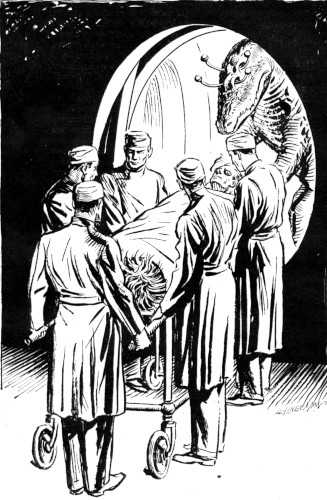
They wheeled Kim out of the speedster, grim Worsel's vast strength gentle to help him into the hospital ship.
"Never mind the anæsthetic, Dr. Lacy. You can't make me unconscious without killing me. Go ahead with your work. I'll hold a nerve block while you're doing what has to be done. I can do it perfectly—I've had lots of practice."
"But we can't, man!" Lacy exclaimed. "You've got to be under a general for this job—we can't have you conscious. You're raving, I think. It will work, surely; it always has. Let us try it, anyway, won't you?"
"Sure. It'll save me the trouble of holding the block, even though it won't do anything else. Go ahead."
The attendant physician did so, with the same cool skill and to the same end point as in thousands of similar and successful undertakings. At its conclusion: "Gone now, aren't you, Kinnison?" Lacy asked, through his Lens.
"No," came the surprising reply. "Physically, it worked. I can't feel a thing and I can't move a muscle, but mentally I am as wide awake as I ever was."
"But you shouldn't be!" Lacy protested. "Perhaps you were right, at that—we can't give you much more without danger of collapse. But you've got to be unconscious! Isn't there some way in which you can be made so?"
"Yes, there is. But why do I have to be unconscious?" Kinnison asked curiously.
"To avoid mental shock—seriously damaging," the surgeon explained. "In your case particularly the mental aspect is much graver than the purely physical one."
"Maybe you're right but you can't do it with drugs. Call Worsel; he has done it before. He had me unconscious most of the way over here, except when he had to give me a drink or something to eat. He's the only man this side of Arisia who can operate on my mind."
Worsel came. "Sleep, my friend," he commanded, gently but firmly. "Sleep profoundly, body and mind, with no physical or mental sensations, no consciousness, no perception even of the passage of time. Sleep until someone having authority to do so bids you awaken."
And Kinnison slept; so deeply that even Lacy's probing Lens could elicit no response.
"He will stay that way?" the surgeon asked in awe.
"Yes."
"For how long?"
"Indefinitely. Until one of you doctors or nurses tells him to wake up, or until he dies for lack of food or water."
"We will see to it that he gets nourishment. He would make a much better recovery if we could keep him in that state until his injuries are almost healed. Would that do him harm, think you?"
"None whatever."
Then the surgeons and the nurses went to work. Lacy was not guilty of exaggeration when he described Kinnison as being a "ghastly mess." He was all of that. The job was long and hard. It was heartbreaking, even for those to whom Kinnison was merely another case, not a beloved personality. What they had to do they did, and the white marble chief nurse carried on through every soul-wrenching second, through every shocking, searing motion of it. She did her part, stoically, unflinchingly, as efficiently as though the patient upon the table were a total stranger undergoing a simple appendectomy and not the one man in her entire universe suffering radical dismemberment. Nor did she faint—then.
Back in Base Hospital, then, time wore on until Lacy decided that the Lensman could be aroused from his trance. Clarrissa it was who woke him up. She had fought for the privilege; first claiming it as a right and then threatening to commit mayhem upon the person of anyone else who dared even to think of doing it.
"Wake up, Kim, dear," she whispered. "The worst of it is over now. You are getting well."
The Gray Lensman came to instantly, in full command of every faculty, knowing everything that had happened up to the instant of his hypnosis by Worsel. He stiffened, ready to establish again the nerve block against the intolerable agony to which he had been subjected so long, but there was no need. His body was, for the first time in untold æons, free from pain; and he relaxed blissfully, reveling in the sheer comfort of it.
"I'm so glad that you're awake, Kim," the nurse went on. "I know that you can't talk to me—we can't unbandage your jaw until next week—and you can't think at me, either, because your new Lens hasn't come yet. But I can talk to you and you can listen. Don't be discouraged, Kim. Don't let it get you down. I love you just as much as I ever did, and as soon as you can talk we're going to get married. I am going to take care of you—"
"Don't 'poor dear' me, Mac," he interrupted her with a vigorous thought. "You didn't say it, I know, but you were thinking it. I'm not half as helpless as you think I am. I can still communicate, and I can see as well as I ever could, or better. And if you think that I'm going to let you marry me to take care of me, you're crazy."
"You're raving! Delirious! Stark, staring mad!" She started back, then controlled herself with an effort. "Maybe you can think at people without a Lens—of course you can, since you just did, at me—but you can't see, Kim, possibly. Believe me, boy, I know that you can't. I was there—"
"I can, though," he insisted. "I got a lot of stuff on my second trip to Arisia that I couldn't let anybody know about then, but I can now. I've got as good a sense of perception as Tregonsee has—maybe better. To prove it, you look thin, worn—whittled down to a nub. You've been working too hard—on me."
"Deduction," she scoffed. "You would know that I would."
"QX. How about those roses over there on the table? White ones, yellow ones, and red ones? With ferns?"
"You can smell them, perhaps"—dubiously. Then, with more assurance: "You would know that practically all the flowers known to botany would be here."
"Well, I'll count 'em and point 'em out to you, then—or, better, how about that little gold locket, with 'CM' engraved on it, that you're wearing under your uniform? I can't smell that, nor the picture in it—" The man's thought faltered in embarrassment. "My picture! Klono's whiskers, Mac, where did you get that—and why?"
"It's a reduction that Admiral Haynes let me have made. I am wearing it because I love you—I've said that before."
The girl's entrancing smile was now in full evidence. She knew now that he could see, that he would never be the helpless hulk which she had so gallingly thought him doomed to become, and her spirits rose in ecstatic relief. But he would never take the initiative now. Well, then, she would; and this was as good an opening as she ever would have with the stubborn brute. Therefore:
"More than that, as I said before, I am going to marry you, whether you like it or not." She blushed a heavenly—and discordant—magenta, but went on unfalteringly: "And not out of pity, either, Kim, or just to take care of you. It's older than that—much older."
"It can't be done, Mac." His thought was a protest to high Heaven at the injustice of Fate. "I've thought it over out in space a thousand times—thought until I was black in the face—but I get the same result every time. It's just simply no soap. You are much too fine a woman—too splendid, too vital, too much of everything a woman should be—to be tied down for life to a thing that's half steel, rubber, and phenoline. It just simply is not on the wheel, that's all."
"You're full of pickles, Kim." Gone was all her uncertainty and nervousness. She was calm, poised; glowing with a transcendent inward beauty. "I didn't really know until this minute that you love me, too, but I do now. Don't you realize, you big, dumb, wonderful clunker, that as long as there's one single, little bit of a piece of you left alive I'll love that piece more than I ever could any other man's entire being?"
"But I can't, I tell you!" He groaned the thought. "I can't and I won't! My job isn't done yet, either, and the next time they'll probably get me. I can't let you waste yourself, Mac, on a fraction of a man for a fraction of a lifetime!"
"QX, Gray Lensman." Clarrissa was serene, radiantly untroubled. She could make things come out right now; everything was on the green. "We'll put this back up on the shelf for a while. I'm afraid that I have been terribly remiss in my duties as a nurse. Patients mustn't be excited or quarreled with, you know."
"That's another thing. How come you, a sector chief, to be on ordinary room duty, and night duty at that?"
"Sector chiefs assign duties, don't they?" she retorted sunnily. "Now I'll give you a rub and change some of these dressings."
XXII.
"Hi, Skeleton-gazer!"
"Ho, Big Chief Feet-on-the-desk!"
"I see that your red-headed sector chief is still occupying all strategic salients in force." Haynes had paused in the surgeon general's office on his way to another of his conferences with the Gray Lensman. "Can't you get rid of her or don't you want to?"
"Don't want to. Couldn't, anyway, probably. The young vixen would tear down the hospital—she might even resign, marry him out of hand, and lug him off somewhere. You want him to recover, don't you?"
"Don't be any more of an idiot than you have to. What a question!"
"Don't work up a temperature about MacDougall, then. As long as she's around him—and that's twenty-four hours a day—he'll get everything in the Universe that he can get any good out of."
"That's so, too. This other thing's out of our hands now, anyway. Kinnison can't hold his position long against her and himself both—overwhelmingly superior force. Just as well, too—civilization needs more like those two."
"Check, but the affair isn't out of our hands yet, by any means. We've got quite a little more fine work to do there, as you'll see, before it's a really good job. But about Kinnison—"
"Yes. When are you going to fit arms and legs on him? He should be practicing with them at this stage of the game, I should think—I was."
"You should think—but, unfortunately, you don't, about anything except war," was the surgeon's dry rejoinder. "If you did, you would have paid more attention to what Phillips has been doing. He is making the final test today. Come along—your conference with Kinnison can wait half an hour."
In the research laboratory which had been assigned to Phillips they found von Hohendorff with the Posenian. Haynes was surprised to see the old commandant of cadets, but Lacy quite evidently had known that he was to be there.
"Phillips," the surgeon general began, "explain to Admiral Haynes, in nontechnical language, what you are doing."
"The original problem was to discover what hormone or other agent caused proliferation of neural tissue—"
"Wait a minute; I'd better do it," Lacy broke in. "Anyway, you wouldn't do yourself justice. The first thing that Phillips found out was that the problem of repairing damaged nervous tissue was inextricably involved with several other unknown things, such as the original growth of such tissue, its relationship to growth in general, the regeneration of lost members in lower forms, and so on. You see, Haynes, it is a known fact that nerves do grow, or else they could not exist; and in some lower forms of life they regenerate. Those facts were all he had, at first. In higher forms, even during the growth stage, regeneration does not occur spontaneously. Phillips set out to find out why.
"The thyroid controls growth, but does not initiate it, he learned. This fact seemed to indicate that there was an unknown hormone involved—that certain lower types possess an endocrine gland which is either atrophied or non-existent in higher types. If the latter, he was sunk. He reasoned, however, that, since higher types evolved from lower, the gland in question might very well exist in a vestigial stage. He studied animals, thousands of them, from the germ upward. He exhausted the patience of the Posenian authorities; and when they cut off his appropriation, on the ground that the thing was impossible, he came here. We gave him carte blanche.
"The man is a miracle of perseverence, a keen observer, a shrewd reasoner, and a mechanic par excellence—a born researcher. Therefore, in time he learned what it must be: to cut it short, the pineal body. Then he had to find the stimulant. Drugs, chemicals, and spectrum of radiation; singly and in combination. Years of plugging, with just enough progress to keep him at it. Visits to other planets peopled by races human to two places or more; learning everything that had been done along the line of his problem. When you fellows moved Medon over here he visited it as a matter of routine, and there he hit the jackpot. Wise himself is a surgeon, and the Medonians have for centuries been having warfare and grief enough, steadily and in heroic doses, to develop the medical and surgical arts no end.
"They knew how to stimulate the pineal—a combination of drugs and specific radiations—but their method was dangerous. With Phillips' fresh viewpoint, his wide, new knowledge, and his mechanical genius, they worked out a new and highly satisfactory technique. He was going to try it out on a pirate going into the lethal chamber, but von Hohendorff heard about it and insisted that it should be tried on him. Got up on his Unattached Lensman's high horse and won't come down. So here we are."
"Hm-m-m—interesting!" The admiral had listened attentively. "You're pretty sure that it will work, aren't you?"
"As sure as we can be of anything that hasn't been tried. Ninety-percent probability, say—certainly not over ninety-five."
"Good enough odds." Haynes turned to the commandant. "What do you mean, you old reprobate, by sneaking around behind my back and horning in on my reservation? I rate Unattached, too, you know, and it's mine. You're out, von."
"I saw it first and I refuse to relinquish." Von Hohendorff was adamant.
"You've got to," Haynes insisted. "He isn't your cub any more; he's my Lensman. Besides, I'm a better test than you are—I've got more parts to replace than you have."
"Four or five make just as good a test as a dozen," the commandant declared.
"Gentlemen, think!" the Posenian pleaded. "Please consider that the pineal is actually inside the brain. It is true that I have not been able to discover any brain injury so far, but the process has not yet been applied to a reasoning brain and I can offer no assurance whatever that some obscure injury will not result."
"What of it?" and the two old Unattached Lensmen resumed their battle, hammer and tongs. Neither would yield a millimeter.
"Operate on them both, then, since they are both above law or reason," Lacy finally ordered in exasperation. "There ought to be a law to reduce Gray Lensmen to the ranks when they begin to suffer from ossification of the intellect."
"Starting with yourself, perhaps?" the admiral shot back, not at all abashed.
Haynes relented enough to let von Hohendorff go first, and both were given the necessary injections. The commandant was then strapped solidly into a chair; his head was clamped so firmly that he could not move it in any direction.
The Posenian swung his needle rays into place; two of them, diametrically opposed, each held rigidly upon micrometered racks and each operated by two huge, double, rock-steady hands. The operator looked entirely aloof—being eyeless and practically headless, it is impossible to tell from a Posenian's attitude or posture anything about the focal point of his attention—but the watchers knew that he was observing in microscopic detail the tiny gland within the old Lensman's skull.
Then Haynes. "Is this all there is to it, or do we come back for more?" he asked, when he was released from his shackles.
"That's all," Lacy answered. "One stimulation lasts for life, as far as we know. But if the treatment is successful you'll come back—about day after tomorrow, I think—to go to bed here. Your spare equipment won't fit and your stumps may require surgical attention."
Sure enough, Haynes did come back to the hospital, but not to go to bed. He was too busy. Instead, he got a wheel chair, and in it he was taken back to his now-boiling office. And in a few more days he called Lacy in high exasperation.
"Know what you've done?" he demanded. "Not satisfied with taking my perfectly good parts away from me, you've taken my teeth, too. They don't fit—I can't eat a thing! And I'm hungry as a wolf—I was never so hungry before in all my life! I can't live on soup, man; I've got work to do. What are you going to do about it?"
"Ho-ho-haw!" Lacy roared. "Serves you right—von Hohendorff is taking it easy here; sitting right on top of the world. Easy, now, sailor, don't rupture your aorta. I'll send a nurse over with a soft-boiled egg and a spoon. Teething—at your age—Haw-ho-haw!"
But it was no ordinary nurse who came, a few minutes later, to see the port admiral; it was the sector chief herself. She looked at him pityingly as she trundled him into his private office and shut the door, thereby establishing complete coverage.
"I had no idea, Admiral Haynes, that you ... that there—" She paused.
"That I was so much of a machine-shop rebuild?"—complacently. "Except in the matter of eyes—which he doesn't need, anyway—our mutual friend Kinnison has very little on me, my dear. I got so handy with the replacements that very few people knew how much of me was artificial. But it's these teeth that are taking all the joy out of life. I'm hungry, confound it! Have you got anything really satisfying that I can eat?"
"I'll say I have!" She fed him; then, bending over, she squeezed him tight and kissed him emphatically. "You and the commandant are just perfectly wonderful old darlings, and I love you all to pieces," she declared. "I think Lacy was simply poisonous to laugh at you the way he did. Why, you two are the world's greatest heroes! He knew perfectly well all the time, the lug, that of course you'd be hungry; that you'd have to eat twice as much as usual while your legs and things were growing. Don't worry, admiral, I'll feed you until you bulge. I want you to hurry up with this, so that they'll do it to Kim."
"Thanks, Mac," and as she wheeled him back into the main office he considered her anew. A ravishing creature, but sound. Rash, and a bit stubborn, perhaps; impetuous and head-strong; but clean, solid metal all the way through. She had what it takes—she qualified. She and Kinnison would make a mighty fine couple when the lad got some of that heroic damn nonsense knocked out of his head—but there was work to do.
There was. The Galactic Council had considered thoroughly Kinnison's reports; its every member had conferred with him and with Worsel at length. Throughout the First Galaxy the Patrol was at work in all its prodigious might, preparing to wipe out the menace to civilization which was Boskone. First-line superdreadnoughts—no others would go upon that mission—were being built and armed, rebuilt and rearmed.
Well it was that the Galactic Patrol had previously amassed an almost inexhaustible supply of wealth, for its "reserves of expendible credit" were running like water.
Weapons, supposedly of irresistible power, were made even more powerful. Screens already "impenetrable" were stiffened into even greater stubbornness.
Primary projectors were made to take even higher loads, for longer times. New and heavier Q-type helices were designed and built. Larger and more destructive duodec bombs were hurled against already ruined, torn, and quivering test planets. Uninhabited worlds were being equipped with super-Bergenholms and with driving projectors. The negasphere, the most incredible menace to navigation which had ever existed in space, was being patrolled by a cordon of guard ships.
And all this activity centered in one vast building and culminated in one man—Port Admiral Haynes, Galactic councilor and chief of staff. And Haynes could not get enough to eat because he was cutting a new set of teeth!
He cut them, all thirty-two of them. His new limbs grew perfectly, even to the nails. Hair grew upon what had for years been a shining expanse of pate. But, much to Lacy's relief, it was old skin, not young, which covered the new limbs. It was white hair, not brown, that was dulling the glossiness of Haynes' bald old head. His bifocals, unchanged, were still necessary if he were to see anything clearly, near or far.
"Our experimental animals aged and died normally," Lacy explained graciously, "but I was beginning to wonder if we had rejuvenated you two, or perhaps endowed you with eternal life. Glad to see that the new parts have the same physical age as the rest of you—it would be mildly embarrassing to have to kill two Gray Lensmen to get rid of them."
"You aren't even as funny as a rubber crutch," Haynes grunted. "When are you going to give young Kinnison the works? Don't you realize that we need him?"
"Pretty soon now—just as soon as we give you and von your psychological examinations."
"Bah! That isn't necessary—my brain's QX!"
"That's what you think, but what do you know about brains? Worsel will tell us what shape your mind—if any—is in."
The Velantian put both Haynes and von Hohendorff through a grueling examination, finding that their minds had not been affected in any way by the stimulants applied to their pineal glands.
Then and only then did Phillips operate upon Kinnison; and in his case, too, the operation was a complete success. Arms and legs and eyes replaced themselves flawlessly. The scars of his terrible wounds disappeared, leaving no sign of ever having been.
He was a little slower, however; somewhat clumsy, and woefully weak. Therefore, instead of discharging him from the hospital as cured, which procedure would have restored to him automatically all the rights and privileges of an Unattached Lensman, the Council decided to transfer him to a physical-culture camp. A few weeks there would restore to him entirely the strength, speed, and agility which had formerly been his, and he would then be allowed to resume active duty.
Just before he left the hospital, Kinnison strolled with Clarrissa out to a bench in the grounds.
"—and you're making a perfect recovery," the girl was saying. "You'll be exactly as you were before. But things between us aren't just as they were, and they never can be again. You know that, Kim. We've got unfinished business to transact—let's take it down off the shelf before you go."
"Better let it lay, Mac," and all the newfound joy of existence went out of the man's eyes. "I'm whole, yes, but that angle was really the least important of all. You never yet have faced squarely the fact that my job isn't done and that my chance of living through it is just about one in ten. Even Phillips can't do anything about a corpse."
"No, and I won't face it, either, unless and until I must." Her reply was tranquillity itself. "Most of the troubles people worry about in advance never do materialize. And even if I did, you ought to know that I ... that any woman would rather ... well, that half a loaf is better than no bread."
"QX. I haven't ever mentioned the worst thing. I didn't want to—but if you've got to have it, here it is," the man wrenched out. "Look at what I am. A barroom brawler. A rum-dum. A hard-boiled egg. A cold-blooded, ruthless murderer, even of my own men—"
"Not that, Kim, ever, and you know it," she rebuked him.
"What else can you call it?" he grated. "A killer besides; a red-handed butcher if there ever was one—then, now, and forever. I've got to be. I can't get away from it. Do you think that you, or any other decent woman, could stand it to live with me? That you could feel my arms around you, feel my gory paws touching you, without going sick at the stomach?"
"Oh, so that's what's really been griping you all this time!" Clarrissa was surprised and entirely unshaken. "I don't have to think about that, Kim—I know. If you were a murderer or had the killer instinct, that would be different, but you aren't and you haven't. You are hard, of course. You have to be—but do you think that I would ever run a temperature over a softy? You brawl, yes—like the world's champion you are. Anybody you ever killed needed killing, there's no question of that. You don't do those things for fun; and the fact that you can drive yourself to do the things that have to be done shows your true caliber.
"Nor have you ever thought of the obverse; that you lean over backward in wielding that terrific power of yours. The Desplaines woman, the countess—lots of other instances. I respect and honor you more than any other man I have ever known. Any woman who really knew you would—she must! And I know! Remember that wide-open two-way put me in your mind for an instant—long enough—that let me understand something of the horrible weight you have to carry, something of the terrible power you must—for civilization—leash or release, direct and control. I know—no words you may say now can add to or change that single, full-view understanding I got then.
"Listen, Kim. Read my mind, all of it. You will know me then, and understand me better than I can ever explain myself."
"Have you got a picture of me doing that?" he asked flatly.
"No, you big, unreasonable clunker, I haven't!" she flared, "and that's just what's driving me mad!" Then, voice dropping to a whisper, almost sobbing: "Cancel that, Kim—I didn't mean it. You wouldn't—you couldn't, I suppose, and still be you, the man I love. But isn't there something—anything—that will make you understand what I really am?"
"I know what you are." Kinnison's voice was uninflected, weary. "As I told you before—the Universe's best. It's what I am that's clogging the jets. What I have been and what I have to keep on being. I simply don't rate up, and you'd better lay off me, Mac, while you can. There's a poem by one of the ancients—Kipling—the 'Ballad of Boh Da Thone'—that describes it exactly. You wouldn't know it—"
"You just think that I wouldn't"—nodding brightly. "The only trouble is that you always think of the wrong verses. Part of it really is descriptive of you. You know, where all the soldiers of the Black Tyrone thought so much of their captain?"
She recited:
"And worshiped with fluency, fervor, and zeal The mud on the boot heels of Crook O'Neil.
"That describes you exactly."
"You're crazy for the lack of sense," he demurred. "I don't rate like that."
"Sure, you do," she assured him. "All the men think of you that way. And not only men. Women, too, darn 'em—and the very next time that I catch one of them at it I'm going to kick her cursed teeth out, one by one!"
Kinnison laughed, albeit a trifle sourly. "You're raving, Mac. Imagining things. But to get back to that poem, what I was referring to went like this—"
"I know how it goes. Listen:
"But the captain had quitted the long-drawn strife And in far Simoorie had taken a wife; "And she was a damsel of delicate mold, With hair like the sunshine and heart of gold. "And little she knew the arms that embraced Had cloven a man from the brow to the waist; "And little she knew that the loving lips Had ordered a quivering life's eclipse, "And the eyes that lit at her lightest breath Had glared unawed in the Gates of Death. "(For these be matters a man would hide, As a general thing, from an innocent bride.)
"That's what you, mean, isn't it?" she asked quietly.
"Mac, you know a lot of things that you've got no business knowing." Instead of answering her question, he stared at her speculatively. "My sprees and brawls, Dessa Desplaines and the Countess Avondrin, and now this. Would you mind telling me how you get the stuff?"
"I'm closer to you than you suspect, Kim, and have been for a long time. Worsel calls it being 'en rapport,' I believe. You don't need to think at me—in fact, you have to put up a conscious block to keep me out. So I know a lot that I shouldn't, but Lensmen aren't the only ones who don't talk. You have been thinking about that poem a lot—it worried you—so I went to the library and looked it up. I memorized most of it."
"Well, to get the true picture of me you'll have to multiply that by a thousand. Also, don't forget that loose heads might be rolling onto your breakfast table almost any morning instead of only once."
"So what?" she countered evenly. "Do you think that I could sit for Kipling's portrait of Mrs. O'Neil? Nobody ever called my mold delicate, and he would have said of me:
"With hair like a conflagration And a heart of solid brass!
"Captain O'Neil's bride, as well as being innocent and ignorant, strikes me as having been a good deal of a sissy, something of a weeping willow, and no little of a shrinking violet. Tell me, Kim, do you think that she would have made good as a sector chief nurse?"
"No, but that's neither here—"
"It is, too," she interrupted. "You've got to consider what I did, and that it's no job for a girl with a weak stomach. Besides, the Boh's head took the fabled Mrs. O'Neil by surprise. She didn't know that her husband used to be in the wholesale mayhem-and-killing business. I do.
"And lastly, you big lug, do you think that I'd be making such barefaced passes at you—playing the brazen hussy this way—unless I was very, very certain of the truth?"
"Huh?" he demanded, blushing furiously. "I thought that you were running a blazer on me before—you really do know, then, that—" He would not say it, even then.
"Of course I know!" She nodded; then, as the man spread his hands helplessly, she abandoned her attempts to keep the conversation upon a light level.
"I know, my dear; there is nothing we can do about it yet." Her voice was unsteady, her heart in every word. "You have to do your job, and I honor you for that, too; even if it does take you from me. It will be easier for you, though, I think, and I know that it will be easier for me, to have us both know the truth. Whenever you are ready, Kim, I'll be here—or somewhere—waiting. Clear ether, Gray Lensman!" and, rising to her feet, she turned back toward the hospital.
"Clear ether, Chris!" Unconsciously he used the pet name by which he had thought of her so much. He stared after her for a minute, hungrily. Then, squaring his shoulders, he strode away.
And upon far Jarnevon Eichmil, the First of Boskone, was conferring with Jalte via communicator. Long since, the Kalonian had delivered through devious channels the message of Boskone to an imaginary director of Lensmen; long since he had transmitted this cryptically direful reply:
"Lensman Morgan lives, and so does Star A Star."
Jalte had not been able to report to his chief any news concerning the fate of that which the speedster bore, since spies no longer existed within the reservations of the Patrol. He had learned of no discovery that any Lensman had made. He could not venture any hypothesis as to how this Star A Star had heard of Jarnevon or had learned of its location in space. He was sure of only one thing, and that was a grimly disturbing fact indeed. The Patrol was re-arming throughout the Galaxy, upon a scale theretofore unknown. Eichmil's thought was cold:
"That means but one thing. A Lensman invaded you and learned of us here—in no other way could knowledge of Jarnevon have come to them."
"Why me?" Jalte demanded. "If there exists a mind of power sufficient to break my screens and tracelessly to invade my mind, what of yours?"
"It is a thing proven by the outcome." The Boskonian's statement was a calm summation of fact. "The messenger sent against you succeeded; the one sent against us failed. The Patrol intends and is preparing: certainly to wipe out our remaining forces within the Tellurian Galaxy; probably to attack your stronghold; eventually to invade our own galaxy. It is well—for that reason, in part, was the Lensman Morgan sent back as he was sent."
"Let them come!" snarled the Kalonian. "We can and we will hold this planet forever against anything they can bring through space!"
"I would not be too sure of that," cautioned the superior. "In fact, if—as I am beginning to regard as a probability—the Patrol does make a concerted drive against any significant number of our planetary organizations, you should abandon your base there and return to Kalonia, after disbanding and so preserving for future use as many as possible of the planetary units."
"Future use? In that case there will be no future."
"There will be," Eichmil replied, coldly vicious. "We are strengthening the defenses of Jarnevon to withstand any conceivable assault. If they do not attack us here of their own free will, we shall compel them to do so. Then, after destroying their every mobile force, we shall again take over their galaxy. Arms for that purpose are even now in the building. Is the matter entirely clear?"
"It is clear. We shall warn all our groups that such orders may issue; and we shall prepare to abandon this base if such a step should become desirable."
So it was planned: neither Eichmil nor Jalte even suspecting two startling truths:
First, that when the Patrol was ready it would strike hard and without warning, and,
Second, that it would strike—not low, but high!
XXIII.
Kinnison played, worked, rested, ate, and slept. He boxed, strenuously and viciously, with masters of the craft. He practiced with his DeLameters until he had regained his old-time speed and dead-center accuracy. He swam for hours at a time, he ran in cross-country races. He lolled, practically naked, in hot sunshine. And finally, when his muscles were writhing and rippling as of yore beneath the bronzed satin of his skin, Lacy answered his insistent demands by coming to see him.
The Gray Lensman met the flier eagerly, but his face fell when he saw that the surgeon general was alone.
"No, MacDougall didn't come—she isn't around any more," he explained guilefully.
"Huh?" came the startled query. "How come?"
"Out in space—out Borova way somewhere. What do you care? After the way you acted you've got the crust of a rhinoceros to think that—"
"You're crazy, Lacy! Why, we ... she—It's all fixed up."
"Funny kind of fixing. Moping around Base, crying her red head off. Finally, though, she decided that she had some Scotch pride left, and I let her go aboard again. If she isn't all done with you, she ought to be." This, Lacy figured, would be good for what ailed the big saphead. "Come on, and I'll see whether you're fit to go back to work or not."
He was fit. "QX, lad, flit!" Lacy discharged him informally with a slap upon the back. "Get dressed and I'll take you back to Haynes—he's been snapping at me like a turtle ever since you've been out here."
At Prime Base, Kinnison was welcomed enthusiastically by the admiral.
"Feel those fingers, Kim!" he exclaimed. "Perfect! Just like the originals!"
"Mine, too. They do feel good."
"It's a pity that you got your new ones so quick. You'd appreciate 'em much more after a few years without 'em. But to get down to business. The fleets have been taking off for a couple of weeks—we're to join up as the line passes. If you haven't anything better to do, I'd like to have you aboard the Z9M9Z."
"I don't know of any place I'd rather be, sir—thanks."
"QX. Thanks should be the other way. You can make yourself mighty useful between now and zero time." He eyed the young man speculatively.
Haynes had a special job for him, Kinnison knew. As a Gray Lensman, he could not be given any military rank or post, and he could not conceive of the admiral of Grand Fleet wanting him around as an aid-de-camp.
"Spill it, chief," he invited. "Not orders, of course—I understand that perfectly. Requests or ... ah-hum ... suggestions."
"I will crown you with something yet, you whelp!" Haynes snorted, and Kinnison grinned. These two were very close, in spite of their disparity in years; and very much of a piece. "As you get older you will realize that it is good tactics to stick pretty close to Gen Regs. Yes, I have got a job for you, and it's a nasty one. Nobody else has been able to handle it, not even two companies of Rigellians. Grand Fleet Operations."
"Grand Fleet Operations!" Kinnison was aghast. "Holy ... Klono's ... brazen ... bowels! What makes you think I've got jets enough to swing that load, chief?"
"I haven't any idea whether you can or not. I know, however, that if you can't, nobody can; and in spite of all the work we've done on the thing we'll have to operate as a mob, as we did before, and not as a fleet. If so, I shudder to think of the results."
"QX. If you'll send for Worsel, we'll try it a fling or two. It'd be a shame to build a whole ship around an Operations tank and then not be able to use it; I'll see what I can do. By the way, I haven't seen my head nurse—Miss MacDougall, you know—any place lately. Have you? I ought to tell her 'thanks' or something—maybe send her a flower."
"Nurse? MacDougall? Oh, yes, the redhead. Let me see—did hear something about her the other day. Married? No, that wasn't it.... She took a hospital ship somewhere. Alsakan—Vandemar—somewhere; didn't pay any attention. She doesn't need thanks—or flowers, either—she's getting paid for her work. Much more important, don't you think, to get Operations straightened out?"
"Undoubtedly, sir," Kinnison replied stiffly, and as he went out Lacy came in.
The two old conspirators greeted each other with knowing grins. Was Kinnison taking it big! He was falling, like ten thousand bricks down a well.
"Do him good to undermine his position a bit. Too cocky altogether. But how they suffer!"
"Check!"
Kinnison rode toward the flagship in a mood which even he could not have described. He had expected to see her, as a matter of course—he wanted to see her—confound it, he had to see her! Why did she have to do a flit now, of all the times on the calendar? She knew that the fleet was shoving off, and that he'd have to go along—and nobody knew where she was. When he got back he'd find her if he had to chase her all over the Galaxy. He'd put an end to this. Duty was duty, of course—but Chris was CHRIS—and half a loaf was better than no bread!
He jerked back to reality as he entered the gigantic teardrop which was technically the Z9M9Z, socially the Directrix, and ordinarily GFHQ. She had been designed and built specifically to be Grand Fleet Headquarters, and nothing else. She bore no offensive armament; but since she had to protect the presiding geniuses of combat, she had every possible defense.
Port Admiral Haynes had learned a bitter lesson during the expedition to Helmuth's base. Long before that relatively small Grand Fleet got there he was sick to the core, realizing that fifty thousand vessels simply could not be controlled or maneuvered as a group. If that base had been capable of an offensive, or even of a real defensive, or if Boskone could have put their fleets into that star cluster in time, the Patrol would have been defeated ignominiously; and Haynes, wise old tactician that he was, knew it only too well.
Therefore, immediately after the return from that "triumphant" venture, he gave orders to design and to build, at whatever cost, a flagship capable of directing efficiently a million combat units.
The "tank"—the three-dimensional galactic chart which is a necessary part of every pilot room—had grown and grown as it became evident that it must be the prime agency in Grand Fleet Operations. Finally, in this last rebuilding, the tank was seven hundred feet in diameter and eighty feet thick in the middle—over seventeen million cubic feet of space in which more than two million tiny lights crawled hither and thither in hopeless confusion. For, after the technicians and designers had put that tank into actual service, they had discovered that it was useless. No available mind had been able either to perceive any situation as a whole, or to identify with certainty any light or group of lights needing correction. And as for linking up any particular light with its individual, blanket-proof communicator in time to issue orders in space combat—
Kinnison looked at the tank, then around the full circle of the million-plug board encircling it. He observed the horde of operators, each one trying frantically to do something. Next he shut his eyes, the better to perceive everything at once, and studied the problem for an hour.
"Attention, everybody!" he thought then. "Open all circuits—do nothing at all for a while." He then called Haynes.
"I think that we can clean up this mess if you'll send over some Simplex analyzers and the crew of technicians. Helmuth had a sweet set-up on multiplex controls, and Jalte had some ideas that we can adapt to fit this tank. If we add them all together, we may have something."
And by the time Worsel arrived, they did.
"Red lights are fleets already in motion," Kinnison explained rapidly to the Velantian. "Greens are fleets still at their bases. Ambers are the planets the greens took off from—connected, you see, by Ryerson string-lights. The white star is us, the Directrix. That violet cross 'way over there is Jalte's planet, our first objective. The pink comets are our free planets, their tails showing their intrinsic velocities. Being so slow, they had to start long ago. The purple circle is the negasphere. It's on its way, too. You take that side, I'll take this. They were supposed to start from the edge of the twelfth sector. The idea was to make it a smooth, bowl-shaped sweep across the Galaxy, converging upon the objective, but each of the fleet commanders apparently wants to run this war to suit himself. Look at that guy there—he's beating the gun by nine thousand parsecs. Watch me pin his ears back!"
He pointed his Simplex at the red light which had so offendingly sprung into being. There was a whirring click and the number 449276 flashed above a board. An operator flicked a switch.
"Grand Fleet Operations!" Kinnison snapped. "Why are you taking off without orders?"
"Why, I ... I'll give you the vice-admiral, sir—"
"No time! Tell your vice-admiral that one more such break will put him in irons. Land at once! GFO—off!"
"With around a million fleets to handle, we can't spend much time on anyone," he thought at Worsel, "but after we get them lined up and get our Rigellians broken in, it won't be so bad."
The breaking in did not take long; definite and meaningful orders flew faster and faster along the tiny, but steel-hard beams of the communicators.
"Take off.... Increase drive four point five.... Decrease drive two point seven.... Change course to—" and so it went, hour after hour and day after day.
And with the passage of time came order out of chaos. The red lights formed a gigantically sweeping, curving wall, its almost imperceptible crawl representing an actual velocity of almost one hundred parsecs an hour. Behind that wall blazed a sea of amber, threaded throughout with the brilliant filaments which were the Ryerson lights. Ahead of it lay a sparkling, almost solid blaze of green. Closer and closer the wall crept toward the bright white star.
And in the "reducer"—the standard, ten-foot tank in the lower well—the entire spectacle was reproduced in miniature. It was plainer there, clearer and much more readily seen; but it was so crowded that details were indistinguishable.
Haynes stood beside Kinnison's padded chair one day, staring up into the immense lens and shaking his head. He went down the flight of stairs to the reducer, studied that, and again shook his head.
"This is very pretty, but it doesn't mean a thing," he thought at Kinnison. "It begins to look as though I'm going along just for the ride. You—or you and Worsel—will have to do the fighting, too, I'm afraid."
"Uh-huh," Kinnison demurred. "What do we—or anyone else—know about tactics, compared to you? You've got to be the brains. That's why we had the boys rig up the original working model there, for a reducer. On that you can watch and figure out the gross developments and tell us in general terms what to do. Knowing that, we will know who ought to do what, from the big tank here, and we will pass your orders along."
"Say, that will work, at that!" and Haynes brightened visibly. "Looks as though a couple of those reds are going to knock our star out of the tank, doesn't it?"
"It'll be close in that reducer. They'll probably touch. Close enough in real space—less than three parsecs."
The zero hour came and the Tellurian armada of eighty-one sleek destroyers—eighty superdreadnoughts and the Directrix—spurned Earth and took its place in that hurtling wall of crimson. Solar system after solar system was passed; fleet after fleet leaped into the ether and fitted itself into the smoothly geometrical pattern which GFO was nursing along so carefully.
Through the Galaxy the formation swept, and out of it, toward a star cluster. It slowed its mad pace; the center hanging back, the edges advancing and folding in.
"Surround the cluster and close in," the admiral directed; and, under the guidance now of two hundred Rigellians, civilization's vast Grand Fleet closed smoothly in and went inert. Drivers flared white as they fought to match the intrinsic velocity of the cluster.
"Vice admirals of all fleets, attention! Using secondaries only, fire at will upon any enemy object coming within range. Engage outlying structures and such battle craft as may appear. Keep assigned distance from planet and stiffen cosmic screens to maximum. Haynes—off!"
From untold millions of projectors there raved out gigantic rods, knives, and needles of force, under the impact of which the defensive screens of Jalte's guardian citadels flamed into terrible refulgence. Duodec bombs were hurled—tight-beam-directed monsters of destruction which, swinging around in huge circles to attain the highest possible measure of momentum, flung themselves against Boskone's defenses in Herculean attempts to smash them down. They exploded; each as it burst filling all nearby space with blindingly intense violet light and with flying scraps of metal. Q-type helices, driven with all the frightful kilowattage possible to Medonian conductors and insulation, screwed in, biting, gouging, tearing in wild abandon. Shear-planes, hellish knives of force beside which Tellurian lightning is pale and wan, struck and struck and struck again—fiendishly, crunchingly.
But those grimly stolid fortresses could take it. They had been repowered; their defenses stiffened to such might as to defy, in the opinion of Boskone's experts, any projectors capable of being mounted upon mobile bases. And not only could they take it—those formidably armed and armored planetoids could dish it out as well. The screens of the Patrol ships flared high into the spectrum under the crushing force of sheer enemy power. Not a few of those defenses were battered down, clear to the wall shields, before the unimaginable ferocity of the Boskonian projectors could be neutralized.
And at this spectacularly frightful deep-space engagement Jalte, Boskone's galactic director, and through him Eichmil, First of Boskone itself, stared in stunned surprise.
"It is insane!" Jalte gloated. "The fools judged our strength by that of Helmuth; not considering that we, as well as they, would be both learning and doing during the intervening time. They have a myriad of ships, but mere numbers will never conquer my outposts, to say nothing of my works here."
"They are not fools. I am not sure—" Eichmil cogitated.
He would have been even less sure could he have listened to a conversation which was even then being held.
"QX, Thorndyke?" Kinnison asked.
"On the green," came instant reply. "Intrinsic, placement, releases—everything on the green!"
"Cut!" and the lone purple circle disappeared from tank and from reducer. The master technician had cut his controls and every pound of metal and other substance surrounding the negasphere had been absorbed by that enigmatic volume of nothingness. No connection or contact with it was now possible; and with its carefully established intrinsic velocity it rushed engulfingly toward the doomed planet. One of the mastodonic fortresses which lay in its path vanished utterly, with nothing save a burst of invisible cosmics to mark its passing. It approached its goal. It was almost upon the planet before any of the defenders perceived it; and even then they could neither understand nor grasp it. All detectors and other warning devices remained static, but:
"Look! There! Something's coming!" an observer jittered, and Jalte swung his plate.
Jalte saw—nothing. Eichmil saw the same thing. There was nothing to see. A vast, intangible nothing—yet a nothing tangible enough to occult everything material in a full third of the cone of vision! Jalte's operators hurled into it their mightiest beams. Nothing happened. They struck nothing and disappeared. They loosed their heaviest duodec torpedoes; gigantic missiles whose warheads contained enough of that frightfully violent detonate to disrupt a world. Nothing happened—not even an explosion. Not even the faintest flash of light. Shell and contents alike merely and, oh, so incredibly peaceful, ceased to exist. There were important bursts of cosmics, but they were invisible and inaudible; and neither Jalte nor any member of his crew were to live long enough to realize how terribly they had already been burned.
Gigantic pressors shoved against it; beams of power sufficient to deflect a satellite; beams whose projectors were braced, in steel-laced concrete down to bedrock, against any conceivable thrust. But this was negative, not positive, matter—matter negative in every respect of mass, inertia, and force. To it a push was a pull. Pressors to it were tractors—at contact they pulled themselves up off their massive foundations and hurtled into the appalling blackness.
Then the negasphere struck. Or did it? Can nothing strike anything? It would be better, perhaps, to say that the spherical hyperplane which was the three-dimensional cross-section of the negasphere began to occupy the same volume of space as that in which Jalte's unfortunate world already was. And at the surface of contact of the two the materials of both disappeared. The substance of the planet vanished; the incomprehensible nothingness of the negasphere faded away into the ordinary vacuity of empty space.
Jalte's base, all the three hundred square miles of it, was taken at the first gulp. A vast pit opened where it had been, a hole which deepened and widened with horrifying rapidity. And as the yawning abyss enlarged itself the stuff of the planet fell into it, in turn to vanish. Mountains tumbled into it, oceans dumped themselves into it. The hot, frightfully compressed and nascent material of the planet's core sought to erupt—but instead of moving, it, too, vanished. Vast areas of the world's surface crust, tens of thousands of square miles in extent, collapsed into it, splitting off along crevasses of appalling depth, and became nothing. The stricken globe shuddered, trembled, ground itself to bits in paroxysm after ghastly paroxysm of disintegration.
What was happening? Eichmil did not know, since his "eye" was destroyed before any really significant developments could eventuate. He and his scientists could only speculate and deduce—which, with surprising accuracy, they did. The officers of the Patrol ships, however, knew what was going on, and they were scanning with intently narrowed eyes the instruments which were recording instant by instant the performance of the new cosmic super-screens which were being assaulted so brutally.
For, as has been said, the negasphere was composed of negative matter. Instead of electrons, its building blocks were positrons—the "Dirac holes" in an infinity of negative energy. Whenever the field of a positron encountered that of an electron, the two neutralized each other, giving rise to two quanta of hard radiation. And, since those encounters were occurring at the rate of countless trillions per second, there was tearing at the Patrol's defenses a flood of cosmic rays of an intensity which no spaceship had ever before been called upon to withstand. But the new screens had been figured with a factor of safety of five, and they stood up.
The planet dwindled with soul-shaking rapidity to a moon, to a moonlet, and finally to a discreetly conglomerate aggregation of meteorites before the mutual neutralization ceased.
"Primaries now," Haynes ordered briskly, as the needles of the cosmic-ray-screen meters dropped back to the points of normal functioning. The probability was that the defenses of the Boskonian citadels would now be automatic only, that no life had endured through that awful flood of lethal radiation; but he was taking no chances. Out flashed the penetrant super rays and the fortresses, too, ceased to exist save as the impalpable infradust of space.
And the massed Grand Fleet of the Galactic Patrol, making its formation, hurtled outward through the intergalactic void.
XXIV.
"They are not fools. I am not so sure—" Eichmil had said; and when the last force-ball, his last means of intergalactic communication, went dead, the First of Boskone became very unsure indeed. The Patrol undoubtedly had something new—he himself had had glimpses of it—but what was it?
That Jalte's base was gone was obvious. That Boskone's hold upon the Tellurian Galaxy was gone, followed as a corollary. That the Patrol was or would soon be wiping out Boskone's regional and planetary units was a logical inference. Star A Star, that accursed director of Lensmen, had—must have—succeeded in stealing Jalte's records, to be willing to destroy out of hand the base which had housed them.
Nor could Boskone do anything to help the underlings, now that the long-awaited attack upon Jarnevon itself was almost certainly coming. Let them come—Boskone was ready. Or was it—quite? Jalte's defenses had been strong, but they had not withstood that unknown weapon even for seconds.
Eichmil called a joint meeting of Boskone and the Academy of Science. Coldly and precisely he told them everything that he had seen. Discussion followed.
"Negative matter beyond a doubt," a scientist summed up the consensus of opinion. "It has long been surmised that in some other, perhaps hyperspatial universe there must exist negative matter of mass sufficient to balance the positive material of the universe we know. It is conceivable that by hyperspatial explorations and manipulations the Tellurians have discovered that other universe and have transported some of its substance into ours."
"Can they manufacture it?" Eichmil demanded.
"The probability that such material can be manufactured is exceedingly small," was the studied reply. "An entirely new mathematics would be necessary. In all probability they found it already existent."
"We must find it also, then, and at once."
"We will try. Bear in mind, however, that the field is large, and do not be optimistic of an early success. Note, also, that the substance is not necessary—perhaps not even desirable—in a defensive action."
"Why not?"
"Because, by directing pressors against such a bomb, Jalte actually pulled it into his base, precisely where the enemy wished it to go. As a surprise attack, against those ignorant of its true nature, such a weapon would be effective indeed; but against us it will prove a boomerang. All that is needful is to mount tractor heads upon pressor bases, and thus drive the bombs back upon those who send them." It did not occur, even to the coldest scientist of them all, that that bomb had been of planetary mass. Not one of the Eich suspected that all that remained of the entire world upon which Jalte's base had stood was a handful of meteorites.
"Let them come, then," the First of Boskone announced grimly. "Their dependence upon a new and supposedly unknown weapon explains what would otherwise be insane tactics. With that weapon impotent, they cannot possibly win a long war waged so far from their bases. We can match them ship for ship, and more; and our supplies and munitions are close at hand. We will wear them down—blast them out—the Tellurian Galaxy shall yet be ours!"
Admiral Haynes spent almost every waking hour setting up and knocking down tactical problems in the practice tank, and gradually his expression changed from one of strained anxiety to one of pleased satisfaction. He went over to his sealed-band transmitter, called all communications officers, and ordered:
"Each vessel will direct its longest-range detector, at highest possible power, centrally upon the objective galaxy. The first observer to find enemy activity will report it instantly to us here. We will send out a general C. B., at which every vessel will cease blasting at once, remaining motionless until further orders." He then called Kinnison.
"Look here," he directed the attention of the younger man into the reducer, which now represented intergalactic space, with a portion of the Second Galaxy filling one edge. "I have a solution, but its practicability depends upon whether or not it calls for the impossible from you, Worsel, and your Rigellians. You remarked at the start that I knew my tactics. I wish that I knew more—or at least could be certain that Boskone and I agree upon what constitutes good tactics. I feel quite safe in assuming, however, that we shall meet their Grand Fleet well outside the Galaxy—"
"Why?" asked the startled Kinnison. "If I were Eichmil, I'd pull every ship I had in around Jarnevon and keep it there; they can't force engagement with us!"
"Poor tactics. The very presence of their fleet out in space will force us to engage, and decisively at that. From his viewpoint, if he defeats us there, that ends it. If he loses, that is only his first line of defense. His observers will have reported fully. He will have invaluable data upon which to work, and much time before even his outlying fortresses can be threatened.
"From our viewpoint, we cannot refuse battle if his fleet is there. It would be suicidal for us to enter that Galaxy, leaving intact outside it a fleet as powerful as that one is bound to be."
"Why? Harrying us from the rear might be bothersome, but I don't see how it could be disastrous."
"Not that. They could, and would, attack Tellus."
"Oh—I never thought of that. But couldn't they, anyway—two fleets?"
"No. He knows that Tellus is very strongly held, and that this is no ordinary fleet. He will have to concentrate everything he has upon either one or the other—it is almost inconceivable that he would divide his forces."
"QX. I said that you're the brains of the outfit, and you are!"
"Thanks, lad. At the first sign of detection, we stop. They may be able to detect us, but I doubt it, since we are looking for them with special instruments. But that's immaterial. What I want to know is, can you and your crew split the fleet, making two big, hollow hemispheres of it? Let this group of ambers represent the enemy. Since they know that we will have to carry the battle to them, they will probably be in fairly close formation. Set your two hemispheres—the reds—there and there. Close in, making a sphere, like this—englobing their whole fleet. Can you do it?"
Kinnison whistled through his teeth; a long, low, unmelodious whistle. "Yes—but Klono's brazen claws, chief, suppose they catch you at it?"
"How can they? If you were using detectors, instead of double-ended, tight-beam binders, how many of our own vessels could you locate?"
"That's right, too—less than one percent of them. They couldn't tell that they were being englobed until long after it was done. They could, however, globe up inside us—"
"Yes—and that would give them the tactical advantage of position," the admiral admitted. "We probably have, however, enough superiority in firing power, if not in actual tonnage, to make up the difference. Also, we have speed enough, I think, so that we could retire in good order. But you are assuming that they can maneuver as rapidly and as surely as we can, a condition which I do not consider at all probable. If, as I believe much more likely, they have no better Grand Fleet Operations than we had in Helmuth's star cluster—if they haven't the equivalent of you and Worsel and this supertank here—then what?"
"In that case it'd be just too bad. Just like pushing baby chicks into a pond." Kinnison saw the possibilities clearly enough after they had been explained to him.
"How long will it take you?"
"With Worsel and both full crews of Rigellians I would guess it at about ten hours—eight to compute and assign positions and two to get there."
"Fast enough—faster than I would have thought possible. Oil up your calculating machines and Simplexes and get ready."
In due time the enemy fleet was detected and detection was confirmed. The "Cease Blasting" signal was sent out. Civilization's prodigious fleet stopped dead, hanging motionless in space with its nearest units at the tantalizing limit of detectability from the warships awaiting them. For eight hours two hundred Rigellians stood at whirring calculators, each solving course-and-distance problems at the rate of ten per minute. Two hours or less of free flight, and Haynes rejoiced audibly in the perfection of the two red hemispheres shown in his reducer. The two immense bowls flashed together, rim to rim. The sphere began inexorably to contract. Each ship put out a red K6T screen as a combined battle flag and identification, and the greatest naval engagement of the age was on.
It soon became evident that the Boskonians could not maneuver their forces efficiently. Their fleet was too huge, too unwieldy for their operations officers to handle. Against an equally uncontrollable mob of battle craft it would have made a showing, but against the carefully planned, chronometer-timed attack of the Patrol individual action, however courageous or however desperate, was useless.
Each red-sheathed destroyer hurtled along a definite course at a definite force of drive for a definite length of time. Orders were strict; no ship was to be lured from course, pace, or time. They could, however, fight en passant with their every weapon if occasion arose; and occasion did arise, some thousands of times. The units of Grand Fleet flashed inward, lashing out with their terrible primaries at everything in space not wearing the crimson robe of civilization. And whatever those beams struck did not need striking again.
The warships of Boskone fought back. Many of the Patrol's defensive screens blazed hot enough almost to mask the scarlet beacons; some of them went down. A few Patrol ships were englobed by the concerted action of two or three subfleet commanders more co-operative or more farsighted than the rest, and were blasted out of existence by an overwhelming concentration of power. But even those vessels took toll with their primaries as they went out; few, indeed, were the Boskonians who escaped through holes thus made.
At a predetermined instant each dreadnought stopped, to find herself one nut of an immense, red-flaming hollow sphere of ships packed almost screen to screen. And upon signal every primary projector that could be brought to bear hurled bolt after bolt, as fast as the burned-out shells could be replaced, into the ragingly incandescent inferno which that sphere's interior instantly became. For two hundred million discharges such as those will convert even a very large volume of space into something utterly impossible to describe.
The raving torrents of energy subsided and keen-eyed observers swept the scene of action. Nothing was there except jumbled and tumbling white-hot wreckage. A few vessels had escaped during the closing in of the sphere, but none inside it had survived this climactic action—not one in five thousand of Boskone's massed fleet made its way back to dark Jarnevon.
"Maneuver fifty-eight—hipe!" and Grand Fleet shot away. There was no waiting, no hesitation. Every course and time had been calculated and assigned.
Into the Second Galaxy the scarcely diminished armada of the Patrol hurtled—to Jarnevon's solar system—around it. Once again the crimson sheathing of civilization's messengers almost disappeared in blinding coruscance as the outlying fortresses unleashed their mighty weapons; once again a few ships, subjected to such concentrations of force as to overload their equipment, were lost; but this conflict, although savage in its intensity, was brief. Nothing mobile could endure for long the utterly hellish energies of the primaries, and soon the armored planetoids, too, ceased to be.
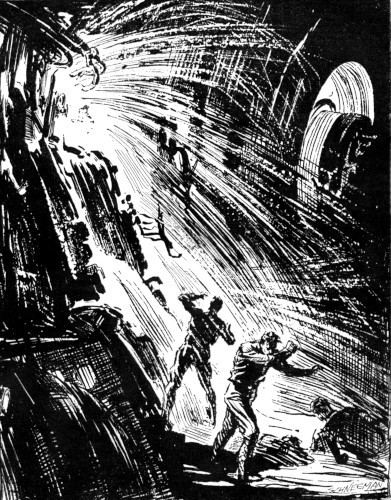
Some ships, attacked on every hand, watched meters climb, strain against stopping—and saw huge converters, hopelessly overloaded, vanish in gouts of atomic flame.
"Maneuver fifty-nine—hipe!" and Grand Fleet closed in upon somber Jarnevon itself.
"Sixty!" It rolled in space, forming an immense cylinder; the doomed planet the midpoint of its axis.
"Sixty-one!" Tractors and pressors leaped out, from ship to ship and from ship to shore. The Patrol did not know whether or not the scientists of the Eich could render their planet inertialess, but now it made no difference. Planet and fleet were for the time being one rigid system.
"Sixty-two—blast!" And against the world-girdling battlements of Jarnevon there flamed out in all their appalling might the dreadful beams against which the defensive webs of battleships and of mobile citadels alike had been so pitifully inadequate.
But these which they were attacking now were not the limited installations of a mobile structure. The Eich had at their command all the resources of a galaxy. Their generators and conductors could be of any desired number and size. Hence Eichmil, in view of prior happenings, had strengthened the defenses of his planet to a point which certain of his fellows derided as being beyond the bounds of sanity or reason.
Now those unthinkably powerful screens were being tested to the utmost. Bolt after bolt of quasi-solid lightning struck against them, spitting mile-long sparks in baffled fury as they raged to ground. Plain and incased in Q-type helices they came; biting, tearing, gouging. Often and often, under the thrust of half a dozen at once, local failures appeared; but these were only momentary, and not even the newly devised shells of the projectors could stand the load long enough to penetrate effectively Boskone's indescribably capable defenses. Nor were the enemies' offensive weapons less capable.
Rods, cones, planes, and shears of pure force bored, cut, stabbed, and slashed. Bombs and dirigible torpedoes charged to the skin with duodec sought out the red-cloaked ships. Beams, sheathed against atmosphere in Q-type helices, crashed against and through their armor—beams of an intensity almost to rival that of the Patrol's primary weapons and of a hundred times their effective aperture. And not singly did those beams come. Eight, ten, twelve at once they clung to and demolished dreadnought after dreadnought of the Expeditionary Force.
Eichmil was well content. "We can hold them and we are burning them down!" he gloated. "Let them loose their negative-matter bombs! Get the analysis of those beams—build them! They are burning out projectors, which means that they cannot keep this up indefinitely. They will have to retire, what there are left of them, for more munitions; and when they come back we will blast them out of space!"
He was wrong. Grand Fleet did not stay there long enough so that even the projectors of the Eich could destroy more than a few thousands of ships. For even while the cylinder was forming, Kinnison was in rapid but careful consultation with Thorndyke, checking intrinsic velocities, directions, and speeds.
"QX, Verne—cut!" he yelled.
Two planets, one well within each end of the combat cylinder, went inert at the word; resuming instantaneously their diametrically opposed intrinsic velocities, each of some thirty miles per second. And it was these two very ordinary, but utterly irresistible planets, instead of the negative-matter bombs with which the Eich were prepared to cope, which hurtled then along the axis of the immense tube of warships toward Jarnevon. Whether or not the Eich could make their planet inertialess has never been found out. Free or inert, the end would have been the same.
"Every Y14M officer of every ship of the Patrol, attention!" Haynes ordered. "Don't get all tensed up. Take it easy; there's lots of time. Any time within a second after I give the word will be p-l-e-n-t-y o-f t-i-m-e—cut!"
The two worlds rushed together, doomed Jarnevon squarely between them. Haynes snapped out his order as the three were within two seconds of contact, and as he spoke all the tractors and all the pressors were released. The ships of the Patrol were already free—none had been inert since leaving Jalte's ex-planet—and thus could not be harmed by flying débris.
The planets touched. They coalesced, squishingly at first, the encircling warships drifting lightly away before a cosmically violent blast of superheated atmosphere; Jarnevon burst open, all the way around, and spattered; billions upon billions of tons of hot core-magma being hurled afar in gouts and streamers. The two planets, crashing through what had been a world, met, crunched, crushed together in all the unimaginable momentum of their masses and velocities. They subsided, crashingly. Not merely mountains, but entire halves of worlds disrupted and fell, in such Gargantuan paroxysms as the eye of man had never elsewhere beheld. And every motion generated heat. The kinetic energy of translation of two worlds became heat. Heat added to heat, piling up ragingly, frantically, unable to escape!
The masses, still falling upon and through and past themselves and each other, melted—boiled—vaporized incandescently. The entire mass, the mass of three fused worlds, began to equilibrate; growing hotter and hotter as more and more of its terrific motion was converted into pure heat. Hotter! Hotter! HOTTER!
And as the Grand Fleet of the Galactic Patrol blasted through intergalactic space toward the First Galaxy and home, there glowed behind it a new, small, comparatively cool, and probably short-lived companion to an old and long-established star.
XXV.
The uproar of the landing of the Tellurian contingent was over; the celebration of victory had not yet begun. Haynes had, peculiarly enough, set a definite time for a conference with Kinnison and the two of them were in the admiral's private office, splitting a bottle of fayalin and discussing—apparently—nothing at all.
"Narcotics has been yelling for you." Haynes finally got around to business. "But they don't need you to help them clean up the zwilnik mess; they just want to have the honor of having you work with them—so I told Ellington, as diplomatically as possible, to take a swan dive off of an asteroid. Hicks wants you, too; and Spencer and Frelinghuysen and thousands of others. See that basketful of stuff? All requests for you, to be submitted to you for your consideration. I submit 'em, thus—into the wastebasket. You see, there's something really important—"
"Nix, chief, nix—jet back a minute, please!" Kinnison implored. "Unless it's something that's got to be done right away, gimme a break, can't you? I've got a couple of things to do first—stuff to attend to. Maybe a little flit somewhere, too, I don't know yet."
"More important than Patrol business?"—dryly.
"Until it's cleaned up, yes." Kinnison's face burned scarlet and his eyes revealed the mental effort necessary for him to make that statement. "The most important thing in the Universe," he finished, quietly but doggedly.
"Well, of course I can't give you orders—" Haynes' frown was distinct with disappointment.
"Don't, chief—that hurts. I'll be back, honest, as soon as I possibly can, and I'll do anything you want me to—"
"That's enough, son." Haynes stood up and grasped Kinnison's hands—hard—in both his own. "I know. Forgive me for taking you for this little ride, but you and Mac suffer so! You're so young, so intense, so insistent upon carrying the entire Cosmos upon your shoulders—I couldn't help it. You won't have to do much of a flit." He glanced at his chronometer. "You'll find all your unfinished business in Room 7295, Base Hospital."
"Huh? You know, then?" shouted the overjoyed young giant.
"Who doesn't?" was the admiral's quizzical rejoinder. "There may be a few members of some backward race somewhere who do not know all about you and your red-headed sector riot, but I don't happen to know—" He was addressing empty air.
Kinnison shot out of the building and, exerting his Gray Lensman's authority, he did a thing which he had always longed boyishly to do but which he had never before really considered doing. He whistled, shrill and piercingly, and waved a Lensed arm, even while he was directing a Lensed thought at the driver of the fast ground car always in readiness in front of GHQ.
"Base Hospital—full emergency blast!" he ordered, and the Jehu obeyed. That chauffeur loved emergency stuff, and the long, low, wide racer took off with a deafening roar of unmuffled exhaust and a scream of tortured, burning rubber.
"Thanks, Jack—you needn't wait." At the hospital's door Kinnison rendered tribute to fast service and strode along a corridor. An express elevator whisked him up to the seventy-second floor, and there his haste departed completely. This was Nurses' Quarters, he realized suddenly. He had no more business there than—yes, he did, too. He found Room 7295 and rapped upon its door. Boldly, he intended, but the resultant sound was surprisingly small.
"Come in!" called a clear contralto. Then, after a moment, "Come in!" more sharply; but the Lensman did not, could not obey the summons. She might be—dammitall, he didn't have any business on this floor! Why hadn't he called her up or sent her a thought or something? Why didn't he think at her now?
The door opened, revealing the mildly annoyed sector chief. At what she saw, her hands flew to her throat and her eyes widened in starkly unbelieving rapture.
"Kim!" she shrieked in ecstasy.
"Chris—my Chris!" Kinnison whispered unsteadily, and for minutes those two uniformed minions of the Galactic Patrol stood motionless upon the room's threshold, strong young arms straining, nurse's crisp and spotless white crushed unregarded against Lensman's pliant gray.
"Oh ... I've missed you so terribly, my darling!" Clarrissa crooned. Her voice, always sweetly rich, was pure music.
"You don't know the half of it, Chris. This isn't real, I don't think. It can't be—nothing can feel this good!"
"You did come back to me—you really did!" she lilted. "I didn't dare to hope that you could come so soon."
"I had to." Kinnison drew a deep breath. "I simply couldn't stand it any longer. It'll be tough sometimes, but you were right—half a loaf is better than no bread."
"Of course it is!" She released herself—partially—after the first transports of their first embrace and eyed him shrewdly. "Tell me, Kim, did Lacy have a hand in this surprise?"
"Uh-huh," he denied. "I haven't seen him for ages—but jet back! Haynes told me—say, what'll you bet that those two old hardheads haven't been giving us the works?"
"Who are old hardheads?" Haynes—in person—demanded. So deeply immersed had Kinnison been in his rapturous delirium that even his sense of perception was in abeyance; and there, not two yards from the entranced couple, stood the two old Lensmen!
The culprits sprang apart, flushing guiltily, but Haynes went on imperturbably, quite as though nothing out of the ordinary had been either said or done:
"We gave you fifteen minutes, then came up to be sure to catch you before you flited off to the celebration or somewhere. We have matters to discuss—important matters, but pleasant."
"QX. Come in, all of you." As she spoke, the nurse stood aside in invitation. "You know, don't you, that it's exceedingly much contraregs for nurses to entertain visitors of the opposite sex in their rooms? Fifty demerits. Most girls never get a chance at even one Gray Lensmen, and here I've got three!" She giggled infectiously. "Wouldn't it be one for the book for me to get a hundred and fifty black spots for this? And to have Surgeon General Lacy, Port Admiral Haynes, and Unattached Lensman Kimball Kinnison all heaved into the clink to boot? Boy, oh, boy, ain't we got fun?"
"Lacy's too old and I'm too moral to be affected by the wiles even of the likes of you, my dear," Haynes explained equably, as he seated himself upon the davenport—the most comfortable thing in the room.
"Old? Moral? Tommyrot!" Lacy glared an "I'll-see-you-later" look at the admiral, then turned to the nurse. "Don't worry about that, MacDougall. No penalties accrue—regulations apply only to nurses actually in the service—"
"And what—" she started to blaze, but checked herself and her tone changed instantly. "Go on—you interest me strangely, sir. I'm just going to love this!" Her eyes sparkled, her voice was vibrant with unconcealed eagerness.
"Told you she was quick on the uptake!" Lacy gloated. "Didn't fox her for a second!"
"But say—listen—what's this all about, anyway?" Kinnison demanded.
"Never mind; you'll learn soon enough," from Lacy, and:
"Kinnison, you are very urgently invited to attend a meeting of the Galactic Council tomorrow afternoon," from Haynes.
"Huh? What's up now?" Kinnison protested. His arm tightened about the girl's supple waist and she snuggled closer, a trace of foreboding beginning to dim the eagerness in her eyes.
"Promotion. We want to make you something—galactic co-ordinator, director, something like that—the job hasn't been named yet. In plain language, the big shot of the Second Galaxy, formerly known as Lundmark's Nebula."
"But, Klono's brazen claws! Chief, I can't swing it—I haven't got jets enough!"
"You always yelp about a deficiency of jets whenever a new job is mentioned, but we notice that you usually deliver the goods. Think it over for a minute. Who else could we wish such a job as that onto?"
"Worsel," Kinnison declared without hesitation. "He's—"
"Balloon juice!" snorted the older man.
"Well, then ... ah ... er—" He stopped. Clarrissa opened her mouth; then shut it, ridiculously, without having uttered a word.
"Go ahead, MacDougall—you are an interested party, you know."
"No." She shook her spectacular head. "I'm not saying a word or thinking a thought to sway his decision one way or the other. Besides, he'd have to flit around as much then as now."
"Some travel involved, of course," Haynes admitted. "All over that Galaxy, some in this one, and back and forth between the two. However, the Dauntless—or something newer, bigger, and faster—will be his private yacht, and I do not see why it is either necessary or desirable that his flits be solo."
"Say, I never thought of that!" Kinnison blurted, and, as thoughts began to race through his mind of what he could do, with Chris beside him all the time, to straighten out the mess in the Second Galaxy:
"Oh, Kim!" Clarrissa squealed in ecstasy, squeezing his arm even tighter against her side.
"Hooked!" the surgeon general chortled in triumph.
"But I'd have to retire!" That thought was the only thorn in Kinnison's whole wreath of roses. "I wouldn't like that."
"Certainly you wouldn't," Haynes agreed. "But remember that all such assignments are conditional, subject to approval, and with a very definite cancellation agreement in case of what the Lensman regards as an emergency. If a Gray Lensman had to give up his right to serve the Patrol in any way he considered himself most able, they'd have to shoot us all before they could make executives out of us. And finally, I don't see how the job we're talking about can be figured as any sort of a retirement. You will be as active as you are now—yes, more so, I think."
"QX. I'll be there—I'll try it," Kinnison promised.
"Now for some more news," Lacy announced. "Haynes didn't tell you, but he has been made president of the Galactic Council. You are his first appointment. I hate to say anything good about the old scoundrel, but he has one outstanding ability. He doesn't know much or do much himself, but he certainly can pick the men who have to do the work for him!"
"There's something vastly more important than that," Haynes steered the acclaim away from himself.
"Just a minute," Kinnison interposed. "I haven't got this all straight yet. What was that crack about active nurses a while ago?"
"Why, Dr. Lacy was just intimating that I had resigned, goose," Clarrissa chuckled. "I didn't know a thing about it myself, but I imagine that it must have been just before this conference started. Am I right, doctor?" she asked innocently.