Front matter (continued 3)
Reading edition
The Gray Lensman made his carefree way down the alleylike thoroughfare, whistling inharmoniously and very evidently at peace with the Universe.
It takes something, friends, to walk knowingly into a trap; without betraying emotion or stress even while a blackjack, wielded by a strong arm, is descending toward the back of your head. Something of quality, something of fiber. But whatever it took, Kinnison in ample measure had.
He did not wink, flinch, or turn an eye as the billy came down. Only as it touched his hair did he act, exerting all his marvelous muscular control to jerk forward and downward, with the weapon and ahead of it, to spare himself as much as possible of the terrific blow.
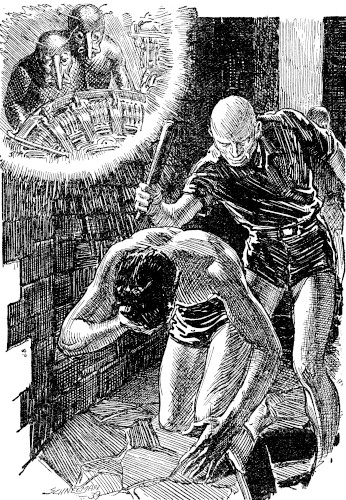
The Lensman, fully aware, yet did not wink, flinch, or turn an eye as the billy came down.
The blackjack crunched against the base of the Lensman's skull in a shower of coruscating constellations. He fell. He lay there, twitching feebly.
VIII.
As has been said, Kinnison rode the blow of the blackjack forward and downward, thus robbing it of some of its power. It struck him hard enough so that the thug did not suspect the truth; he thought that he had all but taken the Lensman's life. And, for all the speed with which the Tellurian had yielded before the blow, he was hurt; but he was not stunned. Therefore, although he made no resistance when the two bullies rolled him over, lashed his feet together, tied his hands behind him, and lifted him into a car, he was fully conscious throughout the proceedings.
When the cab was perhaps half an hour upon its way the Lensman struggled back, quite realistically, to consciousness.
"Take it easy, pal," the larger of his thought-screened captors advised, dandling the blackjack suggestively before his eyes. "One yelp out of you, or a signal, if you've got one of them Lenses, and I bop you another one."
"What the blinding blue hell's coming off here?" demanded the dock-walloper, furiously. "Wha'd'ya think you're doing, you lop-eared—" and he cursed the two, viciously and comprehensively.
"Shut up or he'll knock you kicking," the smaller thug advised from the driver's seat, and Kinnison subsided. "Not that it bothers me any, but you're making too much noise."
"But what's the matter?" Kinnison asked, more quietly. "What'd you slug me for and drag me off? I ain't done nothing and I ain't got nothing."
"I don't know nothing," the big agent replied. "The boss will tell you all you need to know when we get to where we're going. All I know is the boss says to bop you easylike and bring you in alive if you don't act up. He says to tell you not to yell and not to use no Lens. If you yell we burn you out. If you use any Lens, the boss he's got his eyes on all the bases and space-ports and everything, and if any help starts to come this way he'll tell us and we burn you out. Then we buzz off. We can kill you and flit before any help can get near you, he says."
"Your boss ain't got the brains of a fontema," Kinnison growled. He knew that boss, wherever he was, could hear every word. "Hell's hinges, if I was a Lensman you think I'd be walloping junk on a dock? Use your head, cully, if you got one."
"I wouldn't know nothing about that," the other returned, stolidly.
"But I ain't got no Lens!" the dock-walloper stormed, in exasperation. "Look at me—frisk me! You'll see I ain't!"
"All that ain't none of my dish." The thug was entirely unmoved. "I don't know nothing and I don't do nothing except what the boss tells me, see? Now take it easy, all nice and quietlike. If you don't," and he flicked the blackjack lightly against the Lensman's knee, "I'll put out your landing-lights. I'll lay you like a mat, and I don't mean maybe. See?"
Kinnison saw, and relapsed into silence. The automobile rolled along. And, flitting industriously about upon its delivery duties, but never much more or less than one measured mile distant, a panel job pursued its devious way. Oddly enough, its chauffeur was a Lensman. Here and there, high in the heavens, were a few airplanes, gyros, and copters; but they were going peacefully and steadily about their business—even though most of them happened to have Lensmen as pilots.
And, not at Base at all, but high in the stratosphere and so thoroughly screened that a spy-ray observer could not even tell that his gaze was being blocked, Base's swiftest cruiser, Lensman-commanded, rode poised upon flare-baffled, softly hissing under jets. And, equally high and as adequately protected against observation, a keen-eyed Lensman sat at the controls of a speedster, jazzing her muffled jets and peering eagerly through a telescopic sight. As far as the Patrol was concerned, everything was on the trips.
The car approached the gates of a suburban estate and stopped. It waited. Kinnison knew that the Boskonian within was working his every beam, alert for any sign of Patrol activity; knew that if there were any such sign the car would be off in an instant. But there was no activity. Kinnison sent a thought to Gerrond, who relayed micro-metric readings of the objective to various Lensmen. Still everyone waited. Then the gate opened of itself, the two thugs jerked their captive out of the car to the ground, and Kinnison sent out his signal.
Base remained quiet, but everything else erupted at once. The airplanes wheeled, cruiser and speedster plummeted downward at maximum blast. The panel job literally fell open, as did the cage within it, and four ravening cateagles, with the silent ferocity of their kind, rocketed toward their goal.
Although the oglons were not as fast as the flying ships they did not have nearly as far to go, wherefore they got there first. The thugs had no warning whatever. One instant everything was under control; in the next the noiselessly arrowing destroyers struck their prey with the mad fury that only a striking cateagle can exhibit. Barbed talons dug viciously into eyes, faces, mouths; tearing, rending, wrenching; fierce-driven fangs tore deeply, savagely into defenseless throats.
Once each the thugs screamed in mad, lethal terror, but no warning was given; for by that time every building upon that pretentious estate had disappeared in the pyrotechnic flare of detonating duodec. The pellets were small, of course—the gunners did not wish either to destroy the nearby residences or to injure Kinnison—but they were powerful enough for the purpose intended. Mansion and outbuildings disappeared, and not even the most thoroughgoing spy-ray search revealed the presence of anything animate or structural where those buildings had been.
The panel job drove up and Kinnison, perceiving that the cateagles had done their work, sent them back into their cage. The Radeligian Lensman, after securely locking cage and truck, cut the Earthman's bonds.
"QX, Kinnison?" he asked.
"QX, Barknett—thanks," and the two Lensmen, one in the panel truck and the other in the gangsters' car, drove back to Base. There Kinnison recovered his package.
"This has got me all of a soapy lather, but you have called the turn on every play yet," Winstead told the Tellurian, later. "Is this all of the big shots, do you think, or are there some more of them around here?"
"Not around here, I'm pretty sure," Kinnison replied. "No, two main lines is all they would have had, I think—this time. Next time—"
"There won't be any next time," Winstead declared.
"Not on this planet, no. Knowing what to expect, you fellows can handle anything that comes up. I was thinking then of my next step."
"Oh. But you'll get 'em, Gray Lensman!"
"I hope so"—soberly.
"Luck, Kinnison!"
"Clear ether, Winstead!" and this time the Tellurian really did flit.
As his speedster ripped through the void Kinnison did more thinking, but he was afraid that his Arisian mentor would have considered the product muddy, indeed. He couldn't seem to get to the first check station. One thing was limpidly clear; this line of attack or any very close variation of it would never work again. He'd have to think up something new. So far, he had got away with his stuff because he had kept one lap ahead of them, but how much longer could he manage to keep up the pace?
Bominger had been no mental giant, of course; but this other lad was nobody's fool and this next higher-up, with whom he had had an interview via Bominger, would certainly prove to be a really shrewd number.
"'The higher the fewer,'" he repeated to himself the old saying, adding, "and in this case, the smarter." He had to put out some jets, but where he was going to get the fuel he had no idea.
Again the trip to Tellus was uneventful, and the Gray Lensman, the symbol of his rank again flashing upon his wrist, sought interview with Haynes.
"Send him in, certainly—send him in!" Kinnison heard the communicator crackle, and the receptionist passed him along. He paused in surprise, however, at the doorway of the office, for Chief Surgeon Lacy and a Posenian were in conference with the Port Admiral.
"Come in, Kinnison," Haynes invited. "Lacy wants to see you a minute, too. Dr. Phillips—Lensman Kinnison, Unattached. His name is not Phillips, of course; that is merely one we gave him in self-defense. His real name is utterly unpronounceable."
Phillips, the Posenian, was as tall as Kinnison, and heavier. His figure was somewhat human in shape, but not in detail. He had four arms instead of two, each arm had two opposed hands, and each hand had two thumbs, one situated about where a little finger would be expected. He had no eyes, not even vestigial ones. He had two broad, flat noses and two toothful mouths; one of each in what would ordinarily be called the front of his round, shining, hairless head; the other in the back. Upon the sides of his head were large, volute, highly dirigible ears. And, like most races having the faculty of perception instead of that of sight, his head was relatively immobile, his neck being short, massive, and tremendously strong.
"You look well, very well," Lacy reported, after feeling and prodding vigorously the members which had been in splints and casts so long. "Have to take a picture, of course, before saying anything definite. No, we won't, either, now. Phillips, look at his"—an interlude of technical jargon—"and see what kind of a recovery he has made." Then, while the Posenian was examining Kinnison's interior mechanisms, the Chief Surgeon went on:
"Wonderful diagnosticians and surgeons, these Posenians—can see into the patient without taking him apart. In another few centuries every doctor will have to have the sense of perception. Phillips is doing a research in neurology—more particularly a study of the neural synapse and the proliferation of neural dendrites—"
"La—cy-y-y!" Haynes drawled the word in reproof. "I've told you a thousand times to talk English when you're talking to me. How about it, Kinnison?"
"It might be more comprehensible, although we must admit that any scientist likes to speak with precision, which he cannot do in the ordinary language of the layman."
"Right, boy—surprisingly and pleasingly right!" Lacy exclaimed. "Why can't you adopt that attitude, Haynes, and learn enough words so that you can understand what a man is talking about? But to reduce it to monosyllabic simplicity, Phillips is studying a thing that has baffled us for centuries—yes, for millennia. The lower forms of cells are able to regenerate themselves; wounds heal, bones knit. Higher types, such as nerve cells, regenerate imperfectly, if at all; and the highest type, the brain cells, do not do so under any conditions." He turned a reproachful gaze upon Haynes. "This is terrible. Those statements are pitiful—inadequate—false. Worse than that—practically meaningless. What I wanted to say, and what I'm going to say, is that—"
"Oh, no you aren't, not in this office," his old friend interrupted. "We got the idea perfectly. The question is, why can't human beings repair nerves or spinal cords, or grow new ones? If such a worthless beastie as a starfish can grow a whole new body to one leg, including a brain, if any, why can't a really intelligent victim of simple infantile paralysis—or a ray—recover the use of a leg that is otherwise in perfect shape?"
"Well, that's something like it, but I hope you can aim closer than that at a battleship," Lacy grunted. "We'll buzz off now, Phillips, and leave these two war horses alone."
"Here is my report in detail." Kinnison placed the package upon the Port Admiral's desk as soon as the room was sealed behind the visitors. "I talked to you direct about most of it—this is for the record."
"Of course. Mighty glad you found Medon, for our sake as well as theirs. They have things that we need, badly."
"Where did they put them? I suggested a sun near Sol, so as to have them handy to Prime Base."
"Right next door—Alpha Centauri. Didn't get to do much scouting, did you?"
"I'll say we didn't. Boskonia owns that Galaxy; lock, stock, and barrel. Maybe some other independent planets—bound to be, of course; probably a lot of them—but it's too dangerous, hunting them at this stage of the game. But at that, we did enough, for the time being. We proved our point. Boskone, if there is any such being, is certainly in the Second Galaxy. However, it will be a long time before we're ready to carry the war there to him, and in the meantime we've got a lot to do. Check?"
"To nineteen decimals."
"It seems to me, then, that while you are rebuilding our first-line ships, super-powering them with Medonian insulation and conductors, I had better keep on tracing Boskone along the line of drugs. I have proved to my own satisfaction that they are back of almost all of that drug business."
"And in some ways their drugs are more dangerous to Civilization than their battleships. More insidious and, ultimately, more fatal."
"I'm convinced of it. And since I am perhaps as well equipped as any of the other Lensmen to cope with that particular problem—" Kinnison paused, questioningly.
"That certainly is no overstatement," the Port Admiral replied, dryly. "You're the only one equipped to cope with it."
"None of the other boys except Worsel, then? I heard that a couple—"
"They thought that they had a call, but they didn't. All they had was a wish. They came back."
"Too bad—but I can see how that would be. A man has to know exactly what he needs, and his brain must be ready to take it, or it burns it out. It almost does, anyway—mind is a funny thing. But that isn't getting us anywhere. Can you take time to let me talk at you a few minutes?"
"I certainly can. You have what is perhaps the most important assignment in the Galaxy, and I would like to know more about it, if it's anything you can pass on."
"Nothing that need be sealed from any Lensman. The main object of all of us, as you know, is to push Boskonia out of this Galaxy. From a military standpoint they practically are out. Their drug syndicate, however, is very decidedly in, and getting in deeper all the time. Therefore, we next push the zwilniks out. They have peddlers and such small fry, who deal with distributors and so on. These, as it were, form the bottom layer. Above them are the secret agents, the observers, and the wholesale handlers; runners and importers. All these folks are directed and controlled by one man, the boss of each planetary organization. Thus, Bominger was the boss of all zwilnik activities on the whole planet of Radelix.
"In turn the planetary bosses report to, and are synchronized and controlled by, a Regional Director, who supervises the activities of a couple of hundred or so planetary outfits. I got a line on the one over Bominger, you know—Prellin, the Kalonian. By the way, you knew, didn't you, that Helmuth was a Kalonian, too?"
"I got it from the tape. Smart people, they must be, but not my idea of good neighbors."
"I'll say not. Well, that's all I really know of their organization. It seems logical to suppose, though, that the structure is coherent all the way up. If so, the Regional Directors would be under some higher-up, possibly a Galactic Director, who in turn might be under Boskone himself—or one of his cabinet officers, at least. Perhaps the Galactic Director might even be a cabinet officer in their government, whatever it is?"
"An ambitious program you've got mapped out for yourself. How are you figuring on swinging it?"
"That's the rub—I don't know," Kinnison confessed, ruefully. "But if it's done at all, that's the way I've got to go about it. Any other way would take a thousand years and more men than we'll ever have. This way works fine, when it works at all."
"I can see that—lop off the head and the body dies," Haynes agreed.
"That's the way it works—especially when the head keeps detailed records and books covering the activities of all the members of his body. With Bominger and the others gone, and with full transcripts of his accounts, the boys mopped up Radelix in a hurry. From now on it will be simple to keep it clean, except of course, for the usual bootleg trickle, and that can be reduced to a minimum. Similarly, if we can put this Prellin away and take a good look at his ledgers, it will be easy to clear up his two hundred planets. And so on."
"Very clear, and quite simple—in theory." The older man was thoughtful and frankly dubious. "In practice, difficult in the extreme."
"But necessary," the younger insisted.
"I suppose so," Haynes assented finally. "Useless to tell you not to take chances—you'll have to—but for all of our sakes, if not for your own, be as careful as you can."
"I'll do that, chief. I think a lot of me, really. You know that story about the guy who was all right in his place, but the place hadn't been dug yet? Well, I don't want anybody digging my proper place for a long time to come."
Haynes laughed, but the concern did not leave his features. "Anything special you want done?" he asked.
"Yes, very special," Kinnison surprised him by answering in the affirmative. "You know that the Medonians developed a scrambler for a detector-nullifier. Hotchkiss and the boys developed a new line of attack on that—against long-range stuff we're probably safe—but they haven't been able to do a thing on electromagnetics. Well, the Boskonians, beginning with Prellin, are going to start wondering what has been happening. Then, if I succeed in getting Prellin, they are bound to start doing things. One thing they will do will be to fix up their headquarters so that they will have about five hundred percent overlap on their electros. Perhaps they will have outposts, too, close enough together to have the same thing there—possibly two or three hundred even on visuals."
"In that case, I would say that you'd stay out."
"Not necessarily. What do electros work on?"
"Iron, I suppose—they did when I went to school last."
"The answer, then, is to build me a speedster that is inherently indetectable—absolutely non-ferrous. Berylumin and other alloys for all the structural parts—"
"But you've got to have silicon-steel cores for your electrical equipment!"
"I was coming to that. Have you? I was reading in the 'Transactions' the other day that force fields had been used in big units, and were more efficient. Some of the smaller units, instruments and so on, might have to have some iron, but wouldn't it be possible to so saturate those small pieces with a dense field of detector frequencies that they wouldn't react?"
"I don't know. Never thought of it. Would it?"
"I don't know, either—I'm not telling you, I'm just making suggestions. I do know one thing, however. We've got to keep ahead of them—think of things first and oftenest, and be ready to abandon them for something else as soon as we have used them once."
"Except for those primary projectors." Haynes grinned wryly. "They can't be abandoned—even with Medonian power we haven't been able to develop a screen that will stop them cold. We've got to keep them secret from Boskone—and in that connection I want to compliment you on the suggestion of having Velantian Lensmen as mind readers wherever those projectors are even being thought of."
"You caught spies, then? How many?"
"Not many—three or four in each Base—but enough to have done the damage. Now, I believe, for the first time in history, we can be sure of our entire personnel."
"I think so. The Arisian said that the Lens was enough, if we used it properly. That's up to us."
"But how about visuals?" Haynes was still worrying, and to good purpose.
"Well, we have a black coating now that is ninety-nine percent absorptive, and I don't need ports or windows. At that, though, one percent reflection would be enough to give me away at a critical time. How'd it be to put a couple of the boys on that job? Have them put a decimal point after the ninety-nine and see how many nines they can tack on behind it?"
"That's a thought, Kinnison, and they have lots of time to work on it while the engineers are trying to fill your specifications as to a speedster. But you're right, dead right, in everything you have said. We—or rather, you—have got to out-think them; and it certainly is up to us to do everything that can be done to build the apparatus to put your thoughts into practice. And it is not at some vague time in the future that Boskone is going to start thinking seriously about you and what you have done. It is now; or even more probably, a week or so ago. In fact, if there were any way of learning the truth, I think we should find that they have begun acting already, instead of waiting until you abate the nuisance which is Prellin, the Kalonian. But you haven't said a word yet about the really big job you have in mind."
"I've been putting that off until the last." The Gray Lensman's voice held obscure puzzlement. "The fact is that I simply can't get a tooth into it—can't get a grip in it anywhere. I don't know enough about math or physics. Everything comes out negative for me; not only inertia, but also force, velocity, and even mass itself. Final results always contain an 'i', too, the square root of minus one. I can't get rid of it, and I don't see how it can be built into any kind of apparatus. It may not be workable at all, but before I give up the idea I would like to call a conference, if it's QX with you and the Council."
"Certainly it is QX with us. You're forgetting again, aren't you, that you're a Gray Lensman?" Haynes' voice held no reproof, he was positively beaming with a super-fatherly pride.
"Not exactly." Kinnison blushed, almost squirmed. "I'm just too much of a cub to be sticking my neck out so far, that's all. The idea may be—probably is—wilder than a Radeligian cateagle. The only kind of a conference that could even begin to handle it would cost a young fortune, and I don't want to spend that much money on my own responsibility."
"To date your ideas have worked out well enough so that the Council is backing you one hundred percent," the older man said, dryly. "Expense is no object." Then, his voice changing markedly, "Kim, have you any idea at all of the financial resources of the Patrol?"
"Very little, sir, if any, I'm afraid," Kinnison confessed.
"Here on Tellus alone we have an expendible reserve of over ten thousand million credits. With the restriction of government to its proper sphere and its concentration into our organization, resulting in the liberation of man-power into wealth-producing enterprise, and especially with the enormous growth of inter-world commerce, world-income increased to such a point that taxation could be reduced to a minimum; and the lower the taxes the more flourishing business became and the greater the income.
"Now the tax rate is the lowest in recorded history. The total income tax, for instance, in the highest bracket, is only three point five nine two percent. At that, however, if it had not been for the recent slump, due to Boskonian interference with inter-systemic commerce, we would have had to reduce the tax rate again to avoid serious financial difficulty due to the fact that too much of the galactic total of circulating credit would have been concentrated in the expendable funds of the Galactic Patrol. So don't even think of money. Whether you want to spend a thousand credits, a million, or a thousand million; go ahead."
"Thanks, chief; glad you explained. I'll feel better now about spending money that doesn't belong to me. Now if you'll give me, for about a week, the use of the librarian in charge of science files and a galactic beam, I'll quit bothering you."
"I'll do that." The Port Admiral touched a button and in a few minutes a trimly attractive blonde entered the room. "Miss Hostetter, this is Lensman Kinnison, Unattached. Please turn over your regular duties to an assistant and work with him until he releases you. Whatever he says, goes; the sky's the limit."
In the Library of Science Kinnison outlined his problem briefly to his new aide, concluding:
"I want only about fifty, as a larger group could not co-operate efficiently. Are your lists arranged so that you can skim off the top fifty?"
"Such a group can be selected, I think." The girl stood for a moment, lower lip held lightly between white teeth. "That is not a standard index, but each scientist has a rating upon his card. I can set the acceptor ... no, the rejector would be better ... to throw out all the cards above any given rating. If we take out all ratings over seven hundred we will have only the highest of the geniuses."
"How many, do you suppose?"
"I have only a vague idea—a couple of hundred, perhaps. If too many, we can run them again at a higher level, say seven ten. But there won't be very many, since there are only two galactic ratings higher than seven fifty. There will be duplications, too—such people as Sir Austin Cardynge will have two or three cards in the final rejects."
"QX—we'll want to hand-pick the fifth, anyway. Let's go!"
Then for hours, bale after bale of cards went through the machine; thousands of records per minute. Occasionally one card would flip out into a rack, rejected. Finally:
"That's all, I think. Mathematicians, physicists," the librarian ticked off upon pink fingers. "Astronomers, philosophers, and this new classification, which has not been named yet."
"The H.T.T.'s." Kinnison glanced at the label, lightly lettered in pencil, fronting the slim packet of cards. "Aren't you going to run them through, too?"
"No. These are the two I mentioned a minute ago—the only ones rating over seven hundred fifty."
"A choice pair, eh? Sort of a crème de la crème? Let's look 'em over," and he extended his hand. "What do the initials stand for?"
"I'm awfully sorry, sir, really," the girl flushed in embarrassment as she relinquished the cards in high reluctance. "If I'd had any idea, we wouldn't have dared—we call you, among ourselves, the 'High-Tension Thinkers.'"
"Us!" It was the Lensman's turn to flush. Nevertheless, he took the packet and read sketchily the facer: "Class XIX—Unclassifiable at present—lack of adequate methods—minds of range and scope far beyond any available indices—Ratings above high genius (750)—yet no instability—power beyond any heretofore known—assigned rating tentative and definitely minimum."
He then read the cards.
"Worsel, Velantia, eight hundred five."
And:
"Kimball Kinnison, Tellus, nine hundred twenty-five!"
IX.
The Port Admiral was eminently correct in supposing that Boskone, whoever or whatever he or it might be, was already taking action upon what the Tellurian Lensman had done. For, even as Kinnison was at work in the Library of Science, a meeting which was indirectly to affect him no little was being called to order.
In the immensely distant Second Galaxy was that meeting being held; upon the then planet Jarnevon of the Eich; within that sullen fortress already mentioned briefly. Presiding over it was the indescribable entity known to history as Eichlan; or, more properly, Lan of the Eich.
"Boskone is now in session," that entity announced to the eight other like monstrosities who in some fashion indescribable to man were stationed at the long, low, wide bench of stonelike material which served as a table of State. "Nine days ago each of us began to search for whatever new facts might bear upon the activities of the as-yet-entirely-hypothetical Lensman who, Helmuth believed, was the real force back of our recent intolerable reverses in the Tellurian Galaxy.
"As First of Boskone I will report as to the military situation. As you know, our positions there became untenable with the fall of our Grand Base and all our mobile forces were withdrawn. In order to facilitate reorganization, co-ordinating ships were sent out. Some of these ships went to planets held in toto by us. Not one of these vessels has been able to report any pertinent facts whatever. Ships approaching bases of the Patrol, or encountering Patrol ships of war in space, simply ceased communicating. Even their automatic recorders, tuned to my desk as commander-in-chief, ceased to function without transmitting any intelligible data, indicating complete destruction of those ships. A cascade system, in which one ship followed another at long range and with analytical instruments set to determine the nature of any beam or weapon employed, was attempted. The enemy, however, threw out blanketing zones of tremendous power; and we lost six more vessels without obtaining the desired data. These are the facts, all negative. Theorizing, deduction, summation, and integration will as usual, come later. Eichmil, Second of Boskone, will now report."
"My facts are also entirely negative," the Second began. "As soon as our operations upon the planet Radelix began to be really productive of results, a contingent of Tellurian narcotic agents arrived; which may or may not have included the Lensman—"
"Stick to facts for the time being," Eichlan ordered, curtly.
"Shortly thereafter a minor agent, a female instructed to wear a thought-screen at all times, lost her usefulness by suffering a mental disorder which incapacitated her quite seriously. Then another agent, also a female, this time one of the third order and who had been very useful up to that time, ceased reporting. A few days later Bominger, the Planetary Director, failed to report, as did the Planetary Observer; who, as you know, was entirely unknown to, and had no connection with, the operating staff. Reports from other sources, such as importers and shippers—these, I believe, are here admissible as facts—indicate that our entire personnel upon Radelix has been put to death. No unusual developments have occurred upon any other planet, nor has any significant fact, however small, been discovered."
"Eichnor, Third of Boskone."
"Also negative. Our every source of information from within the bases of the Patrol has been shut off. Every one of our representatives—some of whom have been reporting regularly for many years—has been silent, and every effort to reach any of them has failed."
"Eichsnap, Fourth of Boskone."
"Utterly negative. We have been able to find no trace whatever of the planet Medon, or of any one of the twenty-one warships investing it at the time of its disappearance."
And so on, through nine reports, while the tentacles of the mighty First of Boskone played intermittently over the keys of a complex instrument or machine before him.
"We will now reason, theorize, and draw conclusions," the First announced, and each of the organisms fed his ideas and deductions into the machine. It whirred briefly, then ejected a tape, which Eichlan took up and scanned narrowly.
"Rejecting all conclusions having a probability of less than ninety-five percent," he announced, "we have: First, a set of three probabilities of a value of ninety-nine and ninety-nine one-hundredths—virtual certainties—that some one Tellurian Lensman is the prime mover behind what has happened; that he has acquired a mental power heretofore unknown to his race; and that he has been in large part responsible for the development of the Patrol's new and formidable weapons. Second, a probability of ninety-nine percent that he and his organization are no longer on the defensive, but have assumed the offensive. Third, one of ninety-seven percent that it is not primarily Tellus which is an obstacle, even though the Galactic Patrol and Civilization did originate upon that planet, but Arisia; that Helmuth's report was at least partially true. Fourth, one of ninety-five and one half percent that the Lens is also concerned in the disappearance of the planet Medon. There is a lesser probability, but still of some ninety-four percent, that that same Lensman is involved here.
"I will interpolate here that the vanishment of that planet is a much more serious matter than it might appear, on the surface, to be. In situ, it was a thing of no concern—gone, it becomes an affair of almost vital import. To issue orders impossible of fulfillment, as Helmuth did when he said 'Comb Trenco, inch by inch,' is easy. To comb this Galaxy star by star for Medon would be an even more difficult and longer task; but what can be done is being done.
"To return to the conclusions, they point out a state of things which I do not have to tell you is really grave. This is the first major setback which the culture of the Boskone has encountered since it began its rise, thousands of years ago. You are familiar with that rise; how we of the Eich took over in turn a city, a race, a planet, a solar system, a region, a galaxy. How we extended our sway into the Tellurian Galaxy, as a preliminary to the extension of our authority throughout all the populated galaxies of the macro-cosmic Universe.
"You know our creed; to the victor the power. He who is strongest and fittest shall survive and shall rule. This so-called Civilization which is opposing us, which began upon Tellus but whose driving force is that which dwells upon Arisia, is a soft, weak, puny-spirited thing indeed to resist the mental and material power of our culture. Myriads of beings upon each planet, each one striving for power and, so striving, giving of that power to him above. Myriads of planets, each, in return for our benevolently despotic control, delegating and contributing power to the Eich. All this power, delegated to the thousands of millions of the Eich of this planet, culminates in and is wielded by the nine of us who comprise Boskone.
"Power! Our forefathers thought that control of one planet was enough. Later it was declared that mastery of a galaxy, if realized, would sate ambition. We of Boskone, however, now know that our power shall be limited only by the bounds of the Material Cosmic All—every world that exists throughout space shall and must pay homage and tribute to Boskone! What, gentlemen, is the sense of this meeting?"
"Arisia must be visited!" There was no need of integrating this thought; it was dominant and unanimous.
"I would advise caution, however," the Eighth of Boskone amended his ballot. "We are an old race, it is true, and able; we have demonstrated our superiority over every other race of our Galaxy, much more conclusively than the Tellurians have shown their supremacy on theirs, I cannot help but believe, however, that in Arisia there exists an unknown quality, an 'x' which we as yet are unable to evaluate. It must be borne in mind that Helmuth, while not of the Eich, was, nevertheless, an able being; yet he was handled so mercilessly there that he could not render a complete or conclusive report of his expedition, then or ever. With these thoughts in mind I suggest that no actual landing be made, but that the torpedo be launched from a distance."
"The suggestion is eminently sound," the First approved. "As to Helmuth, he was, for an oxygen-breather, fairly able. He was however, mentally soft, as are all such. Do you, our foremost psychologist, believe that any existent or conceivable mind could break yours, with no application whatever of physical force or device, as Helmuth's reports seemed to indicate that his was broken? I use the word 'seemed' advisedly, for I do not believe that Helmuth reported the actual truth. In fact, I was about to replace him with an Eich, however unpleasant such an assignment would be to any of our race, because of that weakness."
"No," agreed the Eighth. "I do not believe that there exists in the Universe a mind of sufficient power to break mine. It is a truism that no mental influence, however powerful, can affect a strong, definitely and positively opposed will. For that reason I voted against the use of thought-screens by our agents. Such screens expose them to detection and can be of no real benefit. Physical means were—must have been—used first, and, after physical subjugation, the screens were, of course, useless."
"I am not sure that I agree with you entirely," the Ninth put in. "We have here cogent evidence that there have been employed mental forces of a type or pattern with which we are entirely unfamiliar. While it is the consensus of opinion that the importance of Helmuth's report should be minimized, it seems to me that we have enough corroborative evidence to indicate that this mentality may be able to operate without material aid. If so, rigid screening should be retained, as offering the only possible safeguard from such force."
"Sound in theory, but in practice dubious," the psychologist countered. "If there were any evidence whatever that the screens had done any good I would agree with you. But have they? Screening failed to save Helmuth or his base; and there is nothing to indicate that the screens impeded, even momentarily, the progress of the suppositious Lensman upon Radelix. You speak of 'rigid' screening. The term is meaningless. Perfectly effective screening is impossible. If, as we seem to be doing, we postulate the ability of one mind to control another without physical, bodily contact—or is the idea at all far fetched, considering what I myself have done to the minds of many of our agents?—the Lensman can work through any unshielded mentality whatever to attain his ends. As you know, Helmuth deduced, too late, that it must have been through the mind of a dog that the Lensman invaded Grand Base."
"Poppycock!" snorted the Seventh. "Or, if not, we can kill the dogs—or screen their minds, too," he sneered.
"Admitted," the psychologist returned, unmoved. "You might conceivably kill all the animals that run and all the birds that fly. You cannot, however, destroy all life in any locality at all extended, clear down to the worms in their burrows and the termites in their hidden retreats; and the mind has not yet existed which is keen enough to draw a line of demarcation and say 'here begins intelligent life.'"
"This discussion is interesting, but futile," put in Eichlan, forestalling a scornful reply. "It is more to the point, I think, to discuss that which must be done; or, rather, who is to do it, since the thing itself admits of only one solution—an atomic bomb of sufficient power to destroy every trace of life upon that accursed planet. Shall we send someone, or shall some of us ourselves go? To overestimate a foe is at worst only an unnecessary precaution; to underestimate this one may well be fatal. Therefore, it seems to me, that the decision in this matter should lie with our psychologist. I will, however, if you prefer, integrate our various conclusions."
Recourse to the machine was unnecessary; it was agreed by all that Eichamp, the Eighth of Boskone, should decide.
"My decision will be evident," that worthy said, measuredly, "when I say that I myself, for one, am going. The situation is admittedly a serious one. Moreover, I believe, to a greater extent than do the rest of you, that there is a certain amount of truth in Helmuth's version of his experiences. My mind is the only one in existence of whose power I am absolutely certain; the only one which I definitely know will not give way before any conceivable mental force, whatever its amount or whatever its method of application. I want none with me save of the Eich, and even those I will examine carefully before permitting them aboard ship with me."
"You decide as I thought," said the First. "I also shall go. My mind will hold, I think."
"It will hold—in your case examination is unnecessary," agreed the psychologist.
"And I! And I!" arose what amounted to a chorus.
"No," came curt denial from the First. "Two are enough to operate all machinery and weapons. To take any more of the Boskone would weaken us here injudiciously; well you know how many are working, and in what fashions, for seats at this table. To take any weaker mind, even of the Eich, might conceivably be to court disaster. We two should be safe; I because I have proven repeatedly my right to hold the title of First of this Council, the rulers and masters of the dominant race of the Universe; Eichamp because of his unparalleled knowledge, of all intelligence. Our vessel is ready. We go."
As has been indicated, none of the Eich were, or ever had been, cowards. Tyrants they were, it is true, and dictators of the harshest, sternest, and most soulless kind; callous and merciless they were; cold as the rocks of their frigid world and as utterly ruthless and remorseless as the fabled Juggernaut; but they were as logical as they were hard. He, who of them all was best fitted to do anything, did it unquestioningly and, as a matter of course; did it with the calmly emotionless efficiency of the machine which in actual fact he was. Therefore, it was the First and the Eighth of Boskone who went.
Through the star-studded purlieus of the Second Galaxy the black, airless, lightless vessel sped; through the reaches, vaster and more tenuous far, of intergalactic space; into the Tellurian Galaxy; up to a solar system shunned then as now, by all uninvited intelligences—dread and dreaded Arisia.
Not close to the planet did even the two of Boskone venture; but stopped at the greatest distance at which a torpedo could be directed surely against the target. But even so the vessel of the Eich had punctured a screen of mental force; and as Eichlan extended a tentacle toward the firing mechanism of the missiles, watched in as much suspense as they were capable of feeling by the planet-bound seven of Boskone, a thought as penetrant as a needle and yet as binding as a cable tempered steel drove into his brain.
"Hold!" That thought commanded, and Eichlan held, as did also his fellow Boskonian.
Both remained rigid, unable to move any single voluntary muscle; while the other seven of the Council looked on in uncomprehending amazement. Their instruments remained dead—since those mechanisms were not sensitive to thought, to them nothing at all was occurring. Those seven leaders of the Eich knew that something was happening; something dreadful, something untoward, something very decidedly not upon the program they had helped to plan. They, however, could do nothing about it; they could only watch and wait.
"Ah, 'tis Lan and Amp of the Eich," the thought resounded within the minds of the helpless twain. "Truly, the Elders are correct. My mind is not yet competent, for, although I have had many facts instead of but a single one upon which to cogitate, and no dearth of time in which to do so, I now perceive that I have erred grievously in my visualization of the Cosmic All. You do, however, fit nicely into the now enlarged Scheme, and I am really grateful to you for furnishing new material with which for many cycles of time to come, I shall continue to build.
"Indeed, I believe that I shall permit you to return unharmed to your own planet. You know the warning we gave Helmuth, your minion, hence your lives are forfeit for violating knowingly the privacy of Arisia; but wanton or unnecessary destruction is not conducive to mental growth. You are, therefore, at liberty to depart. I repeat to you the instructions given your underling: do not return, either in person or by any form whatever of proxy."
The Arisian had as yet exerted scarcely a fraction of his power; although the bodies of the two invaders were practically paralyzed, their minds had not been punished. Therefore the psychologist said, coldly:
"You are not now dealing with Helmuth, nor with any other weak, mindless oxygen-breather, but with the Eich," and, by sheer effort of will, he moved toward the controls.
"What boots it?" the Arisian compressed upon the Eighth's brain a searing force which sent shrieking waves of pain throughout all nearby space. Then, taking over the psychologist's mind, he forced him to move to the communicator panel, upon whose plate could be seen the other seven of Boskone, gazing in wonder.
"Set up planetary coverage," he directed, through Eichamp's organs of speech, "so that each individual member of the entire race of the Eich can understand what I am about to transmit." There was a brief pause, then the deep, measured voice rolled on:
"I am Eukonidor of Arisia, speaking to you through this mass of undead flesh which was once your chief psychologist, Eichamp, the Eighth of that high council which you call Boskone. I had intended to spare the lives of these two simple creatures, but I perceive that such action would be useless. Their minds and the minds of all you who listen to me are warped, perverted, incapable of reason. They and you would have misinterpreted the gesture completely; would have believed that I did not slay them only because I could not do so. Some of you would have offended again and again, until you were so slain; you can be convinced of such a fact only by an unmistakable demonstration of superior force. Force is the only thing you are able to understand. Your one aim in life is to gain material power; greed, corruption, and crime are your chosen implements.
"You consider yourselves hard and merciless. In a sense, and according to your abilities you are, although your minds are too callow to realize that there are depths of cruelty and of depravity which you cannot even faintly envision.
"You love and worship power. Why? To any thinking mind it should be clear that such a lust intrinsically is, and forever must by its very nature be, futile. For, even if any one of you could command the entire material Universe, what good would it do him? None. What would he have? Nothing. Not even the satisfaction of accomplishment, for that lust is in fact insatiable—it would then turn upon itself and feed upon itself. I tell you as a fact that there is only one power which is at one and the same time illimitable and yet finite; insatiable yet satisfying; one which, while eternal, yet invariably returns to its possessor the true satisfaction of real accomplishment in exact ratio to the effort expended upon it. That power is the power of the mind. You, being so backward and so wrong of development, cannot understand how this can be, but if any one of you will concentrate upon one single fact, or a small object, such as a pebble or the seed of a plant or other creature, for as short a period of time as one hundred of your years, you will begin to perceive its truth.
"You boast that your planet is old. What of that? We of Arisia dwelt in turn upon a thousand planets, from planetary youth to cosmic old age, before we became independent of the chance formation of such celestial bodies.
"You prate that you are an ancient race. Compared to us you are sheerly infantile. We of Arisia did not originate upon a planet formed during the recent interpassage of these two galaxies, but upon one which came into being in an antiquity so distant that the figure in years would be entirely meaningless to your minds. We were of an age to your mentalities starkly incomprehensible when your most remote ancestors began to wriggle about in the slime of your parent world.
"'Do the men of the Patrol know—?' I perceive the question in your minds. They do not. None save a few of the most powerful of their minds has the slightest inkling of the truth. To reveal any portion of it to Civilization as a whole would blight that Civilization irreparably. Though Seekers after Truth in the best sense, they are essentially juvenile and their life spans are ephemeral indeed. The mere realization that there is in existence such a race as ours would place upon them such an inferiority complex as would make further advancement impossible. In your case such a course of events is not to be expected. You will close your minds to all that has happened, declaring to yourselves that it was impossible and that therefore, it could not have taken place and did not. Nevertheless, you will stay away from Arisia henceforth.
"But to resume. You consider yourselves long-lived. Know then, insects, that your life span of a thousand of your years is but a moment. I, myself, have already lived eleven thousand such lifetimes, and I am but a youth—a mere Guardian, not yet to be entrusted with really serious thinking.
"I have spoken overlong; the reason for my prolixity being that I do not like to see the energy of a race so misused, so corrupted to material conquest for its own sake. I would like to set your minds upon the Way of Truth, if perchance such a thing should be possible. I have pointed out that Way; whether or not you follow it is for you to decide. Indeed, I fear that most of you, in your short-sighted pride, have already cast my message aside; refusing point-blank to change your habits of thought. It is, however, in the hope that some few of you will perceive the Way and will follow it by abandoning your planet and its Eich before it is too late, that I have discoursed at such length.
"Whether or not you change your habits of thought, I advise you to heed this, my warning. Arisia does not want and will not tolerate intrusion. As a lesson, watch these two violators of our privacy destroy themselves."
The giant voice ceased. Eichlan's tentacles moved toward the controls. The vast torpedo launched itself.
But instead of hurtling toward distant Arisia it swept around in a mighty circle and struck in direct central impact the great cruiser of the Eich. There was an appalling crash, a space-wracking detonation, a flare of incandescence incredible and indescribable as the energy calculated to disrupt—almost to volatilize—a world expended itself upon the insignificant mass of one Boskonian battleship and upon the unresisting texture of the void.
X.
Considerably more than the stipulated week passed before Kinnison was done with the librarian and with the long-range communicator beam, but eventually he succeeded in enlisting the aid of the fifty-three most eminent scientists and thinkers of all the planets of Galactic Civilization. From all over the Galaxy were they selected; from Vandemar and Centralia and Alsakan; from Chickladoria and Radelix; from the solar systems of Rigel and Sirius and Antares. Millions of planets were not represented at all; and of the few which were, Tellus alone had more than one delegate.
This was necessary, Kinnison explained carefully to each of the chosen. Sir Austin Cardynge, the man whose phenomenal brain had developed a new mathematics to handle the positron and the negative energy levels, was the one who would do the work; he himself was present merely as a co-ordinator and observer. The meeting place, even, was not upon Tellus, but upon Medon, the newly acquired and hence entirely neutral planet. For the Gray Lensman knew well the minds with which he would have to deal.
They were all the geniuses of the highest rank, but in all too many cases their stupendous mentalities merged altogether too closely upon insanity for any degree of comfort. Even before the conclave assembled it became evident that jealousy was to be rife and rampant; and after the initial meeting, at which the problem itself was propounded, it required all of Kinnison's ability, authority, and drive, and all of Worsel's vast diplomacy and tact, to keep those mighty brains at work.
Time after time, some essential entity, his dignity outraged and his touchy ego infuriated by some real or fancied insult, stalked off in high dudgeon to return to his own planet; only to be coaxed or bullied, or even mentally man-handled by Kinnison or Worsel, or both, into returning to his task.
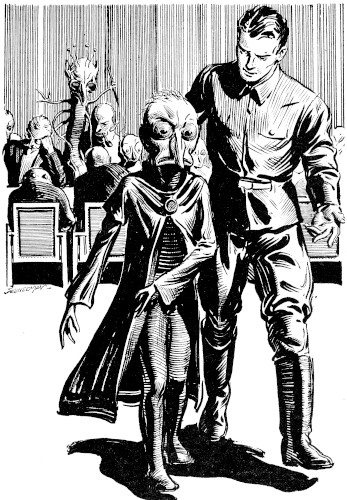
Time after time some essential scientist stalked off in high dudgeon, with Kinnison trailing, soothing ruffled ego.
Nor were those insults all, or even mostly, imaginary. Quarreling and bickering were incessant, violent flare-ups and passionate scenes of denunciation and vituperation were of almost hourly occurrence. Each of those minds had been accustomed to world-wide adulation, to the unquestioned acceptance as gospel of his every idea or pronouncement, and to have to submit his work to the scrutiny and to the unworshipful criticisms of lesser minds—actually to have to give way, at times, to those inferior mentalities—was a situation quite definitely intolerable.
But at length most of them began to work together, as they appreciated the fact that the problem before them was one which none of them singly had been able even partially to solve; and Kinnison let the others, the most fanatically non-co-operative, go home. The progress began—and none too soon. The Gray Lensman had lost twenty-five pounds of weight, and even the iron-thewed Worsel was a wreck. He could not fly, he declared, because his wings buckled in the middle; he could not crawl, because his belly-plate clashed against his backbone!
And finally the thing was done; reduced to a set of equations which could be written upon a single sheet of paper. It is true that those equations would have been meaningless to almost anyone then alive, since they were based upon a system of mathematics which had been brought into existence at that very meeting, but Kinnison had taken care of that.
No Medonian had been allowed in the Conference—the admittance of one to membership would have caused a massed exodus of the high-strung, temperamental maniacs working so furiously there—but the Tellurian Lensman had had recorded every act, almost every thought, of every one of those geniuses. Those records had been studied for weeks, not only by Wise of Medon and his staff, but also by a corps of the less brilliant, but infinitely better balanced scientists of the Patrol proper.
"Now you fellows can really get to work." Kinnison heaved a sigh of profound relief as the last member of the Conference figuratively shook the dust of Medon off his robe as he departed homeward. "I'm going to sleep for a week. Call me, will you, when you get the model done?"
This was sheerest exaggeration, of course, for nothing could have kept the Lensman from watching the construction of that first apparatus. He watched the erection of a spherical shell of loosely latticed truss-work some twenty feet in diameter. He watched the installation, at its six cardinal points, of atomic exciters, each capable of transforming ten thousand pounds per hour of substance into pure energy. He knew that those exciters were driving their intake screens at a ratio of at least twenty thousand to one; that energy equivalent to the annihilation of at least six hundred thousand tons per hour of material was being hurled into the center of that web from the six small mechanisms which were in fact, super-Bergenholms. Nor is that word adequate to describe them. They were engines at whose power the late Dr. Bergenholm himself would have quailed; demons whose fabrication would have been utterly impossible without Medonian conductors and insulation.
He watched the construction of a conveyor and a chute and looked on intently while a hundred thousand tons of refuse—rocks, sand, concrete, scrap iron, loose metal, débris of all kinds—were dropped into that innocuous-appearing sphere, only to vanish as though they had never existed.
"But we ought to be able to see it by this time, I should think!" Kinnison protested once.
"Not yet, Kim," Master Technician LaVerne Thorndyke informed him. "Just forming the vortex—microscopic yet. I haven't the faintest idea of what is going on in there; but man, dear man, am I glad that I'm here to help make it go on!"
"But when?" demanded the Lensman. "How soon will you know whether it's going to work or not? I want to do a flit."
"You can flit any time—now, if you like," the technician told him, brutally. "We don't need you any more—you've done your bit. It's working now. If it wasn't, do you think we could pack all that stuff into that little space? But we'll have it done long before you'll need it."
"But I want to see it work, you big lug!" Kinnison retorted, only half playfully.
"Come back in three-four days—maybe a week; but don't expect to see anything but a hole."
"That's exactly what I want to see, a hole in space," and that was precisely what, a few days later, the Lensman did see.
The spherical framework was unchanged, the machines were still carrying easily their incredible working load. Material—any and all kinds of stuff—was still disappearing; instantaneously, invisibly, quietly, with no flash or fury to mark its passing.
But at the center of that massive sphere there now hung poised a—a something. Or was it a nothing? Mathematically, it was a sphere, or rather a negasphere, about the size of a baseball; but the eye, while it could see something, could not perceive it analytically. Nor could the mind envision it in three dimensions, for it was not essentially three-dimensional in nature. Light sank into the thing, whatever it was, and vanished. The peering eye could see nothing whatever of shape or of texture; the mind behind the eye reeled away before infinite vistas of nothingness.
Kinnison hurled his extrasensory perception into it and jerked back, almost stunned. It was neither darkness nor blackness, he decided, after he recovered enough poise to think coherently. It was worse than that—worse than anything imaginable—an infinitely vast and yet non-existent realm of the total absence of everything whatever—absolute negation!
"That's it, I guess," the Lensman said then. "Might as well stop feeding it now."
"We would have to stop soon, in any case," Wise replied, "for your available waste material is becoming scarce. It will take the substance of a fairly large planet to produce that which you require. You have, perhaps, a planet in mind which is to be used for the purpose?"
"Better than that. I have in mind the material of just such a planet, but already broken up into sizes convenient for handling."
"Oh, the asteroid belt!" Thorndyke exclaimed. "Fine! Kill two birds with one stone, huh? Build this thing and at the same time clear out the menaces to inert interplanetary navigation? But how about the miners?"
"All covered. The ones actually in development will be let alone. They're not menaces, anyway, as they all have broadcasters. The tramp miners we send—at Patrol expense and grubstake—to some other system to do their mining. But there's one more point before we flit. Are you sure that you can shift to the second stage without an accident?"
"Positive. Build another one around it, mount new Bergs, exciters, and screens on it, and let this one, machines and all, go in to feed the kitty—whatever it is," the technician finished.
"QX. Let's go, fellows!"
Two huge Tellurian freighters were at hand; and, holding the small framework between them in a net of tractors and pressors, they set off blithely toward Sol. They took a couple of hours for the journey—and there was no hurry, and in the handling of this particular freight caution was decidedly of the essence.
Arrived at destination, the crews tackled with zest and zeal this new game. Tractors lashed out, seizing chunks of iron—
"Pick out the little ones, men," cautioned Kinnison. "Nothing over about ten feet in section-dimension will go into this frame. Better wait for the second frame before you try to handle the big ones."
"We can cut 'em up," Thorndyke suggested. "What've we got these shear-planes for?"
"QX if you like. Just so you keep the kitty fed."
"We'll feed her!" and the game went on.
Chunks of débris—some rock, but mostly solid meteoric nickel-iron—shot toward the vessels and the ravening sphere, becoming inertialess as they entered a wide-flung zone. Pressors seized them avidly, pushing them through the interstices of the framework, holding them against the voracious screen. As they touched the screen they disappeared; no matter how fast they were driven the screen ate them away, silently and unspectacularly, as fast as they could be thrown against it. A weird spectacle indeed, to see a jagged fragment of solid iron, having a mass of thousands of tons, drive against that screen and disappear! For it vanished, utterly, along a geometrically perfect spherical surface. From the opposite side the eye could see the mirror sheen of the metal at the surface of disintegration! It was as though the material were being shoved out of our familiar three-dimensional space into another universe—which, as a matter of cold fact, may have been the case.
For not even the men who were doing the work made any pretense of understanding what was happening to that iron. Indeed, the only entities who did have any comprehension of the phenomenon—the forty-odd geniuses whose mathematical wizardry had made it possible—thought of it and discussed it, not in the limited, three-dimensional symbols of everyday existence, but only in the language of high mathematics; a language in which few indeed, are able to really and readily to think.
And while the crews became more and more expert at the new technique, so that metal came in faster and faster—huge, hot-sliced bars of iron ten feet square and a quarter of a mile long were being driven into that enigmatic sphere of extinction—an outer framework a hundred and fifty miles in diameter was being built. Nor, contrary to what might be supposed, was a prohibitive amount of metal or of labor necessary to fabricate that mammoth structure. Instead of six there were six cubed—two hundred and sixteen—working stations, complete with generators and super-Bergenholms and screen generators, each mounted upon a massive platform; but, instead of being connected together and supported by stupendous beams and trusses of metal, those platforms were linked by infinitely stronger bonds of pure force. It took a lot of ships to do the job, but the technicians of the Patrol had at call enough floating machine shops and to spare.
When the sphere of negation grew to be about a foot in apparent diameter it had been found necessary to surround it with a screen opaque to all visible light, for to look into it long or steadily then meant insanity. Now the opaque screen was sixteen feet in diameter, nearing dangerously the sustaining framework, and the outer frame was ready. It was time to change.
The Lensman held his breath, but the Medonians and the Tellurian technicians did not turn a hair as they mounted their new stations and tested their apparatus.
"Ready." "Ready." "Ready." Station after station reported: then, as Thorndyke threw in the master switch, the primary sphere—invisible now, through distance, to the eye, but plain upon the visiplates—disappeared; a mere morsel to those new, gigantic forces.
"Swing into it, boys!" Thorndyke yelled into his transmitter. "We don't have to feed her with a teaspoon any more. Let her have it!"
And "let her have it" they did. No more cutting up of the larger meteorites; asteroids ten, fifteen, twenty miles in diameter, along with hosts of smaller stuff, were literally hurled through the black screen into the even lusher blackness of that which was inside it, without complaint from the quietly humming motors.
"Satisfied, Kim?" Master Technician Thorndyke asked.
"Uh-huh!" the Lensman assented, vigorously. "Nice! Slick, in fact," he commended. "I'll buzz off now, I guess."
"Might as well—everything's on the green. Clear ether, spacehound!"
"Same to you, big fella. I'll be seeing you, or sending you a thought. There's Tellus, right over there. Funny, isn't it, doing a flit to a place you can actually see before you start?"
The trip to Earth was scarcely a hop, even in a supply-boat. To Prime Base the Gray Lensman went, where he found that his new non-ferrous speedster was done; and during the next few days he tested it out thoroughly. It did not register at all, neither upon the regular, long-range ultra-instruments nor upon the short-range emergency electros. Nor could it be seen in space, even in a telescope at point-blank range. True, it occulted an occasional star; but since even the direct rays of a searchlight failed to reveal its shape to the keenest eye—the Lensman chemists who had worked out that ninety-nine point nine nine percent absolute black coating had done a wonderful job—the chance of discovery through that occurrence was very slight.
"QX, Kim?" the Port Admiral asked. He was accompanying the Gray Lensman on a last tour of inspection.
"Fine, chief. Couldn't be better—thanks a lot."
"Sure you're non-ferrous yourself?"
"Absolutely. Not even an iron nail in my shoes."
"What is it, then? You look worried. Want something expensive?"
"You hit the thumb, admiral, right on the nail. The trouble is not only that it's expensive; I'm afraid that probably we'll never have any use for it."
"Better build it, anyway. Then if you want it you'll have it, and if you don't want it we can always use it for something. What is it?"
"A nutcracker. There are a lot of cold planets around, aren't there, that aren't good for anything?"
"Thousands of them—perhaps millions."
"The Medonians put Bergenholms on their planet and flew it from Lundmark's Nebula to here in a few weeks. Why wouldn't it be a sound idea to have the planetographers pick out a couple of useless worlds which, at some points in their orbits, have diametrically opposite velocities, to within a degree or two?"
"You've got something there, my boy. It shall be done, and at once. A thing like that is very much worth having, just for its own sake, if we never have any use for it. Anything else?"
"Not a thing in the universe. Clear ether, chief!"
"Light landings, Kinnison!" and gracefully, effortlessly, the dead-black sliver of semi-precious metal lifted herself away from Earth.
Through Bominger, the Radeligian Big Shot, Kinnison had had a long and eminently satisfactory interview with Prellin, the Regional Director of all surviving Boskonian activities. Thus he knew where the latter was, even to the address, and knew the name of the firm which was his alias—Ethan D. Wembleson & Sons, Inc., 4627 Boulevard Dezalies, Cominoche, Quadrant Eight, Bronseca. That name was Kim's first shock, for that firm was one of the largest and most conservative houses in galactic trade; one having an unquestioned AAA1 rating in every mercantile index.
However, that was the way they worked, Kinnison reflected, as his speedster reeled off the parsecs. It wasn't far to Bronseca—easy Lens distance—he'd better call somebody there and start making arrangements. He had heard about the planet, although he'd never been there. Somewhat warmer than Tellus, but otherwise very Earthlike. Millions of Tellurians lived there and liked it.
His approach to the planet Bronseca was characterized by all possible caution, as was his visit to Cominoche, the capital city. He found that 4627 Boulevard Dezalies was a structure covering an entire city block and some eighty stories high, owned and occupied exclusively by Wembleson's. No visitors were allowed except by appointment. His first stroll past it showed him that an immense cylinder, comprising almost the whole interior of the building, was shielded by thought-screens. He rode up and down in the elevators of nearby buildings—no penetration. He visited a dozen offices in the neighborhood upon various errands, choosing his time with care so that he would have to wait in each an hour or so in order to see his man.
These leisurely scrutinies of his objective failed to reveal a single fact of value. Ethan D. Wembleson & Sons, Inc., did a tremendous business, but every ounce of it was legitimate! That is, the files in the outer offices covered only legitimate transactions, and the men and women busily at work there were all legitimately employed. And the inner offices—vastly more extensive than the outer, to judge by the number of employees entering in the morning and leaving at the close of business—were sealed against his prying, every second of every day.
He tapped in turn the minds of dozens of those clerks, but drew only blanks. As far as they were concerned, there was nothing "queer" going on anywhere in the organization. The "Old Man"—Howard Wembleson, a grandnephew or something of Ethan—had developed a complex lately that his life was in danger. Scarcely left the building—not that he had any need to, as he had always had palatial quarters there—and then only under heavy guard.
A good many thought-screened persons came and went, but a careful study of them and their movements convinced the Gray Lensman that he was wasting his time.
"No soap," he reported to a Lensman at Bronseca's Base. "Might as well try to stick a pin quietly into a cateagle. He's been told that he's the next link in the chain, and he's got the jitters right. I'll bet he's got a dozen loose observers, instead of only one. I'll save time, I think, by tracing another line. I have thought before that my best bet is in the asteroid dens instead of on the planets. I let them talk me out of it—it's a dirty job and I've got to establish an identity of my own, which will be even dirtier—but it looks as though I'll have to go back to it."
"But the others are warned, too," suggested the Bronsecan. "They'll probably be just as bad. Let's blast it open and take a chance on finding the data you want."
"No," Kinnison said, emphatically. "Not a chance in the universe that there's anything there that would do me a bit of good on the big hunt. The others are probably warned, yes, but since they aren't on my direct line to the throne, they probably aren't taking it as seriously as this Prellin—or Wembleson—is. Or if they are, they won't keep it up as long. They can't, and get any joy out of life at all.
"And you can't say a word to Prellin about his screens, either," the Tellurian went on in reply to a thought. "They're legal enough; just as much so as spy-ray blocks. Every man has a right to privacy. Just one question here, or just one suspicious move, is apt to blow everything into a cocked hat. You fellows keep on working along the lines we laid out and I'll try another line. If it works, I'll come back and we'll open this can the way you want to. That way, we may be able to get the low-down on about four hundred planetary organizations at one haul."
Thus it came about that Kinnison took his scarcely-used indetectable speedster back to Prime Base; and that, in a solar system prodigiously far removed from both Tellus and Bronseca, there appeared another tramp meteor-miner.
Peculiar people, these toilers in the interplanetary voids; flotsam and jetsam; for the most part the very scum of space. Some solar systems contain vastly greater amounts of asteroidal and meteoric débris than did ours of Sol; others somewhat less; but all have at least some. In the main this material is either nickel-iron or rock, but some of these fragments carry prodigious values in platinum, osmium, and other noble metals, and occasionally there are discovered diamonds and other gems of tremendous size and value. Hence, in the asteroid belts of every solar system there are to be found those universally despised, but nevertheless bold and hardy souls who, risking life and limb from moment to moment though they are, yet live in hope that the next lump of cosmic detritus will prove to be a bonanza.
Some of these men are the sheer misfits of life. Some are petty criminals, fugitives from the justice of their own planets, but not of sufficient importance to be upon the "wanted" lists of the Patrol. Some are of those who for some reason or other—addiction to drugs, perhaps, or the overwhelming urge occasionally to go on a spree—are unable or unwilling to hold down the steady jobs of their more orthodox brethren. Still others, and these are many, live that horridly adventurous life because it is in their blood; like the lumberjacks who in ancient times dwelt upon Tellus, they labor tremendously and unremittingly for weeks, only and deliberately to "blow in" the fruits of their toil in a few wild days and still wilder nights of hectic, sanguine, and lustful debauchery in one or another of the spacemen's hells of which every inhabited solar system has its quota.
But, whatever their class, they have much in common. They all live for the moment only, from hand to mouth. They all are intrepid spacemen. They have to be—all others die during their first venture. They all live dangerously, violently. They are men of red and gusty passions, and they have, if not an actual contempt, at least a loud-voiced scorn of the law in its every phase and manifestation. "Law ends with atmosphere" is the galaxy-wide creed of the clan, and it is a fact that no law save that of the ray-gun is even yet really enforced in the badlands of the asteroid belts.
Indeed, the meteor miners as a matter of course, take their innate lawlessness with them into their revels in the crimson-lit resorts already referred to. In general the nearby Planetary Police adopt a laissez faire attitude, particularly since the asteroids are not within their jurisdictions, but independent worlds, each with its own world-government. If they kill a dozen or so of each other and of the bloodsuckers who batten upon them, what of it? If everybody in those hells could be killed at once, the Universe would be that much better off!—and if the Galactic Patrol is compelled, by some unusually outrageous performance, to intervene in the revelry, it comes in, not as single policemen, but in platoons or in companies of armed, full-armored infantry going to war!
Such, then, were those among whom Kinnison chose to cast his lot, in a new effort to get in touch with the Galactic Director of the drug ring.
XI.
Although Kinnison left Bronseca, abandoning that line of attack completely—thereby, it might be thought, forfeiting all the work he had theretofore done upon it—the Patrol was not idle, nor was Prellin-Wembleson of Cominoche, the Boskonian Regional Director, neglected. Lensman after Lensman came and went, unobtrusively, but grimly determined. There came Tellurians, Manarkans, Borovans; Lensmen of every human breed, any of whom might have been, as far as the minions of Boskone knew, the one foe whom they had such good cause to fear.
Rigellian Lensmen came also, and Poenians, and Ordoviks; representatives, in fact, of almost every available race possessing any type or kind of extrasensory perception, came to test out their skill and cunning. Even Worsel of Velantia came, hurled for days his mighty mind against those screens, and departed.
Whether or not business went on as usual no one could say, but the Patrol was certain of three things. First, that while the Boskonians might be destroying some of their records, they were moving none away, by air, land, or tunnel; second, that there was no doubt in any zwilnik mind that the Lensmen were there to stay until they won, in one way or another; and third, that Prellin's life was not a happy one!
And while his brothers of the Lens were so efficiently pinch-hitting for him—even though they were at the same time trying to show him up and thereby win kudos for themselves—in mentally investing the Regional stronghold of Boskone, Kinnison was establishing an identity as a wandering hellion of the asteroid belts.
There would be no slips this time. He would be a meteor miner in every particular, down to the last, least detail. To this end he selected his equipment with the most exacting care. It must be thoroughly adequate and dependable, but neither new nor of such outstanding quality or amount as to cause comment.
His ship, a stubby, powerful space-tug with an oversized air lock, was a used job—hard-used, too—some ten years old. She was battered, pitted, and scarred; but it should be noted here, perhaps parenthetically, that when the technicians finished their rebuilding she was actually as stanch as a battleship. His space-armor, Spalding drills, DeLameters, tractors and pressors, and "spee-gee"—torsion specific-gravity apparatus—were of the same grade. All bore unmistakable evidence of years of hard use, but all were in perfect working condition. In short, his outfit was exactly that which a successful meteor miner—even such a one as he was going to become—would be expected to own.
He cut his own hair, and his whiskers, too, with ordinary shears, as was good technique. He learned the polyglot of the trade; the language which, made up of words from each of hundreds of planetary tongues, was and is the everyday speech of human or near-human meteor miners, wherever found. By "near-human" is meant a six-place classification of A A point A A A A—meaning erect, bifurcate, warm-blooded, oxygen-breathing, bilaterally duo-symmetrical, and possessing eyes. For, even in meteor-mining, like has a tendency to run with, and especially to play with, like. Thus, warm-blooded oxygen-breathers find neither welcome nor enjoyment in a pleasure-resort operated by and for such a race, say, as the Trocanthers, who are cold-blooded, quasi-reptilian beings who abhor light of all kinds and who breath a gaseous mixture not only paralyzingly cold in temperature but also chemically fatal to man.
Above all, he had to learn how to drink strong liquors and how to take drugs, for he knew that no drink that had ever been distilled, and no drug, with the possible exception of thionite, could enslave the mind he then had. Thionite was out, anyway. It was too scarce and too expensive for meteor miners; they simply didn't go for it. Hadive, heroin, opium, nitrolabe, bentlam—that was it, bentlam. He could get it anywhere, all over the Galaxy, and it was very much in character. Easy to take, potent in results, and not as damaging—if you didn't become a real addict—to the system as most of the others. He would become a bentlam-eater.
Bentlam, known also to the trade by such nicknames as "benny," "benweed," "happy-sleep," and others, is a shredded, moistly fibrous material of about the same consistency and texture as fine-cut chewing tobacco. Through his friends in Narcotics the Gray Lensman obtained a supply of "the clear quill, first chop, in the original tins" from a prominent bootlegger, and had it assayed for potency.
The drinking problem required no thought; he would learn to drink, and apparently to like, anything and everything that would pour. Meteor miners did.
Therefore, coldly, deliberately, dispassionately, and with as complete a detachment as though he were calibrating a burette or analyzing an unknown solution, he set about the task. He determined his capacity as impersonally as though his physical body were a volumetric flask; he noted the effect of each measured increment of high-proof beverage and of habit-forming drug as precisely as though he were studying a chemical reaction in which he himself was not concerned save as a purely scientific observer.
He detested the stuff. Every fiber of his being rebelled at the sensations evoked—the loss of co-ordination and control, the inflation, the aggrandizement, the falsity of values, the sheer hallucinations—nevertheless he went through with the whole program, even to the extent of complete physical helplessness for periods of widely varying duration. And when he had completed his researches he was thoroughly well informed.
He knew to a nicety, by feel, how much active principle he had taken, no matter how strong, how weak, or how adulterated the liquor or the drug had been. He knew to a fraction how much more he could take; or, having taken too much, almost exactly how long he would be incapacitated. He learned for himself what was already widely known, that it was better to get at least moderately illuminated before taking the drug; that bentlam rides better on top of liquor than vice versa. He even determined roughly the rate of increase with practice of his tolerances. Then, and only then, did he begin working as a meteorite miner.
Working in an asteroid belt of one solar system might have been enough, but the Gray Lensman took no chances at all of having his new identity traced back to its source. Therefore he worked, and caroused, in five; approaching step-wise to the solar system of Borova which was his goal.
Arrived at last, he gave his chunky space-boat the average velocity of an asteroid belt just outside the orbit of the fourth planet, shoved her down into it, turned on his Bergenholm, and went to work. His first job was to "set up"; to install in the extra-large air lock, already equipped with duplicate controls, his tools and equipment. He donned space-armor, made sure that his DeLameters were sitting pretty—all meteor miners go armed as routine, and the Lensman had altogether too much at stake in any case to forgo his accustomed weapons—pumped the air of the lock back into the body of the ship, and opened the outer port. For meteor miners do not work inside their ships. It takes too much time to bring the metal in through the air locks. It also wastes air, and air is precious; not only in money, although that is no minor item, but also because no small ship, stocked for a six-weeks' run, can carry any more air than is really needed.
Set up, he studied his electros and flicked his tractor beams out to a passing fragment of metal, which flashed up to him, almost instantaneously. Or, rather, the inertialess tugboat flashed across space to the comparatively tiny, but inert, bit of metal which he was about to investigate. With expert ease Kinnison clamped the meteorite down and rammed into it his Spalding drill, the tool which in one operation cuts out and polishes a cylindrical sample exactly one inch in diameter and exactly one inch long. Kinnison took the sample, placed it in the jaw of his spee-gee, and cut his Berg. Going inert in an asteroid belt is dangerous business, but it is only one of a meteor miner's hazards and it is necessary; for the torsiometer is the quickest and simplest means of determining the specific gravity of metal out in space, and no torsion instrument will work upon inertialess matter.
He read the scale even as he turned on the Berg. Seven point nine. Iron. Worthless. Big operators could use it—the asteroid belts had long since supplanted the mines of the worlds as sources of iron—but it wouldn't do him a bit of good. Therefore, tossing it aside, he speared another. Another, and another. Hour after hour, day after day; the back-breaking, lonely labor of the meteor miner. But very few of the bona-fide miners had the Gray Lensman's physique or his stamina, and not one of them all had even a noteworthy fraction of his brain. And brain counts, even in meteor-mining. Hence Kinnison found pay-metal; quite a few really good, although not phenomenally dense, pieces.
Then one day there happened a thing which, if it was not in actual fact premeditated, was as mathematically improbable, almost, as the formation of a planetary solar system; an occurrence that was to exemplify in startling and hideous fashion the doctrine of tooth and fang which is the only law of the asteroid belts. Two tractor beams seized, at almost the same instant, the same meteor! Two ships, flashing up to zone contact in the twinkling of an eye, the inoffensive meteor squarely between them! And in the air lock of the other tug there were two men, not one; two men already going for their guns with the practiced ease of space-hardened veterans to whom the killing of a man was the veriest bagatelle!
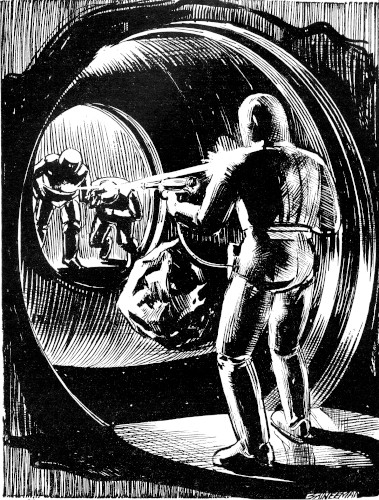
In the air lock of the other meteor miner, two men—not one—were going for their DeLameters—
They must have been hijackers, killing and robbing as a business, Kinnison concluded, afterward. Bona-fide miners almost never work two to a boat, and the fact that they actually beat him to the draw, and yet were so slow in shooting, argued that they had not been taken by surprise, as had he. Indeed, the meteor itself, the bone of contention, might very well have been a bait.
He could not follow his natural inclination to let go, to let them have it. The tale would have spread far and wide, branding him as a coward and a weakling. He would have had to kill, or been killed by, any number of lesser bullies who would have attacked him on sight. Nor could he have taken over their minds quickly enough to have averted death. One, perhaps, but not two; he was no Arisian. These thoughts, as has been intimated, occurred to him long afterward. During the actual event there was no time to think at all. Instead, he acted; automatically and instantaneously.
Kinnison's hands flashed to the worn grips of his DeLameters, sliding them from the leather and bringing them to bear at the hip with one smoothly flowing motion that was a marvel of grace and speed. But, fast as he was, he was almost too late. Four bolts of lightning blasted, almost as one. The two desperadoes dropped, cold; the Lensman felt a stab of agony sear through his shoulder and the breath whistled out of his mouth and nose as his spacesuit collapsed. Gasping terribly for air that was no longer there, holding onto his senses doggedly and grimly, he made shift to close the outer door of the lock and to turn a valve. He did not lose consciousness—quite—and as soon as he recovered the use of his muscles he stripped off his suit and examined himself narrowly in a mirror.
Eyes, plenty bloodshot. Nose, bleeding copiously. Ears bleeding, but not too badly; drums not ruptured, fortunately—he had been able to keep the pressure fairly well equalized. Felt like some internal bleeding, but he could see nothing really serious. He hadn't breathed space long enough to do any permanent damage, he guessed.
Then, baring his shoulder, he treated the wound with Zinmaster burn-dressing. This was no trifle, but at that, it wasn't so bad. No bone gone—it'd heal in two or three weeks. Lastly, he looked over his suit. If he'd only had his G-P armor on—but that, of course, was out of the question. He had a spare suit, but he'd rather—Fine, he could replace the burned section easily enough. QX.
He donned his other suit, re-entered the air lock, neutralized the screens, and crossed over; where he did exactly what any other meteor miner would have done. He divested the bloated corpses of their spacesuits and shoved them off into space. He then ransacked the ship, transferring from it to his own, as well as four heavy meteors, every other item of value which he could move and which his vessel could hold. Then inerting her, he gave her a couple of notches of drive and cut her loose, for so a real miner would have done. It was not compunction or scruple that would have prevented any miner from taking the ship, as well as the supplies. Ships were registered, and otherwise were too hot to be handled except by organized criminal rings.
As a matter of routine he tested the meteor which had been the innocent cause of all this strife—or had it been a bait?—and found it worthless iron. Also as routine he kept on working. He had almost enough metal now, even at Miners' Rest prices, for a royal binge, but he couldn't go in until his shoulder was well. And a couple of weeks later he got the shock of his life.
He had brought in a meteor; a mighty big one, over four feet in its smallest diameter. He sampled it, and as soon as he cut the Berg and flicked the sample experimentally from hand to hand, his skilled muscles told him that that metal was astoundingly dense. Heart racing, he locked the test-piece into the spee-gee; and that vital organ almost stopped beating entirely as the indicator needle went up and up and up—stopping at a full twenty-two, and the scale went only to twenty-four!
"Klono's brazen hoofs and diamond-tipped horns!" he ejaculated. He whistled stridently through his teeth, then measured his find as accurately as he could. Then, speaking aloud, "Just about thirty thousand kilograms of something noticeably denser than pure platinum—thirty million credits or I'm a Zabriskan fontema's maiden aunt. What to do?"
This find, as well it might, gave the Gray Lensman pause. It upset his calculations. It was unthinkable to take that meteor to such a fence's hide-out as Miners' Rest. Men had been murdered, and would be again, for a thousandth of its value. No matter where he took it, there would be publicity galore, and that wouldn't do. If he called a Patrol ship to take the white elephant off his hands he might be seen; and he had put in too much work on this identity to jeopardize it. He would have to bury it, he guessed—he had maps of the System, and the fourth planet was close by.
He cut off a chunk of a few pounds' weight and made a nugget—a tiny meteor—of it, then headed for the planet, a plainly visible disk some fifteen degrees from the Sun. He had a fairly large-scale chart of the System, with notes. Borova IV was uninhabited, except by low forms of life, and by outposts. Cold. Atmosphere thin—good, that meant no clouds. No oceans. No volcanic activity. Very good! He'd look it over, and the first striking landmark he saw, from one diameter out, would be his cache.
He circled the planet once at the equator, observing a formation of five mighty peaks arranged in a semicircle, cupped toward the world's north pole. He circled it again, seeing nothing as prominent, and nothing else resembling it at all closely. Scanning his plate narrowly, to be sure nothing was following him, he drove downward in a screaming dive toward the middle mountain.
It was an extinct volcano, he discovered, with a level-floored crater more than a hundred miles in diameter. Practically level, that is, except for a smaller cone which reared up in the center of that vast, desolate plain of craggy, tortured lava. Straight down into the cold vent of the inner cone the Lensman steered his ship; and in its exact center he dug a hole and buried his treasure. He then lifted his tugboat fifty feet and held her there, poised on her raving underjets, until the lava in the little crater again began sluggishly to flow, and thus to destroy all evidence of his visit. This detail attended to, he shot out into space and called Haynes, to whom he reported in full.
"I'll bring the meteor in when I come—or do you want to send somebody out here after it? It belongs to the Patrol, of course."
"No, it doesn't, Kim—it belongs to you."
"Huh? Isn't there a law that any discoveries made by any employees of the Patrol belong to the Patrol?"
"Nothing as broad as that, that I know of. Certain scientific discoveries, by scientists assigned to an exact research, yes. But you're forgetting again that you're an Unattached Lensman, and as such are accountable to no one in the Universe. Even the ten percent treasure-trove law couldn't touch you. Besides, your meteor is not in that category, as you are its first owner, as far as we know. If you insist I will mention it to the Council, but I know in advance that the Patrol can claim none of it, even if we wanted to—which we definitely do not."
"QX, chief—thanks," and the connection was broken.
There, that was that. He had got rid of the white elephant, yet it wouldn't be wasted. If the zwilniks got him, the Patrol would dig it up; if he lived long enough to retire to a desk job he wouldn't have to take any more of the Patrol's money as long as he lived. Financially, he was all set.
And physically, he was all set for his first real binge as a meteor miner. His shoulder and arm were as good as new. He had a lot of metal; enough so that its proceeds would finance, not only his next venture into space, but also a really royal celebration in any spaceman's resort, even the one he had already picked out.
For the Lensman had devoted a great deal of thought to that item. For his purpose, the bigger the resort the better. The man he was after would not be a small operator, nor would he deal directly with such. Also, the big kingpins did not murder drugged miners for their ships and outfits, as the smaller ones sometimes did. The big ones realized that there was more long-pull profit in repeat business.
Therefore, Kinnison set his course toward the great asteroid Euphrosyne and its festering hell-hole, Miners' Rest. Miners' Rest, to all highly moral citizens the disgrace not only of a solar system but of a sector; the very name of which was—and is—a byword and a hissing to the blue-noses of twice a hundred inhabited and civilized worlds.
XII.
As has been implied, Miners' Rest was the biggest, widest-open, least restrained joint in that entire sector of the Galaxy. And through the underground activities of his fellows of the Patrol, Kinnison knew that of all the king-snipes of that lawless asteroid, the man called Strongheart was the big shot.