Front matter (continued 2)
Reading edition
And Henderson was a virtuoso. Smoothly, effortlessly, but in a space of seconds the great vessel rolled over, spiraled, and swung until her landing jets were in line and exerting five gravities of thrust. Then, equally smoothly, almost imperceptibly, the line of force was varied until the flame-enshrouded dome was stationary below them. Nobody, not even the two other Master Pilots, and least of all Henderson himself, paid any attention to the polished perfection, the consummate artistry, of the performance. That was his job. He was a Master Pilot, and one of the hallmarks of his rating was the habit of making difficult maneuvers look easy.
"Take 'em now, chief? Can't we, huh?" Chatway, the chief firing officer, did not say those words. He did not need to. The attitude and posture of the C.F.O. and his subordinates made the thought tensely plain.
"Not yet, Chatty," the Lensman answered the unsent thought. "We'll have to wait until they englobe us, so that we can get them all. It's got to be all or none. If even one of them gets away, or even has time to analyze and report on the stuff we're going to use, it'll be just too bad."
He then got in touch with the officer within the beleaguered base and renewed the conversation at the point at which it had been broken off.
"We can help you, I think; but to do so effectively we must have clear ether. Will you please order your ships away, out of even extreme range?"
"For how long? They can do us irreparable damage in one rotation of the planet."
"One-twentieth of that time, at most—if we cannot do it in that time we cannot do it at all. Nor will they direct many beams at you, if any. They will be working on us."
Then, as the defending ships darted away, Kinnison turned to his C. F. O. "QX, Chatty. Open up with your secondaries. Fire at will!"
Then from projectors of a power theretofore carried only by maulers, there raved out against the nearest Boskonian vessels beams of a vehemence compared to which the enemies' own seemed weak, futile. And those were the secondaries!
As has been intimated, the Dauntless was an unusual ship. She was enormous. She was bigger even than a mauler in actual bulk and mass; and from needle-beaked prow to jet-studded stern she was literally packed with power—power for any emergency conceivable to the fertile minds of Port Admiral Haynes and his staff of designers and engineers. Instead of two, or at most three intake-screen exciters, she had two hundred. Her bus bars, instead of being the conventional rectangular coppers, of a few square inches cross-sectional area, were laminated members built up of co-axial tubing of pure silver to a diameter of over a yard—multiple and parallel conductors, each of whose current-carrying capacity was to be measured only in millions of amperes. And everything else aboard that mighty engine of destruction was upon the same Gargantuan scale.
Titanic though those thrusts were, not a pirate ship was seriously hurt. Outer screens went down, and more than a few of the second lines of defense also failed. But that was the Patrolmen's strategy; to let the enemy know that they had weapons of offense somewhat superior to their own, but not quite powerful enough to be a real menace.
In minutes, therefore, the Boskonians rushed up and englobed the newcomer; supposing, of course, that she was a product of the world below, that she was manned by the race who had so long and so successfully fought off Boskonian encroachment.
They attacked, and under the concentrated fury of their beams, the outer screen of the Patrol ship began to fail. Higher and higher into the spectrum it radiated, blinding white—blue—an intolerable violet glare; then, patchily, through the invisible ultraviolet and into the black of extinction. The second screen resisted longer and more stubbornly, but finally it also went down; the third automatically taking up the burden of defense. Simultaneously, the power of Civilization's projectors weakened, as though the Dauntless were shifting her power from offense to defense in order to stiffen her third, and supposedly her last, shielding screen.
"Pretty soon, now, Chatway," Kinnison observed. "Just as soon as they can report that they have us in a bad way; that it is just a matter of time until they blow us out of the ether. Better report now—I'll put you on the spool."
"We are equipped to energize simultaneously eight of the new, replaceable-unit primary projectors," the C.F.O. stated, crisply. "There are twenty-one vessels englobing us, and no others within detection. With a discharge period of point six oh second and a switching interval of point oh nine, the entire action should occupy one point nine eight seconds."
"Chief Communications Officer Nelson on the spool. Can the last surviving ship of the enemy report enough in two seconds to do us material harm?"
"In my opinion it cannot, sir," Nelson reported, formally. "The communications officer is neither an observer nor a technician; he merely transmits whatever material is given him by other officers for transmission. If he is already working a beam to his base at the moment of our first blast, he might be able to report the destruction of vessels, but he could not be specific as to the nature of the agent used. Such a report could do no harm, as the fact of the destruction of the vessels will in any event become apparent shortly. Since we are apparently being overcome easily, however, and this is a routine action, the probability is that this detachment is not in direct communication with Base at any given moment. If not, he could not establish working control in two seconds."
"Kinnison now reporting. Having determined to the best of my ability that engaging the enemy at this time will not enable them to send Boskone any information regarding our primary armament, I now give the word to—fire."
The underlying principle of the destructive beam produced by overloading a regulation projector had, it is true, been discovered by a Boskonian technician. In so far as Boskonia was concerned, however, the secret had died with its inventor, since the pirates had at that time no headquarters in the First Galaxy. And the Patrol had had months of time in which to perfect it, for that work was begun before the last of Helmuth's guardian fortress had been destroyed.
The projector was not now fatal to its crew, since they were protected from the lethal back-radiation, not only by shields of force, but also by foot after impenetrable foot of lead, osmium, carbon, and paraffin. The refractories were of neo-cargalloy, backed and permeated by M K R fields; the radiators were constructed of the most ultimately resistant materials known to the science of the age. But even so, the unit had a useful life of but little over half a second, so frightful was the overload at which it was used. Like a rifle cartridge, it was good for only one shot. Then it was thrown away, to be replaced by a new unit.
Those problems were relatively simple of solution. Switching those enormous energies was the great stumbling block. The old Kimmerling block-dispersion circuit breaker was prone to arc over under loads much in excess of a hundred billion KW, hence could not even be considered in this new application. However, the Patrol force finally succeeded in working out a combination of the immersed-antenna and the semi-permeable-condenser types, which they called the Thorndyke heavy-duty switch. It was cumbersome, of course—any device to interrupt voltages and amperages of the really astronomical magnitude in question could not at that time be small—but it was positive, fast-acting, and reliable.
At Kinnison's word of command, eight of those indescribable primary beams lashed out; stilettos of irresistibly penetrant energy which not even a Q-type helix could withstand. Through screens, through wall shields, and through metal they hurtled in a space of time almost too brief to be measured. Then, before each beam expired, it was swung a little, so that the victim was literally split apart or carved into sections. Performance exceeded by far that of the hastily improvised weapon which had so easily destroyed the heavy cruisers of the Patrol; in fact, it checked almost exactly with the theoretical figures of the designers.
As the first eight beams winked out, eight more came into being, then five more; and meanwhile the mighty secondaries were sweeping the heavens with full-aperture cones of destruction. Metal meant no more to those rays than did organic material; everything solid or liquid whiffed into vapor and disappeared. The Dauntless lay alone in the sky of that new world.
"Marvelous—wonderful!" the thought beat into Kinnison's brain as soon as he re-established rapport with the being so far below. "We have recalled our ships. Will you please come down to our spaceport at once, so that we can put into execution a plan which has been long in preparation?"
"As soon as your ships are down," the Tellurian acquiesced. "Not sooner, as your landing conventions are doubtless very unlike our own and we do not wish to cause disaster. Give me the word when your field is entirely clear."
That word came soon, and Kinnison nodded to the pilots. Once more inertialess, the Dauntless shot downward, deep into atmosphere, before her inertia was restored. Rematching velocity this time was a simple matter, and upon the towering, powerfully resilient pillars of her landing-jets the inconceivable mass of the Tellurian ship of war settled toward the ground, as lightly seeming as a wafted thistle-down.
"Their cradles wouldn't fit us, of course, even if they were big enough—which they aren't, by half," Schermerhorn commented. "Where do they want us to put her?"
"'Anywhere,' they say," the Lensman answered, "but we don't want to take that too literally—without a solid dock she'll make an awful hole, wherever we set her down. Won't hurt her any. She's designed for it. We couldn't expect to find cradles to fit her anywhere except on Tellus. I'd say to lay her down on her belly over there in that corner, out of the way, as close to that big hangar as you can work without blasting it out with your jets."
As Kinnison had intimated, the lightness of the vessel was indeed only seeming. Superbly and effortlessly the big boat seeped downward into the designated corner; but when she touched the pavement she did not stop. Still easily and without jar or jolt she settled—a full twenty feet into the concrete, reinforcing steel and hard-packed earth of the field before she came to a halt.
"What a monster! Who are they? Where could they have come from?" Kinnison caught a confusion of startled thoughts as the real size and mass of the visitor became apparent to the natives. Then again came the clear thought of the officer.
"We would like very much to have you and as many as possible of your companions come to confer with us as soon as you have tested our atmosphere. Come in spacesuits if you must."
The air was tested and found suitable. True, it did not match exactly that of Tellus, or Rigel IV, or Velantia; but then, neither did that of the Dauntless, since that gaseous mixture was a compromise one, and mostly artificial to boot.
"Worsel, Tregonsee, and I will go to this conference," Kinnison decided. "The rest of you sit tight. I don't need to tell you to keep on your toes, that anything is apt to happen, anywhere, without warning. Keep your detectors full out and keep your noses clean—be ready like the good little endeavorers you are, 'to do with all your might what your hands find to do.' Come on, fellows," and the three Lensmen strode, wriggled, and waddled across the field, to and into a spacious room of the Administration Building.
"Strangers, or, I should say friends, I introduce you to Wise, our president," Kinnison's acquaintance said, clearly enough, although it was plain to all three Lensmen that he was shocked at the sight of the Earthman's companions.
"I am informed that you understand our language—" the president began doubtfully.
He, too, was staring at Tregonsee and Worsel. He had been told that Kinnison, and therefore, supposed, the rest of the visitors, were beings fashioned more or less after his own pattern. But these two creatures!
For they were not even remotely human in form. Tregonsee, the Rigellian, with his leathery, multiappendaged, oil-drumlike body, his immobile dome of a head and his four blocky pillars of legs must at first sight have appeared fantastic indeed. And Worsel, the Velantian, was infinitely worse. He was repulsive, a thing materialized from sheerest nightmare—a leather-winged, crocodile-headed, crooked-armed, thirty-foot long, pythonish, reptilian monstrosity!
But the President of Medon saw at once that which the three outlanders had in common. The Lenses, each glowingly aflame with its own innate pseudo-vitality—Kinnison's clamped to his brawny wrist by a band of iridium-osmium-tungsten alloy; Tregonsee's embedded in the glossy black flesh of one mighty, sinuous arm; Worsel's apparently driven deep and with cruel force into the horny, scaly hide squarely in the middle of his forehead, between two of his weirdly stalked, repulsively extensible eyes.
"It is not your language we understand, but your thoughts, by virtue of these our Lenses which you have already noticed." The president gasped as Kinnison bulleted the information into his mind. "Go ahead.... Just a minute!" as an unmistakable sensation swept through his being. "We've gone free! The whole planet, I perceive. In that respect, at least, you are in advance of us. As far as I know, no scientist of any of our races has even thought of a Bergenholm big enough to free a world."
"It was long in the designing; many years in the building of its units," Wise replied. "We are leaving this sun in an attempt to escape from our enemy and yours; Boskone. It is our only chance of survival. The means have long been ready, but the opportunity which you have just made for us is the first that we have had. This is the first time in many, many years that not a single Boskonian vessel is in position to observe our flight."
"Where are you going? Surely the Boskonians will be able to find you if they wish."
"That is possible, but we must run that risk. We must have a respite or perish; after a long lifetime of continuous warfare, our resources are at the point of exhaustion. There is a part of this Galaxy in which there are very few planets, and of those few, none are inhabited or habitable. Since nothing is to be gained, ships seldom or never go there. If we can reach that region undetected, the probability is that we shall be unmolested long enough to recuperate."
Kinnison exchanged flashing thoughts with his two fellow Lensmen, then turned again to Wise.
"We come from a neighboring Galaxy," he informed him, and pointed out to his mind just which Galaxy he meant. "You are fairly close to the edge of this one. Why not move over to ours? You have no friends here, since you think that yours may be the only remaining independent planet. We can assure you of friendship. We can also give you some hope of peace—or at least semipeace—in the near future, for we are driving Boskonia out of our Galaxy."
"What you think of as 'semipeace' would be tranquillity incarnate to us," the old man replied with feeling. "We have, in fact, considered long that very move. We decided against it for two reasons: first, because we knew nothing about conditions there, and hence might be going from bad to worse; and second and more important, because of lack of reliable data upon the density of matter in intergalactic space. Lacking that, we could not estimate the time necessary for the journey, and we could have no assurance that our sources of power, great as they are, would be sufficient to make up the heat lost by radiation."
"We have already given you an idea of conditions and we can give you the data you lack."
They did so, and for a matter of minutes the Medonians conferred. Meanwhile Kinnison went on a mental expedition to one of the power plants. He expected to see supercolossal engines; bus bars ten feet thick, perhaps cooled in liquid helium; and other things in proportion. But what he actually saw made him gasp for breath and call Tregonsee's attention. The Rigellian sent out his sense of perception with Kinnison's, and he also was almost stunned.
"What's the answer, Trig?" the Earthman asked, finally. "This is more down your alley than mine. That motor's about the size of my foot, and if it isn't eating a thousand pounds an hour I'm Klono's maiden aunt. And the whole output is going out on two wires no bigger than number four, jacketed together like ordinary parallel pair. Perfect insulator? If so, how about switching?"
"That must be it, a substance of practically infinite resistance," the Rigellian replied absently, studying intently the peculiar mechanism. "Must have a better conductor than silver, too, unless they can handle voltages of ten to the fifteenth or so, and don't see how they could break such potentials.... Guess they don't use switches ... don't see any ... must shut down the prime sources.... No, there it is—so small that I overlooked it completely. In that little box there! Sort of a jam-plate type; a thin sheet of insulation with a knife on the leading edge, working in a slot to cut the two conductors apart—kills the arc by jamming into the tight slot at the end of the box. The conductors must fuse together at each make and burn away a little at each break, that's why they have renewable tips. Kim, they've really got something! I certainly am going to stay here and do some studying."
"Yes, and we'll have to rebuild the Dauntless—"
The two Lensmen were called away from their study by Worsel—the Medonians had decided to accept the invitation to attempt to move to the First Galaxy. Orders were given, the course was changed and the planet, now a veritable spaceship, shot away in the new direction.
"Not as many legs as a speedster, of course, but at that, she's no slouch—we're making plenty of lights," Kinnison commented, then turned to the president. "It seems rather presumptuous for us to call you simply 'Wise,' especially as I gather that that is not really your formal name—"
"That is what I am called, and that is what you are to call me," the oldster replied: "We of Medon do not have names. Each has a number; or, rather, a symbol composed of numbers and letters of our alphabet—a symbol which gives his full classification. Since these things are too clumsy for regular use, however, each of us is given a nickname, usually an adjective, which is supposed to be more or less descriptive. You of Earth we could not give a complete symbol, your two companions we could not give any at all. However, you may be interested in knowing that you three have already been named?"
"Very much so."
"You are to be called 'Keen.' He of Rigel IV is 'Strong,' and he of Velantia is 'Agile.'"
"Quite complimentary to me, but—"
"Not bad at all, I'd say," Tregonsee broke in. "But hadn't we better be getting on with more serious business?"
"We should indeed," Wise agreed. "We have much to discuss with you; particularly the weapon you used."
"Could you get an analysis of it?" Kinnison asked, sharply.
"No. No one beam was in operation long enough. However, a study of the recorded data, particularly the figure for intensity—figures so high as to be almost unbelievable—lead us to believe that the beam is the result of an enormous overload upon a projector otherwise of more or less conventional type. Some of us have wondered why we did not think of the idea ourselves—"
"So did we, when it was used on us," Kinnison grinned and went off to explain the origin of the primary. "But before we go into details, I noticed that your fixed-mount stuff could not work effectively through atmosphere. We have what we call Q-type helices, with which we incase such beams so that they work in a tube of vacuum. We will give you the Q-formulæ and also the working hookup—including the protective devices, because they're mighty dangerous without plenty of force-backing—of the primaries, in exchange for some lessons in power-plant design."
"Such an exchange of knowledge would be helpful indeed," Wise agreed.
"The Boskonians know nothing whatever of this beam, and we do not want them to learn of it," Kinnison cautioned. "Therefore I have two suggestions to make. First, that you try everything else before you use this primary beam. Second, that you don't use it even then unless you can wipe out, as nearly simultaneously as we did out there, every Boskonian who may be able to report back to his base as to what really happened. Fair enough?"
"Eminently so. We agree without reservation—it is to our interest as much as yours that such a secret be kept from Boskone."
"QX. Fellow, let's go back to the ship for a couple of minutes." Then, aboard the Dauntless: "Tregonsee, you and your crew want to stay with the planet, to show the Medonians what to do and to help them along generally, as well as to learn about their power system. Thorndyke, you and your gang, and probably Lensman Hotchkiss, had better study these things, too—you'll know what you want as soon as they show you the hookup. Worsel, I'd like to have you stay with the ship. You're in command of her until further orders. Keep her here for, say, a week or ten days, until the planet is well out of the Galaxy. Then, if Hotchkiss and Thorndyke haven't got all the dope they want, leave them here to ride back with Tregonsee on the planet and drill the Dauntless for Tellus. Keep yourself more or less disengaged for a while, and sort of keep tuned to me. I may not need an ultra-long-range communicator, but you never can tell."
"Why such comprehensive orders, Kim?" asked Hotchkiss. "Who ever heard of a commander abandoning his expeditions? Aren't you sticking around?"
"Nope—got to do a flit. Think maybe I'm getting an idea. Break out my speedster, will you, Allerdyce?"—and the Gray Lensman was gone.
V.
Kinnison's speedster shot away and made an undetectable, uneventful voyage back to the Earth. In due time, therefore, the Gray Lensman was again closeted with Port Admiral Haynes.
"Why the foliage?" the chief of staff asked, almost at sight, for the Gray Lensman was wearing a more-than-half-grown beard.
"I may need to be Chester Q. Fordyce for a while. If I don't, I can shave it off quick. If I do, a real beard is a lot better than an imitation," and he plunged into his subject.
"Very fine work, son, very fine indeed," Haynes congratulated the younger man at the conclusion of his report. "We shall begin at once, and be ready to rush things through when the technicians bring back the necessary data from Medon. But there's one more thing I want to ask you. How did you come to place those spotting-screens so exactly? The beam practically dead-centered them. You said that it was surmise and suspicion before it happened, but I thought then and still think that you had a much firmer foundation than any kind of a mere hunch. What was it?"
"Deduction, based upon an unproved, but logical, cosmogonic theory—but you probably know more about that stuff than I do."
"Highly improbable. I read just a smattering now and then of the doings of the astronomers and astrophysicists. I didn't know that that was one of your specialties, either."
"It isn't, but I had to do a little cramming. We'll have to go back quite a while to make it clear. You know, of course, that a long time ago, before even interplanetary ships were developed, the belief was general that not more than about four planetary solar systems could be in existence at any one time in the whole Galaxy?"
"Yes, I am familiar with that belief—a consequence of the binary-dynamic-encounter theory in a too-limited application. The theory itself is still good, isn't it?"
"Eminently so—every other theory is wrecked by its failure to account for the quantity and above all, the distribution, of angular momentum of planetary systems. But you know what I'm going to say—that 'limited application' proves it!"
"No, just let's say that a bit of light is beginning to dawn. Go ahead."
"QX. Well, when it was discovered that there were millions of times as many planets in the Galaxy as could be accounted for by a dynamic encounter occurring once in two times ten to the tenth years or so, some way had to be figured out to increase, millionfold, the number of such encounters. Manifestly, the random motion of the stars within the Galaxy could not account for it. Neither could the vibration or oscillation of the globular clusters through the Galaxy. The meeting of two Galaxies—the passage of them completely through each other, edgewise—would account for it very nicely. It would also account for the fact that the solar systems on one side of the Galaxy tend to be somewhat older than the ones on the apposite side. Question; find the Galaxy. It was van der Schleiss, I believe, who found it. Lundmark's Nebula. It is edge on to us, with a receding velocity of twelve hundred and forty-six miles per second—the exact velocity which, corrected for gravitational decrement, will put Lundmark's Nebula right here at the time when, according to our best geophysicists and geochemists, old Earth was being born. If that theory was correct, Lundmark's Nebula should also be full of planets. Four expeditions went out to check the theory, and none of them came back. We know why, now—Boskone got them. We got back, because of you, and only you."
"Holy Klono!" the old man breathed, paying no attention to the tribute. "It checks—how it checks!"
"To nineteen decimals."
"But still it doesn't explain why you set your traps on that line."
"Sure it does. How many Galaxies are there in the Universe, do you suppose, that are full of planets?"
"Why, all of them I suppose—or no, not so many perhaps—I don't know—I don't remember of having read anything on that question."
"No, and you probably won't. Only loose-screwed space detectives, like me, and crackpot science-fiction writers, like Wacky Willison, have noodles vacuous enough to harbor such thin ideas. But, according to our admittedly highly tenuous reasoning, there are only two such Galaxies—Lundmark's Nebula and ours."
"Huh? Why?" demanded Haynes.
"Because Galaxies don't collide much, if any, oftener than binaries within a Galaxy do," Kinnison asserted. "True, they are closer together in space, relative to their actual linear dimensions, than are stars; but on the other hand, their relative motions are slower—that is, a star will traverse the average interstellar distance much quicker than a Galaxy will the intergalactic one—so that the whole thing evens up. As nearly as Wacky and I could figure it, two Galaxies will collide deeply enough to produce a significant number of planetary solar systems on an average of once in just about one point eight times ten to the tenth years. Pick up your slide rule and check me on it, if you like."
"I'll take your word for it," the old Lensman murmured absently. "But any Galaxy probably has at least a couple of solar systems all the time—but I see your point. The probability is overwhelmingly great that Boskone would be in a Galaxy having hundreds of millions of planets rather than in one having only a dozen or less inhabitable worlds. But at that, they could all have lots of planets. Suppose that our wilder thinkers are right, that Galaxies are grouped into Universes, which are spaced, roughly, about the same as the Galaxies are. Two of them could collide, couldn't they?"
"They could, but you're getting 'way out of my range now. At this point the detective withdraws, leaving a clear field for you and the science-fiction imaginationeer."
"Well, finish the thought—that I'm wackier even than he is!" Both men laughed, and the Port Admiral went on: "It's a fascinating speculation—it does no harm to let the fancy roam at times—but at that, there are things of much greater importance. You think, then, that the thionite ring enters into this matrix?"
"Bound to. Everything ties in. The most intelligent races of this Galaxy are oxygen-breathers, with warm, red blood: the only kind of physique which thionite affects. The more of us who get the thionite habit, the better for Boskone. It explains why we have never got to the first check station in getting any of the real higher-ups in the thionite game; instead of being an ordinary criminal ring they've got all the brains and all the resources of Boskonia back of them. But if they are that big—and as good as we know they are—I wonder why—" Kinnison's voice trailed off into silence; his brain raced.
"I want to ask you a question that is none of my business," the young Lensman went on almost immediately, in a voice strangely altered. "Just how long ago was it that you started losing fifth-year men just before graduation? I mean, that boys sent to Arisia to be measured for their Lenses supposedly never got there? Or at least, they never came back and no Lenses were ever received for them?"
"About ten years. Twelve, I think, to be ex—" Haynes broke off in the middle of the word and his eyes bored into those of the younger man. "What makes you think that there were any such?"
"Deduction again, but this time I know that I'm right. At least one every year. Usually two or three."
"Right, but there have always been space accidents ... or they were caught by the pirates ... you think, then, that—"
"I don't think. I know!" Kinnison declared. "They got to Arisia, and they died there. All I can say is, thank God for the Arisians! We can still trust our Lenses; they are seeing to that."
"But why didn't they tell us?" Haynes asked, perplexed.
"They wouldn't; that isn't their way," Kinnison stated, flatly and with conviction. "They have given us an instrumentality, the Lens, by virtue of which we should be able to do the job, and they are seeing to it that that instrumentality remains untarnished. If we cannot handle it properly, that is our lookout. We've got to fight our own battles and bury our own dead. Now that we have smeared up the enemy's military organization in this Galaxy by wiping out Helmuth and his headquarters, the drug syndicate seems to be my best chance of getting a line on the real Boskone. While you are mopping up and keeping them from establishing another war base here, I think I'd better be getting at it, don't you?"
"Probably so—you know your own oysters best. Mind if I ask where you're going to start in?" Haynes looked at Kinnison quizzically as he spoke. "Have you deduced that, too?"
The Gray Lensman returned the look in kind. "No. Deduction couldn't take me quite that far," he replied in the same tone. "You are going to tell me that, when you get around to it."
"Me? Where do I come in?" the Port Admiral feigned surprise.
"As follows. Helmuth probably had nothing to do with the dope running, so its organization must still be intact. If so, they would take over as much of the other branch as they could get hold of, and hit us harder than ever. I haven't heard of any unusual activity around here, so it must be somewhere else. Wherever it is, you would know about it, since you are a member of Galactic Council; and Councillor Ellington, in charge of Narcotics, would hardly take any very important step without conferring with you, as port admiral and chief of staff. How near right am I?"
"On the center of the beam, all the way—your deducer is blasting at maximum," Haynes said, in admiration. "Radelix is the worst—they're hitting it mighty hard. We sent a full unit over there last week. Shall we recall them, or do you want to work independently?"
"Let them go on; I'll be of more use working on my own, I think. I did the boys over there a favor a while back—they would co-operate anyway, of course, but it's a little nicer to have them sort of owe it to me. We'll all be able to play together very nicely if the opportunity arises."
"I'm mighty glad you're taking this on. The Radeligians are stuck, and we had no real reason for thinking that our men could do any better. With this new angle of approach, however, and with you working behind the scenes, the picture looks entirely different."
"I'm afraid that's unjustifiably high—"
"Not a bit of it, lad. Just a minute—I'll break out a couple of beakers of fayalin—Luck!"
"Thanks, chief!"
"Down the hatch!" and again the Gray Lensman was gone. To the spaceport, into his speedster, and away—hurtling through the void at the maximum blast of the fastest space-flier then boasted by the Galactic Patrol.
During the long trip, Kinnison exercised, thought, and studied spool after spool of tape—the Radeligian language. Thoughts of the red-headed nurse obtruded themselves strongly at times, but he put them aside resolutely. He was, he assured himself, off women forever—all women. He cultivated his new beard; trimming it, with the aid of a triplex mirror and four stereoscopic photographs, into something which, although neat and spruce enough, was too full and bushy by half to be a Vandyke. Also, he moved his Lens bracelet up his arm and rayed the white skin thus exposed until his whole wrist was the same even shade of tan.
He did not drive his speedster to Radelix, for that racy little fabrication would have been recognized anywhere for what she was; and private citizens simply did not drive ships of that type. Therefore, with every possible precaution of secrecy, he landed her in a Patrol base four solar systems away. In that base Kimball Kinnison disappeared; but the tall, shock-haired, bushy-bearded Chester Q. Fordyce—cosmopolite, man of leisure, and dilettante in science—who took the next space liner for Radelix was not precisely the same individual who had come to that planet a few days before with that name and those unmistakable characteristics.
Mr. Chester Q. Fordyce, then, and not Gray Lensman Kimball Kinnison, disembarked at Ardith, the world-capital of Radelix. He took up his abode at the Hotel Ardith-Splendide and proceeded, with neither too much nor too little fanfare, to be his cosmopolitan self in those circles of society in which, wherever he might find himself, he was wont to move.
As a matter of course, he entertained, and was entertained by, the Tellurian Ambassador. Equally as a matter of course, he attended divers and sundry functions, at which he made the acquaintance of hundreds of persons, many of them personages. That one of these should have been Vice-Admiral Gerrond, Lensman in charge of the Patrol's Radeligian base, was inevitable.
It was, then, a purely routine and logical development that at a reception one evening Vice-Admiral Gerrond stopped to chat for a moment with Mr. Fordyce; and it was purely accidental that the nearest bystander was a few yards distant. Hence, Mr. Fordyce's conduct was strange enough.
"Gerrond!" he said without moving his lips and in a tone almost inaudible, the while he was offering the Admiral an Alsakanite cigarette. "Don't look at me particularly right now, and don't show surprise. Study me for the next ten minutes, then put your Lens on me and tell me whether you have ever seen me before or not." Then, glancing at the watch upon his left wrist—a time-piece just about as large and as ornate as a wrist watch could be and still remain in impeccable taste—he murmured something conventional and strolled away.
The ten minutes passed and he felt Gerrond's thought. A peculiar sensation, this, being on the receiving end of a single beam, instead of using his own Lens.
"As far as I can tell, I have never seen you before. You are certainly not one of our agents, and if you are one of Haynes' whom I have ever worked with you have done a wonderful job of disguising. I must have met you somewhere, sometime, else there would be no point to your question; but beyond the evident—and admitted—fact that you are a white Tellurian, I can't seem to place you."
"Does this help?" This question was shot through Kinnison's own Lens.
"Since I have known so few Tellurian Lensmen it tells me that you must be Kinnison, but I do not recognize you at all readily. You seem changed—older—besides, who ever heard of an Unattached Lensman doing the work of an ordinary agent?"
"I am both older and changed—partly natural and partly artificial. As for the work, it's a job that no ordinary agent can handle—it takes a lot of special equipment—"
"You've got that, indubitably! I get goose-flesh yet every time I think of that trial."
"You think that I'm proof against recognition, then, as long as I don't use my Lens?" Kinnison stuck to the issue.
"Absolutely so. You're here, then, on thionite?" No other issue, Gerrond knew, could be grave enough to account for this man's presence. "But your wrist? I studied it. You can't have worn your Lens there for months—those Tellurian bracelets leave white streaks an inch wide."
"I tanned it with a pencil beam. Nice job, eh? But what I want to ask you about is a little co-operation. As you supposed, I'm here to work on this drug ring."
"Surely—anything we can do. But Narcotics is handling that, not us—but you know that, as well as I do—" the officer broke off, puzzled.
"I know. That's why I want you—that and because you handle the secret service. Frankly, I'm scared to death of leaks. For that reason I'm not saying anything to anyone except Lensmen, and I'm having no dealings with anyone connected with Narcotics. I have as unimpeachable an identity as Haynes could furnish—"
"There's no question as to its adequacy, then," the Radeligian interposed.
"I would like to have you pass the word around among your boys and girls that you know who I am and that I'm safe to play with. That way, if Boskone's agents spot me, it will be for an agent of Haynes, and not for what I really am. That's the first thing. Can do?"
"Easily and gladly. Consider it done. Second?"
"To have a boatload of good, tough marines on hand if I should call you. There are some Valerians coming over later, but I may need help in the meantime. I may want to start a fight—quite possibly even a riot."
"They'll be ready, and they'll be big, tough, and hard. Anything else?"
"Not just now, except for one question. You know Countess Avondrin, the woman I was dancing with a while ago. Got any dope on her?"
"Certainly not—what do you mean?"
"Huh? Don't you know even that she's a Boskonian agent of some kind?"
"Man, you're crazy! She isn't an agent, she can't be. Why, she's the daughter of a Planetary Councillor, the wife of one of our most loyal officers."
"She would be. That's the type they like to get hold of."
"Prove it!" the Admiral snapped. "Prove it or retract it!" He almost lost his poise, almost looked toward the distant corner in which the bewhiskered gentleman was sitting so idly.
"QX. If she isn't an agent, why is she wearing a thought-screen? You haven't tested her, of course."
Of course not. The amenities, as has been said, demanded that certain reserves of privacy remain inviolate. The Tellurian went on: "You didn't, but I did. On this job I can recognize nothing of good taste, of courtesy, of chivalry, or even of ordinary common decency. I suspect everyone who does not wear a Lens."
"A thought-screen!" exclaimed Gerrond. "How could she, without armor?"
"It's a late model—brand new. Just as good and just as powerful as the one I myself am wearing," Kinnison explained. "The mere fact that she's wearing it gives me a lot of highly useful information."
"What do you want me to do about her?" the Admiral asked. He was mentally asquirm, but he was a Lensman.
"Nothing whatever—except possibly, for our own information, to find out how many of her friends have become thionite-sniffers lately. If you do anything, you may warn them, although I know nothing definite about which to caution you. I'll handle her. Don't worry too much, though; I don't think she's anybody we really want. Afraid she's small fry—no such luck as that I'd get hold of a big one so soon."
"I hope she's small fry." Gerrond's thought was a grimace of distaste. "I hate Boskonia as much as anybody does, but I don't relish the idea of having to put that girl into the Chamber."
"If my picture is half right she can't amount to much," Kinnison replied. "A good lead is the best I can expect. I'll see what I can do."
For days, then, the searching Lensman pried into minds: so insidiously that he left no trace of his invasions. He examined men and women, of high and of low estate. Waitresses and ambassadors, flunkies and bankers, ermined prelates and truck drivers. He went from city to city. Always, but with only a fraction of his brain, he played the part of Chester Q. Fordyce; ninety-nine percent of his stupendous mind was probing, searching and analyzing. Into what charnel pits of filth and corruption he delved, into what fastnesses of truth and loyalty and high courage and ideals, must be left entirely to the imagination; for the Lensman never has spoken and never will speak of these things.
He went back to Ardith and, late at night, approached the dwelling of Count Avondrin. A servant arose and admitted the visitor, not knowing then or ever that he did so. The bedroom door was locked from the inside, but what of that? What resistance can any mechanism offer to a master craftsman, plentifully supplied with tools, who can perceive every component part, however deeply buried?
The door opened. The countess was a light sleeper, but before she could utter a single scream one powerful hand clamped her mouth, another snapped the switch of her supposedly carefully concealed thought-screen generator. What followed was done very quickly.
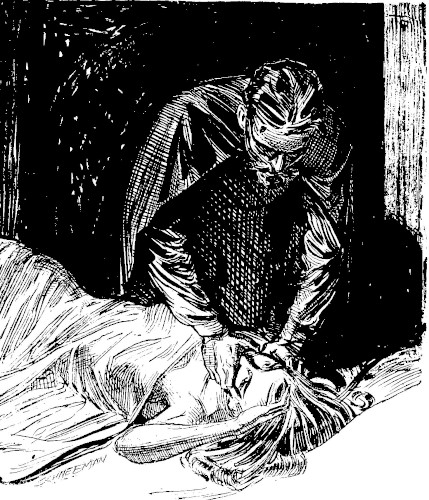
A throttling hand clamped over her mouth even as she awoke, and in the same instant her thought-screen flicked off.
Mr. Fordyce strolled back to his hotel and Lensman Kinnison directed a thought at Vice-Admiral Gerrond.
"Better fake up some kind of an excuse for having a couple of guards or policemen in front of Count Avondrin's town house at eight twenty-five this morning. The countess is going to have a brainstorm."
"What have ... what will she do?" Gerrond mastered his emotions sufficiently to keep from swearing.
"Nothing much. Scream a bit, rush out of doors half dressed, and fight anything and everybody that touches her. Warn the officers that she'll kick, scratch, and bite. There are plenty of signs of a prowler having been in her room, but if they can find him they're good—very good. She'll have all the signs and symptoms, even to the puncture, of having been given a shot in the arm of some brand-new drug, which the doctors won't be able to find or to identify. But there will be no question raised of insanity or of any other permanent damage—she'll be right as rain in a couple of months."
"Oh, that mind-ray machine of yours again, eh? And that's all you're going to do to her?"
"That's all. I can let her off easy and still be just, I think. She's helped me a lot. She'll be a good girl from now on, too; I've thrown a scare into her that will last her the rest of her life."
"Thanks, Gray Lensman! What else?"
"I'd like to have you at the Tellurian Ambassador's Ball day after tomorrow, if it's convenient."
"I've been planning on it, since it's on the 'must' list. Shall I bring anything or anyone special?"
"No. I just want you on hand to give me any information you can on a person who will probably be there to investigate what happened to the countess."
"I'll be there," and he was.
It was a gay and colorful throng, but neither of the two Lensmen was in any mood for gaiety. They acted, of course. They neither sought nor avoided each other but, somehow, they were never alone together.
"Man or woman?" asked Gerrond.
"I don't know. All I've got is the recognition."
The Radeligian did not ask what that recognition was to be. He knew that that information might prove dangerous indeed to any unauthorized possessor. He did not want to know it; he was glad that the Tellurian had not thrust it upon him.
Suddenly the Vice-Admiral's attention was wrenched toward the doorway, to see the most marvelously, the most flawlessly beautiful woman he had ever seen. But not long did he contemplate that beauty, for the Tellurian Lensman's thoughts were fairly seething, despite his iron control.
"Do you mean ... you can't mean—" Gerrond faltered.
"Yes—definitely!" Kinnison rasped. "She looks like an angel, but take it from me, she isn't. She's one of the slimiest snakes that ever lived—she's so low that she could put on a tall silk hat and walk under a duck. I know she's beautiful. She's a riot, a seven-sector callout, a thionite dream. So what? She is also Dessa Desplaines, formerly of Aldebaran II. Does that mean anything to you?"
"Not a thing, Kinnison."
"She's in it, clear to her neck. I had a chance to wring her neck once, too, damn it all, and didn't. She's got a brazen crust, coming here now, with all our Narcotics on the job—Wonder if they think they've got Enforcement so badly whipped that they can get away with stuff as rough as this—Sure you don't know her, or know of her?"
"I never saw her before, or heard of her."
"Perhaps she isn't known, out this way. Or maybe they think they're ready for a show-down ... or don't care. Her being here ties me up hand and foot, anyway. She'll recognize me, for all the tea in China. Gerrond! You know the Narcotics' Lensmen, don't you?"
"Certainly."
"Call one of them right now. Tell him that Dessa Desplaines, the zwilnik[1] houri, is right here on the floor—What! He doesn't know her, either! And none of our boys are Lensmen! Make it a three-way. Lensman Winstead? Kinnison of Sol III—unattached. Sure that none of you recognize this picture?" and he transmitted a perfect image of the ravishing creature then moving regally across the floor. "Nobody does? Good! Maybe that's why she's here, after all—thinks she can get away with it. Anyway, she's your meat. Here's the chance for a real capture. Come and get her."
"You will appear against her, of course?"
"If necessary—but it won't be necessary. As soon as she sees that the game's up, all hell will be out for noon."
As soon as the connection had been broken, Kinnison realized that the thing could not be done that way; that he could not stay out of it. No man alive save himself could prevent her from flashing a warning—badly as he hated it, he had to do it. Gerrond glanced at him curiously: he had received a few of those racing thoughts.
"Tune in on this," Kinnison grinned wryly. "If the last meeting I had with her is any criterion, it ought to be good. S'pose anybody around here understands the language of Aldebaran II?"
"Never heard it mentioned if they do."
The Tellurian walked blithely up to the radiant visitor, held out his hand in Earthly—and Aldebaranian—greeting, and spoke: "Madam Desplaines would not remember Chester Q. Fordyce, of course. It is of the piteousness that I should be so accursedly of the ordinariness; for to see madam but the one time, as I did at the New Year's ball in High Altamont, is to remember her forever."
"Such a flatterer!" The woman laughed. "I trust that you will forgive me, Mr. Fordyce, but one meets so many interesting—" Her eyes widened in surprise, an expression which changed rapidly to one of flaming hatred, not unmixed with fear.
"So you do recognize me, you bedroom-eyed, Aldebaranian hell-cat," he remarked, evenly. "I rather expected that you would."
"Yes, you sweet, uncontaminated sissy, you overgrown super-Boy Scout, I do," she hissed, malevolently, and made a quick motion toward her corsage. These two, as has been intimated, were friends of old.
Quick though she was, the man was quicker. His left hand darted out to seize her left wrist; his right, flashing around her body, grasped her right and held it rigidly in the small of her back. Thus they walked away.
"Stop!" she flared. "You're making a spectacle of me!"
"Now isn't that something to worry about?" His lips smiled, for the benefit of the observers, but his eyes held no glint of mirth. "These folks will think that this is the way all Aldebaranian friends walk together. If you think for a second that I'm going to give you a chance to touch that sounder you're wearing you haven't got the sense of a Zabriskan fontema. Stop wriggling!" he counseled, sharply. "Even if you can do enough hula-hula shimmying to work it, before it contacts once I'll crush your brain to a pulp, right here and right now!"
Outside, in the grounds, "Oh, Lensman, let's sit down and talk this over!" and the girl brought into play everything she had. It was a distressing scene, but it left the Lensman cold.
"Save your breath," he advised her finally, wearily. "To me you're just another zwilnik, no more and no less. A female louse is still a louse; and calling a zwilnik a louse is sheerest flattery."
He said that; and, saying it, knew it to be the exact and crystal truth: but not even that knowledge could mitigate in any iota the recoiling of his every fiber from the deed which he was about to do. He could not even pray, with immortal Merritt's Dwayanu:
"Luka—turn your wheel so I need not slay this woman!"
It had to be. Why in all the nine hells of Valeria did he have to be a Lensman? Why did he have to be the one to do it? But it had to be done, and soon; they'd be here shortly.
"There's just one thing you can do to make me believe that you're even partially innocent," he ground out, "that you have even one decent thought or one decent instinct anywhere in you."
"What is that, Lensman? I'll do it, whatever it is!"
"Release your thought-screen and send out a call to the Big Shot."
The girl stiffened. This big cop wasn't so dumb—he really knew something. He must die, and at once. How could she get word to—
Simultaneously Kinnison perceived that for which he had been waiting; the Narcotics men were coming.
He tore open the woman's gown, flipped the switch of her thought-screen, and invaded her mind. But, fast as he was, he was late—almost too late altogether. He could get neither direction line nor location; but only, and faintly, a picture of a space-dock saloon, of a repulsively obese man in a luxuriously furnished back room. Then her mind went completely blank and her body slumped down, bonelessly.
Thus Narcotics found them; the woman inert and flaccid upon the bench, the man staring down at her in black abstraction.
VI.
"Suicide? Or did you—" Gerrond paused, delicately. Winstead, the Lensman of Narcotics, said nothing, but looked on intently.
"Neither," Kinnison replied, still studying. "I would have had to, but she beat me to it."
"What d'you mean, 'neither'? She's dead, isn't she? How did it happen?"
"Not yet, and unless I'm more cockeyed even than usual, she won't be. She isn't the type to rub herself out—ever, under any conditions. As to 'how,' that was easy. A hollow false tooth. Simple, but new—and clever. But why? WHY?" Kinnison was thinking to himself more than addressing his companions. "If they had killed her, yes. As it is, it doesn't make any kind of sense—any of it."
"But the girl's dying!" protested Gerrond. "What're you going to do?"
"I wish to Klono I knew." The Tellurian was puzzled, groping. "No hurry doing anything about her—what was done to her has been done, and no one this side of Hades can undo it—unless I can fit these pieces together into some kind of a pattern I'll never know what it's all about—none of it makes sense—" He shook himself and went on: "One thing is plain. She won't die. If they had intended to kill her, she would have died almost instantly. They figure she's worth saving; in which I agree with them. At the same time, they certainly are not planning on letting me tap her knowledge. They may be planning on taking her away from us. Therefore, as long as she stays alive—or even not dead, the way she is now—guard her so heavily that an army can't get her. If she should happen to die, don't leave her body unguarded for a second until she's been autopsied, and you know she'll stay dead. The minute she recovers, day or night, call me. Might as well take her to the hospital now, I guess."
The call came soon that the patient had indeed recovered.
"She's talking, but I haven't answered her," Gerrond reported. "There's something strange here, Kinnison."
"There would be—bound to be. Hold everything until I get there," and he hurried to the hospital.
"Good morning, Dessa," he greeted her in Aldebaranian. "You are feeling better, I hope?"
Her reaction was surprising. "You really know me?" she almost shrieked, and flung herself into the Lensman's arms. Not deliberately; not with her wonted, highly effective technique of bringing into play the s.a. equipment with which she was so overpoweringly armed. No; this was the utterly innocent, the wholly unselfconscious abandon of a very badly frightened young girl. "What happened?" she sobbed, frantically, "Where am I? Why are all these strangers here?"
Her wide, childlike, tear-filled eyes sought his; and as he probed them, deeper and deeper into the brain behind them; his face grew set and hard. Mentally, she now was a young and innocent girl! Nowhere in her mind, not even in the deepest recesses of her subconscious, was there the slightest inkling that she had even existed since her fifteenth year. It was staggering; it was unheard of; but it was indubitably a fact. For her, now, the intervening time had lapsed instantaneously—five or six years of her life had disappeared so utterly as never to have been!
"You have been very ill, Dessa," he told her gravely, "and you are no longer a child." He led her into another room and up to a triple mirror. "See for yourself."
"But that isn't I?" she protested. "It can't be! Why, she's beautiful!"
"You're all of that," the Lensman agreed, casually. "You've had a bad shock. Your memory will return shortly, I think. Now you must go back to bed."
She did so, but not to sleep. Instead, she went into a trance; and so, almost, did Kinnison. For over an hour he lay intensely asprawl in an easy-chair, the while he engraved, day by day, a memory of missing years into that bare storehouse of knowledge. And finally the task was done.
"Sleep, Dessa," he told her then. "Sleep. Waken in eight hours; whole."
"Lensman, you're a man!" Gerrond realized vaguely what had been done. "You didn't give her the truth, of course?"
"Far from it. Only that she was married and is a widow. The rest of it is highly fictitious—just enough like the real thing so that she can square herself with herself, if she meets old acquaintances. Plenty of lapses, of course, but they're covered by shock."
"But the husband?" queried the curious Radeligian.
"That's her business," Kinnison countered, callously. "She'll tell you, if she ever feels like it. One thing I did do, though—they'll never use her again. The next man that tries to hypnotize her will be lucky if he gets away alive."
The advent of Dessa Desplaines, however, and his curious adventure with her, had altered markedly the Lensman's situation. No one else in the throng had worn a screen, but there might have been agents—anyway, the observed facts would enable the higher-ups to link Fordyce up with what had happened—they would know, of course, that the real Fordyce hadn't done it—he could be Fordyce no longer.
Wherefore the real Chester Q. Fordyce took over and a strange Unattached Lensman appeared. A Posenian, supposedly, since against the air of Radelix he wore that planet's unmistakable armor. No other race of even approximately human shape could "see" through a helmet of solid, opaque metal.
And in this guise Kinnison continued his investigations. That place and that man must be on this planet somewhere; the sending outfit worn by the Desplaines woman could not possibly reach any other. He had a good picture of the room and a fair picture—several pictures, in fact—of the man. The room was an actuality; all he had had to do was to fill in the details which definitely, by unmistakable internal evidence, belonged there. The man was different. How much of the original picture was real, and how much of it was the girl's impression?
She was, he knew, physically fastidious almost to an extreme. He knew that no possible hypnotism could nullify completely the basic, the fundamental characteristics of the subconscious. The intrinsic ego could not be changed. Was the man really such a monster, or was the picture in the girl's mind partially or largely the product of her physical revulsion?
For hours he had sat at a recording machine, covering yard after yard of tape with every possible picture of the man he wanted. Pictures ranging from a man almost of normal build up to a thing duplicating in every detail the woman's mental image.
Now he ran the tape again, time after time. The two extremes, he concluded, were highly improbable. Somewhere in between—the man was fat, he guessed. Fat, and had a mean pair of eyes. And, no matter how Kinnison changed the man's physical shape he had found it impossible to eradicate a personality that was definitely bad.
"The guy's a louse," Kinnison decided, finally. "Needs killing. Glad of that—if I have to keep on fighting women much longer I'll go completely nuts. Got enough dope to identify him now, I think."
And again the Tellurian Lensman set out to comb the planet, city by city. Since he was not now dealing with Lensmen, every move he made had to be carefully planned and as carefully concealed. It was heartbreaking; but at long last he found a bartender who had once seen his quarry. He was fat, Kinnison discovered, and he was a bad egg. From that point on, progress was rapid. He went to the indicated city, which was, ironically enough, the very Ardith from which he had set out; and, from a bit of information here and a bit there, he tracked down his man. He found the room first, and then the man. The girl wasn't so far wrong, at that. Her aversion was somewhat worse than the actuality, but not too much.
Now what to do? The technique he had used so successfully upon Boyssia II and in other bases could not succeed here; there were thousands of people instead of dozens, and someone would certainly catch him at it. Nor could he work at a distance. He was no Arisian, he had to be right beside his job. He would have to turn dock-walloper.
Therefore a dock-walloper he became. Not like one, but actually one. He labored prodigiously, his fine hands and his entire being becoming coarse and hardened. He ate prodigiously, and drank likewise. But, wherever he drank, his liquor was poured from the bartender's own bottle or from one of similarly innocuous contents; for then, as now, bartenders did not themselves imbibe the corrosively potent distillates in which they dealt. Nevertheless, Kinnison became intoxicated—boisterously, flagrantly, and pugnaciously so, as did his fellows.
He lived scrupulously within his dock-walloper's wages. Eight credits per week went to the company, in advance, for room and board; the rest he spent over the fat man's bar or gambled away at the fat man's crooked games—for Bominger, although engaged in vaster commerce far, nevertheless, allowed no scruple to interfere with his esurient rapacity. Money was money, whatever its amount or source or however despicable its means of acquirement.
The Lensman knew that the games were crooked, certainly. He could see, however they were concealed, the crooked mechanisms of the wheels. He could see the crooked workings of the dealers' minds as they manipulated their crooked decks. He could read as plainly as his own the cards his crooked opponents held. But to win or to protest would have set him apart, hence he was always destitute before pay day. Then, like his fellows, he spent his spare time loafing in the same saloon, vaguely hoping for a free drink or for a stake at cards, until one of the bouncers threw him out.
But in his every waking hour, working, gambling, or loafing, he studied Bominger and Bominger's various enterprises. The Lensman could not pierce the fat man's thought-screen, and he could never catch him without it. However, he could and did learn much. He read volume after volume of locked account books, page by page. He read secret documents, hidden in the deepest recesses of massive vault. He listened in on conference after conference; for a thought-screen of course, does not interfere with either sight or sound. The Big Shot did not own—legally—the saloon, nor the ornate, almost palatial back room which was his office. Nor did he own the dance hall and boudoirs upstairs, nor the narrow, cell-like rooms in which addicts of twice a score of different noxious drugs gave themselves over libidinously to their addictions. Nevertheless, they were his; and they were only a part of that which was his.
Kinnison detected, traced, and identified agent after agent. With his sense of perception he followed passages, leading to other scenes, utterly indescribable here. One comparatively short gallery, however, terminated in a different setting altogether; for there, as here and perhaps everywhere, ostentation and squalor lie almost back to back. Nalizok's Café, the high-life hot-spot of Radelix! Downstairs was innocuous enough; nothing rough—that is, too rough—was ever pulled there. Most of the robbery there was open and above-board, plainly written upon the checks. But there were upstairs rooms, and cellar rooms, and back rooms. And there were addicts, differing only from those others in wearing finer raiment and being of a self-styled higher stratum. Basically they were the same.
Men, women, girls ever were there, in the rigid muscle-lock of thionite. Teeth hard-set, every muscle tense and staring, eyes jammed closed, fists clenched, faces white as though carved from marble, immobile in the frenzied emotion which characterized the ultimately passionate fulfillment of every suppressed desire; in the release of their every inhibition crowding perilously close to the dividing line beyond which lay death from sheer ecstasy. That was the technique of the thionite-sniffer—to take every microgram that he could stand, to come to, shaken and too weak even to walk; to swear that he would never so degrade himself again; to come back after more as soon as he had recovered strength to do so; and finally, with an irresistible craving for stronger and ever stronger thrills, to take a larger dose than his rapidly-weakening body could endure, and so to cross the fatal line.
There also were the idiotically smiling faces of the hadive smokers, the twitching members of those who preferred the Centralian nitrolabe-needle, the helplessly stupefied eaters of bentlam—but why go on? Suffice it to say that in that one city block could be found every vice and every drug enjoyed by Radeligians and the usual run of visitors; and if perchance you were an unusual visitor, desiring something unusual, Bominger could get it for you—at a price.
Kinnison studied, perceived, and analyzed. Also, he reported, via Lens, daily and copiously, to Narcotics, under Lensman's Seal.
"But Kinnison!" Winstead protested one day. "How much longer are you going to make us wait?"
"Until I get what I came after or until they get onto me," Kinnison replied, flatly. For weeks his Lens had been hidden in the side of his shoe, in a flat sheath of highly charged metal, proof against any except the most minutely searching spy-ray inspection; but this new location did not in any way interfere with its functioning.
"Any danger of that?" the Narcotics head asked, anxiously.
"Plenty—and getting worse every day. More actors in the drama. Some day I'll make a slip—I can't keep this up forever."
"Let us go, then," Winstead urged. "We've got enough now to blow this ring out of existence, all over the planet."
"Not yet. You're making good progress, aren't you?"
"Yes, but considering—"
"Don't consider it yet. Your present progress is normal for your increased force. Any more would touch off an alarm. You could take this planet's drug personnel, yes, but that isn't what I'm after. I want big game, not small fry. So sit tight until I give you the g.a. QX?"
"Got to be QX if you say so, Kinnison. Be careful!"
"I am. Won't be long now, I'm sure. Bound to break very shortly, one way or the other. If possible, I'll give you and Gerrond warning."
Kinnison had everything lined up except the one thing he had come after. This was, in fact, the headquarters of the drug syndicate for the entire planet of Radelix. He knew where the stuff came in, and when, and how. He knew who received it, and the principal distributors of it. He knew almost all of the secret agents of the ring, and not a few even of the small-fry peddlers. He knew where the remittances went, and how much, and what for. But every lead had stopped at Bominger. Apparently the fat man was the absolute head of the drug syndicate; and that appearance didn't make sense—it had to be false. Bominger and the other planetary lieutenants—themselves only small fry if the Lensman's ideas were only half right—must get orders from, and send reports and, in probability, payments to some Boskonian authority; of that Kinnison felt certain, but he had not been able to get even the slightest trace of that higher-up.
That the communication would be established upon a thought-beam the Tellurian was equally certain. The Boskonian would not trust any ordinary, tappable communicator beam, and he certainly would not be such a fool as to send any written or taped or otherwise permanently recorded message, however coded. No, that message, when it came, would come as thought, and to receive it the fat man would have to release his screen. Then, and not until then, could Kinnison act. Action at that time might not prove simple—judging from the precautions Bominger was taking already, he would not release his screen without taking plenty more—but until then the Lensman could do nothing.
That screen had not yet been released, Kinnison could swear to that. True, he had had to sleep at times, but he had slept in a very hair-trigger, with his subconscious and his Lens set to guard that screen and to give the alarm at its first sign of weakening.
As the Lensman had foretold, the break came soon. Not in the middle of the night, as he had half-thought that it would come; nor yet in the quiet of the daylight hours. Instead, it came well before midnight, while revelry was at its height. It did not come suddenly, but was heralded by a long period of gradually increasing tension, of a mental stress very apparent to the mind of the watcher.
Agents of the drug baron came in, singly and in groups, to an altogether unprecedented number. Some of them were their usual viciously self-contained selves, others were slightly but definitely ill at ease. Kinnison, seated alone at a small table, playing a game of Radeligian solitaire, divided his attention between the big room as a whole and the office of Bominger; in neither of which was anything definite happening.
Then a wave of excitement swept over the agents as five men wearing thought-screens entered the room and, sitting down at a reserved table, called for cards and drinks; and Kinnison thought it time to send his warning.
"Gerrond! Winstead! Three-way! It's going to break soon, now, I think—tonight. Agents all over the place—five men with thought-screens here on the floor. Nervous tension high. Lots more agents outside, for blocks. General precaution, I think, not specific. Not suspicious of me, at least not exactly. Afraid of spies with a sense of perception—Rigellians or Posenians or such. Just killed an Ordovik on general principles, over on the next block. Get your gangs ready, but don't come too close—just close enough so that you can be here in thirty seconds after I call you."
"What do you mean 'not exactly suspicious'? What have you done?"
"Nothing that I know of—any one of a million possible small slips I may have made. Nothing serious, though, or they wouldn't have let me hang around this long."
"You're in danger. No armor, no DeLameter, no anything. Better come out while you can."
"And miss what I've spent all this time building up? Not a chance; I'll be able to take care of myself, I think—Here comes one of the boys in a screen, to talk to me. I'll leave my Lens open, so that you can sort of look on."
Just then Bominger's screen went down and Kinnison invaded his mind; taking complete possession of it. Under his domination the fat man reported to the Boskonian, reported truly and fully. In turn, he received orders and instructions. Had any inquisitive stranger been around, or anyone on the planet using any kind of a mind-ray machine since that quadruply-accursed Lensman had held that trial? (Oh, that was what had touched them off! Kinnison was glad to know it.) No, nothing unusual at all—
And just at that critical moment, when the Lensman's mind was so busy with its task, the stranger came up to his table and stared down at him dubiously, questioningly.
"Well, what's on your mind?" Kinnison growled. He could not spare much of his mind just then, but it did not take much of it to play his part as a dock-walloper. "You another of these smoking house-numbers, snooping around to see if I'm trying to run a blazer on myself? By the devil and his imps, if I hadn't lost so much money here already I'd tear up this deck and go over to Croleo's and never come near this crummy joint again—his rotgut can't be any worse than yours is."
"Don't burn out a jet, pal." The agent, apparently reassured, adopted a conciliatory tone.
"Who in hell ever said you was a pal of mine, you Radelig-gig-gigian pimp?" The supposedly three quarters drunken, certainly three quarters naked, Lensman got up, wobbled a little, and sat down again, heavily. "Don't 'pal' me, ape—I'm partic-hic-hicular about who I pal with."
"That's all right, big fellow; no offense intended," soothed the other. "Come on, I'll buy you a drink."
"Don't want no drink until after I've finished this game," Kinnison grumbled, and took an instant to flash a thought via Lens. "All set, boys? Thing's moving fast. If I have to take this drink—it's doped, of course—I'll bust this bird wide open. When I yell, shake the lead out of your pants!"
"Of course you want a drink!" the pirate urged. "Come and get it—it's on me, you know."
"And who are you to be buying me, a Tellurian gentleman, a drink?" the Lensman roared, flaring into one of the sudden, senseless rages of the character he had cultivated so assiduously. "Did I ask you for a drink? I'm educated, I am, and I've got money, I have. I'll buy myself a drink when I want one." His rage mounted higher and higher, visibly. "Did I ever ask you for a drink, you—" (unprintable here for the space of two long breaths).
This was the blow-off. If the fellow was even half honest, there would be a fight, which Kinnison could make as long as necessary. If he did not start slugging after what Kinnison had just called him, he was not what he seemed and the Lensman was surely suspected; for the Earthman had dredged out the noisomest depths of the foulest vocabularies in space for the terms he had just employed.
"If you weren't drunk I'd break every bone in your laxlo-soaked carcass." The other man's anger was sternly suppressed, but he looked at the dock-walloper with no friendship in his eyes. "I don't ask lousy spaceport bums to drink with me every day, and when I do, they do—or else. Do you want to take that drink now or do you want a couple of the boys to work you over first? Barkeep! Bring two glasses of laxlo over here!"
Now the time was short, indeed, but Kinnison would not—could not—act yet. Bominger's conference was still on; the Lensman didn't know enough yet. The fellow wasn't very suspicious, certainly, or he would have made a pass at him before this. Bloodshed meant less than nothing to these gentry; the stranger did not want to incur Bominger's wrath by killing a steady customer. The fellow probably thought the whole mind ray story was hocus-pocus, anyway—not a chance in a million of it being true. Besides, he needed a machine, and Kinnison couldn't hide a thing, let alone anything as big as that mind-ray machine had been, because he didn't have clothes enough on to flag a handcar with. But that free drink was certainly doped—Oh, they wanted to question him. It would be a truth-dope in the laxlo, then—he certainly couldn't take that drink!
Then came the all-important second; just as the bartender set the glasses down Bominger's interview ended. At the signing off, Kinnison got additional data, just as he had thought that he would; and in that instant, before the drugmaster could restore his screen, the fat man died—his brain literally blasted. And in that same instant Kinnison's Lens fairly throbbed with the power of the call he sent out to his allies.
But not even Kinnison could hurl such a mental bolt without some outward sign. His face stiffened, perhaps, or his eyes may have lost their drunken, vacant stare, to take on momentarily the keen, cold ruthlessness that was for the moment his. At any rate, the enemy agent was now definitely suspicious.
"Drink that, bum, and drink it quick—or burn!" he snapped, DeLameter out and poised.
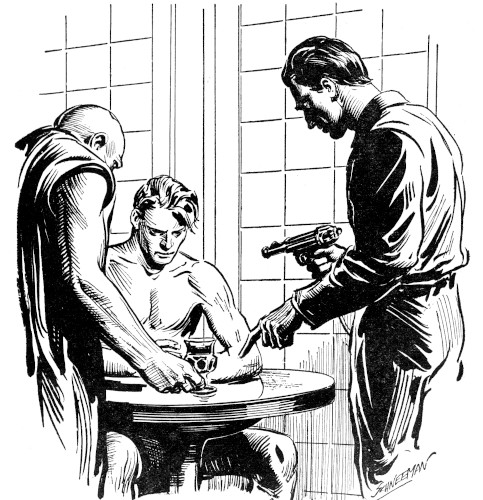
Kinnison looked up at the stranger blearily. "Drink that, bum, and drink it quick—or burn!" the gunman snapped.
The Tellurian's hand reached out for the glass, but his mind also reached out, and faster by a second, to the brains of two nearby agents. Those worthies drew their own weapons and, with wild yells, began firing. Seemingly indiscriminately, yet in those blasts two of the thought-screened minions died. For a fraction of a second even the hard-schooled mind of Kinnison's opponent was distracted, and that was long enough for the Gray Lensman's instantaneous nervous reactions and his mighty muscles.
A quick flick of the wrist sent the potent liquor into the Boskonian's eyes; a lightning thrust of the knee sent the little table hurtling against his gun-hand, flinging the weapon afar. Simultaneously, the Lensman's hamlike fist, urged by all the strength and all the speed of his two hundred and sixteen pounds of rawhide and whalebone, drove forward. Not for the jaw. Not for the head or the face. Lensmen know better than to mash bare hands, break fingers and knuckles, against bone. For the solar plexus. The big Patrolman's fist sank forearm-deep. The stricken zwilnik uttered one shrieking grunt, doubled up, and collapsed; never to rise again. Kinnison leaped for the fellow's DeLameter—too late, he was already hemmed in.
One—two—three—four of the nearest men died without having received a physical blow; again and again Kinnison's heavy fists and far heavier feet crashed deep into vital spots. One thought-screened enemy dived at him bodily in a Tomingan donganeur, to fall with a broken neck as the Lensman opposed instantly the only possible parry—a savage chop, edge-handed, just below the base of the skull; the while he disarmed the surviving thought-screened stranger with an accurately-hurled chair. The latter, feinting a swing, launched a vicious French kick. The Lensman, expecting anything, perceived the foot coming. His big hands shot out like striking snakes, closing and twisting savagely in the one fleeting instant, then jerking upward and backward. A hard and heavy dock-walloper's boot crashed thuddingly to a mark. A shriek rent the air and that foeman, too, was done.
Not fair fighting, no; nor cluvvy. Lensmen did not and do not fight according to the tenets of the late Marquis of Queensberry. They use the weapons provided by Mother Nature only when they must; but they can, and do use them with telling effect indeed, when body-to-body brawling becomes necessary. For they are skilled in the art—every Lensman has a completely detailed knowledge of all the lethal tricks of foul combat known to all the dirty fighters of ten thousand planets for twice ten thousand years.
And then the doors and windows crashed in, admitting those whom no other bifurcate race has ever faced willingly in hand-to-hand combat—full-armed Valerians, swinging their space-axes!
The gangsters broke then, and fled in panic disorder; but escape from Narcotics' fine-meshed net was impossible. They were cut down to a man.
"QX, Kinnison?" came two hard, sharp thoughts. The Lensmen did not see the Tellurian, but Lieutenant Peter van Buskirk did. That is, he saw him, but did not look at him.
"Hi, Kim, you little Tellurian wart!" That worthy's thought was a yell. "Ain't we got fun?"
"QX fellows—thanks," to Gerrond and to Winstead, and—
"Ho, Bus! Thanks, you big, Valerian ape!" to the gigantic Dutch-Valerian with whom he had shared so many experiences in the past. "A good clean-up, fellows?"
"One hundred per cent, thanks to you. We'll put you—"
"Don't, please. You will probably clog my jets if you do. I don't appear in this anywhere—it's just one of your good, routine jobs of mopping up. Clear ether, fellows, I've got to do a flit."
"Where?" all three wanted to ask, but they didn't—the Gray Lensman was gone.
VII.
Kinnison did start his flit, but he did not get far. In fact, he did not even reach his squalid room before cold reason told him that the job was only half done—yes, less than half. He had to give Boskone credit for having brains, and it was not at all likely that even such a comparatively small unit as a planetary headquarters would have only one string to its bow. They certainly would have been forced to install duplicate controls of some sort or other by the trouble they had had after Helmuth's supposedly impregnable Grand Base had been destroyed.
There were other straws pointing the same way. Where had those five strange thought-screened men come from? Bominger hadn't known of them apparently. If that idea was sound, the other headquarters would have a spy ray on the whole thing. Both sides used spy rays freely, of course, and to block them was, ordinarily, worse than to let them come. The enemies' use of the thought-screen was different. They realized that it made it easy for the unknown Lensman to discover their agents, but they were forced to use it because of the deadliness of the supposed mind-ray. Why hadn't he thought of this sooner, and had the whole area blocked off? Too late to cry about it now, though.
Assume the idea correct. They certainly knew now that he was a Lensman; probably were morally certain that he was the Lensman. His instantaneous change from a drunken dock-walloper to a cold-sober, deadly-skilled rough-and-tumble brawler—and the unexplained deaths of half-a-dozen agents, as well as that of Bominger himself—this was bad. Very, very bad—a flare lit tip-off, if there ever was one. Their spy rays would have combed him, millimeter by plotted cubic millimeter: they knew exactly where his Lens was, as well as he did himself. He had put his tail right into the wringer—wrecked the whole job right at the start—unless he could get that other headquarters outfit, too, and get them before they reported in detail to Boskone.
In his room, then, he sat and thought, harder and more intensely than he had ever thought before. No ordinary method of tracing would do. It might be anywhere on the planet, and it certainly would have no connection whatever with the thionite gang. It would be a small outfit; just a few men, but under smart direction. Their purpose would be to watch the business end of the organization, but not to touch it save in an emergency. All that the two groups would have in common would be recognition signals, so that the reserves could take over in case anything happened to Bominger—as it already had. They had him, Kinnison, cold—What to do? What to do?
The Lens. That must be the answer—it had to be. The Lens—what was it, really, anyway? Simply an aggregation of crystalloids. Not really alive; just a pseudolife, a sort of a reflection of his own life—he wondered—great Klono's brazen teeth and tail, could that be it? An idea had struck him, an idea so stupendous in its connotations and ramifications that he gasped, shuddered, and almost went faint at the shock. He started to reach for his Lens, then forced himself to relax and shot a thought to Base.
"Gerrond! Send me a portable spy-ray block, quick!"
"But that would give everything away!" protested the vice-admiral. "That's why we haven't been using them."
"Are you telling me?" the Lensman demanded. "Shoot it along—I'll explain while it's on the way." He went on to tell the Base commander everything that he thought it well for him to know, concluding: "So you see, it's a virtual certainty that I am already as wide open as intergalactic space, and that nothing but fast and sure moves will do us a bit of good."
The block arrived, and as soon as the messenger had departed Kinnison set it going. He was now the center of a sphere into which no spy-ray beam could penetrate. He was also an object of suspicion to anyone using a spy ray, but that fact made no difference, then. He snatched off his shoe, took out his Lens, and tossed that ultra-precious fabrication across the room. Then, just as though he still wore it, he directed a thought at Winstead.
"All serene, Lensman?" he asked, quietly.
"Everything's on the beam," came instant reply. "Why?"
"Just checking, is all." Kinnison did not specify exactly what it was that he was checking!
He then did something which, so far as he knew, no Lensman had ever before even thought of doing. Although he felt stark naked without his Lens, he hurled a thought three quarters of the way across the Galaxy to that dread planet Arisia; a thought narrowed down to the exact pattern of that gigantic, fearsome Brain who had been his mentor and his sponsor.
"Ah, 'tis Kimball Kinnison, of Earth," that entity responded, in precisely the same modulation it had employed once before. "You have perceived, then, youth, that the Lens is not the supremely important thing you have supposed it to be?"
"I ... you ... I mean—" The flustered Lensman, taken completely aback, was cut off by a sharp rebuke.
"Stop! You are thinking muddily—conduct ordinarily inexcusable! Now, youth, to redeem yourself, you will explain the phenomenon to me, instead of asking me to explain it to you. I realize that you have just discovered another facet of the Cosmic Truth, I know what a shock it has been to your immature mind; hence for this once it may be permissible for me to overlook your crime. But strive not to repeat the offense; for I tell you again in all possible seriousness—I cannot urge upon you too strongly the fact—that in clear and precise thinking lies your only safeguard through that which you are attempting. Confused, wandering thought will assuredly bring disaster inevitable and irreparable."
"Yes, sir," Kinnison replied meekly; a small boy reprimanded by his teacher. "It must be this way. In the first stage of training the Lens is a necessity; just as is the crystal ball or some other hypnotic object in a séance. In the more advanced stage the mind is able to work without aid. The Lens, however, may be—in fact, it must be—endowed with uses other than that of a symbol of identification; uses about which I as yet know nothing. Therefore, while I can work without it, I should not do so except when it is absolutely necessary, as its help will be imperative if I am to advance to any higher stage. It is also clear that you were expecting my call. May I ask if I am on time?"
"You are—your progress has been highly satisfactory. Also, I note with approval that you are not asking for help in your admittedly difficult present problem."
"I know that it wouldn't do me any good—and why." Kinnison grinned wryly. "But I'll bet that Worsel, when he comes up for his second treatment, will know on the spot what it has taken me all this time to find out."
"You deduce truly. He did."
"What? He has been back there already? And you told me—"
"What I told you was true and is. His mind is more fully developed and more responsive than yours; yours is of vastly greater latent capacity, capability, and force—" and the line of communication snapped.
Calling a conveyance, Kinnison was whisked to Base, the spy-ray block full on all the way. There, in a private room, he put his heavily-insulated Lens and a full spool of tape into a ray-proof container, sealed it, and called in the Base commander.
"Gerrond, here is a package of vital importance," he informed him. "Among other things, it contains a record of everything I have done to date. If I don't come back to claim it myself, please send it to Prime Base for personal delivery to Port Admiral Haynes. Speed will be no object, but safety very decidedly of the essence."
"QX—we'll send it in by special messenger."
"Thanks a lot. Now I wonder if I could use your visiphone a minute? I want to talk to the zoo."
"Certainly."
"Zoological Gardens?" and the image of an elderly, white-bearded man appeared upon the plate. "Lensman Kinnison of Tellus—Unattached. Have you as many as three oglons, caged together?"
"Yes. In fact, we have four of them in one cage."
"Better yet. Will you please send them over here to Base at once? Vice-admiral Gerrond, here, will confirm."
"It is most unusual, sir—" the gray-beard began, but broke off at a curt word from Gerrond. "Very well, sir," he agreed, and disconnected.
"Oglons?" the surprised commander demanded. "Oglons!"
For the oglon, or Radeligian cateagle, is one of the fiercest, most intractable beasts of prey in existence; it assays more concentrated villainy and more sheerly vicious ferocity to the gram than any other creature known to science. It is not a bird, but a winged mammal; and is armed not only with the gripping, tearing talons of the eagle, but also with the heavy, cruel, needle-sharp fangs of the wildcat. And its mental attitude toward all other forms of life is anti-social to the nth degree.
"Oglons." Kinnison confirmed, shortly. "I can handle them."
"You can, of course. But—" Gerrond stopped. This Gray Lensman was forever doing amazing, unprecedented, incomprehensible things. But, so far, he had produced eminently satisfactory results, and he could not be expected to spend all his time in explanations.
"But you think I'm screwy, huh?"
"Oh, no, Kinnison, I wouldn't say that. I only ... well ... after all, there isn't much real evidence that we didn't mop up one hundred percent."
"Much? Real evidence? There isn't any," the Tellurian assented, cheerfully enough. "But you've got the wrong slant entirely on these people. You are still thinking of them as gangsters, desperadoes, renegade scum of our own civilization. They are not. They are just as smart as we are; some of them are smarter. Perhaps I am taking too many precautions; but, if so, there is no harm done. On the other hand, there are two things at stake which, to me at least, are extremely important; this whole job of mine and my life: and remember this—the minute I leave this Base both of those things are in your hands."
To that, of course, there could be no answer.
While the two men had been talking and while the oglons were being brought out, two trickling streams of men had been passing, one into and one out of the spy ray shielded confines of Base. Some of these men were heavily bearded, some were shaven clean, but all had two things in common. Each one was human in type and each one in some respect or other resembled Kimball Kinnison.
"Now remember, Gerrond," the Gray Lensman said impressively as he was about to leave. "They're probably right here in Ardith, but they may be anywhere on the planet. Keep a spy ray on me wherever I go, and trace theirs if you can. That will take some doing, as the head one is bound to be an expert. Keep those oglons at least a mile—thirty seconds flying time—away from me; get all the Lensmen you can on the job; keep a cruiser and a speedster hot, but not too close. I may need one of them, or all, or none of them, I can't tell; but I do know this—if I need anything at all, I'll need it fast. Above all, Gerrond, by the Lens you wear, do nothing whatever, no matter what happens around me or to me, until I give you the word. QX?"
"QX, Gray Lensman. Clear ether!"
Kinnison took a ground-cab to the mouth of the narrow street upon which was situated his dock-walloper's mean lodging. This was a desperate, a fool-hardy trick—but in its very boldness, in its insolubly paradoxical aspects, lay its strength. Probably Boskone could solve its puzzles, but—he hoped—this ape, not being Boskone, couldn't. And, paying off the cabman, he thrust his hands into his tattered pockets and, whistling blithely if a bit raucously through his stained teeth, he strode off down the narrow way as though he did not have a care in the world. But he was doing the finest job of acting of his short career; even though, for all he really knew, he might not have any audience at all. For, inwardly, he was strung to highest tension. His sense of perception, sharply alert, was covering the full hemisphere around and above him; his mind was triggered to jerk any muscle of his body into instantaneous action.
Meanwhile, in a heavily guarded room, there sat a manlike being, faintly but definitely blue; not only as to eyes, but also as to hair, teeth, and complexion. For two hours he had been sitting at his spy ray plate, studying with ever-growing uneasiness the human beings so suddenly and so surprisingly numerously having business at the Patrol's Base. For minutes he had been studying minutely a man in a ground-cab, and his uneasiness reached panic heights.
"It is the Lensman!" he burst out. "It's got to be, Lens or no Lens. Who else would have the cold nerve to go back there when he knows that he has exposed himself?"
"Well, get him, then," advised his companion. "All set, aren't you?"
"But it can't be!" the chief went on, reversing himself in mid-flight. "A Lensman without a Lens is unthinkable, and invisible Lens is preposterous. And this fellow has not now, and never has had, a mind-ray machine. He hasn't got anything! And besides, the Lensman we're after wouldn't think of doing a thing like this—he always disappears the instant a job is finished, whether or not there is any chance of his having been discovered."
"Well, drop him and chase somebody else, then," the lieutenant advised, unfeelingly.
"But there's nobody nearly enough like him!" snarled the chief, in desperation. He was torn by doubt and indecision. This whole situation was a mess—it didn't add up right, from any possible angle. "It's got to be him—it can't be anybody else. I've checked and rechecked him. It is him, and not a double. He thinks that he's safe enough; he doesn't suspect that we're here at all. Besides, his only good double, Fordyce—and he's not good enough to stand the inspection I just gave him—hasn't appeared anywhere."
"Probably inside Base yet. Maybe this is a better double. Perhaps this is the real Lensman pretending he isn't, or maybe the real Lensman is slipping out while you're watching the man in the cab," the junior suggested, helpfully.
"Shut up!" the superior yelled. He started to reach for a switch, but paused, hand in air.
"Go ahead. That's it, call District and toss it into their laps, if it's too hot for you to handle. I think myself that whoever did this job is a warm number—plenty warm."
"And get my ears bunted off with that 'your report is neither complete nor conclusive' of his?" the chief sneered. "And get reduced for incompetence besides? No, we've got to do it ourselves, and do it right—but that man there isn't the Lensman—he can't be!"
"Well, you'd better make up your mind—you haven't got all day. And nix on that 'we' stuff. It's you that's got to do it—you're the boss, not me," the underling countered, callously. For once, he was really glad that he was not the one in command. "And you'd better get busy and do it, too."
"I'll do it," the chief declared, grimly. "There's a way."
There was a way. One only. He must be brought in alive and compelled to divulge the truth. There was no other way.
The blue man touched a stud and spoke. "Don't kill him—bring him in alive. If you kill him even accidentally, I'll kill both of you, myself."