Front matter (continued 4)
Reading edition
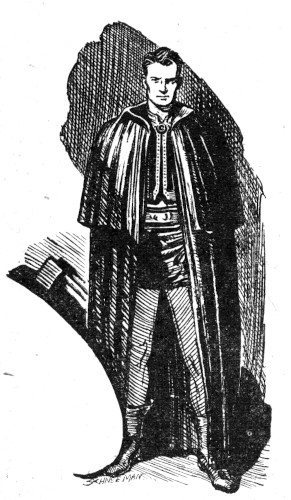
Therefore, the Lensman landed his battered craft at Strongheart's dock, loaded the equipment of the hijacker's boat into a hand truck, and went in to talk to Strongheart himself. "Supplies—Equipment—Metal—Bought and Sold" the sign read; but to any experienced eye it was evident that the sign was conservative indeed; that it did not cover Strongheart's business, by half. There were dance halls, there were long and ornate bars, there were rooms in plenty devoted to various games of so-called chance, and most significant, there were scores of the unmistakable cubicles in which the basest passions and lusts of man were satisfied.
"Welcome, stranger! Glad to see you. Have a good trip?" The divekeeper always greeted new customers effusively. "Have a drink on the house!"
"Business before pleasure," Kinnison replied, tersely. "Pretty good, yes. Here's some stuff I don't need any more that I aim to sell. What'll you gimme for it?"
The dealer inspected the suits and instruments, then bored a keen stare into the miner's eyes; a scrutiny under which Kinnison neither flushed nor wavered.
"Two hundred and fifty credits for the lot," Strongheart decided.
"Best you can do?"
"Tops. Take it or leave it."
"QX, they're yours. Gimme it."
"Why, this just starts our business, don't it? Ain't you got cores? Sure you have."
"Yeah, but not for no"—doubly and unprintably qualified—"damn robber. I like a louse, but you suit me altogether too damn well. Them suits alone, just as they lay, are worth a thousand."
"So what? For why go to insult me, a business man? Sure I can't give what that stuff is worth—who could? You ought to know how I got to get rid of hot goods. You killed, ain't it, the guys what owned it, so how could I treat it except like it's hot? Now be your age—don't burn out no jets," as the Lensman turned with a blistering, sizzling deep-space oath. "I know they shot first, they always do, but how does that change things? But keep your shirt on yet. I don't tell nobody nothing. For why should I? How could I make any money on hot goods if I talk too much with my mouth, huh? But on cores, that's something else again. Meteors is legitimate merchandise, and I pay you as much as anybody, maybe more."
"QX," and Kinnison tossed over his cores. He had sold the bandits' spacesuits and equipment deliberately, in order to minimize further killing.
This was his first visit to Miners' Rest, but he intended to become an habitue of the place; and before he would be accepted as a "regular" he knew that he would have to prove his quality. Buckoes and bullies would be sure to try him out. This way was much better. The tale would spread; and any gunman who had drilled two hijackers, dead-center through the face-plates, was not one to be challenged lightly. He might have to kill one or two, but not many, nor frequently.
And the fellow was honest enough in his buying of the metal. His Spaldings cut honest cores—Kinnison put micrometers on them to be sure of that fact. He did not under-read his torsiometer, and he weighed the meteors upon certified balances. He used Galactic Standard average-value-density tables, and offered exactly half of the calculated average value; which, Kinnison knew, was fair enough. By taking his metal to a mint or rare-metals station of the Patrol, any miner could get the precise value of any meteor, as shown by detailed analysis. However, instead of making the long trip and waiting—and paying—for the exact analyses, the miners usually preferred to take the "fifty-percent-of-average-density-value" which was the customary offer of the outside dealers.
Then, the meteors unloaded and hauled away. Kinnison dickered with Strongheart concerning the supplies he would need during his next trip; the hundred-and-one items which are necessary to make a tiny spaceship a self-contained, self-sufficient, warm and inhabitable worldlet in the immense and unfriendly vacuity of space. Here, too, the Lensman was overcharged shamelessly; but that, too, was routine. No one would, or could be expected to, do business in any such place as Miners' Rest in any sane or ordinary percentage of profit.
When Strongheart counted out to him the net proceeds of the voyage, Kinnison scratched reflectively at his whiskery chin.
"That ain't hardly enough, I don't think, for the real, old-fashioned, stem-winding bender I was figuring on," he ruminated. "I been out a long time and I was figuring on doing the thing up brown. Have to let go of my nugget, too, I guess. Kinda hate to—been packing it around quite a while—but here she is." He reached into his kit-bag and tossed over the lump of really precious metal. "Let you have it for fifteen hundred credits."
"Fifteen hundred! An idiot you must be, or you should think I'm one, I don't know?" Strongheart yelped, as he juggled the mass lightly from hand to hand. "Two hundred, you mean ... well two fifty, then, but that's an awful high bid, mister, believe me. I tell you, I couldn't give my own mother over three hundred—I'd lose money on the goods. You ain't tested it, what makes you think it's such a much?"
"No, and I notice you ain't testing it, neither," Kinnison countered. "Me and you both know metal well enough so we don't need to test no such nugget as that. Fifteen hundred or I flit to a mint and get full value for it. I don't have to stay here, you know, by all the nine hells of Valeria. There's millions of other places where I can get just as drunk and have just as good a time as I can here."
There ensued howls of protest, but Strongheart finally yielded, as the Lensman had known that he would. He could have forced him higher, but fifteen hundred was enough.
"Now, sir, just the guarantee and you're all set for a lot of fun." Strongheart's anguish had departed miraculously upon the instant of the deal's closing. "We take your keys, and when your money's gone and you come back to get 'em, to sell your supplies or your ship or whatever, we takes you, without hurting you a bit more than we have to, and sober you up, quick as scat. A room here, whenever you want it, included. Padded, sir, very nice and comfortable—you can't hurt yourself, possibly. We been in business here for years, with perfect satisfaction. Not one of our customers—and we got hundreds who never go nowhere else—have we ever let sell any of the stuff he had laid in for his next trip, and we never steal none of his supplies, neither. Only two hundred credits for the whole service, sir. Cheap, sir—very, very cheap at the price."
"Um-m-m"—Kinnison again scratched meditatively, this time at the nape of his neck—"I'll take your guarantee, I guess, because sometimes, when I get to going real good, I don't know just exactly when to stop. But I won't need no padded cell. Me, I don't never get violent. I always taper off on twenty-four units of bentlam. That gives me twenty-four hours on the shelf, and then I'm all set for another stretch out in the ether. You couldn't get me no benny, I don't suppose, and if you could it wouldn't be no damn good."
This was the critical instant, the moment the Lensman had been approaching so long and so circuitously. Mind was already reading mind, Kinnison did not need the speech which followed.
"Twenty-four units!" Strongheart exclaimed. That was a heroic dose—but the man before him was of heroic mold. "Sure of that?"
"Sure I'm sure; and if I get cut weight or cut quality I cut the guy's throat that peddles it to me. But I ain't out. I got a few good jolts left. Guess I'll use my own, and when it gets gone go buy some from a fella I know that's about half honest."
"Don't handle it myself," this, the Lensman knew, was at least partially true, "but I know a man who has a friend who can get it. Good stuff, too, in the original tins; special import from Corvina II. That'll be four hundred altogether. Gimme it and you can start your helling around."
"Whatja mean, four hundred?" Kinnison snorted. "Think I'm just blasting off about having some left, huh? Here's two hundred for your guarantee, and that's all I want out of you."
"Wait a minute. Jet back, miner!" Strongheart had thought that the newcomer was entirely out of his drug, and could therefore be charged eight prices for it. "How much do you get it for, mostly, the clear quill?"
"One credit per unit—twenty-four for the jolt," Kinnison replied tersely and truly. That was the prevailing price charged by retail peddlers. "I'll pay you that, and I don't mean twenty-five, neither."
"QX, gimme it. You don't need to be afraid of being bumped off or rolled here, neither. We got a reputation, we have."
"Yeah, I been told you run a high-class joint," Kinnison agreed, amiably. "That's why I'm here. But you wanna be mighty sure that the ape don't gyp me on the dose—looky here!"
As the Lensman spoke he shrugged his shoulders and the divekeeper leaped backward with a shriek; for faster than sight two ugly DeLameters had sprung into being in the miner's huge, dirty paws and were pointing squarely at his midriff!
"Put 'em away!" Strongheart yelled.
"Look 'em over first," and Kinnison handed them over, butts first. "These ain't like them buzzards' cap-pistols what I sold you. These are my own, and they're hot and tight. You know guns, don't you? Look 'em over, pal—real close."
The renegade did know weapons, and he studied these two with care, from the worn, rough-checkered grips and full-charged magazines to the burned, scarred, deeply-pitted orifices. Definitely and unmistakably they were weapons of terrific power; weapons, withal, which had seen hard and frequent service; and Strongheart personally could bear witness to the blinding speed of this miner's draw.
"And remember this," the Lensman went on. "I never yet got so drunk that anybody could take my guns away from me, and if I don't get a full jolt of benny I get mighty peevish."
The publican knew that—it was a characteristic of the drug—and he certainly did not want that miner running amuck with those two weapons in his highly capable hands. He would, he assured him, get his full dose.
And, for his part, Kinnison knew that he was reasonably safe, even in this hell of hells. As long as he was active he could take care of himself, in any kind of company, and he was fairly certain that he would not be slain, during his drug-induced physical helplessness, for the value of his ship and supplies. This one visit had yielded Strongheart a profit of four or five times what he had left, and each subsequent visit should yield a similar amount.
"The first drink's on the house, always," Strongheart derailed his guest's train of thought. "What'll it be? Tellurian ain't you—whiskey?"
"Uh-huh. Close, though—Aldebaran II. Got any good old Aldebaranian bolega?"
"No, but we got some good old Tellurian whiskey, about the same thing."
"QX—gimme a shot." He poured a stiff three fingers, downed it at a gulp, shuddered ecstatically, and emitted a wild yell. "Yip-yip-yipee! I'm Wild Bill Williams, the ripping, roaring, ritoo-dolorum from Aldebaran II, and this is my night to howl. Whee ... yow ... owrie-e-e!" Then, quieting down, "This rotgut wasn't never within a million parsecs of Tellus, but it ain't bad—not bad at all. Got the teeth and claws of holy old Klono himself—goes down your throat just like swallowing a mad Radeligian cateagle. Clear ether, pal, I'll be back shortly."
For his first care was to tour the entire Rest, buying scrupulously one good stiff drink, of whatever first came to hand, at each hot spot as he came to it.
"A good-will tour," he explained joyously to Strongheart upon his return. "Got to do it, pal, to keep 'em from calling down the curse of Klono on me, but I'm going to do all my serious drinking right here."
And he did. He drank various and sundry beverages, mixing them with a sublime disregard for consequences which surprised even the hard-boiled booze fighters assembled there. "Anything that'll pour," he declared, loud and often, and acted accordingly. Potent or mild; brewed, fermented, or distilled; loaded, cut, or straight, all one. "Down the hatch!" and down it went. Here was a two-fisted drinker whose like had not been seen for many a day, and his fame spread throughout the Rest.
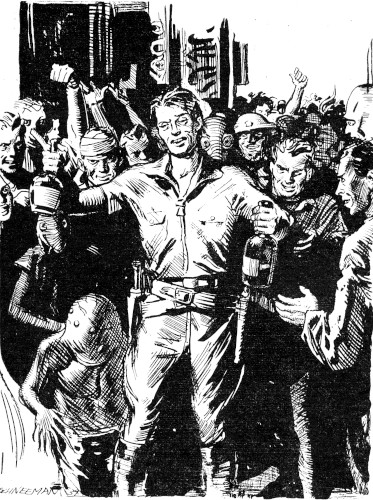
Miners' Rest was a meeting place for a dozen races of meteor miners—and Kim, with free-flowing liquor, made friends with them all!
Being a "happy jag," the more he drank the merrier he became. He bestowed largess hither and yon, in joyous abandon. He danced blithely with the hostesses and tipped them extravagantly. He did not gamble, explaining frequently and painstakingly that that wasn't none of his dish; he wanted to have fun with his money.
He fought, even, without anger or rancor; but gayly, laughing with Homeric gusto the while. He missed with terrific swings that would have felled a horse had they landed; only occasionally getting in, as though by chance, a paralyzing punch. Thus he accumulated an entirely unnecessary mouse under each eye and a sadly bruised nose.
However, his good humor was, as is generally the case in such instances, quite close to the surface, and was prone to turn into passionate anger with less real cause even than the trivialities which started the friendly fist-fights. During various of these outbursts of wrath he smashed four chairs, two tables, and assorted glassware.
But only once did he have to draw a deadly weapon—the news, as he had known it would, had spread abroad that with a DeLameter he was nobody to monkey with—and even then he didn't have to kill the guy. Just winging him—a little bit of a burn through his gun-arm—had been enough.
So it went for days. And finally, it was an immense relief that the hilariously drunken Lensman, his money gone to the last millo, went roistering up the street with a two-quart bottle in each hand; swigging now from one, then from the other; inviting bibulously the while any and all chance comers to join him in one last, fond drink. The sidewalk was not wide enough for him, by half; indeed, he took up most of the street. He staggered and reeled, retaining any semblance of balance only by a miracle and by his rigorous spaceman's training.
He threw away one empty bottle, then the other. Then, as he strode along, so purposefully and yet so futilely, he sang. His voice was not particularly musical, but what it lacked in quality of tone it more than made up in volume. Kinnison had a really remarkable voice, a bass of tremendous power, timbre, and resonance; and, pulling out all the stops, in tones audible for two thousand yards against the wind, he poured out his zestfully lusty reveler's soul. His song was a deep-space chanty that would have blistered the ears of any of the gentler spirits who had known him as Kimball Kinnison, of Earth; but which, in Miners' Rest, was merely a humorous and sprightly ballad.
Up the full length of the street he went. Then back, as he put it, to "Base." Even if this final bust did make him sicker at the stomach than a ground-gripper going free for the first time, the Lensman reflected, he had done a mighty good job. He had put Wild Bill Williams, meteor miner, of Aldebaran II, on the map in a big way. It wasn't a faked and therefore fragile identity, either; it was solidly, definitely his own.
Staggering up to his friend Strongheart he steadied himself with two big hands upon the latter's shoulders and breathed a forty-thousand-horsepower breath into his face.
"I'm boiled like a Tellurian hoot-owl," he announced, still happily. "When I'm this stewed I can't say 'partic-hic-hicu-lar-ly' without hick-hicking, but I would partic-hic-hicularly just like one more quart. How about me borrowing a hundred on what I'm going to bring in next time, or selling you—"
"You've had plenty, Bill. You've had lots of fun. How about a good chew of sleep-happy, huh?"
"That's a thought!" the miner exclaimed eagerly. "Lead me to it!"
A stranger came up unobtrusively and took him by one elbow. Strongheart took the other, and between them they walked him down a narrow hall and into a cubicle. And while he walked flabbily along Kinnison studied intently the brain of the newcomer. This was what he was after!
The ape had had a screen; but it was such a nuisance he took it off for a rest whenever he came here. No Lensman on Euphrosyne! They had combed everybody, even this drunken bum here. This was one place that no Lensman would ever come to; or, if he did, he wouldn't last long. Kinnison had been pretty sure that Strongheart would be in cahoots with somebody bigger than a peddler, and so it had proved. This guy knew plenty, and the Lensman was taking the information—all of it. Six weeks from now, eh? Just right—time to find enough metal for another royal binge here. And during that binge he would really do things.
Six weeks. Quite a while ... but ... QX. It would take some time yet, anyway, probably, before the Regional Directors would, like this fellow, get over their scares enough to relax a few of their most irksome precautions. And, as has been intimated, Kinnison, while impatient enough at times, could hold himself in check like a cat watching a mouse hole whenever it was really necessary.
Therefore, in the cell, he seated himself upon the bunk and seized the packet from the hand of the stranger. Tearing it open, he stuffed the contents into his mouth; and, eyes rolling and muscles twitching, he chewed vigorously; expertly allowing the potent juice to trickle down his gullet just fast enough to keep his head humming like a swarm of angry bees. Then, the cud sucked dry, he slumped down upon the mattress, physically dead to the world for the ensuing twenty-four G-P hours.
He awakened; weak, flimsy, and supremely wretched. He made heavy going to the office, where Strongheart returned to him the keys of his boat.
"Feeling low, sir." It was a statement, not a question.
"I'll say so," the Lensman groaned. He was holding his spinning head, trying to steady the gyrating universe. "I'd have to look up—'way, 'way up, with a number nine visiplate—to see a snake's belly in a swamp. Make that damn cat quit stomping his feet, can't you?"
"Too bad, but it won't last long." The voice was unctuous enough, but totally devoid of feeling. "Here's a pickup—you need it."
The Lensman tossed off the potion, without thanks, as was good technique in those parts. His head cleared miraculously, although the stabbing ache remained.
"Come in again next time. Everything's been on the green, ain't it, sir?"
"Uh-huh, very nice," the Lensman admitted. "Couldn't ask for better. I'll be back in five or six weeks, if I have any luck at all."
As the battered but stanch and powerful meteorboat floated slowly upward a desultory conversation was taking place in the dive he had left. At that early hour business was slack to the point of nonexistence, and Strongheart was chatting idly with a bartender and one of the hostesses.
"If more of the boys was like him, we wouldn't have no trouble at all," Strongheart stated with conviction. "Nice, quiet, easygoing—why, he didn't hardly damage a thing, for all his fun."
"Yeah, but at that maybe it's a good gag nobody riled him up too much," the barkeep opined. "He could be rough if he wanted to, I bet a quart. Drunk or sober, he's chain lightning with them DeLameters."
"He's so refined, such a perfect gentleman," sighed the woman. "He's nice." To her, he had been. She had had plenty of credits from the big miner, without having given anything save smiles and dances in return. "Them two guys he drilled must have needed killing, or he wouldn't have burned 'em."
And that was that. As the Lensman had intended, Wild Bill Williams was an old, known, and highly respected resident of Miners' Rest!
Out among the asteroids again; more muscle-tearing, back-breaking, lonesome labor. Kinnison did not find any more fabulously rich meteors—such things happen only once in a hundred lifetimes—but he was getting his share of heavy stuff. Then one day when he had about half a load there came, screaming in upon the emergency wave, a call for help; a call so loud that the ship broadcasting it must be very close indeed. Yes, there she was, right in his lap; startlingly large even upon the low-power plates of his spacetramp.
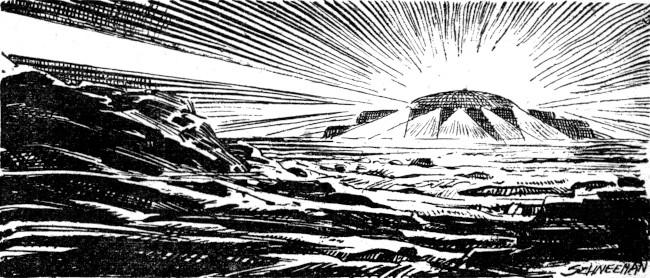
"Help! Spaceship Hyperion, position—" a rattling string of numbers. "Bergenholm dead, meteorite screens practically disabled, intrinsic velocity throwing us into the asteroids. Any spacetugs, any vessels with tractors—hurry!"
At the first word Kinnison had shoved his blast-lever full over. A few seconds of free flight, a minute of inert maneuvering that taxed to the utmost his Lensman's skill and powerful frame, and he was within the liner's air lock.
"I know something about Bergs!" he snapped. "Take this boat of mine and pull! Are you evacuating passengers?" he shot at the mate as they ran toward the engine room.
"Yes, but afraid we haven't boats enough—overloaded," was the gasped reply.
"Use mine—fill 'er up!" If the mate was surprised at such an offer from the despised spacerat he did not show it. There were many more surprises in store.
In the engine room Kinnison brushed aside a crew of helplessly futile gropers and threw in switch after switch. He looked. He listened. Above all, he pried into that sealed monster of power with all his sense of perception. How glad he was now that he and Thorndyke had struggled so long and so furiously with a balky Bergenholm on that trip to tempestuous Trenco! For as a result of that trip he did know Bergs, with a sure knowledge.
"Number four lead is shot somewhere," he reported. "Must be burned off where it clears the pilaster. Careless overhaul last time—got to take off the lower port third cover. No time for wrenches—get me a cutting beam, and get the lead out of your pants!"
The beam was brought on the double and the Lensman himself blasted away the designated cover. Then, throwing an insulated plate over the red-hot casing he lay on his back—"Hand me a light!"—and peered briefly upward into the bowels of the Gargantuan mechanism.
"I thought so," he grunted. "Piece of four-oh stranded, eighteen inches long. Ditmars number six clip ends, spaced to twenty inches between hole-centers. Myerbeer insulation on center section, doubled. Snap it up! One of you other fellows, bring me a short, heavy screwdriver and a Ditmars six wrench!"
The technicians worked fast and in a matter of seconds the stuff was there. The Lensman labored briefly but hugely; and much more surely than if he were dependent upon the rays of the hand-lamp to penetrate the smoky, steamy, greasy murk in which he toiled. Then:
"QX—give her the juice!" he snapped.
They gave it, and to the stunned surprise of all, she took it. The liner again was free!
"Kind of a jury-rigging I gave it, but it'll hold long enough to get you into port, sir," he reported to the captain in his sanctum, saluting crisply. He was in for it now, he knew, as the officer stared at him. But he couldn't have let that shipload of passengers get ground up into hamburger. Anyway, there was no way out.
In apparent reaction he turned pale and trembled, and the officer hastily took from his medicinal stores a bottle of choice brandy.
"Here, drink this," he directed, proffering the glass:
Kinnison did so. More, he seized the bottle from the captain's hand and drank that, too—all of it—a draft which would have literally turned him inside out a few months since. Then, to the captain's horrified disgust, he took from his filthy dungarees a packet of bentlam and began to chew it, idiotically blissful. Thence, and shortly, into oblivion.
"Poor devil—you poor, poor devil," the commander murmured, and had him put into a bunk.
When he had come to and had had his pickup, the captain came and regarded him soberly.
"You were a man once. An engineer, and a crackerjack; or I'm an oiler's pimp," he said levelly.
"Maybe," Kinnison replied, white and weak. "I'm all right yet, except once in a while—"
"I know," the captain frowned. "No cure?"
"Not a chance. Tried dozens. So—" and the Lensman spread out his hands in a hopeless gesture.
"Better tell me your name, anyway—your real name. That'll let your planet know that you aren't—"
"Better not," the sufferer shook his aching head. "Folks think I'm dead. Better let them keep on thinking so. Williams is the name, sir; William Williams, of Aldebaran II."
"As you say."
"How far are we from where I boarded you?"
"Close. Less than half a billion miles. This, the second, is our home planet: your asteroid belt is just outside the orbit of the fourth."
"I can hop it in an hour, easy. Guess I'll buzz off."
"As you say," the officer agreed, again. "But we'd like to—" and he extended a sheaf of currency.
"Rather not, sir, thanks. You see, the longer it takes me to earn another stake, the longer it'll be before—"
"I see. Thanks, anyway, for us all," and captain and mate helped the derelict embark. They scarcely looked at him, scarcely dared look at each other, but—
Kinnison, for his part, was almost content. This story, too, would get around. It would be in Miners' Rest before he got back there, and it would help—help a lot.
He did not see how he could possibly, or ever, let those officers know the truth, even though he realized full well that at that very moment they were thinking, pityingly:
"The poor devil—the poor, brave devil!"
XIII.
The Gray Lensman went back to his mining with a will and with unimpaired vigor, for his distress aboard the ship he had rescued had been sheerest acting. One small bottle of good brandy was scarcely a cocktail to the physique that had stood up under quart after quart of the crudest, wickedest, fieriest beverage known to space; that tiny morsel of bentlam—scarcely half a unit—affected him no more than a lozenge of licorice.
Three weeks. Twenty-one days, each of twenty-four G-P hours. At the end of that time, he had learned from the mind of the zwilnik that the Boskonian director of this, the Borovan solar system, would visit Miners' Rest, to attend some kind of a meeting. His informant did not know what the meeting was to be about, and he was not unduly curious about it. Kinnison, however, did and was.
The Lensman knew, or at least very shrewdly suspected, that that meeting was to be a regional conference of big-shot zwilniks; he was intensely curious to know all about everything that was to take place; and he was determined to be present.
Three weeks was lots of time. In fact, he should be able to complete his quota of heavy metal in two, or less. It was there, there was no question of that. Right out there were the meteors, unaccountable thousands of millions of them, and a certain proportion of them carried values. The more and the harder he worked, the more of these worthwhile wanderers of the void he would find. Therefore he labored long, hard, and rapidly, and his store of high-test meteors grew apace.
To such good purpose did he use beam and Spalding drill that he was ready more than a week ahead of time. That was QX—he'd much rather be early than late. Something might have happened to hold him up—things did happen, too often—and he had to be at that meeting!
Thus it came about that, a few days before the all-important date, Kinnison's battered treasure-hunter blasted herself down to her second landing at Strongheart's dock. This time the miner was welcomed, not as a stranger, but as a friend of long standing.
"Hi, Wild Bill!" Strongheart yelled at sight of the big spacehound. "Right on time, I see—glad to see you! Luck, too, I hope—lots of luck, and all good, I bet me—ain't it?"
"Ho, Strongheart!" the Lensman roared in return, pommeling the divekeeper affectionately. "Had a good trip, yeah—a fine trip. Struck a rich sector—twice as much as I got last time. Told you I'd be back in five or six weeks, and made it in five weeks and four days."
"Keeping tab on the days, huh?"
"I'll say I do. With a thirst like mine a guy can't do nothing else—I tell you all my guts're dryer than any desert on the whole of Mars. Well, what're we waiting for? Check this plunder of mine in and let me get to going places and doing things!"
The business end of the visit was settled with neatness and dispatch. Dealer and miner understood each other thoroughly, each knew what could and what could not be done to the other. The meteors were tested and weighed. Supplies for the ensuing trip were bought. The guarantee and twenty-four units of benny—QX. No argument. No hysterics. No bickering or quarreling or swearing. Everything on the green, all the way. Gentlemen and friends. Kinnison turned over his keys, accepted a thick sheaf of currency, and, after the first formal drink with his host, set out upon the self-imposed, superstitious tour of the other hot spots which would bring him favor—or at least would avert the active disfavor—of Klono, his spaceman's deity.
This time, however, that tour took longer. Upon his first ceremonial round he had entered each saloon in turn, had bought one drink of whatever was nearest, had tossed it down, and had gone on to the next place; unobserved and inconspicuous. Now, how different it all was! Wherever he went he was the center of attention.
Men who had met him before flung themselves upon him with whoops of welcome; men who had never seen him clamored to drink with him; women, whether or not they knew him, fawned upon him and brought into play their every lure and wile. For not only was this man a hero and a celebrity of sorts; he was a lucky—or a skillful—miner whose every trip resulted in wads of money big enough to clog the under jets of a Valerian freighter! Moreover, when he was lit up he threw it around regardless, and he was getting stewed as fast as he could swallow. Let's keep him here—or, if we can't do that, let's go along, wherever he goes!
This, too, was strictly according to the Lensman's expectations. Everybody knew that he did not do any serious drinking glass by glass at the bar, but bottle by bottle; that he did not buy individual drinks for his friends, but let them drink as deeply as they would from whatever container chanced then to be in hand; and his vast popularity gave him a sound excuse to begin his bottle-buying at the start instead of waiting until he got back to Strongheart's. He bought, then, several or many bottles and tins in each place, instead of a single drink. And, since everybody knew for a fact that he was a practically bottomless drinker, who was even to suspect that he barely moistened his gullet while the hangers-on were really emptying the bottles, flasks, and flagons?
And during his real celebration at Strongheart's, while he drank enough, he did not drink too much. He waxed exceedingly happy and frolicsome, as before. He was as profligate, as extravagant in tips. He had the same sudden flashes of hot anger. He fought enthusiastically and awkwardly, as Wild Bill Williams did, although only once or twice, that time; and he did not have to draw his DeLameters at all—he was so well known and so beloved! He sang as loudly and as raucously, and with the same good taste in madrigals.
Therefore, when the infiltration of thought-screened men warned him that the meeting was about to be called Kinnison was ready. He was in fact cold sober when he began his tuneful, last-two-bottles trip up the street, and he was almost as sober when he returned to "Base," empty of bottles and pockets, to make the usual attempt to obtain more money from Strongheart and to compromise by taking his farewell chew of bentlam instead.
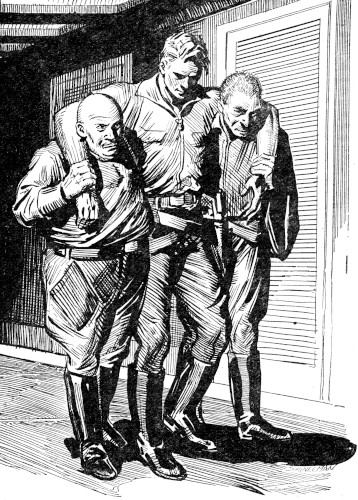
As any man should under that mighty dose of bentlam, Kim passed out—physically. But his mind reached out, even while the attendants carried his dulled body out—
Nor was he unduly put out by the fact that both Strongheart and the zwilnik were now wearing screens. He had taken it for granted that they might be, and had planned accordingly. He seized the packet as avidly as before, chewed its contents as ecstatically, and slumped down as helplessly and as idiotically. That much of the show, at least, was real. Twenty-four units of that drug will paralyze any human body, make it assume the unmistakable pose and stupefied mien of the bentlam-eater. But Kinnison's mind was not an ordinary one; the dose which would have rendered any bona-fide miner's brain as helpless as his body did not affect the Lensman's new equipment at all. Alcohol and bentlam together were bad, but the Lensman was sober. Therefore, if anything, the drugging of his body only made it easier to dissociate his new mind from it. Furthermore, he need not waste any thought in making it act. There was only one way it could act, now, and Kinnison let his new senses roam abroad without even thinking of the body he was leaving behind him.
In view of the rigorous orders from higher-up the conference room was heavily guarded by screened men; no one except old and trusted employees were allowed to enter it, and they were also protected. Nevertheless, Kinnison got in, by proxy.
A clever pickpocket brushed against a screened waiter who was about to enter the sacred precincts, lightning fingers flicking a switch. The waiter began to protest—then forgot what he was going to say, even as the pickpocket forgot completely the deed he had just done. The waiter in turn was a trifle clumsy in serving a certain big shot, but earned no rebuke thereby; for the latter forgot the offense almost instantly. Under Kinnison's control the director fumbled at his screen-generator for a moment, loosening slightly a small but important resister. That done, the Lensman withdrew delicately and the meeting was an open book.
"Before we do anything," the director began, "show me that all your screens are on." He bared his own—it would have taken an expert service man an hour to find that it was not functioning perfectly.
"Poppycock!" snorted the zwilnik. "Who in all the hells of space thinks that a Lensman would—or could—come to Euphrosyne?"
"No one can tell what this particular Lensman can or can't do, and nobody knows what he is doing until just before he dies. Hence the strictness. You've searched everybody here, of course?"
"Everybody," Strongheart averred, "even the drunks and dopes. The whole building is screened, besides the screens we're wearing."
"The dopes don't count, of course, provided they're really doped." No one, except the Gray Lensman himself, could possibly conceive of a Lensman being—not seeming to be, but actually being—a drunken sot, to say nothing of being a confirmed addict of any drug. "By the way, who is this Wild Bill Williams that I've been hearing about?"
Strongheart and his friend looked at each other and laughed.
"I checked up on him early," the zwilnik chuckled. "He isn't the Lensman, of course, but I thought at first he might be an agent. We frisked him and his ship thoroughly—no dice—and checked back on him as a miner, four solar systems back. He's clean, anyway; this is his second bender here. He's been guzzling everything in stock for a week, getting more pie-eyed every day, and Strongheart and I just put him to bed with twenty-four units of benny. You know what that means, don't you?"
"Your own benny or his?" the director asked.
"My own. That's why I know he's clean. All the other dopes are, too. The drunks we gave the bum's rush, like you told us to."
"QX. I don't think there's any danger, myself—I think that the hot-shot Lensman they're afraid of is still working Bronseca—but these orders not to take any chances at all come from 'way, 'way up."
"How about this new system they're working on, that nobody knows his boss any more?" asked the zwilnik. "Hooey, I call it."
"Not ready yet," the director answered. "They haven't been able to invent one that is safe enough for them and yet will handle the volume of work that has to be done. In the meantime, we're using these books. Cumbersome, but absolutely safe, they say, unless and until the enemy gets onto the idea. Then one group will go into the lethal chambers of the Patrol and the rest of us will use something else. Some say that this code can't be cracked without the key; others say any code can be read in time. Anyway here's your orders. Pass them along. Give me your stuff and we'll have supper and a few drinks."
They ate. They drank. They enjoyed an evening and a night of high revelry and low dissipation, each to his taste; each secure in the knowledge that his thought-screen was one-hundred-percent effective against the one enemy he really feared. Indeed, the screens were that effective—then. The Lensman, having learned from the director all that he knew, had restored the generator to full efficiency in the instant of his relinquishment of control.
Although the heads of the zwilniks, and therefore their minds, were secure against Kinnison's prying, the books of record were not. And, though his body was lying helpless, inert upon a drug-fiend's cot, his sense of perception read those books; if not as readily as though they were in his hands and open, yet readily enough. And, far off in space, a power-brained Lensman yclept Worsel, recorded upon imperishable metal a detailed account, including names, dates, facts, and figures, of all the doings of all the zwilniks of a solar system!
The information was coded, it is true; but, since Kinnison knew the key, it might just as well have been printed in English. To the later consternation of Narcotics, however, that tape was sent in under Lensman's seal—the spool could not be opened until the Gray Lensman gave the word.
In twenty-four hours Kinnison recovered from the effects of his debauch. He got his keys from Strongheart. He left the asteroid. He knew the mighty intellect with whom he had next to deal, he knew where that entity was to be found; but, sad to say, he had positively no idea at all as to what he was going to do or how he was going to do it.
Wherefore it was that a sense of relief tempered, with no small degree, the natural apprehension he felt upon receiving an insistent call from Port Admiral Haynes. Truly this must be something really extraordinary, for while during the long months of his service Kinnison had called the chief of staff scores of times, Haynes had never before lensed him.
"Kinnison! Haynes calling!" the message beat into his consciousness.
"Kinnison acknowledging Haynes, sir!" the Gray Lensman thought back.
"Am I interrupting anything important?"
"No, sir, not at all. I'm just doing a little flit."
"A situation has come up which we feel you should study, not only in person, but also without advance information or preconceived ideas. Is it at all possible for you to come into Prime Base immediately?"
"Yes, sir, eminently so. In fact, a little time right now might do me good in two ways—let me mull a job over, and let a nut mellow down to a point where maybe I can crack it. At your orders, sir!"
"Not orders, Kinnison!" the old man reprimanded him sharply. "No one gives unattached Lensmen orders. We request or suggest, but you are the sole judge as to where your greatest usefulness lies."
"Please believe, sir, that your requests are orders, to me," Kinnison replied in all seriousness. Then, more lightly, "Your calling me in suggests an emergency, and traveling in this miner's scow of mine is just a trifle faster than going afoot. How about sending out something with some legs to pick me up?"
"The Dauntless, for instance?"
"Oh—you've got her rebuilt already?"
"Yes."
"I'll bet she's a sweet clipper! She was a mighty slick stepper before; now she must have more legs than a centipede!"
And so it came about that in a region of space entirely empty of all other vessels as far as ultrapowerful detectors could reach, the Dauntless met Kinnison's tugboat. The two went inert and maneuvered briefly, then the immense warship engulfed her tiny companion and flashed away.
"Hi, Kim, you old son-of-a-space-flea!" A general yell arose at sight of him, and irrepressible youth rioted, regardless of Regs, in this reunion of old comrades-in-arms who were yet scarcely more than boys in years.
"His Nibs says for you to call 'im, Kim, when we're about an hour out from Prime Base," Commander Maitland informed his classmate irreverently, as the Dauntless neared the Solarian System.
"Plate or Lens?"
"Didn't say—as you like, I suppose."
"Plate then, I guess—don't want to butt in."
In a few moments chief of staff and Gray Lensman were in image face-to-face.
"How are you making out, Kinnison?" The Port Admiral studied the young man's face intently, gravely, line by line. Then, upon his Lens, "We heard about the shows you put on, clear over here on Tellus. A man can't drink and dope the way you did without suffering consequences. I've been wondering if even you can fight it off. How about it? How do you feel now?"
"Some craving, of course," Kinnison replied, shrugging his shoulders. "That can't be helped—you can't make an omelette without breaking eggs. However, I can assure you as a fact that it's nothing I can't lick. I've got it pretty well boiled out of my system already."
"Mighty glad to hear that, son. Only Ellison and I know who Wild Bill Williams really is. You had us scared stiff for a while." Then, speaking aloud:
"I would like to have you come to my office as soon as is convenient after you land."
"I'll be there, chief, two minutes after we hit the bumpers," and he was.
"Right of way, Norma?" he asked, waving an airy salute at the attractive young woman in Haynes' outer office.
"Go right in, Lensman Kinnison, he's waiting for you," and opening the door for him, she stood aside as he strode into the sanctum.
The Port Admiral returned the younger man's punctilious salute, then the two shook hands warmly before Haynes referred to the third man in the room.
"Navigator Xylpic, this is Lensman Kinnison, unattached. Sit down, please; this may take some time. Now, Kinnison, I want to tell you that ships have been disappearing, right and left, disappearing without sending out an alarm or leaving a trace. Convoying makes no difference, as the escorts also disappear—"
"Any with the new projectors?" Kinnison flashed the question via Lens—this was nothing to talk about aloud.
"No," came the reassuring thought in reply. "Every one bottled up tight until we find out what it's all about. Sending out the Dauntless after you was the only exception."
"Fine. You shouldn't have taken even that much chance." This interplay of thought took but an instant; Haynes went on with scarcely a break in his voice:
"—with no more warning or report than the freighters and liners they are supposed to be protecting. Automatic reporting also fails—the instruments simply stop sending. The first and only sign of light—if it is such a sign; which, frankly, I doubt—came shortly before I called you in, when Xylpic here came to me with a tall story."
Kinnison looked then at the stranger. Pink. Unmistakably a Chickladorian—pink all over. Bushy hair, triangular eyes, teeth, skin; all that same peculiar color. Not the flush of red blood showing through translucent skin, but opaque pigment; the brick-reddish pink so characteristic of the near-humanity of that planet.
"We have investigated this Xylpic thoroughly." Haynes went on, discussing the Chickladorian as impersonally as though he were upon his home planet instead of there in the room, listening. "The worse of it is that the man is absolutely honest—or at least, he himself believes that he is—in telling this yarn. Also, except for this one thing—this obsession, fixed idea, hallucination, call it what you like; it seems incredible that it can be a fact—he not only seems to be, but actually is, absolutely sane.
"Now, Xylpic, tell Kinnison what you have told the rest of us. And Kinnison, I hope that you can make sense of it—none of the rest of us can."
"QX. Go ahead, I'm listening." But Kinnison did far more than listen. As the fellow began to talk the Gray Lensman insinuated his mind into that of the Chickladorian. He groped for moments, seeking the wave-length; then he, Kimball Kinnison, was actually reliving with the pink man an experience which harrowed his very soul.
"The Second Navigator of a Radeligian vessel died in space, and when it landed on Chickladoria I took the berth. About a week out, the whole crew went mad, all at once. The first I knew of it was when the pilot on duty beside me left his board, picked up a stool, and smashed the automatic recorder. Then he went inert and neutralized all the controls.
"I yelled at him, but he didn't answer me, and all the men in the control room acted funny. They just milled around like men in a trance. I buzzed the captain, but he didn't acknowledge either. Then the men around me left the control room and went down the companionway toward the main lock. I was scared—my skin prickled and the hair on the back of my neck stood straight up—but I followed along, quite a ways behind, to see what they were going to do. The captain, all the rest of the officers, and the whole crew joined them in the lock. Everybody was acting kind of crazy, and as if they were in an awful hurry to get somewhere.
"I didn't go any nearer—I wasn't going to go out into space without a suit on. I went back into the control room to get at a spy ray, then changed my mind. That was the first place they would come to if they boarded us, as they probably would—other ships had disappeared in space, plenty of them. Instead, I went over to a lifeboat and used its spy. And I tell you, sirs, there was nothing there—nothing at all!" The stranger's voice rose almost to a shriek, his mind quivered in an ecstasy of horror.
"Steady, Xylpic, steady," the Gray Lensman said, quietingly. "Everything you've said so far makes sense. It all fits right into the matrix. Nothing to go off the beam about, at all."
"What! You believe me!" the Chickladorian stared at Kinnison in amazement, an emotion very evidently shared by the Port Admiral.
"Yes," the man in gray leather asserted. "Not only that, but I have a very fair idea of what's coming next. G. A."
"The men walked out into space." The pink man offered this information diffidently, although positively—an oft-repeated but starkly incredible statement. "They did not float outward, sirs, they walked; and they acted as if they were breathing air, not space. And as they walked they sort of faded out; became thin, mistylike. This sounds crazy, sir"—to Kinnison alone—"I thought then maybe I was cuckoo, and everybody around here thinks I am now, too. Maybe I am nuts, sir—I don't know."
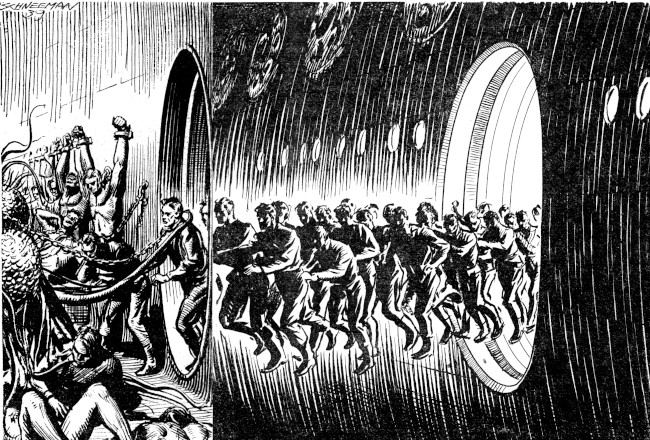
"I saw them walk out of the ship into space—but as though they walked on something, something invisible. And they walked into that ghost-ship, the hell-ship from nowhere—"
"I do. You aren't," Kinnison said, calmly.
"Well, and here comes the worst of it, they walked around just as though they were in a ship, growing fainter all the time. Then some of them lay down and something began to skin one of them—skin him alive, sir—but there was nothing there at all. I ran, then. I got into the fastest lifeboat on the far side and gave her all the oof she'd take. That's all, sir."
"Not quite all, Xylpic, unless I'm badly mistaken. Why didn't you tell the rest of it while you were at it?"
"I didn't dare to, sir. If I'd told any more they would have known I was crazy instead of just thinking so—" He broke sharply, his voice altering strangely as he went on: "What makes you think there was anything more, sir? Do you—" The question trailed off into silence.
"I do. If what I think happened really did happen, there was more—quite a lot more—and worse. Wasn't there?"
"I'll say there was!" The navigator almost exploded in relief. "Or rather, I think now that there was. But I can't describe any of it very well—everything was getting fainter all the time, and I thought that I must be imagining most of it."
"You weren't imagining a thing—" the Lensman began, only to be interrupted by Haynes.
"Hell's jingling bells!" that worthy almost shouted. "If you know what it was, tell me!"
"Think I know, but not quite sure yet—got to check it. Can't get it from him—he's told everything he really knows. He didn't really see anything, it was practically invisible. Even if he had tried to describe the whole performance you wouldn't have recognized it. Nobody could have, except Worsel and I, and possibly Van Buskirk. I'll tell you the rest of what actually happened and Xylpic can tell us if it checks." His features grew taut, his voice became hard and chill. "I saw it done, once. Worse, I heard it. Saw it and heard it, clear and plain. Also, I knew what it was all about, so I can describe it a lot better than Xylpic possibly can.
"Every man of that crew was killed by torture. Some were flayed alive, as Xylpic said; then they were carved up, slowly and piecemeal. Some were stretched, pulled apart by chains and hooks, on racks. Others twisted on frames. Boiled, little by little. Picked apart, bit by bit. Gassed. Eaten away by corrosives, one molecule at a time. Pressed out flat, as though between two plates of glass. Whipped. Scourged. Beaten gradually to a pulp. Other methods, lots of them—indescribable. All slow, though, and extremely painful. Greenish-yellow light, showing the aura of each man as he died. Beams from somewhere—possibly invisible—consuming the auras. Check, Xylpic?"
"Yes, sir, it checks!" The Chickladorian exclaimed in profound relief; then added, carefully: "That is, that's the way the torture was, exactly, sir, but there was something funny, a difference, about their fading away. I can't describe what was funny about it, but it didn't seem so much that they became invisible as that they went away, sir, even though they didn't go any place."
"That's due to the way that system of invisibility works. Got to be—nothing else will fit into—"
"The Overlords of Delgon!" Haynes rasped, sharply. "But if that's a true picture, how in all the hells of space did this Xylpic, alone of all the ship's personnel, get away clean? Tell me that!"
"Simple!" the Gray Lensman snapped back as sharply. "The rest were all Radeligians—he was the only Chickladorian aboard. The Overlords simply didn't know that he was there. They didn't feel him at all. Chickladorians think on a wave nobody else in the Galaxy uses—you must have noticed that when you felt of him with your Lens. It took me half a minute to synchronize with him.
"As for his escape, that makes sense, too. The Overlords are slow workers and when they're playing that game they really concentrate on it—they don't pay any attention to anything else. By the time they got done and were ready to take over the ship, he could be almost anywhere."
"But he says that there was no ship there—nothing at all!" Haynes protested.
"Invisibility isn't hard to understand," Kinnison countered. "We've almost got it ourselves—we undoubtedly could have it as good as that, with a little more work on it. There was a ship there, beyond question. Close. Hooked on with magnets, and with a spacetube, lock to lock.
"The only peculiar part of it, and the bad part, is something you haven't mentioned yet. What would the Overlords—if, as we must assume, some of them got away from Worsel and his crew—be doing with a ship? They never had any spaceships that I ever knew anything about, nor any other mechanical devices requiring any advanced engineering skill. Also, and most important, they never did and never could invent or develop such an invisibility apparatus as that."
Kinnison fell silent, and while he frowned in thought Haynes dismissed the Chickladorian, with orders that his every want be supplied.
"What do you deduce from those facts?" the Port Admiral presently asked.
"Plenty," the Gray Lensman said, darkly. "I smell a rat. In fact, it stinks to high Heaven. Boskone."
"You may be right," the chief of staff conceded. It was hopeless, he knew, for him to try to keep up with this man's mental processes. "But why, and above all, how?"
"'Why' is easy. They both owe us a lot, and want to pay us in full. Both hate us all to pieces. 'How' is immaterial. One found the other, some way. They're together, just as sure as hell's a mantrap, and that's what matters. It's bad. Very, very bad, believe me."
"Orders?" asked Haynes. He was a big man; big enough to ask instructions from anyone who knew more than he did—big enough to make no bones of such asking.
"One does not give orders to the Port Admiral," Kinnison mimicked him lightly, but meaningly. "One may request, perhaps, or suggest, but—"
"Skip it! I'll take a club to you yet, you young hellion! You said you'd take orders from me. QX—I'll take 'em from you. What are they?"
"No orders yet, I don't think—" Kinnison ruminated. "No ... not until after we investigate. I'll have to have Worsel and Van Buskirk; we're the only three who have had experience. We'll take the Dauntless, I think—it'll be safe enough. Thought-screens will stop the Overlords cold, and a scrambler will take care of the invisibility business if they use the same principle we do, and they very probably do."
"Safe enough, then, you think, to let traffic resume, if they're protected with screens?"
"I wouldn't say so. They've got Boskonian superdreadnoughts now to use if they want to, and that's something else to think about. Another week or so won't hurt much—better wait until we see what we can see. I've been wrong once or twice before, too, and I may be again."
He was. Although his words were conservative enough, he was practically certain in his own mind that he knew all the answers. But how wrong he was—how terribly, how tragically wrong! For even his mentality had not as yet envisaged the incredible actuality; his deductions and perceptions fell far, far short of the appalling truth!
XIV.
The fashion in which the Overlords of Delgon had come under the ægis of Boskone, while obscure for a time, was in reality quite simple and logical; for upon distant Jarnevon the Eich had profited signally from Eichlan's disastrous raid upon Arisia. Not exactly in the sense suggested by Eukonidor, the Arisian guardian, it is true, but profited nevertheless. They had learned that thought, hitherto considered only a valuable adjunct to achievement, was actually an achievement in itself; that it could be used as a weapon of surpassing power.
Eukonidor's homily, as he more than suspected at the time, might as well never have been uttered, for all the effect it had upon the life or upon the purpose in life of any single member of the race of the Eich. Eichmil, who had been Second of Boskone, was now First; the others were advanced correspondingly; and a new Eighth and Ninth had been chosen to complete the roster of the council which was Boskone.
"The late Eichlan," Eichmil stated harshly after calling the new Boskone to order—which event took place within a day after it became apparent that the two bold spirits had departed to a bourne from which there was to be no returning—"erred seriously, in fact fatally, in underestimating an opponent, even though he himself was prone to harp upon the danger of that very thing.
"We are agreed that our objectives remain unchanged; and also that greater circumspection must be used until we have succeeded in discovering the hitherto unsuspected potentialities of pure thought. We will now hear from one of our new members, the Ninth, also a psychologist, who most fortunately had been studying this situation even before the inception of the expedition which yesterday came to such a catastrophic end."
"It is clear," the Ninth of Boskone began, "that Arisia is at present out of the question. Perceiving the possibility of some such dénouement—an idea to which I repeatedly called the attention of my predecessor psychologist, the late Eighth—I have been long at work upon certain alternative measures.
"Consider, please, that we learned first of the thought-screens from Helmuth; who was then of the opinion that they were first used in the Tellurian Galaxy by the natives of Velantia. This belief was amended later, in discredited reports, to one that said devices did in fact originate upon Arisia. This later conclusion we may now accept as a fact, since the Arisians could and did break such screens by the application of mental forces either of greater magnitude than they could withstand or of some new and as yet unknown composition or pattern.
"Such screens were, however, and probably still are, used largely and commonly upon the planet Velantia. Therefore they must have been both necessary and adequate. The deduction is, I believe, defensible that they were used as a protection against entities who were, and who still may be, employing against the Velantians the weapons of pure thought which we wish to investigate and to acquire.
"I propose, then, that I and a few others of my selection continue this research, not upon Arisia, but upon Velantia and perhaps elsewhere."
To this suggestion there was no demur and a vessel set out forthwith. The visit to Velantia was simple and created no untoward disturbance whatever. In this connection it must be remembered that the natives of Velantia, then in the early ecstasies of discovery by the Galactic Patrol and the consequent acquisition of inertialess flight, were fairly reveling in visits to and from the widely-variant peoples of the planets of hundreds of other suns. It must be borne in mind that, since the Eich were, if anything, physically more like the Velantians than were the men of Tellus, the presence of a group of such entities upon the planet would create no more interest or comment than that of a group of human beings. Therefore that fateful visit went unnoticed at the time, and as it was only by long and arduous research, after Kinnison had deduced that some such visit must have been made, that it was shown to have been an actuality.
Space forbids any detailed account of what the Ninth of Boskone and his fellows did, although that story of itself would be no mean epic. Suffice it to say, then, that they became well acquainted with the friendly Velantians; they studied and they learned. Particularly did they seek information concerning the noisome Overlords of Delgon, although the natives did not care to dwell at any length upon the subject.
"Their power is broken," they were wont to inform the questioners, with airy flirtings of tail and wing. "Every known cavern of them, and not a few hitherto unknown caverns, have been blasted out of existence. Whenever one of them dares to obtrude his mentality upon any one of us he is at once hunted down and slain. Even if they are not all dead, as we think, they certainly are no longer a menace to our peace and security."
Having secured all the information available upon Velantia, the Eich went to Delgon, where they devoted all the power of their admittedly first-grade minds and all the not inconsiderate resources of their ship to the task of finding and uniting the remnants of what had once been a flourishing race, the Overlords of Delgon.
The Overlords! That monstrous, repulsive, amoral race which, not excepting even the Eich themselves, achieved the most universal condemnation ever to have been given in the long history of the Galactic Union. The Eich, admittedly deserving of the fate which was theirs, had and have their apologists. The Eich were wrong-minded, all admit. They were anti-social, blood-mad, obsessed with an insatiable lust for power and conquest which nothing except complete extinction could extirpate. Their evil attributes were legion. They were, however, brave. They were organizers par excellence. They were, in their own fashion, creators and doers. They had the courage of their convictions and followed them to the bitter end.
Of the Overlords, however, nothing good has ever been said. They were debased, cruel, perverted to a degree starkly unthinkable to any normal intelligence, however housed. In their native habitat they had no weapons, nor need of any. Through sheer power of mind they reached out to their victims, even upon other planets, and forced them to come to the gloomy caverns in which they had their being. There the victims were tortured to death in numberless unspeakable fashions, and while they died the captors fed, ghoulishly, upon the departing life principle of the sufferer.
The mechanism of that absorption is entirely unknown; nor is there any adequate evidence as to what end was served by it in the economy of that horrid race. That these orgies were not essential to their physical well-being is certain, since many of the creatures survived for a long time after the frightful rites were rendered impossible.
Be that as it may, the Eich sought out and found many surviving Overlords. The latter tried to enslave the visitors and to bend them into their hideously sadistic purposes, but to no avail. Not only were the Eich protected by thought-screens; they had minds of a fierce power almost, if not quite, equal to the Overlord's own. And, after these first overtures had been made and channels of communication established, the alliance was a natural.
Much has been said and written of the binding power of love. That, and other noble emotions, have indeed performed wonders. It seems to this historian, however, that all too little has been said of the effectiveness of pure hate as a cementing material. Probably for good and sufficient moral reasons; perhaps because—and for the best—its application has been of comparatively infrequent occurrence. Here, in the case in hand, we have history's best example of two entirely dissimilar peoples working efficiently together under the urge, not of love or of any other lofty sentiment, but of sheer, stark, unalloyed and corrosive, but common, hate.
Both hated civilization and everything pertaining to it. Both wanted revenge; wanted it with a searing, furious need almost tangible; a gnawing, burning lust which neither countenanced palliation nor brooked denial. And above all, both hated vengefully, furiously, esuriently—every way except blindly—an as yet unknown and unidentified wearer of the million-times accursed Lens of the Galactic Patrol!
The Eich were hard, ruthless, cold; not even having such words in their language as "conscience," "mercy," or "scruple." Their hatred of the Lensman was then a thing of an intensity unknowable to any human mind. Even that emotion, however, grim as it was and fearsome, paled beside the passionately vitriolic hatred of the Overlords of Delgon for the being who had been the Nemesis of their race.
And when the sheer mental power of the Overlords, unthinkably great as it was and operative withal in a fashion sheerly incomprehensible to us of civilization, was combined with the ingenuity, resourcefulness, and drive, as well as with the scientific ability of the Eich, the results would in any case have been portentous indeed.
In this case they were more than portentous, and worse. Those prodigious intellects, fanned into fierce activity by fiery blasts of hatred, produced a thing incredible.
XV.
Before the Dauntless was serviced for the flight into the unknown Kinnison changed his mind. He was vaguely troubled about the trip. It was nothing as definite as a "hunch"; hunches are, the Gray Lensman knew, the results of the operation of an extrasensory perception possessed by all of us in greater or lesser degree. It was probably not an obscure warning to his super-sense from another, more pervasive dimension. It was, he thought, a repercussion of the doubt in Xylpic's mind that the fading out of the men's bodies had been due to simple invisibility.
"I think I'd better go alone, chief," he informed the Port Admiral one day. "I'm not quite as sure as I was as to just what they've got."
"What difference does that make?" Haynes demanded.
"Lives," was the terse reply.
"Your life is what I'm thinking about. You'll be safer with the big ship, you can't deny that."
"We-ll, perhaps. But I don't want—"
"What you want is immaterial."
"How about a compromise? I'll take Worsel and Van Buskirk. When the Overlords hypnotized him that time it made Bus so mad that he's been taking treatments from Worsel. Nobody can hypnotize him now, Worsel says, not even an Overlord."
"No compromise. I can't order you to take the Dauntless, since your authority is transcendent. You can take anything you like. I can, however, and shall, order the Dauntless to ride your tail wherever you go."
"QX, I'll have to take her then." Kinnison's voice grew somber. "But suppose half the crew don't get back—and that I do?"
"Isn't that what happened on the Brittania?"
"No," came flat answer. "We were all taking the same chance then—it was the luck of the draw. This is different."
"How different?"
"I've got better equipment than they have. I'd be a murderer, cold."
"Not at all, no more than then. You had better equipment then, too, you know, although not as much of it. Every commander of men has that same feeling when he sends men to death. But put yourself in my place. Would you send one of your best men, or let him go alone on a highly dangerous mission when more men or ships would improve his chances? Answer that, honestly."
"Probably I wouldn't," Kinnison admitted, reluctantly.
"QX. Take all the precautions you can—but I don't have to tell you that. I know you will."
Therefore it was the Dauntless in which Kinnison set out a day or two later. With him were Worsel and Van Buskirk, as well as the vessel's full operating crew of Tellurians. As they approached the region of space in which Xylpic's vessel had been attacked every man in the crew got his armor in readiness for instant use, checked his side arms, and took his emergency battle station. Kinnison turned then to Worsel.
"How d'you feel, fellow old snake?" he asked.
"Scared," the Velantian replied, sending a rippling surge of power the full length of the thirty-foot-long cable of supple, although almost steel-hard flesh that was his body. "Scared to the tip of my tail. Not that they can treat me as they did before—we three, at least, are safe from their minds—but at what they will do. Whatever it is to be, it will not be what we expect. They certainly will not do the obvious."
"That's what's clogging my jets." The Lensman agreed. "As a flapper told me once, I'm getting the screaming meamies."
"That's what you mugs get for being so brainy," Van Buskirk put in. With a flick of his massive wrist he brought his thirty-pound spaceax to the "ready" as lightly as though it were a Tellurian dress saber. "Bring on your Overlords—squish! Just like that!" and a whistling sweep of his atrocious weapon was illustration enough.
"May be something in that, too, Bus," he laughed. Then, to the Velantian, "About time to tune in one of 'em, I guess."
He was in no doubt whatever as to Worsel's ability to reach them. He knew that that incredibly powerful mind, without Lens or advanced Arisian instruction, had been able to cover eleven solar systems: he knew that, with his present ability, Worsel could cover half of space!
Although every fiber of his being shrieked protest against contact with the hereditary foe of his race, the Velantian put his mind en rapport with the Overlords and sent out his thought. He listened for seconds, motionless, then glided across the room to the thought-screened pilot and hissed directions. The pilot altered his course sharply and gave her the gun.
"I'll take her over now," Worsel said, presently. "It'll look better that way—more as though they had us all under control."
He cut the Bergenholm, then set everything on zero—the ship hung, inert and practically motionless, in space. Simultaneously twenty unscreened men—volunteers—dashed toward the main air lock, overcome by some intense emotion.
"Now! Screens on! Scramblers!" Kinnison yelled; and at his words a thought-screen enclosed the ship; high-powered scramblers—within whose fields no invisibility apparatus could hold—burst into action. Then the vessel was, right beside the Dauntless, a Boskonian in every line and member!
"Fire!"
But even as she appeared, before a firing-stud could be pressed, the enemy craft almost disappeared again; or rather, she did not really appear at all, except as the veriest wraith of what a good, solid ship of space-alloy ought to be. She was a ghost ship, as unsubstantial as fog. Mist, tenuous, immaterial; the shadow of a shadow. A dream ship, built of the gossamer of dreams, manned by figments of horror recruited from sheerest nightmare. Not invisibility this time, Kinnison knew with a profound shock. Something else—something entirely different—something utterly incomprehensible. Xylpic had said it as nearly as it could be put into understandable words—the Boskonian ship was leaving, although it was standing still! It was monstrous—it couldn't be done!
Then, at a range of only feet instead of the usual "point-blank" range of hundreds of miles, the tremendous secondaries of the Dauntless cut loose. At such a ridiculous range as that—why, the screens themselves kept anything farther away from them than that ship was—they couldn't miss. Nor did they; but neither did they hit. Those ravening beams went through and through the tenuous fabrication which should have been a vessel, but they struck nothing whatever. They went past—entirely harmlessly past—both the ship itself and the wraithlike but unforgettable figures which Kinnison recognized at a glance as Overlords of Delgon. His heart sank with a thud. He knew when he had had enough; and this was altogether too much.
"Go free!" he rasped. "Give 'er the oof!"
Energy poured into and through the great Bergenholm, but nothing happened; ship and contents remained inert. Not exactly inert, either, for the men were beginning to feel a new and unique sensation.
Energy raved from the driving jets, but still nothing happened. There was none of the thrust, none of the reaction of an inert start; there was none of the lashing, quivering awareness of speed which affects every mind, however hardened to free flight, in the instant of change from rest to a motion many times faster than that of light.
"Armor! Thought-screens! Emergency stations all!" Since they could not run away from whatever it was that was coming, they would face it.
And something was happening now, there was no doubt of that. Kinnison had been seasick and airsick and spacesick. Also, since cadets must learn to be able to do without artificial gravity, pseudo-inertia, and those other refinements which make space liners so comfortable, he had known the nausea and the queasily terrifying endless-fall sensations of weightlessness, as well as the even worse outrages of the sensibilities incident to inertialessness in its crudest, most basic applications. He thought that he was familiar with all the untoward sensations of every mode of travel known to science. This, however, was something entirely new.
He felt as though he were being compressed; not as a whole, but atom by atom. He was being twisted—cork-screwed in a monstrously obscure fashion which permitted him neither to move from his place nor to remain where he was. He hung there, poised, for hours—or was it for a thousandth of a second? At the same time he felt a painless, but revolting transformation progress in a series of waves throughout his entire body; a rearrangement, a writhing, crawling distortion, an incomprehensibly impossible extrusion of each ultimate corpuscle of his substance in an unknowable and non-existent direction!
As slowly—or as rapidly—as the transformation had waxed, it waned. He was again free to move. As far as he could tell, everything was almost as before. The Dauntless was about the same; so was the almost-invisible ship attached to her so closely. There was, however, a difference. The air seemed thick—familiar objects were seen blurrily, dimly—distorted—outside the ship there was nothing except a vague blur of grayness—no stars, no constellations.
A wave of thought came beating into his brain. He had to leave the Dauntless. It was most vitally important to go into that dimly-seen companion vessel without an instant's delay! And even as his mind instinctively reared a barrier, blocking out the intruding thought, he recognized it for what it was—the summons of the Overlords!
But how about the thought-screens, he thought in a semidaze, then reason resumed accustomed sway. He was no longer in space—at least, not in the space he knew. That new, indescribable sensation had been one of acceleration—when they attained constant velocity it stopped. Acceleration—velocity—in what? To what? He did not know. Out of space as he knew it, certainly. Time was distorted, unrecognizable. Matter did not necessarily obey the familiar laws. Thought? QX—thought, lying in the subether, probably was unaffected. Thought-screen generators, however, being material might not—in fact, did not—work. Worsel, Van Buskirk, and he did not need them, but those other poor devils—
He looked at them. The men—all of them, officers and all—had thrown off their armor, thrown away their weapons, and were again rushing toward the lock. With a smothered curse Kinnison followed them, as did the Velantian and the giant Dutch-Valerian. Into the lock. Through it, into the almost invisible spacetube, which, he noticed, was floored with a much denser-appearing substance. The air felt heavy; dense, like water, or even more like metallic mercury. It breathed, however, QX. Into the Boskonian ship, along corridors, into a room which was precisely such a torture chamber as Kinnison had described. There they were, ten of them; ten of the dragonlike, reptilian Overlords of Delgon!
They moved slowly, sluggishly, as did the Tellurians, in that thick, dense medium which was not, could not be, air. Ten chains were thrown, like pictures in slow motion, about ten human necks; ten entranced men were led unresistingly to anguished doom. This time the Gray Lensman's curse was not smothered—with a blistering deep-space oath he pulled his DeLameter and fired—once, twice, thrice. No soap—he knew it, but he had to try. Furious, he launched himself. His taloned fingers, ravening to tear, went past, not around, the Overlord's throat; and the scimitared tail of the reptile, fierce-driven, apparently went through the Lensman, screens, armor, and brisket, but touched none of them in passing. He hurled a thought a more disastrous bolt by far than he had sent against any mind since he had learned the art. In vain—the Overlords, themselves masters of mentality, could not be slain or even swerved by any forces at his command.
Kinnison reared back then in thought. There must be some ground, some substance common to the planes or dimensions involved, else they could not be here. The deck, for instance, was as solid to his feet as it was to the enemy. He thrust out a hand at the wall beside him—it was not there. The chains, however, held his suffering men, and the Overlords held the chains. The knives, also and the clubs, and the other implements of torture being wielded with such peculiarly horrible slowness.
To think was to act. He leaped forward, seized a maul, and made as though to swing it in terrific blow; only to stop, shocked. The maul did not move! Or rather, it moved, but so slowly, as though he were hauling it through putty! He dropped the handle, shoving it back, and received another shock, for it kept on coming under the urge of his first mighty heave—kept coming, knocking him aside as it came!
Mass! Inertia! The stuff must be a hundred times as dense as platinum!
"Bus!" he flashed a thought to the staring Valerian. "Grab one of these clubs here—a little one, even you can't swing a big one—and get to work!"
As he thought, he leaped again; this time for a small, slender knife, almost a scalpel, but with a long, keenly thin blade. Even though it was massive as a dozen broadswords he could swing it and he did so; plunging lethally as he swung. A full-arm sweep—razor-edge shearing, crunching through plated, corded throat—grisly head floating one way, horrid body the other!
Then an attack in waves of his own men! The Overlords knew what was toward. They commanded their slaves to abate the nuisance, and the Gray Lensman was buried under an avalanche of furious, although unarmed, humanity.
"Chase 'em off me, will you, Worsel?" Kinnison pleaded. "You're husky enough to handle 'em all—I'm not. Hold 'em off while Bus and I polish off this crowd, huh?" And Worsel did so.
Van Buskirk, scorning Kinnison's advice, had seized the biggest thing in sight, only to relinquish it sheepishly—he might as well have attempted to wield a bridge-girder! He finally selected a tiny bar, only half an inch in diameter and scarcely six feet long; but he found that even this sliver was more of a bludgeon than any spaceaxe he had ever swung.
Then the armed pair went joyously to war, the Tellurian with his knife, the Valerian with his magic wand. When the Overlords saw that a fight to the finish was inevitable they also seized weapons and fought with the desperation of the cornered rats they were. This, however, freed Worsel from guard duty, since the monsters were fully occupied in defending themselves. He seized a length of chain, wrapped six feet of tail in an unbreakable anchorage around a torture rack, and set viciously to work.
Thus again the intrepid three, the only minions of civilization theretofore to have escaped alive from the clutches of the Overlords of Delgon, fought side by side. Van Buskirk particularly was in his element. He was used to a gravity almost three times Earth's; he was accustomed to enormously heavy, almost viscous air. This stuff, thick as it was, tasted infinitely better than the vacuum that Tellurians liked to breathe. It let a man use his strength; and the gigantic Dutchman waded in happily, swinging his frightfully massive weapon with devastating effect. Crunch! Splash! THWUCK! When that bar struck it did not stop. It went through; blood, brains, smashed heads and dismembered limbs flying in all directions. And Worsel's lethal chain, driven irresistibly at the end of the twenty-five-foot lever of his free length of body, clanked, hummed, and snarled its way through reptilian flesh. And, while Kinnison was puny indeed in comparison with his two brothers-in-arms, he had selected a weapon which would make his skill count; and his wicked knife stabbed, sheared, and trenchantly bit.
And thus, instead of dealing out death, the Overlords died.
XVI.
The carnage over, Kinnison made his way to the control board, which was more or less standard in type. There were, however some instruments new to him; and these he examined with care, tracing their leads throughout their lengths with his sense of perception before he touched a switch. Then he pulled out three plungers, one after the other.
There was a jarring thunk! and a reversal of the inexplicable, sickening sensations he had experienced previously. They ceased; the ships, solid now and still locked side by side, lay again in open, familiar space.
"Back to the Dauntless," Kinnison directed, tersely, and they went; taking with them the bodies of the slain patrolmen. The ten who had been tortured were dead; twelve more had perished under the mental forces or the physical blows of the Overlords. Nothing could be done for any of them save to take their remains back to Tellus.
"What do we do with this ship? Let's burn her out, huh?" asked Van Buskirk.
"Not on Tuesdays—the College of Science would fry me to a crisp in my own lard if I did," Kinnison retorted. "We take her in, as is. Where are we, Worsel? Have you and the navigator found out yet?"
"'Way, 'way out—almost out of the Galaxy," Worsel replied, and one of the computers recited a string of numbers, then added, "I don't see how we could have come so far in that short a time."
"How much time was it—got any idea?" Kinnison asked, pointedly.
"Why, by the chronometers—Oh—" the man's voice trailed off.
"You're getting the idea. Wouldn't have surprised me much if we'd been clear out of the known universe. Hyperspace is funny that way, they say. Don't know a thing about it myself, except that we were in it for a while, but that's enough for me."
Back to Tellus they drove at the highest practicable speed, and at Prime Base scientists swarmed over and throughout the Boskonian vessel. They tore down, rebuilt, measured, analyzed, tested, and conferred.
"They got some of it. All of it, they say, except the stuff that is of real importance," Thorndyke reported to his friend Kinnison one day. "Old Cardynge is mad as a cateagle about your report of that vortex, or tunnel, or whatever it was. He says your lack of appreciation of the simplest fundamentals is something pitiful, or words to that effect. He's going to blast you to a cinder as soon as he gets hold of you."
"Vell, ve can't all be first violiners in der orchestra, some of us got to push vind through der trombone," Kinnison quoted, philosophically. "I done my darnedest. How's a guy going to report accurately on something he can't hear, see, feel, smell, taste, or sense? But I heard that they've solved that thing of the interpenetrability of the two kinds of matter. What's the low-down on that?"
"Cardynge says it's simple. Maybe it is, but I'm a technician myself, not a mathematician. As near as I can get it, the Overlords and their stuff were treated or conditioned with an oscillatory wave of some kind, so that under the combined action of the fields generated by the ship and the shore station all their substance was rotated almost out of space. Not out of space, exactly, either, more like, say, very nearly one hundred eighty degrees out of phase; so that two bodies—one untreated, our stuff—could occupy the same place at the same time without perceptible interference. The failure of either force, such as your cutting the ship's generators, would relieve the strain."
"It did more than that—it destroyed the vortex ... but it might, at that," the Lensman went on, thoughtfully. "It could very well be that only that one special force, exerted in the right place relative to the home-station generator, could bring the vortex into being. But how about that heavy stuff, common to both planes, or phases, of matter?"
"Synthetic, they say. Not as dense as it appears—that's due largely to field-action, too. They're working on it now."
"Thanks for the dope. I've got to flit—got a date with Haynes. I'll see Cardynge later and let him get it off his chest," and the Lensman strode away toward the Port Admiral's office.
Haynes greeted him cordially; then, at sight of the storm signals flying in the Gray Lensman's eyes, he sobered.
"QX," he said, wearily. "If we have to go over this again, unload it, Kim."
"Twenty-two good men," Kinnison said, harshly. "I murdered them. Just as surely, if not quite as directly, as though I brained them with a spaceaxe."
"In one way, if you look at it fanatically enough, yes," the older man admitted, much to Kinnison's surprise. "I am not asking you to look at it in a broader sense, because you probably can't—yet. Some things you can do alone; some things you can do even better alone than with help. I have never objected; nor shall I ever object to your going alone on such missions, however dangerous they may be. That is, and will be, your job. What you are forgetting in the luxury of giving way to your emotions is that the Patrol comes first. The Patrol is of vastly greater importance than the lives of any man or group of men in it."
"But I know that, sir," protested Kinnison. "I—"
"You have a peculiar way of showing it, then," the Admiral broke in. "You say that you killed twenty-two men. Admitting it for the moment, which would you say was better for the Patrol—to lose those twenty-two good men in a successful and productive operation, or to lose the life of one Unattached Lensman without gaining any information or any other benefit whatever thereby?"
"Why ... I—If you look at it that way, sir—" Kinnison still knew that he was right, but in that form the question answered itself.
"That is the only way it can be looked at," the old man returned, flatly. "No heroics on your part, no maudlin sentimentality. Now, as a Lensman, is it your considered judgment that it is best for the Patrol that you traverse that hyperspatial vortex alone, or with all the resources of the Dauntless at your command?"
Kinnison's face was white and strained. He could not lie to the Port Admiral. Nor could he tell the truth, for the dying agonies of those fiendishly tortured boys still wracked him to the core.
"But I can't order men into any such death as that," he broke out, finally.
"You must," Haynes replied, inexorably. "Either you take the ship as she is or else you call for volunteers—and you know what that would mean."
Kinnison did, too well. The surviving personnel of the two Brittanias, the full present complement of the Dauntless, the crews of every other ship in Base, practically everybody on the Reservation—Haynes himself certainly, even Lacy and old von Hohendorff, everybody, even or especially if they had no business on such a trip as that—would volunteer; and every man jack of them would yell his head off at being left out. Each would have a thousand reasons for going.
"QX, I suppose. You win." Kinnison submitted, although with ill grace, rebelliously. "But I don't like it, nor any part of it. It clogs my jets."
"I know it, Kim," Haynes put a hand upon the boy's shoulder, tightening his fingers. "We all have to do it, it's part of the job. But remember always, Lensman, that the Patrol is not an army of mercenaries or conscripts. Any one of them—just as would you yourself—would go out there, knowing that it meant death in the torture chamber of the Overlords, if in so doing he knew that he could help to end the torture and the slaughter of non-combatant men, women, and children that is now going on."
Kinnison walked slowly back to the Field; silenced, but not convinced. There was something screwy somewhere, but he couldn't—
"Just a moment, young man!" came a sharp, irritated voice. "I have been looking for you. At what time do you propose to set out for that which is being so loosely called the 'hyperspatial vortex'?"
He pulled himself out of his abstraction to see Sir Austin Cardynge. Testy, irascible, impatient, and vitriolic of tongue, he had always reminded Kinnison of a frantic hen attempting to mother a brood of ducklings.
"Hi, Sir Austin! Tomorrow—hour fifteen. Why?" The Lensman had too much on his mind to be ceremonious with this mathematical nuisance.
"Because I find that I must accompany you, and it is most damnably inconvenient, sir. The Society meets Tuesday week, and that ass Weingarde will—"
"Huh?" Kinnison ejaculated. "Who told you that you had to go along, or that you even could, for that matter?"
"Don't be a fool, young man!" the peppery scientist advised. "It should be apparent even to your feeble intelligence that after your fiasco, your inexcusable negligence in not reporting even the most elementary vectorial-tensorial analysis of that extremely important vortex, someone with at least a rudimentary brain should—"
"Hold on, Sir Austin!" Kinnison interrupted the harangue, "Do you mean to say that you want to come along just to study the mathematics of that damn—"
"Just to study it!" shrieked the old man, almost tearing his hair. "You dolt—you blockhead! My God, why should anything with such a brain be permitted to live? Don't you even know, Kinnison, that in that vortex lies the solution of one of the greatest problems in all science?"
"Never occurred to me," the Lensman replied, unruffled by the old man's acid fury. He had had weeks of it, at the Conference.
"It is imperative that I go." Sir Austin was still acerbic, but the intensity of his passion was abating. "I must analyze those fields, their patterns, interactions and reactions, myself. Unskilled observations are useless, as you learned to your sorrow, and this opportunity is priceless—possibly it is unique. Since the data must be not only complete but also entirely authoritative, I myself must go. That is clear, is it not, even to you?"
"No. Hasn't anybody told you that everybody aboard is simply flirting with the undertaker?"
"Nonsense! I have subjected the affair, every phase of it, to a rigid statistical analysis. The probability is significantly greater than zero—oh, ever so much greater, almost point one nine, in fact—that the ship will return, with my notes."
"But listen, Sir Austin," Kinnison explained patiently. "You won't have time to study the generators at the other end, even if the folks there felt inclined to give us the chance. Our object is to blow the whole thing clear out of space."
"Of course, of course—certainly! The mere generating mechanisms are immaterial. Analyses of the forces themselves are the sole desiderata. Vectors—tensors—performance of mechanisms in reception—ethereal and subethereal phenomena—propagation—extinction—phase angles—complete and accurate data upon hundreds of such items—slighting even one would be calamitous. Having this material, however, the mechanism of energization becomes a mere detail—complete solution and design inevitable, absolute—childishly simple."
"Oh," the Lensman was slightly groggy under the barrage. "The ship may get back, but how about you, personally?"
"What difference does that make?" Cardynge snapped fretfully. "Even if, as is theoretically probable, we find that communication is impossible, my notes have a very good chance—very good indeed—of getting back. You do not seem to realize, young man, that to science that data is necessary. It is so evident that the persons or beings who are operating it do not know, or are at least not utilizing, one percent of its potentialities. They stumbled upon it—blundered into it—someone with at least a rudimentary knowledge of science must analyze it, so that the Conference may exhaust its real possibilities."
Kinnison looked down at the wispy little man in surprise. Here was something he had never suspected. Cardynge was a scientific wizard, he knew. That he had a phenomenal mind there was no shadow of doubt, but the Lensman had never thought of him as being physically brave. It was not merely courage, he decided. It was something bigger—better. Transcendent. An utter selflessness, a devotion to science so complete that neither physical welfare nor even life itself could be given any consideration whatever.
"You think, then, that this data is worth sacrificing the lives of four hundred men, including yours and mine, to get?" Kinnison asked, earnestly.
"Certainly, or a hundred times that many," Cardynge snapped, testily. "You heard me say, did you not, that this opportunity is priceless, and may very well be unique?"
"QX, you can come," and Kinnison went on into the Dauntless.
Kinnison went to bed wondering. Maybe the chief was right. He woke up, still wondering. Perhaps he was taking himself too seriously. Perhaps he was, as Haynes had more than intimated, indulging in mock heroics.
He prowled about. The two ships of space were still locked together. They would fly together to and along that dread tunnel, and he had to see that everything was on the green.
He went into the wardroom. One young officer was thumping the piano right tunefully and a dozen others were rending the atmosphere with joyous song. In that room any formality or "as you were" signal was unnecessary; the whole bunch fell upon their commander gleefully and with a complete lack of restraint, in a vociferous hilarity very evidently neither forced nor assumed.
Kinnison went on with his tour. "What was it?" he demanded of himself. Haynes didn't feel guilty. Cardynge was worse—he would kill forty thousand men, including the Lensman and himself, without batting an eye. These kids didn't give a damn. Their fellows had been slain by the Overlords, the Overlords had in turn been slain. All square—QX. Their turn next? So what? Kinnison himself did not want to die—he wanted to live—but if his number came up that was part of the game.
What was it, this willingness to give up life itself for an abstraction? Science, the Patrol, Civilization—notoriously ungrateful mistresses. Why? Some inner force—some compensation defying sense, reason, or analysis?
Whatever it was, he had it, too. Why deny it to others? What in all the nine hells of Valeria was he griping about?
"Maybe I'm nuts!" he concluded, and gave the word to blast off.
To blast off—to find and to traverse wholly that awful hypertube, at whose far terminus there would be lurking no man knew what.
XVII.
Out in space Kinnison called the entire crew to a mass meeting, in which he outlined to them as well as he could that which they were about to face.
"The Boskonian ship will undoubtedly return automatically to her dock," he concluded. "That there is probably docking space for only one ship is immaterial, since the Dauntless will remain free. That ship is not manned, as you know, because no one knows what is going to happen when the fields are released in the home dock. Consequences may be disastrous to any foreign, untreated matter within her. Some signal will undoubtedly be given upon landing, although we have no means of knowing what that signal will be and Sir Austin has pointed out that there can be no communication between that ship and her base until her generators have been cut.