Front matter (continued 5)
Reading edition
"Since we also will be in hyperspace until that time, it is clear that the generator must be cut from within the vessel. Electrical and mechanical relays are out of the question. Therefore two of our personnel will keep alternate watches in her control room, to pull the necessary switches. I am not going to order any man to such a duty, nor am I going to ask for volunteers. If the man on duty is not killed outright—this is a distinct possibility, although not a probability—speed in getting back here will be decidedly of the essence. It seems to me that the best interests of the Patrol will be served by having the two fastest members of our force on watch. Time trials from the Boskonian panel to our air lock are, therefore, now in order."
This was Kinnison's device for taking the job himself. He was, he knew, the fastest man aboard, and he proved it. He negotiated the distance in seven seconds flat, over half a second faster than any other member of the crew. Then:
"Well, if you small, slow runts are done playing creepie-mousie, get out of the way and let folks run that really can," Van Buskirk boomed. "Come on, Worsel, I see where you and I are going to get ourselves a job."
"But see here, you can't!" Kinnison protested, aghast. "I said members of the crew."
"No, you didn't," the Valerian contradicted. "You said 'two of our personnel,' and if Worsel and I ain't personnel, what are we? We'll leave it to Sir Austin."
"Indubitably 'personnel,'" the arbiter decided, taking a moment from the apparatus he was setting up. "Your statement that speed is a prime requisite is also binding."
Whereupon the winged Velantian flew and wriggled the distance in two seconds, and the steel-thewed Dutch-Valerian ran it in three!
"You big, knot-headed Valerian ape!" Kinnison hissed a malevolent thought; not as the expedition's commander to a subordinate, but as an outraged friend speaking plainly to friend. "You knew I wanted that job myself, you clunker—damn your thick, hard crust!"
"Well, so did I, you poor, spindly little Tellurian wart, and so did Worsel," the giant warrior shot back in kind. "Besides it's for the good of the Patrol—you said so yourself! Comb that out of your whiskers, half-portion!" he added, with a wide and toothy grin, as he swaggered away, lightly brandishing his ponderous mace.
The run to the point in space where the vortex had been was made on schedule. Switches drove home, most of the fabric of the enemy vessel went out of phase, the voyagers experienced the weirdly uncomfortable acceleration along an impossible vector, and the familiar firmament disappeared into an impalpable but impenetrable murk of featureless, textureless gray.
Sir Austin was in his element. Indeed, he was in the seventh heaven of rapture as he observed, recorded, and calculated. He chuckled over his interferometers, he clucked over his meters, now and again he emitted shrill whoops of triumph as a particularly abstruse bit of knowledge was torn from its lair. He strutted, he gloated, he practically purred as he recorded upon the tape still another momentous conclusion or a gravid equation, each couched in terms of such incomprehensibly formidable mathematics that no one not a member of the Conference of Scientists could even dimly perceive its meaning.
Cardynge finished his work; and, after doing everything that could be done to insure the safe return to Science of his priceless records, he simply preened himself. He wasn't like an old hen, after all, Kinnison decided. More like a lean, gray tomcat. One that has just eaten the canary and, contemplatively smoothing his whiskers, is full of pleasant, if somewhat sanguine visions of what he is going to do to those other felines at that next meeting.
Time wore on. A long time? Or a short? Who could tell? What possible measure of that unknown and intrinsically unknowable concept exists or can exist in that fantastic region of—hyperspace? Interspace? Pseudospace? Call it what you like.
Time, as has been said, wore on. The ships arrived at the enemy base, the landing signal was given. Worsel, on duty at the time, recognized it for what it was—with his brain that was a foregone conclusion. He threw the switches, then flew and wriggled as even he had never done before, hurling a thought as he came.
And as the Velantian, himself in the throes of weird deceleration, tore through the thinning atmosphere, the queasy Gray Lensman watched the development about them of a forbiddingly inimical scene.
They were materializing upon a landing field of sorts, a smooth and level expanse of black igneous rock. Two suns, one hot and close, one pale and distant, cast the impenetrable shadows so characteristic of an airless world. Dwarfed by distance, but still massively, craggily tremendous, there loomed the encircling rampart of the volcanic crater upon whose floor the fortress lay.
And what a fortress! New—raw—crude—but fanged with armament of might. There was the typically Boskonian dome of control, there were powerful ships of war in their cradles, there beside the Dauntless was very evidently the power plant in which was generated the cryptic force which made interdimensional transit an actuality. But, and here was the saving factor which the Lensman had dared only half hope to find, those ultrapowerful defensive mechanisms were mounted to resist attack from without, not from within. It had not occurred to the foe, even as a possibility, that the Patrol might come upon them in panoply of war through their own hyperspatial tube!
Kinnison knew that it was useless to assault that dome. He could, perhaps, crack its screens with his primaries, but he did not have enough stuff to reduce the whole establishment and therefore could not use the primaries at all. Since the enemy had been taken completely by surprise, however, he had a lot of time—at least a minute, perhaps a trifle more—and in that time the old Dauntless could do a lot of damage. The power plant came first; that was what they had come out here to get.
"All secondaries fire at will!" Kinnison barked into his microphone. He was already at his conning board, every man of the crew was at his station. "All of you who can reach twenty-seven, three-oh-eight, hit it—hard. The rest of you do as you please."
Every beam which could be brought to bear upon the powerhouse, and there were plenty of them, flamed out practically as one. The building stood for an instant, starkly outlined in a raging inferno of incandescence, then slumped down flabbily; its upper, nearer parts flaring away in clouds of sparklingly luminous vapor even as its lower members flowed sluggishly together in streams of molted metal. Deeper and deeper bored the frightful beams; foundations, subcellars, structural members and Gargantuan mechanisms uniting with the obsidian of the crater's floor to form a lake of bubbling, frothing lava.
"QX—that's good!" Kinnison snapped. "Scatter your stuff, fellows—hit 'em!"
Kinnison then spoke to Henderson, his chief pilot. "Lift us up a bit, Hen, to give the boys a better sight. Be ready to flit, fast; all hell's going to be out for noon any second now!"
Ships—warships of Boskone's mightiest—caught cold. Some crewless; some half-manned; none ready for the stunning surprise attack of the Patrolmen. Through and through them the ruthless beams tore; leaving, not ships, but nondescript masses of half-fused metal. Hangars, machine shops, supply depots suffered the same fate; a good third of the establishment became a smoking, smoldering heap of junk.
Then, one by one, the fixed-mount weapons of the enemy, by dint of what Herculean efforts can only be surmised, were brought to bear upon the bold invader. Brighter and brighter flamed her prodigiously powerful defensive screens. Number One faded out; crushed flat by the hellish energies of Boskone's projectors. Number Two flared into ever more spectacular pyrotechnics, until soon even its tremendous resources of power became inadequate—blotchily, in discrete areas, clinging to existence when all the might of its Medonian generators and transmitters, it, too, began to fall.
"Better we flit, Hen, while we're all in one piece—right now," Kinnison advised the pilot then. "And I don't mean loaf, either. Let's see you burn a hole in the ether."
Henderson's fingers swept over his board, depressing to maximum and locking down key after key. Blast after blast flared from her jets of energies of an intensity almost to pale the brilliance of the madly warring screens, and to Boskone's observers the immense Patrol raider vanished from all ken.
At that drive, the Dauntless incomprehensible maximum, there was little danger of pursuit: for, as well as being the biggest and the most powerfully armed, she was also the fastest thing in space.
Out in open intergalactic space—safe—discipline went by the board as though on signal and all hands joined in a release of pent-up emotion. Kinnison threw off his armor and, seizing the scandalized and highly outraged Cardynge, spun him around in dizzying, though effortless circles.
"Didn't lose a man—NOT A MAN!" he yelled, exuberantly.
He plucked the now idle Henderson from his board and wrestled with him, only to drift lightly away, ahead of a tremendous slap aimed at his back by Van Buskirk. Inertialessness takes most of the edge off rough housing, but the performance did relieve the tension and soon the ebullient youths quieted down.
The enemy base was located well outside the Galaxy. Not, as Kinnison had feared, in the Second Galaxy, but in a star cluster not too far removed from the first. Hence the flight to Prime Base did not take long.
Sir Austin Cardynge was more like a self-satisfied tomcat than ever as he gathered up his records, gave a corps of aides minute instructions regarding the packing of his equipment, and set out, figuratively but very evidently licking his chops, rehearsing the scene in which he would confound his allegedly learned fellows, especially that insufferable puppy, that upstart Weingarde.
"And that's that," Kinnison concluded his informal report to Haynes. "They're all washed up, there, at least. Before they can rebuild, you can wipe out the whole nest. If there should happen to be one or two more such bases, the boys know now how to handle them. I think I'd better be getting back onto my own job, don't you?"
"Probably so," Haynes thought for moments, then continued: "Can you use help, or can you work better alone?"
"I've been thinking about that. The higher the tougher, and it might not be a bad idea at all to have Worsel standing by in my speedster; close by and ready all the time. He's pretty much of an army himself, mental and physical. QX?"
"Can do," and thus it came about that the good ship Dauntless flew again, this time out Borova way; her sole freight a sleek black speedster and a rusty, battered meteor-tug, her passengers a sinuous Velantian and a husky Tellurian.
"Sort of a thin time for you, old man, I'm afraid." Kinnison leaned unconcernedly against the towering pillar of his friend's tail, whereupon four or five grotesquely stalked eyes curled out at him speculatively. To these two, each other's appearance and shape were neither repulsive nor strange. They were friends, in the deepest, truest sense. "He's so hideous that he's positively distinguished-looking," each had boasted more than once of the other to friends of his own race.
"Nothing like that." The Velantian flashed out a leather wing and flipped his tail aside in a playfully unsuccessful attempt to catch the Earthman off balance. "Some day, if you ever learn really to think, you will discover that a few weeks' solitary, undisturbed and concentrated thought is a rare treat. To have such an opportunity in the line of duty makes it a pleasure unalloyed."
"I always did think that you were slightly screwy at times, and now I know it," Kinnison retorted, unconvinced. "Thought is—or should be—a means to an end, not an end in itself; but if that's your idea of a wonderful time I'm glad to be able to give it to you."
They disembarked carefully in far space, the complete absence of spectators assured by the warship's fullest reach of detectors, and Kinnison again went down to Miners' Rest. Not, this time, to carouse. Miners were not carousing there. Instead, the whole asteroid was buzzing with news of the fabulously rich finds which were being made in the distant solar system of Tressilia.
Kinnison had known that the news would be there, for it was at his instructions that those rich meteors had been placed there to be found. Tressilia III was the home of the Regional Director with whom the Gray Lensman had important business to transact; he had to have a solid reason, not a mere excuse, for Bill Williams to leave Borova for Tressilia.
The lure of wealth, then as ever, was stronger even than that of drink or of drug. Miners came to revel, but instead they outfitted in haste and hied themselves to the new Klondike. Nor was this anything out of the ordinary. Such stampedes occurred every once in a while, and Strongheart and his minions were not unduly concerned. They'd be back, and in the meantime there was the profit on a lot of metal and an excess profit due to the skyrocketing prices of supplies.
"You too, Bill?" Strongheart asked without surprise.
"I'll tell the Universe!" came ready answer. "If there's metal there, I'll find it, pal." In making this declaration he was not boasting, he was merely voicing a simple truth. By this time the meteor belts of a hundred solar systems knew for a fact that Wild Bill Williams, of Aldebaran II could find metal if metal was there to be found.
"If it's a bloomer, Bill, come back," the divekeeper urged. "Come back anyway when you've worked it a couple of drunks."
"I'll do that, Strongheart old pal, I sure will," the Lensman agreed, amiably enough. "You run a nice joint here and I like it."
Thus Kinnison went to the asteroid belts of Tressilia and there Bill Williams found rich metal. Or, more precisely, he dumped out into space and then recovered a very special meteor indeed—one in whose fabrication Kinnison's own treasure-trove had played a leading part. He did not find it the first day, of course, nor during the first week—it would be a trifle smelly to have even Wild Bill strike it rich too soon—but after a decent interval of time.
His Tressilian find had to be very much worth while, far too much so to be left to chance; for Edmund Crowninshield, the Regional Director, inhabited no such rawly obvious dive as Miners' Rest. He catered only to the upper crust; meteor miners and other similar scum were never permitted to enter his door.
When Kinnison repaired the Bergenholm of the Borovan spaceliner he had, by sheerest accident, laid the groundwork of a perfect approach, and now he was taking advantage of the circumstance. That incident had been reported widely: it was well known that Wild Bill Williams had been a gentleman once. If he should strike it rich—really rich—what would be more natural than that he should forsake the noisesome space hells he had been wont to frequent in favor of such gilded palaces of sin as the Crown-On-Shield?
In due time, then, Kinnison "found" his special meteor, which was big enough and rich enough so that any miner would have taken it to a Patrol station instead of to a space robber. He disposed of his whole load by analysis; then, with more money in the bank than William Williams had ever dreamed of having, he hesitated visibly before embarking upon one of the gorgeous, spectacular sprees from which he had derived his nickname. He hesitated; then, with an effort apparent to all observers, he changed his mind.
He had been a gentleman once, he would be again. He had his hair cut, he had himself shaved every day. Manicurists dug away and scrubbed away the ingrained grime from his hardened, meteor-miner's paws. His nails, even, became pink and glossy. He bought clothes, including the full-dress shorts, barrel-top jacket, and voluminous cloak of the Aldebaranian gentleman, and wore them with easy grace.
And in the meantime he was drinking steadily. He drank, however, only the choicest beverages; decorously and—for him—sparingly. Thus, while he was seldom what could be called strictly sober, he was never really drunk. He shunned low resorts, living in the best hotels and frequenting only the finest taverns. The finest, that is, with one exception, the Crown-On-Shield. Not only did he not go there, he never spoke of or would discuss the place. It was as though for him it did not exist.
Occasionally he escorted—oh, so correctly!—a charming companion to supper or to the theater, but ordinarily he was alone. Alone by choice. Aloof, austere, possibly not quite sure of himself. He rebuffed all attempts to inveigle him into any one of the numerous cliques with which the "upper crust" abounded. He waited for what he knew would come.
Underlings of gradually increasing numbers and importance came to him with invitations to the Crown-On-Shield, but he refused them all; curtly, definitely, and without giving reason or excuse. In the light of what he was going to do there he could not be seen in the place unless and until it was clear to all that the visit was not of his design. Finally Crowninshield himself met the ex-miner as though by accident.
"Why haven't you been out to our place, Mr. Williams?" he asked, heartily.
"Because I didn't want to, and don't want to," Kinnison replied, flatly and definitely.
"But why?" demanded the Boskonian Director, this time in genuine surprise. "It's getting talked about—everybody comes to the Crown!—people are wondering why you never even look in on us."
"You know who I am, don't you?" The Lensman's voice was coldly level, uninflected.
"Certainly. William Williams, formerly of Aldebaran II."
"No. Wild Bill Williams, meteor miner. The Crown-On-Shield boasts that it does not solicit the patronage of men of my profession. If I go there, some dim-wit will start blasting off about miners. Then you'll have the job of mopping him up off the floor with a sponge and the Patrol will be after me with a speedster. Thanks just the same, but none of that for me."
"Oh, is that all?" Crowninshield smiled in relief. "Perhaps a natural misapprehension, Mr. Williams, but you are entirely mistaken. It is true that practicing miners do not find our society congenial, but you are no longer a miner and we never refer to any man's past. As an Aldebaranian gentleman we would welcome you. And, in the extremely remote contingency to which you refer, I assure you that you would not have to act. Any guest so boorish would be expelled."
"In that case I would really enjoy spending a little time with you. It has been a long time since I associated with persons of breeding," he explained, with engaging candor.
"I'll have a boy see to the transfer of your things," and thus the Gray Lensman allowed the zwilnik to persuade him to visit the one place in the Universe where he most ardently wished to be.
For days in the new environment everything went on with the utmost decorum and circumspection, but Kinnison was not deceived. They would feel him out some way, just as effectively if not as crassly as did the zwilniks of Miners' Rest. They would have to—this was Regional Headquarters. At first he had been suspicious of thionite, but since the high-ups were not wearing anti-thionite plugs in their nostrils, he wouldn't have to either.
Then one evening a girl—young, pretty, vivacious—approached him, a pinch of purple powder between her fingers. As the Gray Lensman he knew that the stuff was not thionite, but as William Williams he did not.
"Do have a tiny smell of thionite, Mr. Williams!" she urged, coquettishly, and made as though to blow it into his face.
Williams reacted strangely, but instantaneously. He ducked with startling speed and the flat of his palm smacked ringingly against the girl's cheek. He did not slap her hard—it looked and sounded much worse than it really was—the only actual force was in the follow-up push that sent her flying across the room.
"Whatja mean, you? You can't slap girls around like that here!" and the chief bouncer came at him with a rush.
This time the Lensman did not pull his punch. He struck with everything he had, from heels to fingertips. Such was the sheer brute power of the blow that the bouncer literally somersaulted the length of the room, bringing up with a crash against the distant wall; so accurate was its placement that the victim, while not killed outright, would be unconscious for many hours to come.
Others turned then, and paused; for Williams was not running away; he was not even giving ground. Instead, he stood lightly poised upon the balls of his feet, knees bent the veriest trifle, arms hanging at ready, eyes as hard and as cold as the iron meteorites of the space he knew so well.
"Any others of you damn zwilniks want to make a pass at me?" he demanded, and a concerted gasp arose: the word "zwilnik" was in those circles far worse than a mere fighting word. It was absolutely taboo: it was never, under any circumstance, uttered.
Nevertheless, no action was taken. At first the cold arrogance, the sheer effrontery of the man's pose held them in check; then they noticed one thing and remembered another, the combination of which gave them most emphatically to pause.
No garment, even by the most deliberate intent, could possibly have been designed as a better hiding place for DeLameters than the barrel-topped full-dress jacket of Aldebaran II; and—
Mr. William Williams, poised there in steel-spring readiness for action; so coldly self-confident; so inexplicably, so scornfully derisive of that whole roomful of men not a few of whom he knew must be armed; was also the Wild Bill Williams, meteor miner, who was widely known as the fastest and deadliest performer with twin DeLameters who had ever infested space!
XVIII.
Edmund Crowninshield sat in his office and seethed quietly, the all-pervasive blueness of the Kalonian brought out even more prominently than usual by his mood. His plan to find out whether or not the ex-miner was a spy had backfired, badly. He had had reports from Euphrosyne that the fellow was not—could not be—a spy, and now his test had confirmed that conclusion, too thoroughly by far. He would have to do some mighty quick thinking and perhaps some salve-spreading or lose him. He certainly didn't want to lose a client who had over a quarter of a million credits to throw away, and who could not possibly resist his cravings for alcohol and bentlam much longer! But curse him, what had the fellow meant by having a kit-bag built of indurite, with a lock on it that not even his cleverest artists could pick!
"Come in," he called, unctuously, in answer to a tap. "Oh, it's you! What did you find out?"
"Janice isn't hurt. He didn't make a mark on her—just gave her a shove and scared hell out of her. But Clovis was nudged, believe me. He's still out—will be for hours, the doctor says. What a sock that guy's got! Clovis looks like he'd been hit with a Valerian maul."
"You're sure he was armed?"
"Must have been. Typical gun fighter's crouch. He was ready, not bluffing, believe me. The man don't live that could bluff a roomful of us like that. He was betting that he could whiff us all before we could get a gun out, and I wouldn't wonder if he was right."
"QX. Beat it, and don't let anyone come near here except Williams."
Therefore the ex-miner was the next visitor.
"You wanted to see me, Crowninshield, before I flit." Kinnison was fully dressed, even to his flowing cloak, and he was carrying his own kit. This, in an Aldebaranian, implied the extremest height of dudgeon.
"Yes, Mr. Williams, I wish to apologize for the house. However," somewhat exasperated, "it does seem that you were abrupt, to say the least, in your reaction to a childish prank."
"Prank!" The Aldebaranian's voice was decidedly unfriendly. "Sir, to me thionite is no prank. I don't mind nitrolabe or heroin, and a little bentlam now and then is good for a man, but when anyone comes around me with thionite I object, sir, vigorously, and I don't care who knows it."
"Evidently. But that wasn't really thionite—we would never permit it—and Miss Carter is an exemplary young lady—"
"How was I to know it wasn't thionite?" Williams demanded. "And as for your Miss Carter, as long as a woman acts like a lady I treat her like a lady, but if she acts like a zwilnik—"
"Please, Mr. Williams—"
"—I treat her like a zwilnik, and that's that."
"Mr. Williams, please! Not that word, ever!"
"No? A planetary idiosyncrasy, perhaps?" The ex-miner's towering wrath abated into curiosity. "Now that you mention it, I do not recall having heard it lately, nor hereabouts. For its use please accept my apology."
Oh, this was better. Crowninshield was making headway. The big Aldebaranian didn't even know thionite when he saw it, and he had a rabid fear of it.
"There remains, then, only the very peculiar circumstance of your wearing arms here in a quiet hotel—"
"Who says I was armed?" Kinnison demanded.
"Why ... I ... it was assumed—" The proprietor was flabbergasted.
The visitor threw off his coat and removed his jacket, revealing a shirt of sheer glamorette through which could be plainly seen his hirsute chest and the smooth, bronzed skin of his brawny shoulders. He strode over to his kit-bag, unlocked it, and took out a double DeLameter harness, complete with instruments. He donned the contraption, put on jacket and cloak—open, now, this latter—shrugged his shoulders a few times to settle the new burden into its wonted position, and turned again to the hotelkeeper.
"This is the first time that I have worn this hardware since I came here," he said, quietly. "Having the name, however, you may take it upon the very best of authority that I will be armed during the remaining minutes of my visit here. With your permission, I shall leave now."
"Oh, no, that won't do, sir, really." Crowninshield was almost abject at the prospect. "We should be desolated. Mistakes will happen, sir—planetary prejudices—misunderstandings. Give us a little more time to get really acquainted, sir—" and thus it went.
Finally Kinnison let himself be mollified into staying on. With true Aldebaranian mulishness, however, he wore his armament, proclaiming to all and sundry his sole reason therefor: "An Aldebaranian gentleman, sir, keeps his word; however lightly or under whatever circumstances given. I said that I would wear these things as long as I stay here; therefore wear them I must and I shall. I will leave here any time, sir, gladly; but while here I remain armed, every minute of every day."
And he did. He never drew them, was always and in every way a gentleman. Nevertheless, the zwilniks were always uncomfortably conscious of the fact that those grim, formidable portables were there—always there and always ready. The fact that they themselves went armed with weapons deadly enough was all too little reassurance.
Always the quintessence of good behavior, Kinnison began to relax his barriers of reserve. He began to drink—to buy, at least—more and more. He had taken regularly a little bentlam; now, as though his will to moderation had begun to go down, he took larger and larger doses. It was not a significant fact to any one, except himself, that the nearer drew the time for a certain momentous meeting the more he apparently drank and the larger the doses of bentlam became.
Thus it was a purely unnoticed coincidence that it was upon the afternoon of the day during whose evening the conference was to be held that Williams' quiet and gentlemanly drunkenness degenerated into a noisy and obstreperous carousal. As a climax he demanded—and obtained—the twenty-four units of bentlam which, his host knew, comprised the highest-ceiling dose of the old, unregenerate mining days. They gave him the Titanic jolt, undressed him, put him carefully to bed upon a soft mattress covered with silken sheets and forgot him.
Before the meeting every possible source of interruption or spying was checked, rechecked, and guarded against; but no one even thought of suspecting the free-spending, hard-drinking, drug-soaked Williams. How could they?
And so it came about that the Gray Lensman attended that meeting also; as insidiously and as successfully as he had the one upon Euphrosyne. It took longer, this time, to read the reports, notes, orders, addresses, and so on, for this was a Regional meeting, not merely a local one. However, the Lensman had ample time and was a fast reader withal; and in Worsel he had an aide who could tape the stuff as fast as he could send it in. Wherefore, when the meeting broke up Kinnison was well content. He had forged another link in his chain—was one link nearer to Boskone, his goal.
As soon as Kinnison could walk without staggering he sought out his host. He was ashamed, embarrassed, bitterly and painfully humiliated; but he was still—or again—an Aldebaranian gentleman. He had made a resolution, and gentlemen of that planet did not take their gentlemanliness lightly.
"First, Mr. Crowninshield, I wish to apologize, most humbly, most profoundly, sir, for the fashion in which I have outraged your hospitality." He could slap down a girl and half-kill a guard without loss of self-esteem, but no gentleman, however inebriated, should descend to such depths of commonness and vulgarity as he had plumbed here. Such conduct was inexcusable. "I have nothing whatever to say in defense or palliation of my conduct. I can only say that in order to spare you the task of ordering me out, I am leaving."
"Oh, come, Mr. Williams, that is not at all necessary. Anyone is apt to take a drop too much occasionally. Really, my friend, you were not at all offensive, we have not even entertained the thought of your leaving us." Nor had he. The ten thousand credits which the Lensman had thrown away during his spree would have condoned behavior a thousand times worse; but Crowninshield did not refer to that.
"Thank you for your courtesy, sir, but I remember some of my actions, and I blush with shame," the Aldebaranian rejoined, stiffly. He was not to be mollified. "I could never look your other guests in the face again. I think, sir, that I can still be a gentleman; but until I am certain of the fact—until I know I can get drunk as a gentleman should—I am going to change my name and disappear. Until a happier day, sir, good-by."
Nothing could make the stiff-necked Williams change his mind, and leave he did, scattering five-credit notes abroad as he departed. However, he did not go far. As he had explained so carefully to Crowninshield, William Williams did disappear—forever, Kinnison hoped; he was all done with him—but the Gray Lensman made connections with Worsel.
"Thanks, old man," Kinnison shook one of the Velantian's gnarled, hard hands, even though Worsel never had had much use for that peculiarly human gesture. "Nice work. I won't need you for a while now, but I probably will later. If I succeed in getting the data I'll Lens it to you as usual for record—I'll be even less able than usual, I imagine, to take recording apparatus with me. If I can't get it I'll call you anyway, to help me make other arrangements. Clear ether, big fella!"
"Luck, Kinnison," and the two Lensmen went their separate ways; Worsel to Prime Base, the Tellurian on a long flit indeed. He had not been surprised to learn that the Galactic Director was not in the Galaxy proper, but in a star cluster; nor at the information that he whom he sought was one Jalte, a Kalonian. Boskone, Kinnison thought, was a highly methodical sort of a chap—he marked out the best way to do anything, and then stuck by it through thick and thin.
Kinnison was almost wrong there, for not long afterward Boskone was called in session and that very question was discussed seriously and at length.
"Granted that the Kalonians are good executives," the new Ninth of Boskone argued. "They are strong of mind and do produce results. It cannot be claimed, however, that they are in any sense comparable to us of the Eich. Eichlan was thinking of replacing Helmuth, but he put off acting until it was too late.
"There are many factors to consider," the First replied, gravely. "The planet is uninhabitable save for warm-blooded oxygen-breathers. The base is built for such, and such is the entire personnel. Years of time went into the construction there. One of us could not work efficiently alone, insulated against its heat and its atmosphere. If the whole dome were conditioned for us, we must needs train an entire new organization to man it. Then, too, the Kalonians have to work well in hand and, with all due respect to you and the others of your mind, it is by no means certain that even Eichlan could have saved Helmuth's base had he been there. Eichlan's own doubt upon this point had much to do with his delay in acting. In the end it comes down to efficiency, and some Kalonians are efficient. Jalte is one. And, while it may seem as though I am boasting of my own selection of directors, please note that Prellin, the Kalonian director upon Bronseca, seems to have been able to stop the advance of the Patrol."
"'Seems to' may be too exactly descriptive for comfort," said another, darkly.
"That is always a possibility," was conceded, "but whenever that Lensman has been able to act, he has acted. Our keenest observers can find no trace of his activities elsewhere, with the possible exception of the misfunctioning of the experimental hyperspatial tube of our allies of Delgon. Some of us have from the first considered that venture ill-advised, premature; and its seizure by the Patrol smacks more of their able mathematical physicists than of a purely hypothetical, superhuman Lensman. Therefore, it seems logical to assume that Prellin has stopped him. Our observers report that the Patrol is loath to act illegally without evidence, and no evidence can be obtained. Business was hurt, but Jalte is reorganizing as rapidly as may be."
"I still say that the Galactic Base should be rebuilt and manned by the Eich," Nine insisted. "It is our sole remaining Grand Headquarters there, and since it is both the brain of the peaceful conquest and the nucleus of our new military organization, it should not be subjected to any unnecessary risk."
"And you will, of course, be glad to take that highly important command, man the dome with your own people, and face the Lensman—if and when he comes—backed by the forces of the Patrol?"
"Why ... ah ... no," the Ninth managed. "I am of so much more use here—"
"That's what we all think," the first said, cynically. "While I would like very much to welcome that hypothetical Lensman here, I do not care to meet him upon any other planet. I really believe, however, that any change in our organization would weaken it seriously. Jalte is capable, energetic, and is as well informed as is any of us as to the possibilities of invasion by the Lensman or his Patrol. Beyond asking him whether he needs anything, and sending him everything he may wish of supplies and of reinforcements, I do not see how he can improve matters."
But even before the question was asked, Kinnison's blackly invisible, indetectable speedster was well within the star cluster. The guardian fortresses were closer spaced by far than Helmuth's had been. Electromagnetics had a three hundred percent overlap; ether and subether alike were suffused with vibratory fields in which nullification of detection was impossible, and the observers were alert and keen. To what avail? The speedster was non-ferrous, intrinsically indetectable; the Lensman slipped through the net with ease.
Sliding down the edge of the world's black shadow he felt for the expected thought-screen, found it, dropped cautiously through it, and poised there; observing during one whole rotation. This had been a fair, green world—once. It had had forests. It had once been peopled by intelligent, urban dwellers, who had had roads, works, and other evidences of advancement. But the cities had been melted down into vast lakes of lava and slag. Cold now for years, cracked, fissured, weathered; yet to Kinnison's probing sense they told tales of horror, revealed all too clearly the incredible ferocity and ruthlessness with which the conquerors had wiped out all the population of a world. What had been roads and works were jagged ravines and craters of destruction. The forests of the planet had been burned, again and again; only a few charred stumps remaining to mark where a few of the mightiest monarchs had stood. Except for the Boskonian base the planet was a scene of desolation and ravishment indescribable.
"They'll pay for that, too, the fiends," Kinnison gritted, and directed his attention toward the base. Forbidding indeed it loomed; thrice a hundred square miles of massively banked offensive and defensive armament, with a central dome of such colossal mass as to dwarf even the stupendous fabrications surrounding it. Typical Boskonian layout, Kinnison thought, very much like Helmuth's Grand Base. Fully as large and as strong, or stronger—but he had cracked that one and he was pretty sure that he could crack this. Exploringly he sent out his sense of perception; nor was he surprised to find that the whole aggregation of structures was screened. He had not thought that it would be as easy as that!
He did not need to get inside the dome this time, as he was not going to work directly upon the personnel. Inside the screen anywhere would do. But how to get there? The ground all around the thing was flat, as level as molten lava would cool, and every inch of it was bathed in the white glare of floodlights. They had observers, of course, and photo-cells, which were worse.
Approach then, either through the air or upon the ground, did not look so promising. That left only underground. They got water from somewhere—wells, perhaps—and their sewage went somewhere unless they incinerated it, which was highly improbable. There was a river over there, he'd see if there wasn't a trunk sewer running into it somewhere. There was. There was also a place within easy flying distance to hide his speedster, an overhanging bank of smooth black rock. The risk of his being seen was nil, anyway, for the only intelligent life left upon the planet inhabited the Boskonian fortress and did not leave it.
Donning his space-black, indetectable armor, Kinnison flew down the river to the sewer's mouth. He lowered himself into the placid stream and against the sluggish current of the sewer he made his way. The drivers of his suit were not as efficient in water as they were in air or in space, and in the dense medium his pace was necessarily slow. But he was in no hurry. It was fast enough—in a few hours he was beneath the stronghold.
He then began his study of the dome. It was like Helmuth's in some ways, entirely different from it in others. There were fully as many firing-stations, each with its operators ready at signal to energize and to direct the most terrifically destructive agencies known to the science of the time. There were fewer visiplates and communicators, fewer catwalks; but there were vastly more individual offices and there were ranks and tiers of filing cabinets. There would have to be; this was headquarters for the organized illicit commerce of an entire galaxy. There, in the familiar center, sat at his great desk Jalte the Kalonian, and beside him there sparkled the peculiar globe of force which the Lensman now knew was an intergalactic communicator.
"Ha!" Kinnison exclaimed triumphantly, if inaudibly, to himself, "the real boss of the outfit—Boskone—is in the Second Galaxy!"
He would have to wait until that communicator went into action, if it took a month. But in the meantime there was plenty to do. Those cabinets at least were not thought-screened, they held all the really vital secrets of the drug ring, and it would take many days to transmit the information which the Patrol must have if it were to make a one-hundred-percent clean-up of the whole zwilnik organization.
He called Worsel, and, upon being informed that the recorders were ready, he started in. Characteristically, he began with Prellin of Bronseca, and memorized the data covering that wight as he transmitted it. The next one to go down upon the steel tape was Crowninshield of Tressilia. Having exhausted all the filed information upon the organization controlled by those two Regional Directors, he took the rest of them in order.
He had finished his real task and had practically finished a detailed survey of the entire Base when the force-ball communicator burst into activity. Knowing approximately the analysis of the beam and exactly its location in space, it took only seconds for Kinnison to tap it; but the longer the interview went on the more disappointed the Lensman grew. Orders, reports, discussions of broad matters of policy—it was simply a conference between two high executives of a vast business firm.
"I assume from lack of mention that the Lensman has made no further progress," Eichmil concluded.
"Not so far as our best men can discover," Jalte replied, carefully, and Kinnison grinned like the Cheshire cat in his secure, if uncomfortable, retreat. It tickled his vanity immensely to be referred to so matter-of-factly as the Lensman, and he felt very smart and cagy indeed to be within a few hundred feet of Jalte as the Boskonian uttered the words. "Lensmen by the score are still working Prellin's base in Cominoche. Some twelve of these—human or approximately so—have been returning again and again. We are checking those with care, because of the possibility that one of them may be the one we want, but as yet I can make no conclusive report."
The connection was broken, and the Lensman's brief thrill of elated self-satisfaction died away.
"No soap," he growled to himself in disgust. "I've got to get into that guy's mind, some way or other!"
How could he make the approach? Every man in the Base wore a head-screen, and they were mighty careful. No dogs or other pet animals. There were few birds, but it would smell very cheesy indeed to have a bird flying around, pecking at screen generators. To anyone with half a brain that would tell the whole story, and these folks were really smart. What, then?
There was a nice spider up there in a corner. Big enough to do light work, but not big enough to attract much, if any, attention. Did spiders have minds? The power pack and the generator set were both open, being on Jalte's belt, while the screen itself was radiated from a collar-antenna round his neck. He would see what he could do.
The spider had more of a mind than he had supposed, and he got into it easily enough. She could not really think at all, and at the starkly terrible savagery of her tiny ego the Lensman actually winced, but at that she had redeeming features. She was willing to work hard and long for a comparatively small return of food. He could not fuse his mentality with hers smoothly, as he could do in the case of creatures of greater brain power, but he could handle her after a fashion. At least she knew that certain actions would result in nourishment.
Through the insect's compound eyes the room and all its contents were weirdly distorted, but the Lensman could make them out well enough to direct her efforts. She crawled along the ceiling and dropped upon a silken rope to Jalte's belt. She could not pull the plug of the power pack—it loomed before her eyes, a gigantic metal pillar as immovable as the Rock of Gibraltar—therefore she scampered on and began to explore the mazes of the set itself. She could not see the thing as a whole, it was far too immense a structure for that; so Kinnison, to whom the device was no larger than a hand, directed her to the first grid lead.
A tiny thing, thread-thin in gross; yet to the insect it was an ordinary cable of stranded soft-metal wire. Her powerful mandibles pried loose one of the component strands and with very little effort pulled it away from its fellows beneath the head of a binding screw. The strand bent easily, and as it touched the metal of the chassis the thought-screen vanished.
Instantly Kinnison insinuated his mind into Jalte's and began to dig for knowledge. Eichmil was his chief—Kinnison knew that already. His office was in the Second Galaxy, on the planet Jarnevon. Jalte had been there—co-ordinates so and so, courses such and such—Eichmil reported to Boskone—
The Lensman stiffened. Here was the first positive evidence he had found that his deductions were correct—or even that there really was such an entity as Boskone! He bored anew.
Boskone was not a single entity, but a council—probably of the Eich, the natives of Jarnevon—weird impressions of coldly intellectual reptilian monstrosities, horrific, indescribable—Eichmil must know exactly who and where Boskone was. Jalte did not.
Kinnison finished his research and abandoned the Kalonian's mind as insidiously as he had entered it. The spider opened the short, restoring the screen to usefulness. Then, before he did anything else, the Lensman directed his small ally to a whole family of young grubs just under the cover of his manhole. Lensmen paid their debts, even to spiders.
Then, with a profound sigh of relief, he dropped down into the sewer. The submarine journey to the river was made without incident, as was the flight to his speedster. Night fell, and through its blackness there darted the even blacker shape which was the Lensman's little ship. Out into intergalactic space she flashed, and homeward. And as she flew the Tellurian scowled.
He had gained much, but not enough by far. He had hoped to get all the data on Boskone, so that he could storm Headquarters in the van of Civilization's armada, invincible in its newly-devised might.
No soap. Before he could do that he would have to scout Jarnevon—in the Second Galaxy—alone. Alone? Better not. Better take the flying snake along. Good old dragon. That was a mighty long flit to be doing alone, and one with some mightily high-powered opposition at the other end of it.
XIX.
"Before you go anywhere; or, rather, whether you go anywhere or not, we want to knock down that Bronsecan base of Prellin's," Haynes declared to Kinnison in no uncertain voice. "It's a Galactic scandal, the way we've been letting them thumb their noses at us. Everybody in space thinks that the Patrol has gone soft all of a sudden. When are you going to let us smack them down? Do you know what they've done now?"
"No. What?"
"Gone out of business. We've been watching then so closely that they couldn't do any queer business—goods, letters, messages, or anything—so they closed up the Bronseca branch entirely. 'Unfavorable conditions,' they said. Locked up tight—telephones disconnected, communicators cut, everything."
"Hm-m-m. In that case we'd better take 'em, I guess. No harm done, anyway, now—maybe all the better. Let Boskone think that our strategy failed and we had to fall back on brute force."
"You say it easy. You think that it'll be a push-over, don't you?"
"Sure—why not?"
"You noticed the shape of their screens?"
"Roughly cylindrical"—in surprise. "They're hiding a lot of stuff, of course, but they can't possibly—"
"I'm afraid that they can, and will. I've been checking up on the building. Ten years old. Plans and permits QX except for the fact that nobody knows whether or not the inside of the building resembles the plans in any particular."
"Klono's whiskers!" Kinnison was aghast, his mind racing. "How could that be, chief? Inspectors—builders—contractors—workmen?"
"The city inspector who had the job came into money later, retired, and nobody has seen him since. Nobody can locate a single builder or workman who saw it constructed. No competent inspector has been in it since. Cominoche is lax—all cities are, for that matter—with an outfit as big as Wembleson's, that carries its own insurance, does its own inspecting, and won't allow outside interference. Wembleson's isn't alone in that attitude—they're not all zwilniks, either."
"You think that it's really fortified, then?"
"Sure of it. That's why we ordered a gradual, but complete, evacuation of the city, beginning a couple of months ago."
"How could you?" Kinnison was growing more surprised by the minute. "The businesses—the houses—the expense!"
"Martial law—the Patrol takes over in emergencies, you know. Businesses moved, and mostly carrying on very well. People ditto—very nice temporary camps, lake and river cottages, and so on. As for expense, the Patrol pays damages. We'll pay for rebuilding the whole city if we have to—much rather that than leave that Boskonian base standing there untouched."
"What a mess! Never thought of it that way, but you're right, as usual. They wouldn't be there at all unless they thought—but they must know, chief, that they can't hold off the stuff that you can bring to bear."
"Probably betting that we won't destroy our own city to get them—if so, they're wrong. Or possibly they hung on a few days too long."
"How about the observers?" Kinnison asked. "They have four auxiliaries there, you know."
"That's strictly up to you." Haynes was unconcerned. "Smearing that base is the only thing I insist on. We'll wipe out the observers or let them observe and report, whichever you say; but that base goes—it has been there far too long already."
"Be nicer to let them alone," Kinnison decided. "We're not supposed to know anything about them. You won't have to use the primaries, will you?"
"No. It's a fairly large building, as business blocks go, but it lacks a lot of being big enough to be a first-class base. We can burn the ground out from under all its foundations with our secondaries."
He called an adjutant. "Get me Sector 19." Then, as the seamed, scarred face of an old Lensman appeared upon a plate:
"You can go to work on Cominoche now, Parker. Twelve maulers. Twenty heavy caterpillars and about fifty units of Q-type screen, remote control. Supplies and service. Have them muster all available fire-fighting apparatus. If desirable, import some—we want to save as much of the place as we can. I'll come over in the Dauntless."
He glanced at Kinnison, one eye-brow raised quizzically.
"I feel as though I rate a little vacation; I think I'll go and watch this," he commented. "Got time to come along?"
"I think so. It's more or less on my way to Lundmark's Nebula."
Upon Bronseca, then, as the Dauntless ripped her way through protesting space, there converged structures of the void from a dozen nearby systems; each ship emblazoned with the device of ray-emitting intertwined spirals which is the emblem of the Galactic Patrol. There came maulers; huge, ungainly flying fortresses of stupendous might. There came transports, bearing the commissariat and the service units. Vast freighters, under whose unimaginable mass the Gargantuanly braced and latticed and trussed docks yielded visibly and groaningly, crushed to a standstill and disgorged their varied cargoes.
What Haynes had so matter-of-factly referred to as "heavy" caterpillars were all of that; and the mobile screens were even heavier. Clanking and rumbling, but with their weight so evenly distributed over huge, flat treads that they sank only a foot or so into even ordinary ground, they made their ponderous way along Cominoche's deserted streets.
What thoughts seethed within the minds of the Boskonians can only be imagined. They knew that the Patrol had landed in force, but what could they do about it? At first, when the Lensmen began to infest the place, they could have fled in safety; but at that time they were too certain of their immunity to abandon their richly established position. Even now, they would not abandon it until that course became absolutely necessary.
They could have destroyed the city, true; but it was not until after the non-combatant inhabitants had unobtrusively moved out that that course suggested itself as a desirability. Now the destruction of property would be a gesture worse than meaningless; it would be a waste of energy which would all too certainly be needed—badly and soon.
Hence, as the Patrol's land forces ground clangorously into position the enemy made no demonstration. The mobile screens were in place, surrounding the doomed section with a wall of force to protect the rest of the city from the hellish energies so soon to be unleashed. The heavy caterpillars, mounting projectors quite comparable in size and power with the warships' own—weapons similar in purpose and function to the railway-carriage coast-defense guns of an earlier day—were likewise ready. Far back of the line, but still too close, as they were to discover later, heavily armored men crouched at their remote controls behind their shields; barriers both of hard-driven, immaterial fields of force and of solid, grounded, ultrarefrigerated walls of the most refractory materials possible of fabrication. In the sky hung the maulers, poised stolidly upon the towering pillars of flame erupting from their under jets.
Cominoche, Bronseca's capital city, witnessed then what no one there present had ever expected to see; the warfare designed for the illimitable reaches of empty space being waged in the very heart of its business district!
For Port Admiral Haynes had directed the investment of this minor stronghold almost as though it were a regulation base, and with good reason. He knew that from their coigns of vantage afar four separate Boskonian observers were looking on, charged with the responsibility of recording and reporting everything that transpired, and he wanted that report to be complete and conclusive. He wanted Boskone, whoever and wherever he might be, to know that when the Galactic Patrol started a thing, that thing it finished; that the mailed fist of civilization would not spare an enemy base simply because it was so located within one of humanity's cities that its destruction must inevitably result in severe property damage. Indeed, the chief of staff had massed there thrice the force necessary; specifically and purposely to drive that message home.
At the word of command there flamed out, almost as one, a thousand lances of energy intolerable. Masonry, brickwork, steel, glass, and chromium trim disappeared; flaring away in sparkling, hissing vapor or cascading away in brilliantly mobile streams of fiery, corrosive liquid. Disappeared, revealing the unbearably incandescent surface of the Boskonian defensive screen.
Full-driven, that barrier held, even against the titanic thrusts of the maulers above and of the heavy defense guns below. Energy rebounded in scintillating torrents, shot off in blinding streamers, released itself in bolts of lightning hurling themselves frantically to ground.
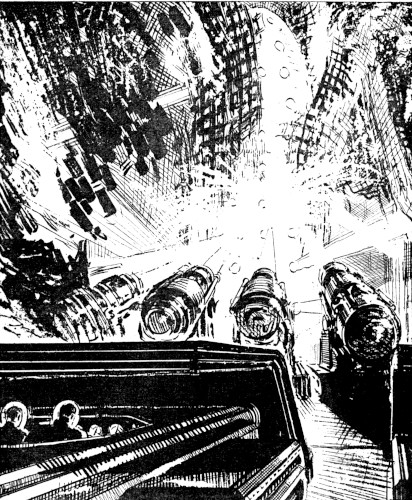
The fury of the beams rebounded in scintillating torrents, shot off in blinding streamers—
Nor was that superbly disguised citadel designed for defense alone. Knowing now that the last faint hope of continuing in business upon Bronseca was gone, and grimly determined to take full toll of the hated Patrol, the defenders in turn loosed their beams. Five of them shot out simultaneously, and five of the panels of mobile screen flamed instantly into eye-tearing violet. Then black. These were not the comparatively feeble, antiquated rays which Haynes had expected, but were the output of up-to-the-minute, first-line space artillery!
Defenses down, it took but a blink of time to lick up the caterpillars. On, then, the destroying beams tore, each in a direct line for a remote-control station. Through tremendous edifices of masonry and steel they drove, the upper floors collapsing into the cylinders of annihilation only to be consumed almost as fast as they could fall.
"All screen-control stations, back, fast!" Haynes directed crisply. "Back, dodging! Put your screens on automatic block until you get back beyond effective range. Spy-ray men! See if you can locate the enemy observers directing fire!"
But no matter how far back they went, Boskonian beams still sought them out in grimly persistent attempts to slay. Their shielding fields blazed white, their refractories wavered in the high blue as the overdriven refrigerators strove mightily to cope with the terrific load. The operators, stifling, almost roasting in their armor of proof, shook sweat from the eyes they could not reach as they drove themselves and their mechanisms on to even greater efforts; cursing luridly, fulminantly the while at carrying on a space war in the hotly reeking, the hellishly reflecting and heat-retaining environment of a metropolis!
And all around the embattled structure, within the Patrol's now partially open wall of screen, spread holocaust supreme; holocaust spreading wider and wider during each fractional split second. In an instant, it seemed, nearby buildings burst into flame. The fact that they were fireproof meant nothing whatever. The air inside them, heated in moments to a point far above the ignition temperature of organic material, fed furiously upon furniture, rugs, drapes, and whatever else had been left in place. Even without such adventitious aids the air itself, expanding tremendously, irresistibly, drove outward before it the glass of windows and the solid brickwork of walls. And as they fell, glass and brick ceased to exist as such. Falling, they fused; coalescing and again splashing apart as they descended through the inferno of annihilatory vibrations in an appalling rain which might very well have been sprinkled from the hottest middle of the central core of hell itself. And in this fantastically potent, this incredibly corrosive flood the ground itself, the metaled pavement, the sturdily immovable foundations of skyscrapers, dissolved as do lumps of sugar in boiling coffee. Dissolved, slumped down, flowed away in blindingly turbulent streams. Super-structures toppled into disintegration, each discrete particle contributing as it fell to the utterly indescribable fervency of the whole.
More and more panels of mobile screen went down. They were not designed to stand up under such heavy projectors as "Wemblesons" mounted, and the Boskonians blasted them down in order to get at the remote-control operators back of them. Swath after swath of flaming ruin was cut through the Bronsecan capital as the enemy gunners tried to follow the dodging caterpillar tractors.
"Drop down, maulers!" the commander-in-chief ordered. "Low enough so that your screens touch ground. Never mind damage—they'll blast the whole city if we don't stop those beams. Surround him!"
Down the maulers came, ringwise; mighty protective envelopes overlapping; down until the screens bit ground. Now the caterpillar and mobile-screen crews were safe; powerful as Prellin's weapons were, they could not break through those maulers' screens.
Now holocaust waxed doubly infernal. The wall was tight, the only avenue of escape of all that fiercely radiant energy straight upward; and adding to the furor were the flaring under jets—themselves destructive agents by no means to be despised!
Inside the screens, then, raged pure frenzy. At the line raved the maulers' prodigious lifting blasts. Out and away, down every avenue of escape, swept torrents of superheated air at whose touch anything and everything combustible burst into flame. But there could be no fire-fighting—yet. Outlying fires, along the lines of destruction previously cut, yes; but personal armor has never been designed to enable life to exist in such an environment as that near those screens then was.
"Burn out the ground under them!" came the order. "Tip them over—slag them down!"
Sharply downward angled twoscore of the beams which had been expending their energies upon Boskone's radiant defenses. Downward into the lake of lava which had once been pavement. That lake had already been seething and bubbling; emitting momently bursts of lambent flame. Now it leaped into a frenzy of its own; a transcendent fury of volatilization. High-explosive shells by the hundred dropped also into the incandescent mess, hurling the fiery stuff afar; deepening and broadening the sulphurous moat.
"Deep enough," Haynes spoke into his microphone. "Tractors and pressors as assigned—tip him over."
The intensity of the bombardment did not slacken, but from the maulers to the north there reached out pressors, from those upon the south came tractors; each a beam of terrific power, each backed by all the mass and all the driving force of a veritable flying fortress.
Slowly that which had been a building leaned from the perpendicular, its inner defensive screen still intact.
"Chief?" From his post as observer, Kinnison flashed a thought to Haynes. "Are you beginning to think any funny thoughts about that ape down there?"
"No. Are you? What?" asked the port admiral, surprised.
"Maybe I'm nuts, but it wouldn't surprise me if he'd start doing a flit pretty quick. I've got a CRX tracer on him, just in case, and it might be smart to caution Henderson to keep up on his toes."
"Your diagnosis—'nuts'—is correct, I think," came the answering thought; but the port admiral followed the suggestion, nevertheless.
And none too soon. Deliberately, grandly, the Colossus was leaning over, bowing in stately fashion toward the awful lake in which it stood. But only so far. Then there was a flash, visible even in the inferno of energies already there at war, and the already coruscant lava was hurled to all points of the compass as the full-blast drive of a superdreadnought was cut loose beneath its surface!
To the eye the thing simply and instantly disappeared; but not to the ultra-vision of the observers' plates, and especially not to the CRX tracers attached by Kinnison and by Henderson. They held, and the chief pilot, already warned, was on the trail as fast as he could punch his keys.
Through atmosphere, through stratosphere, into interplanetary space flew pursued and pursuer at ever-increasing speed. The Dauntless overtook her proposed victim fairly easily. The Boskonian was fast, but the Patrol's new flier was the fastest thing in space. But tractors would not hold against the now universal standard equipment of shears, and the heavy secondaries served only to push the fleeing vessel along all the faster. And the dreadful primary beams could not be used—yet.
"Not yet," cautioned the admiral. "Don't get too close—wait until there's nothing detectable in space."
Finally an absolutely empty region was entered, the word to close up was given, and Prellin drank of the bitter cup which so many commanders of vessels of the Patrol had had to drain—the gallingly fatal necessity of engaging a ship which was both faster and more powerful than his own. The Boskonian tried, of course. His beams raged out at full power against the screens of the larger ship, but without effect. Three primaries lashed out as one. The fleeing vessel, structure and contents, ceased to be. The Dauntless returned to the torn and ravaged city.
The maulers had gone. The lumbering caterpillars—what were left of them—were clanking away; reeking, smoking hot in every plate and member. Only the firemen were left, working like Trojans with explosives, rays, water, carbon-dioxide snow, clinging and smothering chemicals; anything and everything which would isolate, absorb, or dissipate any portion of the almost incalculable heat energy so recently and so profligately released.
Fire apparatus from four planets was at work. There were pumpers, ladder trucks, hose and chemical trucks. There were men in heavily insulated armor. Vehicles and men alike were screened against the specific wave lengths of heat; and under the direction of a fire marshal in his red speedster high in air they fought methodically and efficiently the conflagration which was the aftermath of battle. They fought, and they were winning.
And then it rained. As though the heavens themselves had been outraged by what had been done, they opened and rain sluiced down in level sheets. It struck hissingly the nearby structures, but it did not touch the central area at all. Instead, it turned to steam in mid-air, and, rising or being blown aside by the tempestuous wind, it concealed the redly glaring, raw wound beneath a blanket of crimson fog.
"Well, that is that," the port admiral said slowly. His face was grim and stern. "A good job of clean-up—expensive, but worth the price. So be it to every pirate base and every zwilnik hide-out in the Galaxy! Henderson, land us at Cominoche Spaceport."
And from four other cities of the planet four Boskonian observers, each unknown to all the others, took off in four spaceships for four different destinations. Each had reported fully and accurately to Jalte everything that had transpired until the two fliers had faded into the distance. Then, highly elated—and probably, if the truth could be known, no little surprised as well—at the fact that he was still alive, each had left Bronseca at maximum blast.
The Galactic director had done all that he could, which was little enough. At the Patrol's first warlike move he had ordered a squadron of Boskone's ablest fighting craft to Prellin's aid. It was almost certainly a useless gesture, he knew as he did it. Gone were the days when pirate bases dotted the Tellurian Galaxy; only by a miracle could those ships reach the Bronsecan's line of flight in time to be of service.
Nor could they. The howl of interfering vibrations which was smothering Prellin's communicator beam snapped off into silence while the would-be rescuers were many hours away. For minutes, then, Jalte sat immersed in thought at his great desk in the Center, his normally bluish face turning a sickly green, before he called the planet Jarnevon to report to Eichmil, his chief.
"There is, however, a bright side to the affair," he concluded. "Prellin's records were destroyed with him. Also, there are two facts—that the Patrol had to use such force as practically to destroy the city of Cominoche, and that our four observers escaped unmolested—which furnish conclusive proof that the vaunted Lensman failed completely to penetrate with his mental powers the defenses we have been using against him."
"Not conclusive proof," Eichmil rebuked him harshly. "Not proof at all, in any sense—scarcely a probability. Indeed, the display of force may very well mean that he has already attained his objective. He may have allowed the observers to escape, to lull our suspicions. You yourself are probably the next in line. How certain are you that your own base has not already been invaded?"
"Absolutely certain, sir." Jalte's face, however, turned a shade greener at the thought.
"You use the term 'absolutely' very loosely—but I hope that you are right. Use all the men and all the equipment we have sent you to make sure that it remains impenetrable."
XX.
In their nonmagnetic, practically invisible speedster, Kinnison and Worsel entered the terra incognita of the Second Galaxy and approached the solar system of the Eich, slowing down to a crawl as they did so. They knew as much concerning dread Jarnevon, the planet which was their goal, as did Jalte, from whom the knowledge had been acquired; but that was all too little.
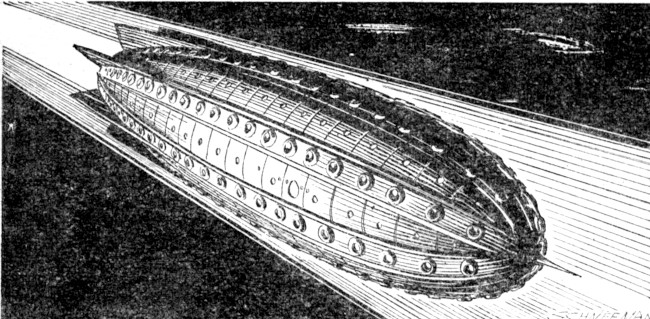
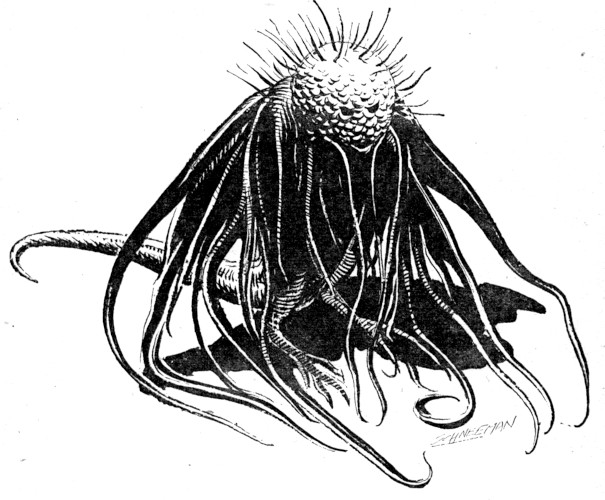
They knew that it was the fifth planet out from the Sun and that it was bitterly cold. It had an atmosphere, but one containing no oxygen; one poisonous to oxygen-breathers. It had no rotation—or rather, its day coincided with its year—and its people dwelt upon its eternally dark hemisphere. If they had eyes, a point upon which there was doubt, they did not operate upon the frequencies ordinarily referred to as "visible" light. In fact, about the Eich as persons or identities they knew next to nothing. Jalte had seen them, but either he did not perceive them clearly or else his mind could not retain their true likeness; his only picture of the Eichlan physique being a confusedly horrible blur.
"I'm scared, Worsel," Kinnison declared. "Scared purple, and the closer we come the more scared I get."
And he was scared. He was afraid as he had never before been, in all his short life. He had been in dangerous situations before, certainly; not only that, he had been wounded almost unto death. In those instances, however, peril had come upon him suddenly. He had reacted to it automatically, having had little if any time to think about it beforehand.
Never before had he gone into a place in which he knew in advance that the advantage was all upon the other side; from which his chance of getting out alive was so terrifyingly small. It was worse, much worse, than going into that vortex. There, while the road was strange, the enemy was known to be one whom he had conquered before; and furthermore, he had had the Dauntless, its eager young crew, and the scientific self-abnegation of old Cardynge to back him. Here he had the speedster and Worsel—and Worsel was just as scared as he was.
The pit of his stomach felt cold, his bones seemed bits of rubber tubing. Nevertheless, the two Lensmen were going in. That was their job. They had to go in, even though they knew that the foe was at least their equal mentally, was overwhelmingly their superior physically, and was upon his own ground.
"So am I," Worsel admitted. "I'm scared to the tip of my tail. I have one advantage over you, however—I've been that way before." He was referring to the time when he had gone to Delgon, abysmally certain that he would not return. Nor would he have returned save for Kinnison and Van Buskirk. "What is fated, happens. Shall we prepare?"
They had spent many hours in discussion of what could be done, and in the end had decided that the only possible preparation was to make sure that if Kinnison failed, his failure would not bring disaster to the Patrol.
"Might as well. Come in; my mind's wide open."
The Velantian insinuated his mind into Kinnison's and the Earthman slumped down, unconscious. Then for many minutes Worsel wrought within the plastic brain. Finally:
"Thirty seconds after you leave me these inhibitions will become operative. When I release them your memory and your knowledge will be exactly as they were before I began to operate," he thought, slowly, intensely, clearly. "Until that time you know nothing whatever of any of these matters. No mental search, however profound; no truth drug, however potent; no probing, even of the subconscious, will or can discover them. They do not exist. They never have existed. They shall not exist until I so allow. These other matters have been, are, and shall be the facts until that instant. Kimball Kinnison, awaken!"
The Tellurian came to, not knowing that he had been out. Nothing had occurred; for him no time whatever had elapsed. He could not perceive even that his mind had been touched.
"Sure it's done, Worsel? I can't find a thing!" Kinnison, who had himself operated upon so many minds as tracelessly, could scarcely believe that his own had been tampered with.
"It is done. If you could detect any trace of the work it would have been poor work, and wasted."
The speedster dropped as nearly as the Lensmen dared toward Jarnevon's tremendous primary base. They did not know whether they were being observed or not. For all they knew, these incomprehensible beings might be able to see or to sense them as plainly as though their ship were painted with radium and were landing openly, with searchlights ablaze and with bells a-clang. Muscles tense, ready to hurl their tiny flier away at the slightest alarm, they wafted downward.
Through the screens they dropped. Power off, even to the gravity pads; thought, even, blanketed to zero. Nothing happened. They landed. They disembarked. Foot by foot they made their cautious way forward.
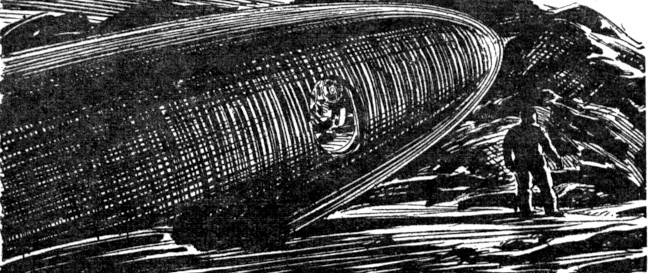
In essence the plan was simplicity itself. Worsel would accompany Kinnison until both were within the thought-screens of the dome. Then the Tellurian would get, some way or other, the information the Patrol had to have, and the Velantian would get it back to Prime Base. If the Gray Lensman could go, too, well and good. After all, there was no real reason to think that he couldn't—he was merely playing safe, on general principles. If, however, worst came to worst, well—
They arrived.
"Now remember, Worsel, no matter what happens to me, or around me, you stay out. Don't come in after me. Help me all you can with your mind, but not otherwise. Take everything I get, and at the first sign of danger you flit back to the speedster and give her the oof, whether I'm around or not. Check?"
"Check," Worsel agreed, quietly. Kinnison's was the harder part. Not because he was the leader, but because he was the better qualified. They both knew it. The Patrol came first. It was bigger, vastly more important than any being or any group of beings in it.
The man strode away and in thirty seconds underwent a weird and striking mental transformation. Three quarters of his knowledge disappeared so completely that he had no inkling that he had ever had it. A new name, a new personality were his, so completely and indisputably his that he had no faint glimmering of a recollection that he had ever been otherwise.
He was wearing his Lens. It could do no possible harm, since it was almost inconceivable that the Eich could be made to believe that any ordinary agent could have penetrated so far, and the fact should not be revealed to the foe that any Lensman could work without his Lens. That would explain far too much of what had already happened. Furthermore, it was a necessity in the only really convincing rôle which Kinnison could play in the event of his capture.
He would not think into that base until he was far enough away from Worsel so that the Velantian's hiding place, if it were not already known, would not be revealed. He did not then know that such a being as Worsel existed; he did not think into the stronghold simply because he was not yet close enough to work efficiently.
Closer he crept. Closer. There were pits beneath the pavement, he observed, big enough to hold a speedster. Traps. He avoided them. There were various mechanisms within the blank walls he skirted. More traps. He avoided them. Photo-cells, trigger beams, invisible rays, networks. He avoided them all. Close enough.
Delicately he sent out a mental probe, and almost in the instant of its sending, cables of steel came whipping from afar. He perceived them as they came, but he was unable to dodge them all. His projectors flamed briefly, only to be sheared away. The cables wrapped about his limbs, binding him fast. Helpless, he was carried through the atmosphere, into the dome, through an air lock into a chamber housing much grimly unmistakable apparatus. And in the council room, where the nine of Boskone and one armored Delgonian Overlord held meeting, a communicator buzzed and snarled.
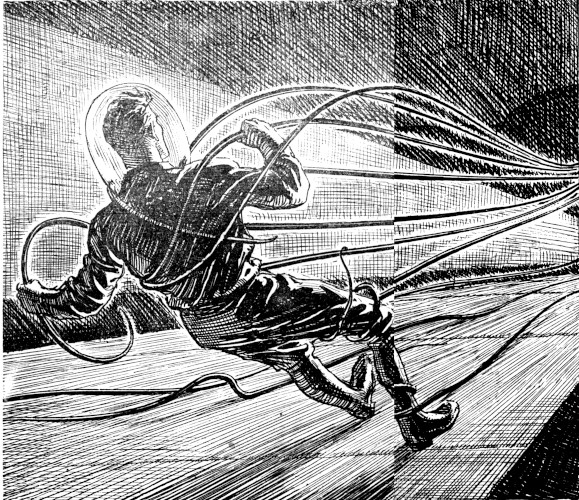
At the first faint touch of Kim's mind, the Eich reacted. Tentacles like steel whips lashed out to bind and hold him, to drag him into the frowning fortress—
"Ah!" exclaimed Eichmil. "Our visitor has arrived and is awaiting us in the Delgonian hall of question. Shall we meet again, there?"
They did so; they of the Eich armored against the poisonous oxygen, the Overlord naked. All wore screens.
"Earthling, we are glad indeed to see you here," the First of Boskone welcomed the prisoner. "For a long time we have been anxious indeed—"
"I don't see how that can be," the Lensman blurted. "I just graduated. My first big assignment, and I have failed," he ended bitterly.
A start of surprise swept around the circle. Could this be?
"He is lying," Eichmil decided. "You of Delgon, take him out of his armor." The Overlord did so, the Tellurian's struggles meaningless to the reptile's superhuman strength. "Release your screen and see whether or not you can make him tell the truth."
After all, the man might not be lying. The fact that he could understand a strange language meant nothing at all. All Lensmen could.
"But in case he should be the one we seek—" The Overlord hesitated.
"We will see to it that no harm comes to you—"
"We cannot," the Ninth—the psychologist—broke in. "Before any screen is released I suggest that we question him verbally, under the influence of the drug which renders it impossible for any warm-blooded oxygen breather to tell anything except the complete truth."
The suggestion, so eminently sensible, was adopted forthwith.
"Are you the Lensman who has made it possible for the Patrol to drive us out of the Tellurian Galaxy?" came the sharp demand.
"No," was the flat and surprising reply.
"Who are you, then?"
"Philip Morgan, class of—"
"Oh, this will take forever!" snapped the Ninth. "Let me question him. Can you control minds at a distance and without previous treatment?"
"If they are not too strong, yes. All of us specialists in psychology can do that."
"Go to work upon him, Overlord!"
The now fully reassured Delgonian snapped off his screen and a battle of wills ensued which made the subether boil. For Kinnison, although he no longer knew what the truth was, still possessed a large part of his mental power, and the Delgonian's mind, as has already been made clear, was a capable one indeed.
"Desist!" came the command. "Earthman, what happened?"
"Nothing," Kinnison replied truthfully. "Each of us could resist the other; neither could penetrate or control."
"Ah!" and nine Boskonian screens snapped off. Since the Lensman could not master one Delgonian, he would not be a menace to the massed minds of the nine of Boskone, and the questioning need not wait upon the slowness of speech. Thoughts beat into Kinnison's brain from all sides.
This power of mind was relatively new, yes. He did not know what it was. He went to Arisia, fell asleep, and woke up with it. A refinement, he thought, of hypnotism. Only advanced students in psychology could do it. He knew nothing except by hearsay of the old Brittania—he was a cadet then. He had never heard of Blakeslee, or of anything unusual concerning any one hospital ship. He did not know who had scouted Helmuth's base, or put the thionite into it. He had no idea who it was who had killed Helmuth. As far as he knew, nothing had ever been done about any Boskonian spies in Patrol bases. He had never happened to hear of the planet Medon, or of anyone named Bominger, or Madame Desplaines, or Prellin. He was entirely ignorant of any unusual weapons of offense—he was a psychologist, not an engineer or a physicist. No, he was not unusually adept with DeLameters—
"Hold on!" Eichmil commanded. "Stop questioning him, everybody! Now, Lensman, instead of telling us what you do not know, give us positive information, in your own way. How do you work? I am beginning to suspect that the man we really want is a director, not an operator."
This was a more productive line. Lensmen, hundreds of them, each worked upon a definite assignment. None of them had ever seen or ever would see the man who issued orders. He had not even a name, but was a symbol—Star A Star. They received orders through their Lenses, wherever they might be in space. They reported back to him in the same way. Yes, Star A Star knew what was going on in that room. He was reporting constantly—
A knife descended viciously. Blood spurted. The stump was dressed, roughly but effectively. They did not wish their victim to bleed to death when he died, and he was not to die in any fashion—yet.
And in the instant that Kinnison's Lens went dead, Worsel, from his safely distant nook, reached out direct to the mind of his friend, thereby putting his own life in jeopardy. He knew that there was an Overlord in that room, and the grue of a thousand helplessly sacrificed generations of forebears swept his sinuous length at the thought, despite his inward certainty of the new powers of his mind. He knew that of all the entities in the Universe, the Delgonians were most sensitive to the thought vibrations of Velantians. Nevertheless, he did it.
He narrowed the beam down to the smallest possible coverage, employed a frequency as far as possible from that ordinarily used by the Overlords, and continued to observe. It was risky, but it was necessary. It was beginning to appear as though the Earthman might not be able to escape, and he must not die in vain.
"Can you communicate now?" In the ghastly chamber the relentless questioning went on.
"I cannot communicate."
"It is well. In one way I would not be averse to letting your Star A Star know what happens when one of his minions dares to spy upon the Council of Boskone itself, but the information is as yet a trifle premature. Later, he shall learn—"
Kinnison did not consciously thrill at that thought. He did not know that the news was going beyond his brain; that he had achieved his goal. Worsel, however, did; and Worsel thrilled for him. The Gray Lensman had finished his job; all that was left to do was to destroy this world and the power of Boskone would be broken. Kinnison could die, now, content.
But no thought of leaving entered Worsel's mind. He would, of course, stand by as long as there remained the slightest shred of hope, or until some development threatened his ability to leave the planet with his priceless information. And the pitiless inquisition went on.
Star A Star had sent him to investigate their planet, to discover whether or not there was any connection between it and the zwilnik organization. He had come alone, in a speedster. No, he could not tell them even approximately where the speedster was. It was so dark, and he had come such a long distance on foot. In an hour or so, though, it would start sending out a thought signal which he could detect—
"But you must have some ideas about this Star A Star!" This director was the man they wanted so desperately to get. They believed implicitly in this figment of a Lensman director. Fitting in so perfectly with their own ideas of efficient organization, it was more convincing by far than the actual truth would have been. They knew now that he would be hard to find. They did not now insist upon facts; they wanted every possible crumb of surmise. "You must have wondered who and where Star A Star is? You must have tried to trace him?"
Yes, he had tried, but the problem could not be solved. The Lens was non-directional, and the signals came in at practically the same strength, anywhere in the Galaxy. They were, however, very much fainter out here. That might be taken to indicate that Star A Star's office was in a star cluster, well out in either the zenith or the nadir direction—
The victim sucked dry, eight of the Council departed, leaving Eichmil and the Overlord with the Lensman.
"What you have in mind to do, Eichmil, is childish. Your basic idea is excellent, but your technique is pitifully inadequate."
"What could be worse?" Eichmil demanded. "I am going to dig out his eyes, smash his bones, flay him alive, roast him, cut him up into a dozen pieces, and send him back to his Star A Star with a warning that every creature he sends into this Galaxy will be treated the same way. What would you do?"
"You of the Eich lack finesse," the Delgonian sighed. "You have no subtlety, no conception of the nicer possibilities of torture, either of an individual or of a race. For instance, to punish Star A Star adequately this man must be returned to him alive, not dead."
"Impossible! He dies—here!"
"You misunderstand me. Not alive as he is now—but not entirely dead. Bones broken, yes, and eyes removed; but those minor matters are but a beginning. If I were doing it, I should then apply several of these devices here, successively; but none of them to the point of complete incompatibility with life. I should inoculate the extremities of his four limbs with an organism which grows—shall we say—unpleasantly? Finally, I should extract his life force and consume it—as you know, that essence is a rarely satisfying delicacy with us—taking care to leave just enough to maintain a bare existence. I would then put what is left of him aboard his ship, start it toward the Tellurian Galaxy, and send notice to the Patrol as to its exact course and velocity."
"But they would find him alive!" Eichmil stormed.
"Exactly. For the fullest vengeance they must, as I have said. Which is worse, think you? To find a corpse, however dismembered, and to dispose of it with full military honors, or to find and to have to take care of for a full lifetime a something that has not enough intelligence even to swallow food placed in its mouth? Remember also that the organism will be such that they themselves will be obliged to amputate all four of the creature's limbs to save its life."
While thinking thus the Delgonian shot out a slender tentacle which, slithering across the floor, flipped over the tiny switch of a small mechanism in the center of the room. This entirely unexpected action surprised Worsel. He had been debating for minutes whether or not to release the Gray Lensman's inhibitions. He would have done so instantly if he had had any warning of what the Delgonian was about to do. Now it was too late.
"I have set up a thought-screen about the room. I do not wish to share this titbit with any of my fellows, as there is not enough to divide," the monster explained, parenthetically. "Have you any suggestions as to how my plan may be improved?"
"No. You have shown that you understand torture better than we do."
"I should, since we Overlords have practiced it as a fine art since our beginnings as a race. Do you wish the pleasure of co-operating with me in the work?"
"I do not torture for pleasure. Since you do, you may carry out the procedure as outlined. All I require is the assurance that he will be a warning and an object lesson to Star A Star of the Galactic Patrol."
"I can assure you definitely that he will be both. More, I will show you the results when I have finished with him. Or, if you like, I would be glad to have you stay and look on—you will find the spectacle interesting, entertaining and highly instructive."
"No, thanks—that is, not if you are sure that you can handle him alone."
"Handle him! This pitiful weakling?" The Overlord snorted contemptuously. "I could handle seven like him. He is on the verge of fainting already. Observe, please, his reaction to the fungus-culture injections."
Four times the Delgonian rammed the needle home; and, true to prediction, Kinnison's body went limp in its shackles.
"Ah, yes; a weak race, physically—very weak," Eichmil observed, as he left the room; and the Overlord, alone with his victim, cast off the chains in order to stretch the Lensman out upon one of the sinister machines so close at hand.
But Kinnison had not fainted. He had not allowed himself to feel the hurt of the knife, of the needle, nor of the injected fluid. Never before had he been more coldly, intently alert than in this, the climactic minute of his life. The full of his powers he did not have, perhaps, yet even now he was better equipped, mentally and physically, than the Kinnison of even a short year ago, able to establish a nerve block that would permit full and unshaken concentration on every move of offense and defense he might make, whatever frightful toll of pain and injury the inhumanly powerful, semireptilian Delgonian might inflict in the struggle that the Lensman now proposed. Thus, upon the first instant of opportunity, he exploded into action with a violence which took even the trigger-nerved Overlord entirely by surprise.
In practically one motion he rolled, ducked, gathered himself together and launched a kick behind which there was the driving force of every ounce of his powerful body and the concentrated urge of every cell of his brain. It struck its mark squarely—the hard toe of the Lensman's heavy boot crashed squarely against the Overlord's plated neck at the exact base of the skull. That kick would have pulped any human or near-human head—it would have slain a horse—it staggered momentarily even the reptilianly armored monstrosity which was the Delgonian.
Kinnison went leaping across the room toward a rack of implements and weapons, only to be buried in mid-course beneath a hurtling avalanche of fury. For a moment man and monster stood poised, almost en tableau, then they crashed to the floor together—talons and fingers clawing, gouging at eyes; wings, feet, hard-gnarled hands, scimitared tail, balled fist, boots and teeth wreaking every ultimate possibility of damage. Against the frightfully armed and naturally armored body of the Delgonian, human physical weapons and human strength were near useless; but, insulated against the agony of snapping bones and bludgeon blows of the mighty tail by that hard-held nerve block, the Lensman's furiously active mind had a goal—a vaguely understood goal—toward which he directed the deadly struggle he could not control or hope to win—
Upon and over the thought-screen generator rolled the madly warring pair, and as the delicate mechanism disintegrated it ceased to function.
Worsel's prodigious mentality had been beating ceaselessly against that screen ever since its erection, and in the very instant of its fall Kinnison became again the Gray Lensman of old. And in the next instant both of those mighty minds—the two most powerful then known to civilization—had hurled themselves against that of the Delgonian. Bitter though the ensuing struggle was, it was brief. Nothing short of an Arisian mentality could have withstood the venomous intensity, the berserk power, of that concerted and synchronized attack.
Brain half burned out, the Overlord wilted; and, docility itself, he energized the communicator.
"Eichmil? The work is done. Thoroughly done, and well."
"So soon?"
"Yes. I was hungry—and, as I intimated, Tellurians are much too weak to furnish any real sport. Do you wish to inspect what is left of the Lensman?" This question was safe enough; Worsel knew exactly how Kinnison had fared during his whirlwind bodily encounter with the frightfully armed, heavily armored engine of destruction which was the Delgonian.
"No." Eichmil, as a high executive, was accustomed to delegating far more important matters to competent underlings. "If you say that it is well done, that is sufficient."
"Clear the way for me, then, please," the Overlord requested. Then, picking up the hideously mangled thing that was Kinnison's body, he incased it in its armor and, donning his own, wriggled boldly away with his burden. "I go to place this residuum within its ship and to return it to Star A Star."
"You will be able to find the speedster?"
"Certainly. He was to find it. Whatever he could have done, I, working through the cells of his brain, can likewise do."
"Can you handle him alone, Kinnison?" Worsel asked presently. "Can you hold out until you reach the boat?"
"Yes, to both. I can handle him—we softened him down plenty. I will last—I'll make myself last, long enough."
"I go, then, lest they be observing with spy rays."
To the black flier the completely subservient Delgonian then bore his physically disabled master, and carefully he put him aboard. Worsel helped openly there, for he had put out screens against all forms of intrusion. The vessel took off and the Overlord wriggled blithely back toward the dome. He was full of the consciousness of a good job, well done. He even felt the sensation of repletion concomitant with having consumed much vital force!
"I hate to let him go!" Worsel's thought was a growl of baffled fury. "It gripes me to the tail to let him think that he has done everything he set out to do; that he will never even know how he got those bruises and contusions. I wanted—I still want—to tear him apart for what he has done to you, my friend."
"Thanks, old snake." Kinnison's thought came faintly. "Just temporary. He's living on borrowed time. He'll get his. You've got everything under control, haven't you?"
"On the green. Why?"
"Because I can't hold this nerve block any longer.... It hurts.... I'm sick.... I think I'm going to—"
He fainted. More, he plunged parsecs deep into the blackest depths of oblivion as outraged nature took the toll she had been so long denied.
Worsel hurled a call to Earth, then turned to his maimed and horribly broken companion. He applied splints to the shattered limbs, he dressed and bandaged the hideous wounds and the raw sockets which had once held eyes, he ministered to the raging, burning thirst. Whenever Kinnison's mind wearied he held for him the nerve block, the priceless anodyne without which the Gray Lensman must have died from sheerest agony.
"Why not allow me, friend, to relieve you of all consciousness until help arrives?" the Velantian asked pityingly.
"Can you do it without killing me?"
"If you so allow, yes. If you offer any resistance, I do not believe that any mind in the Universe could."
"I won't resist you. Come in," and Kinnison's suffering ended.
But kindly Worsel could do nothing about the fantastically atrocious growths which were transforming the Earthman's legs and arms into monstrosities out of nightmare.
He could only wait—wait for the skilled assistance which he knew must be so long in coming.
XXI.
When Worsel's hard-driven call impinged upon the port admiral's lens, Haynes dropped everything to take the report himself. Characteristically Worsel sent first and Haynes first recorded a complete statement of the successful mission to Jarnevon. Last came personalities, the tale of Kinnison's ordeal and of his present plight.
"Are they following you in force, or can't you tell?"
"Nothing has been detectable, and at the time of our departure there had been no suggestion of any such action," Worsel replied carefully.
"We'll come in force, anyway, and fast. Keep him alive until we meet you," Haynes urged, and disconnected.
It was an unheard-of occurrence for the port admiral to turn over his very busy and extremely important desk to a subordinate without notice and without giving him detailed instructions, but Haynes did it now.
"Take charge of everything, Southworth!" he snapped. "I'm called away—emergency. Kinnison found Boskone—got away—hurt—I'm going after him in the Dauntless. Taking the new flotilla with me. Time indefinite—probably a few weeks."