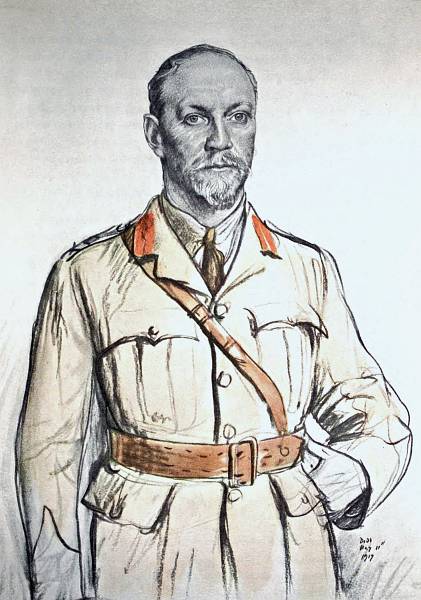
XII LIEUT.-GENERAL THE RT. HON. JAN CHRISTIAAN SMUTS, P.C., K.C., M.L.A. COMPANION OF HONOUR
Reading edition
GENERAL SMUTS was born on May 24th, 1870, at Bovenplaats in the Malmesbury district of the Cape Colony, the residence of his father, Jacobus Abraham Smuts, who was for some time a member of the Legislative Assembly of the Cape. He was educated at Victoria College, Stellenbosch, and graduating with high honours in arts and science, passed as Ebden Scholar to Christ's College, Cambridge, in 1891.
He secured a double first in the Law Tripos, was called to the Bar and, returning to South Africa in 1895, was duly admitted to the Supreme Court at Cape Town, where he began to practice his profession. He was admitted to the Transvaal Bar in the following year, soon after the Jameson Raid. About this time he married Miss Sibylla Krige, of Stellenbosch, and settled in Johannesburg. He had already been mentioned as Dr. Leyds' successor to the post of State Secretary, when in 1898 he was offered and accepted the post of State Attorney. President Kruger's choice of so young a man was amply and speedily justified, and his reforming zeal exercised a formidable influence in the State.
It was in his capacity as State Attorney that he accompanied President Kruger, when the latter met Lord (then Sir Alfred) Milner at Bloemfontein, and took part in the negotiation with Mr. Conyngham Greene, the British Agent at Pretoria. The young advocate and statesman suddenly found his country confronted with war, and shortly after the Boer Commandos had taken the field he was attached to General Joubert as a legal adviser and administrative officer for the territory in Natal occupied by the Republican forces.
LIEUT.-GEN. THE RT. HON. JAN C. SMUTS
Eventually, after the occupation of Pretoria by the British armies, he received a command in the western Transvaal as Vecht-General under General de la Rey. He proved himself a dashing and skilful commander, and by the boldness of his movements in the Cape Colony, in the later stages of the war, created a feeling of nervousness in Lord Kitchener's main communications. He was in supreme command in the Cape and was applying himself to the reduction of Ookiep when the news of the opening of peace negotiations brought him back to the Transvaal. His was one of the strongest voices at Vereeniging in favour of peace when terms would still be obtainable, and when the Treaty was signed he returned to the practice of his old profession.
In the interval between Vereeniging and the grant of responsible government, he took a leading part with General Botha in restoring the moral of the Boer people, which had suffered severely in the disastrous war, and also in preparing them for self-government.
When, in 1907, responsible government was granted to the Transvaal, General Smuts assumed the portfolio of Colonial Secretary in General Botha's Ministry, and continued the work of national reconstruction and reconciliation between the two races and was largely responsible for the holding of the conferences on closer union which eventually culminated in the National Convention at which the South Africa Act, the Constitution of the Union, was framed.
He held successively the portfolios of Defence, the Interior, Mines, and Finance in General Botha's First Union Cabinet, and amongst other legislative activities was responsible for the South African Defence Act, the machinery of which was severely tested in the Syndicalist strikes at Johannesburg of 1913 and 1914, and the unfortunate rebellion in the latter portion of that year and also the campaign in South West Africa.
In March, 1916, Lieut.-General Smuts arrived in British East Africa and assumed command of the East African Expeditionary Force upon the pressing request of the Imperial Government and in succession to General Smith-Dorrien, who had been compelled to relinquish the command owing to a severe illness. Within a year he had driven the German troops from British territory, reduced them by two-thirds, and penned them into the southern and south-western malarial area with its one healthy spot at Mahenge.
General Smuts is still a young man, though he has had exceptional experience. A scholar by taste, a lawyer by profession, and perforce a soldier, he represents a unique figure in the Empire. The boldness and energy of his leading as a General seem to suggest the born commander. As Statesman, his conceptions reveal an intuitive grasp of the fundamental ideals that must guide the present and inspire the future.
In Monthly Parts, Price 2/- net. Parts I.-V. in Volume form, with extra matter, 15/- net.
The Western Front
Drawings by MUIRHEAD BONE
"They illustrate admirably the daily life of the troops under my command."
—F.M. Sir Douglas Haig, K.T.
SOME RECENT PRESS NOTICES:
"It is a matter for thankfulness that the authorities were able to secure the services of so distinguished an artist as Mr. Muirhead Bone to depict for us the conditions in the war zone of the Western Front. To give not only the thing seen but the spirit lying within it, that is the province of the imaginative and selective artist. And that is what Mr. Bone has done with a measure of success that almost defies exaggerated praise. He brings to his task the technique of a master and the vision of a true artist."—Daily Telegraph.
"Mr. Muirhead Bone has clearly justified the action of H.M. Government in employing him as an official artistic chronicler of the greatest of all wars."—Burlington Magazine.
"Mr. Muirhead Bone's vigorous drawings of the toil and moil of British warfare and all its circumstantial splendour and squalor stand in no further need of commendation.... It is a noble and enduring achievement.... These two drawings alone assure Lieutenant Bone's place among the immortals."—Morning Post.
"Mr. Bone's drawings convey an extraordinary idea of the abomination and desolation caused by shell fire."—Field.
"The drawings are of endless interest in their subjects and excite a natural wonder at the artist's remarkable fertility and versatility. It is impossible to overestimate the value of these drawings as a record of the actualities of the war."—Scotsman.
"The selection of Mr. Bone is triumphantly justified by his terrific Tank drawing, which no one's romantic exaggeration—not Doré's or Hugo's even—could have made more overwhelming in its onset or more deadly."—Daily Chronicle.
"Whether it be a speaking drawing of a road liable to be shelled, or a V.A.D. rest station, or German prisoners coming down from the front, or, again, the finished sketch of Amiens Cathedral with the aeroplanes round the spire, or a hospital ship scene at the quayside, all give a permanent impression of war scenes and war conditions which can hardly be too highly commended."—Bookseller.
"Among the little aristocracy of war pictures, destined to have permanent value both as history and as art, must certainly be placed the drawings of Mr. Muirhead Bone."—Coventry Herald.
"The Work grows on us."—Liverpool Post.
"In selecting Mr. Muirhead Bone for the task of depicting the varied scenes of activity on the British Front in France and Flanders, the Government have shown a very wise choice, which has been justified by the excellent series of drawings now being published."—Broad Arrow.
"It cannot be too strongly said that no mere photographic record can ever approach the great work Mr. Bone is doing in these sketches.—Montrose Standard."
"The Series will certainly be greatly prized."—Army and Navy Gazette.
"An eloquent pencil, a dashing stroke, guided by a discerning brain, and the art of perspective are the requisites for a successful portrayal of the varied scenes of every battlefield, and these qualities Mr. Bone possesses to admiration."—Aberdeen Journal.
"Of all the records of the war up to date this publication alone conveys something of the impressiveness that fighting on the present scale might be expected to give."—Manchester Weekly Times.
"Mr. Bone's work was needed. Now that I have seen his picture books I know more about the war. A poet with a line of verse, a cunning draughtsman with a few strokes of the pencil on paper, can tell you what you will never learn from Blue Books and histories. I begin to understand this tremendous war."—The Londoner in the Evening News.
"Among the drawings are some of extraordinary power and interest made by the artist in British munition factories."—Westminster Gazette.
"Dozens of Artists have drawn ships. Mr. Bone has interpreted them. He has done the Fleet a great service in bringing it thus intimately to the Landsmen. The drawings will rank for all time among the world's greatest treasures in nautical art."—Country Life.
"Will take a foremost place among the permanent records of the war."—Manchester Guardian.
"Mr. Bone has the eye to see, the imagination to realise, and the hand to present."—The Times.
Mr. Muirhead Bone's drawings are reproduced in the following form, apart from "The Western Front" publication:—
WAR DRAWINGS
Size 20 by 15 inches. Ten Plates in each part, 10/6 net.
MUNITION DRAWINGS
Size 31½ by 22 inches. Six Plates in portfolio, 20/- net.
WITH THE GRAND FLEET
Size 31½ by 22 inches. Six Plates in portfolio, 20/- net.
"TANKS"
Size 28 by 20¼ inches. Single Plate, 5/- net.
Further particulars of these publications will be sent on application to "Country Life," Ltd., 20, Tavistock Street, Covent Garden, London, W.C. 2.
Uniform with this publication.
Admirals of the British Navy Portraits by FRANCIS DODD
INTRODUCTION
I.— JELLICOE, ADMIRAL SIR JOHN R., G.C.B., O.M., G.C.V.O.
II.— ADMIRAL SIR CECIL BURNEY, G.C.M.G., K.C.B.
III.— MADDEN, VICE-ADMIRAL SIR C. E., K.C.B., K.C.M.G., C.V.O.
IV.— STURDEE, VICE-ADMIRAL SIR F. C. D., K.C.B., K.C.M.G., C.V.O.
V.— BACON, VICE-ADMIRAL SIR R. H. S., K.C.B., K.C.V.O., D.S.O.
VI.— DE ROBECK, REAR-ADMIRAL SIR J. M., K.C.B.
VII.— NAPIER, VICE-ADMIRAL T. D. W., C.B., M.V.O.
VIII.— BROCK, REAR-ADMIRAL SIR OSMOND de B., K.C.V.O., C.B., C.M.G.
IX.— HALSEY, REAR-ADMIRAL LIONEL, C.B., C.M.G.
X.— PAKENHAM, REAR-ADMIRAL SIR W. C., K.C.B., K.C.V.O.
XI.— PAINE, COMMODORE GODFREY M., C.B., M.V.O.
XII.— TYRWHITT, COMMODORE SIR R. Y., K.C.B., D.S.O.
Hudson & Kearns, Ltd., Printers, Hatfield Street, London, S.E. 1.