I FIELD-MARSHAL VISCOUNT FRENCH OF YPRES, K.P., G.C.B., O.M., G.C.V.O., K.C.M.G.
Reading edition
LORD FRENCH'S name will descend to posterity as the leader of the British Expeditionary Force. Were all his other great services to his country reckoned as naught, his name would live for ever by reason of the German Emperor's vainglorious allusion to "French's contemptible little army." For, as long as the British Empire shall endure, men will hold in honour "the old Contemptibles," who shattered for ever an Emperor's dreams of world supremacy and made his boast recoil upon his head.
John Denton Pinkstone French comes of one of the most ancient Irish families, the Frenches of Galway and Roscommon, of whom Lord French of French Park, Roscommon, is the head. The Field-Marshal is fifth in descent from John French, M.P., who fought in the army of William III. and commanded a troop of Enniskillen Dragoons at Aughrim in 1689. His grandfather left Ireland at the beginning of the XIXth century and settled in Kent at Ripple Vale, near Deal, where, on September 28th, 1852, Lord French of Ypres was born.
Lord French's father was Captain John French, R.N., who retired from the service with the rank of Post Captain and died when the boy, his only son, was but two years old. Upon his mother, a Scottish lady, a Miss Eccles from the neighbourhood of Glasgow, devolved the upbringing of the infant son and his five sisters. After a brief sojourn at Harrow, the boy was sent to Eastman's School at Portsmouth to prepare for the Navy. In 1866, in his fourteenth year, he entered the "Britannia," and thence passed out as a midshipman.
At the age of 18, young John French sought the advice of a family friend and decided to make the change which was destined to alter the whole course of his life. He entered the militia and spent two years in the Garrison Artillery at Ipswich (1871 to 1873). Then he passed into the regular army, being gazetted, at the age of 21, to the 8th Hussars, with whom, however, he remained only a short time, transferring, after a few weeks, to the 19th Hussars, the regiment with which he passed the first half of his life as a soldier.
In 1880 Captain French became Adjutant of the Northumberland Yeomanry, and was thus, to his great disappointment, prevented from accompanying his regiment, the 19th, to Egypt in 1882. However, his chance came two years later when he went out as second in command of the 19th to join Wolseley's Nile Expedition. French was at Abu Klea and in the subsequent desperate fighting, and he was actually the first man of the column to learn, from the lips of Stuart Wortley, of the fall of Khartum and the death of Gordon. For his good work in Egypt French was mentioned in despatches and returned to England as Lieutenant-Colonel.
FIELD-MARSHAL VISCOUNT FRENCH
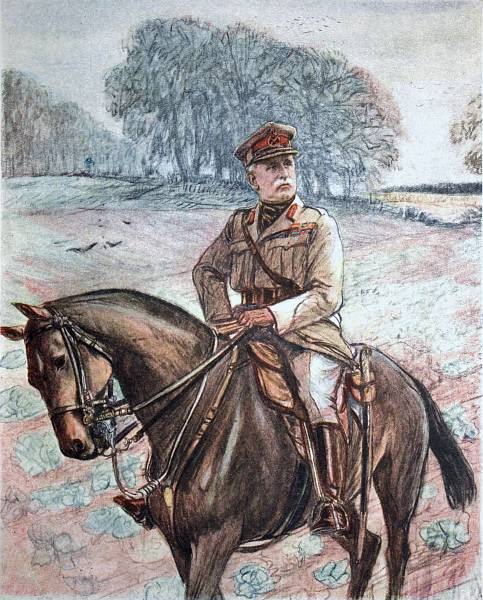
Five years of garrison duty followed. In 1891 Col. French took the 19th Hussars out to India, being stationed first at Secunderabad and afterwards at Bangalore. In 1893 he returned to England and retired on half-pay. In the following year he was entrusted with the compilation of the Cavalry Drill-book, and 1895 found him installed at the War Office as Deputy-Adjutant-General under Sir Redvers Buller.
From now on French rose rapidly in his profession. As commander of the 2nd Cavalry Brigade at Canterbury (1897), and the 1st Cavalry Brigade at Aldershot (1898), he had ample scope to elaborate his theories on cavalry training. None was more tenacious than French of maintaining the "cavalry spirit" in the British Cavalry, but he had recognized in Egypt the advantages of teaching the cavalry to fight dismounted as well. His theories were violently combated, but his justification was at hand. The time was approaching when he was to burst into prominence as England's main hope in South Africa.
Lord French was given command of the cavalry in Natal, and landed in South Africa on October 12th, 1899, the day after the declaration of war. He returned to England in July, 1902, with an almost unbroken record of successes in the campaign to his name.
His next command was the 1st Army Corps at Aldershot. Here for five years he worked at high pressure with the watch-word of "Efficiency." From Aldershot French was summoned by Lord Haldane, then Secretary of State for War, and given the appointment of Inspector-General of the Forces. In this post he laid the bases of the Expeditionary Force and of the Territorial Army which was to prove its valuable auxiliary in the years to come. In 1911 he was appointed Chief of the Imperial General Staff and held this appointment until 1914, when he resigned.
From his retirement he was summoned to take command of the Expeditionary Force. He left London on the afternoon of Friday, August 14th, and landed in France that evening. For sixteen months he remained at the head of the British Army in France, which he watched expand from the four Divisions of the Retreat from Mons into a vast army of a million men. In December, 1915, he was recalled to take up the post of Commander-in-Chief of the Home Forces. At the New Year, 1916, he was created a Viscount.
In the title he assumed the Field-Marshal has commemorated the sternest battle he fought across the Channel. Ypres was the supreme test. When the full history of the war comes to be written, the Empire will realize how much it owes its security to the high patriotism and indomitable tenacity of the Commander-in-Chief of the Expeditionary Force.