VIII GENERAL THE HON. SIR JULIAN HEDWORTH GEORGE BYNG, K.C.B., K.C.M.G., M.V.O.
Reading edition
SIR JULIAN BYNG was born on September 11th, 1862, the seventh son of the second Earl of Strafford. He joined the 10th Hussars in 1883, and served in the Soudan Expedition of 1884, being present at the actions of El Teb and Tamai. In South Africa he commanded a column with great distinction in the pursuit of De Wet, and finished the campaign with the rank of Colonel. One of his most successful actions was on the Vlei River, west of Reitz, where he surprised a Boer Commando and took a 15-pounder, two pom-poms, and many prisoners.
He landed in Belgium in October, 1914, in command of the 3rd Cavalry Division. He accompanied Rawlinson's 7th Division in its retreat from Antwerp to Ypres. The doings of the famous 3rd Cavalry Division are writ large in history, and in all the great drama of Ypres there was no finer incident than the charge of the Household Brigade at Klein Zillebeke on November 6th, 1914.
In May, 1915, General Byng succeeded General Allenby in command of the Cavalry Corps, and was responsible for the cavalry fighting in the later part of the Second Battle of Ypres. In August of that year he went to the Dardanelles to take over the command of the IX Corps, and was present during the later stages of that campaign and the famous withdrawal from the peninsula. In February, 1916, he returned to France to command the XVII Corps, and was transferred to the Canadian Corps on May 24th.
LIEUT.-GEN. THE HON. SIR JULIAN BYNG
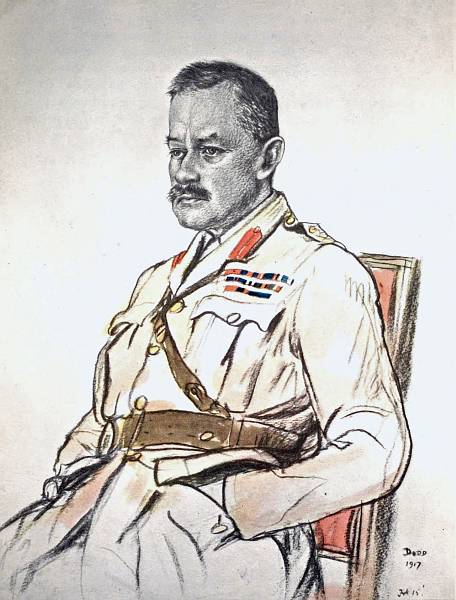
Since then he has been one of the most brilliant among Corps Commanders. During the Battle of the Somme the Canadians fought on the right of Sir Hubert Gough's 5th Army and did notable work, taking Courcelette, and fighting many desperate actions on the Thiepval Ridge. During the long stormy winter their raids on the enemy line were among the most remarkable on the British front. More especially, they made the section north of Arras an unquiet place for the enemy. Their culminating achievement came at the Battle of Arras on April 9th, 1917, when they stormed in one stride four positions on the Vimy Ridge, and wrested from the enemy the key of the plain of Douai.
In June Sir Julian Byng succeeded General Allenby in command of the Third Army.
Sir Julian Byng has the appearance and manner of the cavalier of tradition. No more soldierly figure has appeared in the campaign. He has had the good fortune always to have fine troops to lead, and he is a fit leader for the best troops. He has become to the Canadians what General Birdwood is to the Anzacs—at once a trusted Commander and a well-beloved friend.