X LIEUT.-GENERAL JAMES AYLMER LOWTHORPE HALDANE, C.B., D.S.O.
Reading edition
GENERAL HALDANE was born on November 17th, 1862, of a well-known Scottish family which has given many distinguished members to the learned professions. He was educated at Edinburgh Academy and Sandhurst, and, in 1882, joined the Gordon Highlanders. He served in the Waziristan Campaign of 1894; the Chitral Campaign of 1895; the Tirah Campaign of 1897; and from 1896-99 he was A.D.C. to Sir William Lockhart. He received the D.S.O. for his work on the Indian frontier.
During the South African War he fought with the 2nd Gordon Highlanders at Elandslaagte, where he was severely wounded. He was in command of the armoured train which was captured at Chieveley on November 15th, 1899. The story of his escape from Pretoria after some months' imprisonment is one of the romances of the South African Campaign. He rejoined his battalion and was present at some of the later actions of the war, receiving a brevet Lieut.-Colonelcy.
During the Russo-Japanese War he was Military Attaché with the Japanese Army, and was present at the Battles of Liao-yang, Sha-Ho, and Mukden.
He went to France in August, 1914, in command of the 10th Infantry Brigade, which was part of the 4th Division in the III Corps. The Brigade arrived in time for the Battle of Le Cateau, and took part in all the subsequent fighting, being heavily engaged in the Armentières area during the First Battle of Ypres. General Haldane was one of the first Brigadiers to receive a Division. He succeeded Major-General Sir Hubert Hamilton in command of the 3rd Division in October, 1914, and remained with this famous Division till the Battle of the Somme. Its heaviest fighting took place in the summer of 1915 within the Ypres salient, and, in the spring of 1916, it was again engaged in the neighbourhood of St. Eloi and the Bluff at Ypres.
LIEUT.-GEN. J. A. L. HALDANE
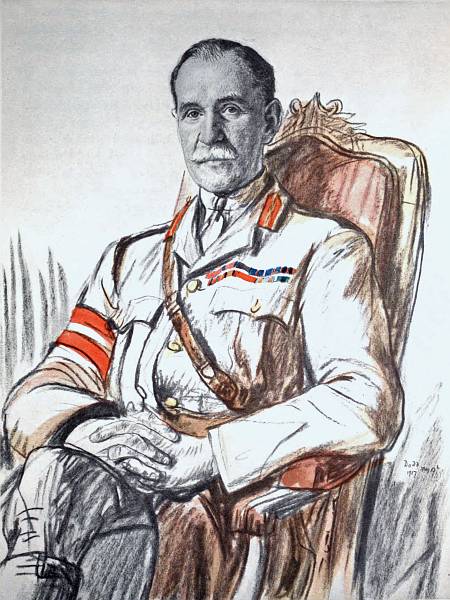
At the Battle of the Somme General Haldane took part in the great advance of July 14th, when the 3rd Division was brilliantly successful, carrying Bazentin le Grand, and sharing afterwards in the desperate fighting around Longueval and Delville Wood. In August he was promoted to the command of the VI Corps, and, during the winter, held a portion of the Arras front. The opportunity of the Corps came in the Battle of Arras on April 9th, 1917, when, advancing due east of the city, its three divisions carried all their objectives, including such formidable fortresses as the Harp and Railway Triangle, and made record captures of prisoners and guns.
Few British soldiers have had a more varied experience of warfare. He is a scholar in his profession, but his book knowledge is borne lightly, and he has shown himself in every crisis a leader of shrewd judgment and ample resource. He is still a young man, and, fine as his record has been, he is universally regarded as only at the outset of his career.