VI GENERAL SIR HENRY SINCLAIR HORNE, K.C.B.
Reading edition
SIR HENRY HORNE was born on February 19th, 1861; a son of the late Major James Horne, of Stirkoke, Caithness. He was educated at Harrow and Woolwich, and entered the Royal Artillery in 1880. He served in the South African War with distinction, and during the early stages of the European War was soon recognised as one of the most able of our gunner Generals.
He went to France with Sir Douglas Haig as Brigadier-General of Artillery of the I Corps, and took part in the Retreat from Mons, the Battle of the Aisne and the First Battle of Ypres. He commanded the 2nd Division during the attack at Givenchy in connection with the Battle of Neuve Chapelle in March, 1915. This Division was also in action at the Battle of Loos in September, 1915, when it had much desperate fighting on both sides of the La Bassée Canal.
In November, 1915, General Horne accompanied Lord Kitchener to Gallipoli and was afterwards sent on to Egypt to report on the defences of the Suez Canal. In January, 1916, he was appointed to the command of the XV Corps in Egypt, which, in April, was transferred to the Somme area.
In the first part of the battle his Corps was in action as the second from the British right. It was his men who took Fricourt and Mametz, assisted in the capture of Contalmaison and Bazentin le Petit, and on September 15th triumphantly entered Flers.
GENERAL SIR HENRY HORNE
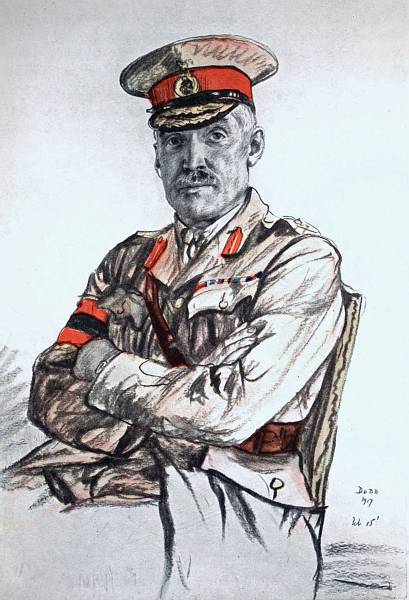
In the autumn of 1916 Sir Henry Horne took over the command of the First Army and during the winter held the section of the British line between General Plumer and General Allenby.
In the Battle of Arras he commanded the British left. His troops carried the Vimy ridge and fought their way to the southern and western suburbs of Lens. Sir Henry Horne's Army had now a similar general objective to that which his Division had had at the earlier Battle of Loos.
Sir Henry Horne is one of the most trusted of British soldiers. Like the Commander-in-Chief, he is a man of few words but of many deeds. Scotland has played a great part in the war and has contributed more than her share of brilliant Generals. The one Scottish Army Commander in the West has nobly sustained the traditions of his country.