Part 1 — GLOSSARY OF TECHNICAL TERMS USED IN PART I.
Reading edition
Amphioxi (adj. amphioxous)Rod-like spicules sharp at both ends.
Amphistrongyli (adj. amphistrongylous)Rod-like spicules blunt at both ends.
Basal membraneA horny, structureless membrane found at the base of some sponges.
Birotulate (subst. or adj.)Spicule with a transverse disk at both ends.
Bubble-cellsSpherical cells of the parenchyma the contents of which consist of a drop of liquid covered by a thin film of protoplasm.
Ciliated (or flagellated) chamberA cavity lined with collar-cells.
Collar-cell (choanocyte)Cell provided at one end with a membranous collar and a vibratile lash or flagellum that springs from within the collar.
Derma or ectodermal layerA layer of flat cells arranged like a pavement on the surface of the sponge.
Exhalent (or efferent) canalA tubular canal through which water passes from a ciliated chamber towards the osculum.
Fibres (skeleton)Thread-like structures that compose the skeleton of the sponge and are formed (in the Spongillidæ) mainly of overlapping spicules.
Flesh-spiculesMicroscleres (q. v.) that lie free in the parenchyma and the derma.
ForamenAn orifice of the gemmule.
Foraminal tubuleA horny tube that surrounds the foramina of some gemmules.
GemmuleA mass of cells packed with food-material, surrounded by at least one horny coat, capable of retaining vitality in unfavourable conditions and finally of giving origin to a new sponge.
Green corpusclesMinute green bodies found inside cells of sponges and other animals and representing a stage in the life-history of an alga (Chlorella).
Inhalent (or afferent) canal.A tubular canal through which water passes from the exterior towards a ciliated chamber.
MegascleresThe larger spicules that (in the Spongillidæ) form the basis of the skeleton of the sponge.
MicroscleresSmaller spicules that lie free in the substance or the derma of the sponge, or are associated with the gemmule.
Monaxon(Of spicules) having a single main axis; (of sponges) possessing skeleton spicules of this type.
OsculumAn aperture through which water is ejected from the sponge.
Oscular collarA ring-shaped membrane formed by an extension of the derma round an osculum.
ParenchymaThe gelatinous part of the sponge.
Pavement layerAdherent gemmules arranged close together in a single layer at the base of a sponge.
Pneumatic coatA horny or chitinous layer on the surface of the gemmule containing air-spaces. If these spaces are of regular form and arrangement it is said to be cellular; if they are minute and irregular it is called granular.
PoreA minute hole through which water is taken into the sponge.
Pore-cell (porocyte)A cell pierced by a pore.
Radiating fibresFibres in the skeleton of a sponge that are vertical or radiate from its centre.
RotulaA transverse disk borne by a microsclere.
Rotulate (subst. or adj.)Spicule bearing one or two transverse disks.
SpiculeA minute mineral body of regular and definite shape due not to the forces of crystallization but to the activity of the living cell or cells in which it is formed.
SponginThe horny substance found in the skeletal framework and the coverings of gemmules of sponges. Structures formed of this substance are often referred to as chitinous.
Subdermal cavityA cavity immediately below the derma (q. v.).
Transverse fibresFibres in the skeleton of a sponge that run across between the radiating fibres.
Tubelliform (of spicule)Having a straight shaft with a transverse disk at one end and a comparatively small knob-like projection at the other.
SYSTEMATIC LIST OF THE INDIAN SPONGILLIDÆ.
[Types, schizotypes, or cotypes have been examined in the case of all species, &c. , whose names are marked thus, *.]
Genus 1. Spongilla, Lamarck (1816).
Subgenus A. Euspongilla, Vejdovsky (1883).
1.
? S. lacustris, auct. (perhaps in N.W. India).
1a.
S. lacustris subsp. reticulata*, Annandale (1907).
2.
S. proliferens*, Annandale (1907).
3.
S. alba*, Carter (1849).
3a.
S. alba var. cerebellata, Bowerbank (1863).
3b.
S. alba var. bengalensis*, Annandale (1906).
4.
S. cinerea*, Carter (1849).
5.
S. travancorica*, Annandale (1909).
6.
S. hemephydatia*, Annandale (1909).
7.
S. crateriformis* (Potts) (1882).
Subgenus B. Eunapius, J. E. Gray (1867).
8.
S. carteri*, Carter (1849).
8a.
S. carteri var. mollis*, nov.
8b.
S. carteri var. cava*, nov.
8c.
S. carteri var. lobosa*, nov.
9a.
S. fragilis subsp. calcuttana*, nov.
9b.
S. fragilis var. decipiens, Weber
(probably Malaysian, not Indian).
10.
S. gemina*, sp. nov.
11.
S. crassissima*, Annandale (1907).
11a.
S. crassissima var. crassior*, Annandale (1907).
Subgenus C. Stratospongilla, Annandale (1909).
12.
S. indica*, Annandale (1908).
13.
S. bombayensis*, Carter (1882).
14.
S. ultima*, Annandale (1910).
Genus 2. Pectispongilla, Annandale (1909).
15.
P. aurea*, Annandale (1909).
15a.
P. aurea var. subspinosa*, nov.
Genus 3. Ephydatia, Lamouroux (1816).
16.
E. meyeni* (Carter) (1849).
Genus 4. Dosilia, J. E. Gray (1867).
17.
D. plumosa* (Carter) (1849).
Genus 5. Trochospongilla, Vejdovsky (1883).
18.
T. latouchiana*, Annandale (1907).
19.
T. phillottiana*, Annandale (1907).
20.
T. pennsylvanica* (Potts) (1882).
Genus 6. Tubella, Carter (1881).
21.
T. vesparioides*, Annandale (1908).
Genus 7. Corvospongilla, nov.
22.
C. burmanica* (Kirkpatrick) (1908).
23.
C. lapidosa* (Annandale) (1908).
Order HALICHONDRINA.
Siliceous monaxon sponges in which the horny skeleton is much reduced or absent and the spicular skeleton is more or less definitely reticulate. The microscleres are usually rod-like and rarely have more than one main axis.
Family SPONGILLIDÆ.
Spongilladæ, J. E. Gray, P. Zool. Soc. London, 1867, p. 550.
Freshwater Halichondrina which at certain seasons produce gemmules armed with peculiar microscleres. Two distinct kinds of microsclere are often present, that associated with the gemmule sometimes consisting of a vertical shaft at the ends of which transverse disks or rotulæ are borne. There is always at least a trace of a subdermal cavity.
Many authors divide the Spongillidæ into two subfamilies:—Spongillinæ (or Euspongillinæ), in which the gemmule-spicules have no transverse rotulæ, and Meyeninæ (or Ephydatiinæ), in which they have rotules at one or both ends. So gradual, however, is the transition that I find it difficult to decide in one instance to which of two genera, typical respectively of the two "subfamilies," a species should be assigned. Minchin in his account of the Porifera in Lankester's "Treatise on Zoology" (1900) regards the Spongillidæ merely as a subfamily of the Heterorrhaphidæ, and there certainly are few differences of a definite nature between them and the marine family (or subfamily) Remeridæ.
Key to the Indian Genera of Spongillidæ.
I.Microscleres without transverse disks.
A.Microscleres of the parenchyma similar in general structure to those or the gemmule; the latter without comb-like vertical rows of spines at the endsSpongilla, p. 67.
B.Microscleres of the gemmule with comb-like vertical rows of spines at both endsPectispongilla, p. 106.
II.Some or all of the microscleres birotulate. (Birotulate microscleres of one kind only.)
A.Microscleres of the gemmule birotulate, the rotules with serrated or strongly sinuous edges; parenchyma spicules usually absent, never of complicated structureEphydatia, p. 108.
B.Microscleres of the gemmule as in Ephydatia; microscleres of the parenchyma consisting of numerous shafts meeting in different planes in a central noduleDosilia, p. 110.
C.Microscleres as in Ephydatia except that the rotulæ of the gemmule-spicules have smooth edgesTrochospongilla, p. 113.
D.Microscleres of the gemmule without a trace of rotules, those of the parenchyma birotulateCorvospongilla, nov., p. 122.
III.Microscleres of the gemmule with a well-developed basal rotule and a vertical shaft ending above in a mere knob.Tubella, p. 120.
The most distinct genus of Spongillidæ not yet found in India is Heteromeyenia, Potts. It is easily distinguished from all others by the fact that the birotulate spicules of the gemmule are of two quite distinct kinds, which occur together on every mature gemmule. Heteromeyenia is represented by several American species, one of which has been found in Europe. Acalle, J. E. Gray, which is represented by a single South American species (Spongilla recurvata, Bowerbank), is related to Heteromeyenia but has one kind of gemmule-spicule tubelliform, the other birotulate. Probably Uraguaya, Carter, should be regarded as a subgenus of Trochospongilla with an unusually solid skeleton; it is peculiar to S. America. Parmula, Carter (=Drulia, Gray) includes South American forms allied to Tubella, but with the shaft of the gemmule-spicule degenerate and consisting of a mere projection in the centre of a shield-like body, which represents the lower rotule. The status of Potamolepis, Marshall, originally described from the Lake of Galilee, is very doubtful; possibly some or all of its species belong to the subgenus of Spongilla here called Stratospongilla (p. 100); but they are stated never to produce gemmules. The same is the case as regards Pachydictyum, Weltner, which consists of a single species from Celebes.
The sponges from Lake Baikal assigned by Weltner (Arch. Naturg. lxi (i) p. 131) to the subfamily Lubomirskinæ are of doubtful position and need not be considered here; while Lessepsia, Keller, from one of the salt lakes on the Suez Canal, certainly does not belong to the family, although it is assigned to it by von Lendenfeld (Mon. Horny Sponges, p. 904 (1889)) and subsequently by Minchin (Porifera, p. 152, in Lankester's Treatise on Zoology, part ii (1900)).
Genus 1. SPONGILLA, Lamarck (Carter emend.).
Spongilla, Lamarck, Histoire des Animaux sans Vertèbres, ii, p. 111 (1836). Spongilla, Carter, Ann. Nat. Hist. (5) vii, p. 86 (1881). Euspongilla, Vejdovsky, Abh. Böhm. Ges. xii, p. 15 (1883). Spongilla, Potts, P. Ac. Philad. 1887, p. 182.
Type, Spongilla lacustris, auctorum.
Spongillidæ in which the gemmules have (normally) cylindrical or subcylindrical spicules that are sharp or blunt at the ends, without a distinct transverse disk or disks and without comb-like vertical rows of spines.
The skeleton is variable in structure, sometimes being almost amorphous, sometimes having well-defined radiating and transverse fibres firmly compacted with spongin. The skeleton-spicules are either sharp or blunt at the ends. Flesh-spicules are often absent; when present they are needle-like and resemble the gemmule-spicules in general structure; they have not even rudimentary rotules at their ends. The gemmules either lie free in the substance of the sponge or are attached to its support; sometimes they adhere together in free or attached groups.
Spongilla is undoubtedly the most primitive genus of the Spongillidæ, its spicules showing less sign of specialization than those of any other genus included in the family. As a fossil it goes back at any rate to the Upper Jurassic (p. 52).
Geographical Distribution.—Cosmopolitan. In most countries the majority of the freshwater sponges belong to this genus, but in Japan Ephydatia seems to predominate.
Key to the Indian Species of Spongilla.
I.Gemmule provided with a thick, apparently granular pneumatic coat in which the gemmule-spicules are arranged tangentially or vertically. (Subgenus Euspongilla, p. 69.)
A.No foraminal tubule.
a. Sponge bright green, soft and compressible when fresh, very fragile dry lacustris, p. 69.
a'. Sponge white or grey, hard both fresh and dryalba, p. 76.
B.A foraminal tubule present.
b. Skeleton-spicules smooth.
β. Gemmules free; gemmule-spicules arranged tangentially and horizontallyproliferens, p. 72.
β'. Gemmules free; gemmule-spicules arranged vertically or nearly so in a single serieshemephydatia, p. 82.
β''. Gemmules firmly fixed to the support of the sponge; gemmule-spicules almost vertical, irregularly arranged, as a rule in more than one seriestravancorica, p. 81.
b'. Skeleton-spicules spiny or irregular in outline.
β'''. Gemmule-spicules tangential and horizontal, without rudimentary rotulescinerea, p. 79.
β''''. Gemmule-spicules vertical or nearly so, often with rudimentary rotules at the tipscrateriformis, p. 83.
II.Gemmules surrounded in several layers by distinct polygonal air-spaces with chitinous walls. (Subgenus Eunapius, p. 86.)
A.Gemmules single. Skeleton- and gemmule-spicules smooth, pointed, not very stoutcarteri, p. 87.
B.Gemmules bound together in pairs. Skeleton friable; skeleton-spicules slendergemina, nov., p. 97.
C.Gemmules bound together in free groups of more than two or forming a "pavement-layer" at the base of the sponge.
c. Skeleton friable; skeleton-spicules slenderfragilis, p. 95.
c'. Skeleton very hard and resistant; skeleton-spicules stoutcrassissima, p. 98.
III.Gemmules without or with irregular pneumatic coat, covered by a chitinous membrane or membranes in which the gemmule-spicules lie parallel to the surface. (Subgenus Stratospongilla, p. 100.)
A.Skeleton spicules spiny or irregular in outline.
a. Skeleton-spicules blunt; gemmules covered by a single chitinous membraneindica, p. 100.
a'. Skeleton-spicules sharp; gemmules covered by two chitinous membranesbombayensis, p. 102.
B.Skeleton-spicules smooth. Skeleton-spicules sharp; gemmule spicules very irregular in formultima, p. 104.
Subgenus A. EUSPONGILLA, Vejdovsky.
Euspongilla, Vejdovsky, Abh. Böhm. Ges. xii, p. 15 (1883). Euspongilla, id., in Potts's "Fresh-Water Sponges," P. Ac. Philad. 1887, p. 172. Euspongilla, Weltner, in Zacharias's Tier- und Pflanzenwelt des Süsswassers, i, p. 210 (1891).
Type, Spongilla lacustris, auctorum.
Spongillæ in which the gemmules are covered with a thick, apparently granular pneumatic coat. A delicate membrane often occurs outside this coat, but it is never thick or horny. The gemmules usually lie free in the sponge but sometimes adhere to its support; rarely they are fastened together in groups (e. g. in S. aspinosa, Potts). The skeleton-spicules are never very stout and the skeleton is always delicate.
The species in this subgenus are closely allied and must be distinguished rather by the sum of their peculiarities than by any one character. They occur in all countries in which Spongillidæ are found. Seven Indian species may be recognized.
1. Spongilla lacustris, auctorum.
Spongilla lacustris, Bowerbank, P. Zool. Soc. London, 1863, p. 441, pl. xxxviii, fig. 14. Spongilla lacustris, Carter, Ann. Nat. Hist. (5) vii, p. 87 (1881). Euspongilla lacustris, Vejdovsky, in Potts's "Fresh-Water Sponges," P. Ac. Philad. 1887, p. 172. Spongilla lacustris, Potts, ibid., p. 186, pl. v, fig. 1, pl. vii, figs. 1-6. Euspongilla lacustris, Weltner, in Zacharias's Tier- und Pflanzenwelt des Süsswassers, i, p. 211, figs. 36-38 (1891). Spongilla lacustris, id., Arch. Naturg. lxi (i), pp. 118, 133-135 (1895). Spongilla lacustris, Annandale, J. Linn. Soc., Zool., xxx, p. 245 (1908).
[I have not attempted to give a detailed synonymy of this common species. There is no means of telling whether many of the earlier names given to forms or allies of S. lacustris are actual synonyms, and it would serve no useful purpose, so far as the fauna of India is concerned, to complicate matters by referring to obscure descriptions or possible descriptions of a species only represented in India, so far as we know, by a specialized local race, to which separate references are given.]
Sponge soft and easily compressed, very brittle when dry, usually consisting of a flat or rounded basal portion of no great depth and of long free cylindrical branches, which droop when removed from the water; branches occasionally absent. Colour bright green when the sponge is growing in a strong light, dirty flesh-colour when it is growing in the shade. (Even in the latter case traces of the "green corpuscles" can be detected in the cells of the parenchyma.) Oscula star-shaped, of moderate size, as a rule rendered conspicuous by the furrows that radiate from them over the outer surface of the parenchyma below the external membrane; oscular collars well developed.
Skeleton reticulate, loose, with definite radiating and transverse fibres held together by a small quantity of spongin; the fibres slender but not extremely so.
Spicules. Skeleton-spicules smooth, sharply pointed, long, slender. Flesh-spicules slender, covered with small spines, sharply pointed, nearly straight. Gemmule-spicules resembling the flesh-spicules but shorter and as a rule more strongly curved, sometimes bent so as to form semicircular figures, usually pointed somewhat abruptly; their spines relatively longer than those of the flesh-spicules, often curved backwards, especially near the ends of the spicules, at which points they are often longer than elsewhere.
Gemmules usually numerous in autumn, lying free in the sponge, spherical, variable in size but usually rather large, as a rule covered with a thick granular coat in which the spicules are arranged tangentially; a horizontal layer of spicules often present in the external membrane; the granular coat and its spicules occasionally deficient. No foraminal tubule; its place sometimes taken by an open, bowl-shaped chitinous structure the base of which is in continuity with the inner chitinous coat of the gemmule.
S. lacustris is an extremely variable species, varying in the size, proportions and shape of its spicules, in its external form and in the size and structure of the gemmule. A considerable number of varieties have been described from different parts of Europe and N. America, but some of these may represent distinct but closely-allied species; descriptions of most of them will be found in Potts's "Fresh-Water Sponges." The embryology and the earlier stages of the development from the egg have been described in great detail by Evans (Quart. J. Micr. Sci. (n. s.) xlii, p. 363 (1899)), while the anatomy and physiology are discussed by most authors who have written on these features in the Spongillidæ.
Type.—It is impossible to say who was the first authority to use the name Spongilla lacustris in the sense in which it is used by recent authors. No type can therefore be recognized.
Geographical Distribution.—S. lacustris occurs all over Europe and N. America and is probably the commonest species in most parts of both continents. It has also been found in Northern Asia and may occur in the Himalayan lakes and in the north-west of India.
1 a. Subspecies reticulata*, Annandale.
Spongilla reticulata, Annandale, Rec. Ind. Mus. i, p. 387, pl. xiv, fig. 1 (1907). Spongilla lacustris subspecies reticulata, id., P. U.S. Mus. xxxvii, p. 401 (1909).
This race differs from the typical S. lacustris in the following particulars:—
(1) The branches are always compressed and anastomose freely when well developed (fig. 5, p. 37);
(2) the skeleton-fibres are finer;
(3) the skeleton-spicules are longer;
(4) the gemmule-spicules are longer and more slender and are never strongly bent.
As regards the form of the skeleton- and gemmule-spicules and also that of the branches the subspecies reticulata resembles S. alba rather than S. lacustris, but owing to the fact that it agrees with S. lacustris in its profuse production of branches, in possessing green corpuscles and in its fragility, I think it should be associated with that species.
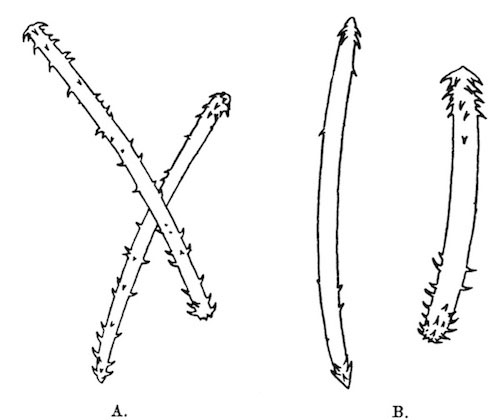
Fig. 8.
A=gemmule-spicules of Spongilla lacustris subsp. reticulata (from type); B=gemmule-spicules of S. alba from Calcutta: both highly magnified.
The branches are sometimes broad (fig. 5, p. 37), sometimes very slender. In the latter condition they resemble blades of grass growing in the water.
Type in the Indian Museum; a co-type in the British Museum.
Geographical Distribution.—All over Eastern India and Burma; also in the Bombay Presidency. Localities:—Bengal, Port Canning, Ganges delta; Rajshahi (Rampur Bhulia) on the Ganges, 150 miles N. of Calcutta (Annandale); Puri district, Orissa (Annandale); R. Jharai, Siripur, Saran district, Tirhut (M. Mackenzie): Madras Presidency, Madras (town) (J. R. Henderson): Bombay Presidency, Igatpuri, W. Ghats (Annandale).
Biology.—This subspecies is usually found in small masses of water, especially in pools of rain-water, but Mr. Mackenzie found it growing luxuriantly in the Jharai at a time of flood in September. It is very abundant in small pools among the sand-dunes that skirt the greater part of the east coast of India. Here it grows with great rapidity during the "rains," and often becomes desiccated even more rapidly as soon as the rain ceases. As early in the autumn as October I have seen masses of the sponge attached, perfectly dry, to grass growing in the sand near the Sur Lake in Orissa. They were, of course, dead but preserved a life-like appearance. Some of them measured about six inches in diameter. At Port Canning the sponge grows during the rains on the brickwork of bridges over ditches of brackish water that dry up at the beginning of winter, while at Rajshahi and at Igatpuri I found it at the edges of small ponds, at the latter place in November, at the former in February. Specimens taken at Madras by Dr. Henderson during the rains in small ponds in the sand contained no gemmules, but these structures are very numerous in sponges examined in autumn or winter.
Numerous larvæ of Sisyra indica (p. 92) were found in this sponge at Rajshahi. Unlike those obtained from S. alba, they had a green colour owing to the green matter sucked from the sponge in their stomachs. The coralloides phase of Plumatella fruticosa (p. 219) was also found in S. lacustris subsp. reticulata at Rajshahi.
So far as my experience goes, this subspecies has always a bright green colour due to the presence of "green corpuscles," even when it is growing in a pond heavily shaded by trees or under the arch of a small bridge. Probably the more intense light of India enables the corpuscles to flourish in situations in which in Europe they would lose their chlorophyll.
2. Spongilla proliferens*, Annandale.
Spongilla cinerea, Weber (nec Carter), Zool. Ergeb. Niederl. Ost-Ind. vol. i, pp. 35, 46 (1890). Spongilla proliferens, Annandale, J. Asiat. Soc. Bengal, 1907, p. 15, fig. 1. Spongilla proliferens, id., Rec. Ind. Mus. i, pp. 267, 271 (1907).
Sponge forming soft, shallow cushions rarely more than 10 cm. in diameter on the leaves of water-plants, or small irregular masses on their roots and stems. Colour bright green. Oscula moderate, flat, surrounded by deep, cone-shaped collars; radiating furrows and canals in the parenchyma surrounding them often deep. External pores contained normally in single cells. The surface frequently covered by small rounded buds; true branches if present more or less flattened or conical, always short, as a rule absent.
Skeleton loose, feebly reticulate at the base of the sponge; transverse fibres slender in the upper part of the sponge, often scarcely recognizable at its base. Very little spongin present.
Spicules. Skeleton-spicules long, smooth, sharply pointed; the length on an average at least 20 times the greatest breadth, often more. Flesh-spicules slender, gradually pointed, nearly straight, covered with minute straight or nearly straight spines. Gemmule-spicules very similar, but usually a little stouter and often blunt at the ends; their spines rather longer than those on the flesh-spicules, usually more numerous near the ends than in the middle of the spicule, slightly retroverted, those at the extreme tips often so arranged as to suggest a rudimentary rotule.
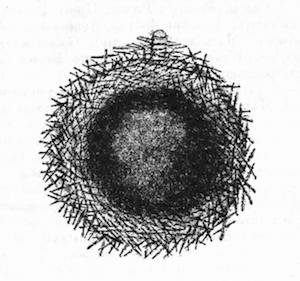
Fig. 9.—Gemmule of Spongilla proliferens as seen in optical section (from Calcutta), × 140.
Gemmules usually numerous, lying free near the base of the sponge, very variable in size, spherical, surrounded by a thick granular layer in which the spicules, which are always very numerous, are arranged tangentially, their position being more near the vertical than the horizontal; a few horizontal spicules usually present on the external surface of the gemmule, which frequently has a ragged appearance owing to some of the tangential spicules protruding further than others. Foraminal tubule stout, cylindrical, usually somewhat contorted; its orifice irregular in outline. Sometimes more than one foramen present.
S. proliferens can be distinguished from all forms of S. lacustris and S. alba by the fact that its gemmules possess a foraminal tubule; from S. cinerea it can be distinguished by its colour and its smooth skeleton-spicules, and from S. travancorica by its free gemmules. I have been enabled by the kindness of Prof. Max Weber to examine specimens from Celebes and Java identified by him as S. cinerea, Carter, and have no doubt that they belong to my species.
Type in the Indian Museum; a co-type in the British Museum.
Geographical Distribution.—All over Eastern India and Burma; also in Cochin on the west coast; Ceylon; W. China; Java, Flores and Celebes. Localities:—Bengal, Calcutta and neighbourhood (Annandale); Berhampore, Murshidabad district (R. E. Lloyd): Assam, Mangal-dai near the Bhutan frontier (S. W. Kemp): Madras Presidency, Madras (town) and neighbourhood (J. R. Henderson); Rambha, Ganjam district (Annandale); Bangalore, Mysore (alt. ca. 3000 ft.) (Annandale); Ernakulam and Trichur, Cochin (G. Mathai): Burma, Rangoon (Annandale, J. Coggin Brown); Prome, Upper Burma (J. Coggin Brown); Kawkareik, Amherst district, Tenasserim (Annandale): Ceylon, between Maradankawela and Galapita-Gala, North Central Province (Willey). Mr. J. Coggin Brown has recently brought back specimens from Yunnan.
Biology.—S. proliferens is usually found in ponds which never dry up; Prof. Max Weber found it in small streams in Malaysia. It is common in India on the leaves of Vallisneria and Limnanthemum, on the roots of Pistia stratiotes and on the stems of rushes and grass. So far as I have been able to discover, the life of the individual sponge is short, only lasting a few weeks.
Sexual reproduction occurs seldom or never, but reproduction by means of buds and gemmules continues throughout the year. The former is a rare method of reproduction in most Spongillidæ but in this species occurs normally and constantly, the buds being often very numerous on the external surface. They arise a short distance below the surface as thickenings in the strands of cells that accompany the radiating fibres of the skeleton. As they grow they push their way up the fibres, forcing the external membrane outwards. The membrane contracts gradually round their bases, cuts off communication between them and the parent sponge and finally sets them adrift. No hole remains when this takes place, for the membrane closes up both round the base of the bud and over the aperture whence it has emerged.
The newly liberated bud already possesses numerous minute pores, but as yet no osculum; its shape exhibits considerable variation, but the end that was farthest from the parent-sponge before liberation is always more or less rounded, while the other end is flat. The size also varies considerably. Some of the buds float, others sink. Those that float do so either owing to their shape, which depends on the degree of development they have reached before liberation, or to the fact that a bubble of gas is produced in their interior. The latter phenomenon only occurs when the sun is shining on the sponge at the moment they are set free, and is due to the action of the chlorophyll of the green bodies so abundant in certain of the parenchyma cells of this species. If the liberation of the bud is delayed rather longer than usual, numbers of flesh-spicules are produced towards the ends of the primary skeleton-fibres and spread out in one plane so as to have a fan-like outline; in such buds the form is more flattened and the distal end less rounded than in others, and the superficial area is relatively great, so that they float more readily. Those buds that sink usually fall in such a way that their proximal, flattened end comes in contact with the bottom or some suspended object, to which it adheres. Sometimes, however, owing to irregularity of outline in the distal end, the proximal end is uppermost. In this case it is the distal end that adheres. Whichever end is uppermost, it is in the uppermost end, or as it may now be called, the upper surface, that the osculum is formed. Water is drawn into the young sponge through the pores and, finding no outlet, accumulates under the external membrane, the subdermal cavity being at this stage even larger than it is in the adult sponge. Immediately after adhesion the young sponge flattens itself out. This process apparently presses together the water in the subdermal cavity and causes a large part of it to accumulate at one point, which is usually situated near the centre of the upper surface. A transparent conical projection formed of the external membrane arises at this point, and at the tip of the cone a white spot appears. What is the exact cause of this spot I have not yet been able to ascertain, but it marks the point at which the imprisoned water breaks through the expanded membrane, thus forming the first osculum. Before the aperture is formed, it is already possible to distinguish on the surface of the parenchyma numerous channels radiating from the point at which the osculum will be formed to the periphery of the young sponge. These channels as a rule persist in the adult organism and result from the fact that the inhalent apertures are situated at the periphery, being absent from both the proximal and the distal ends of the bud. In the case of floating buds the course of development is the same, except that the osculum, as in the case of development from the gemmule in other species (see Zykoff, Biol. Centrbl. xii, p. 713, 1892), is usually formed before adhesion takes place.
The sponge of S. proliferens is usually too small to afford shelter to other animals, and I have not found in it any of those commonly associated with S. carteri and S. alba.
Owing to its small size S. proliferens is more easily kept alive in an aquarium than most species, and its production of buds can be studied in captivity. In captivity a curious phenomenon is manifested, viz. the production of extra oscula, often in large numbers. This is due either to a feebleness in the currents of the sponge which makes it difficult to get rid of waste substances or to the fact that the canals get blocked. The effluent water collects in patches under the external membrane instead of making its way out of the existing oscula, and new oscula are formed over these patches in much the same way as the first osculum is formed in the bud.
3. Spongilla alba*, Carter.
Spongilla alba, Carter, J. Bombay Asiat. Soc. iii, p. 32, pl. i, fig. 4 & Ann. Nat. Hist. (2) iv, p. 83, pl. iii, fig. 4 (1849) Spongilla alba, Bowerbank, P. Zool. Soc. London, 1863, p. 463 pl. xxxviii, fig. 15. Spongilla alba, Carter, Ann. Nat. Hist. (5) vii, p. 88 (1881). Spongilla alba, Petr, Rozp. Ceske Ak. Praze, Trída, ii, pl. i, figs. 3-6 (1899) (text in Czech). Spongilla alba, Annandale, Rec. Ind. Mus. i, p. 388, pl. xiv, fig. 2 (1907).
Sponge forming masses of considerable area, but never of more than moderate depth or thickness. Surface smooth and undulating or with irregular or conical projections; sponge hard but brittle; colour white or whitish; oscula of moderate or large size, never very conspicuous; radiating furrows absent or very short; external membrane adhering to the substance of the sponge.
Skeleton forming a moderately dense network of slender radiating and transverse fibres feebly held together; little spongin present; the meshes much smaller than in S. lacustris or S. proliferens.
Spicules. Skeleton-spicules smooth, sharply pointed, slender, feebly curved. Gemmule-spicules (fig. 8, p. 71) slender, cylindrical, blunt or abruptly pointed at the ends, feebly curved, bearing relatively long backwardly directed spines, which are usually more numerous at the ends than near the middle of the shaft. Flesh-spicules very numerous in the parenchyma and especially the external membrane, as a rule considerably more slender and more sharply pointed than the gemmule-spicules, covered with straight spines which are often longer at the middle of the shaft than at the ends.
Gemmules usually of large size, with a moderately thick granular layer; spicules never very numerous, often lying horizontally on the external surface of the gemmule as well as tangentially in the granular layer; no foraminal tubule; a foraminal cup sometimes present.
3a. Var. cerebellata, Bowerbank.
Spongilla cerebellata, Bowerbank, P. Zool. Soc. London, 1863, p. 465, pl. xxxviii, fig. 16. Spongilla alba var. cerebellata, Carter, Ann. Nat. Hist. (5) vii, p. 88 (1881). Spongilla cerebellata, Weltner, Arch. Naturg. lxi (i), p. 117 (1895). Spongilla cerebellata, Kirkpatrick, Ann. Nat. Hist. (7) xx, p. 523 (1907).
This variety is distinguished from the typical form by the total absence of flesh-spicules. The gemmule-spicules are also more numerous and cross one another more regularly.
3b. Var. bengalensis*, Annandale. (Plate I, figs. 1-3.)
Spongilla lacustris var. bengalensis, Annandale, J. Asiat. Soc. Bengal, 1906, p. 56. Spongilla alba var. marina, id., Rec. Ind. Mus. i, p. 389 (1907).
The sponge is either devoid of branches or produces irregular, compressed, and often digitate processes, sometimes of considerable length and delicacy. Flesh-spicules are usually present throughout the sponge, but are sometimes absent from one part of a specimen and present in others. Some of the gemmules are often much smaller than the others. Perhaps this form should be regarded as a phase rather than a true variety (see p. 18).
All forms of S. alba can be distinguished from all forms of S. lacustris by the much closer network of the skeleton and by the consequent hardness of the sponge; also by the complete absence of green corpuscles.
Types. The types of the species and of the var. cerebellata are in the British Museum, with fragments of the former in the Indian Museum; that of var. bengalensis is in the Indian Museum, with a co-type in London.
Geographical Distribution.—India and Egypt. Localities:—Bombay Presidency, island of Bombay (Carter); Igatpuri, W. Ghats (Annandale): Bengal, Calcutta; Port Canning, Ganges delta (var. bengalensis) (Annandale); Garia, Salt Lakes, nr. Calcutta (var. bengalensis) (B. L. Chaudhuri); Chilka Lake, Orissa (var. bengalensis) (Gopal Chunder Chatterjee): Madras Presidency, Rambha, Ganjam district (Annandale): Nizam's Territory, Aurangabad (Bowerbank, var. cerebellata). The var. cerebellata has also been taken near Cairo.
Biology.—The typical form of the species is usually found growing on rocks or bricks at the edges of ponds, while the variety bengalensis abounds on grass-roots in pools and swamps of brackish water in the Ganges delta and has been found on mussel-shells (Modiola jenkinsi, Preston) in practically salt water in the Chilka Lake. Carter procured the typical form at Bombay on stones which were only covered for six months in the year, and "temporarily on floating objects." In Calcutta this form flourishes in the cold weather on artificial stonework in the "tanks" together with S. carteri, S. fragilis, Ephydatia meyeni, and Trochospongilla latouchiana.
The variety bengalensis is best known to me as it occurs in certain ponds of brackish water at Port Canning on the Mutlah River, which connects the Salt Lakes near Calcutta with the sea. It appears in these ponds in great luxuriance every year at the beginning of the cold weather and often coats the whole edge for a space of several hundred feet, growing in irregular masses which are more or less fused together on the roots and stems of a species of grass that flourishes in such situations. Apparently the tendency for the sponges to form branches is much more marked in some years than in others (see Pl. I, figs. 1-3). The gemmules germinate towards the end of the "rains," and large masses of sponge are not formed much before December. At this season, however, the level of the water in the ponds sinks considerably and many of the sponges become dry. If high winds occur, the dry sponges are broken up and often carried for considerable distances over the flat surrounding country. In January the gemmules floating on the surface of the ponds form a regular scum. S. alba var. bengalensis is the only sponge that occurs in these ponds at Port Canning, but S. lacustris, subsp. reticulata, is occasionally found with it on brickwork in the ditches that drain off the water from the neighbouring fields into the Mutlah estuary. The latter sponge, however, perishes as these ditches dry up, at an earlier period than that at which S. alba reaches its maximum development.
The larvæ of Sisyra indica are commonly found in the oscula of the typical form of S. alba as well as in those of S. lacustris subsp. reticulata, and S. carteri; but the compact structure of the sponge renders it a less suitable residence for other incolæ than S. carteri.
In the variety bengalensis, as it grows in the ponds at Port Canning, a large number of arthropods, molluscs and other small animals take shelter. Apart from protozoa and rotifers, which have as yet been little studied, the following are some of the more abundant inhabitants of the sponge:—The sea-anemone, Sagartia schilleriana subsp. exul (see p. 140), which frequently occurs in very large numbers in the broader canals; the free-living nematode, Oncholaimus indicus[W], which makes its way in and out of the oscula; molluscs belonging to several species of the genus Corbula, which conceal themselves in the canals but are sometimes engulfed in the growing sponge and so perish; young individuals of the crab Varuna litterata, which hide among the branches and ramifications of the larger sponges together with several small species of prawns and the schizopod Macropsis orientalis[X]; the peculiar amphipod Quadrivisio bengalensis[Y], only known from the ponds at Port Canning, which breeds in little communities inside the sponge; a small isopod[Z], allied to Sphæroma walkeri, Stebbing; the larva of a may-fly, and those of at least two midges (Chironomidæ).
The peculiarly mixed nature (marine and lacustrine) of the fauna associated with S. alba in the ponds at Port Canning is well illustrated by this list, and it only remains to be stated that little fish (Gobius alcockii, Barbus stigma, Haplochilus melanostigma, H. panchax, etc.) are very common and feed readily on injured sponges. They are apparently unable to attack a sponge so long as its external membrane is intact, but if this membrane is broken, they swarm round the sponge and devour the parenchyma greedily. In fresh water one of these fishes (Gobius alcockii, see p. 94) lays its eggs in sponges.
The chief enemy of the sponges at Port Canning is, however, not an animal but a plant, viz., a green filamentous alga which grows inside the sponge, penetrating its substance, blocking up its canals and so causing it to die. Similar algæ have been described as being beneficial to the sponges in which they grow[AA], but my experience is that they are deadly enemies, for the growth of such algæ is one of the difficulties which must be fought in keeping sponges alive in an aquarium. The alga that grows in S. alba often gives it a dark green colour, which is, however, quite different from the bright green caused by the presence of green corpuscles. The colour of healthy specimens of the variety bengalensis is a rather dark grey, which appears to be due to minute inorganic particles taken into the cells of the parenchyma from the exceedingly muddy water in which this sponge usually grows. If the sponge is found in clean water, to whichever variety of the species it belongs, it is nearly white with a slight yellowish tinge. Even when the typical form is growing in close proximity to S. proliferens, as is often the case, no trace of green corpuscles is found in its cells.
4. Spongilla cinerea*, Carter.
Spongilla cinerea, Carter, J. Bombay Soc. iii, p. 30, pl. i, fig. 5, & Ann. Nat. Hist. (2) iv, p. 82, pl. iii, fig. 5 (1849). Spongilla cinerea, Bowerbank, P. Zool. Soc. London, 1863, p. 468, pl. xxxviii, fig. 19. Spongilla cinerea, Carter, Ann. Nat. Hist. (5) vii, p. 263 (1881).
Sponge forming large, flat sheets, never more than a few millimetres in thickness, without a trace of branches, compact but very friable, of a dark greyish colour; oscula small and inconspicuous or moderately large, never prominent; membrane adhering closely to the sponge.
Skeleton with well-defined but slender radiating fibres, which contain very little spongin; transverse fibres close together but consisting for the most part of one or two spicules only.
Spicules. Skeleton-spicules short, slender, sharply pointed, minutely serrated or irregular in outline, almost straight. Gemmule-spicules very small, rather stout, cylindrical, pointed, covered with relatively long and stout spines which are either straight or directed towards the ends of the spicule. Flesh-spicules fairly numerous in the external membrane but by no means abundant in the parenchyma, very slender, gradually pointed, covered uniformly with minute but distinct spines.
Gemmules very small, only visible to the naked eye as minute specks, as a rule numerous, free in the substance of the sponge, each provided with a slender foraminal tubule and covered with a thick granular coat in which the gemmule-spicules are arranged almost horizontally; a horizontal layer of spicules also present on the external surface of the gemmule; gemmule-spicules very numerous.
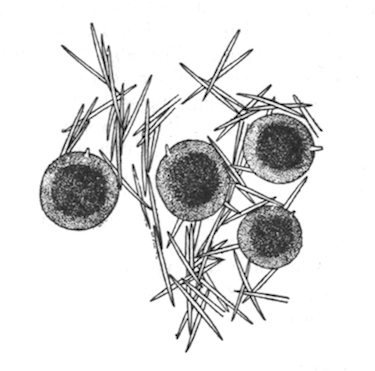
Fig. 10.—Gemmules and fragment of the skeleton of Spongilla cinerea (from type specimen), × 35.
This sponge is easily distinguished from its Indian allies by the form of its skeleton-spicules, which are, as Bowerbank expresses it, "subspined"; that it to say, under a high power of the microscope their outline appears to be very minutely serrated, although under a low power they seem to be quite smooth. The spicules also are smaller than those of S. alba, the only species with which S. cinerea is likely to be confused, and the gemmule has a well-developed foraminal tubule; the skeleton is much closer than in S. proliferens.
Type in the British Museum; a piece in the Indian Museum.
Geographical Distribution.—S. cinerea is only known from the Bombay Presidency. Carter obtained the original specimens at Bombay and the only ones I have found were collected at Nasik, which is situated on the eastern slopes of the Western Ghats, about 90 miles to the north-east.
Biology.—Carter's specimens were growing on gravel, rocks and stones at the edge of "tanks," and were seldom covered for more than six months in the year. Mine were on the sides of a stone conduit built to facilitate bathing by conveying a part of the water of the Godaveri River under a bridge. They were accompanied by Spongilla indica and Corvospongilla lapidosa (the only other sponges I have found in running water in India) and in the month of November appeared to be in active growth.
5. Spongilla travancorica*, Annandale.
Spongilla travancorica, Annandale, Rec. Ind. Mus. iii, p. 101, pl. xii, fig. 1 (1909).
Sponge small, encrusting, without branches, hard but brittle; its structure somewhat loose; colour dirty white. Dermal membrane in close contact with the skeleton; pores and oscula inconspicuous. Surface minutely hispid, smooth and rounded as a whole.
Skeleton consisting of moderately stout and coherent radiating fibres and well-defined transverse ones; a number of horizontal megascleres present at the base and surface, but not arranged in any definite order. No basal membrane.
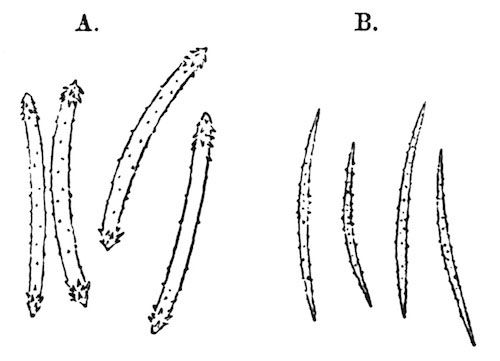
Fig. 11.—Microscleres of Spongilla travancorica. A=Gemmule-spicules; B=flesh-spicules (from type specimen), × 240.
Spicules. Skeleton-spicules smooth, pointed at either end, moderately stout, straight or curved, sometimes angularly bent; curvature usually slight. Free microscleres abundant in the dermal membrane, slender, nearly straight, gradually and sharply pointed, profusely ornamented with short straight spines, which are much more numerous and longer at the middle than near the ends. Gemmule-spicules stouter and rather longer, cylindrical, terminating at each end in a sharp spine, ornamented with shorter spines, which are more numerous and longer at the ends than at the middle; at the ends they are sometimes directed backwards, without, however, being curved.
Gemmules firmly adherent to the support of the sponge, at the base of which they form a layer one gemmule thick; each provided with at least one foraminal tubule, which is straight and conical: two tubules, one at the top and one at one side, usually present. Granular layer well developed. Spicules arranged irregularly in this layer, as a rule being more nearly vertical than horizontal but pointing in all directions, not confined externally by a membrane; no external layer of horizontal spicules.
Measurements of Spicules and Gemmules.
Length of skeleton-spicules0.289-0.374 mm.
Greatest diameter of skeleton-spicules0.012-0.016 mm.
Length of free microscleres0.08-0.096 mm.
Greatest diameter of free microscleres0.002 mm.
Length of gemmule-spicules0.1-0.116 mm.
Diameter of gemmule-spicule0.008 mm.
Diameter of gemmule0.272-0.374 mm.
This species is easily distinguished from its allies of the subgenus Euspongilla by its adherent gemmules with their (usually) multiple apertures and rough external surface.
Type in the collection of the Indian Museum.
Habitat. Backwater near Shasthancottah, Travancore, in slightly brackish water; on the roots of shrubs growing at the edge; November, 1908 (Annandale).
The specimens were dead when found.
6. Spongilla hemephydatia*, Annandale.
Spongilla hemephydatia, Annandale, Rec. Ind. Mus. iii, p. 275 (1909).
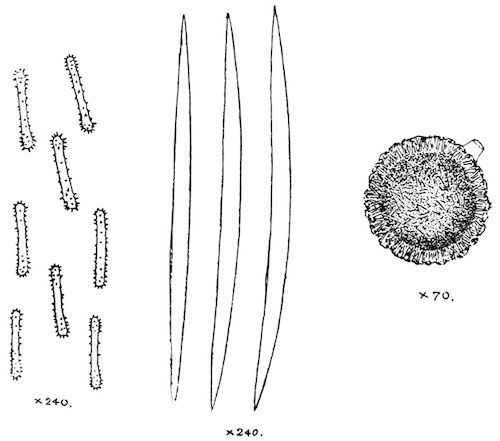
Fig. 12.—Gemmule and spicules of Spongilla hemephydatia (from type specimen).
Sponge soft, fragile, amorphous, of a dirty yellow colour, with large oscula, which are not conspicuously raised above the surface but open into very wide horizontal channels in the substance of the sponge. The oscular collars are fairly well developed, but the subepidermal space is not extensive.
Skeleton diffuse, consisting of very fine radiating fibres, which are crossed at wide and irregular intervals by still finer transverse ones; very little chitinoid substance present.
Spicules. Skeleton-spicules smooth, slender, sharply pointed at both ends, nearly straight. No true flesh-spicules. Gemmule-spicules straight or nearly so, cylindrical, or constricted in the middle, obscurely pointed or blunt, clothed with short, sharp, straight spines, which are very numerous but not markedly longer at the two ends; these spicules frequently found free in the parenchyma.
Gemmules numerous, small, free, spherical, yellow, with a well-developed granular coat (in which the spicules are arranged almost horizontally) and external to it a fine membrane which in preserved specimens becomes puckered owing to unequal contraction; each gemmule with a single aperture provided with a straight, rather wide, but very delicate foraminal tubule.
Measurements of Spicules and Gemmules.
Length of skeleton-spicule0.313 mm.
Breadth of skeleton-spicule0.012 mm.
Length of gemmule-spicule0.062 mm.
Breadth of gemmule-spicule0.004 mm.
Diameter of gemmule0.313-0.365 mm.
This sponge in its general structure bears a very close resemblance to Spongilla crateriformis.
Type in the collection of the Indian Museum.
Habitat. Growing on weeds at the edge of the Sur Lake, Orissa, October 1908. Only one specimen was taken, together with many examples of S. lacustris subsp. reticulata, S. carteri and S. crassissima.
7. Spongilla crateriformis* (Potts).
Meyenia crateriforma, Potts, P. Ac. Philad. 1882, p. 12. Meyenia crateriformis, id., ibid. 1887, p. 228, pl. v, fig. 6, pl. x, fig. 5. ? Ephydatia crateriformis, Hanitsch, Nature, ii, p. 511 (1895). Ephydatia crateriformis, Weltner, Arch. Naturg. lxi (i), pp. 122, 134 (1895). ? Ephydatia crateriformis, Hanitsch, Irish Natural. iv, p. 125, pl. iv, fig. 5 (1895). Ephydatia indica, Annandale, J. Asiat. Soc. Bengal, 1907, p. 20 (figures poor). Ephydatia indica, id., Rec. Ind. Mus. i, pp. 272, 279, 388, 391 (1907). Ephydatia crateriformis, Scharff, European Animals, p. 34 (1907). Ephydatia crateriformis, Annandale, P. U.S. Mus. xxxvii, p. 402, fig. 1 (1909).
Sponge very fragile, forming soft irregular masses on the roots and stems of water-plants, between which it is sometimes stretched as a delicate film, or thin layers or cushions on flat surfaces. Oscula large, flat, circular, or of irregular shape, opening into broad horizontal canals, which at their distal end are superficial and often covered by the external membrane only. Colour white, yellowish, greyish, or blackish.
Skeleton very delicate; radiating fibres rarely consisting of more than two parallel spicules; transverse fibres far apart, frequently consisting of single spicules; very little spongin present.
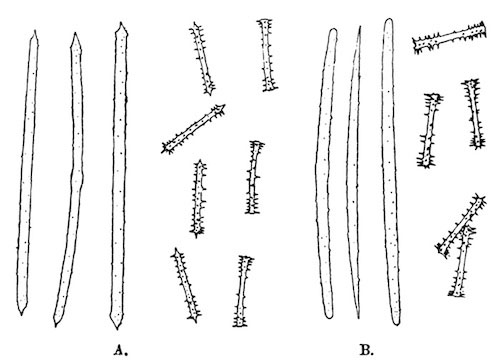
Fig. 13.—Spicules of Spongilla crateriformis.
A. From specimen taken in July in a tank on the Calcutta maidan. B. From type specimen of Ephydatia indica taken in the Indian Museum tank in winter. Both figures × 240.
Spicules. Skeleton-spicules feebly curved, slender, as a rule irregular in outline, sometimes almost smooth; the ends as a rule sharply pointed, often constricted off and expanded so as to resemble spear-heads, occasionally blunt. No true flesh-spicules. Gemmule-spicules often free in the parenchyma, cylindrical, slender, very variable in length in different sponges, straight or nearly so, as a rule with an irregular circle of strong straight or recurved spines at either end resembling a rudimentary rotule, and with shorter straight spines scattered on the shaft, sometimes without the rudimentary rotule, either truncate at the ends or terminating in a sharp spine.
Gemmules small, free, each surrounded by a thick granular layer in which the spicules stand upright or nearly so, and covered externally by a delicate but very distinct chitinous membrane; no horizontal spicules; foramen situated at the base of a crater-like depression in the granular coat, which is sometimes raised round it so as to form a conspicuous rampart; a short, straight foraminal tubule.
The shape of the spicules is extremely variable, and sponges in which they are very different occur in the same localities and even in the same ponds. It is possible that the differences are directly due to slight changes in the environment, for in one pond in Calcutta a form with Spongilla-like gemmule-spicules appears to replace the typical form, which is common in winter, during the hot weather and "rains." I have not, however, found this to be the case in other ponds. Perhaps S. hemephydatia will ultimately prove to be a variety of this very variable species, but its smooth and regular skeleton-spicules and short-spined gemmule-spicules afford a ready method of distinguishing it from S. crateriformis. The two sponges are easily distinguished from all others in the subgenus Euspongilla by the upright and regular arrangement of their gemmule-spicules, for although in S. proliferens and S. travancorica some of the gemmule-spicules are nearly vertical, their arrangement is always irregular, a large proportion of the spicules make an acute angle with the inner coat of the gemmule and a few as a rule lie parallel to it. The systematic position of S. crateriformis is almost exactly intermediate between Euspongilla and Ephydatia, to which genus it has hitherto been assigned. I think, however, that taking into consideration its close relationship to S. hemephydatia, it is best to assign it to Spongilla, as its rudimentary rotules never form distinct disks. I have examined some of Potts's original specimens from different American localities and can detect no constant difference between them and Indian specimens.
Types in the United States National Museum; co-types in Calcutta.
Geographical Distribution.—This sponge was originally described from North America (in which continent it is widely distributed) and has been recorded from the west of Ireland with some doubt. In India and Burma it is widely distributed. Bengal, Calcutta and neighbourhood (Annandale); Sonarpur, Gangetic delta (Annandale); Bombay Presidency, Igatpuri Lake, W. Ghats (altitude ca. 2,000 feet) (Annandale); Madras Presidency, neighbourhood of Madras town (J. R. Henderson); Museum compound, Egmore (Madras town) (Annandale); near Bangalore (alt. ca. 3,000 ft.), Mysore State (Annandale); Ernakulam, Cochin (G. Mathai): Burma, Kawkareik, interior of Amherst district, Tenasserim, and the Moulmein waterworks in the same district (Annandale).[AB]
Biology.—S. crateriformis flourishes in Calcutta throughout the year. Here it is usually found adhering to the roots of water-plants, especially Pistia and Limnanthemum. In the case of the former it occurs at the surface, in that of the latter at the bottom. When growing near the surface or even if attached to a stone at the bottom in clear water, it is invariably of a pale yellowish or greyish colour. When growing on the roots of Limnanthemum in the mud of the Gangetic alluvium, however, it is almost black, and when growing in the reddish muddy waters of the tanks round Bangalore of a reddish-brown colour. This appears to be due entirely to the absorption of minute particles of inorganic matter by the cells of the parenchyma. If black sponges of the species are kept alive in clean water, they turn pure white in less than a week, apparently because these particles are eliminated. When growing on stones the sponge, as found in India, often conforms exactly with Potts's description: "a filmy grey sponge, branching off here and there ... yet with a curious lack of continuity...."
The wide efferent canals of this sponge afford a convenient shelter to small crustacea, and the isopod Tachæa spongillicola, Stebbing (see p. 94), is found in them more abundantly than in those of any other sponge. This is especially the case when the sponge is growing at the bottom. On the surface of the sponge I have found a peculiar protozoon which resembles the European Trichodina spongillæ in general structure but belongs, I think, to a distinct species, if not to a distinct genus.
Subgenus B. EUNAPIUS, J. E. Gray.
Eunapius, J. E. Gray (partim), P. Zool. Soc. London, 1867, p. 552. Spongilla (s. str.), Vejdovsky, in Potts's "Fresh-Water Sponges," P. Ac. Philad. 1887, p. 172. Spongilla (s. str.), Weltner, in Zacharias's Tier- und Pflanzenwelt des Süsswassers, i, p. 214 (1891). Spongilla (s. str.), Annandale, Zool. Jahrb., Syst. xxvii, p. 559 (1909).
Type, Spongilla carteri, Carter.
Spongillæ in which the gemmules are covered with layers of distinct polygonal air-spaces with chitinous walls.
The gemmules are usually fastened together in groups, which may either be free in the sponge or adhere to its support as a "pavement layer"; sometimes, however, they are not arranged in this manner, but are quite independent of one another. The skeleton is usually delicate, sometimes very stout (e. g., in S. nitens, Carter).
The term Eunapius here used is not quite in the original sense, for Gray included under it Bowerbank's Spongilla paupercula which is now regarded as a form of S. lacustris. His description, nevertheless, fits the group of species here associated except in one particular, viz., the smoothness of the gemmule-spicules to which he refers, for this character, though a feature of S. carteri, is not found in certain closely allied forms. The use of "Spongilla" in a double sense may be avoided by the adoption of Gray's name.
The subgenus Eunapius is, like Euspongilla, cosmopolitan. It is not, however, nearly so prolific in species. Four can be recognized in India, two of which range, in slightly different forms, as far north as Europe, one of them also being found in North America, Northern Asia, and Australia.
8. Spongilla carteri* Carter (Bowerbank, in litt.). (Plate II. fig. 1.)
Spongilla friabilis?, Carter (nec Lamarck), J. Bombay Asiat. Soc. iii, p. 31, pl. i, fig. 3 (1849), & Ann. Nat. Hist. (2) iv, p. 83, pl. ii. fig. 3 (1849). Spongilla carteri, Carter, Ann. Nat. Hist. (3) iii, p. 334, pl. viii, figs. 1-7 (1859). Spongilla carteri, Bowerbank, P. Zool. Soc. London, 1863, p. 469, pl. xxxviii, fig. 20. Eunapius carteri, J. E. Gray, ibid. 1867, p. 552. Spongilla carteri, Carter, Ann. Nat. Hist. (5) vii, p. 86 (1881). Spongilla carteri, id., ibid. x, p. 369 (1882). Spongilla carteri, Potts, P. Ac. Philad. 1887, p. 194. Spongilla carteri, Weltner, Arch. Naturg. lxi (i), pp. 117, 134 (1895). Spongilla carteri, Kirkpatrick, P. Zool. Soc. London, 1906 (i), p. 219, pl. xv, figs. 3, 4 (? figs. 1, 2). Spongilla carteri, Annandale, J. Asiat. Soc. Bengal, 1906, p. 188, pl. i, fig. 1. Spongilla carteri, Willey, Spolia Zeyl. iv, p. 184 (1907). Spongilla carteri, Annandale, ibid. vii, p. 63, pl. 1, fig. 1 (1910).
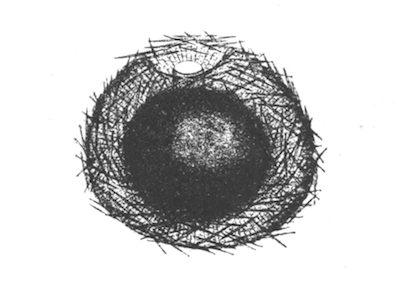
Fig. 14.—Gemmule of Spongilla carteri (from Calcutta), as seen in optical section, × 140.
Sponge massive, as a rule with the surface smooth and rounded, occasionally bearing irregular ridges, which may even take the form of cockscombs; the oscula large, rounded, conspicuous but not raised above the surface of the sponge, leading into broad vertical canals; the lateral canals, except in the immediate vicinity of the central vertical ones, not very broad; the oscular collars extending for a considerable distance over the oscula in living or well-preserved specimens, never standing out from the surface; the oscula never surrounded by radiating furrows. The inhalent pores surrounded externally by unmodified cells of the external membrane. Colour greyish, sometimes with a flush of green on the external surface.
The sponge has a peculiarly strong and offensive smell.
Skeleton fairly compact, with well-developed radiating fibres; the transverse fibres splayed out at either end so that they sometimes resemble a pair of fans joined together by the handles (fig. 3, p. 33). A moderate amount of spongin present.
Spicules. Skeleton-spicules smooth, pointed, nearly straight, never very stout but somewhat variable in exact proportions. Gemmule-spicules similar but much smaller. (There are no true flesh-spicules, but immature skeleton-spicules may easily be mistaken for them.)
Gemmules as a rule numerous, spherical or flattened at the base, variable in size, each covered by a thick coat consisting of several layers of relatively large polygonal air-spaces. A single aperture surrounded by a crater-like depression in the cellular coat and provided with a foraminal tubule resembling an inverted bottle in shape. (This tubule, which does not extend beyond the surface of the cellular coat, is liable to be broken off in dried specimens.) The spicules variable in quantity, arranged irregularly among the spaces of the cellular coat and usually forming a sparse horizontal layer on its external surface. Each gemmule contained in a cage of skeleton-spicules, by the pressure of which it is frequently distorted.
8a. Var. mollis*, nov.
This variety is characterized by a paucity of skeleton-spicules. The sponge is therefore soft and so fragile that it usually breaks in pieces if lifted from the water by means of its support. Owing to the paucity of skeleton-spicules, which resemble those of the typical form individually, the radiating and transverse fibres are extremely delicate.
Common in Calcutta.
8b. Var. cava*, nov.
This variety is characterized by the fact that the oscula open into broad horizontal canals, the roof of which is formed by a thin layer of parenchyma and skeleton or, in places, of the external membrane only. The skeleton is loose and fragile, and the living sponge has a peculiar glassy appearance. In spirit the colour is yellowish, during life it is greenish or white.
Taken at Bombay; November, 1907.
8c. Var. lobosa*, nov.
The greater part of the sponge in this variety consists of a number of compressed but pointed vertical lobes, which arise from a relatively shallow, rounded base, in which the oscula occur. The dried sponge has a yellowish colour.
Apparently common in Travancore.
* * * * *
I cannot distinguish these three "varieties"[AC] from the typical form as distinct species; indeed, their status as varieties is a little doubtful in two cases out of the three. Var. cava appears to be a variety in the strict sense of the word (see p. 18), for it was found on the island of Bombay, the original locality of the species, growing side by side with the typical form. Var. lobosa, however, should perhaps be regarded as a subspecies rather than a variety, for I have received specimens from two localities in the extreme south-west of India and have no evidence that the typical form occurs in that part of the country. Evidence, however, is rather scanty as regards the occurrence of freshwater sponges in S. India. Var. mollis, again, may be a phase directly due to environment. It is the common form in the ponds of certain parts (e. g. in the neighbourhood of the Maidan and at Alipore) of the Calcutta municipal area, but in ponds in other parts (e. g. about Belgatchia) of the same area, only the typical form is found. It is possible that the water in the former ponds may be deficient in silica or may possess some other peculiarity that renders the production of spicules difficult for S. carteri; but this seems hardly probable, for S. crassissima, a species with a rather dense siliceous skeleton, flourishes in the same ponds. I have noticed that in ponds in which the aquatic vegetation is luxuriant and such genera of plants as Pistia and Limnanthemum flourish, there is always a tendency for S. carteri to be softer than in ponds in which the vegetation is mostly cryptogamic, and in Calcutta those parts of the town in which sponges of this species produce most spicules are those in which a slight infiltration of brackish water into the ponds may be suspected; but in the interior of India, in places where the water is absolutely fresh, hard specimens seem to be the rule rather than the exception.
S. carteri is closely related to S. nitens, Carter (Africa, and possibly S. America), but differs from that species in its comparatively slender, sharp skeleton-spicules and smooth gemmule-spicules. It may readily be distinguished from all other Indian freshwater sponges by its large, deep, round oscula, but this feature is not so marked in var. lobosa as in the other forms. The typical form and var. mollis grow to a larger size than is recorded for any other species of the family. I possess a specimen of the typical form from the neighbourhood of Calcutta which measures 30 × 27 cm. in diameter and 19.5 cm. in depth, and weighs (dry) 24-3/4 oz. The base of this specimen, which is solid throughout, is nearly circular, and the general form is mound-shaped. Another large specimen from Calcutta is in the form of an irregular wreath, the greatest diameter of which is 34 cm. This specimen weighs (dry) 16-1/4 oz. Both these specimens probably represent the growth of several years.
Types.—The types of the varieties mollis, cava and lobosa are in the collection of the Indian Museum. I regard as the type of the species the specimen sent by Carter to Bowerbank and by him named S. carteri, although, owing to some confusion, Carter's description under this name appeared some years before Bowerbank's. This specimen is in the British Museum, with a fragment in the Indian Museum.
Geographical Distribution.—The range of the species extends westwards to Hungary, southwards to Mauritius and eastwards to the island of Madura in the Malay Archipelago; a specimen from Lake Victoria Nyanza in Central Africa has been referred to it by Kirkpatrick (P. Zool. Soc. London, 1906 (i), p. 219), but I doubt whether the identification is correct. In India S. carteri is by far the most universally distributed and usually much the commonest freshwater sponge; it is one of the only two species as yet found in Ceylon. Specimens are known from the following localities:—Punjab, Lahore (J. Stephenson): Bombay Presidency, island of Bombay (Carter, Kirkpatrick, Annandale); Igatpuri, W. Ghats (alt. ca. 2,000 ft.) (Annandale): United Provinces (plains), Agra (Kirkpatrick); Lucknow: Himalayas, Bhim Tal, Kumaon (alt. 4,500 ft.) (Annandale); Tribeni, Nepal (Hodgart): Bengal, Calcutta and neighbourhood; Rajshahi (Rampur Bhulia) on the R. Ganges about 150 miles N. of Calcutta (Annandale); Berhampur, Murshidabad district (R. E. Lloyd); Pusa, Darbbhanga district (Bainbrigge Fletcher); Siripur, Saran district, Tirhut (M. Mackenzie); Puri and the Sur Lake, Orissa (Annandale): Madras Presidency, near Madras town (J. R. Henderson); Madura district (R. Bruce Foote); Bangalore (Annandale) and Worgaum, Mysore State (2,500-3,000 ft.); Ernakulam and Trichur, Cochin (G. Mathai); Trivandrum and the neighbourhood of C. Comorin, Travancore (var. lobosa) (R. S. N. Pillay): Burma, Kawkareik, interior of Amherst district, Tenasserim (Annandale); Rangoon (Annandale); Bhamo, Upper Burma (J. Coggin Brown): Ceylon, Peradeniya (E. E. Green); outlet of the Maha Rambaikulam between Vavuniya and Mamadu, Northern Province (Willey); Horowapotanana, between Trincomalee and Anuradihapura, North-Central Province (Willey).
Biology.—S. carteri usually grows in ponds and lakes; I have never seen it in running water. Mr. Mackenzie found it on the walls of old indigo wells in Tirhut.
The exact form of the sponge depends to some extent on the forces acting on it during life. At Igatpuri, for instance, I found that specimens attached to the stems of shrubs growing in the lake and constantly swayed by the wind had their surface irregularly reticulated with high undulating ridges, while those growing on stones at the bottom of a neighbouring pond were smooth and rounded.
Sponges of this species do not shun the light.
In Calcutta S. carteri flourishes during the cold weather (November to March). By the end of March many specimens that have attached themselves to delicate stems such as those of the leaves of Limnanthemum, or to the roots of Pistia stratiotes, have grown too heavy for their support and have sunk down into the mud at the bottom of the ponds, in which they are quickly smothered. Others fixed to the end of branches overhanging the water or to bricks at the edge have completely dried up. A large proportion, however, still remain under water; but even these begin to show signs of decay at this period. Their cells migrate to the extremities of the sponge, leaving a mass of gemmules in the centre, and finally perish.
Few sponges exist in an active condition throughout the hot weather. The majority of those that do so exhibit a curious phenomenon. Their surface becomes smoothly rounded and they have a slightly pinkish colour; the majority of the cells of their parenchyma, if viewed under a high power of the microscope, can be seen to be gorged with very minute drops of liquid. This liquid is colourless in its natural condition, but if the sponge is plunged into alcohol the liquid turns of a dark brown colour which stains both the alcohol and the sponge almost instantaneously. Probably the liquid represents some kind of reserve food-material. Even in the hot weather a few living sponges of the species may be found that have not this peculiarity, but, in some ponds at any rate, the majority that survive assume the peculiar summer form, which I have also found at Lucknow.
Reproduction takes place in S. carteri in three distinct ways, two of which may be regarded as normal, while the third is apparently the result of accident. If a healthy sponge is torn into small pieces and these pieces are kept in a bowl of water, little masses of cells congregate at the tips of the radiating fibres of the skeleton and assume a globular form. At first these cells are homogeneous, having clear protoplasm full of minute globules of liquid. The masses differ considerably in size but never exceed a few millimetres in diameter. In about two days differentiation commences among the cells; then spicules are secreted, a central cavity and an external membrane formed, and an aperture, the first osculum, appears in the membrane. In about ten days a complete young sponge is produced, but the details of development have not been worked out.
The most common normal form of reproduction is by means of gemmules, which are produced in great numbers towards the end of the cold weather. If small sponges are kept alive in an aquarium even at the beginning of the cold weather, they begin to produce gemmules almost immediately, but these gemmules although otherwise perfect, possess few or no gemmule-spicules. If the sponge becomes desiccated at the end of the cold weather and is protected in a sheltered place, some or all of the gemmules contained in the meshes of its skeleton germinate in situ as soon as the water reaches it again during the "rains." It is by a continuous or rather periodical growth of this kind, reassumed season after season, that large masses of sponge are formed. In such masses it is often possible to distinguish the growth of the several years, but as a rule the layers become more or less intimately fused together, for no limiting membrane separates them. A large proportion of the gemmules are, however, set free and either float on the surface of the water that remains in the ponds or are dried up and carried about by the wind. In these circumstances they do not germinate until the succeeding cold weather, even if circumstances other than temperature are favourable; but as soon as the cold weather commences they begin to produce new sponges with great energy.
Sexual reproduction, the second normal form, takes place in S. carteri mainly if not only at the approach of a change of season, that is to say about March, just before the hot weather commences, and about November, just as the average temperature begins to sink to a temperate level. At these seasons healthy sponges may often be found full of eggs and embryos, which lie in the natural cavities of the sponge without protecting membrane.
In the ponds of Calcutta a large number of animals are found associated in a more or less definite manner with Spongilla carteri. Only one, however, can be described with any degree of certainty as being in normal circumstances an enemy, namely the larva of Sisyra indica,[AD] and even in the case of this little insect it is doubtful how far its attacks are actually injurious to the sponge. The larva is often found in considerable numbers clinging to the oscula and wide efferent canals of S. carteri, its proboscis inserted into the substance of the sponge. If the sponge dies and the water becomes foul the larvæ swim or crawl away. If the sponge dries up, they leave its interior (in which, however, they sometimes remain for some days after it has become dry) and pupate in a silken cocoon on its surface. Hence they emerge as perfect insects after about a week.
An animal that may be an enemy of S. carteri is a flat-worm (an undescribed species of Planaria) common in its larger canals and remarkable for the small size of its pharynx. The same worm, however, is also found at the base of the leaves of bulrushes and in other like situations, and there is no evidence that it actually feeds on the sponge. Injured sponges are eaten by the prawn Palæmon lamarrei, which, however, only attacks them when the dermal membrane is broken. A Tanypus larva (Chironomid Diptera) that makes its way though the substance of the sponge may also be an enemy; it is commoner in decaying than in vigorous sponges.
The presence of another Chironomid larva (Chironomus, sp.) appears to be actually beneficial. In many cases it is clear that this larva and the sponge grow up together, and the larva is commoner in vigorous than in decayed sponges. Unlike the Tanypus larva, it builds parchment-like tubes, in which it lives, on the surface of the sponge. The sponge, however, often grows very rapidly and the larva is soon in danger of being engulfed in its substance. The tube is therefore lengthened in a vertical direction to prevent this catastrophe and to maintain communication with the exterior. The process may continue until it is over an inch in length, the older part becoming closed up owing to the pressure of the growing sponge that surrounds it. Should the sponge die, the larva lives on in its tubes without suffering, and the ends of tubes containing larvæ may sometimes be found projecting from the worn surface of dead sponges. The larva does not eat the sponge but captures small insects by means of a pair of legs on the first segment of its thorax. In so doing it thrusts the anterior part of its body out of the tube, to the inner surface of which it adheres by means of the pair of false legs at the tip of the abdomen. This insect, which is usually found in the variety mollis, appears to do good to the sponge in two ways—by capturing other insects that might injure it and by giving support to its very feeble skeleton.
A precisely similar function, so far as the support of the sponge is concerned, is fulfilled by the tubular zoœcia of a phase of the polyzoon Plumatella fruticosa (see p. 218) which in India is more commonly found embedded in the substance of S. carteri than in that of any other species, although in Great Britain it is generally found in that of S. lacustris, which is there the commonest species of freshwater sponge.
Another animal that appears to play an active part in the œconomy of the sponge is a peculiar little worm (Chætogaster spongillæ) also found among the zoœcia of Plumatella and belonging to a widely distributed genus of which several species are found in association with pond-snails. Chætogaster spongillæ often occurs in enormous numbers in dead or dying sponges of S. carteri, apparently feeding on the decaying organic matter of the sponge and assisting by its movements in releasing numerous gemmules. In so doing it undoubtedly assists in the dissemination of the species.
Major J. Stephenson (Rec. Ind. Mus. v, p. 233) has recently found two other species of oligochætes inhabiting S. carteri var. lobosa from Travancore. Both these species, unlike Chætogaster spongillæ, belong to a genus that is vegetarian in habits. One of them, Nais pectinata, has not yet been found elsewhere, while the other, Nais communis, has a very wide distribution. The latter, however, occurs in the sponge in two forms—one with eyes, the other totally blind. The blind form (N. communis var. cæca) has only been found in this situation, but the other (var. punjabensis) lives free as well as in association with the sponge, in which the blind form was the commoner of the two.
The majority of the animals found in association with S. carteri gain shelter without evident assistance to the sponge. This is the case as regards the little fish (Gobius alcockii), one of the smallest of the vertebrates (length about 1/2 inch), which lays its eggs in the patent oscula, thus securing for them a situation peculiarly favourable to their development owing to the constant current of water that passes over them. In the absence of sponges, however, this fish attaches its eggs to the floating roots of the water-plant Pistia stratiotes. Numerous small crustacea[AE] also take temporary or permanent refuge in the cavities of S. carteri, the most noteworthy among them being the Isopod Tachæa spongillicola[AF], the adults of which are found in the canal of this and other sponges, while the young cling to the external surface of the carapace of Palæmon lamarrei and other small prawns. Many worms and insects of different kinds also enter the canals of S. carteri, especially when the sponge is becoming desiccated; from half-dry sponges numerous beetles and flies may be bred, notably the moth-fly Psychoda nigripennis[AG] of which enormous numbers sometimes hatch out from such sponges.
As the sponge grows it frequently attaches itself to small molluscs such as the young of Vivipara bengalensis, which finally become buried in its substance and thus perish. Possibly their decaying bodies may afford it nourishment, but of the natural food of sponges we know little. S. carteri flourishes best and reaches its largest size in ponds used for domestic purposes by natives of India, and thrives in water thick with soap-suds. It is possible, though direct proof is lacking, that the sponge does good in purifying water used for washing the clothes, utensils, and persons of those who drink the same water, by absorbing decaying animal and vegetable matter from it.
Various minute algæ are found associated with S. carteri, but of these little is yet known. The green flush sometimes seen on the surface of the typical form is due to the fact that the superficial cells of the parenchyma contain green corpuscles. These, however, are never very numerous and are not found in the inner parts of the sponge, perhaps owing to its massive form. It is noteworthy that these green bodies flourish in large numbers throughout the substance of sponges of S. proliferens, a species always far from massive, growing in the same ponds as S. carteri.
9. Spongilla fragilis, Leidy.
Spongilla fragilis, Leidy, P. Ac. Philad. 1851, p. 278. Spongilla lordii, Bowerbank, P. Zool. Soc. London, 1863, p. 466, pl. xxxviii, fig. 17. Spongilla contecta, Noll, Zool. Garten*, 1870, p. 173. Spongilla ottavænsis, Dawson, Canad. Nat.* (new series) viii, p. 5 (1878). Spongilla sibirica, Dybowski, Zool. Anz., Jahr. i, p. 53 (1878). Spongilla morgiana, Potts, P. Ac. Philad. 1880, p. 330. Spongilla lordii, Carter, Ann. Nat. Hist. (5) vii, p. 89, pl. vi, fig. 13 (1881). Spongilla sibirica, Dybowski, Mém. Ac. St. Pétersb. (7) xxx, no. x, p. 10, fig. 12. Spongilla glomerata, Noll, Zool. Anz., Jahr. ix, p. 682 (1886). Spongilla fragilis, Vejdovsky, P. Ac. Philad. 1887, p. 176. Spongilla fragilis, Potts, ibid. p. 197, pl. v, fig. 2; pl. viii, figs. 1-4. Spongilla fragilis, Weltner, Arch. Naturg. lix (1), p. 266, pl. ix, figs. 18-20 (1893). Spongilla fragilis, id., Arch. Naturg. lxi (i), p. 117 (1895). Spongilla fragilis, id., in Semon's Zool. Forsch. in Austral. u. d. Malay. Arch. v, part v, p. 523. Spongilla fragilis, Annandale, P. U.S. Mus. xxxvii, p. 402 (1909). Spongilla fragilis, id., Annot. Zool. Japon. vii, part ii, p. 106, pl. ii, fig. 1 (1909).
Sponge flat, lichenoid, never of great thickness, devoid of branches, dense in texture but very friable; colour brown, green, or whitish; oscula numerous, small, flat, distinctly star-shaped.
Skeleton with well defined radiating and transverse fibres, which are never strong but form a fairly dense network with a small amount of spongin.
Spicules. Skeleton-spicules smooth, sharply pointed, moderately stout, as a rule nearly straight. No flesh-spicules. Gemmule-spicules cylindrical, blunt or abruptly pointed, nearly straight, covered with relatively stout, straight, irregular spines, which are equally distributed all over the spicule.
Gemmules bound together in free groups of varying numbers and forming a flat layer at the base of the sponge; each gemmule small in size, surrounded by a thick cellular coat of several layers; with a relatively long and stout foraminal tubule, which projects outwards through the cellular coat at the sides of the group or at the top of the basal layer of gemmules, is usually curved, and is not thickened at the tip; more than one foraminal tubule sometimes present on a single gemmule; gemmule-spicules arranged horizontally or at the base of the cellular coat.
The species as a species is easily distinguished from all others, its nearest ally being the N. American S. ingloriformis with sparsely spined skeleton-spicules which are very few in number, and gemmule groups in which the foraminal tubules all open downwards.
Several varieties of S. fragilis have been described in Europe and America.
Type.—Potts refers to the type as being in the Academy of Natural Sciences at Philadelphia.
Geographical Distribution.—All over Europe and N. America; also in Siberia, Australia, and S. America. The species is included in this work in order that its Asiatic local races may be fitly described.
9 a. Subsp. calcuttana*, nov.
? Spongilla decipiens, Weltner (partim), Arch. Naturg. lxi (i), pp. 117, 134 (1895). Spongilla decipiens, Annandale, Journ. As. Soc. Beng. 1906, p. 57. Spongilla fragilis, id., Rec. Ind. Mus. i, p. 390 (1907).
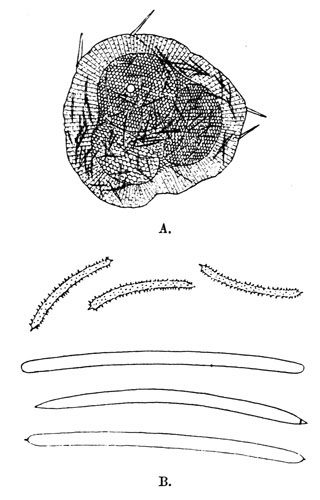
Fig. 15.—Spongilla fragilis subsp. calcuttana. A=group of gemmules, × 70; B=spicules, × 240. From type specimen.
This local race, which is common in Calcutta, is distinguished from the typical form mainly by the shape of its skeleton-spicules, most of which are abruptly pointed or almost rounded at the tips, sometimes bearing a minute conical projection at each end. The gemmule-spicules, which are usually numerous, are slender. The foraminal tubules are usually long and bent, but are sometimes very short and quite straight. The colour is usually greyish, occasionally brown.
I have not found this race except in Calcutta, in the ponds of which it grows on bricks or, very commonly, on the stems of bulrushes, often covering a considerable area.
Type in the Indian Museum.
9 b. Subsp. decipiens*, Weber.
Spongilla decipiens, Weber, Zool. Ergeb. Niederländ. Ost-Ind. i, p. 40, pl. iv, figs. 1-5 (1890).
This (?) local race is distinguished by the fact that the foraminal tubules are invariably short and straight and thickened at the tips, and that gemmule-spicules do not occur on the external surface of the cellular coat of the gemmules.
I include Weber's Spongilla decipiens in the Indian fauna on the authority of Weltner, who identified specimens from the Museum "tank," Calcutta, as belonging to this form. All, however, that I have examined from our "tank" belong to the subspecies calcuttana, most of the skeleton-spicules of which are much less sharp than those of decipiens. By the kindness of Prof. Max Weber I have been able to examine a co-type of his species, which is probably a local race peculiar to the Malay Archipelago.
Type in the Amsterdam Museum; a co-type in Calcutta.
Perhaps the Japanese form, which has spindle-shaped gemmule-spicules with comparatively short and regular spines, should be regarded as a third subspecies, and the Siberian form as a fourth.
10. Spongilla gemina*, sp. nov.
Sponge forming small, shallow, slightly dome-shaped patches of a more or less circular or oval outline, minutely hispid on the surface, friable but moderately hard. Oscula numerous but minute and inconspicuous, never star-shaped. Dermal membrane adhering closely to the sponge. Colour grey or brown.
Skeleton forming a close and regular network at the base of the sponge, becoming rather more diffuse towards the external surface; the radiating and the transverse fibres both well developed, of almost equal diameter. Little spongin present.
Spicules. Skeleton-spicules slender, smooth, sharply pointed. No flesh-spicules. Gemmule-spicules long, slender, cylindrical, blunt or bluntly pointed, somewhat irregularly covered with minute straight spines.
Gemmules small, bound together in pairs, as a rule free in the parenchyma but sometimes lightly attached at the base of the sponge. Each gemmule flattened on the surface by which it is attached to its twin, covered with a thin coat of polygonal air-spaces which contains two layers of gemmule-spicules crossing one another irregularly in a horizontal plane. One or two foraminal tubules present on the surface opposite the flat one, bending towards the latter, often of considerable length, cylindrical and moderately stout.
Type in the Indian Museum.
This species is closely allied to S. fragilis, from which it may be distinguished by the curious twinned arrangement of its gemmules. It also differs from S. fragilis in having extremely small and inconspicuous oscula.
Locality. I only know this sponge from the neighbourhood of Bangalore, where Dr. Morris Travers and I found it in October, 1910 growing on stones and on the leaves of branches that dipped into the water at the edge of a large tank.
11. Spongilla crassissima*, Annandale.
Spongilla crassissima, Annandale, J. Asiat. Soc. Bengal, 1907, p. 17, figs. 2, 3. Spongilla crassissima, id., ibid. p. 88. Spongilla crassissima, id., Rec. Ind. Mus. i. p. 390, pl. xiv, fig. 4 (1907).
Sponge very hard and strong, nearly black in colour, sometimes with a greenish tinge, forming spherical, spindle-shaped or irregular masses without branches but often several inches in diameter. Oscula circular or star-shaped, usually surrounded by radiating furrows; pores normally contained in single cells. External membrane closely adherent to the sponge except immediately round the oscula.
Skeleton dense, compact and only to be broken by the exercise of considerable force; radiating and transverse fibres not very stout but firmly bound together by spongin (fig. 6, p. 38), which occasionally extends between them as a delicate film; their network close and almost regular.
Spicules. Skeleton-spicules smooth, feebly curved, sausage-shaped but by no means short, as a rule bearing at each end a minute conical projection which contains the extremity of the axial filament. No flesh-spicules. Gemmule-spicules closely resembling those of S. fragilis subsp. calcuttana, but as a rule even more obtuse at the ends.
Gemmules as in S. fragilis subsp. calcuttana; a basal layer of gemmules rarely formed.
11 a. Var. crassior*, Annandale.
Spongilla crassior, Annandale, Rec. Ind. Mus. i, p. 389, pl. xiv, fig. 3 (1907).
This variety differs from the typical form chiefly in its even stronger skeleton (fig. 3, p. 33) and its stouter skeleton-spicules, which do not so often possess a terminal projection. The sponge is of a brownish colour and forms flat masses of little thickness but of considerable area on sticks and on the stems of water-plants.
Types.—The types of both forms are in the Indian Museum. Co-types have been sent to London.
Geographical Distribution.—This sponge is only known from Bengal. The variety crassior was found at Rajshahi (Rampur Bhulia) on the Ganges, about 150 miles N. of Calcutta, while the typical form is fairly common in the "tanks" of Calcutta and very abundant in the Sur Lake near Puri in Orissa.
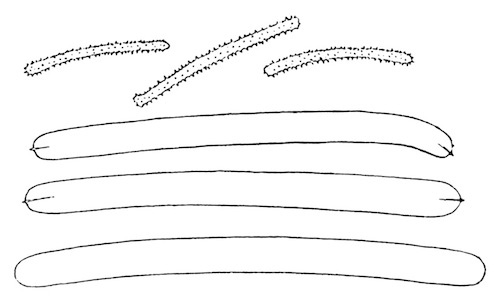
Fig. 16.—Spicules of Spongilla crassissima var. crassior (from type specimen), × 240.
Biology.—S. crassissima is usually found near the surface in shallow water. Attached to the roots of the floating water-plant Pistia stratiotes it assumes a spherical form, while on sticks or like objects it is spindle-shaped. Sometimes it is found growing on the same stick or reed-stem as S. carteri, the two species being in close contact and S. carteri always overlapping S. crassissima. The dark colour is due to minute masses of blackish pigment in the cells of the parenchyma. The dense structure of the sponge is not favourable to the presence of incolæ, but young colonies of the polyzoon Plumatella fruticosa are sometimes overgrown by it. Although they may persist for a time by elongating their tubular zoœcia through the substance of the sponge, they do not in these circumstances reach the same development as when they are overgrown by the much softer S. carteri.
S. crassissima is found during the "rains" and the cold weather. In Calcutta it attains its maximum size towards the end of the latter season. In spite of its hard and compact skeleton, the sponge does not persist from one cold weather to another.
A curious phenomenon has been noticed in this species, but only in the case of sponges living in an aquarium, viz. the cessation during the heat of the day of the currents produced by its flagella.
Subgenus C. STRATOSPONGILLA, Annandale.
Stratospongilla, Annandale, Zool. Jahrb., Syst. xxvii, p. 561 (1909).
Type, Spongilla bombayensis, Carter.
Spongillæ in the gemmules of which the pneumatic layer is absent or irregularly developed, its place being sometimes taken by air-spaces between the stout chitinous membranes that cover the gemmule. At least one of these membranes is always present.
The gemmule-spicules lie in the membrane or membranes parallel to the surface of the gemmule, and are often so arranged as to resemble a mosaic. The gemmules themselves are usually adherent to the support of the sponge. The chitinous membrane or membranes are often in continuity with a membrane that underlies the base of the sponge. The skeleton is usually stout, though often almost amorphous, and the skeleton-spicules are sometimes sausage-shaped.
Sponges of this subgenus form crusts or sheets on solid submerged objects.
Stratospongilla is essentially a tropical subgenus, having its head-quarters in Central Africa and Western India. One of its species, however, (S. sumatrana*, Weber) occurs both in Africa and the Malay Archipelago, while another has only been found in S. America (S. navicella, Carter).
Aberrant species occur in China (S. sinensis*, S. coggini*) and the Philippines (S. clementis*). Three species have been found in the Bombay Presidency and Travancore, one of which (S. bombayensis*) extends its range eastwards to Mysore and westwards across the Indian Ocean to Natal.
12. Spongilla indica*, Annandale.
Spongilla indica, Annandale, Rec. Ind. Mus. ii, p. 25, figs. 1, 2 (1908).
Sponge forming a very thin layer, of a bright green or pale grey colour; surface smooth, minutely hispid; pores and oscula inconspicuous, the latter approached in some instances by radiating furrows; subdermal cavity small; texture compact, rather hard.
Skeleton incoherent, somewhat massive owing to the large number of spicules present. Spicules forming triangular meshes and occasionally arranged in vertical lines several spicules broad but without spongin.
Spicules. Skeleton-spicules straight or nearly straight, slender, cylindrical, amphistrongylous, uniformly covered with minute, sharp spines; flesh-spicules slender, sharply pointed, straight or curved, irregularly covered with relatively long, straight sharp spines, abundant in the dermal membrane, scarce in the substance of the sponge. Gemmule-spicules short, stout, sausage-shaped, covered with minute spines, which are sometimes absent from the extremities.
Gemmules spherical, somewhat variable in size, with a single aperture, which is provided with a trumpet-shaped foraminal tubule and is situated at one side of the gemmule in its natural position; the inner chitinous coat devoid of spicules, closely covered by an outer coat composed of a darkly coloured chitinoid substance in which the gemmule-spicules are embedded, lying parallel or almost parallel to the inner coat. The outer coat forms a kind of mantle by means of the skirts of which the gemmule is fastened to the support of the sponge. This coat is pierced by the foraminal tubule. The gemmules are distinct from one another.
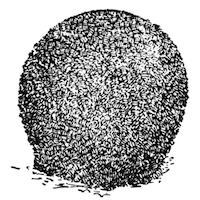
Fig. 17.—Gemmule of Spongilla indica seen from the side (from type specimen), magnified.
Average length of skeleton-spicules0.2046 mm.
Average breadth of skeleton-spicules0.0172 mm.
Average length of flesh-spicules0.053 mm.
Average breadth of flesh-spicules0.0053 mm.
Average length of gemmule-spicules0.044 mm.
Average breadth of gemmule-spicules0.0079 mm.
S. indica is closely allied to S. sumatrana*, Weber, which has been found both in the Malay Archipelago and in East Africa. It may be distinguished by its blunt, almost truncated megascleres and comparatively slender gemmule-spicules.
Type in the Indian Museum.
Habitat, etc.—Growing, together with S. cinerea and Corvospongilla lapidosa, on the stone sides of an artificial conduit in the R. Godaveri at Nasik on the eastern side of the Western Ghats in the Bombay Presidency. The water was extremely dirty and was used for bathing purposes. The sponge was green where the light fell upon it, grey where it was in the shadow of the bridge under which the conduit ran. The only specimens I have seen were taken in November, 1907.
13. Spongilla bombayensis*, Carter. (Plate II, fig. 2.)
Spongilla bombayensis, Carter, Ann. Nat. Hist. (5) x, p. 369, pl. xvi, figs. 1-6 (1882). Spongilla bombayensis, Annandale, Zool. Jahrb., Syst. xxvii, p. 562, figs. B, C (1909).
Sponge hard but friable, forming thin layers or cushions; its surface often irregular but without a trace of branches; its area never very great; oscula inconspicuous; external membrane adhering closely to the sponge; colour brownish or greyish.
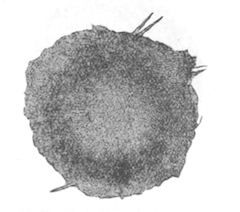
Fig. 18.—Gemmule of Spongilla bombayensis as seen from above (from type specimen), magnified.
Skeleton almost amorphous, very dense, consisting of large numbers of spicules arranged irregularly; radiating fibres occasionally visible in sections, but almost devoid of spongin; a more or less definite reticulation of horizontal spicules lying immediately under the external membrane.
Spicules. Skeleton-spicules slender, pointed, feebly curved, irregularly roughened or minutely spined all over the surface. Flesh-spicules straight, narrowly rhomboidal in outline, sharply pointed, slender, covered with minute, irregular, straight spines, scanty in the parenchyma, abundant in the external membrane. Gemmule-spicules sausage-shaped or bluntly pointed, variable in length but usually rather stout, covered with minute spines, as a rule distinctly curved.
Gemmules round or oval, firmly adherent[AH] to the base of the sponge, as a rule rather shallowly dome-shaped, covered by two thick chitinous membranes, in each of which there is a dense horizontal layer of spicules; no granular or cellular covering; the two chitinous coats separated by an empty space; the aperture or apertures on the side of the gemmule in its natural position, provided with foraminal tubules, which may be either straight or curved, project through the outer chitinous membrane and often bend down towards the base of the gemmule. The spicules of the outer layer often more irregular in outline and less blunt than those of the inner layer.
This sponge is allied to S. indica, but is distinguished among other characters by its sharp skeleton-spicules and by the fact that the gemmule is covered by two chitinous membranes instead of one.
Type in the British Museum; a fragment in the Indian Museum.
Geographical Distribution.—S. and W. India and S. Africa. Carter's type was found in the island of Bombay, my own specimens in Igatpuri Lake in the Western Ghats. I have recently (October 1910) found sponges and bare gemmules attached to stones at the end of a tank about 10 miles from Bangalore (Mysore State) in the centre of the Madras Presidency. Prof. Max Weber obtained specimens in Natal.
Biology.—The specimens collected by Prof. Weber in Natal and those collected by myself in the Bombay Presidency were both obtained in the month of November. It is therefore very interesting to compare them from a biological point of view. In so doing, it must be remembered that while in S. Africa November is near the beginning of summer, in India it is at the beginning of the "cold weather," that is to say, both the coolest and the driest season of the year. The lake in which my specimens were obtained had, at the time when they were collected, already sunk some inches below its highest level, leaving bare a gently sloping bank of small stones. Adhering to the lower surface of these stones I found many small patches of Spongilla bombayensis, quite dry but complete so far as their harder parts were concerned and with the gemmules fully formed at their base. From the shallow water at the edge of the lake I took many similar stones which still remained submerged. It was evident that the sponge had been just as abundant on their lower surface as on that of the stones which were now dry; but only the gemmules remained, sometimes with a few skeleton-spicules adhering to them (Pl. II, fig. 2). The bulk of the skeleton had fallen away and the parenchyma had wholly perished. In a few instances a small sponge, one or two millimetres in diameter, had already been formed among the gemmules; but these young sponges appeared to belong to some other species, possibly Spongilla indica, which was also common in the lake.
Carter's specimen of S. bombayensis, which was evidently in much the same condition as those I found still submerged a month later, was taken in October in a disused quarry. It was surrounded by a mass of S. carteri three inches in diameter, and was attached to a herbaceous annual. The point on the edge of the quarry at which this plant grew was not reached by the water until July. It is therefore necessary to assume that the gemmules of S. bombayensis had been formed between July and October. Probably the larva of the sponge had settled down on the plant during the "rains"—which commence in Bombay about the beginning of June—and had grown rapidly. The production of gemmules may have been brought about owing to the sponge being choked by the more vigorous growth of S. carteri, a species which grows to a considerable size in a comparatively short time, while S. bombayensis apparently never reaches a thickness of more than a few millimetres.
The manner in which the gemmules of S. bombayensis are fastened to the solid support of the sponge must be particularly useful in enabling them to sprout in a convenient environment as soon as the water reaches them. The fact that the gemmules remained fixed without support renders it unnecessary for the skeleton to persist as a cage containing them (or at any rate a proportion of them) during the period of rest.
Prof. Weber's specimens of S. bombayensis were collected in a river, apparently on stones or rocks, towards the beginning of the S. African summer. They contain comparatively few gemmules and were evidently in a vigorous condition as regards vegetative growth. Unfortunately we know nothing of the seasonal changes which take place in freshwater sponges in S. Africa, but the difference between these changes in Europe and in India shows that they are dependent on environment as well as the idiosyncrasy of the species. It is very interesting, therefore, to see that the condition of sponges taken in S. Africa differs so widely from that of other individuals of the same species taken in India at the same season.
In Prof. Weber's specimens I have found numerous small tubules of inorganic débris. These appear to be the work of Chironomid larvæ, of which there are several specimens loose in the bottle containing the sponges. Other tubules of a very similar appearance but with a delicate chitinoid foundation appear to be the remains of a species of Plumatella of which they occasionally contain a statoblast.
14. Spongilla ultima*, Annandale. (Plate II, fig. 3.)
Spongilla ultima, Annandale, Rec. Ind. Mus. v, p. 31 (1910).
Sponge hard and strong, forming a thin layer on solid objects, of a pale green colour (dry); the oscula small but rendered conspicuous by the deep radiating furrows that surround them; external surface of the sponge rough but not spiny.
Skeleton forming a compact but somewhat irregular reticulation in which the radiating fibres are not very much more distinct than the transverse ones; a considerable amount of almost colourless spongin present.
Spicules. Skeleton-spicules smooth, stout, amphioxous, as a rule straight or nearly straight, not infrequently inflated in the middle or otherwise irregular. No flesh-spicules. Gemmule-spicules variable in size, belonging to practically every type and exhibiting practically every abnormality possible in the genus, the majority being more or less sausage-shaped and having a roughened surface, but others being cruciform, spherical, subspherical, rosette-like, needle-like, bifid or even trifid at one extremity.