Part 1 — GLOSSARY OF TECHNICAL TERMS USED IN PART I. (continued 2)
Reading edition
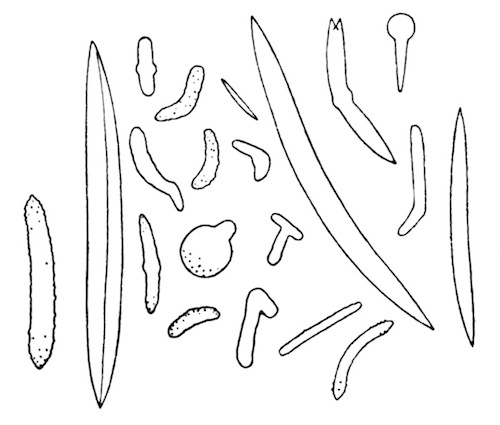
Fig. 19.—Spicules of Spongilla ultima (from type specimen), × 120.
Gemmules adherent, spherical, large, each covered by two distinct layers of horizontal spicules; the outer layer intermixed with skeleton-spicules and often containing relatively large siliceous spheres, a large proportion of the spicules being irregular in shape; the spicules of the inner layer much more regular and as a rule sausage-shaped. The outer layer is contained in a chitinous membrane which spreads out over the base of the sponge. The foraminal tubules are short and straight.
This sponge is allied to S. bombayensis, from which it is distinguished not only by the abnormal characters of its gemmule-spicules and the absence of flesh-spicules, but also by the form of its skeleton-spicules and the structure of its skeleton. I have examined several specimens dry and in spirit; but S. ultima is the only Indian freshwater sponge, except Corvospongilla burmanica, I have not seen in a fresh condition.
Types in the Indian Museum; co-types at Trivandrum.
Habitat. Discovered by Mr. R. Shunkara Narayana Pillay, of the Trivandrum Museum, in a tank near Cape Comorin, the southernmost point of the Indian Peninsula.
Genus 2. PECTISPONGILLA, Annandale.
Pectispongilla, Annandale, Rec. Ind. Mus. iii, p. 103 (1909).
Type, Pectispongilla aurea, Annandale.
The structure of the sponge resembling that of Euspongilla or Ephydatia; but the gemmule-spicules bear at either end, at one side only, a double vertical row of spines, so that they appear when viewed in profile like a couple of combs joined together by a smooth bar.
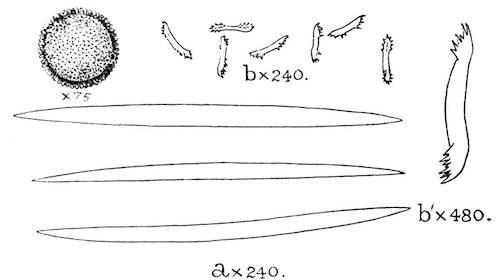
Fig. 20.—Gemmule and spicules of Pectispongilla aurea (type specimen). a, Skeleton-spicules; b, gemmule-spicules; b', a single gemmule-spicule more highly magnified.
Geographical Distribution.—The genus is monotypic and is only known from Travancore and Cochin in the south-west of the Indian Peninsula.
15. Pectispongilla aurea*, Annandale.
Pectispongilla aurea, Annandale, op. cit., p. 103, pl. xii, fig. 2.
Sponge forming minute, soft, cushion-like masses of a deep golden colour (dull yellow in spirit); the surface smooth, minutely hispid. One relatively large depressed osculum usually present in each sponge; pores inconspicuous; dermal membrane in close contact with the parenchyma.
Skeleton consisting of slender and feebly coherent radiating fibres as a rule two or three spicules thick, with single spicules or ill-defined transverse fibres running horizontally. Towards the external surface transverse spicules are numerous, but they do not form any very regular structure.
Spicules. Skeleton-spicules smooth, sharply pointed, straight or nearly so. Gemmule-spicules minute, with the stem smooth and cylindrical, relatively stout and much longer than the comb at either end; the two combs equal, with a number of minute, irregularly scattered spines between the two outer rows of stouter ones. No free microscleres.
Gemmules minute, spherical, with a single aperture, which is provided with a very short foraminal tubule; the granular coat well developed; the spicules arranged in a slanting position, but more nearly vertically than horizontally, with the combs pointing in all directions; no external chitinous membrane.
Length of skeleton-spicule0.2859 mm.
Greatest diameter of skeleton-spicule0.014 mm.
Length of gemmule-spicule0.032-0.036 mm.
Length of comb of gemmule-spicule0.008 mm.
Greatest diameter of shaft of gemmule-spicule0.004 mm.
Diameter of gemmule0.204-0.221 mm.
The gemmule-spicules first appear as minute, smooth, needle-like bodies, which later become roughened on one side at either end and so finally assume the mature form. There are no bubble-cells in the parenchyma.
15a. Var. subspinosa*, nov.
This variety differs from the typical form in having its skeleton spicules covered with minute irregular spines or conical projections.
Types of both the typical form and the variety in the Indian Museum; co-types of the typical form in the Trivandrum Museum.
Geographical Distribution.—The same as that of the genus. Localities:—Tenmalai, at the base of the western slopes of the W. Ghats in Travancore (typical form) (Annandale); Ernakulam and Trichur in Cochin (var. subspinosa) (G. Mathai).
Biology.—My specimens, which were taken in November, were growing on the roots of trees at the edge of an artificial pool by the roadside. They were in rather dense shade, but their brilliant golden colour made them conspicuous objects in spite of their small size. Mr. Mathai's specimens from Cochin were attached to water-weeds and to the husk of a cocoanut that had fallen or been thrown into the water.
Genus 3. EPHYDATIA, Lamouroux.
Ephydatia, Lamouroux, Hist. des Polyp. corall. flex.* p. 6 (fide Weltner) (1816). Ephydatia, J. E. Gray, P. Zool. Soc. London. 1867, p. 550. Trachyspongilla, Dybowsky (partim), Zool. Anz. i, p. 53 (1874). Meyenia, Carter (partim), Ann. Nat. Hist. (5) vii, p. 90 (1881). Carterella, Potts & Mills (partim), P. Ac. Philad. 1881, p. 150. Ephydatia, Vejdovsky, Abh. Böhm. Ges. xii, p. 23 (1883). Meyenia, Potts (partim), ibid. 1887, p. 210. Carterella, id. (partim), ibid. 1887, p. 260. Ephydatia, Weltner (partim), Arch. Naturg. lxi (i), p. 121 (1895). Ephydatia, Annandale, P. U.S. Mus. xxxvii, p. 404 (1909).
Type, (?) Spongilla fluviatilis, auctorum.
This genus is separated from Spongilla by the structure of the gemmule-spicules, which bear at either end a transverse disk with serrated or deeply notched edges, or at any rate with edges that are distinctly undulated. The disks are equal and similar. True flesh-spicules are usually absent, but more or less perfect birotulates exactly similar to those associated with the gemmules are often found free in the parenchyma. The skeleton is never very stout and the skeleton-spicules are usually slender.
As has been already stated, some authors consider Ephydatia as the type-genus of a subfamily distinguished from the subfamily of which Spongilla is the type-genus by having rotulate gemmule-spicules. The transition between the two genera, however, is a very easy one. Many species of the subgenus Euspongilla, the typical subgenus of Spongilla (including S. lacustris, the type-species of the genus), have the spines at the ends of the gemmule-spicules arranged in such a way as to suggest rudimentary rotules, while in the typical form of S. crateriformis this formation is so distinct that the species has hitherto been placed in the genus Ephydatia (Meyenia), although in some sponges that agree otherwise with the typical form of the species the gemmule-spicules are certainly not rotulate and in none do these spicules bear definite disks.
Geographical Distribution.—Ephydatia, except Spongilla, is the most generally distributed genus of the Spongillidæ, but in most countries it is not prolific in species. In Japan, however, it appears to predominate over Spongilla. Only one species is known from India, but another (E. blembingia*, Evans) has been described from the Malay Peninsula, while Weber found both the Indian species and a third (E. bogorensis*) in the Malay Archipelago.
16. Ephydatia meyeni* (Carter).
Spongilla meyeni, Carter, J. Bomb. Asiat. Soc. iii, p. 33, pl. i, fig. 1, & Ann. Nat. Hist. (2) iv, p. 84, pl. iii, fig. 1 (1849). Spongilla meyeni, Bowerbank, P. Zool. Soc. London, 1863, p. 448, pl. xxxviii, fig. 4. Spongilla meyeni, Carter, Ann. Nat. Hist. (5) vii, p. 93 (1881). Ephydatia fluviatilis, Weber, Zool. Ergeb. Niederländ. Ost-Ind. i. pp. 32, 46 (1890). Ephydatia mülleri, Weltner (partim), Arch. Naturg. lxi (i), p. 125 (1895). Ephydatia robusta, Annandale, J. Asiat. Soc. Bengal, 1907, p. 24, fig. 7. Ephydatia mülleri subsp. meyeni, id., Rec. Ind. Mus. ii, p. 306 (1908).
Sponge hard and firm but easily torn, usually of a clear white, sometimes tinged with green, forming irregular sheets or masses never of great thickness, without branches but often with stout subquadrate projections, the summits of which are marked with radiating grooves; the whole surface often irregularly nodulose and deeply pitted; the oscula inconspicuous; the membrane adhering closely to the parenchyma. The parenchyma contains numerous bubble-cells (see p. 31, fig. 2).
Skeleton dense but by no means regular; the radiating fibres distinct and containing a considerable amount of spongin, at any rate in the outer part of the sponge; transverse fibres hardly distinguishable, single spicules and irregular bundles of spicules taking their place.
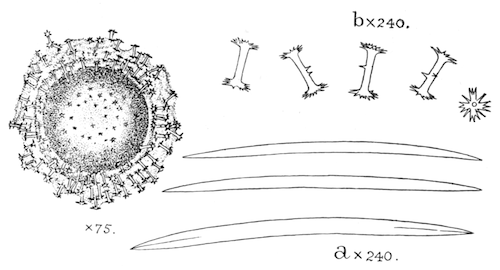
Fig. 21.—Gemmule and spicules of Ephydatia meyeni (from Calcutta). a, Skeleton-spicules; b, gemmule-spicules.
Spicules. Skeleton-spicules entirely smooth, moderately stout, feebly curved, sharply pointed. No flesh-spicules. Gemmule-spicules with the shaft as a rule moderately stout, much longer than the diameter of one disk, smooth or with a few stout, straight horizontal spines, which are frequently bifid or trifid; the disks flat, of considerable size, with their margins cleanly and deeply divided into a comparatively small number of deep, slender, triangular processes of different sizes; the shaft extending not at all or very little beyond the disks.
Gemmules spherical, usually numerous and of rather large size; each covered by a thick layer of minute air-spaces, among which the gemmule-spicules are arranged vertically, often in two or even three concentric series; a single short foraminal tubule; the pneumatic coat confined externally by a delicate membrane, with small funnel-shaped pits over the spicules of the outer series.
I think that the gemmules found by me in Bhim Tal and assigned to Potts's Meyenia robusta belong to this species, but some of the spicules are barely as long as the diameter of the disks. In any case Potts's description is so short that the status of his species is doubtful. His specimens were from N. America.
E. meyeni is closely related to the two commonest Holarctic species of the genus, E. fluviatilis and E. mülleri, which have been confused by several authors including Potts. From E. fluviatilis it is distinguished by the possession of bubble-cells in the parenchyma, and from E. mülleri by its invariably smooth skeleton-spicules and the relatively long shafts of its gemmule-spicules. The latter character is a marked feature of the specimens from the Malay Archipelago assigned by Prof. Max Weber to E. fluviatilis; I am indebted to his kindness for an opportunity of examining some of them.
Type in the British Museum; a fragment in the Indian Museum.
Geographical Distribution.—India and Sumatra. Localities:—Bengal, Calcutta and neighbourhood (Annandale); Madras Presidency, Cape Comorin, Travancore (Trivandrum Mus.): Bombay Presidency, Island of Bombay (Carter): Himalayas, Bhim Tal, Kumaon (alt. 4,500 feet) (Annandale).
Biology.—My experience agrees with Carter's, that this species is never found on floating objects but always on stones or brickwork. It grows in the Calcutta "tanks" on artificial stonework at the edge of the water, together with Spongilla carteri, S. alba, S. fragilis subsp. calcuttana, and Trochospongilla latouchiana. It flourishes during the cold weather and often occupies the same position in succeeding years. In this event the sponge usually consists of a dead base, which is of a dark brownish colour and contains no cells, and a living upper layer of a whitish colour.
The larva of Sisyra indica is sometimes found in the canals, but the close texture of the sponge does not encourage the visits of other incolæ.
Genus 4. DOSILIA, Gray.
Dosilia, J. E. Gray, P. Zool. Soc. London, 1867, p. 550.
Type, Spongilla plumosa, Carter.
This genus is distinguished from Ephydatia by the nature of the free microscleres, the microscleres of the gemmule being similar in the two genera. The free microscleres consist as a rule of several or many shafts meeting together in several or many planes at a common centre, which is usually nodular. The free ends of these shafts often possess rudimentary rotulæ. Occasionally a free microsclere may be found that is a true monaxon and sometimes such spicules are more or less distinctly birotulate. The skeleton is also characteristic. It consists mainly of radiating fibres which bifurcate frequently in such a way that a bush-like structure is produced. Transverse fibres are very feebly developed and are invisible to the naked eye. Owing to the structure of the skeleton the sponge has a feathery appearance.
Gray originally applied the name Dosilia to this species and to "Spongilla" baileyi, Bowerbank. It is doubtful how far his generic description applies to the latter, which I have not seen; but although the position of "Spongilla" baileyi need not be discussed here, I may say that I do not regard it as a congener of Dosilia plumosa, the free microscleres of which are of a nature rare but not unique in the family. With Dosilia plumosa we must, in any case, associate in one genus the two forms that have been described as varieties, viz., palmeri*, Potts from Texas and Mexico, and brouini*, Kirkpatrick from the White Nile. By the kindness of the authorities of the Smithsonian Institution and the British Museum I have been able to examine specimens of all three forms, in each case identified by the author of the name, and I am inclined to regard them as three very closely allied but distinct species. Species with free microscleres similar to those of these three forms but with heterogeneous or tubelliform gemmule-spicules will probably need the creation of a new genus or new genera for their reception.
Geographical Distribution.—The typical species occurs in Bombay and Madras; D. palmeri has probably an extensive range in the drier parts of Mexico and the neighbouring States, while D. brouini has only been found on the banks of the White Nile above Khartoum, in Tropical Africa.
17. Dosilia plumosa* (Carter).
Spongilla plumosa, Carter, J. Bomb. Asiat. Soc. iii, p. 34, pl. i, fig. 2, & Ann. Nat. Hist. (2) iv, p. 85, pl. iii, fig. 2 (1849). Spongilla plumosa, Bowerbank, P. Zool. Soc. London, 1863, p. 449, pl. xxxviii, fig. 5. Dosilia plumosa, J. E. Gray, ibid. 1867, p. 551. Meyenia plumosa, Carter, Ann. Nat. Hist. (5) vii, p. 94, pl. v, fig. 6 (1881). Meyenia plumosa, Potts, P. Ac. Philad. 1887, p. 233. Ephydatia plumosa, Weltner, Arch. Naturg. lxi (i), p. 126 (1895). Ephydatia plumosa, Petr, Rozp. Ceske Ak. Praze, Trída ii, pl. ii, figs. 29, 30 (text in Czech) (1899).
Sponge forming soft irregular masses which are sometimes as much as 14 cm. in diameter, of a pale brown or brilliant green colour; no branches developed but the surface covered with irregular projections usually of a lobe-like nature.
Skeleton delicate, with the branches diverging widely, exhibiting the characteristic structure of the genus in a marked degree, containing a considerable amount of chitin, which renders it resistant in spite of its delicacy.
Spicules. Skeleton-spicules smooth, sharply pointed, nearly straight, moderately slender, about twenty times as long as their greatest transverse diameter. Flesh-spicules occasionally amphioxous or birotulate and with a single shaft, more frequently consisting of many shafts meeting in a distinct central nodule, which is itself smooth; the shafts irregularly spiny, usually more or less nodular at the tip, which often bears a distinct circle of recurved spines that give it a rotulate appearance. Gemmule-spicules with long, slender, straight shafts, which bear short, slender, straight, horizontal spines sparsely and irregularly scattered over their surface; the rotulæ distinctly convex when seen in profile; their edge irregularly and by no means deeply notched; the shafts not extending beyond their surface but clearly seen from above as circular umbones.
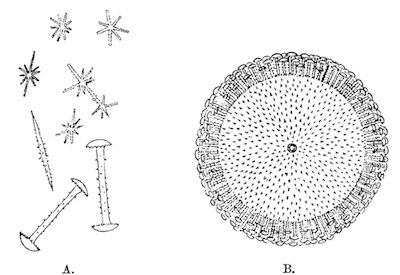
Fig. 22.—Dosilia plumosa.
A=microscleres, × 240; B=gemmule as seen in optical section from below, × 75. (From Rambha.)
Gemmules. Somewhat depressed, covered with a thick granular pneumatic coat, in which the spicules stand erect; the single aperture depressed. Each gemmule surrounded more or less distinctly by a circle or several circles of flesh-spicules.
Type in the British Museum; some fragments in the Indian Museum.
Geographical Distribution.—Bombay and Madras. Carter's specimens were taken in the island of Bombay, mine at Rambha in the north-east of the Madras Presidency. I have been unable to discover this species in the neighbourhood of Calcutta, but it is apparently rare wherever it occurs.
Biology.—Carter writes as regards this species:—"This is the coarsest and most resistant of all the species. As yet I have only found three or four specimens of it, and these only in two tanks. I have never seen it fixed on any solid body, but always floating on the surface of the water, about a month after the first heavy rains of the S.W. monsoon have fallen. Having made its appearance in that position, and having remained there for upwards of a month, it then sinks to the bottom. That it grows like the rest, adherent to the sides of the tank, must be inferred from the first specimen which I found (which exceeds two feet in circumference) having had a free and a fixed surface, the latter coloured by the red gravel on which it had grown. I have noticed it growing, for two successive years in the month of July, on the surface of the water of one of the two tanks in which I have found it, and would account for its temporary appearance in that position, in the following way, viz., that soon after the first rains have fallen, and the tanks have become filled, all the sponges in them appear to undergo a partial state of putrescency, during which gas is generated in them, and accumulates in globules in their structure, through which it must burst, or tear them from their attachments and force them to the surface of the water. Since then the coarse structure of plumosa would appear to offer greater resistance to the escape of this air, than that of any of the other species, it is probable that this is the reason of my having hitherto only found it in the position mentioned."
It seems to me more probable that the sponges are actually broken away from their supports by the violence of the rain and retain air mechanically in their cavities. The only specimens of D. plumosa that I have seen alive were attached very loosely to their support. In writing of the "coarse structure" of this species, Carter evidently alludes to the wide interspaces between the component branches of the skeleton.
My specimens were attached to the stem of a water-lily growing in a pool of slightly brackish water and were of a brilliant green colour. I mistook them at first for specimens of S. lacustris subsp. reticulata in which the branches had not developed normally. They were taken in March and were full of gemmules. The pool in which they were growing had already begun to dry up.
Genus 5. TROCHOSPONGILLA, Vejdovsky.
Trochospongilla, Vejdovsky, Abh. K. Böhm. Ges. Wiss. xii, p. 31 (1883). Trochospongilla, Wierzejski, Arch. Slaves de Biologie, i, p. 44 (1886). Trochospongilla, Vejdovsky, P. Ac. Philad. 1887, p. 176. Meyenia, Potts (partim), ibid. p. 210. Tubella, id. (partim), ibid., p. 248. Meyenia, Carter (partim), Ann. Nat. Hist. (5) vii, p. 90 (1881). Trochospongilla, Weltner, in Zacharias's Tier- und Pflanzenwelt, i, p. 215 (1891). Trochospongilla, id., Arch. Naturg. lxi (i), p. 120 (1895). Tubella, id. (partim), ibid. p. 128.
Type, Spongilla erinaceus, Ehrenberg.
The characteristic feature of this genus is that the rotulæ of the gemmule-spicules, which are homogeneous, have smooth instead of serrated edges. Their stem is always short and they are usually embedded in a granular pneumatic coat. The sponge is small in most of the species as yet known; in some species microscleres without rotulæ are associated with the gemmules.
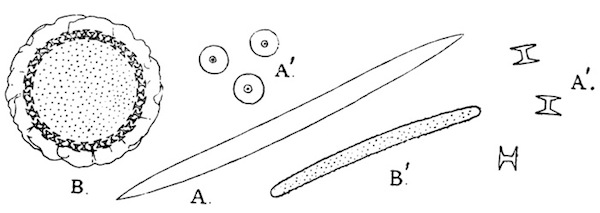
Fig. 23.—A=skeleton-spicule of Trochospongilla latouchiana; A'=gemmule-spicule of the same species; B=gemmule of T. phillottiana as seen in optical section from above; B'=skeleton-spicule of same species: A, A', B' × 240; B × 75. All specimens from Calcutta.
I think it best to include in this genus, as the original diagnosis would suggest, all those species in which all the gemmule-spicules are definitely birotulate and have smooth edges to their disks, confining the name Tubella to those in which the upper rotula is reduced to a mere knob. Even in those species in which the two disks are normally equal, individual spicules may be found in which the equality is only approximate, while, on the other hand, it is by no means uncommon for individual spicules in such species as "Tubella" pennsylvanica, which is here included in Trochospongilla, to have the two disks nearly equal, although normally the upper one is much smaller than the lower. There is very rarely any difficulty, however, in seeing at a glance whether the edge of the disk is smooth or serrated, the only species in which this difficulty would arise being, so far as I am aware, the Australian Ephydatia capewelli* (Haswell), the disks of which are undulated and nodulose rather than serrated.
Geographical Distribution.—The genus includes so large a proportion of small, inconspicuous species that its distribution is probably known but imperfectly. It would seem to have its headquarters in N. America but also occurs in Europe and Asia. In India three species have been found, one of which (T. pennsylvanica) has an extraordinarily wide and apparently discontinuous range, being common in N. America, and having been found in the west of Ireland, the Inner Hebrides, and near the west coast of S. India. The other two Indian species are apparently of not uncommon occurrence in eastern India and Burma.
Key to the Indian Species of Trochospongilla.
I.Rotules of the gemmule-spicules equal or nearly so.
A.Skeleton-spicules smooth, usually pointedlatouchiana, p. 115.
B.Skeleton-spicules spiny, bluntphillottiana, p. 117.
II.Upper rotule of the gemmule-spicules distinctly smaller than the lower.
Skeleton-spicules spiny, pointedpennsylvanica, p. 118.
18. Trochospongilla latouchiana*, Annandale.
Trochospongilla latouchiana, Annandale, J. Asiat. Soc. Bengal, 1907, p. 21, fig. 5. Trochospongilla latouchiana, id., Rec. Ind. Mus. ii, p. 157 (1908). Trochospongilla leidyi, id. (nec Bowerbank), ibid. iii, p. 103 (1909).
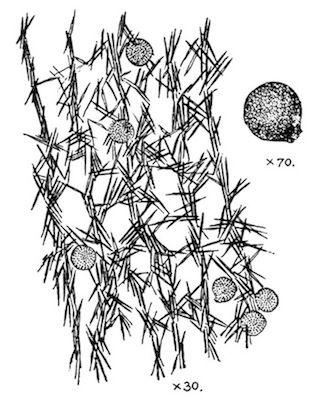
Fig. 24.—Trochospongilla latouchiana.
Vertical section of part of skeleton with gemmules in situ, × 30; also a single gemmule, × 70. (From Calcutta).
Sponge forming cushion-shaped masses rarely more than a few centimetres in diameter or thickness and of a brown or yellow colour, hard but rather brittle; surface evenly rounded, minutely hispid; oscula inconspicuous, small, circular, depressed, very few in number; external membrane adhering closely to the parenchyma; a chitinous membrane at the base of the sponge. Larger sponges divided into several layers by similar membranes.
Skeleton dense, forming a close reticulation; radiating fibres slender but quite distinct, running up right through the sponge, crossed at frequent intervals by single spicules or groups of spicules.
Spicules. Skeleton-spicules smooth, about twenty times as long as the greatest transverse diameter, as a rule sharply pointed; smooth amphistrongyli, which are often inflated in the middle, sometimes mixed with them but never in large numbers. No flesh-spicules. Gemmule-spicules with the rotulæ circular or slightly asymmetrical, flat or nearly flat, marked with a distinct double circle as seen from above, sometimes not quite equal; the shaft not projecting beyond them; the diameter of the rotule 4-1/2 to 5 times that of the shaft, which is about 2-2/3 times as long as broad.
Gemmules small (0.2 × 0.18 mm.), as a rule very numerous and scattered throughout the sponge, flask-shaped, clothed when mature with a thin microcell coat in which the birotulates are arranged with overlapping rotulæ, their outer rotulæ level with the surface; foraminal aperture circular, situated on an eminence.
Average Measurements.
Diameter of gemmule0.2 × 0.18 mm.
Length of skeleton-spicule0.28 mm.
Length of birotulate-spicule0.175 mm.
Diameter of rotula0.02 mm.
T. latouchiana is closely related to T. leidyi (Bowerbank) from N. America, but is distinguished by its much more slender skeleton-spicules, by the fact that the gemmules are not enclosed in cages of megascleres or confined to the base of the sponge, and by differences in the structure of the skeleton.
Type in the Indian Museum.
Geographical Distribution.—Lower Bengal and Lower Burma. Localities:—Bengal, Calcutta and neighbourhood (Annandale): Burma, Kawkareik, Amherst district, Tenasserim (Annandale).
Biology.—This species, which is common in the Museum tank, Calcutta, is apparently one of those that can grow at any time of year, provided that it is well covered with water. Like T. leidyi it is capable of producing fresh layers of living sponge on the top of old ones, from which they are separated by a chitinous membrane. These layers are not, however, necessarily produced in different seasons, for it is often clear from the nature of the object to which the sponge is attached that they must all have been produced in a short space of time. What appears to happen in most cases is this:—A young sponge grows on a brick, the stem of a reed or some other object at or near the edge of a pond, the water in which commences to dry up. As the sponge becomes desiccated its cells perish. Its gemmules are, however, retained in the close-meshed skeleton, which persists without change of form. A heavy shower of rain then falls, and the water rises again over the dried sponge. The gemmules germinate immediately and their contents spread out over the old skeleton, secrete a chitinous membrane and begin to build up a new sponge. The process may be repeated several times at the change of the seasons or even during the hot weather, or after a "break in the rains." If, however, the dried sponge remains exposed to wind and rain for more than a few months, it begins to disintegrate and its gemmules are carried away to other places. Owing to their thin pneumatic coat and relatively heavy spicules they are not very buoyant. Even in the most favourable circumstances the sponge of T. latouchiana never forms sheets of great area. In spite of its rapid growth it is frequently overgrown by Spongilla carteri.
19. Trochospongilla phillottiana*, Annandale.
Trochospongilla phillottiana, Annandale, J. Asiat. Soc. Bengal, 1907, p. 22, fig. 6. Trochospongilla phillottiana, id., Rec. Ind. Mus. i, p. 269 (1907). Trochospongilla phillottiana, id., ibid. ii, p. 157 (1908).
Sponge hard but friable, forming sheets or patches often of great extent but never more than about 5 mm. thick; the surface minutely hispid, flat; colour pale yellow, the golden-yellow gemmules shining through the sponge in a very conspicuous manner; oscula inconspicuous; external membrane adherent; no basal chitinous membrane.
Skeleton dense but by no means strong; the reticulation close but produced mainly by single spicules, which form triangular meshes; radiating fibres never very distinct, only persisting for a short distance in a vertical direction; each gemmule enclosed in an open, irregular cage of skeleton-spicules.
Spicules. Skeleton-spicules short, slender, blunt, more or less regularly and strongly spiny, straight or feebly curved. No flesh-spicules. Gemmule-spicules with the rotulæ circular, very wide as compared with the shaft, concave on the surface, with the shaft projecting as an umbo on the surface; the lower rotula often a little larger than the upper.
Gemmules numerous, situated at the base of the sponge in irregular, one-layered patches, small (0.32 × 0.264 mm.), of a brilliant golden colour, distinctly wider than high, with a single aperture situated on an eminence on the apex, each clothed (when mature) with a pneumatic coat that contains relatively large but irregular air-spaces among which the spicules stand with the rotulæ overlapping alternately, a funnel-shaped pit in the coat descending from the surface to the upper rotula of each of them; the surface of the gemmule covered with irregular projections.
Diameter of gemmule0.32 × 0.264 mm.
Length of skeleton-spicule0.177 mm.
Length of gemmule-spicule0.015 mm.
Diameter of rotule0.022 mm.
This species appears to be related to T. pennsylvanica, from which it differs mainly in the form of its gemmule-spicules and the structure of its gemmule. My original description was based on specimens in which the gemmule-spicules were not quite mature.
Type in the Indian Museum.
Geographical Distribution.—Lower Bengal and Lower Burma. Localities:—Bengal, Calcutta (Annandale): Burma, jungle pool near Kawkareik, Amherst district, Tenasserim (Annandale).
Biology.—This species covers a brick wall at the edge of the Museum tank in Calcutta every year during the "rains." In the cold weather the wall is left dry, but it is usually submerged to a depth of several feet before the middle of July. It is then rapidly covered by a thin layer of the sponge, which dies down as soon as the water begins to sink when the "rains" are over. For some months the gemmules adhere to the wall on account of the cage of spicules in which each of them is enclosed, but long before the water rises again the cages disintegrate and the gemmules are set free. Many of them fall or are carried by the wind into the water, on the surface of which, owing to their thick pneumatic coat, they float buoyantly. Others are lodged in cavities in the wall. On the water the force of gravity attracts them to one another and to the edge of the pond, and as the water rises they are carried against the wall and germinate. In thick jungle at the base of the Dawna Hills near Kawkareik[AI] in the interior of Tenasserim, I found the leaves of shrubs which grew round a small pool, covered with little dry patches of the sponge, which had evidently grown upon them when the bushes were submerged. This was in March, during an unusually severe drought.
20. Trochospongilla pennsylvanica* (Potts).
Tubella pennsylvanica, Potts, P. Ac. Philad. 1882, p. 14. Tubella pennsylvanica, id., ibid. 1887, p. 251, pl. vi, fig. 2, pl. xii, figs. 1-3. Tubella pennsylvanica, Mackay, Trans. Roy. Soc. Canada, 1889, Sec. iv, p. 95. Tubella pennsylvanica, Hanitsch, Nature, li, p. 511 (1895). Tubella pennsylvanica, Weltner, Arch. Naturg. lxi (i), p. 128 (1895). Tubella pennsylvanica, Hanitsch, Irish Natural. iv, p. 129 (1895). Tubella pennsylvanica, Annandale, J. Linn. Soc., Zool., xxx, p. 248 (1908). Tubella pennsylvanica, id., Rec. Ind. Mus. iii, p. 102 (1909). Tubella pennsylvanica, id., P. U.S. Mus. xxxvii, p. 403, fig. 2 (1909).
Sponge soft, fragile, forming small cushion-shaped masses, grey or green; oscula few in number, often raised on sloping eminences surrounded by radiating furrows below the external membrane; external membrane adhering to the parenchyma.
Skeleton close, almost structureless. "Surface of mature specimens often found covered with parallel skeleton spicules, not yet arranged to form cell-like interspaces" (Potts).
Spicules. Skeleton-spicules slender, cylindrical, almost straight, sharp or blunt, minutely, uniformly or almost uniformly spined; spines sometimes absent at the tips. No flesh-spicules. Gemmule-spicules with the lower rotula invariably larger than the upper; both rotulæ flat or somewhat sinuous in profile, usually circular but sometimes asymmetrical or subquadrate in outline, varying considerably in size.
Gemmules small, numerous or altogether absent, covered with a granular pneumatic coat of variable thickness; the rotulæ of the gemmule-spicules overlapping and sometimes projecting out of the granular coat.
The measurements of the spicules and gemmules of an Indian specimen and of one from Lehigh Gap, Pennsylvania, are given for comparison:—
Travancore.Pennsylvania.
Length of skeleton-spicules0.189-0.242 mm.0.16-0.21 mm.
(average 0.205 mm.)(average 0.195 mm.)
Breadth of skeleton-spicules0.0084-0.0155 mm.0.0084 mm.
Length of birotulate0.0126 mm0.0099 mm.
Diameter of upper rotula0.0084 mm.0.0084 mm.
Diameter of lower rotula0.0169 mm.0.0168 mm.
Diameter of gemmule0.243-0.348 mm.0.174-0.435 mm.
The spicules of the Travancore specimen are, therefore, a trifle larger than those of the American one, but the proportions are closely similar.
The difference between the gemmule-spicules of this species and those of such a form as T. phillottiana is merely one of degree and can hardly be regarded as a sufficient justification for placing the two species in different genera. If, as I have proposed, we confine the generic name Tubella to those species in which the gemmule-spicules are really like "little trumpets," the arrangement is a much more natural one, for these species have much in common apart from the gemmule-spicules. T. pennsylvanica does not appear to be very closely related to any other known species except T. phillottiana.
Type in the U.S. National Museum, from which specimens that appear to be co-types have been sent to the Indian Museum.
Geographical Distribution.—Very wide and apparently discontinuous:—N. America (widely distributed), Ireland (Hanitsch), Hebrides of Scotland (Annandale), Travancore, S. India (Annandale). The only Indian locality whence I have obtained specimens is Shasthancottah Lake near Quilon in Travancore.
Biology.—In Shasthancottah Lake T. pennsylvanica is found on the roots of water-plants that are matted together to form floating islands. It appears to avoid light and can only be obtained from roots that have been pulled out from under the islands. In Scotland I found it on the lower surface of stones near the edge of Loch Baa, Isle of Mull. In such circumstances the sponge is of a greyish colour, but specimens of the variety minima taken by Potts on rocks and boulders in Bear Lake, Pennsylvania, were of a bright green.
Sponges taken in Travancore in November were full of gemmules; in my Scottish specimens (taken in October) I can find no traces of these bodies, but embryos are numerous.
Genus 6. TUBELLA, Carter.
Tubella, Carter, Ann. Nat. Hist. (5) vii, p. 96 (1881). Tubella, Potts (partim), P. Ac. Philad. 1887, p. 248. Tubella, Weltner (partim), Arch. Naturg. lxi (i), p. 128 (1895).
Type, Spongilla paulula, Bowerbank.
This genus is distinguished from Ephydatia and Trochospongilla by the fact that the two ends of the gemmule-spicules are unlike not only in size but also in form. It sometimes happens that this unlikeness is not so marked in some spicules as in others, but in some if not in all the upper end of the shaft (that is to say the end furthest removed from the inner coat of the gemmule in the natural position) is reduced to a rounded knob, while the lower end expands into a flat transverse disk with a smooth or denticulated edge. The spicule thus resembles a little trumpet resting on its mouth. The shaft of the spicule is generally slender and of considerable length. The skeleton of the sponge is as a rule distinctly reticulate and often hard; the skeleton-spicules are either slender or stout and sometimes change considerably in proportions and outline as they approach the gemmules.
Geographical Distribution.—The genus is widely distributed in the tropics of both Hemispheres, its headquarters apparently being in S. America; but it is nowhere rich in species. Only two are known from the Oriental Region, namely T. vesparium* from Borneo, and T. vesparioides* from Burma.
21. Tubella vesparioides*, Annandale. (Plate II, fig. 4.)
Tubella vesparioides, Annandale, Rec. Ind. Mus. ii, p. 157 (1908).
Sponge forming rather thick sheets of considerable size, hard but brittle, almost black in colour; oscula inconspicuous; external membrane supported on a reticulate horizontal skeleton.
Skeleton. The surface covered with a network of stout spicule-fibres, the interstices of which are more or less deeply sunk, with sharp fibres projecting vertically upwards at the nodes; the whole mass pervaded by a similar network, which is composed of a considerable number of spicules lying parallel to one another, overlapping at the ends and bound together by a profuse secretion of spongin.
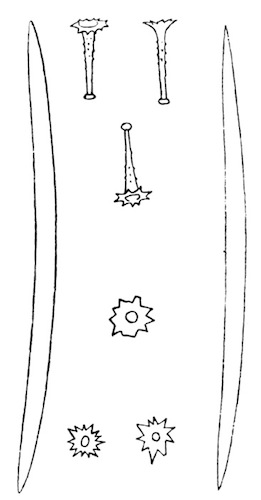
Fig. 25.—Spicules of Tubella vesparioides (from type specimen). × 240.
Spicules. Skeleton-spicules slender, smooth, amphioxous, bent in a wide arc or, not infrequently, at an angle. No true flesh-spicules. Gemmule-spicules terminating above in a rounded, knob-like structure and below in a relatively broad, flat rotula, which is very deeply and irregularly indented round the edge when mature, the spicules at an earlier stage of development having the form of a sharp pin with a round head; shaft of adult spicules projecting slightly below the rotula, long, slender, generally armed with a few stout conical spines, which stand out at right angles to it.
Gemmules numerous throughout the sponge, spherical, provided with a short, straight foraminal tubule, surrounded by one row of spicules, which are embedded in a rather thin granular coat.
Average length of skeleton-spicule0.316 mm.
Average breadth of skeleton-spicule0.0135 mm.
Average length of gemmule-spicule0.046 mm.
Average diameter of rotula0.0162 mm.
Average diameter of gemmule0.446 mm.
This sponge is closely related to Tubella vesparium (v. Martens) from Borneo, from which it may be distinguished by its smooth skeleton-spicules and the deeply indented disk of its gemmule-spicules. The skeleton-fibres are also rather less stout. By the kindness of Dr. Weltner, I have been able to compare types of the two species.
Type in the Indian Museum.
Habitat.—Taken at the edge of the Kanghyi ("great pond") at Mudon near Moulmein in the Amherst district of Tenasserim. The specimens were obtained in March in a dry state and had grown on logs and branches which had evidently been submerged earlier in the year. The name vesparium given to the allied species on account of its resemblance to a wasps' nest applies with almost equal force to this Burmese form.
Genus 7. CORVOSPONGILLA, nov.
Type[AJ], Spongilla loricata, Weltner.
Spongillidæ in which the gemmule-spicules are without a trace of rotulæ and the flesh-spicules have slender cylindrical shafts that bear at or near either end a circle of strong recurved spines. The gemmule-spicules are usually stout and sausage-shaped, and the gemmules resemble those of Stratospongilla in structure. The skeleton is strong and the skeleton-spicules stout, both resembling those of the "genus" Potamolepis, Marshall.
As in all other genera of Spongillidæ the structure of the skeleton is somewhat variable, the spicule-fibres of which it is composed being much more distinct in some species than in others. The skeleton-spicules are often very numerous and in some cases the skeleton is so compact and rigid that the sponge may be described as stony. The flesh-spicules closely resemble the gemmule-spicules of some species of Ephydatia and Heteromeyenia.
Geographical Distribution.—The species of this genus are probably confined to Africa (whence at least four are known) and the Oriental Region. One has been recorded from Burma and another from the Bombay Presidency.
Key to the Indian Species of Corvospongilla.
I.Gemmule with two layers of gemmule-spicules; those of the inner layer not markedly smaller than those of the outer.burmanica, p. 123.
II.Gemmule with two layers of gemmule-spicules, the outer of which contains spicules of much greater size than the inner.lapidosa, p. 124.
22. Corvospongilla burmanica* (Kirkpatrick). (Plate II, fig. 5.)
Spongilla loricata var. burmanica, Kirkpatrick, Rec. Ind. Mus. ii, p. 97, pl. ix (1908).
Sponge forming a shallow sheet, hard, not very strong, of a pale brownish colour; the surface irregularly spiny; the oscula small but conspicuous, circular, raised on little turret-like eminences; the external membrane adhering closely to the sponge.
Skeleton dense but by no means regular; the network composed largely of single spines; thick radiating fibres distinguishable in the upper part of the sponge.
Spicules. Skeleton-spicules smooth, not very stout, amphistrongylous, occasionally a little swollen at the ends, often with one or more fusiform swellings, measuring on an average about 0.27 × 0.0195 mm. Flesh-spicules with distinct rotules, the recurved spines numbering 4 to 6, measuring about 1/7 the length of the spicules; the shaft by no means strongly curved; their length from 0.03-0.045 mm. Gemmule-spicules amphioxous, as a rule distinctly curved, sometimes swollen at the ends, covered regularly but somewhat sparsely with fine spines, not measuring more than 0.49 × 0.078 mm.
Gemmules strongly adherent, arranged in small groups, either single or double; when single spherical, when double oval; each gemmule or pair of gemmules covered by two layers of gemmule-spicules bound together in chitinous substance; the inner layer on the inner coat of the gemmule, the outer one separated from it by a space and in contact with the outer cage of skeleton-spicules; the size of the gemmule-spicules variable in both layers; external to the outer layer a dense cage of skeleton-spicules; foraminal tubule short, cylindrical.
This sponge is closely related to S. loricata, Weltner, of which Kirkpatrick regards it as a variety. "The main difference," he writes, "between the typical African form and the Burmese variety consists in the former having much larger microstrongyles (83 × 15.7 µ [0.83 × 0.157 mm.]) with larger and coarser spines;... Judging from Prof. Weltner's sections of gemmules, these bodies lack the definite outer shell of smooth macrostrongyles [blunt skeleton-spicules], though this may not improbably be due to the breaking down and removal of this layer. A further difference consists in the presence, in the African specimen, of slender, finely spined strongyles [amphistrongyli], these being absent in the Burmese form, though perhaps this fact is not of much importance."
Type in the British Museum; a piece in the Indian Museum.
Habitat.—Myitkyo, head of the Pegu-Sittang canal, Lower Burma (E. W. Oates).
Biology.—The sponge had grown over a sheet of the polyzoon Hislopia lacustris, Carter (see p. 204), remains of which can be detected on its lower surface.
"Mr. E. W. Oates, who collected and presented the sponge, writes that the specimen was found encrusting the vertical and horizontal surfaces of the bottom beam of a lock gate, where it covered an area of six square feet. The beam had been tarred several times before the sponge was discovered. The portion of the gate on which the sponge was growing was submerged from November to May for eight hours a day at spring tides, but was entirely dry during the six days of neap tides. From May to October it was constantly submerged. The sponge was found in April. Although the canal is subject to the tides, the water at the lock is always fresh. The colour of the sponge during life was the same as in its present condition."
23. Corvospongilla lapidosa* (Annandale).
Spongilla lapidosa Annandale, Rec. Ind. Mus. ii, pp. 25, 26, figs. 3, 4, 5 (1908).
The sponge forms a thin but extremely hard and resistant crust the surface of which is either level, slightly concave, or distinctly corrugated; occasional groups of spicules project from it, but their arrangement is neither so regular nor so close as is the case in C. burmanica. The dermal membrane adheres closely to the sponge. The oscula are small; some of them are raised above the general surface but not on regular turret-shaped eminences. The colour is grey or black. There is a thick chitinous membrane at the base of the sponge.
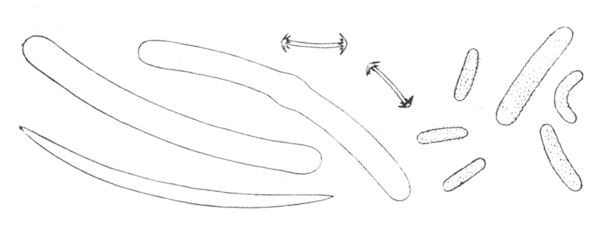
Fig. 26.—Spicules of Corvospongilla lapidosa (from type specimen), × 240.
The skeleton is extremely dense owing to the large number of spicules it contains, but almost structureless; broad vertical groups of spicules occur but lack spongin and only traverse a small part of the thickness of the sponge; their position is irregular. The firmness of the skeleton is due almost entirely to the interlocking of individual spicules. At the base of the sponge the direction of a large proportion of the spicules is horizontal or nearly horizontal, the number arranged vertically being much greater in the upper part.
Spicules. The skeleton-spicules are sausage-shaped and often a little swollen at the ends or constricted in the middle. A large proportion are twisted or bent in various ways, and a few bear irregular projections or swellings. The majority, however, are quite smooth. Among them a few more or less slender, smooth amphioxi occur, but these are probably immature spicules. The length and curvature of the amphistrongyli varies considerably, but the average measurements are about 0.28 × 0.024 mm. The flesh-spicules also vary greatly in length and in the degree to which their shafts are curved. At first sight it seems to be possible to separate them into two categories, one in which the shaft is about 0.159 mm. long, and another in which it is only 0.05 mm. or even less; and groups of birotulates of approximately the same length often occur in the interstices of the skeleton. Spicules of all intermediate lengths can, however, be found. The average diameter of the shaft is 0.0026 mm. and of the rotula 0.0106 mm., and the rotula consists of from 6 to 8 spines. The gemmule-spicules vary greatly in size, the longest measuring about 0.08 × 0.014 and the smallest about 0.034 × 0.007 or even less. There appears to be in their case an even more distinct separation as regards size than there is in that of the flesh-spicules; but here again intermediate forms occur. They are all stout, more or less blunt, and more or less regularly covered with very short spines; most of them are distinctly curved, but some are quite straight.
Gemmules. The gemmules are firmly adherent to the support of the sponge, at the base of which they are congregated in groups of four or more. They vary considerably in size and shape, many of them being asymmetrical and some elongate and sausage-shaped. The latter consist of single gemmules and not of a pair in one case. Extreme forms measure 0.38 × 0.29 and 0.55 × 0.25. Each gemmule is covered with a thick chitinous membrane in close contact with its wall and surrounding it completely. This membrane is full of spicules arranged as in a mosaic; most or all of them belong to the smaller type, and as a rule they are fairly uniform in size. Separated from this layer by a considerable interval is another layer of spicules embedded in a chitinous membrane which is in continuity with the basal membrane of the sponge. The spicules in this membrane mostly belong to the larger type and are very variable in size; mingled with them are often a certain number of birotulate flesh-spicules. The membrane is in close contact with a dense cage of skeleton-spicules arranged parallel to it and bound together by chitinous substance. The walls of this cage, when they are in contact with those of the cages of other gemmules, are coterminous with them. There is a single depressed aperture in the gemmules, as a rule situated on one of the longer sides.
This sponge is distinguished from C. burmanica not only by differences in external form, in the proportions of the spicules and the structure of the skeleton, but also by the peculiar nature of the armature of the gemmule. The fact that birotulate spicules are often found in close association with them, is particularly noteworthy.
Type in the Indian Museum.
Geographical Distribution.—This sponge has only been found in the Western Ghats of the Bombay Presidency. Localities:—Igatpuri Lake and the R. Godaveri at Nasik.
Biology.—There is a remarkable difference in external form between the specimens taken in Igatpuri and those from Nasik, and this difference is apparently due directly to environment. In the lake, the waters of which are free from mud, the sponges were growing on the lower surface of stones near the edge. They formed small crusts not more than about 5 cm. (2 inches) in diameter and of a pale greyish colour. Their surface was flat or undulated gently, except round the oscula where it was raised into sharply conical eminences with furrowed sides. The specimens from Nasik, which is about 30 miles from Igatpuri, were attached, together with specimens of Spongilla cinerea and S. indica, to the sides of a stone conduit full of very muddy running water. They were black in colour, formed broad sheets and were markedly corrugated on the surface. Their oscula were not raised on conical eminences and were altogether most inconspicuous. The skeleton was also harder than that of sponges from the lake.
In the lake C. lapidosa was accompanied by the gemmules of Spongilla bombayensis, but it is interesting that whereas the latter sponge was entirely in a resting condition, the former was in full vegetative vigour, a fact which proves, if proof were necessary, that the similar conditions of environment do not invariably have the same effect on different species of Spongillidæ.
APPENDIX TO PART I.
Form of Uncertain Position.
(Plate I, fig. 4.)
On more than one occasion I have found in my aquarium in Calcutta small sponges of a peculiar type which I am unable to refer with certainty to any of the species described above. Fig. 4, pl. I, represents one of these sponges. They are never more than about a quarter of an inch in diameter and never possess more than one osculum. They are cushion-shaped, colourless and soft. The skeleton-spicules are smooth, sharply pointed, moderately slender and relatively large. They are arranged in definite vertical groups, which project through the dermal membrane, and in irregular transverse formation. Small spherical gemmules are present but have only a thin chitinous covering without spicules or foramen.
These sponges probably represent an abnormal form of some well-known species, possibly of Spongilla carteri. I have seen nothing like them in natural conditions.