YOU MUST NOT WORK ON SUNDAY
Martha Ward Carey translation
A STORY OF THE DISTRICT OF AMIENS
THERE was once upon a time a woodcutter and his wife who had an invalid daughter; they had made all the pilgrimages in the neighborhood in vain, and had become entirely discouraged. But it happened one evening that Mathias (that was the woodcutter’s name), being belated in the forest, came upon a noisy company of dwarfs, who insisted upon his dancing with them. The dwarfs were singing,—
“The day is for working, The day is for working;”
and they did not know how to sing anything else. Mathias said to them,—“Your song has but little variety; it would be well to add something to it.” “Add! add!” cried the dwarfs. And when they began to sing again,—
“The day is for working,”
the woodcutter added,—
“And the night is for resting.”
Then there was a great commotion; a little old man, mounted on a colt, appeared in the midst of the assembly; when silence was re-established he addressed these words to the woodcutter,—
“You shall be rewarded for having added something to our song; I will give you the choice between riches for yourself, and beauty, with health, for your daughter.”
Mathias did not hesitate; he preferred the happiness of his child to riches; and when he returned to his house, he found that she was in good health and had become marvelously beautiful. This adventure caused much stir in the country, and the baker’s wife, who had also an invalid daughter, after having heard from the woodcutter, in detail, all that had happened to him, resolved to go and find the dwarfs in the forest. The latter seized her quickly by the petticoats and dragged her round and round in their circle. After awhile, the dwarfs, seeing her out of breath, gave her a moment to recover.
“It is my opinion, my joyous companions,” said she to them, “that your song is too short.”
“Cheerly, woman, cheerly! Round we go!” shouted the dwarfs as they again began their dance, singing,—
“The day is for working, And the night is for resting.”
The baker’s wife added,—
“All the whole year long.”
She was going to go on, but moved her lips in vain; she could not speak another word. At this moment, the ground opened, and out of the opening came a young girl mounted on a goat.
“Choose,” said she, “between riches for yourself, and beauty, with health, for your daughter.”
The baker’s wife was very avaricious; she chose riches, and when she returned to her house she found her daughter dying. She became envious of the happiness of the woodcutter, and as he owed her some money, she threatened to sell his hut and all that he possessed.
In order to pay their debts, the woodcutter, his wife, and daughter, went to work earnestly together in the forest. While Mathias cut the wood, his wife and daughter made fagots of the twigs.
One Sunday our woodcutter left his wife and daughter at home and went to work in the wood; but he was so overcome by fatigue that he fell asleep; when he awoke he found himself surrounded by the company of dwarfs who were singing,—
“The day is for working, And the night is for resting. All the whole year long.”
Mathias, who had been forced against his will to join in the dance, cried out for spite,—
“Save Sunday alone, Which God kept for his own.”
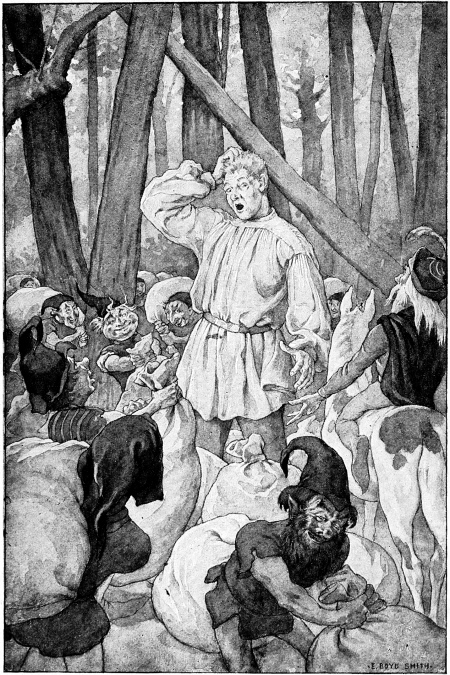
EACH DWARF THEN CAME AND PLACED A LARGE SACK AT MATHIAS’ FEET.
At this moment the forest became illuminated; the little old man on the colt appeared, followed by an immense crowd of dwarfs, and said to the woodcutter, “By finishing our couplet you have broken the charm which forced us to impose such hard tests on mankind; for your reward we give you all our riches.” Each dwarf then came and placed a large sack at Mathias’ feet. He gathered up as many of them as he could and returned triumphantly to his house. But when he opened them he saw that they contained only dry leaves!
“The dwarfs have mocked thee,” said his wife; “I shall sprinkle the sacks with holy water, for one must purify what comes from the evil one.”
No sooner said than done; but what was her astonishment to see the dry leaves change into bright gold crowns!
The baker’s wife was paid immediately; she died of vexation a few days after; the woodcutter and his wife lived ever after rich and happy.
Told in the Picard dialect by Fernand Delaunoy, aged 51 years, at Warloy-Baillon (Somme).
Henri Carnoy.