THE SIREN OF LA FRESNAYE
Martha Ward Carey translation
A STORY OF UPPER BRITANNY
ONCE upon a time there was in the woods of the isle of Aval, in the parish of Saint-Cast, a wooden-shoe maker, who lived with his wife and two children in a poor little mud hut which he had built himself by the seashore, just at the end of the valley. There are those who say that the ruins of it may still be seen; but that is hardly credible, for it is a long time since then, and usually the cabins of wooden-shoe makers do not last very long.
They were not rich; for they had only their work to live on; and you know wooden-shoe makers rarely buy small farms. The husband dug out the wooden shoes, his wife helped him as well as she could, and the little boy and girl, who were not large enough to work in the wood, went every day to fish along the shore.
One day when the little boy was fishing among the rocks, he heard suddenly a sweet, musical song, and looking in the direction from which it seemed to come, he saw the Siren, who was singing as she swam among the waves; and around her the sea was so brilliant that it dazzled you to look at it.
He ran very quickly to the cabin where his father was working.
“Ah, papa!” said he to him, “do come and see! there is a fish in the bay of Port-au-Moulin more beautiful than any I have ever seen; it sings, and it shines like gold!”
“Like fire, papa,” added the little girl, who had seen it also.
The wooden-shoe maker and his wife hastened to follow their children; but when they reached the shore, the Siren had disappeared; they saw nothing on the sea and heard no singing.
“It was nothing,” said the mother; “the children dreamed it all.”
But the wooden-shoe maker was not so incredulous as his wife. The next morning he said to the children,—
“Go back again to the edge of the water, and watch attentively to see if the beautiful singing fish will show herself again.”
The little boy went out; but as soon as he had gone a few steps from the cabin he ran back, crying out,—
“Ah, papa! the beautiful fish has returned; you can hear it sing from here.”
When they went outside, they heard a delicious music in the distance; and they hastened to go to the seashore, where they saw the Siren, who sang as she played about on the waves, and leaped sometimes more than three feet above the water.
“It is not an ordinary fish,” said the wooden-shoe maker; “it looks like a human being.”
“Ah!” said his wife, “we must get the lines; perhaps you can catch it. I should like very much to see it close by.”
They all went to work to get the lines ready: and when the sea was high, they set them; but in vain. They put the choicest bait on the hook; the singing fish did not come to take it, although they saw it every day.
The wooden-shoe maker thought often of the wonderful fish, and devised means to possess himself of it. One day as he was walking on the shore, he saw the Siren, who, cradled by the waves, and fast asleep, was floating at a short distance from the shore. He went into the water without making any noise, and slipped a large basket that he had, under her, and carried her off in it to the land without waking her.
She was about the size of a child of eight years. She had golden hair on her head, and her white and polished body resembled that of a woman; but instead of feet she had fins, and her body ended with the tail of a fish.
“Ah!” said the wooden-shoe maker, as he looked at her, “my little brats did not lie; it is really the most curious thing that ever was seen. It is doubtless a siren; for it is half woman and half fish.”
He made these reflections on his way back to his cabin, and he had almost reached it when the Siren awoke and said to him,—
“Ah, wooden-shoe maker! you surprised me while I was asleep; I beg you to take me back to the water, now that you have seen me close, and I will protect you, you and all your family, as long as you live.”
“No,” answered the wooden-shoe maker; “I will not put you back into the sea; I have watched for you for a long time, and so have my wife and children. I am going to take you to the house so that they can see you; but when you have sung a song, if my wife wishes, I will carry you back to the place from which I took you.”
He called his wife, who was named Olérie, and cried to her,—
“Olérie, come here and see, and bring the children; I have the singer in my basket.”
The good woman ran, full of joy, followed by the little boy and girl, and began to examine the Siren.
“She asks to be taken back to the water,” said the wooden-shoe maker; “she will sing you a song first. Do you agree to that?”
“No,” she answered; “it is too beautiful a fish; I have never seen one like it; we must eat it.”
“Ah!” said the Siren, “if you feed upon my flesh, if you feast upon my fish, you will never eat anything else in this world, for you will perish. I am not a fish like the others; I am the Siren of Fresnaye, and your husband surprised me while I was sleeping. Ask of me what you will, and I will grant it, for I have the power of a fairy. But make haste to carry me back to the sea, and do not lose any time; I am already growing weak and I shall soon die.”
“What do you say about it?” asked Olérie of her husband.
“If you consent to it, I am very willing to put her back into the sea; it would be a shame to kill her, she is so pretty and has never done any harm to any one.”
They each took hold of one end of the basket, and carried the Siren gently to the sea, and let her plunge into it again without thinking of asking anything of her.
When she felt the freshness of the water, she shouted with laughter, for joy that she was no longer in captivity, and she said to the wooden-shoe maker,—
“What do you ask of me now?”
“I ask,” said he, “for some bread, some fish, and clothing for my wife and my children.”
“You shall have all that in twenty-four hours,” said the Siren.
“I should like very well also,” added he, “if it is in your power, to have a little money to pay my master, for I am not at all rich.”
The Siren did not make any reply, but she begun to flap the water with her fins, and each time that she struck the waves they flashed up in little drops, and all that went up in the air became gold which fell down at the feet of the wooden-shoe maker. The shore was soon covered with it; then she became still and said to the wooden-shoe maker and his wife,—
“All that is for you, good people; you can pick it up.”
They thanked the Siren, who went off singing; then they filled their pockets with gold and returned to their cabin very happy.
When the twenty-four hours had passed, Olérie and her husband returned to the seashore to look for the clothing that the Siren had promised them. They heard her singing in the distance, and soon they saw her glide over the waves and come near them, always singing her sweet and melodious song. She flapped the water with her fins; a large wave broke into foam on the strand, and rolled back, leaving at the feet of the wooden-shoe maker a very large and tightly closed chest. Then the Siren leaped three times out of the water and said to the wooden-shoe maker,—
“You will find in this chest what I promised you; good-by, till I see you again, you who have been so good to me! When you want some fish, do not forget this shore.”
They took the chest away with them to their house; it contained good clothing made to fit them; and every time that they or their children wanted to catch fish, they went to the seashore, and in a few moments they caught an abundance.
For a whole year they did not see the Siren; their purse grew lighter meanwhile, and the lighter it grew, the more they thought of the Siren. They often went to the seashore, listening and hoping to hear her voice.
One day they heard her singing in the distance; they ran at once to the shore, and were very glad to see her gliding over the waves; all along where she had passed, the sea gleamed like a pathway of fire.
When she came within a little distance, the wooden-shoe maker said to her,—
“My Siren, I am very glad to see you again; if you will, you can do me a great service, for I have no longer either bread or money.”
“I will give you,” said the Siren, “enough to fill your purse again.”
After saying these words, she unfolded her fins, and beating the water around her, she sent to the shore a wave of gold and silver.
“With that,” said she, “you can buy all you need; but if you wish to keep it, use it well. Hereafter you will see me no more; I am going to leave this country and go to India.”
The Siren went away after having said this; since then no one has ever seen her, or heard her sing in the bay of Fresnaye.
Paul Sebillot, “Contes des Paysans et des Pêcheurs.”
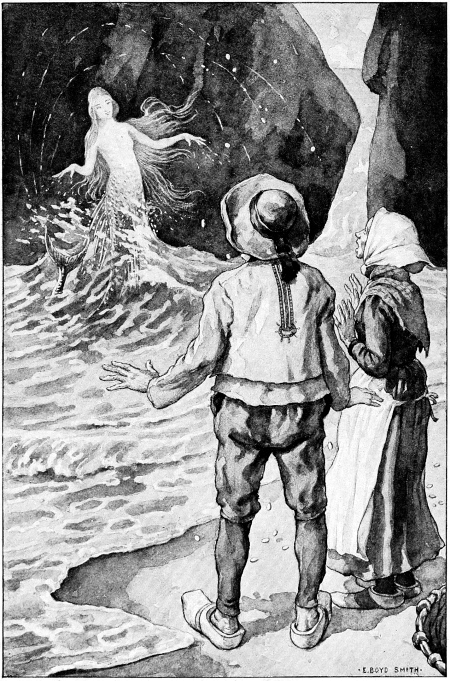
ALL THAT WENT UP IN THE AIR BECAME GOLD.