THE HARE, THE BEAR, AND THE FOX
Martha Ward Carey translation
I
THERE was a young soldier named Hervé Laz-Bleiz. When he returned from the war in far away lands, his father and mother were dead. He had no brother, but he had a young sister named Hénori. Their parents had left them, for their entire inheritance, a cow and two sheep. Hervé said to Hénori,—
“Let us sell the cow and the sheep, and go to seek our fortunes somewhere else, instead of remaining here in poverty.”
The cow and the sheep were sold; then the brother and sister set out on their journey, by the grace of God. After having walked a long time and gone very, very far, they found themselves one day in a great forest, in the midst of which there was an old castle surrounded by high walls. They gained entrance to the court, creeping in under the door, but saw no one. The castle door stood open. They entered and found themselves in a hall, but no one was there. But they saw on a table meals which were quite hot, and the odor of them was delicious. They were very hungry, and they looked at each other out of the corners of their eyes, and their mouths watered. They remained silently standing, waiting for some one to come, of whom they might ask hospitality.
But they waited in vain; no one came, and the castle appeared to be abandoned. Seeing this, Hervé, who was not very timid, said to his sister,—
“Upon my word, it is useless to wait longer, and it is a shame to let such a good dinner get cold; let us seize the opportunity, and eat and drink, and then we shall see what will happen.”
They seated themselves at the table, and ate and drank with good appetites, without any one coming to interrupt them. Hénori, who was at first much frightened, became quite brave when she had drank a glass or two of the excellent wine she had found on the table; and as for Hervé, who had drank much more, he already dreamed of being master of the chateau, and thought it would be a great pity to leave a hotel when he was so comfortable.
On rising from the table, the brother and sister went through the halls and rooms. In the first room, they found heaps of gold and silver; in the second, more gold and silver; in the third, there were guns, and pieces of linen and stuff, goods, and men’s clothing of all shapes and sizes.
“It is a den of robbers,” said Hervé, when he saw all this. “They have gone off on some expedition, and will doubtless soon return. But since we are here, and these are good arms, let us take possession of them and all the treasure will be ours.”
And they began to prepare themselves, as well as possible, to stand a siege. They barricaded the doors and window casements, loaded all the guns, and sat down to wait.
About two or three o’clock in the morning the robbers returned, laden with booty and all drunk. Hervé and Hénori, each stationed at a window on the first floor, and having near them a great many guns all loaded, began immediately to fire on them. The robbers threw themselves against the door, raging and swearing. But they could not break it open, and Hervé and his sister killed one with each discharge of their guns, so that the number rapidly diminished. At last, seeing that their efforts were in vain, all those who remained still unhurt, retired, leaving the courtyard strewn with dead and wounded.
Hervé and Hénori passed the day in strengthening the barricades of the doors and windows and reloading their guns, for they were sure the robbers had gone to seek reinforcements, and would return to give them another charge. And they were not mistaken, for they returned, having mustered up some comrades. It was now broad daylight, so that Hervé and his sister, each stationed at a window on the first floor, could see clearly through the holes they had made in the shutters, and they struck down one at each discharge of their guns. They shot so well that they finally killed them all, except two or three wounded ones, who ran away.
The next day there was a third attack. But this time the robbers were all killed, every single one.
And now, Hervé and Hénori were in possession of the castle and all the treasure it contained. However, they did not dare go out for several days. But when they saw that no more robbers came to trouble them, they grew bolder, and visited the gardens and all the apartments of the castle, and everywhere they found treasures and provisions of every kind. So, seeing that everything needful was provided, they determined to take up their abode there.
The wood which surrounded the castle was full of all sorts of game. Hervé went hunting there every day, often with his sister and sometimes alone. One day when he went out alone, he ran across a fine hare and aimed at it to kill it, when he was perfectly astonished to hear the animal say to him, as plainly as if it had been a man,—
“Do not kill me, Hervé.”
“What! do you know me, you poor beast of the good God?”
“Yes, I know you, and I may perhaps be useful to you some day.”
“Very well! come with me then.”
And he went on, followed by the hare.
Farther on he saw a fox, and aimed at him also, but the fox said, as the hare had done,—
“Do not kill me, Hervé, and I will pay you back some day.”
“Am I then known to all the beasts of this wood?” said Hervé, and he lowered his gun and told the fox to follow him as well as the hare.
A little farther on he saw a bear and aimed at his jaw. But the bear said to him, also,—
“Do not kill me, Hervé, and I will pay you back some day.”
“Good! come on; follow me and let us see what will happen.”
He continued to hunt until the evening, and killed so much game that, not being able to carry it himself, he put it on the back of the bear. Then they started on the road to the castle. On the way, the bear ate the game, and the fox, seeing him, said to Hervé, “Master, the bear is eating your game.” Hervé threatened to shoot the bear, who growled and promised not to eat any more. When the four had reached the castle walls the hare said to Hervé, “Master, do you know that your sister is in her room with the chief of the robbers?”
“How can you say so? We killed all the robbers.”
“No matter, their chief still lives and he comes every day to see your sister, while you are out hunting. Look out for them, for they are thinking of betraying you and getting rid of you.”
“My sister loves me, and I do not believe a single word you tell me.”
“Your life is in danger, I assure you; but leave it to me: I will save you.”
“Very well, I leave it to you, and we shall see.”
“When he knows that you are in the castle, he will hide himself somewhere, so that he may strangle you in the night while you sleep. But as soon as we enter, you, fox, who have such a good nose, you go sniff all around to find where he is hid; then when you have found him, come and tell me and we will see about it.”
They entered the castle. Hervé remained in the kitchen with the hare and the bear, and the fox went on the search for the chief of the robbers, sniffing and ferreting around everywhere with his pointed snout. He discovered him in an empty cask and came to inform his comrades.
“Go, bear,” said the hare, “go with the fox, and bring him to us.”
The bear mounted the stairs, following the fox and growling as he went. He pulled the robber out of the cask, and taking him by one foot, he dragged him down the stone stairway, his head falling heavily on each step, and laid him at Hervé’s feet in the kitchen. When he saw the latter, he ground his teeth and tried to throw himself on him. But the bear prevented him and tore him to pieces at his master’s order. Then Hénori was treated in the same manner.
Hervé continued to live in the castle with his three animals. Every day they went out hunting and killed all the game they could wish.
II
One day the hare said suddenly,—
“I have just had something whispered in my ear!”
“What is it?” asked Hervé.
“The daughter of the king of England is about to be taken to a dragon to be devoured by him; shall we go and deliver her?”
“That would be a very perilous undertaking,” said Hervé.
“Pshaw!” said the bear, “I will undertake it: you will see.”
“All four of us,” said the fox, “can surely see it well put through.”
“Let us go, then,” said Hervé.
“Let us go,” they all repeated at once.
So they all four set out together.
But the road was long, and Hervé, overcome with fatigue, could not walk any farther. Then the bear took him on his back and they went on. At last they reached England, and when they came to the suburbs of London, they met the procession which was conducting the poor princess. All the people of the land were there, and they were grieved and weeping as though they were at a funeral. When they came to the edge of an immense plain, all bare and desolate, all the people turned back and left the poor princess to go on her way alone. The cavern of the dragon was in the midst of this plain, and twice a day he threw out fire from his seven mouths, and burned up all vegetation for several leagues around.
The poor princess, abandoned by all the world, went slowly on, sobbing and shedding great tears. Hervé, who was provided with a horse, joined her, followed by his three animals, and said to her,—
“Come with me in the croup, dear lady, and I will take you where you are going.”
“Alas!” she replied, “I shall get there only too soon, and I do not wish to run to my death.”
“Confide in me, mount to the croup on my horse, and I will save you from the monster, with the aid of my three companions whom you see.”
And he showed her the three animals who were following him.
The princess mounted, and immediately Hervé put his horse at a gallop, for already the dragon had begun to throw out fire.
The hare had told each one what to do. He had said to the bear,—
“You, bear, must drag the monster from his cavern; and you, fox, fill your stomach with water so as to extinguish the fire which he will throw on us, while I shall fight with my good saber.”
When they reached the opening of the cavern, the dragon said,—
“Here you are at last, daughter of the king of England! I was getting impatient, and you have done well to come, for I should have reduced your father’s whole kingdom to ashes if you had kept me waiting too long. But I see that you have not come alone; so much the better, for I shall eat you all.”
Then, addressing Hervé:—
“Throw me the princess first.”
“Come take her,” he replied.
“Throw her to me, I tell you, and at once!”
“Come take her, I tell you, if you want her.”
“Throw her to me, or I shall burn you to ashes.”
“Pshaw! I am not afraid of you.”
And addressing his companions:—
“Come, my friends, do your duty and work hard.”
Then the bear seized the monster and dragged him from his cave. Immediately he began to throw fire from his seven mouths; but the fox vomited over it torrents of water, and the hare, on his part, made such frequent and terrible thrusts with his sword, that at last they killed the seven heads. “Victory!” then cried Hervé and the princess.
They had conquered, in truth, but not without difficulty, and the hare, the fox, and the bear, had their skins all torn and burned, and they were overcome with fatigue. Hervé, himself, and the princess had suffered somewhat, though they kept at a distance. Moreover, night was approaching, and for many reasons they could not think of returning to the city. They resolved then to pass the night in the open plain, without shelter. Hervé, fearing the effect of a night spent in the open air upon the princess, whose constitution appeared delicate, was much troubled. Fortunately there were on the plain great masses of rocks to which they repaired, and when the bear had rolled together several bowlders so as to form quite a sheltering cavern, they all gathered there to wait for the morning, except the horse, who was fastened near by and slept on the sand. Then the hare served as a pillow for the princess, and the bear slept at her feet to keep them warm. The fox was a little indisposed from having drunk too much water, in spite of having thrown it all up.
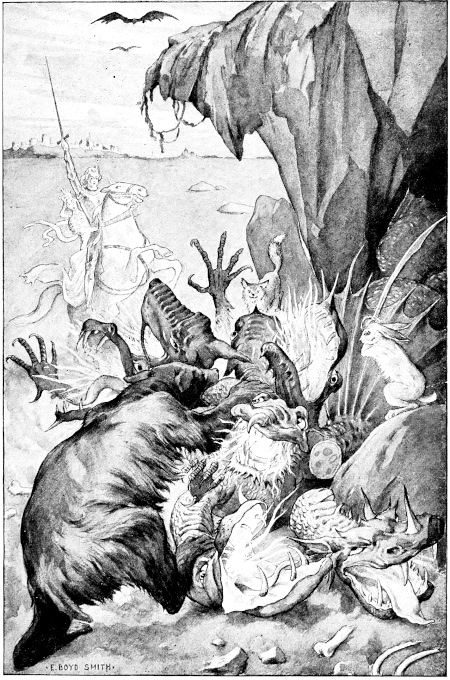
THE BEAR SEIZED THE MONSTER AND DRAGGED HIM FROM HIS CAVE.
Before going to sleep, though very much fatigued, they talked a little over the events of the struggle and their plans for the future. It was clearly understood that Hervé should marry the princess.
A charcoal-burner, who was passing by, heard a noise and stopped to listen. He drew near the rocks, heard all their conversation, and resolved to profit by it. When they were all fast asleep, he took away the rock which closed the entrance to the grotto, entered softly, cut off Hervé’s head, and carried off the princess. The hare, the fox, and the bear were so broken down by fatigue that they heard not a sound. When they woke next morning, and saw Hervé dead, with his head cut off, and the princess nowhere to be seen, their astonishment was great.
“How is it, bear, that you who were at the feet of the princess did not wake up?” said the hare.
“I was so weary,” replied the bear, “that I slept like a rock.”
“And you, fox, whose ear is so keen?”
“And you, yourself, hare, who served as a pillow for the princess?” replied the fox.
“The first thing to be done,” said the hare, “is to put our master’s head again upon his shoulders and bring him to life; then we will see what has become of the princess. Fortunately I know how to make an ointment which will bring the dead to life, but I shall need the assistance of you both to do this. You, bear, must find and bring to me the solitary worm which is hidden a thousand feet under the ground; and you, fox, bring me a blackbird and a gray raven to make my ointment.”
“But that is not easy,” said the bear, “a thousand feet under the ground.”
“Suppose you go look for them yourself,” said the fox.
“And would you know how to make the ointment? You wouldn’t, would you?”
“Go, then, each on your way, work, and do not return without bringing me what I have ordered.”
So the bear went in one direction, growling, and the fox took another road, grumbling.
The bear went all over the plain, with his nose to the earth, sniffing everywhere. He stopped at last and began to dig up the earth. He dug and dug till he came to the solitary worm, and he seized it eagerly and carried it to the hare.
The fox had run to a forest which he had perceived from a distance, mounting to it over a mass of rocks. He stretched himself on his back in the bottom of a ravine, where there was a little running brook, his four paws in the air and his mouth wide open, as if he were dead. Soon a blackbird flew down upon him from a tree, hoping to regale himself. But the make-believe snapped it up quickly and strangled it. He hid it in a bush, went a little farther, and stretched himself under an old oak, and pretended to be dead again. After a while a gray raven passed by, crying, Oak! oak! and seeing a dead fox, lighted on him, and was caught like the blackbird.
Then the fox also took the fruit of his search to the hare, who immediately set about preparing the ointment. And when it was finished he said to the bear,—
“Come, bear, stand your master on his feet and keep him in that position.”
The bear stood Hervé’s body up.
“Now, then, put his head in its place.”
The bear took his head, and put it on facing the wrong way.
“Idiot! see what you are doing!”
Then the hare himself put it on in the right way, rubbed the wound and the whole body with his ointment, and the head grew again on the neck, life returned little by little to the whole body, Hervé opened his eyes, rubbed them as one does on awaking, and said, “How well I have slept!” Then looking round and seeing only the hare, the fox, and the bear,—
“Where is the princess?” he asked.
The hare told him all that had happened and he was greatly astonished. But the disappearance of the princess vexed him very much.
“Be comforted,” said the hare to him, “we will find her again.”
The charcoal-burner carried her back to her father, the king of England, and claimed to be her deliverer and the conqueror of the dragon. The old king had promised the hand of his daughter to the man who should deliver her from the monster, whoever he might be. But the princess, who knew the treachery of the charcoal-burner, refuses to take him for her husband, and declares it is not he to whom she owes her life, although the impostor shows the seven heads of the dragon which he has cut off and brought with him in a sack. He has the heads, but the heads have no tongues in them, for “I cut them out myself and here they are.” Then he showed them where he had put them in a corner of the grotto, adding: “In spite of the resistance of the princess, her father, finding the proofs quite sufficient, and wishing to keep his word, has fixed to-morrow for the wedding. We have then no time to lose, and we must set off at once.” So they all four started out on the road to London. Hervé was on horseback, having in the croup the tongues of the dragon in a bag; the hare, the fox, and the bear followed him.
They stopped in a small wood near the king’s palace, and the hare said to his companions, “You three remain here, and I will go and see what is going on in the king’s palace.”
Then he crept into the palace and went even into the dining-hall, where they were at table when he arrived. There had been feasting and rejoicing every day since the return of the king’s daughter; not only at the palace, but in the whole city.
The charcoal-burner was betrothed to the princess, and although she steadily refused to take him for her husband, the marriage was to take place the next day.
“Look! look! a hare!” cried the guests, astonished.
The servants went in pursuit of it and tried to catch it. About to be overtaken, he jumped into the princess’s lap, and said in a low voice,—
“It is I! Hervé is still alive and loves you always!”
“What! is it you, poor animal?”
And she embraced him and gave him some sweetmeats.
The charcoal-burner, seeing this, cried,—
“Drive it away, this ugly beast.”
“What harm has he done?” said the princess, wrapping the hare in the skirt of her gown.
“Drive it away quickly, I tell you; it is an infamous sorcerer.”
“A sorcerer?” cried the old king, much frightened.
“A sorcerer! put him out the door at once!”
And the servants, armed with brooms and sticks, set to work to drive away the hare.
But the latter leaped lightly through the window, and rejoined his companions in the woods.
The charcoal-burner urged the old king to have the marriage take place the next morning. But the princess cried and implored her father so constantly that the ceremony was deferred to the day after.
The hare had told Hervé, as well as the fox and the bear, what was going on at the palace.
“I, too, will go there to-morrow,” said the fox.
“Take care you are not caught,” said the hare.
“Fear nothing, and be sure that I shall not return without having had a taste of the feast and bringing you your share also.”
So the fox set out the next day, as he had said, at the hour for dinner. He also got well into the dining-hall; but as soon as the charcoal-burner saw him he rose and cried out,—
“See! the wicked sorcerer has come back again. Drive him out at once, or something dreadful will happen to us!”
Then all the servants hunted down the poor animal with brooms and sticks.
He leaped on the table, passed near the princess, and said to her, “To-morrow we will all come; Hervé, the hare, the bear, and I.” Then he jumped through the window. As he passed through the court he snapped up a hen and ran off with her to the wood.
The next day the whole little company, Hervé, the hare, the fox and the bear, went to the palace. The bear marched at the head, carrying Hervé on his back. The others followed, and thus made their way into the banquet hall.
Every one wished to escape from this sight, the charcoal-burner first of all. But Hervé, raising his hand, said,—
“Stay! let no one go out for a moment, or he will have to deal with my friend here.” And he pulled the bear’s ear, who growled.
“Do you believe, sire, that it is this ugly, charcoal-burner here, this impostor, who has delivered your daughter from the dragon, and are you willing to give him your daughter’s hand?”
“I am a man of my word,” said the king.
“Very well! the man who delivered your daughter from the monster is not this charcoal-burner; it is I who have done it with the aid of my friends;” and he pointed to his three animals.
The charcoal-burner was white as the cloth before him.
“He has given us his proofs,” replied the king; “he brought us the seven heads of the dragon.”
“Very well; let me see these heads and I will expose the fraud.”
The king ordered the dragon’s heads to be brought, and a servant emptied them from a bag on the flags of the hall.
“Open their mouths,” said Hervé then, “and see if they have tongues.”
The same servant opened the jaws of the seven heads, one after the other, and not one had a tongue; all had been cut out.
“Where are the tongues?” said the king.
“Here they are,” said Hervé, throwing them on the table.
“Yes, it is indeed he who is my deliverer, and who shall be my husband!” cried the princess, throwing herself on Hervé’s neck.
Seeing that everything was going against him, the charcoal-burner wanted to go out, but the bear stopped the way.
Then the old king, addressing his servants, said angrily,—
“Seize this impostor and let him be burned!”
And they built an enormous pile of fagots, set it on fire, and threw the charcoal-burner into the midst of the flames. Then Hervé married the princess and they had holidays and magnificent banquets.
Told by Margaret Philip, of Pluzunet, 1873.
F. M. Luzel.