Front matter
Martha Ward Carey translation
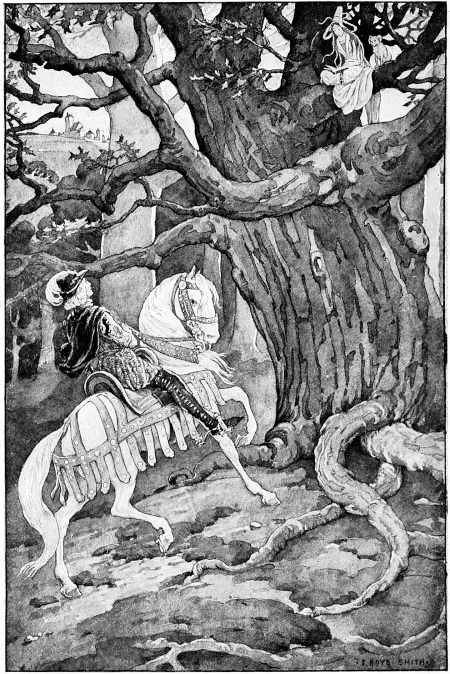
THE YOUNG LORD SAW A CHARMING GIRL SEATED AMONG THE BRANCHES.
FRENCH FAIRY TALES
TRANSLATED BY
M. CARY
ILLUSTRATED BY
E. BOYD SMITH
NEW YORK
THOMAS Y. CROWELL COMPANY
PUBLISHERS
Copyright, 1887 and 1903, by THOMAS Y. CROWELL AND COMPANY
INTRODUCTORY NOTE
The young readers into whose hands this book may come, will care little for a preface which only keeps them from the entertainment which they have learned unfailingly to expect from such stories. But their elders have rights which the purveyors of folk-stories are bound to respect; for these popular tales, or old wives’ fables, while losing none of their popularity in the nursery, have descended thence, and found a place also in the parlor and the study. They are like the rough little box which the kind fairy has given to the little brother, and at which his elders at first look with disdain, until, when it has been opened, and fold after fold of rich stuff has tumbled out of it, they value it highly, for all its outward roughness, and even would despoil the youngest of his magic prize. The fairy stories, which had hitherto been only food for childish entertainment, became, in the hands of the brothers Grimm and the philologians and literary students who succeeded them, the foundation of a science rich in conclusions respecting portions of human history anterior to or unrepresented in more artificial literary memorials.
It is not possible, in an introductory page or two, to say anything of all that the study of such stories and of their transmission has added to the sum of modern learning, nor of the light they throw on peasant character; but it is only justice to readers who approach these studies from this point of view, with a more or less scientific interest in studies of folk-lore, to state the sources whence the tales in this collection have been translated, and to attest the fidelity of the translation. Of these stories,—derived from the French provinces or, in one or two cases, colonies,—the first part, extending to page 192, have been selected and translated from the pages of the admirable French folk-lore journal, “Mélusine,” of which the first volume appeared in 1878, the second in 1884 and 1885, the third in 1886 and 1887; the remaining stories have been selected and translated from Paul Sébillot’s “Contes des Provinces de la France” (Paris, 1884). Scrupulous care has been taken to preserve a note of the sources of the stories.
Naturally some slight verbal changes have here and there been necessary; but these have been few in number. In all other passages, a scrupulous fidelity to the original has been aimed at, and has, I believe, been attained.
J. F. Jameson.
Contents
PAGE
The Legend of the Lake of Issarlès 1
The Fairies and the Two Hunchbacks 6
The Skilful Thief 8
The King’s Three Sons 23
The Hare, the Bear, and the Fox 33
Papa Tiger and Papa Sheep 52
John Bit-of-a-Man 60
Long Time 65
Skilful John 69
The Tailor and the Hurricane 72
The Baker’s Three Daughters 85
You Must Not Work on Sunday 102
Destiny 106
The Little Ant That Was Going to Jerusalem, and the Snow 110
The Most Powerful Husband in the World 114
The Nine Brothers, Who Were Changed to Sheep, and Their Sister 117
The King and His Three Sons 127
Fanch Scouarnec 130
The Roebuck Hunt 148
Pierre and Helene 153
The Three Eggs 166
The Three Brothers 176
The Cock’s Wife 189
The Castle Hung in the Air 193
The Two Soldiers 204
The Three Brothers and the Giant 210
The Fairy and the Daughter of the Earth 220
Sister and Half-Sister 232
The Fairies’ Ship 237
The Shepherd Who Won the King’s Daughter by a Single Word 246
The Enchanted Ring 251
The Siren of La Fresnaye 259
The Little Hunchback 267
The Princess of Tronkolaine 276
French Fairy Tales